Factors That Influence Property Valuation and Market Value
By Housey · Last reviewed 30th of May 2026

Factors That Influence Property Valuation and Market Value
Whether you are preparing to sell, remortgage, or question a surveyor's figure, understanding what drives property valuation can help you make better decisions and avoid costly surprises. Questions about valuation typically arise at key transaction stages — when a mortgage lender instructs a valuer, when an estate agent sets a guide price, or when a buyer suspects a property has been mispriced relative to the local market. The figure that emerges is not simply an estate agent's opinion; it is a structured professional assessment that RICS-registered valuers anchor in comparable market evidence, physical condition, and a range of location-specific factors.
Key points
- RICS defines market value as the estimated amount a property would exchange for between a willing buyer and a willing seller in an arm's-length transaction on the valuation date, per RICS Red Book Global Standards.
- HM Land Registry's published sold prices are the primary comparable evidence base for residential valuations in England and Wales; Registers of Scotland covers Scottish transactions.
- EPC-rated A or B properties increasingly attract a price premium as buyers, lenders, and landlords price in energy running costs and Minimum Energy Efficiency Standards (MEES) compliance risk.
- Structural defects — including evidence of subsidence, active damp, or roof failure — can trigger a mortgage lender's down-valuation or a conditional retention until remediation is evidenced by a specialist.
- Leasehold properties with fewer than 80 years remaining on the lease typically suffer a measurable reduction in value and may become unmortgageable below 70 years remaining.
What does 'market value' mean in a UK context?
RICS Red Book Global Standards define market value as the estimated amount a property would exchange for on the valuation date between a willing buyer and willing seller, after proper marketing, where both parties act knowledgeably and without compulsion. This is a specific technical definition — not the same as asking price, insurance reinstatement value, or council tax band.
Mortgage lenders commission valuations to satisfy themselves that the security (the property) is adequate cover for the loan, not necessarily to confirm that the buyer is paying fair value. A 'desktop valuation' — increasingly common for remortgages — uses automated valuation models (AVMs) referencing Land Registry data rather than a physical inspection of the property.
Location and neighbourhood factors
Location remains the single most significant driver of residential property value in the UK. Within a single postcode, proximity to the following can meaningfully affect a valuer's assessment:
- Good-rated or Outstanding-rated schools (Ofsted in England, Estyn in Wales, Education Scotland) can add measurable value in competitive catchment areas.
- Commuter rail or underground links — properties within walking distance of stations typically command a premium in markets where journey time to employment centres directly influences buyer choice.
- Retail and leisure amenities — town centre access, supermarkets, parks, and green spaces all affect desirability.
- Flood risk zones — properties in Environment Agency Flood Zone 2 or 3 (England) or equivalent risk areas in Scotland and Wales often face a reduced buyer pool, lower achieved values, and higher insurance premiums.
- Noise and pollution — proximity to flight paths, major roads, or industrial uses can depress value relative to comparable quieter streets in the same postcode district.
Postcode-level granularity matters. Two identical 1930s semi-detached houses on opposite sides of a school catchment boundary can show a material price difference in the same Land Registry dataset.
Property size, condition, and specification
After location, usable floor area — measured in square metres to RICS Property Measurement standards (gross internal area, or GIA) — is typically the most reliable predictor of value. Condition matters because lenders and buyers price risk. Key condition factors that directly affect valuations include:
- Roof covering — age, material, and visible defects affect both current value and future insurability.
- Damp and drainage — rising damp, penetrating damp, or drainage failure can prompt a mortgage retention until remediation is evidenced.
- Structural movement — hairline cracking is common in older properties and often noted without affecting value, but stepped or diagonal cracking through brickwork that is widening warrants investigation by a structural engineer before a valuer can treat it as non-material.
- Heating system — an aged boiler, absence of central heating, or an outdated electrical consumer unit reduces buyer appeal and may prompt a downward adjustment against comparables.
- Kitchens and bathrooms — while cosmetic, very dated or poorly installed rooms influence buyer expectations and are factored into the comparable evidence a valuer selects.
What not to assume
Common assumption | Reality |
|---|---|
A full renovation always recovers its cost in the valuation | Improvements must align with what comparable buyers in that market expect and pay for. Over-improving relative to the street level rarely returns full cost in a formal valuation. |
Fresh paint significantly increases a RICS valuation | Cosmetic work is rarely material to a professional valuation, though it aids saleability and presentation to buyers. |
The estate agent's guide price equals market value | Guide prices are marketing tools. A mortgage valuer may reach a different figure based on comparable sold evidence. |
A high asking price on a nearby property confirms your value | Only completed sold prices from HM Land Registry count as comparable evidence. Active listings are not evidence of achieved value. |
EPC rating and energy efficiency
Energy Performance Certificates (EPCs) have become an increasingly material factor in UK property valuation. Buyers and lenders are more attentive to running costs, and MEES regulations mean landlords cannot legally let residential properties below EPC band E in England and Wales (with some exceptions).
Properties rated A or B are positioned as a premium offering; those rated E or below face growing buyer resistance, particularly from prospective buy-to-let purchasers who must factor in mandatory improvement costs. Some mortgage lenders now offer green mortgage products at preferential rates for higher-rated properties, which indirectly supports demand at the upper end.
An EPC rating reflects the assessed energy performance of the building fabric and fixed installations — not actual energy bills. Improvements such as loft insulation, cavity wall insulation, or a heat pump installation can move the rating and may be reflected in subsequent valuations.
Comparable sales evidence
A valuer's most important analytical tool is recent sold price data from HM Land Registry for England and Wales (or Registers of Scotland for Scottish properties). Comparable sales — often called 'comps' — that have completed within the recent period, typically six to twelve months, anchor the valuation to actual market activity rather than aspiration.
Selecting appropriate comps requires professional judgement:
- Properties must be broadly comparable in type (detached, semi-detached, flat), size, tenure, condition, and location.
- Adjustments are made for material differences: an additional bedroom, a south-facing garden, or a recently refitted kitchen may justify a per-square-metre premium or discount against the closest comp.
- In thin markets — rural areas, unusual property types, or high-value locations — genuine comps may be scarce and the margin of professional judgement consequently wider.
Planning potential and permitted development
The possibility of extending, converting, or changing a property's use adds what valuers sometimes call 'hope value.' Factors that may be reflected in a valuation include:
- Permitted development rights — whether the property retains standard PD rights, or whether these have been removed in a conservation area, Article 4 Direction area, or for a flat.
- Planning history — an approved but unimplemented extension consent can be a positive signal; an enforcement notice or refused application may suppress value.
- Loft, basement, or side-return potential — in areas with strong demand and limited supply of larger homes, realistic extension potential has documented market impact on comparable evidence.
Tenure: leasehold versus freehold
Tenure significantly affects value, particularly for leasehold flats. The Leasehold Reform (Ground Rent) Act 2022 and the Leasehold and Freehold Reform Act 2024 continue to reshape the landscape for buyers and sellers of leasehold property.
Key leasehold value considerations:
- Leases below 80 years attract a 'marriage value' uplift calculation when extending, making the process more expensive and the property harder to finance and sell.
- Ground rent terms, service charge levels, and the financial standing of the freeholder or managing agent all affect buyer appetite.
- Buying the freehold (enfranchisement) or extending the lease adds demonstrable value but requires a formal legal process under the Leasehold Reform Act 1967 and subsequent legislation.
Important limitations
This article is general information only. Property valuation is a complex professional activity governed by RICS Red Book Global Standards. The valuations that matter most in practice — a mortgage lender's formal valuation, a shared ownership valuation, a Help to Buy equity loan redemption valuation, or a contested probate valuation — must be carried out by a RICS-registered valuer. Rules, methodology, and outcomes vary by property type, location, tenure, lender policy, and prevailing market conditions. Nothing here constitutes a formal valuation, professional advice, or a recommendation to buy or sell.
When this becomes urgent
Seek professional input without delay if:
- Exchange of contracts is imminent and a lender's down-valuation threatens to collapse the transaction or require a renegotiation.
- A probate, divorce, or Help to Buy redemption valuation has a regulatory or court deadline attached.
- A bridging loan or auction completion depends on a formal valuation and the timetable is short.
- Evidence of active structural movement — widening cracks, sticking doors, or sloping floors — has emerged during the conveyancing period, as this may affect both value and mortgage offer.
What to ask a qualified professional
Before instructing a RICS-registered valuer or reviewing a valuation report you have received, consider asking:
- What valuation basis are you using — market value, mortgage lending value, insurance reinstatement, or another basis?
- Which comparable sales have you used, and how have you adjusted for differences in size, condition, and location?
- Has the EPC rating been considered in your assessment, and does it affect the figure?
- Are there any aspects of the property you were unable to inspect, and how have you reflected that uncertainty?
- If a lender's down-valuation has been issued, can you provide the comparables used so I can assess whether counter-evidence is available?
- Is there a formal complaints procedure if I wish to dispute the valuation outcome?
When to get professional help
Instruct a RICS-registered valuer or chartered surveyor if:
- A mortgage lender has issued a down-valuation and you want to understand or formally challenge it.
- You are selling a property with unusual features — a listed building, flying freehold, short lease, or a history of structural movement — where an estate agent's opinion alone is insufficient for a buyer's lender.
- Probate, divorce, or a Help to Buy equity loan redemption requires a formal RICS Red Book valuation.
- You suspect a property has been significantly overpriced relative to the local market and want an independent view before exchange of contracts.
How Housey can help
Housey can connect you with RICS-registered professionals offering valuation surveys and full RICS Home Surveys across the UK. Whether you need a pre-sale appraisal, a formal mortgage valuation, or a comprehensive condition report before exchange, you can submit a request in minutes and receive quotes from qualified local surveyors.
Frequently asked questions
Can I challenge a low mortgage valuation in the UK?
Yes. Ask the lender for a copy of the valuation report and request a formal review. Providing counter-evidence — such as recent comparable sold prices, planning permissions, or improvement records — can support your case. Some lenders accept a second valuation at the borrower's cost. A RICS-registered surveyor can help you identify and compile appropriate comparable evidence.
Does planning permission add value to a property?
Planning permission can add value, particularly where it enables a significant extension or change of use. An approved but unimplemented consent is often reflected in comparable evidence for similar properties. However, the uplift depends on the local market, the practicality of the approved scheme, and whether comparable nearby properties already have equivalent extensions in place.
How much does an EPC rating affect house price?
Research suggests properties rated A or B can attract a premium of several percentage points over lower-rated equivalents, though the figure varies by location, buyer profile, and current energy prices. The premium tends to be most pronounced where buyers include landlords facing Minimum Energy Efficiency Standards (MEES) compliance obligations.
What is the difference between a mortgage valuation and a survey?
A mortgage valuation confirms the property is adequate security for the lender's loan and is produced for the lender's benefit, not the buyer's. A RICS Home Survey (Level 2 or Level 3) reports on condition, defects, and maintenance priorities for the buyer's benefit. Many buyers commission both, though they serve distinct purposes.
Sources and further reading
- RICS Red Book Global Standards — RICS
- UK House Price Index — HM Land Registry / GOV.UK
- Minimum Energy Efficiency Standards: landlord guidance — GOV.UK
- Leasehold and Freehold Reform Act 2024 — legislation.gov.uk
- Flood Map for Planning — Environment Agency
Useful next reads
 Buying & Moving
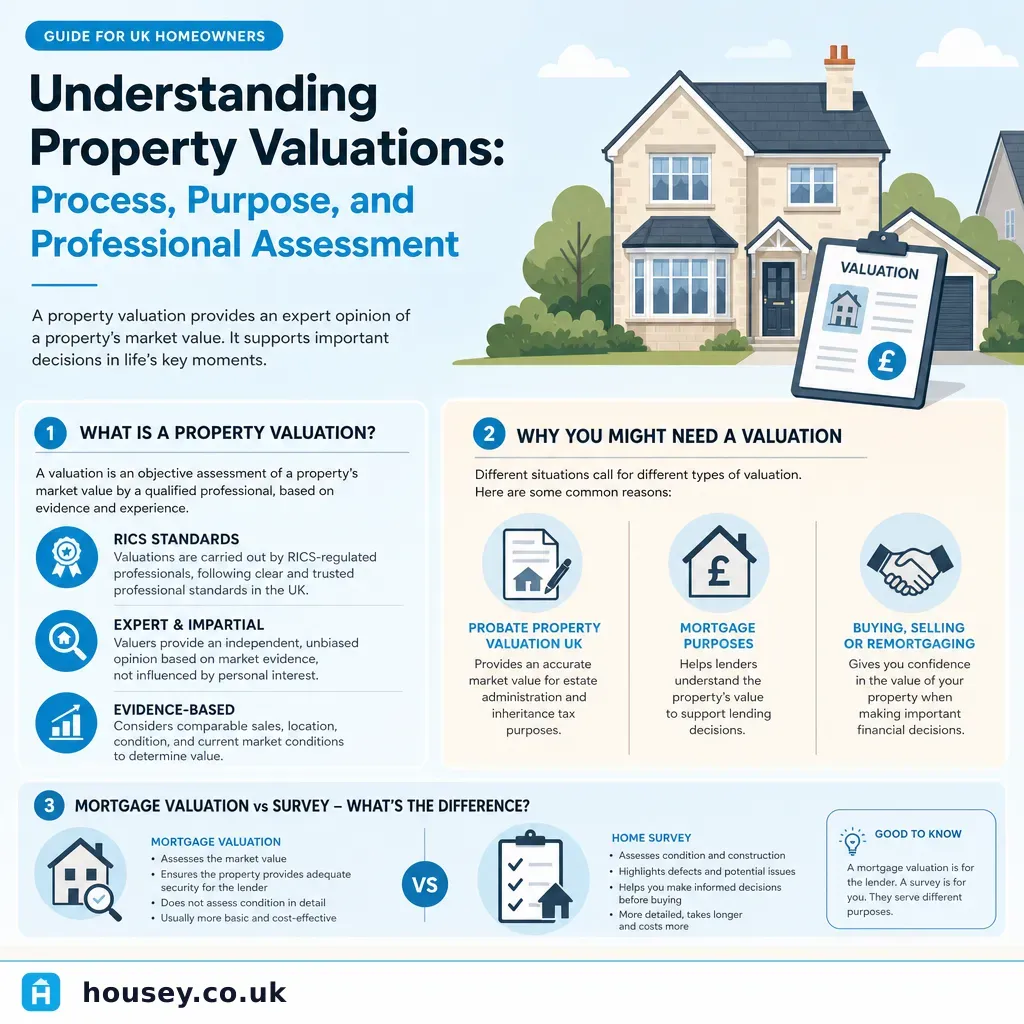
Understanding Property Valuations: Process, Purpose, and Professional Assessment
A property valuation is a professional opinion of a property's market value, carried out by a RICS Registered Valuer after a physical inspection and comparable sales analysis.
 Buying & Moving
How to Get Your Property Professionally Valued
To get a professional property valuation in the UK, instruct a RICS Registered Valuer for any formal purpose — mortgage, probate, Help to Buy, or legal proceedings.
 Buying & Moving
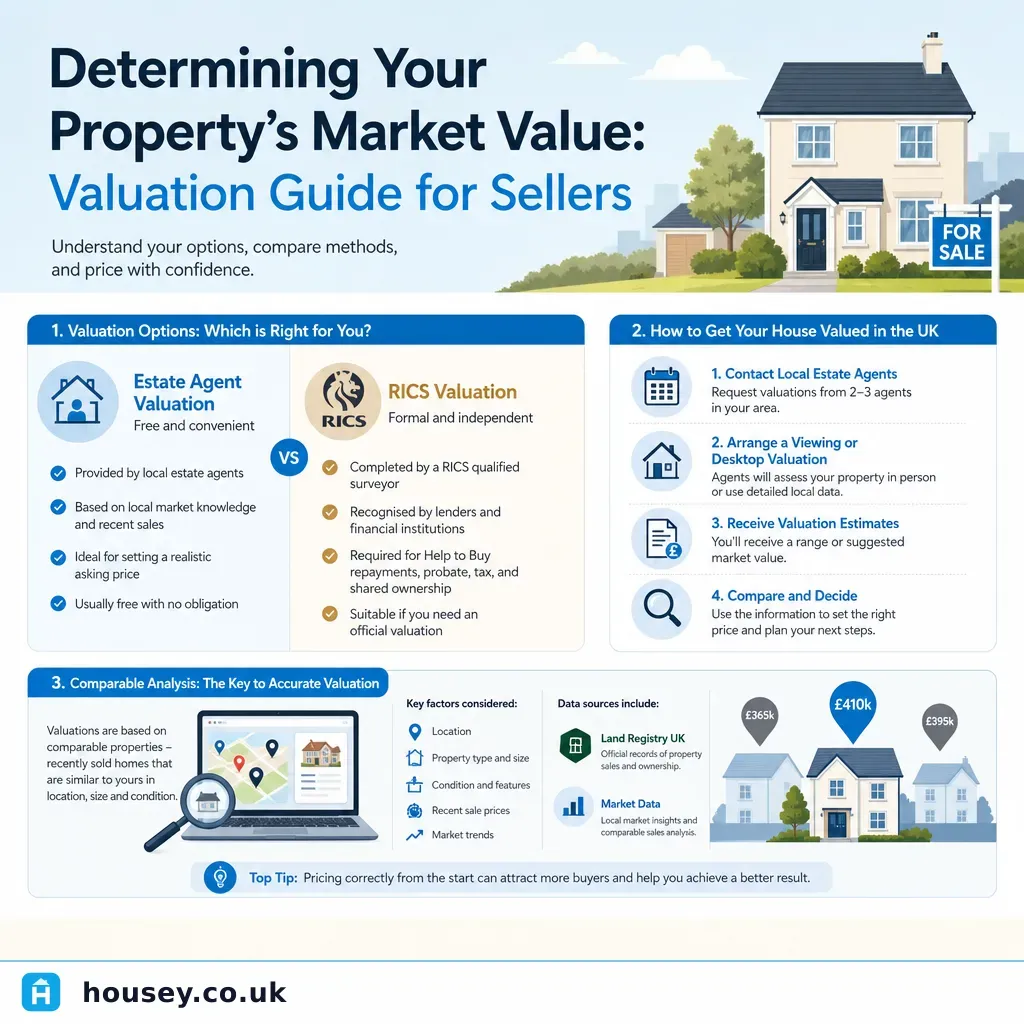
Determining Your Property's Market Value: Valuation Guide for Sellers
Market value in the UK is most reliably established by combining estate agent appraisals with your own analysis of recent sold prices on the HM Land Registry database.
 Buying & Moving
Valuing Your Property for Rapid Sale: Strategic Pricing Guidance
Pricing a UK home for a quick sale means setting an asking price supported by recent comparable sales evidence — not significantly above it.
 Buying & Moving
Which Home Improvements Add Real Value to Your Property?
In the UK, loft conversions, single and double-storey extensions, and energy-efficiency upgrades are most reliably linked to added property value.