Understanding Property Valuations: Process, Purpose, and Professional Assessment
By Housey · Last reviewed 11th of May 2026
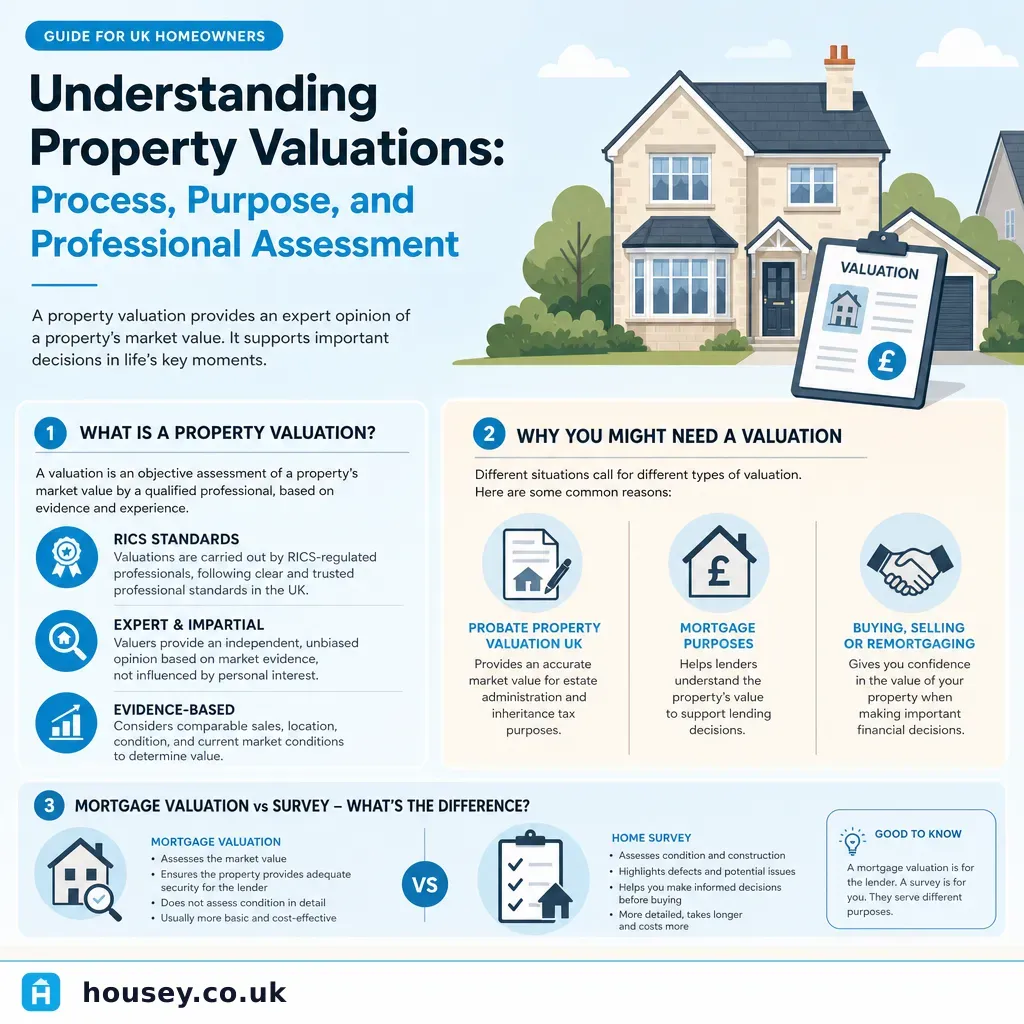
Understanding Property Valuations: Process, Purpose, and Professional Assessment
Property valuations sit at the heart of some of the most consequential financial and legal moments in a homeowner's life — mortgage applications, probate settlements, divorce proceedings, and tax assessments. Yet what a formal valuation actually involves, who is qualified to carry one out, and why there are such significant differences between an estate agent's appraisal and a RICS-compliant valuation report, is often poorly understood until the moment the distinction matters most.
Key points
- RICS Registered Valuers must follow the RICS Valuation — Global Standards 2022 (the Red Book) when preparing formal valuations for regulated purposes such as mortgage lending, probate, or litigation.
- A mortgage valuation is not a survey — it is a brief risk assessment prepared for the lender's benefit, not a detailed condition report for the buyer.
- Probate valuations submitted to HMRC for Inheritance Tax must state a value at the date of death and are subject to independent review by HMRC's District Valuer Service.
- Desktop valuations and automated valuation models (AVMs) used by some online estate agents are not RICS-compliant formal valuations and do not carry weight in legal, mortgage, or tax proceedings.
- In England and Wales, the valuation report is addressed to the instructing party and typically cannot be relied upon by third parties or transferred to a different lender or purpose.
What a property valuation is — and what it is not
A formal property valuation is a professional opinion of value, prepared by a qualified valuer after a physical inspection of the property, analysis of comparable transaction evidence, and assessment of current market conditions. It results in a written report stating a figure — usually Market Value as defined in the RICS Red Book — at a specific valuation date.
This is distinct from several related but fundamentally different assessments:
- An estate agent appraisal: A non-regulated estimate used to guide marketing decisions. Estate agents are not required to hold RICS accreditation, and their figures may reflect sales strategy as much as objective market evidence.
- An automated valuation model (AVM): A computer-generated estimate based on publicly available sales data and property characteristics. Useful as a rough orientation; not appropriate for legal, mortgage, or tax purposes.
- A mortgage valuation: Carried out for the lender, not the buyer. It confirms the property is adequate security for the loan. The buyer often pays the fee but typically receives only a brief summary — not a full report.
- A RICS Home Survey (Level 2 or Level 3): A condition inspection that may include a valuation opinion but is primarily focused on defects, maintenance needs, and risks to the buyer.
Valuation types: comparison
Valuation type | Carried out by | Primary purpose | Who receives the report | RICS-compliant? |
|---|---|---|---|---|
Mortgage valuation | RICS Registered Valuer (lender's panel) | Mortgage security assessment | Lender (buyer may receive summary) | Yes |
Probate valuation | RICS Registered Valuer | HMRC Inheritance Tax | Executor / HMRC | Yes |
Matrimonial valuation | RICS Registered Valuer (often jointly instructed) | Divorce settlement | Both parties / court | Yes |
Help to Buy valuation | RICS Registered Valuer (Homes England approved list) | Equity loan redemption | Homes England / buyer | Yes |
CGT valuation | RICS Registered Valuer | Capital Gains Tax calculation | Owner / HMRC | Yes |
Shared ownership staircasing | RICS Registered Valuer (housing association panel) | Staircasing or resale | Housing association | Yes |
Estate agent appraisal | Estate agent | Marketing guidance | Seller | No |
AVM or desktop estimate | Online tool or platform | Informal guide | Buyer or seller | No |
The valuation process: what to expect
A formal RICS-compliant valuation for a residential property typically follows these stages:
1. Instruction and terms of engagement. You appoint a RICS Registered Valuer and agree the purpose, basis of value, and report format. The valuer confirms their terms in writing, including any assumptions the report will rest on — for example, that the property has good and marketable title — and any matters outside the scope of the inspection.
2. Physical inspection. The valuer inspects the property internally and externally, noting construction type, accommodation, condition, and any features or defects that affect value. This is not a full structural survey — valuers are not required to inspect behind finishes, beneath floors, or in roof voids unless visible evidence warrants further investigation.
3. Comparable evidence review. The valuer analyses recent comparable sales in the vicinity, adjusting for differences in size, condition, location, and specification. For unusual or complex properties this stage is more involved and may draw on wider geographic data.
4. Report preparation. The written report states the property address, inspection date, basis of value, the valuation figure, and the valuer's reasoning. Red Book reports must include specific disclosures, assumptions, any departures from standard methodology, and a statement of the valuer's independence from the instructing party.
5. Delivery and reliance. The report is addressed to the instructing party — the lender, the executor, or the court. Valuations prepared for one lender cannot typically be transferred to another lender or relied upon by parties not named in the report.
A formal valuation does not cover: detailed structural defects, legal title issues such as boundaries, covenants, or easements, planning history or compliance, or environmental risks beyond publicly available information at the time of inspection.
Preparing for a valuation
Providing relevant documentation ahead of the inspection helps the valuer reflect the property's characteristics accurately and avoids follow-up delays that hold up mortgage offers, probate administration, or court timetables.
Document preparation list
Important limitations
This article provides general information only. Property valuation is a regulated professional service governed by RICS Valuation — Global Standards 2022. The value of any individual property depends on specific factors including its physical condition, legal title, tenure, local market conditions, and the purpose of the valuation. Nothing in this article constitutes a valuation, legal advice, tax advice, or financial advice. Rules and regulatory requirements can change. Always instruct a RICS Registered Valuer for formal valuation purposes, and seek independent legal or tax advice where required.
When to get professional help
Several situations make a formal RICS valuation legally necessary or financially significant, and delays can have real consequences:
- Probate: HMRC may challenge the valuation figure submitted with an Inheritance Tax return (IHT400). Undervalued probate properties can attract interest charges and penalties. Instruct a valuer promptly — ideally one with experience of HMRC District Valuer negotiations.
- Shared ownership staircasing: Housing associations may reject valuations not prepared by valuers on their approved panel. Confirm the approved list before instructing.
- Help to Buy equity loan redemption: The equity loan charge is calculated on current market value; the valuer must be on Homes England's approved list.
- Matrimonial proceedings: If both parties cannot agree on a joint instruction, the court may direct a single joint expert valuation. Instruct early to avoid court timetable delays.
- Mortgage applications on unusual properties: Short leases (under 85 years for some lenders), properties above commercial premises, or non-standard construction can face delays or down-valuations that affect mortgage offers and require prompt action.
What to ask a qualified professional
Before instructing a valuer, ask:
- Are you a RICS Registered Valuer, and are you on the relevant approved panel — lender, Homes England, or housing association?
- What basis of value will you use — Market Value, reinstatement cost, or another basis — and is that appropriate for my specific purpose?
- Who will the report be addressed to, and can I personally rely on it?
- What assumptions will the report be based on, and what falls outside its scope?
- What does the fee include, and are there additional charges for specialist input, access difficulties, or follow-up queries?
- How long will the inspection take, and when will I receive the completed report?
- What is your experience with this type of property and this valuation purpose?
- If HMRC or another party challenges the figure, do you offer representation or written support?
How Housey can help
Housey connects homeowners and buyers with qualified professionals offering valuation surveys for mortgage, probate, Capital Gains Tax, and market purposes. Describe your valuation requirement and property type to receive quotes from vetted, RICS-qualified professionals.
Frequently asked questions
How much does a property valuation cost in the UK?
Fees vary by property value, location, and purpose. Mortgage valuations paid by buyers to a lender's panel valuer typically range from £150 to £600 for standard residential properties. Independent RICS valuations for probate, divorce, or tax purposes commonly cost £200 to £600 or more depending on complexity (Indicative UK costs, last reviewed 2026-05-11). Obtain at least two quotes and confirm what is included.
Can an estate agent provide a formal valuation for probate?
No. Estate agent appraisals are not RICS-compliant formal valuations and are not accepted by HMRC for Inheritance Tax purposes. A probate valuation must be prepared by a RICS Registered Valuer and state a value at the date of death. HMRC's District Valuer Service may review and challenge the submitted figure independently.
How long is a property valuation valid for?
Valuations are valid as at the date of inspection and can become outdated quickly in an active market. Most mortgage lenders accept a valuation for three to six months, though policies vary by lender. For probate, the valuation date must be the date of death; for Capital Gains Tax, the relevant date of disposal. Always confirm the currency requirement for your specific purpose before commissioning a report.
What is a down-valuation and what can I do about it?
A down-valuation occurs when a lender's valuer places a lower value on a property than the agreed purchase price, reducing the mortgage offer against the lower figure and potentially requiring a larger deposit. You can request a copy of the valuation, ask the lender to consider additional comparable evidence, or instruct your own RICS valuer and submit a formal challenge. Outcomes are not guaranteed.
Do I need a separate survey if I am getting a mortgage valuation?
Yes. A mortgage valuation is prepared for the lender and does not provide a detailed condition assessment for the buyer. Homebuyers who rely solely on a mortgage valuation before exchange have no independent report on the property's condition. A RICS Level 2 or Level 3 Home Survey is strongly recommended for your own protection.
Sources and further reading
- RICS Valuation — Global Standards (Red Book) — RICS
- Valuing the estate of someone who has died — GOV.UK / HMRC
- Help to Buy: equity loan — GOV.UK
- Search for property information — HM Land Registry
- District Valuer Services (DVS) — HMRC / GOV.UK
- Find a surveyor — RICS
Useful next reads
 Buying & Moving
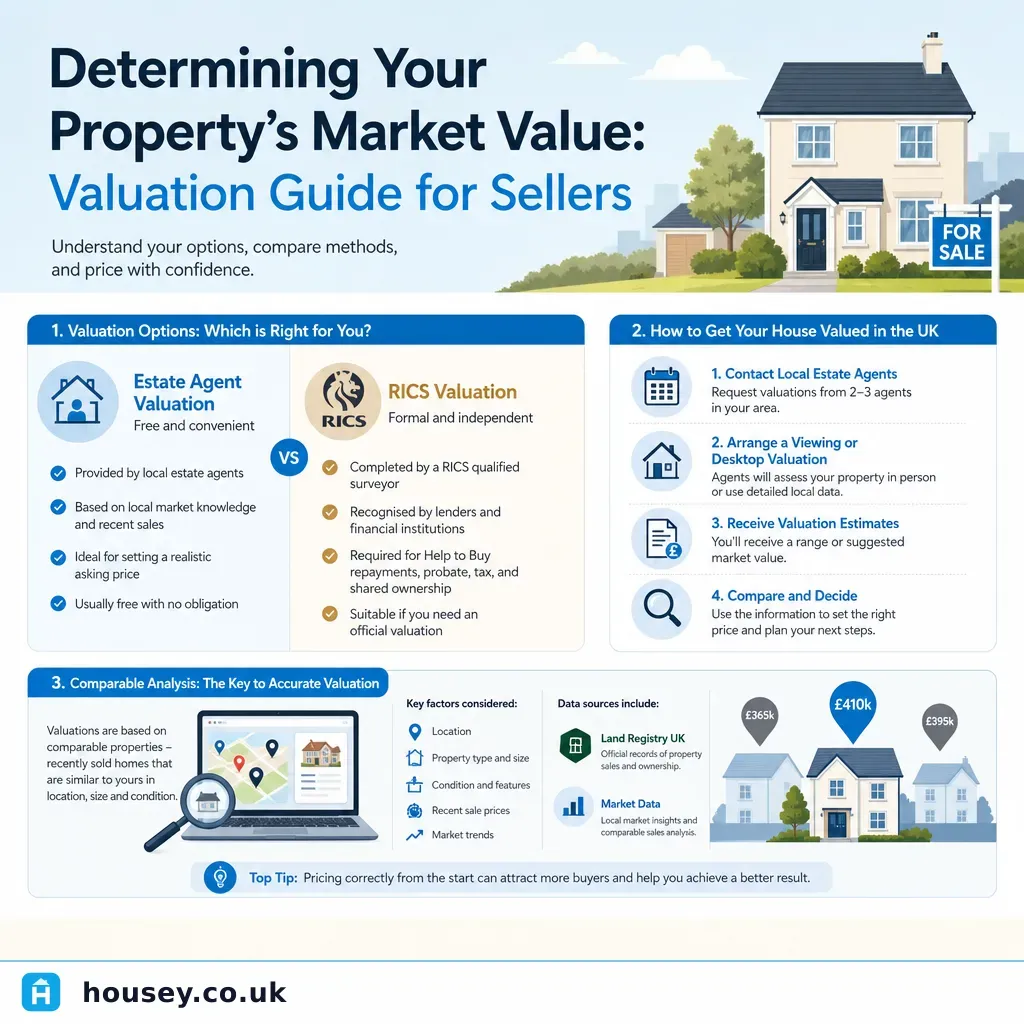
Determining Your Property's Market Value: Valuation Guide for Sellers
Market value in the UK is most reliably established by combining estate agent appraisals with your own analysis of recent sold prices on the HM Land Registry database.
 Buying & Moving
Factors That Influence Property Valuation and Market Value
Property market value in the UK is shaped by location, floor area, structural condition, EPC rating, tenure, and recent comparable sold prices in the local area.
 Buying & Moving
Valuing Your Property for Rapid Sale: Strategic Pricing Guidance
Pricing a UK home for a quick sale means setting an asking price supported by recent comparable sales evidence — not significantly above it.
 Buying & Moving
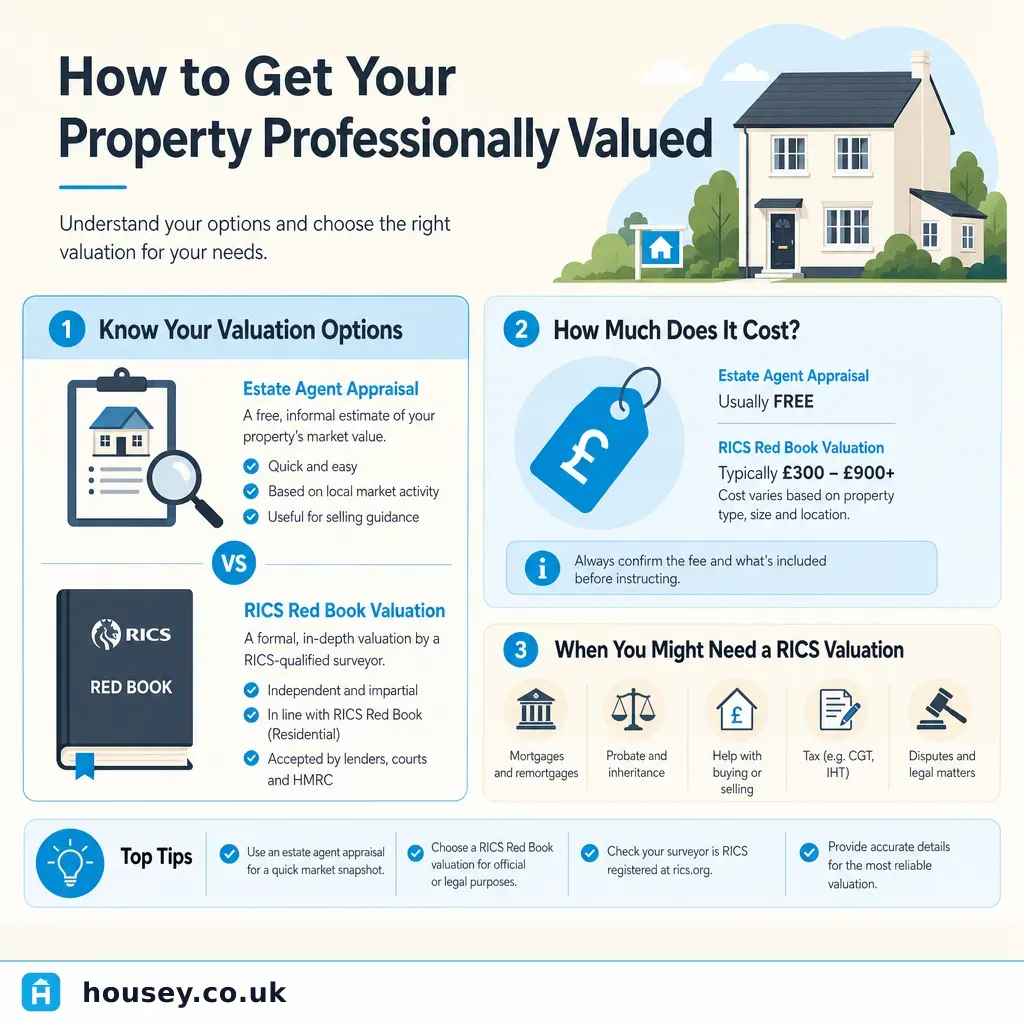
How to Get Your Property Professionally Valued
To get a professional property valuation in the UK, instruct a RICS Registered Valuer for any formal purpose — mortgage, probate, Help to Buy, or legal proceedings.
 Buying & Moving
Which Home Improvements Add Real Value to Your Property?
In the UK, loft conversions, single and double-storey extensions, and energy-efficiency upgrades are most reliably linked to added property value.