Fence Panel Installation Pricing and Materials
By Housey · Last reviewed 7th of May 2026
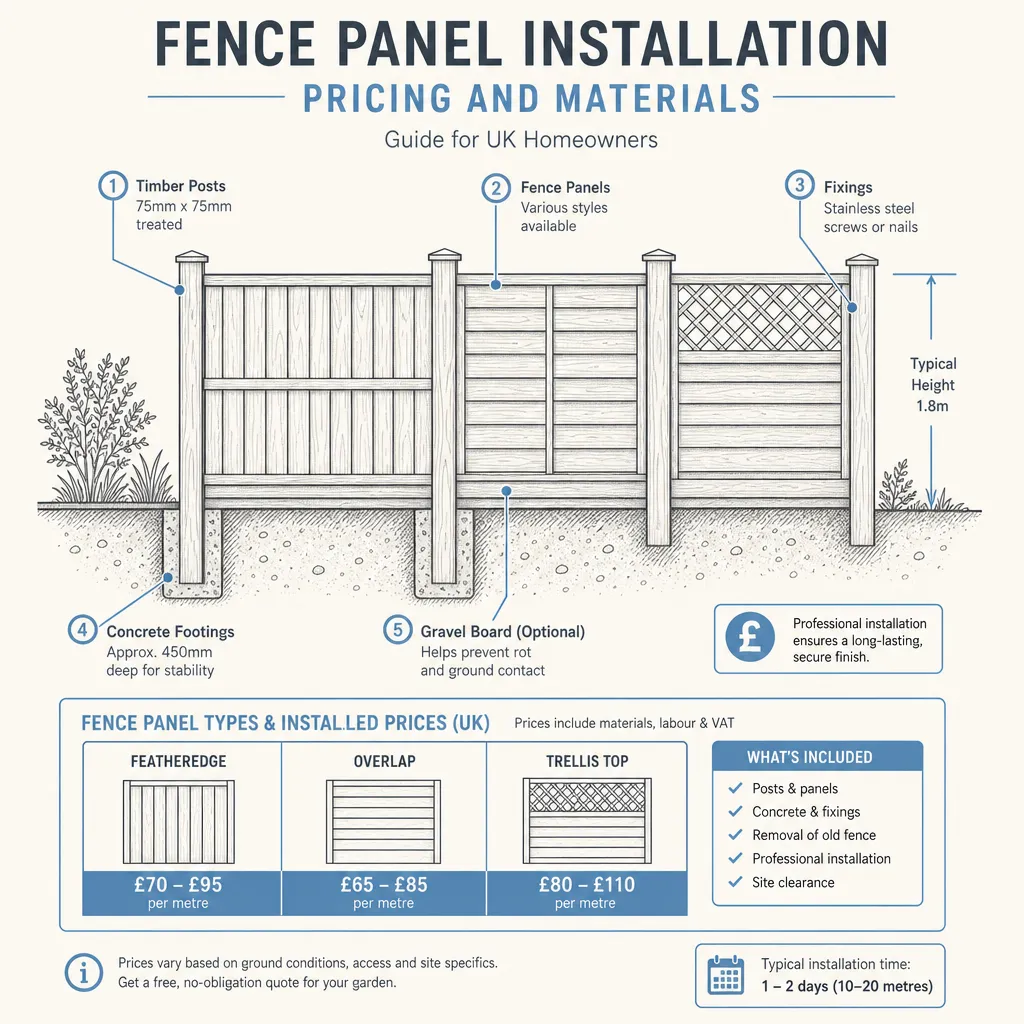
Fence Panel Installation Pricing and Materials
Replacing or installing a garden boundary fence is one of the most common home improvement jobs in the UK, yet prices vary considerably depending on panel type, post material, ground conditions, and access. Whether you are replacing storm-damaged panels, enclosing a new garden, or upgrading from tired lap panels to something more durable, understanding what drives the cost helps you compare quotes on a like-for-like basis.
Key points
- Standard lap panel fences typically cost £100–£200 per bay installed, including post, gravel board, and labour; close board and composite panels cost more.
- Under permitted development rules, garden boundary fences are limited to 2 metres in height without planning permission; fences adjacent to a highway are limited to 1 metre (Town and Country Planning Act 1990, Schedule 2, Part 2).
- Concrete fence posts typically last 25 or more years; pressure-treated softwood posts usually last 10–15 years; composite posts fall between the two.
- A fence or wall sitting exactly on the boundary between two properties may engage the Party Wall etc. Act 1996 — check your title deeds and speak to your neighbour before work starts.
- Many fencing contractors who operate as sole traders are not VAT-registered; always confirm whether quoted prices include or exclude VAT before comparing.
How much does fence panel installation cost?
Indicative UK costs, last reviewed 2026-05-07.
Installation costs break down into materials (panels, posts, gravel boards, fixings), groundworks (post-hole digging and concreting), and labour. Prices below assume flat ground with reasonable access.
Panel type | Supply cost per panel (6ft × 6ft) | Installed cost per bay (inc. posts and labour) |
|---|---|---|
Overlap/lap panel (softwood) | £20–£40 | £100–£180 |
Featherboard/close board | £50–£90 | £150–£250 |
Trellis top panel | £30–£60 | £120–£200 |
Acoustic/sound barrier panel | £80–£200 | £200–£400 |
Composite panel | £80–£250 | £200–£500 |
Slatted hardwood | £100–£300 | £250–£600 |
Indicative UK costs, last reviewed 2026-05-07. Prices vary by region, ground conditions, and contractor. Always obtain at least three quotes.
A 20-metre boundary (approximately 11 bays at 1.83m wide) with standard 6ft lap panels and concrete posts would typically cost £1,100–£2,000. The same run in close board or composite would be £1,650–£5,500.
Post materials: what to choose
Posts are the most critical structural element. A quality panel in a failing post will blow over in the first significant storm.
Post material | Typical lifespan | Pros | Cons | Relative cost |
|---|---|---|---|---|
Pressure-treated softwood | 10–15 years | Low upfront cost, widely available | Can rot at ground level | Lowest |
Concrete | 25+ years | Very durable, no rot risk | Heavy, awkward to install | Medium |
Composite (metal core + cladding) | 25+ years | Attractive, low maintenance | Higher upfront cost | Medium-high |
Steel (galvanised) | 30+ years | Very strong, slim profile | Highest cost, specialist install | Highest |
Concrete posts are the most common choice for standard timber panel fencing and are accepted by most contractors. Composite or steel posts are worth considering for close board or high-value installations where longevity matters more than upfront spend.
Planning permission and boundary rules
Most residential fencing does not need planning permission in England, but important limits apply:
- 2-metre rule: Any fence, gate, or wall up to 2 metres is generally permitted development — unless the property is in a conservation area, a World Heritage Site, or the right has been removed by a planning condition.
- 1-metre rule: Where the fence borders a highway (including a public footpath), the permitted development height limit drops to 1 metre. Exceeding this requires a householder planning application.
- Conservation areas and listed buildings: Permitted development rights are often more restricted. Check with your local planning authority (LPA) before starting work.
- New-build properties: Permitted development rights are sometimes removed by conditions on the original planning permission; check your title documents.
Always verify the current rules with the Planning Portal or your LPA before installing a fence that approaches these limits.
Party wall and boundary considerations
A fence sitting on the legal boundary can engage the Party Wall etc. Act 1996 if it constitutes a party fence wall — a masonry wall straddling the boundary. Timber panel fences do not normally meet this definition, but if any masonry is involved it is worth checking.
Before commissioning work:
- Check your title deeds to confirm which boundary you own (the transfer plan usually shows this with a T-mark on the relevant line).
- Speak to your neighbour before work starts if the fence will be on or close to the boundary.
- If the boundary position is uncertain, take advice from a property solicitor before any installation is carried out.
What to check before accepting a quote
- What is included? Confirm whether the quote covers removal and disposal of the old fence, concrete setting of posts, gravel boards, fixings, and ground clearance.
- Are posts set in concrete or spiked? Spiked post supports are quicker to install but less suitable for heavy panels or exposed locations.
- Who carries out the work? Is it the contractor themselves or a subcontractor? What experience do they have with your chosen panel type?
- What could change the price? Buried rubble, tree roots, hard ground, or difficult access can all increase cost; ask how these would be handled.
- Is VAT included? Many smaller fencing contractors are not VAT-registered; larger firms usually are. Confirm before comparing quotes side by side.
- What guarantee is offered? A reputable contractor should stand behind their workmanship for at least one year.
- Will they remove the old fence? Skip hire or disposal fees can add £150–£300 if not included in the original quote.
When to get professional help
Fencing is generally straightforward, but professional input matters when:
- The fence is in a conservation area, near a listed building, or adjacent to a highway — planning or heritage constraints may apply.
- The boundary is disputed — do not install until the legal boundary position is established.
- Ground conditions are complex (steep slopes, waterlogged ground, or tree roots near post positions) — a groundworker or landscaper can advise on appropriate foundation depths.
- The fence run is long or in an exposed location — a fencing specialist can specify correct post depths, concrete mix, and spacing for wind loading.
How Housey can help
For larger fencing projects, complex ground conditions, or landscaping work to complete alongside the fence, Housey can connect you with experienced groundworkers and landscapers who can quote on the full scope. Getting multiple quotes through Housey helps you compare on a consistent, like-for-like basis.
Frequently asked questions
Do I need planning permission to replace an existing fence?
In most cases, no. Replacing a like-for-like fence of the same height does not normally require planning permission under permitted development rules in England. However, if you want to increase the height, the fence borders a highway, or your property is in a conservation area, you may need to apply. Check with your local planning authority if you are unsure.
Who is responsible for maintaining a boundary fence?
Responsibility depends on your title deeds. The transfer plan often uses a T-mark to indicate which party owns which boundary. If the T is on your side, you usually own and are responsible for that boundary. Where deeds are unclear, disputes can arise. Citizens Advice or a property solicitor can help resolve ambiguity without resorting to formal proceedings.
How long does fence installation take?
A typical residential run of 10–15 panels can usually be installed in one to two days by a two-person team, assuming the old fence has been removed and the ground is reasonably straightforward. Close board fencing takes longer than pre-made panel fencing because each board is installed individually rather than as a pre-assembled section.
What is the difference between lap panel and close board fencing?
Lap panels are pre-made sections of overlapping horizontal boards fixed to a frame — quick to install but less durable and wind-resistant. Close board fencing is built in situ by nailing individual vertical featherboards to arris rails fixed to posts. Close board is stronger, lasts longer, and looks neater from both sides, but costs more in materials and labour.
Can I install fence panels myself to save money?
Straightforward panel replacement on flat ground is within the capability of a competent DIYer. Posts should be set at roughly one-third of their length below ground and concreted in vertically. For longer runs, sloped ground, or where the fence is on a shared boundary, professional installation usually delivers a better and more durable result.
Sources and further reading
- Planning Portal: Fences, gates and garden walls — Planning Portal
- Town and Country Planning Act 1990, Schedule 2, Part 2 — legislation.gov.uk
- Party Wall etc. Act 1996 — legislation.gov.uk
- Citizens Advice: Property boundaries — Citizens Advice
Useful next reads
 Improvement & Build
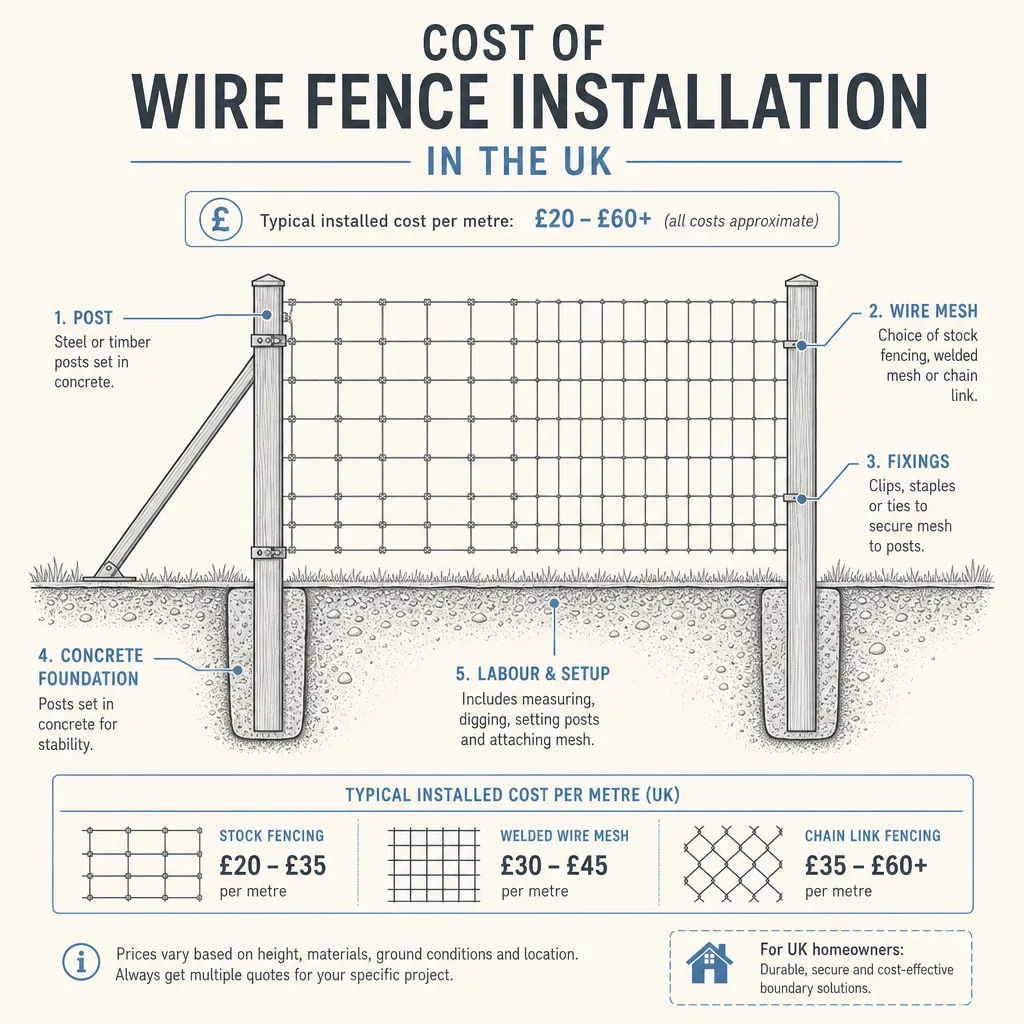
Cost of Wire Fence Installation in the UK
Wire fence installation in the UK typically costs £8–18 per metre for stock fencing, £15–35 per metre for chain-link, and £20–45 per metre for welded wire mesh panels, all installed.
 Improvement & Build
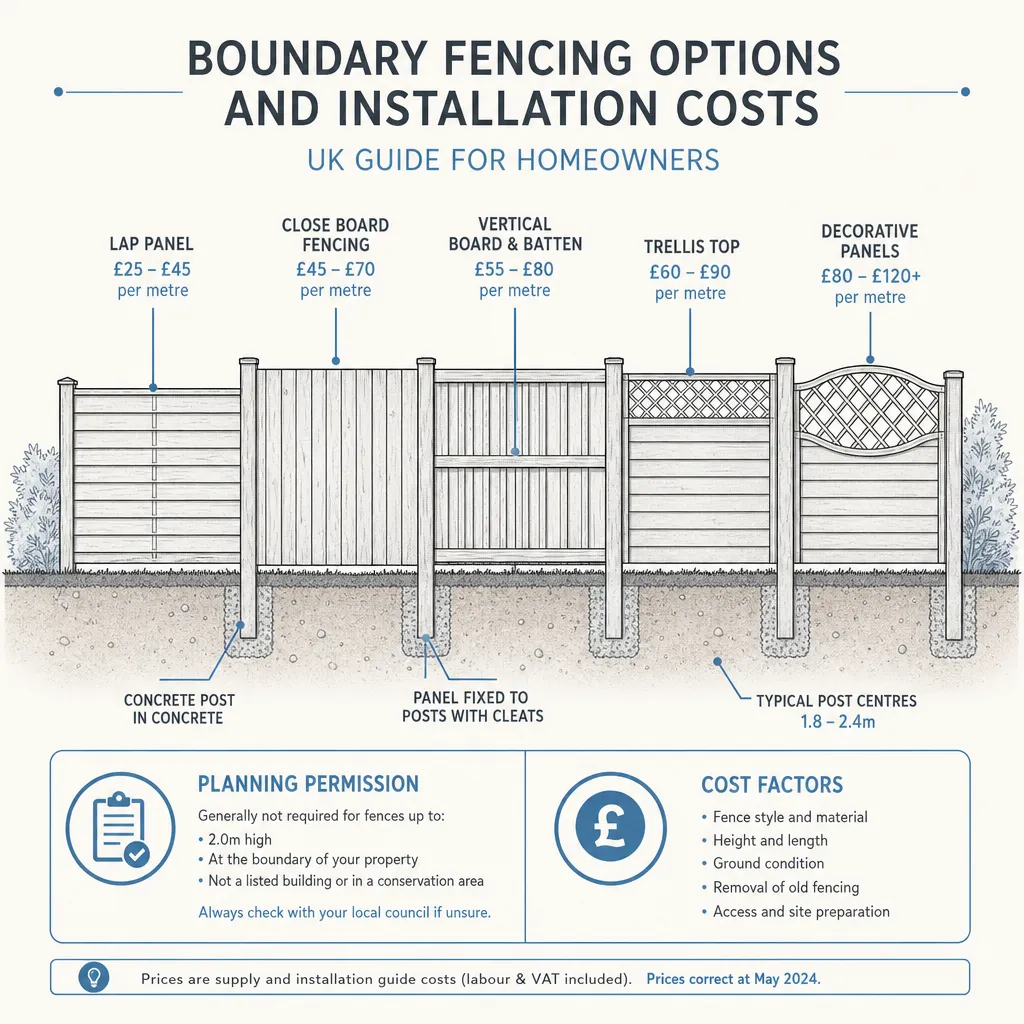
Boundary Fencing Options and Installation Costs
Boundary fencing in the UK ranges from around £50 to £250 per linear metre installed, depending on material, height, and ground conditions.
 Improvement & Build
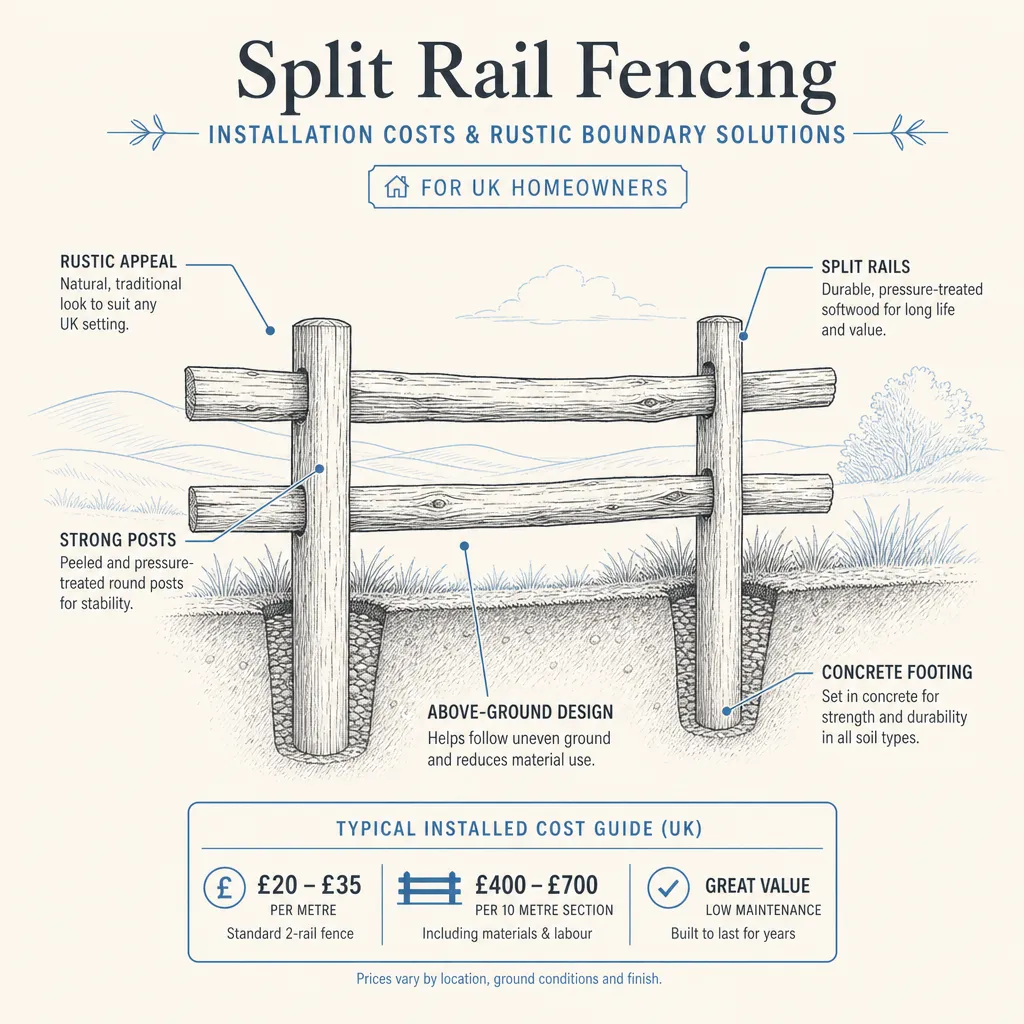
Split rail fencing: installation costs and rustic boundary solutions
Split rail fencing typically costs between £30 and £60 per linear metre installed in the UK, depending on timber species, number of rails, and local labour rates.
 Improvement & Build
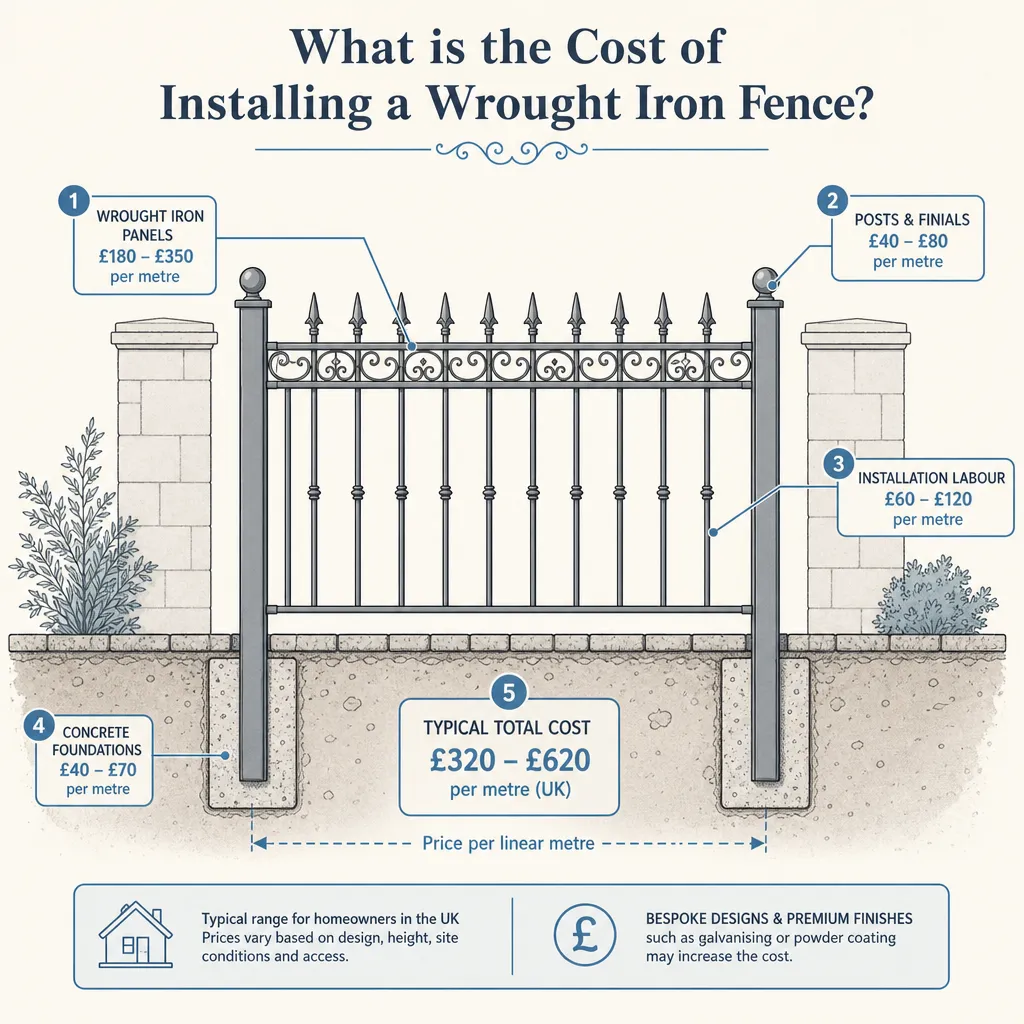
What is the Cost of Installing a Wrought Iron Fence?
Wrought iron fencing in the UK typically costs between £100 and £400 per metre installed, depending on design complexity, material, and regional labour rates.
 Improvement & Build
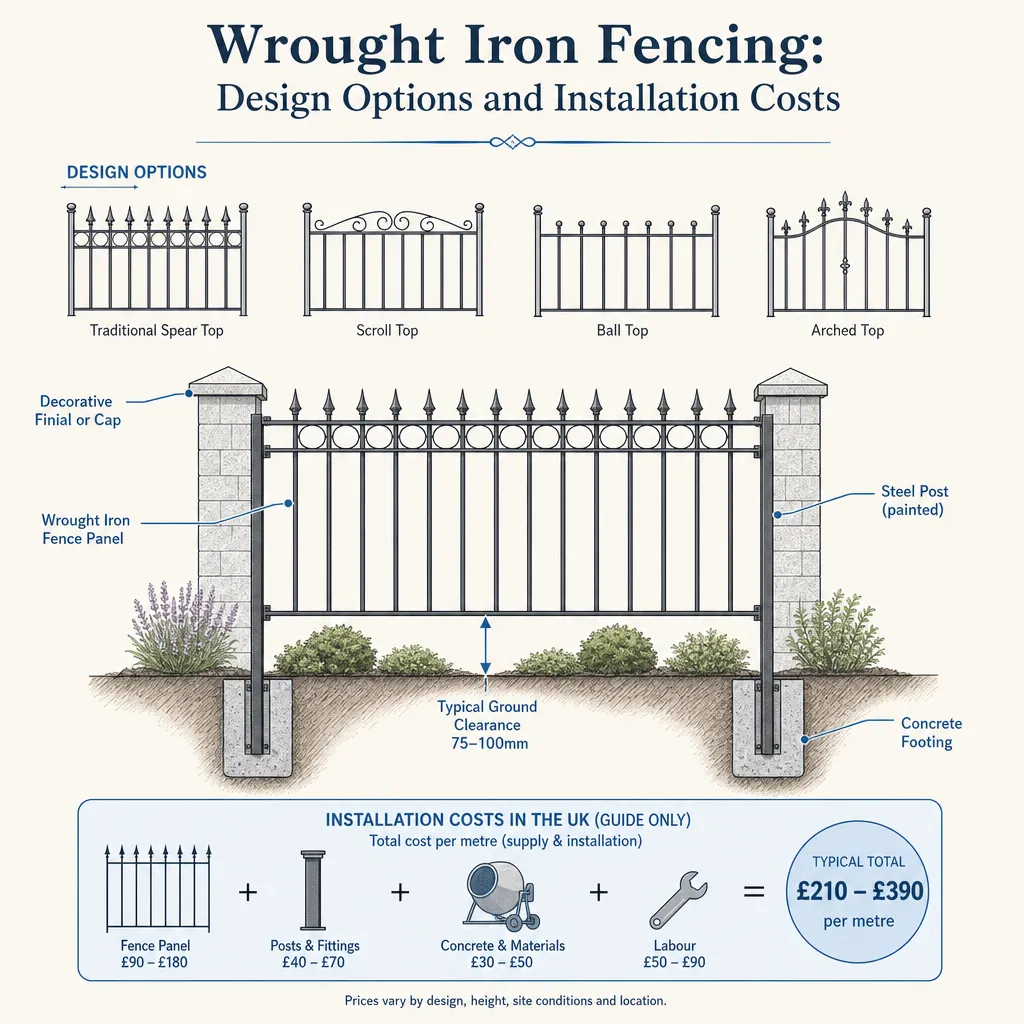
Wrought Iron Fencing: Design Options and Installation Costs
Wrought iron style fencing in the UK is typically mild steel, powder-coated or hot-dip galvanised for rust resistance.