Split rail fencing: installation costs and rustic boundary solutions
By Housey · Last reviewed 12th of May 2026
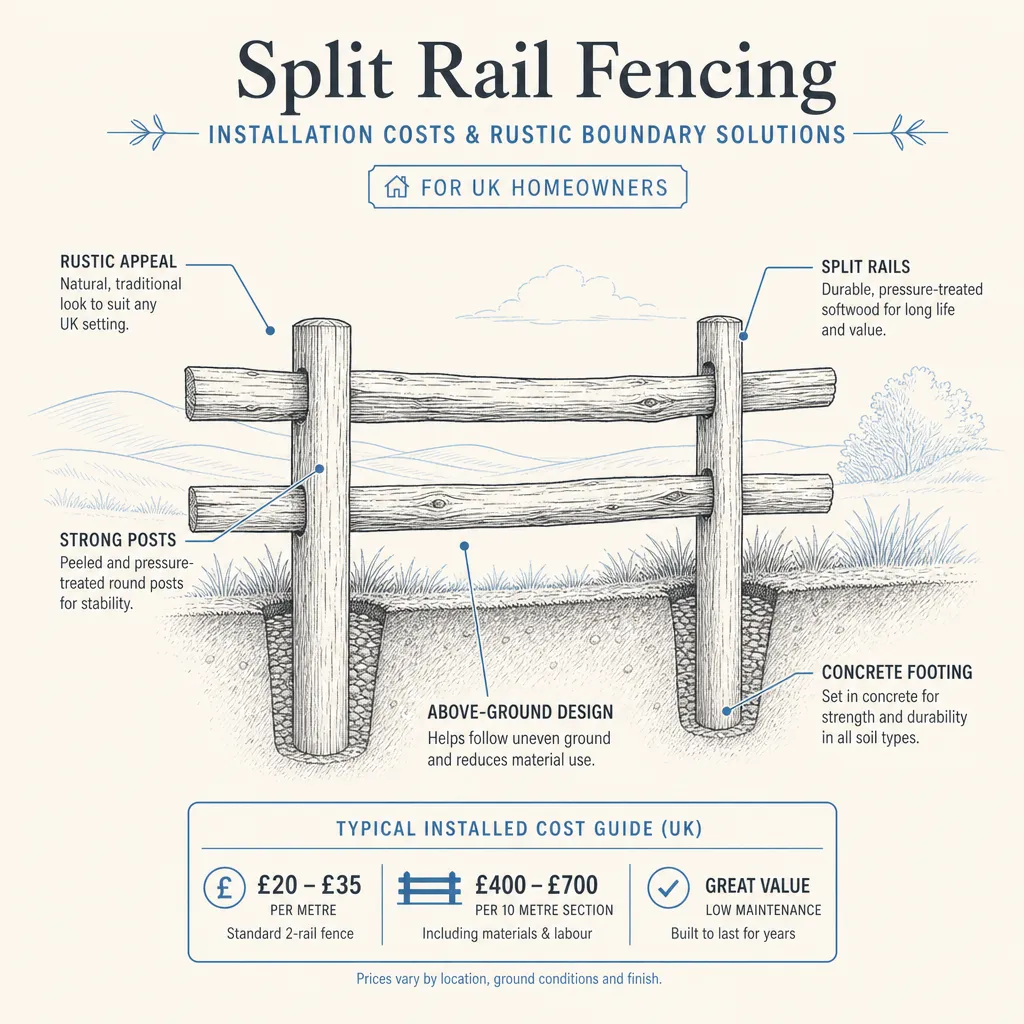
Split rail fencing: installation costs and rustic boundary solutions
Split rail fencing — also sold as post and rail fencing across much of the UK — has a long history as a practical boundary marker for rural and semi-rural properties, and it has grown steadily in popularity for informal garden borders, paddock edges, and countryside-style landscaping schemes. It suits properties where the aim is to define a boundary clearly without blocking light, views, or the movement of wildlife. Questions about cost, timber choice, and planning permission arise most often when homeowners are planning a new garden layout, replacing worn posts, or managing a recently acquired rural plot.
Key points
- Split rail fencing typically costs £30–£60 per linear metre for supply and installation in the UK, depending on timber species, rail count, and regional labour rates (indicative costs, last reviewed 2026-05-12).
- Under permitted development rights in England, a fence up to 2 m high generally does not require planning permission; this falls to 1 m when adjacent to a highway, including a public footpath.
- Sweet chestnut and larch are naturally durable and preferred for longevity without chemical treatment; pressure-treated softwood is more affordable but requires periodic retreatment.
- Boundary ownership is recorded in title deeds and HM Land Registry documents — confirm ownership and any covenants before installing or replacing any boundary fence.
- A two-rail design suits decorative or light-boundary use; three-rail is more appropriate when the fence must contain livestock or support post-and-mesh netting.
What is split rail fencing?
Split rail fencing consists of round or half-round timber posts set into the ground at regular intervals, with two or three horizontal rails morticed, notched, or bolted into them. Traditional designs used hand-split chestnut poles; modern versions are more commonly machine-cut and pressure-treated for consistency and longevity.
In the UK, the style is closely related to cleft chestnut pale fencing and rural post-and-rail, though split rail typically refers to the open horizontal-rail design without vertical pales or close-board infill. It does not function as a security or stock-proof barrier on its own but can be combined with post-and-mesh or high-tensile stock netting fixed behind the rails.
How much does split rail fencing cost in the UK?
Cost by timber type
Timber | Supply cost per metre (approx.) | Natural durability (untreated) | Notes |
|---|---|---|---|
Pressure-treated softwood (pine or spruce) | £10–£18 | 10–15 years | Most affordable; requires retreatment every few years |
Sweet chestnut (cleft or round) | £18–£30 | 20–25 years | Traditionally durable; classic rural appearance |
Larch | £15–£25 | 15–20 years | Good natural durability; warm reddish colour |
Oak | £25–£40 | 25–30+ years | Premium option; heavy; suits period or rural properties |
Indicative UK supply-only costs per linear metre of finished fence run, last reviewed 2026-05-12. Installation labour is additional.
Typical all-in installed costs
- Two-rail split rail fence: £30–£50 per linear metre installed
- Three-rail split rail fence: £40–£60 per linear metre installed
- Posts set in concrete: usually included in contractor quotes; post caps may add £2–£5 per post
- Matching gate (1.2 m wide): £150–£400 supply and fit, depending on timber species
Labour rates vary between regions. Always obtain at least three quotes from local fencing contractors or landscapers, and ask for quotes itemised separately for materials and labour.
Worked UK scenario
A homeowner in the East Midlands wants to fence a 40-metre boundary between their rear garden and a paddock, using two-rail pressure-treated softwood. At £35 per linear metre installed, the total is approximately £1,400. Upgrading to sweet chestnut at £48 per metre would cost around £1,920 — an additional £520 for a fence expected to last at least 10 years longer with minimal maintenance.
Does split rail fencing need planning permission?
In England, permitted development rights generally allow garden and boundary fencing up to 2 m high without a planning application, provided the property is not subject to local restrictions. Key exceptions:
- Adjacent to a highway (including a public footpath): the height limit falls to 1 m.
- Listed buildings: alterations within the curtilage of a listed building may require listed building consent.
- Conservation areas: additional restrictions can apply; check with your local planning authority before starting any work.
- Article 4 Directions: some local authorities have removed permitted development rights for fencing in specific areas.
In Wales and Scotland, the broad permitted development framework is similar but may differ in detail — confirm with your local planning authority if in doubt.
Confirming boundary ownership
Before installation, check your title deeds and HM Land Registry title plan to establish which boundary belongs to your property. The T-mark convention is commonly used in England and Wales to indicate ownership and maintenance responsibility. Also check for:
- Any easements, restrictive covenants, or shared-fence arrangements that affect what can be installed.
- Whether neighbourly agreement is needed or advisable where boundaries are shared or close.
Searching for your title register at HM Land Registry costs £3 for an official copy of the register.
Which specification should you choose?
- Choose two-rail if the fence is decorative, a visual boundary marker, or an informal garden feature with no livestock or containment requirement.
- Choose three-rail if you need a more defined enclosure, plan to add post-and-mesh or stock netting behind the rails, or the boundary must contain animals.
- Choose sweet chestnut or larch if the fence will be difficult to access for maintenance, or you want to minimise long-term upkeep costs.
- Choose pressure-treated softwood if initial budget is the priority and you are comfortable carrying out periodic retreatment every few years.
- Consult a fencing contractor if the ground is steeply sloping, rocky, waterlogged, or has significant tree root systems — post-setting becomes substantially more complex in difficult ground.
- Check your local planning authority and title deeds before starting if there is any doubt about permitted development rights, boundary ownership, or covenants.
What to ask a fencing contractor before accepting a quote
- What timber species and treatment class are you supplying?
- What is the post diameter and setting depth, and how are posts fixed (concrete, driven, or bolt-down)?
- Is concrete or post-mix included in the quoted price?
- How are rails fixed to posts — morticed, notched, or bolted?
- Is VAT included in the quoted figure?
- What is the expected lifespan, and what maintenance would you recommend?
- Are you a member of the Fencing Contractors Association or a comparable trade body?
- What happens if ground conditions turn out to be more difficult than expected — how would that affect the price or programme?
When to get professional help
Split rail fencing is one of the more accessible DIY fence types for short runs on level ground. Professional installation is advisable when:
- The fence run exceeds 20–30 metres, where consistent post spacing, alignment, and level setting become demanding.
- Ground conditions include rock, heavy clay, waterlogging, or substantial tree roots.
- The boundary is shared, disputed, or subject to a restrictive covenant.
- The fence runs adjacent to a highway or a public right of way.
- The property is listed or in a conservation area.
How Housey can help
For larger projects where split rail fencing forms part of a wider garden redesign, landscapers can supply and install fencing alongside planting, levelling, and hard landscaping. Garden designers can advise on how fencing style and timber species integrate with the overall layout and planting scheme before you commit to any materials.
Frequently asked questions
Does split rail fencing need planning permission in the UK?
In most cases, no. Permitted development rights generally allow boundary fences up to 2 m in height without a planning application. The limit falls to 1 m adjacent to a highway. Listed buildings and conservation areas are exceptions. Confirm with your local planning authority and check your title deeds for any relevant covenants before starting work.
How long does split rail fencing last?
Lifespan depends on timber species and ground conditions. Pressure-treated softwood typically lasts 10–15 years with some retreatment; sweet chestnut and larch can last 15–25 years naturally; oak may exceed 25 years. Post quality and the method of setting into the ground have the greatest influence on durability, as ground contact is the primary point of decay.
What is the difference between two-rail and three-rail split rail fencing?
A two-rail design has posts with two horizontal rails and functions mainly as a decorative or visual boundary marker. A three-rail design adds a lower rail closer to the ground, offering more enclosure and making it easier to attach post-and-mesh or stock netting behind the rails for containment on rural or paddock boundaries.
Can I install split rail fencing myself?
Yes — it is one of the more DIY-friendly fence types for short runs on level ground, and post-and-rail kits are widely available at agricultural merchants and timber yards. The main challenges on longer or sloping runs are accurate post spacing, vertical alignment, and consistent setting depth. Rocky, waterlogged, or heavily rooted ground makes the work significantly harder.
Sources and further reading
- Planning Portal: fences, gates and garden walls — Planning Portal
- Search for property information at HM Land Registry — GOV.UK
- Fencing Contractors Association — Fencing Contractors Association
- TRADA: timber species and durability — TRADA
Useful next reads
 Improvement & Build
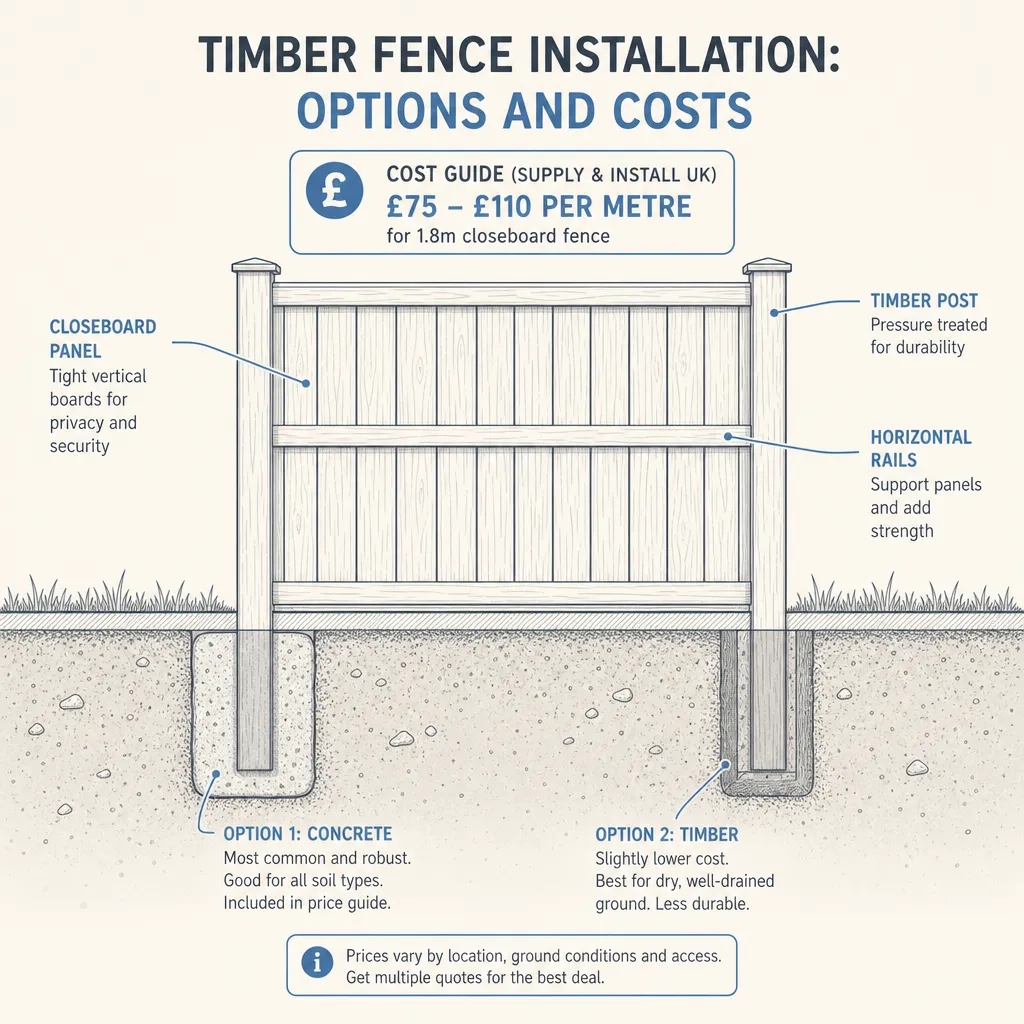
Timber Fence Installation: Options and Costs
Timber fence installation in the UK typically costs £60–£150 per metre installed, depending on fence type, post material, and ground conditions.
 Improvement & Build
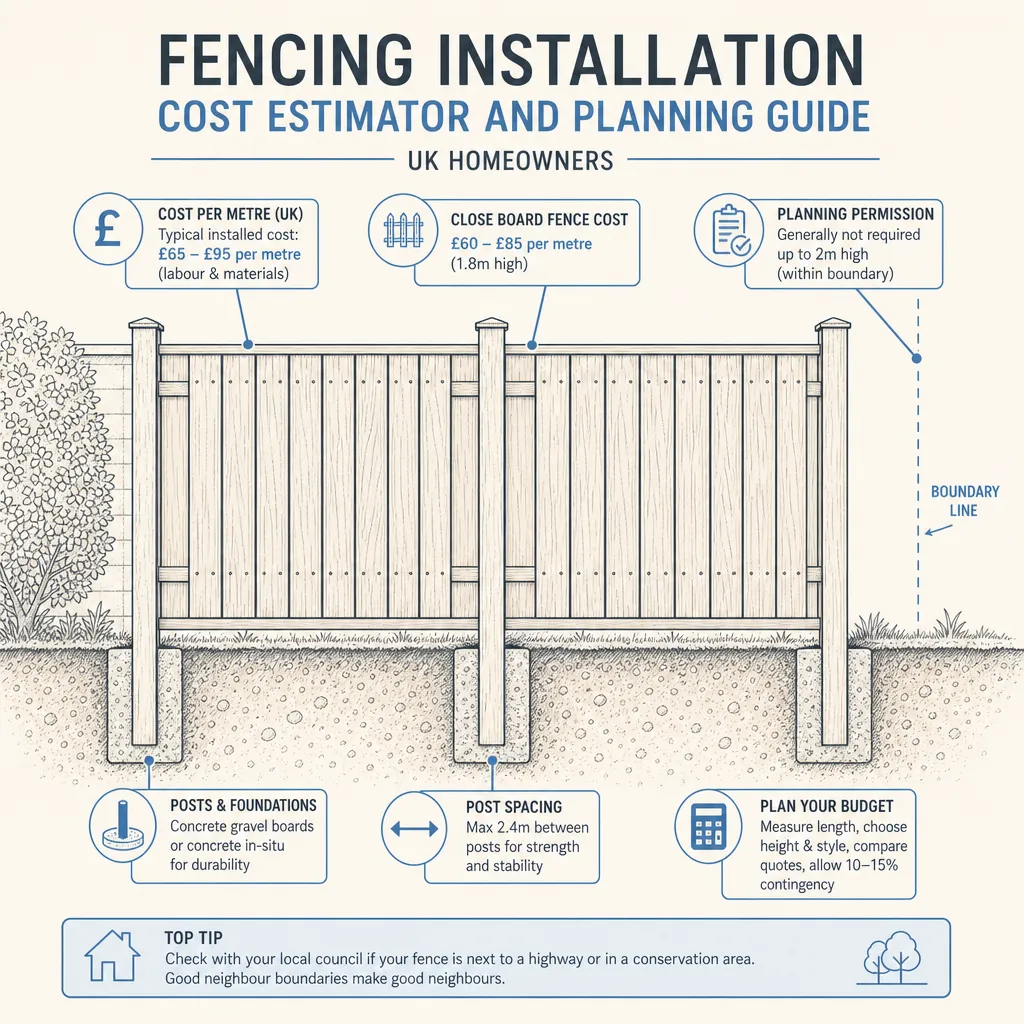
Fencing Installation Cost Estimator and Planning Guide
Fencing installation in the UK typically costs £50–£160 per metre installed, depending on fence type and ground conditions.
 Improvement & Build
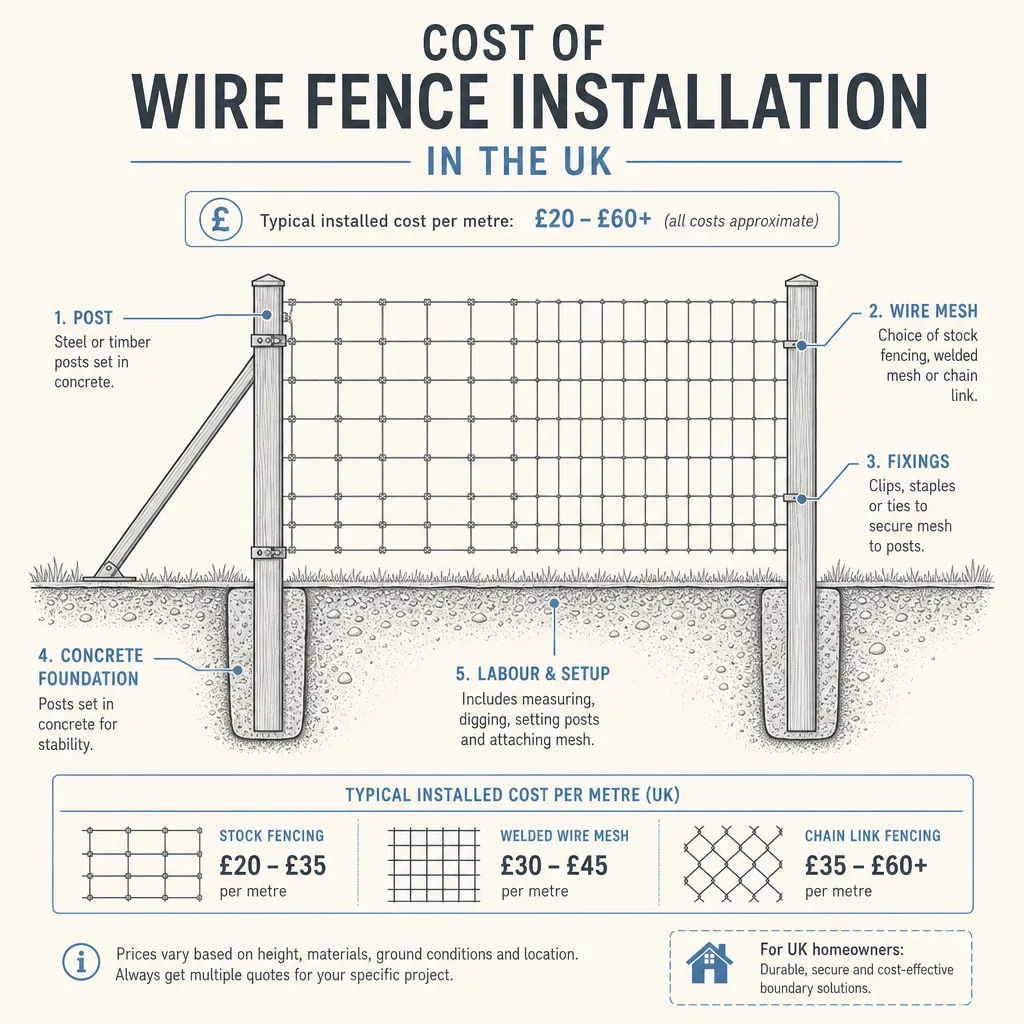
Cost of Wire Fence Installation in the UK
Wire fence installation in the UK typically costs £8–18 per metre for stock fencing, £15–35 per metre for chain-link, and £20–45 per metre for welded wire mesh panels, all installed.
 Improvement & Build
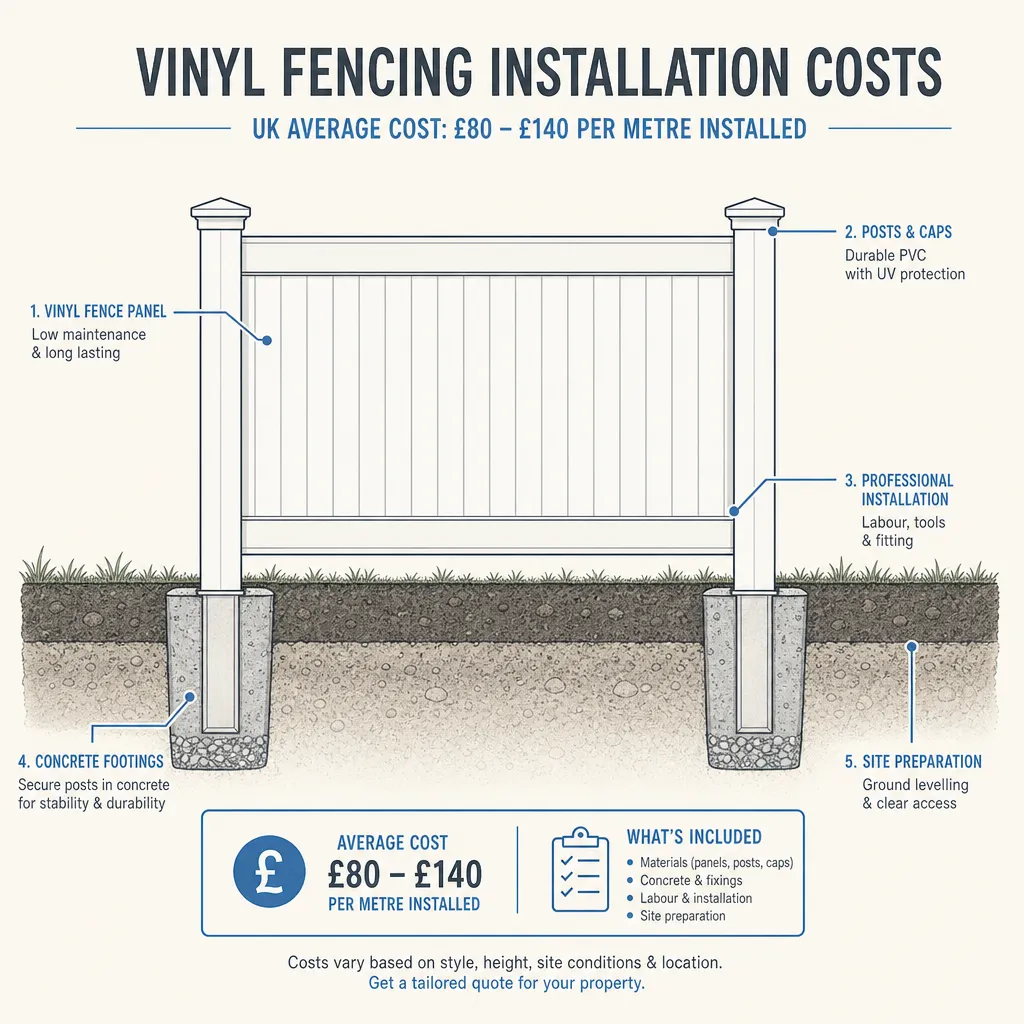
Vinyl Fencing Installation Costs
Vinyl fencing in the UK costs roughly £60–£200 per metre for supply and installation, depending on fence style, height, and ground conditions.
 Improvement & Build
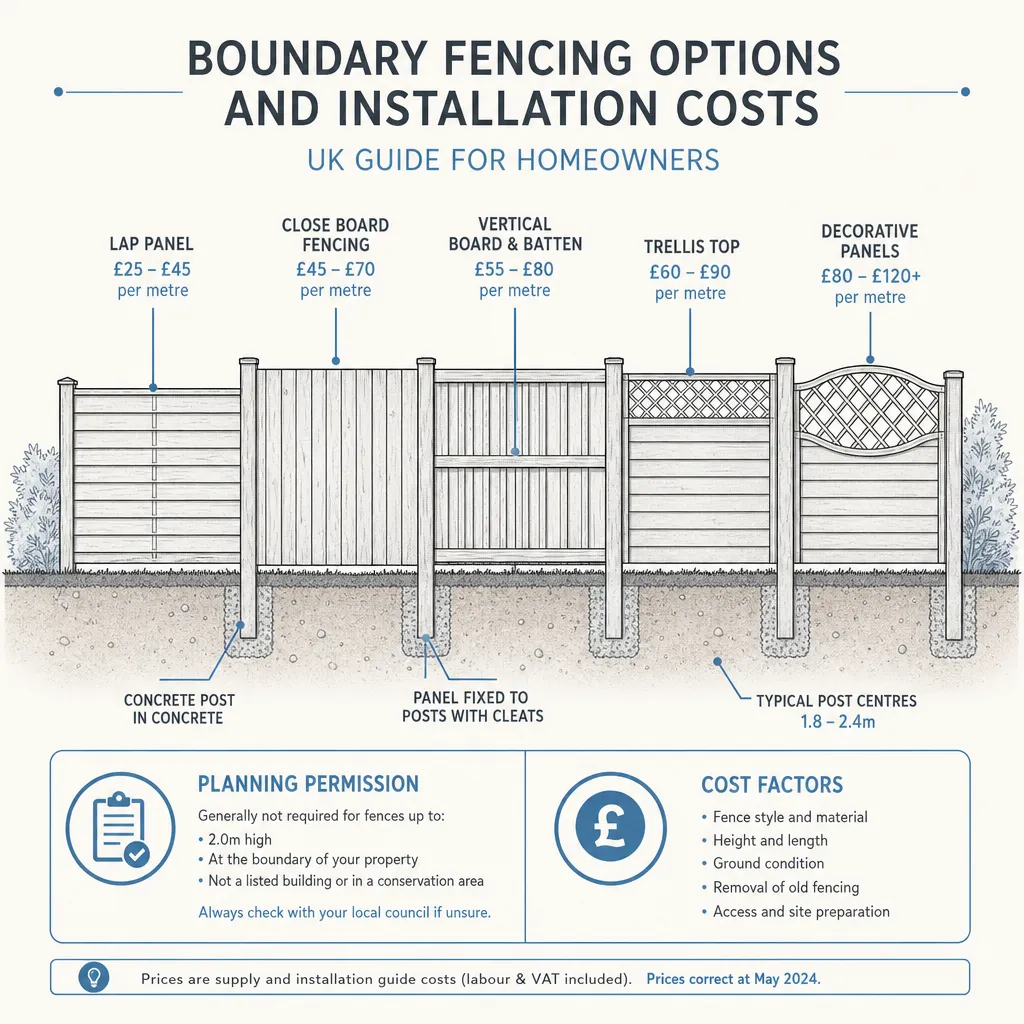
Boundary Fencing Options and Installation Costs
Boundary fencing in the UK ranges from around £50 to £250 per linear metre installed, depending on material, height, and ground conditions.