Soundproofing Materials and Acoustic Treatments for UK Homes
By Housey · Last reviewed 26th of May 2026
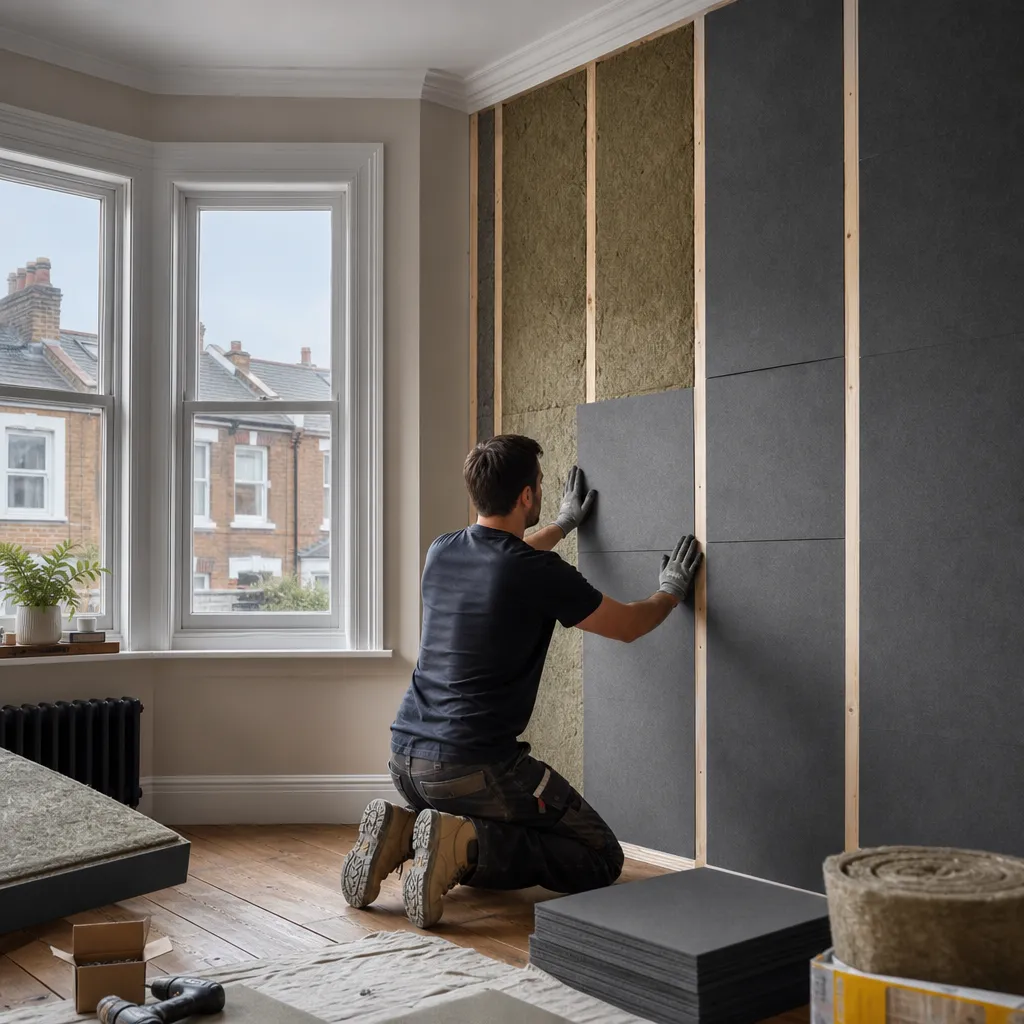
Soundproofing Materials and Acoustic Treatments for UK Homes
Noise complaints are among the most common grievances in UK residential properties — whether from a shared party wall in a Victorian terrace, impact sound travelling through a concrete flat floor, or a home studio disturbing the rest of the household. Choosing the wrong material wastes money without meaningfully reducing noise; choosing the right combination, correctly installed, can make a substantial difference.
Key points
- Building Regulations Approved Document E sets minimum airborne and impact sound insulation standards for new dwellings and material changes of use, including conversions from houses to flats.
- The three pillars of acoustic control are mass (adding weight to a surface), decoupling (breaking the vibration path between surfaces), and absorption (filling cavities with sound-absorbing material).
- Mass-loaded vinyl (MLV) at 5 kg/m² can deliver around 20–27 dB of sound reduction when correctly installed, according to manufacturer test data.
- Acoustic plasterboard (typically 12.5 mm or 15 mm) has a higher surface density than standard board but rarely suffices on its own — it should be combined with decoupling and cavity absorption.
- Resilient bars or acoustic clips decouple a new plasterboard layer from the structural wall or ceiling, reducing the vibration path that carries both impact and airborne noise.
Airborne noise vs impact noise — why the distinction matters
Airborne noise (voices, TV, music) travels through air and then sets building surfaces vibrating. Impact noise (footsteps, dropped objects) is generated by direct physical contact with a surface and travels through the structure itself.
Treating airborne noise without addressing impact noise — or vice versa — leaves the problem largely unresolved. Most party-wall and floor complaints in UK flats involve both types. A third complication is flanking: sound travelling around a treated surface via the building structure, through perimeter junctions, gaps, or service penetrations.
Noise type | Common UK sources | Primary treatment strategy |
|---|---|---|
Airborne | Voices and TV through a party wall | Mass and absorption — acoustic plasterboard combined with dense mineral wool |
Impact | Footsteps and dropped objects through the ceiling | Decoupling — resilient bars, acoustic clips, or a floating floor system |
Flanking | Sound bypassing the treated surface via the structure | Sealing perimeter gaps, adding mass to flanking paths, resilient perimeter isolation |
Soundproofing materials: what is available and when to use each
Acoustic mineral wool
Dense mineral wool batts — such as Rockwool RW3 or equivalent, typically 45–100 kg/m³ for acoustic applications — installed in wall, floor, or ceiling cavities absorb mid- and high-frequency airborne sound. They are most effective when combined with mass on both faces of the cavity.
Best for: Timber stud party walls, new-build timber floors, and ceiling cavities.
Limitation: Provides little benefit where there is no cavity, and has limited impact on low-frequency noise.
Acoustic plasterboard
Acoustic plasterboard contains a higher-density gypsum core — sometimes with a damping compound layer — compared with standard board. Common UK products are available in 12.5 mm and 15 mm variants; doubling up layers with staggered joints improves performance further.
Best for: Adding mass to existing walls or ceilings, especially alongside resilient bars.
Limitation: A single layer on a standard timber frame offers only modest improvement; decoupling is usually also required.
Mass-loaded vinyl (MLV)
MLV is a dense, flexible sheet material — typically 5 kg/m² — that adds mass without significant thickness. It can be used under floor finishes, on walls beneath plasterboard, or wrapped around noisy pipes.
Best for: Pipe boxing, adding mass in confined spaces, and inclusion beneath floating floor layers.
Limitation: Effective primarily against airborne noise; it does not address impact noise on its own.
Resilient bars and acoustic clips
Resilient bars are thin metal channels screwed to structural joists or wall studs; a new plasterboard layer is then fixed only to the bars — not to the structure. Acoustic clips (such as proprietary RSIC or Kinetics RIM systems) offer greater isolation, particularly for low frequencies, at higher cost.
Critical installation point: The new plasterboard must not touch the structure at any point — not at perimeter edges or around service penetrations. All perimeter gaps must be sealed with acoustic sealant.
Best for: Ceilings beneath noisy flats, party walls, and home cinema or music rooms.
Floating floor systems
A floating floor places a resilient layer — rubber matting, acoustic underlay, or proprietary isolation cradles — between the structural floor and the finished surface. This isolates impact vibrations before they enter the structure.
Best for: Flats with impact noise complaints from below, home studios, and rooms with hard floor finishes over concrete.
Common UK products: Regupol acoustic underlays, Sylomer isolation pads, and acoustic decoupling cradles from various manufacturers.
Which rooms benefit most — and which approach to use
Room or scenario | Primary noise concern | Recommended approach |
|---|---|---|
Party wall in a Victorian terrace | Airborne (voices, TV) | Independent timber stud wall with mineral wool, acoustic plasterboard, and resilient bars |
Ceiling below a noisy flat | Impact and airborne | Resilient-bar ceiling with two layers of acoustic plasterboard and mineral wool in the cavity |
Hard floor in a flat above neighbours | Impact | Acoustic screed or raised floating floor with Sylomer or Regupol underlay |
Home cinema or music room | Airborne and low-frequency | Room-within-a-room construction, acoustic panels, and bass traps |
Home office above a garage | Airborne from below (road noise) | Acoustic ceiling system combining MLV and mineral wool |
Decision tree: which soundproofing approach should you take?
- Is the noise mainly footsteps or impacts from above? → Prioritise a floating floor or ceiling decoupling system; adding mass alone will not resolve impact noise.
- Is the noise voices or TV through a party wall? → Add mass and absorption: an independent stud wall with dense mineral wool and acoustic plasterboard is the standard approach.
- Are you converting a house to flats or undertaking a material change of use? → Approved Document E applies; you will need to meet minimum Rw values and pre-completion sound testing may be required.
- Is the affected room a home studio or music rehearsal space? → Low-frequency control requires room-within-a-room construction; a standard acoustic plasterboard kit will not achieve meaningful bass isolation.
- Are there perimeter gaps, service penetrations, or back-to-back electrical sockets? → Address flanking paths first; treating only the main surface is a common reason why acoustic works underperform.
- Is the building listed or in a conservation area? → Check with your local planning authority before adding significant mass to external walls or altering windows.
Homeowner checklist before starting acoustic works
When to get professional help
For straightforward tasks — such as fitting resilient bars and a second layer of acoustic plasterboard — an experienced building contractor can manage the work. Consider involving a specialist acoustic consultant or a member of the Institute of Acoustics (IOA) when:
- The noise problem is severe and previous treatment attempts have made no meaningful difference.
- The project is a flat conversion subject to Approved Document E pre-completion testing requirements.
- You are designing a home studio or music room where low-frequency control is essential.
- The building is listed or the work involves structural elements.
- There is a neighbour dispute and you need documented acoustic performance evidence.
A RICS-registered building surveyor can also help specify and oversee acoustic works as part of a broader renovation or extension project.
How Housey can help
If soundproofing is part of a larger renovation or extension, our extension builders can incorporate acoustic specifications from the outset — often far more cost-effective than retrofitting acoustic systems after walls and ceilings have been closed. For projects requiring integrated design and build coordination, our design-and-build firms can include acoustic performance targets within the full project specification.
Frequently asked questions
Does acoustic plasterboard alone soundproof a wall?
Acoustic plasterboard increases the mass of a wall, which improves its sound reduction index, but on its own it rarely delivers the step-change most homeowners hope for. Meaningful improvement requires combining it with decoupling — via resilient bars or an independent stud frame — and a cavity filled with dense mineral wool. Using acoustic plasterboard without these additional measures typically yields only a small and often disappointing noise reduction.
Does soundproofing a room require planning permission?
Internal acoustic works — adding layers to walls, floors, or ceilings — generally do not require planning permission. However, if works affect a party wall, a Party Wall Agreement under the Party Wall etc. Act 1996 may be needed before starting. If the property is leasehold, landlord consent is often required. Always check your lease and notify your neighbour in writing where relevant.
How much does soundproofing cost in the UK?
Indicative UK costs, last reviewed 2026-05-26. A basic resilient-bar ceiling with two layers of acoustic plasterboard in a single room may cost £800–£2,500 depending on room size and access. A full independent stud-wall treatment for a party wall can range from £500 to £1,500 or more per wall. A professional room-within-a-room home studio installation can cost £5,000–£25,000 or more. Always obtain at least three itemised quotes; costs vary considerably by region, specification, and site conditions.
What is Approved Document E and does it apply to my project?
Approved Document E (Resistance to the Passage of Sound) is part of the Building Regulations for England. It sets minimum airborne and impact sound insulation standards for new dwellings, new rooms for residential purposes, and material changes of use — such as converting a house into flats. If your project falls into one of these categories, compliance must be demonstrated, usually including pre-completion sound testing by an accredited body. Replacing internal finishes within an existing single dwelling does not typically trigger Part E requirements.
Sources and further reading
- Approved Document E: Resistance to the Passage of Sound — GOV.UK
- Institute of Acoustics — Professional body for acoustic consultants and engineers in the UK
- Party Wall etc. Act 1996 — overview — GOV.UK
- Building Regulations Approved Documents — GOV.UK
Useful next reads
 Improvement & Build
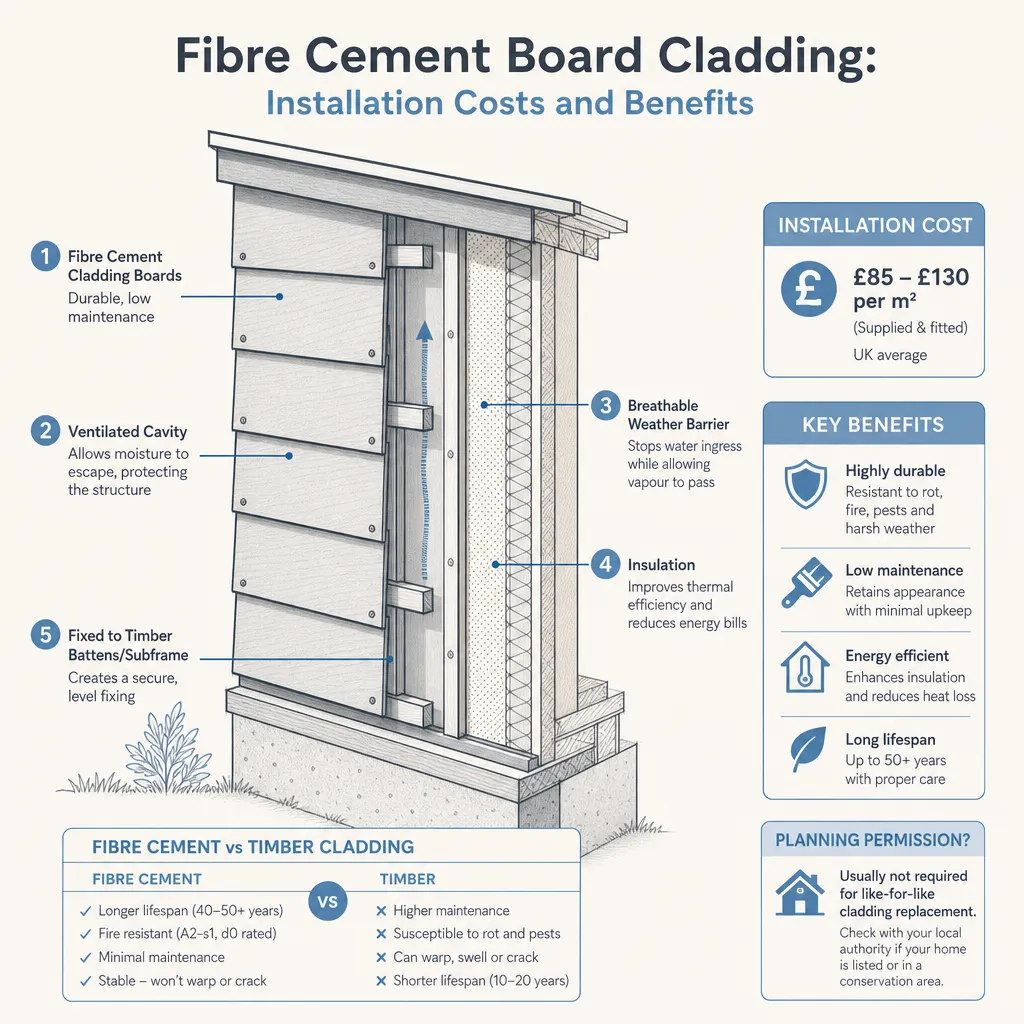
Fibre Cement Board Cladding: Installation Costs and Benefits
Fibre cement board cladding typically costs £80–£180 per m² installed in the UK, including boards, battens, breather membrane, and labour.
 Improvement & Build
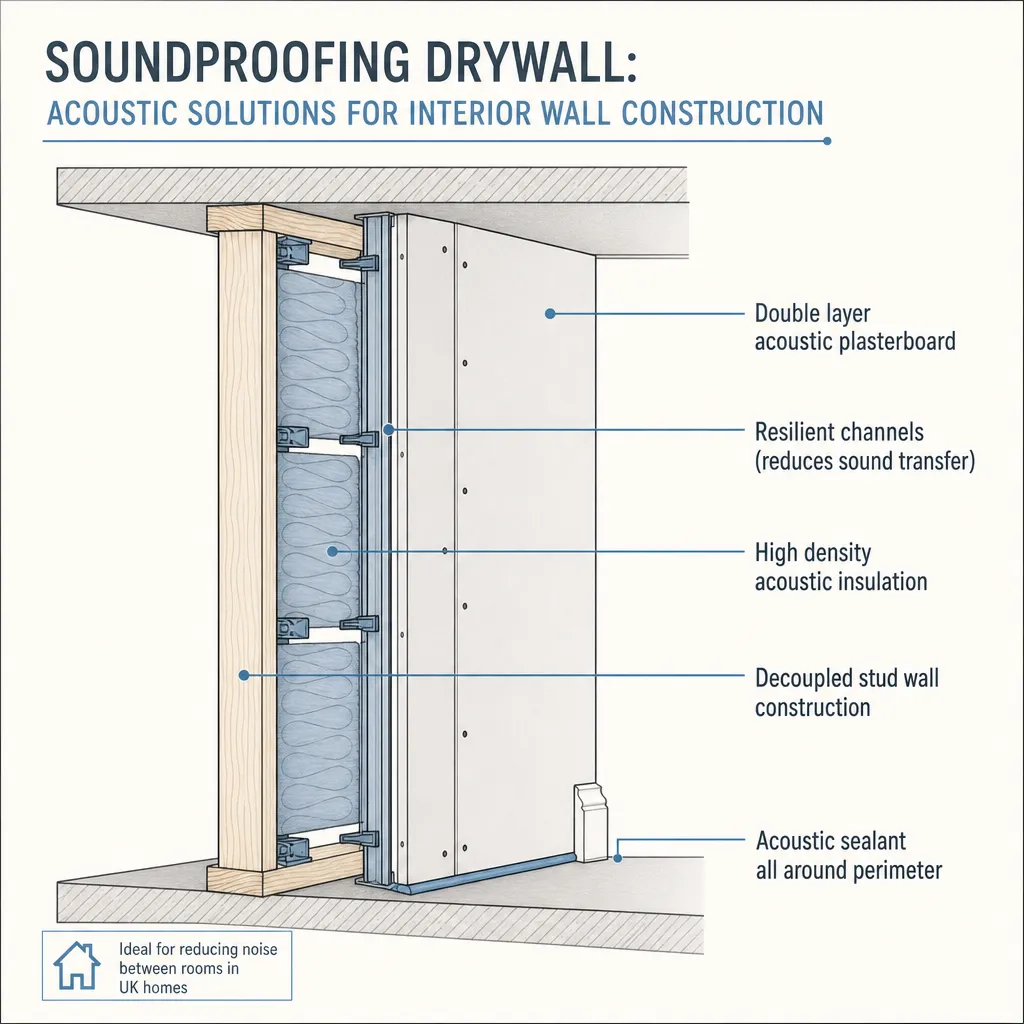
Soundproofing drywall: acoustic solutions for interior wall construction
Soundproofing drywall in UK homes typically combines acoustic plasterboard, resilient bar fixings, and mineral wool cavity fill to reduce airborne and structure-borne noise.
 Improvement & Build
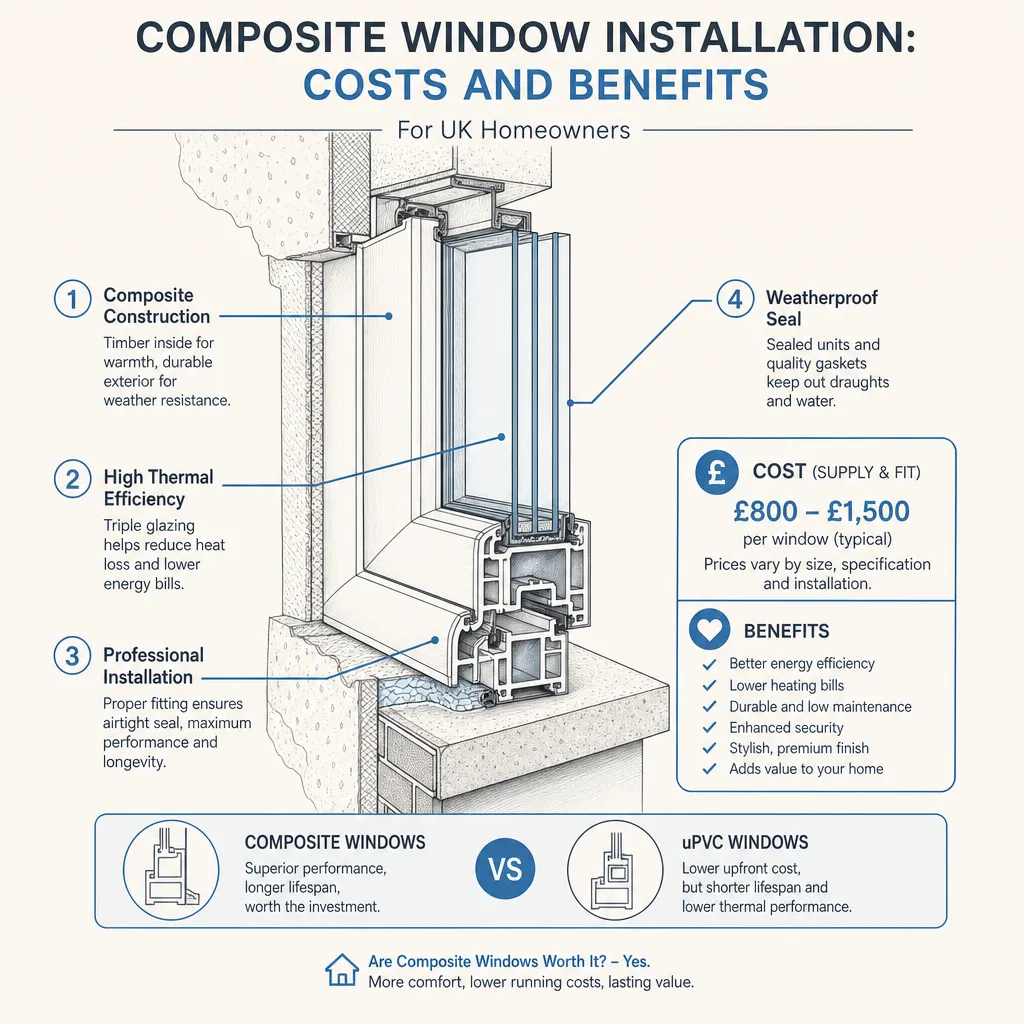
Composite Window Installation: Costs and Benefits
Composite windows combine two or more frame materials — typically a timber or aluminium core with a uPVC or aluminium outer casing — for better thermal performance and durability than standard uPVC.
 Improvement & Build
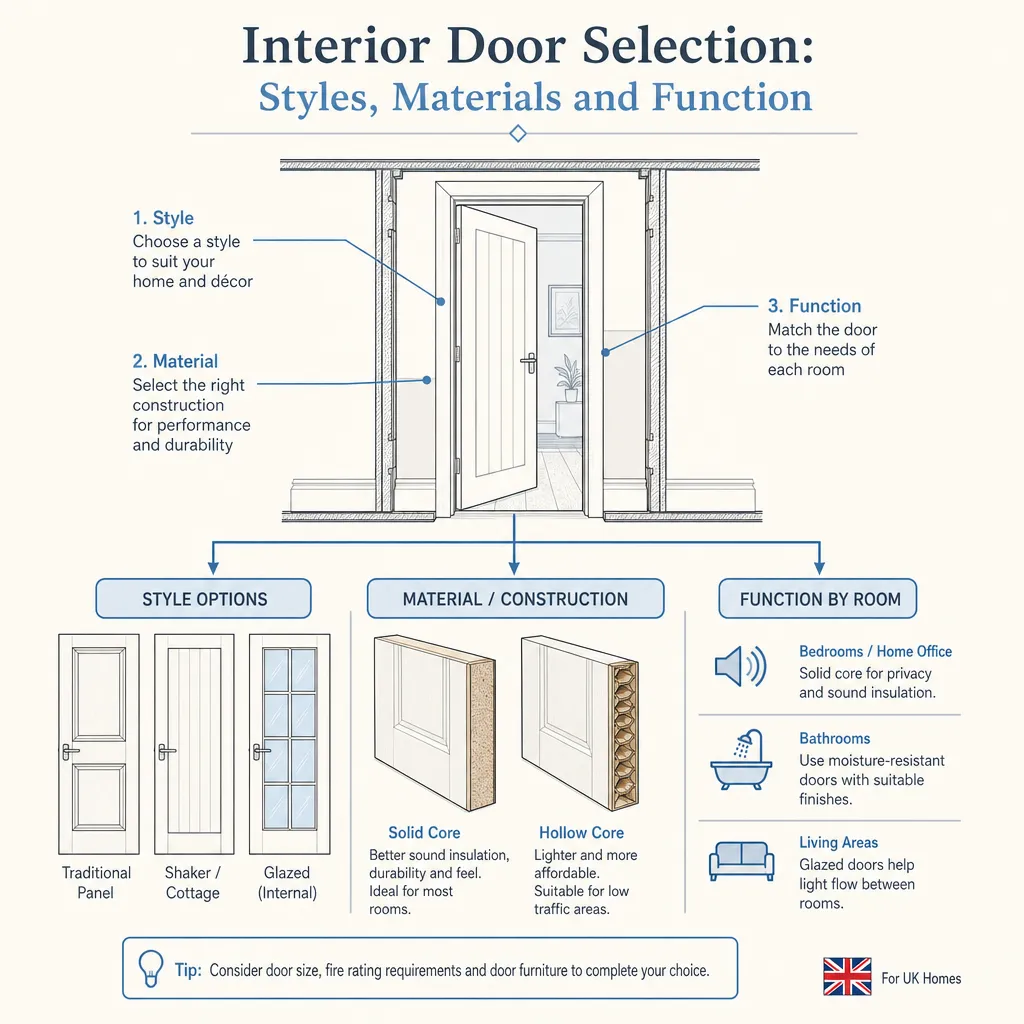
Interior Door Selection: Styles, Materials and Function
Interior doors in UK homes come in solid core, hollow core, and glazed varieties, with styles from flush and panelled to bifold and pocket.
 Improvement & Build
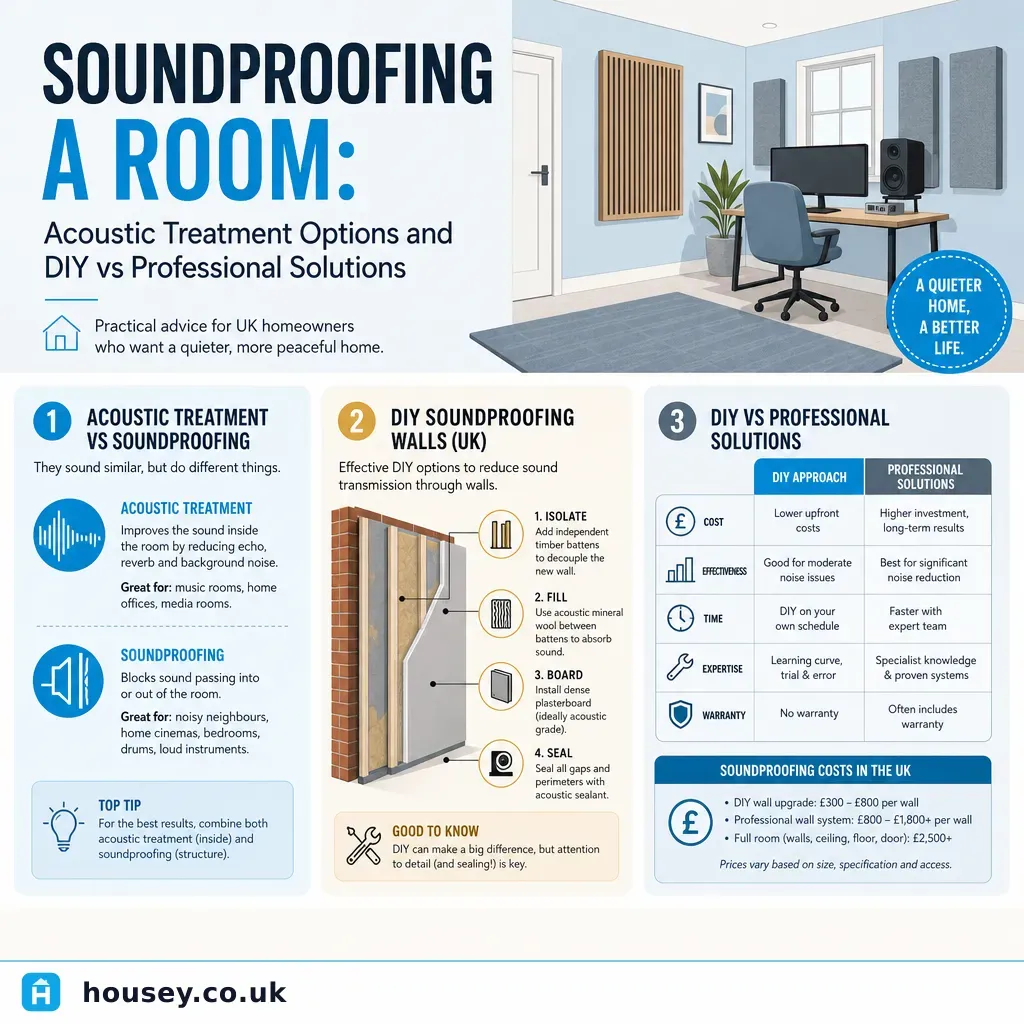
Soundproofing a Room: Acoustic Treatment Options and DIY vs Professional Solutions
Effective room soundproofing relies on four principles — mass, decoupling, absorption, and damping.