Modern Cladding Solutions: Latest Materials for Enhancing Exterior Appearance
By Housey · Last reviewed 31st of May 2026
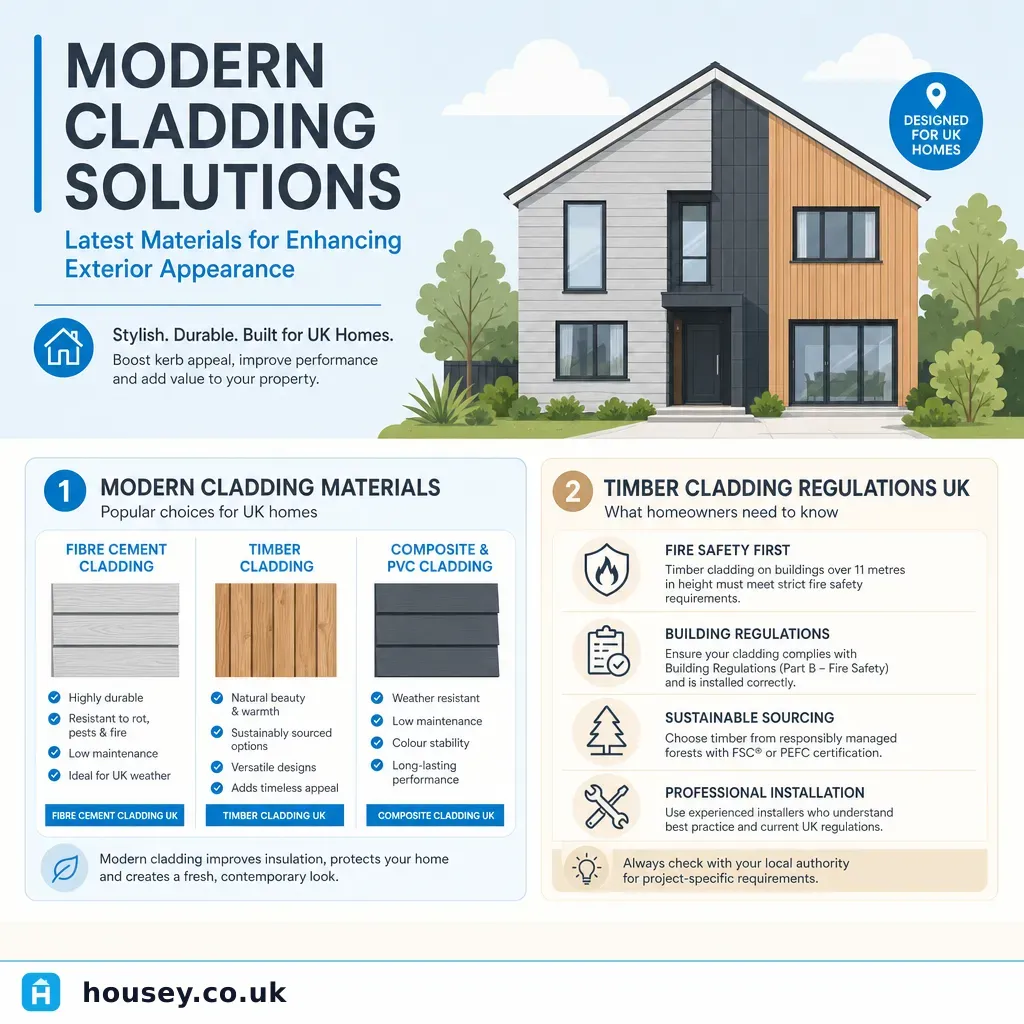
Modern Cladding Solutions: Latest Materials for Enhancing Exterior Appearance
Exterior cladding has moved from a largely functional decision to a significant aesthetic and investment consideration for UK homeowners. Whether you are upgrading a 1970s rendered semi, adding a contemporary extension to a Victorian terrace, or improving weather protection on a solid-wall home, your choice of cladding material affects planning permission requirements, fire safety compliance, Building Regulations, long-term maintenance costs, and ultimately the property's kerb appeal and market value.
Key points
- Combustible cladding is banned on residential buildings over 18 metres in England under the Building Safety Act 2022 and amended Building Regulations Approved Document B.
- Timber cladding on extensions and new work must comply with Part B (fire safety) of the Building Regulations; requirements depend on proximity to site boundaries and building height.
- Most exterior cladding work on a standard house may fall under permitted development, but changes in conservation areas, to listed buildings, or where an Article 4 Direction applies will require planning permission.
- Fibre cement cladding (e.g., Cedral, James Hardie, Marley Eternit) is classified non-combustible at Class A2-s1,d0 and is widely used on UK homes as an alternative to render on solid-wall and timber-frame buildings.
- Any cladding that forms part of the building envelope and affects thermal or structural performance typically requires building control notification and approval before work begins.
What cladding materials are available for UK homes?
The residential cladding market has broadened considerably, with options to suit a wide range of property types, styles, and budgets. The table below compares the main materials used on UK domestic buildings.
Cladding material comparison
Material | Appearance | Fire class (typical) | Maintenance | Approx. lifespan | Best for | Not ideal for |
|---|---|---|---|---|---|---|
Fibre cement (Cedral, Hardie Plank) | Timber-look or smooth boards | A2-s1,d0 (non-combustible) | Low — repaint every 10–15 yrs | 30–50 years | Solid-wall homes, extensions, broad style range | Where authentic timber grain is essential |
Timber (larch, cedar, thermally modified) | Natural, warm | Class C–D (combustible unless treated) | Medium-high — oil or stain every 3–7 yrs | 25–40 years treated | Contemporary extensions, rural settings | Buildings over 11m; may be restricted near boundaries |
Brick slips | Traditional brick face | A1 (non-combustible) | Very low | 50+ years | Period extensions, matching existing brickwork | Heavy; requires structural support; higher cost |
Metal (aluminium, zinc, Corten steel) | Industrial or contemporary | A1/A2 (non-combustible) | Low | 40–60 years | Modern extensions, urban settings | Period or conservation area properties |
Render (monocouche, through-colour silicone) | Smooth or lightly textured | A1/A2 if mineral-based | Medium — crack repair, periodic cleaning | 15–25 years | All property types | Very exposed locations without movement joints |
Composite (wood-plastic, WPC) | Timber-look | Varies — check BBA cert | Low | 25–35 years | Low-rise homes, garden rooms | Buildings requiring Class A1/A2 fire rating |
Indicative UK costs, last reviewed 2026-05-31. Supply-and-install costs vary significantly by material, area, access, and preparation. Obtain at least three written quotes.
Which cladding material should you choose?
Choose fibre cement cladding if your priority is low maintenance, confirmed non-combustible fire classification, and a material that works across modern and traditional styles at moderate cost. It suits solid-wall homes, timber-frame extensions, and new-build cladding upgrades alike.
Choose timber cladding if you value natural aesthetics, your building is under 11 metres, and the profile and colour are acceptable in your area. Check whether the site is in a conservation area or subject to an Article 4 Direction before selecting a species or finish.
Choose brick slips if you are adding an extension to a period or traditional-style property and want to match the existing brick facade without constructing a full structural brick outer leaf.
Choose metal cladding if the design brief is contemporary and the building is in an urban, industrial-heritage, or commercial-edge setting where zinc, aluminium, or weathering steel would be contextually appropriate.
Consult your local planning authority before proceeding if your property is listed, in a conservation area, on an Article 4 Direction estate, or if the cladding change would materially alter the external appearance in a way that removes permitted development rights.
Consult a structural engineer or architect if you are installing heavier materials such as brick slips or natural stone on a timber-frame, light-gauge steel, or older solid-wall building where the substrate's load-bearing capacity is uncertain.
Fire safety and Building Regulations
Post-Grenfell legislative changes have substantially tightened cladding fire safety requirements in England. The key points for homeowners considering standard residential properties:
- Buildings over 18 metres: combustible external wall cladding is banned under the Building Regulations (England). The Building Safety Act 2022 also introduced new duties for higher-risk residential buildings and their responsible persons.
- Buildings 11–18 metres: limited combustibility requirements apply to external wall construction. Refer to Approved Document B (Volume 1 for dwellinghouses, Volume 2 for other buildings) for the relevant requirements.
- Houses under 11 metres: standard Part B requirements apply, including distance-to-boundary rules. If the cladding face is within 1 metre of the site boundary, more restrictive requirements on external wall materials apply.
- Building control notification: cladding that forms part of the thermal envelope, affects structural performance, or triggers fire safety requirements requires notification to and approval from your local authority building control (LABC) or an approved inspector before work begins.
Planning permission — when is it needed?
Most cladding work on a standard house in England falls under permitted development and does not require a planning application, provided it does not materially alter the external appearance in a restricted way. Key exceptions:
- Conservation areas: changes to the external appearance of a dwelling — including adding or changing cladding — typically require a householder planning application.
- Listed buildings: listed building consent is required for any alteration to the external appearance, including applying new cladding or changing existing materials.
- Article 4 Directions: some local authorities remove permitted development rights in specific areas, particularly for street-facing elevations. Check with your local planning authority.
- Flats and purpose-built apartment buildings: permitted development rights are more restricted than for houses; planning permission is more likely to be required.
Red flags when choosing a cladding installer
Before instructing a contractor, watch for these warning signs:
- Cannot provide evidence of current public liability insurance and relevant trade accreditation or industry body membership.
- No mention of building control notification for work that affects the thermal or structural envelope.
- Quote does not separately itemise material cost, labour, scaffolding, ventilation battening, and fixings.
- Proposes combustible timber cladding on a building over 11 metres without a fire engineer's input.
- Suggests starting work before planning or building control approval is in place.
- Cannot supply the manufacturer's BBA (British Board of Agrément) certification or equivalent for the cladding system.
- Quote is based on a verbal description only, with no written specification of materials, fixing method, or drainage gap requirements behind the cladding.
When to get professional help
An architect, CIAT-accredited architectural technologist, or experienced design-and-build contractor is advisable when:
- The project is an extension requiring planning permission or prior approval.
- The existing wall construction is unknown, unusual, or complex — solid brick, timber frame, light-gauge steel.
- The property is listed or in a conservation area.
- The cladding system incorporates insulation (External Wall Insulation) — this changes the thermal performance and moisture behaviour of the wall and should be specified by a suitably qualified professional, ideally under PAS 2035 for solid-wall homes.
How Housey can help
Whether you are planning a new extension with contemporary cladding or replacing ageing render on an existing property, Housey connects you with extension builders experienced in modern cladding systems and with window and door installers who can ensure new glazing interfaces correctly with new cladding for a weathertight, properly detailed finish.
Frequently asked questions
Do I need planning permission to clad my house in England?
In most cases, cladding a standard house in England falls under permitted development and does not require planning permission, provided the work does not materially alter the external appearance and permitted development rights have not been removed. If your property is listed, in a conservation area, or subject to an Article 4 Direction, you will likely need planning permission or listed building consent. Always check with your local planning authority before starting work.
Is timber cladding still allowed on UK homes after post-Grenfell fire safety changes?
Yes, timber cladding is still used on UK homes. On houses under 11 metres, it is generally permitted under Building Regulations subject to distance-to-boundary rules. On buildings between 11 and 18 metres, limited combustibility requirements apply. On residential buildings over 18 metres, combustible cladding including standard timber is prohibited under amended Approved Document B in England. Consult your building control body before specifying materials on any multi-storey building.
What is fibre cement cladding and why is it popular in the UK?
Fibre cement cladding — sold under brands including Cedral, James Hardie, and Marley Eternit — is made from Portland cement, sand, and cellulose fibres pressed into boards or panels. It is non-combustible (typically Class A2-s1,d0), resistant to moisture and insects, and available in a wide range of profiles and colours including timber-effect finishes. Its low maintenance requirements and confirmed fire classification make it a practical choice for extensions and solid-wall upgrades.
How much does external cladding cost in the UK?
Indicative UK costs, last reviewed 2026-05-31: fibre cement cladding, supplied and installed, typically ranges from £60–£120 per m² depending on profile, colour, and preparation required. Brick slips typically cost £90–£160 per m² or more due to weight and installation complexity. Costs exclude scaffolding (typically £500–£1,500 for a standard house elevation) and building control fees. Obtain at least three quotes, each with a written specification of materials, fixings, and drainage detail. Costs vary significantly by region, wall condition, and contractor.
Sources and further reading
- Approved Document B — Fire Safety (Volume 1: Dwellinghouses) — GOV.UK
- Building Safety Act 2022 — legislation.gov.uk
- Planning Portal — permitted development rights for householders — Planning Portal
- British Board of Agrément (BBA) — product certification — BBA
- HSE — fire safety in construction — Health and Safety Executive
Useful next reads
 Improvement & Build
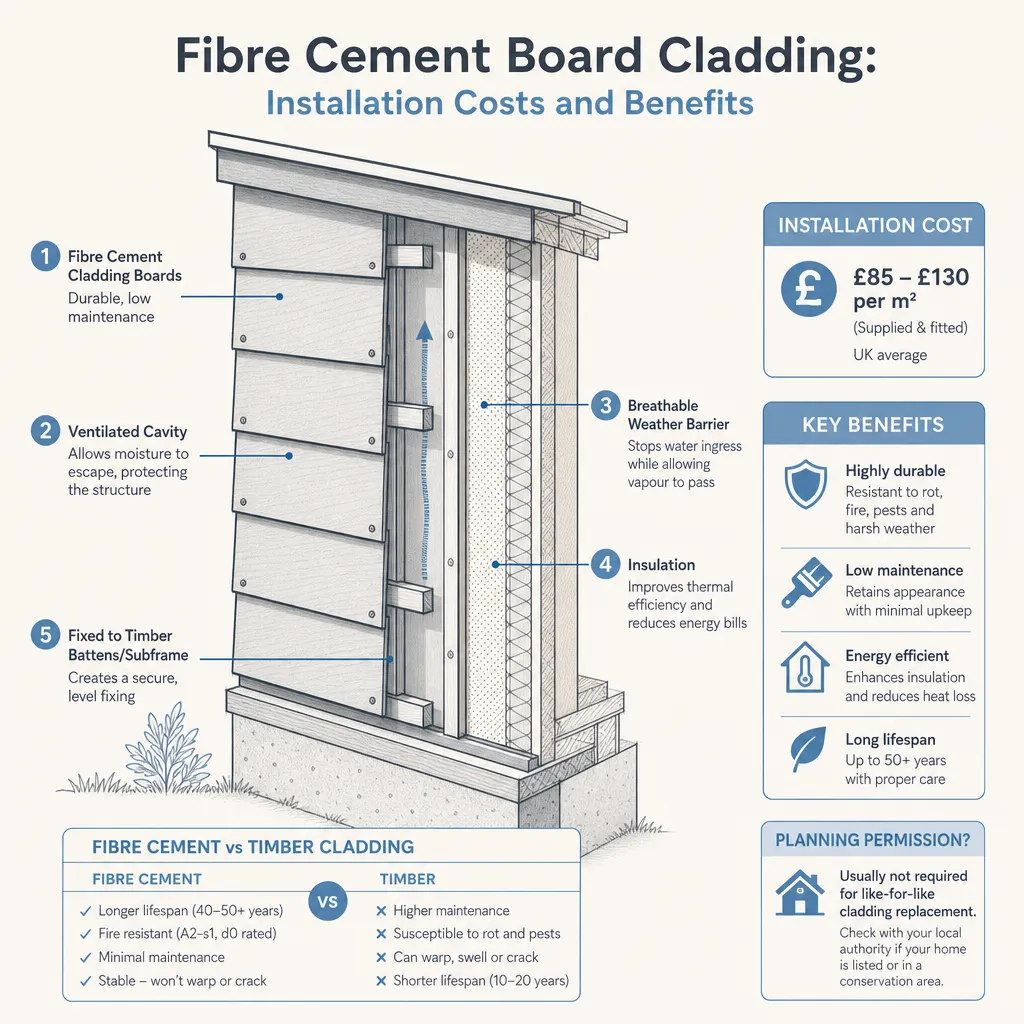
Fibre Cement Board Cladding: Installation Costs and Benefits
Fibre cement board cladding typically costs £80–£180 per m² installed in the UK, including boards, battens, breather membrane, and labour.
 Improvement & Build
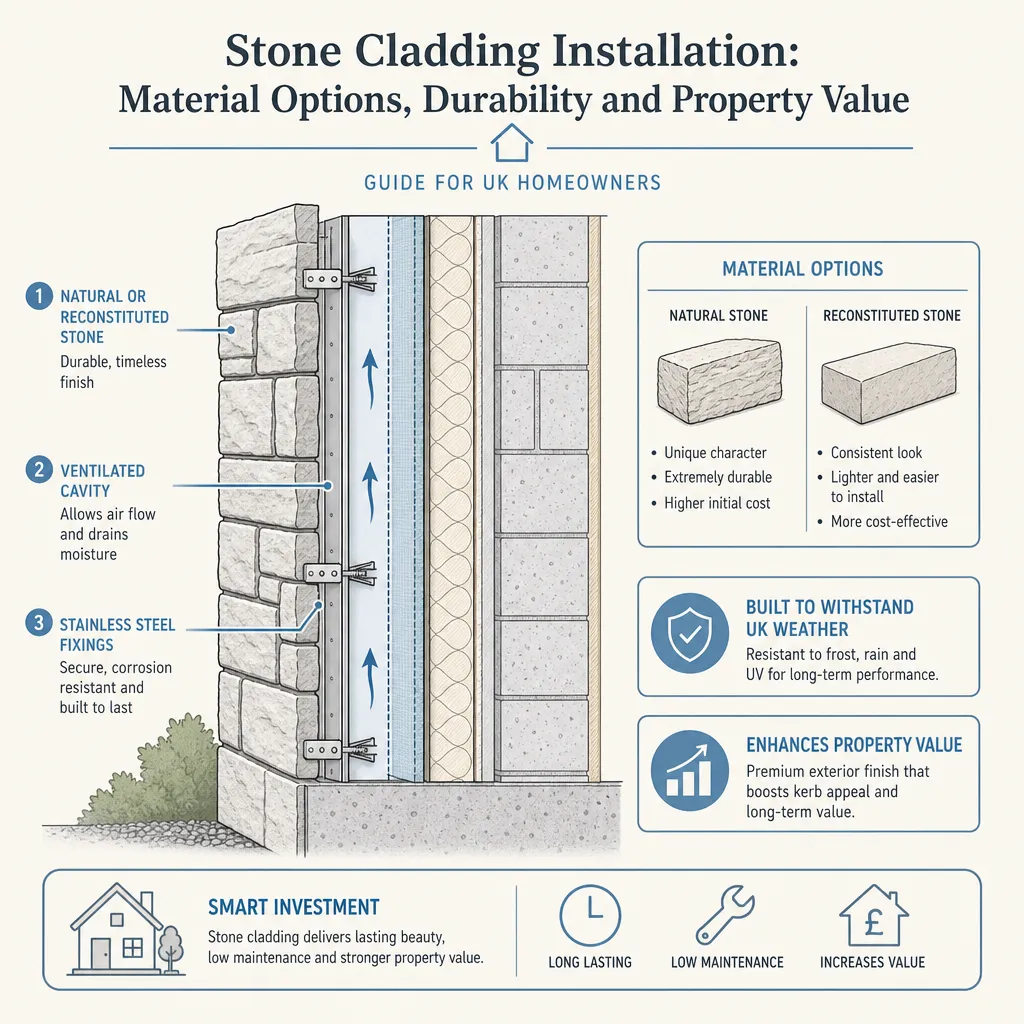
Stone Cladding Installation: Material Options, Durability and Property Value
Stone cladding adds texture and character to a UK property's exterior and can improve weather protection, but installation quality is critical — poorly fixed cladding can trap moisture and cause structural damage.
 Improvement & Build
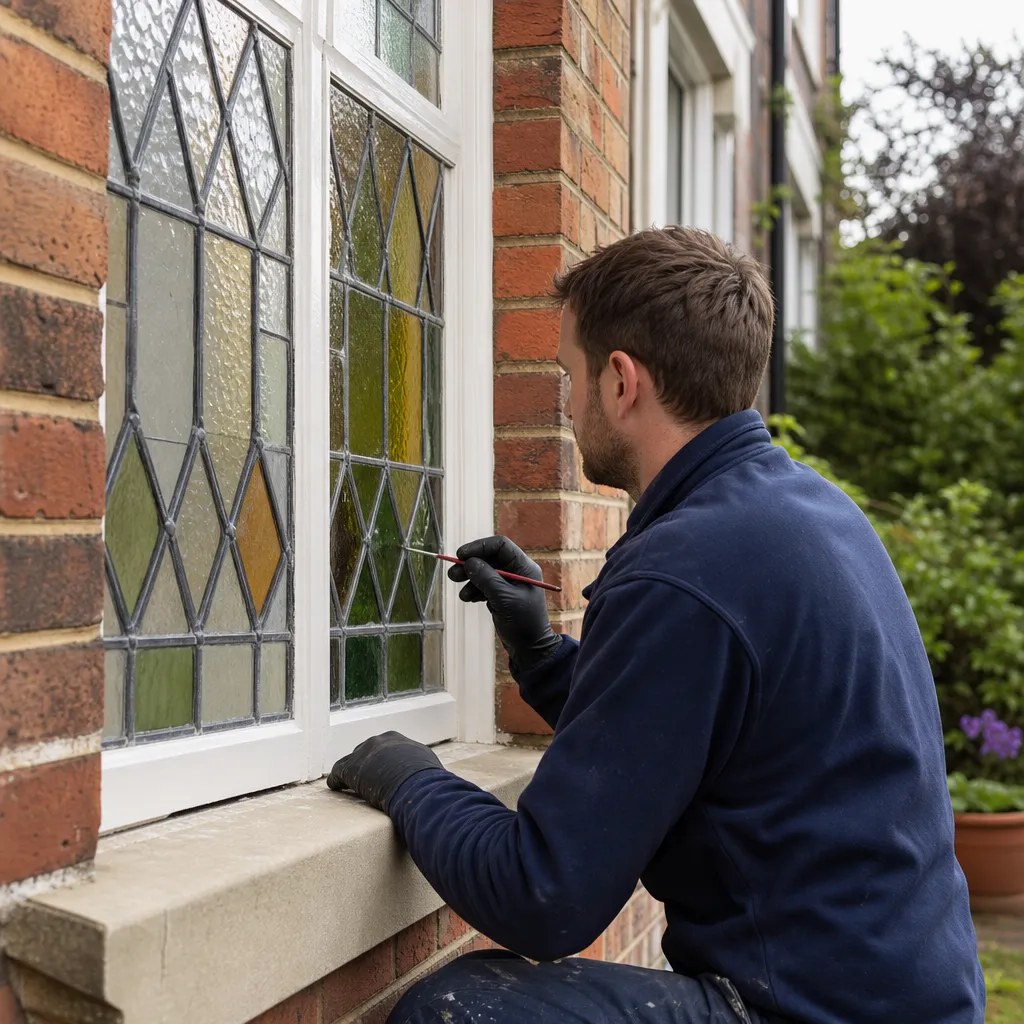
Sealing and Maintaining Historic Leaded Glass Windows: Preservation and Performance
Leaded glass windows are maintained using traditional linseed oil cement — not silicone or modern sealants, which prevent natural movement in the lead came.
 Improvement & Build
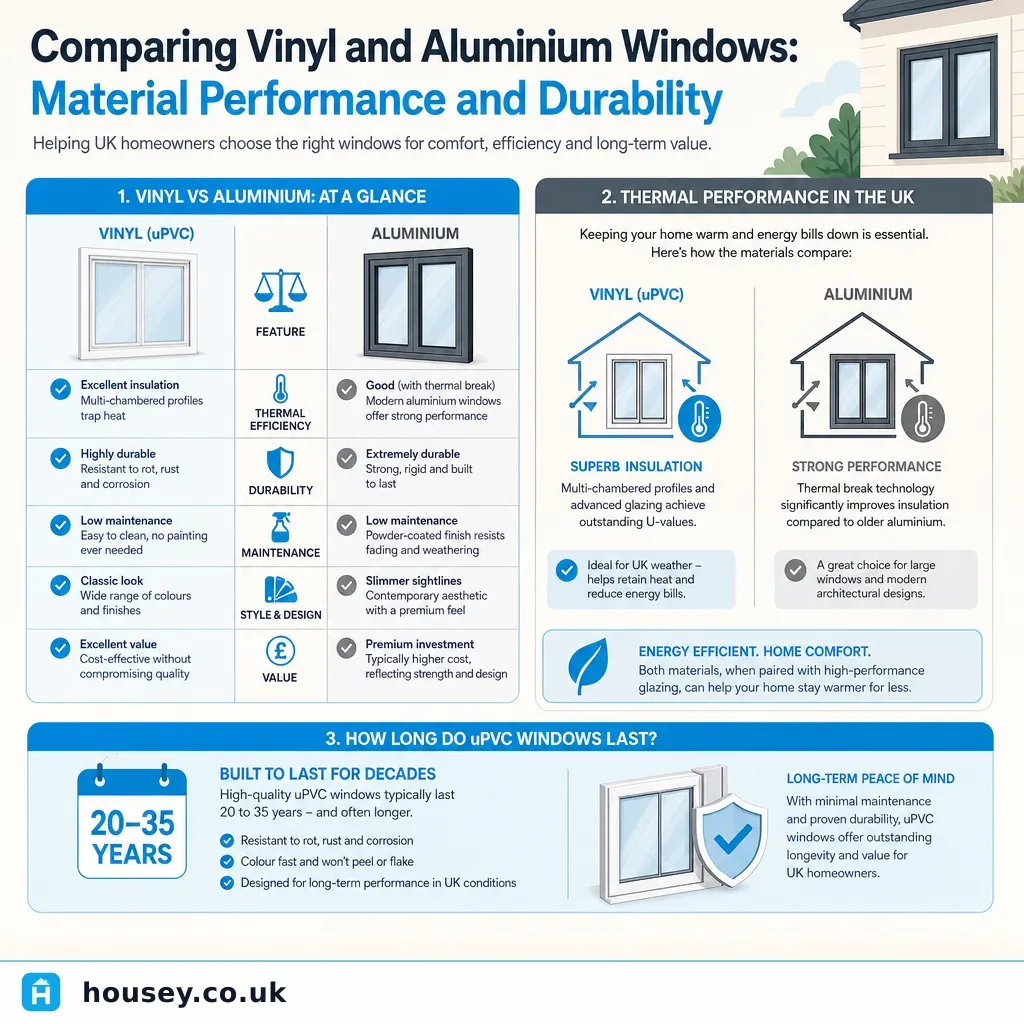
Comparing Vinyl and Aluminium Windows: Material Performance and Durability
uPVC (vinyl) and aluminium windows both meet UK Building Regulations Part L when properly specified.
 Improvement & Build
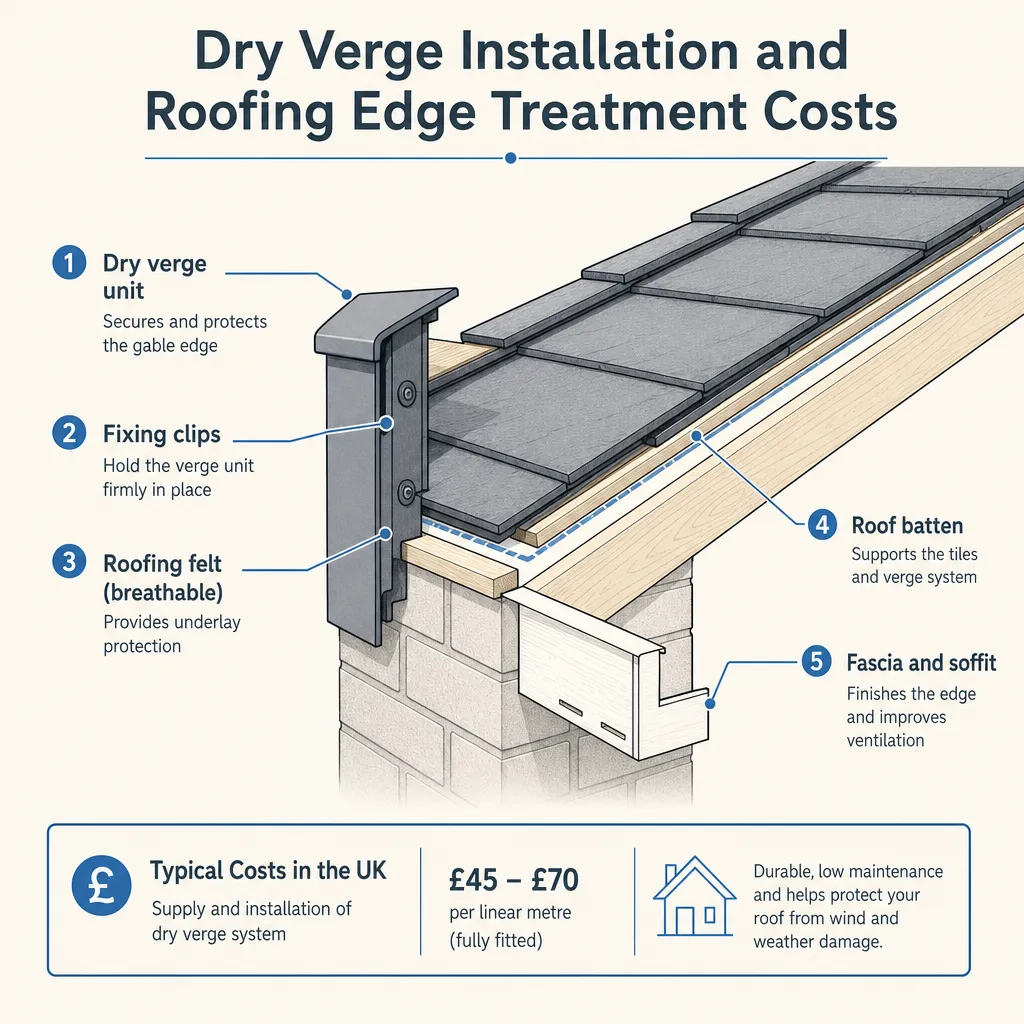
Dry Verge Installation and Roofing Edge Treatment Costs
A dry verge system replaces mortar bedding along the gable edge of a pitched roof with interlocking uPVC or aluminium units.