Finding and Hiring Heat Pump Installers
By Housey · Last reviewed 17th of May 2026
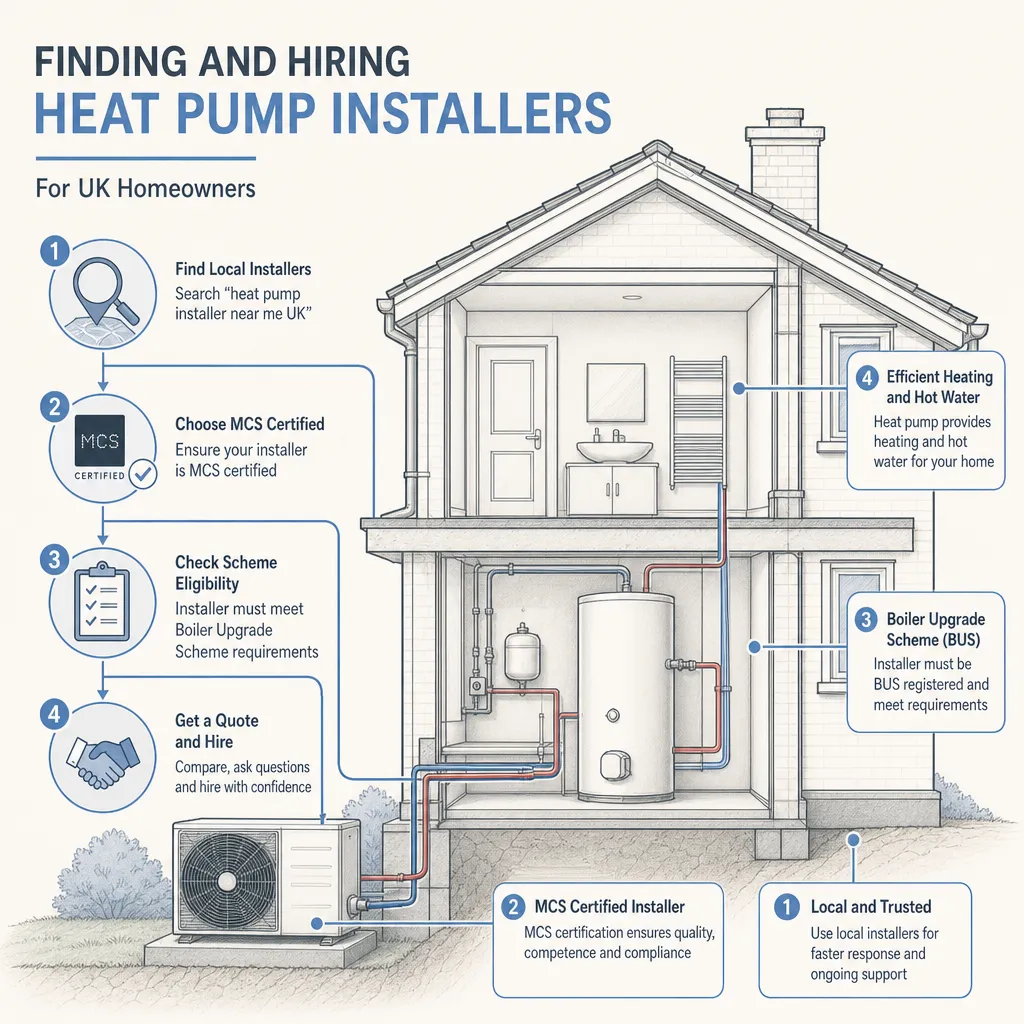
Finding and Hiring Heat Pump Installers
Heat pump installations are among the most consequential energy-upgrade decisions a UK homeowner can make: the technology performs reliably when correctly specified and installed, but a poorly sized or badly fitted system can produce high running costs, inadequate comfort in cold weather, and loss of grant eligibility. The rapid expansion of the installer market — driven by the Boiler Upgrade Scheme (BUS) and evolving Building Regulations Part L — makes it more important than ever to know how to identify a genuinely qualified contractor before committing.
Key points
- All heat pump installations must be completed by an MCS-certified installer to qualify for the Boiler Upgrade Scheme grant — currently £7,500 for air source and ground source heat pumps as of 2026; confirm the current amount at the GOV.UK BUS guidance page before applying.
- MCS certification (Microgeneration Certification Scheme) is the recognised UK quality standard for heat pump installers; check the MCS live installer database at mcscertified.com before appointing any contractor and verify they are currently listed.
- Heat pumps must be correctly sized using a room-by-room heat loss calculation — oversizing causes short-cycling and reduced efficiency, and is as damaging to system performance as undersizing.
- A retrofit assessment under PAS 2035 may be required if you are accessing certain government funding schemes such as ECO4; your installer or a PAS 2035-accredited retrofit coordinator should clarify which standards apply to your situation.
- Permitted development rights generally allow the installation of a single air source heat pump on most houses in England, subject to noise and siting conditions — listed buildings, flats, and some designated areas are excluded.
Why installer quality has an outsized impact
A heat pump is not a straightforward like-for-like boiler replacement. The system operates most efficiently at lower flow temperatures — typically 35–45°C for underfloor heating and up to 55°C for correctly sized radiators — which requires accurate heat loss calculations, correctly specified emitters, and often fabric improvements such as loft insulation or draughtproofing to make the technology genuinely cost-effective in the UK climate.
An inexperienced or uncertified installer may:
- Oversize the heat pump unit, causing short-cycling, increased component wear, and a lower seasonal coefficient of performance (SCOP)
- Fail to conduct a heat loss survey, resulting in a system that cannot maintain comfort during cold periods
- Site the external unit suboptimally, increasing neighbour noise risk or creating planning difficulties after installation
- Install without full MCS compliance, disqualifying you from BUS grant funding and potentially affecting product warranties
MCS certification: what it means and how to verify it
MCS (Microgeneration Certification Scheme) is the industry standard for heat pump design and installation quality in the UK. MCS-certified installers are required to:
- Hold relevant trade qualifications, typically City and Guilds Level 3 Heat Pump Installation or an accepted equivalent
- Maintain appropriate professional indemnity and public liability insurance throughout their certification period
- Follow MCS installation standards, particularly MCS 020 for heat pump systems
- Submit MCS installation certificates that trigger the BUS grant payment process on the homeowner's behalf
Verify certification by using the MCS installer finder to search by postcode and technology type. Do not rely solely on a contractor's own logo or a copy of a certificate — check the live register at the time of appointing. TrustMark registration is a further indicator of quality, and many MCS-certified installers hold both accreditations.
Comparing heat pump installers: key criteria
Factor | What a strong installer looks like | Red flag |
|---|---|---|
MCS certification | Verifiable on the live MCS register at the time of appointment | Claims certification but is not currently listed on the live register |
Heat loss survey | Offers a full room-by-room heat loss calculation before producing a system design or quote | Quotes based on number of bedrooms or floor area only, without a site visit |
System design | Specifies make, model, capacity, emitter sizing, and projected SCOP | Generic specification with no design rationale or SCOP projection provided |
Grant process knowledge | Explains the BUS application clearly and manages the MCS certificate submission | Unaware of or unwilling to engage with the BUS grant application process |
Verifiable references | Recent completed installations on similar UK property types, contactable by you | No verifiable examples or references offered |
Post-installation support | Includes full commissioning, documented handover, and a service contract option | Handover is brief verbal instruction with no written documentation |
What a proper heat pump survey involves
Before accepting any quote, a reputable installer should carry out — or explicitly commission — a heat loss survey. This room-by-room assessment calculates how much heat your property loses under design-weather conditions (typically -3°C for most of England) and determines:
- The correct heat pump capacity in kW output
- Whether existing radiators are adequately sized to work at lower flow temperatures, or need upgrading to larger panels
- Whether underfloor heating would improve system efficiency in any rooms or zones
- Whether fabric improvements should be sequenced before installation to achieve a viable SCOP
Starting with a dedicated heat pump survey ensures that any system design is based on your property's actual measured heat loss, not an approximation derived from house type or age.
Getting and comparing quotes
Request at least three written quotes. Each should specify:
- The heat loss calculation methodology used and the resulting design heat load in kW
- Make, model, and capacity of the proposed heat pump unit
- Emitter specification — radiator sizes by room, or underfloor heating zone details
- Hot water cylinder make, model, and capacity if the existing cylinder is being replaced or supplemented
- Any electrical upgrade requirements, including consumer unit work or a Distribution Network Operator (DNO) application for an increased supply
- Total installed cost, broken down by equipment and labour, with the BUS grant clearly deducted if you are eligible
- Anticipated programme and installation duration
- Equipment warranty and separate workmanship warranty terms
Do not compare quotes that omit a heat loss calculation — without a calculated design heat load, you cannot meaningfully assess whether the proposed system is correctly sized for your property.
Important limitations
This article provides general guidance for homeowners considering heat pump installation in the UK. Heat pump system design, correct sizing, grant eligibility, and planning rules are technically complex and vary significantly depending on property type, fabric condition, existing heating system, location, and local authority constraints. A qualified MCS-certified installer or an independent retrofit coordinator accredited under PAS 2035 should assess your specific property before you commit to any system or sign any contract. The information here does not constitute technical or legal advice for any individual situation.
What to ask a qualified professional
Before commissioning an installer or signing a contract, ask:
- Are you currently MCS-certified, and can I verify your registration on the live MCS register right now?
- Will you carry out a full room-by-room heat loss calculation before finalising the system design and issuing a quote?
- What heat pump capacity in kW do you propose, and what is the calculated design heat load for my property?
- Will my existing radiators be adequate at the proposed flow temperature, or will they need upgrading?
- What seasonal coefficient of performance (SCOP) do you project for my property, and what assumptions underpin that figure?
- Am I eligible for the Boiler Upgrade Scheme grant, and will you manage the MCS certificate submission on my behalf?
- Are there any planning restrictions I should be aware of for my property type or location?
- What electrical upgrades are required, and are these costs included in the quoted price?
- What warranty covers the equipment, and what separate warranty covers your workmanship?
- Do you offer an annual service and maintenance contract, and what does it include?
When to get professional help
Seek independent advice — beyond your proposed installer — if:
- An installer cannot provide a heat loss calculation or declines to discuss projected SCOP before quoting
- Your property is a listed building or in a conservation area, where permitted development rights may not apply or may be subject to conditions
- Your property is a flat above or below other dwellings — shared fabric, planning constraints, and noise considerations add significant complexity
- Your property has significant insulation deficiencies that may need addressing before a heat pump is viable; a retrofit coordinator accredited under PAS 2035 can advise on the correct sequencing of measures
- You are accessing funding — such as ECO4 or the Great British Insulation Scheme — that requires a formal PAS 2035 retrofit assessment before works commence
How Housey can help
Starting with the right assessment makes every subsequent decision more reliable. Housey connects you with qualified professionals who can carry out a thorough heat pump survey, giving you a property-specific heat loss figure and system recommendations before you invite installation quotes — so any contractor you appoint is working from the same verified baseline.
Frequently asked questions
Do I need planning permission for an air source heat pump?
In England, a single air source heat pump can usually be installed under permitted development rights, provided it meets noise limits (42 dBA at 1 m from a neighbour's window or door), is not installed on a listed building or flat, and the property is not in certain designated areas. Scotland, Wales, and Northern Ireland have their own rules. Always check with your local planning authority before installation begins.
How much does a heat pump installation cost in the UK?
Indicative UK costs, last reviewed 2026-05-17: a typical air source heat pump installation costs £8,000–£15,000 before any grant deduction, depending on heat pump capacity, emitter upgrades required, and installation complexity. The Boiler Upgrade Scheme currently offers £7,500 toward eligible installations — verify the current grant amount on the GOV.UK BUS guidance page before applying. Ground source heat pump installations typically cost £15,000–£30,000 or more.
What is the difference between an MCS certificate and a manufacturer warranty?
An MCS installation certificate is issued by the installer following a compliant installation and is the document required to trigger the BUS grant payment. It confirms the installation meets MCS scheme standards. A manufacturer warranty — typically 5–10 years on the heat pump unit — is a separate commitment from the equipment manufacturer covering product defects. Installer workmanship warranties, usually 1–2 years, are separate again.
What is SCOP and why does it matter for running costs?
SCOP (Seasonal Coefficient of Performance) is the ratio of heat energy output to electrical energy input over a full heating season. A SCOP of 3.0 means the system produces three units of heat for every unit of electricity consumed. A higher SCOP translates directly into lower running costs. Your installer should project the likely SCOP based on the heat loss calculation, proposed heat pump model, and intended flow temperature.
Sources and further reading
- MCS — Find a certified installer — Microgeneration Certification Scheme
- Boiler Upgrade Scheme — GOV.UK
- Air source heat pumps: permitted development rights — GOV.UK
- Heat pumps — Energy Saving Trust
- TrustMark — TrustMark
- PAS 2035 — retrofitting dwellings for improved energy efficiency — BSI
Useful next reads
 Energy & Retrofit
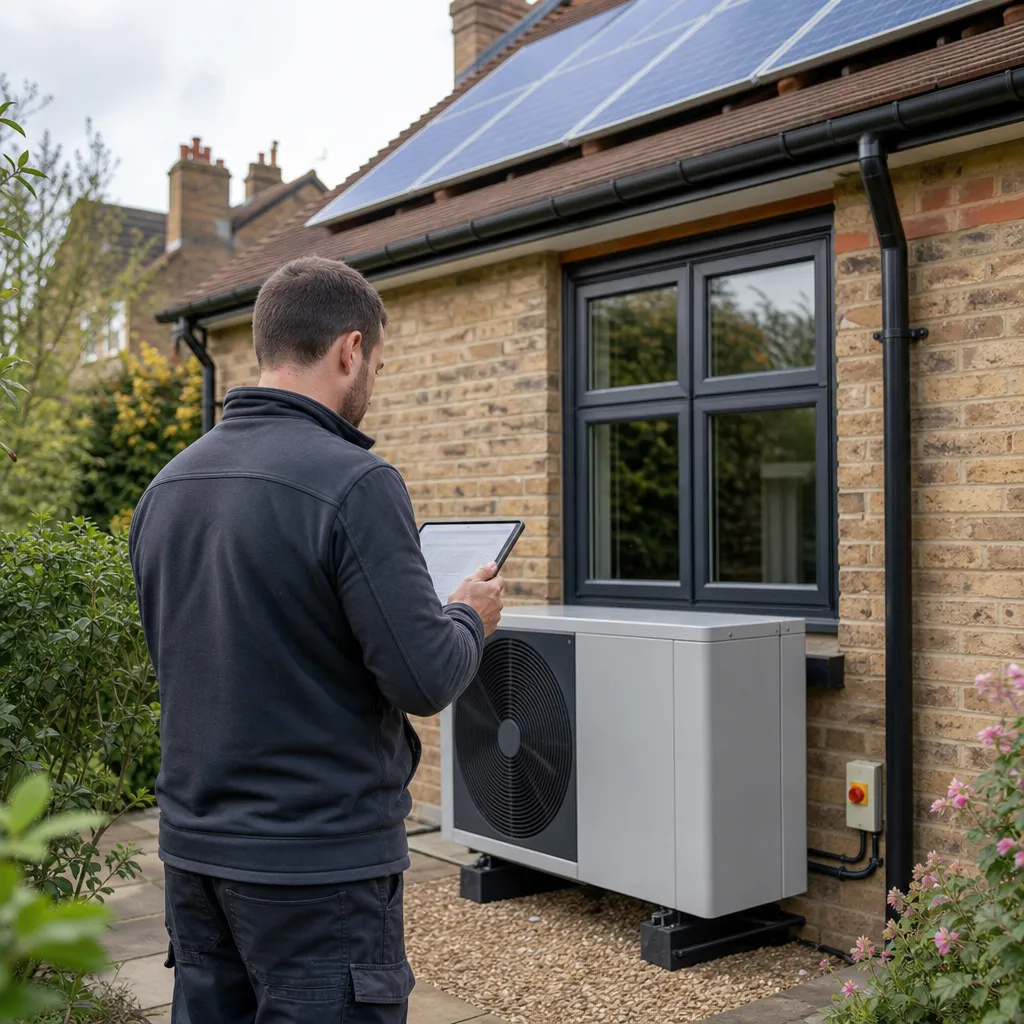
Finding a Renewable Energy Specialist for Your Home
Look for MCS-certified installers registered with TrustMark for any grant-funded work.
 Energy & Retrofit
How to Find and Hire an Insulation Contractor
Look for contractors registered with TrustMark, the government-endorsed quality scheme for energy efficiency retrofit work.
 Energy & Retrofit
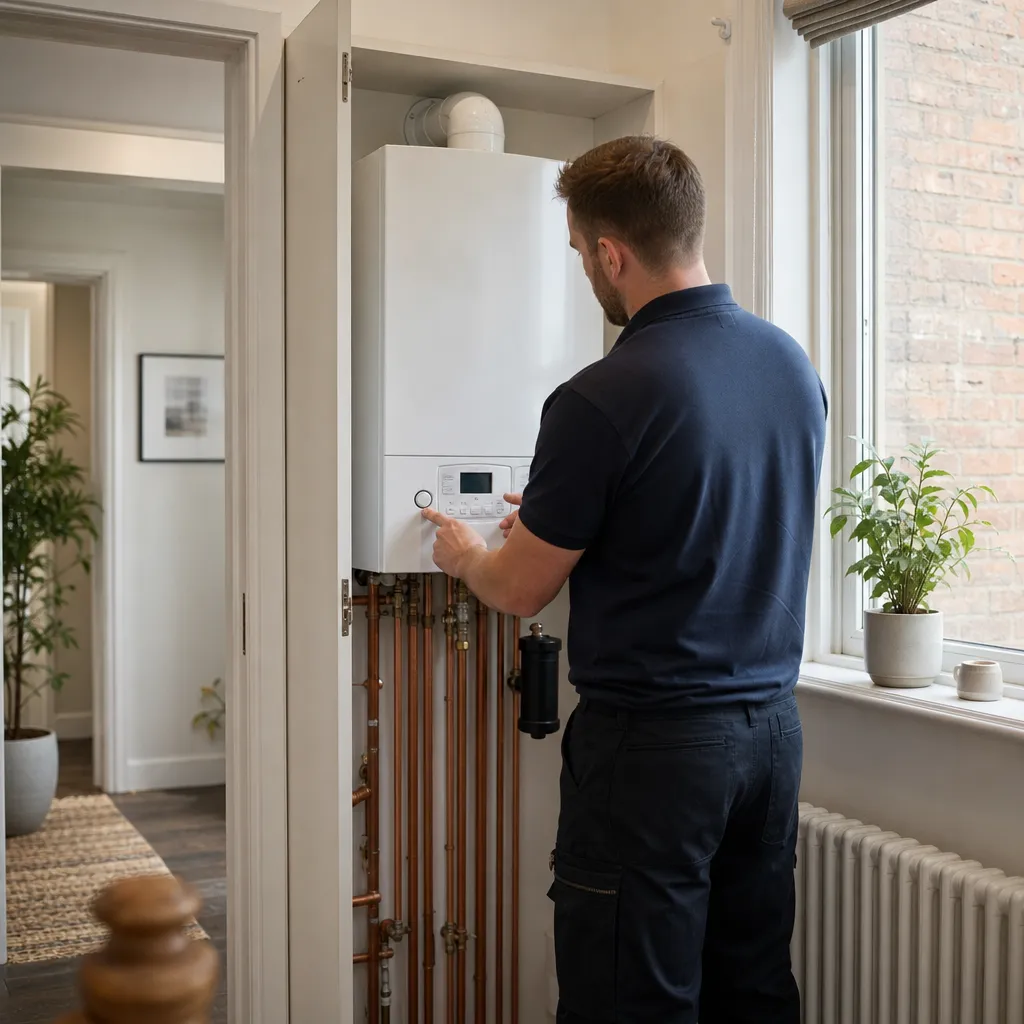
Optimising Heating Systems for Energy Efficiency
Optimising a UK heating system usually involves improving controls such as smart thermostats and thermostatic radiator valves, ensuring the boiler or heat pump is correctly sized, and upgrading radiators or pipework where needed.
 Improvement & Build
How to Hire a Professional Window Installer
Use a FENSA or CERTASS-registered installer so your window replacement complies with Building Regulations Part L and Part Q and you receive a certificate registered with your local authority.
 Energy & Retrofit
Integrating Solar Panels with Combi Boiler Systems: Feasibility and Requirements
Combi boilers heat water on demand without a hot water storage cylinder, making direct solar thermal integration impractical.