Finding the Best Solar Installation Companies for UK Homes
By Housey · Last reviewed 30th of May 2026
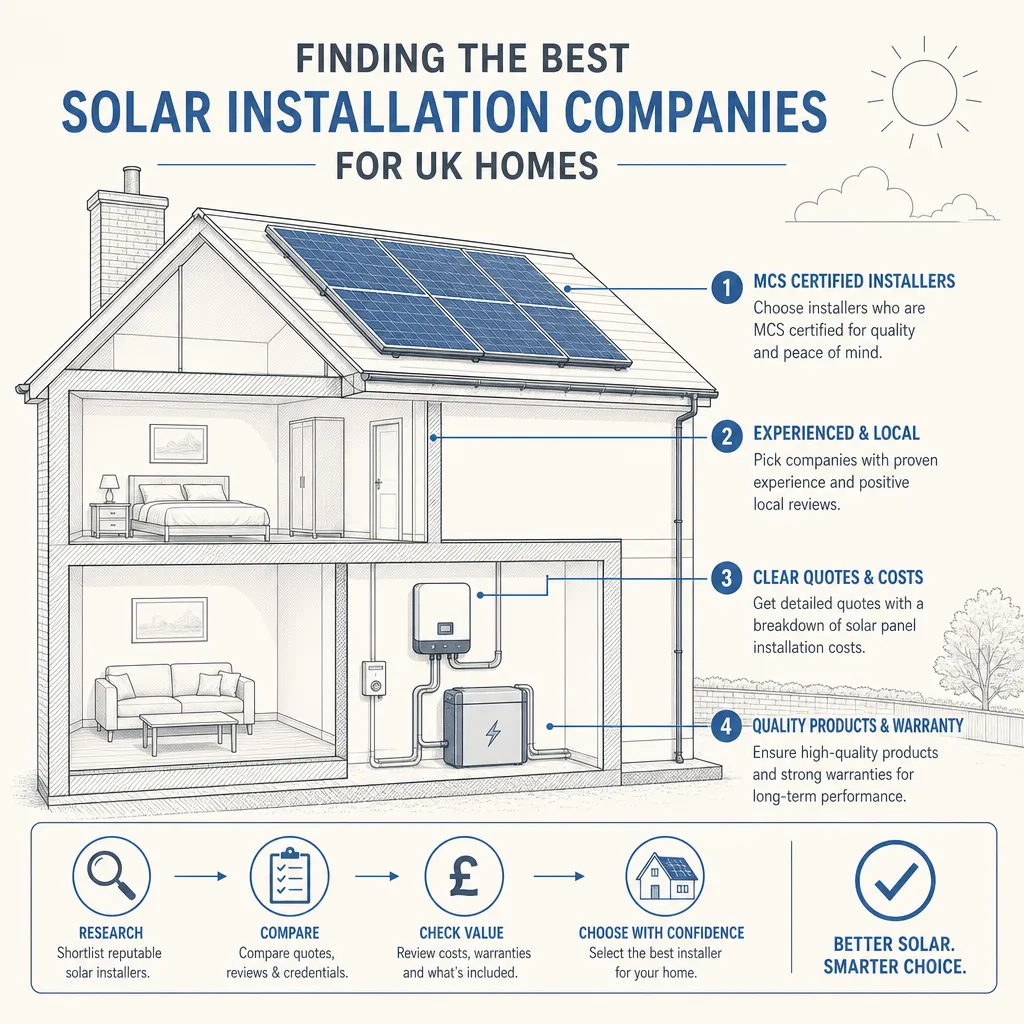
Finding the Best Solar Installation Companies for UK Homes
With energy bills remaining high and the Smart Export Guarantee paying homeowners for surplus electricity exported to the grid, interest in solar panel installation continues to grow. Choosing the right installer is among the most consequential decisions in the process — a poorly specified system or a company that dissolves after installation leaves you with no recourse on warranties that must last 25 years. Understanding what credentials matter and what questions to ask before signing protects your investment from the outset.
Key points
- Only MCS (Microgeneration Certification Scheme) certified installers can issue the MCS certificate required to register for the Smart Export Guarantee (SEG), which allows eligible homeowners to receive payment for surplus electricity exported to the grid.
- The Feed-in Tariff (FiT) closed to new applicants on 31 March 2019 and has been replaced by the SEG; any company claiming FiT eligibility for a new installation is giving inaccurate advice.
- Solar panels on a pitched roof in England usually qualify as permitted development under Schedule 2, Part 14 of the Town and Country Planning (General Permitted Development) (England) Order 2015 — but not in all conservation areas, and not for listed buildings.
- VAT on the supply and installation of solar panels for domestic properties in Great Britain was reduced to 0% from April 2022, as confirmed by HMRC; always verify current VAT treatment with your installer.
- Under the Renewable Energy Consumer Code (RECC), member installers must provide a 25-year performance guarantee for panels and a minimum 10-year workmanship guarantee.
Why MCS certification matters
The MCS (Microgeneration Certification Scheme) is the UK's quality standard for small-scale renewable energy installations. An MCS-certified solar installer must:
- Hold relevant electrical qualifications (typically NICEIC or NAPIT accreditation)
- Design systems to MCS 012 product standard
- Issue a post-installation MCS certificate
- Register the completed installation on the MCS database
Without an MCS certificate, your installation cannot be registered for the Smart Export Guarantee with an energy supplier. You can verify any installer's MCS certification at the MCS certified installer database.
Comparing solar installer types
Not all solar companies operate the same way. Understanding the difference helps you choose the right fit for your project.
Installer type | Best for | Watch out for |
|---|---|---|
National installer (large) | Standard pitched-roof systems, volume pricing | Sales agents rather than surveyors; check who actually carries out the system design |
Local independent MCS installer | Bespoke design, ongoing support, local knowledge | Smaller warranty backing — check insurance and MCS status carefully |
Manufacturer-linked installer | Brand-specific systems (e.g., SolarEdge, Enphase) | May not offer best value; limited to one product range |
Energy company solar arm | Bundled tariff or financing deals | Lock-in contracts; read all small print before signing |
What to look for in a solar quote
When comparing quotes from solar companies, request the following in writing before signing anything.
What to ask before accepting a quote:
- What is the system size (kWp) and projected annual yield (kWh/year) for your specific roof aspect and pitch?
- Which panels and inverter are specified, and what are their individual manufacturer warranties?
- Who carries out the installation, and what is their MCS installer number?
- What scaffolding is included, and who arranges it?
- Will you notify the DNO (Distribution Network Operator)? This is required for systems above 3.68kW single phase.
- What MCS certificate and handover documentation will I receive at completion?
- Is VAT at 0% confirmed and shown separately on the quote?
- What is the process if a panel or inverter fails within the warranty period?
Red flags when selecting a solar company
Be cautious if any of the following apply:
- Pressure to sign on the same day — MCS-compliant companies should allow adequate time to compare quotes.
- No site survey before quoting — a reputable installer will arrange a physical or detailed remote assessment before specifying a system. A solar survey establishes roof condition, orientation, shading analysis, and structural suitability.
- No MCS installer number provided on the quote or contract.
- Quoted yields seem unusually high — check against the PVGIS tool (EU Joint Research Centre) for your postcode and roof orientation.
- No mention of DNO notification for systems over 3.68kW — this is a regulatory requirement.
- Unusually low pricing — may indicate an underspecified system or work carried out by an unregistered electrician.
Checking installer credentials
Credential | What it confirms | How to verify |
|---|---|---|
MCS certification | Quality standard for installation and equipment | |
NICEIC registration | Electrical competence; Part P compliance | |
NAPIT registration | Alternative electrical competence scheme | |
RECC membership | Consumer code compliance; adjudication access | |
TrustMark registration | Government-endorsed quality scheme |
Combining solar with battery storage and EV charging
Many homeowners now install solar panels alongside battery storage and EV chargers as a single package. Points to check:
- Battery storage installers should also hold MCS certification (or HIES membership) to issue certificates relevant to SEG registration.
- EV charger installation must comply with BS 7671 (18th Edition Wiring Regulations) and, if using an OZEV grant, the charger must appear on the OZEV-approved product list.
- A combined quote from one contractor is often cheaper than three separate appointments, but ensure each element is separately specified and warranted in writing.
When to get professional help
A dedicated solar survey before installation is always advisable — not a sales visit, but a proper assessment of roof condition, structural loading, shading, and grid connection capacity. This is especially important if:
- Your roof is over 20 years old or has visible defects.
- You have a flat roof, which involves different mounting systems and waterproofing requirements.
- Your property is listed or in a conservation area, where permitted development rights may not apply.
- You are combining solar with battery storage and want a whole-system design assessment.
How Housey can help
Housey connects homeowners with qualified professionals at every stage of the solar journey. Start with a solar survey to assess your property before committing to an installer. You can also find vetted battery storage installers and EV charger installers to complete your home energy package.
Frequently asked questions
How do I check if a solar installer is MCS certified?
Visit mcscertified.com/find-an-installer and search by postcode or company name. An MCS certificate issued after installation will carry the installer's unique MCS number, which you can cross-reference on the database. Always verify the installer's certification before signing any contract, not after work begins.
What is the Smart Export Guarantee and how much does it pay?
The Smart Export Guarantee (SEG) requires licensed energy suppliers with more than 150,000 customers to offer tariffs to eligible small-scale generators. Rates vary by supplier and are set commercially — not by the government. As of early 2026, export tariffs range from around 1p to over 20p per kWh depending on the supplier and tariff type. You must hold an MCS certificate to register.
Do solar panels need planning permission in the UK?
In England, most domestic solar panels on pitched roofs qualify as permitted development under Schedule 2, Part 14 of the Town and Country Planning (General Permitted Development) (England) Order 2015, subject to conditions: panels must not protrude more than 200mm from the roof slope, and must not be on a wall fronting a highway. Rules differ for listed buildings and Article 4 Direction areas. Always check with your local planning authority if in doubt.
How long do solar panels last and what warranties should I expect?
Most monocrystalline solar panels carry a 25-year linear performance guarantee from the manufacturer, typically guaranteeing at least 80% output at year 25. Inverters generally carry 10–12-year manufacturer warranties, extendable on most models. RECC-compliant installers must provide a 25-year performance guarantee and a minimum 10-year workmanship guarantee. Request all warranty documents before installation day.
Sources and further reading
- MCS — Find a certified installer — Microgeneration Certification Scheme: certified installer database and installation standards
- Smart Export Guarantee guidance — GOV.UK: SEG eligibility and how to register
- Renewable Energy Consumer Code (RECC) — RECC: consumer protection standards for renewable energy buyers
- Permitted development rights for householders — technical guidance — GOV.UK: guidance on solar panel permitted development rights
- PVGIS solar irradiance tool — EU Joint Research Centre: estimate annual yield for UK properties
Useful next reads
 Energy & Retrofit
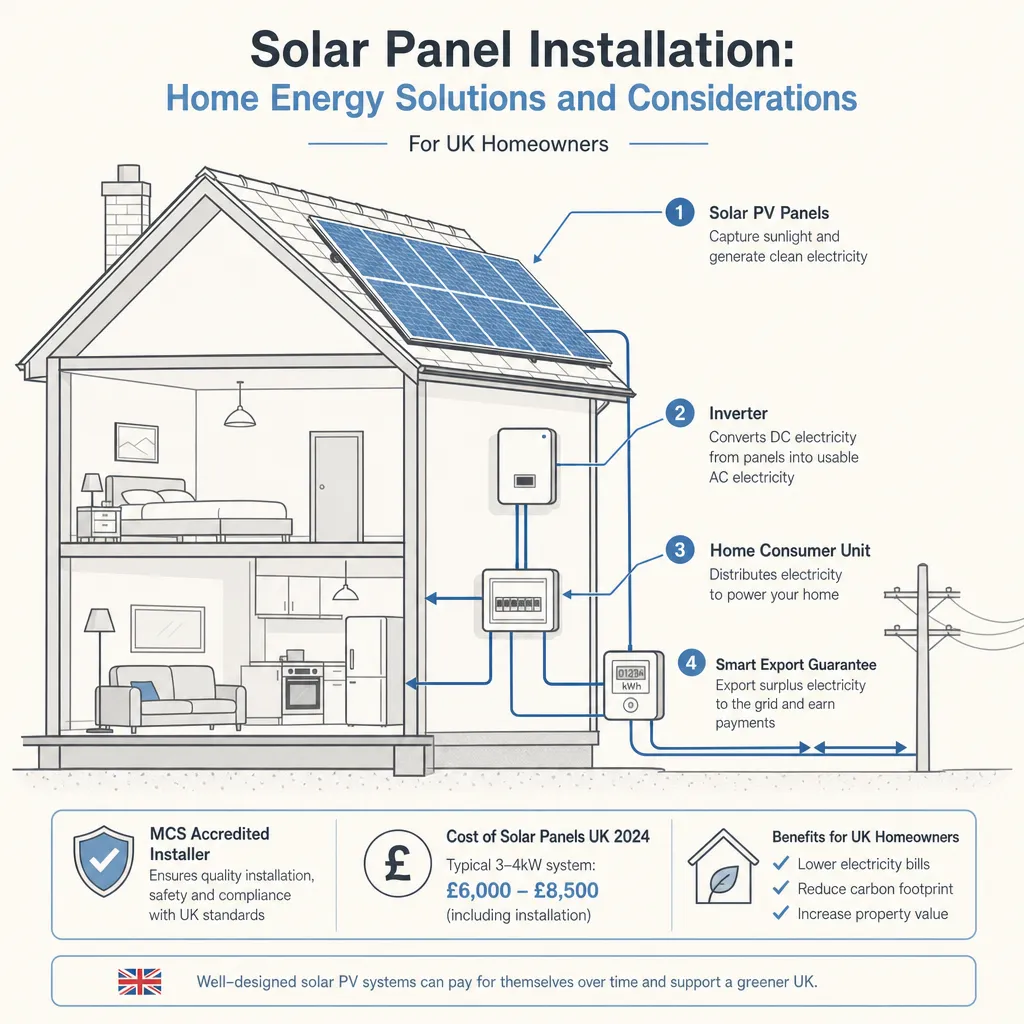
Solar Panel Installation: Home Energy Solutions and Considerations
A typical 4 kWp solar PV system costs £6,000–£9,000 installed and generates around 3,400–3,800 kWh per year on a south-facing roof in southern England.
 Energy & Retrofit
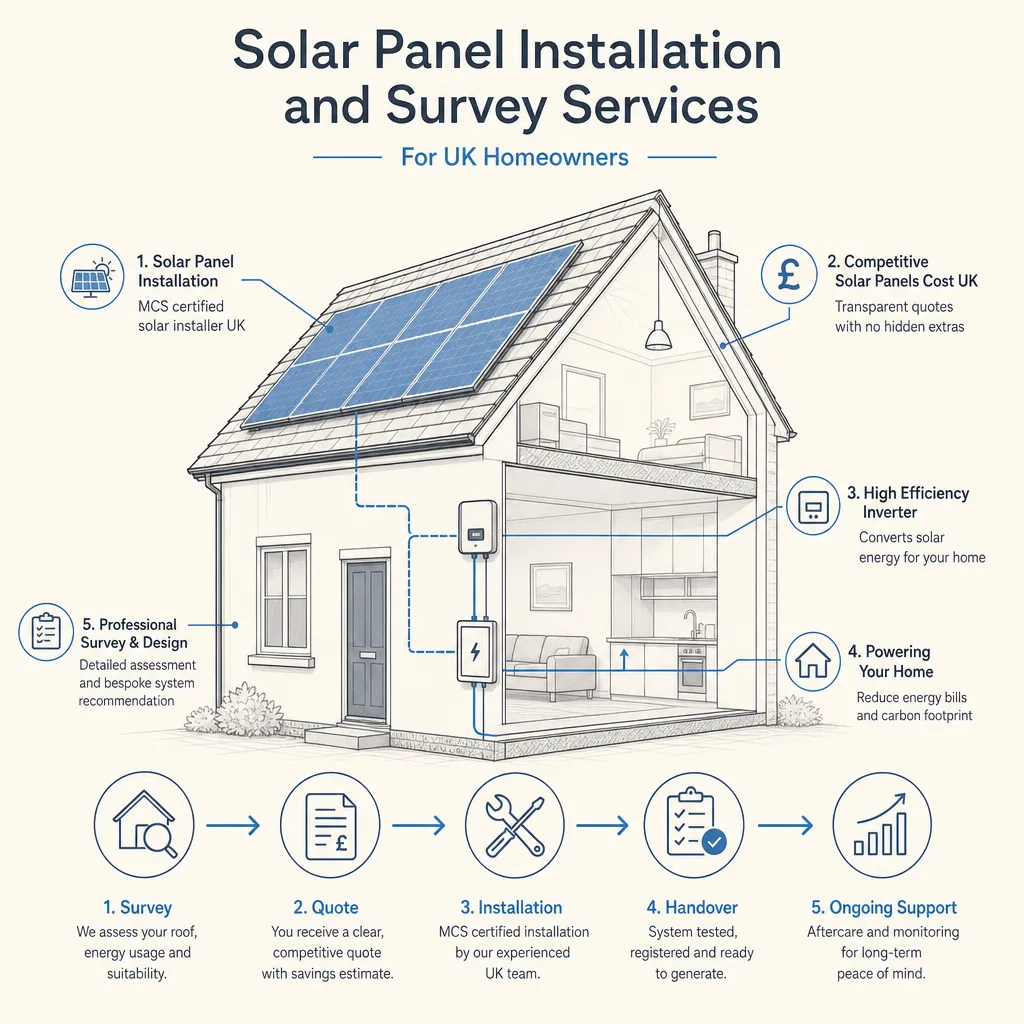
Solar Panel Installation and Survey Services
Solar panel installation in the UK involves a pre-installation roof survey, system design, MCS-accredited fitting, and notification to your Distribution Network Operator (DNO).
 Energy & Retrofit
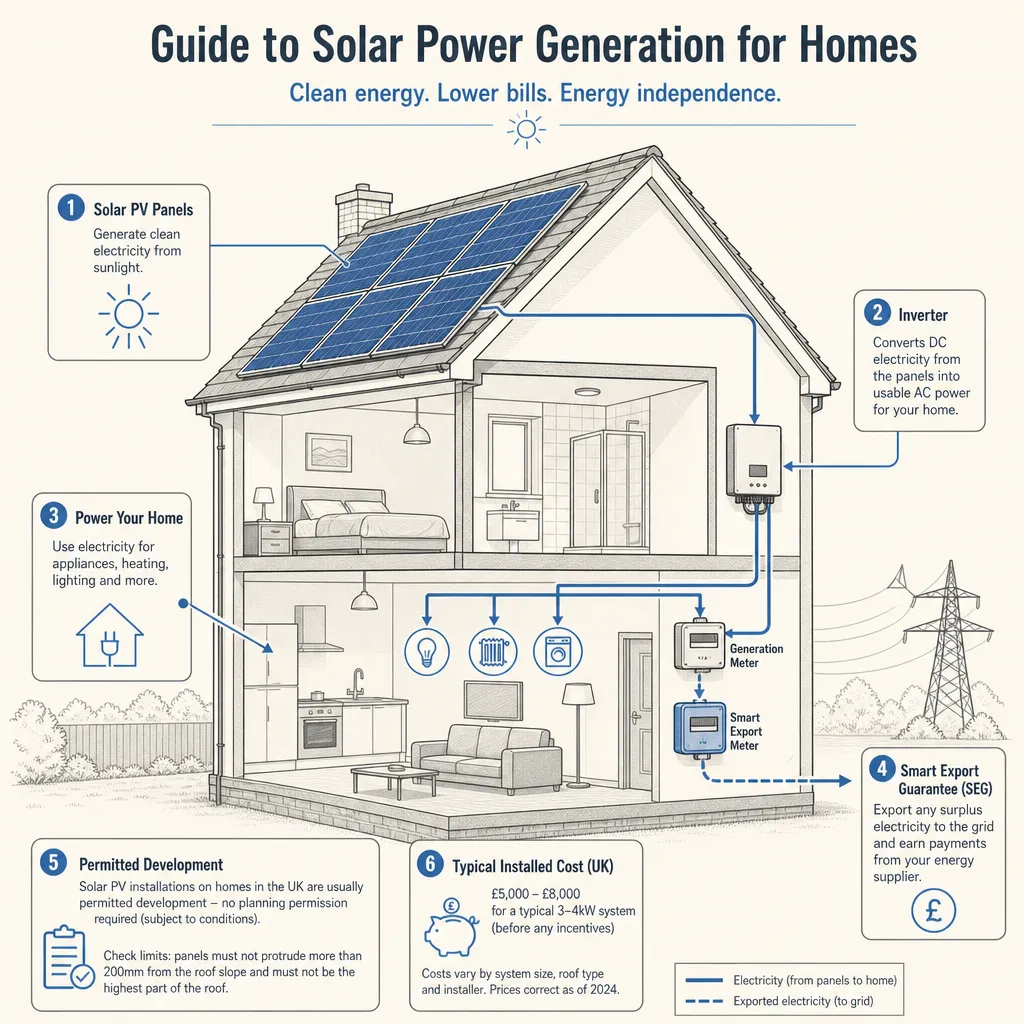
Guide to Solar Power Generation for Homes
Solar photovoltaic (PV) panels convert daylight into electricity and export surplus to the grid via the Smart Export Guarantee (SEG).
 Energy & Retrofit
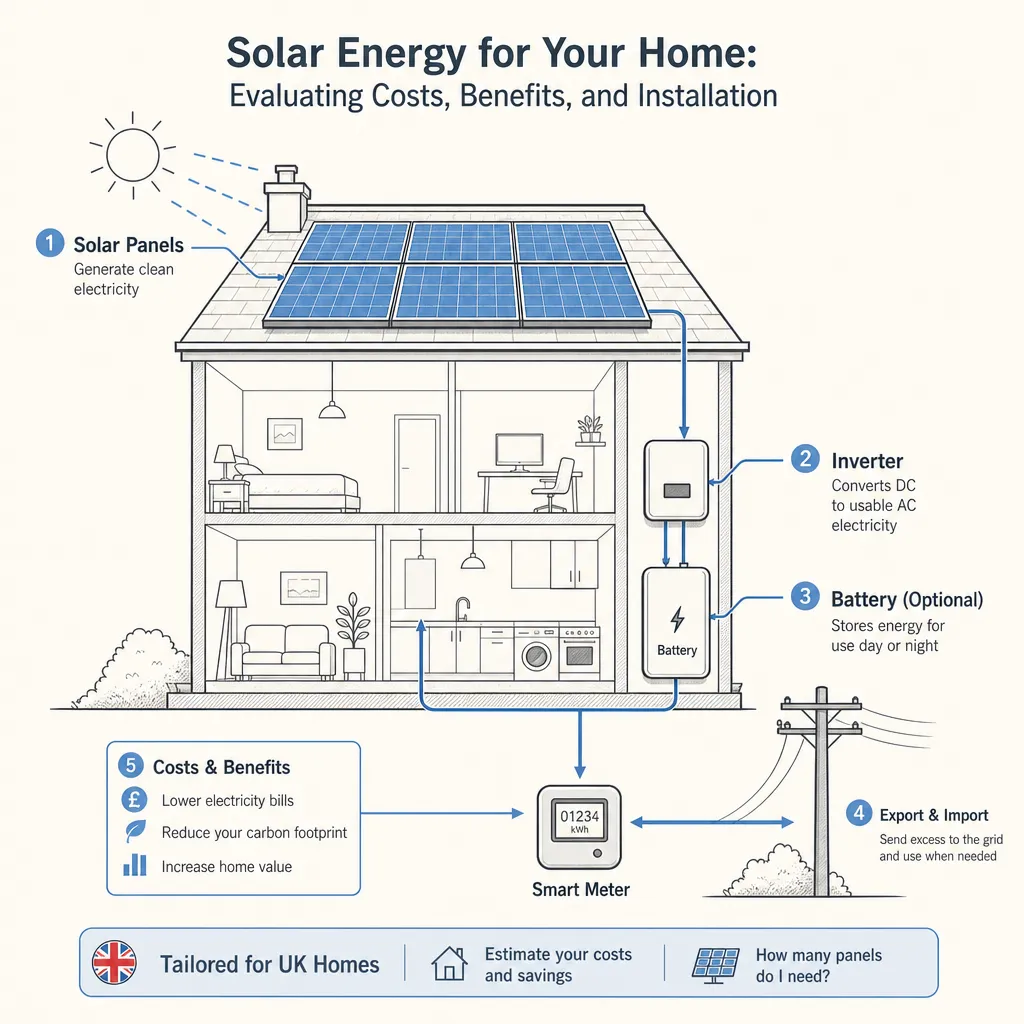
Solar Energy for Your Home: Evaluating Costs, Benefits, and Installation
A typical UK home solar PV system of 3–4 kWp costs approximately £5,000–£8,000 fully installed and can generate 2,600–3,800 kWh per year, covering 40–60% of average household electricity use.
 Energy & Retrofit
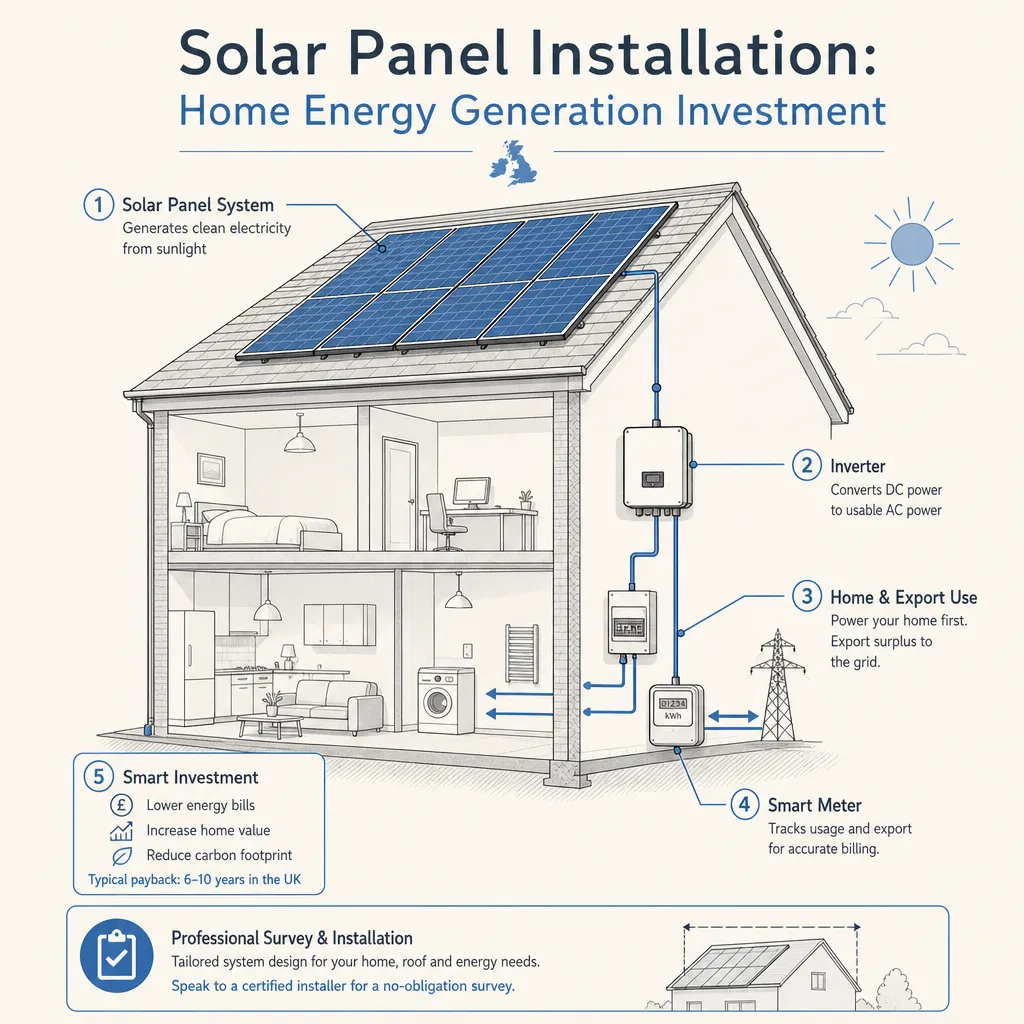
Solar Panel Installation: Home Energy Generation Investment
Solar panel installation in the UK typically costs £5,000–£9,000 for a 3–4 kWp system.