Guide to Solar Power Generation for Homes
By Housey · Last reviewed 11th of May 2026
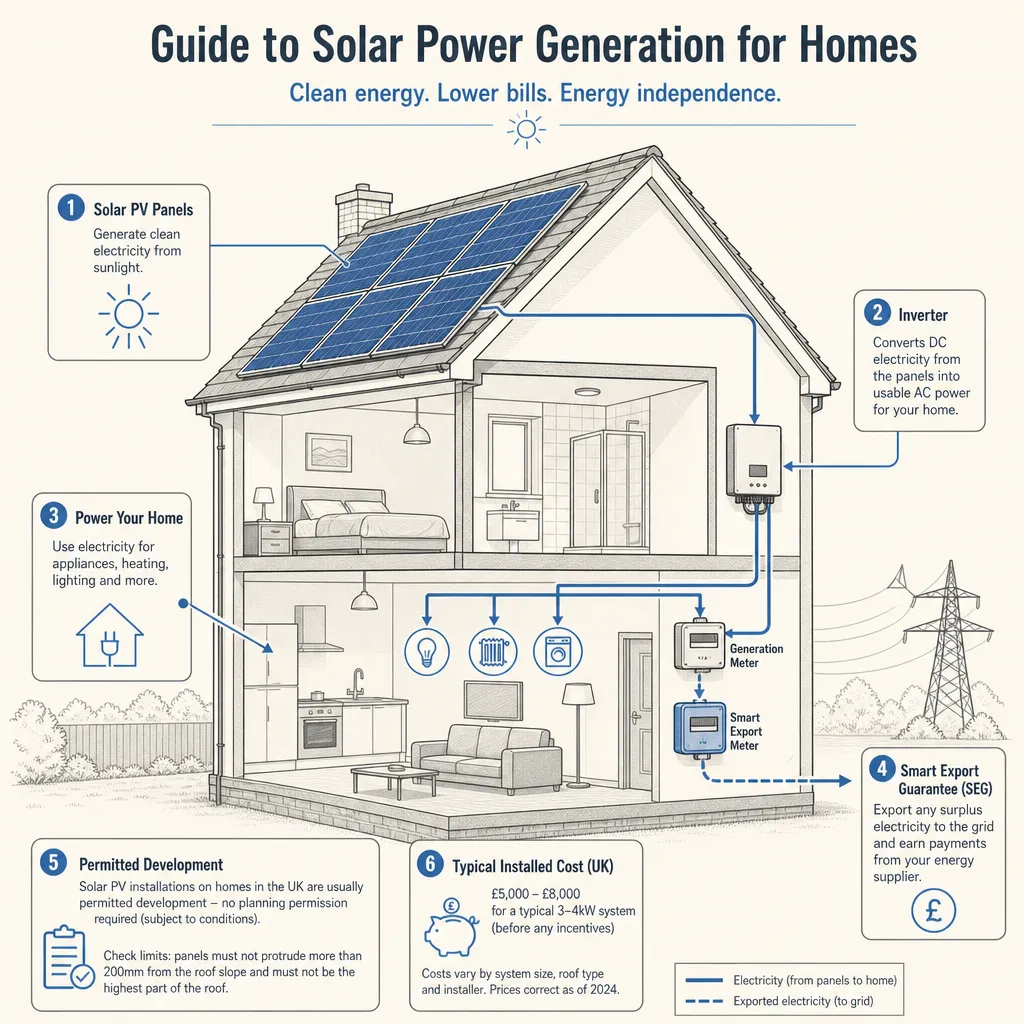
Guide to Solar Power Generation for Homes
Rising electricity bills and the UK's legally binding net-zero commitments have brought solar photovoltaic (PV) panels into serious consideration for homeowners across the country. The economics of home solar have shifted considerably since the Feed-in Tariff closed to new applicants in 2019, and the regulatory landscape — from permitted development rights to the Smart Export Guarantee — has evolved alongside it. A poorly specified system on the wrong roof can underperform its projections for twenty years; a well-designed installation on a suitable property can deliver meaningful bill reductions and a predictable return over the same period.
Key points
- A typical UK domestic solar PV system (3–4 kWp) costs approximately £5,000–£9,000 fully installed, including inverter and cabling (indicative UK costs, last reviewed 2026-05-11; quotes vary significantly by region, roof type, and system size).
- The Smart Export Guarantee (SEG), regulated by Ofgem, requires licensed electricity suppliers with 150,000+ customers to offer a tariff for surplus solar electricity exported to the grid; export rates vary between suppliers and tariff types.
- Under the Town and Country Planning (General Permitted Development) (England) Order 2015, most roof-mounted domestic solar installations do not require planning permission, subject to conditions around protrusion, visibility, and property type.
- MCS (Microgeneration Certification Scheme) accreditation is required of your installer for you to register for the Smart Export Guarantee and access most government or local authority solar grant funding.
- Battery storage added to a solar PV system typically costs an additional £2,500–£6,000 (indicative UK costs, last reviewed 2026-05-11) and increases self-consumption by allowing surplus daytime generation to be used in the evening.
How does home solar PV work?
Solar photovoltaic panels contain semiconductor cells — usually silicon — that generate direct current (DC) electricity when exposed to daylight. An inverter then converts this DC electricity into alternating current (AC) suitable for use on your home's circuits. Any electricity generated but not consumed in real time either charges a battery (if one is installed) or is exported to the national grid.
The output of a system depends on several factors:
- Panel orientation and tilt — south-facing at 30–35° is optimal for UK latitudes; east or west-facing roofs generate roughly 15–20% less annually; north-facing roofs are generally unsuitable.
- Shading — even partial shading from chimneys, dormer windows, or neighbouring trees can significantly reduce output from a standard string system; micro-inverters or power optimisers can mitigate this at additional cost.
- System size (kWp) — the kilowatt-peak rating describes peak output under standard test conditions; a 3 kWp system in the UK might generate 2,400–3,000 kWh per year depending on location.
- Latitude and local climate — a property in Cornwall will generate meaningfully more annually than one in Aberdeen; the Energy Saving Trust's solar tool provides regional estimates.
Solar PV, solar thermal, or battery storage: which is right for your home?
Option | Best for | Not ideal for | Typical annual benefit | Main consideration |
|---|---|---|---|---|
Solar PV panels | Most households wanting to reduce electricity import bills and earn SEG export payments | Heavily shaded roofs; roofs needing replacement within five years | Reduced electricity import costs plus SEG payments | Must use MCS-certified installer; significant upfront cost |
Solar thermal panels | Homes with high hot water demand — families, larger properties, homes with large cylinders | Homes already on a heat pump (which heats water efficiently at low running cost) | Reduced gas or oil consumption for hot water | Does not generate electricity; separate system from PV |
Battery storage only | Households on time-of-use electricity tariffs wanting to store cheap overnight electricity | Properties with very low evening electricity demand | Lower electricity import costs without solar generation | Lifespan approximately 10–15 years; no generation benefit |
Solar PV plus battery | Households aiming to maximise energy self-sufficiency and minimise grid dependence | High-shading or north-facing roofs where PV generation is too low to justify the cost | Highest self-consumption rate; best long-term bill reduction | Highest upfront cost; best value for high-use households with suitable roofs |
Does solar installation need planning permission?
For most UK homes, roof-mounted solar panels fall within permitted development rights and a planning application is not required. However, planning permission is needed if:
- The property is a listed building of any grade — permitted development rights do not apply.
- The property is in a conservation area and panels would be visible from a highway or public right of way.
- The property is subject to an Article 4 direction removing permitted development rights.
- Panels would project more than 200 mm from the roof surface.
- The installation is on a flat roof visible from a public road.
In Wales, Scotland, and Northern Ireland, permitted development rules differ in detail from England. Always check with your local planning authority if your property has any of these characteristics before commissioning installation.
Is your roof ready for solar panels?
Before instructing a full solar survey, consider these factors:
- Roof age and condition: Solar panels carry panel warranties of 25 years and working lives of 30+ years. If your roof covering is approaching end of life, replace it before installation — removing and refitting panels later adds significant cost.
- Structural capacity: Solar panels add approximately 15–20 kg/m² to the roof structure. Most UK roofs can accommodate this, but the installer or a surveyor should confirm capacity for older or unusual buildings.
- Orientation and pitch: South-facing pitches at 30–40° are optimal. East and west-facing roofs are viable. North-facing roofs are generally unsuitable for cost-effective solar generation.
- Shading: A reputable installer carries out a shading analysis as part of the system design; ask to see the methodology.
Which solar installer should you use?
Use this decision tree to evaluate your options before accepting any quote:
- Always choose an MCS-certified installer — MCS accreditation is a condition of registering for the Smart Export Guarantee and most grant funding. Check the MCS installer search at mcscertified.com.
- Ask whether they will design for your specific roof — a reputable installer produces a site-specific layout showing panel positions, shading analysis, generation estimate, and payback calculation.
- Request at least three quotes — solar pricing varies significantly between installers and regions; a quote comparison helps identify outliers.
- Avoid installers who quote over the phone without a site visit — system design requires roof measurement, shading assessment, and a review of your consumer unit.
- Check inverter brand and warranty — Fronius, SolarEdge, Enphase, and SMA are widely used in UK residential installations and have established UK service networks.
- Confirm whether the installation carries TrustMark registration — this is separate from MCS but provides additional consumer protection and dispute resolution.
What to ask before accepting a solar quote
- What is the system size in kWp and how many panels are included?
- What is the estimated annual generation in kWh, and what assumptions underpin that figure — location, orientation, shading, and performance degradation over time?
- Which inverter and panel models are specified, and what are their respective product and performance warranties?
- Is the quote turnkey — including scaffolding, DC and AC cabling, inverter installation, grid connection notification (G98 or G99), and commissioning?
- Is a structural or roof condition check included, or is the quote conditional on the roof being suitable?
- Which SEG suppliers and tariff rates are you recommending, and what export income assumption is used in payback calculations?
- Will I receive an MCS certificate and commissioning documentation?
- Is VAT included? Solar panel installations on dwellings in Great Britain are currently zero-rated for VAT purposes under HMRC rules (position as of 2026-05-11).
- What is the payment schedule, and what happens if commissioning is delayed by your firm or by grid connection requirements?
The Smart Export Guarantee explained
The Smart Export Guarantee (SEG) replaced the Feed-in Tariff (FiT) scheme for new installations from January 2020. Key points UK homeowners should understand:
- All licensed electricity suppliers with 150,000 or more domestic customers are required by Ofgem to offer at least one SEG tariff for exported solar electricity.
- Export rates vary between suppliers — fixed tariffs typically range from 3p to 15p per kWh, while some suppliers offer variable or time-of-export rates (indicative range, last reviewed 2026-05-11; check Ofgem's tariff comparison for current rates).
- You must have a smart meter to participate; your energy supplier arranges this.
- Your installer must be MCS-certified and provide an MCS certificate for the installation before you can register.
- Your SEG supplier does not have to be the same as your electricity import supplier; you can switch SEG supplier at any time without affecting your import tariff.
When to get professional help
Solar PV installation must be carried out by a qualified, MCS-certified installer — this is not DIY work. Additionally, seek independent professional advice if:
- Your roof shows signs of structural defect — sagging, cracked rafters, failed flashings — before any installation proceeds.
- You live in a listed building or conservation area, where planning implications are more complex and specialist advice is advisable.
- You want to add battery storage to an existing older solar PV system — inverter compatibility and grid protection relay requirements should be confirmed by a qualified electrician.
- Your property has a complex or older electrical installation — consult a NICEIC or NAPIT registered electrician about consumer unit capacity and earthing arrangements before a solar system is connected.
How Housey can help
Before committing to a solar installation, a professional solar survey can assess your roof's structural suitability, produce an accurate generation forecast, and identify any planning or installation constraints early. Housey connects you with vetted solar professionals who carry out pre-installation surveys — use our quote request tool to compare proposals from providers in your area.
Frequently asked questions
How much electricity will solar panels generate in the UK?
Generation depends on system size, orientation, shading, and location. A 3 kWp south-facing system in the South of England typically generates around 2,700–3,000 kWh per year; the same system in Scotland might produce 2,200–2,600 kWh. The Energy Saving Trust's solar calculator provides location-specific estimates. Your installer should supply a generation forecast based on your specific roof and system design.
How long do solar panels take to pay back their cost in the UK?
Payback period depends on system cost, household energy use, self-consumption rate, SEG export tariff, and future electricity prices. Based on current UK energy prices and SEG rates, payback periods are commonly cited in the range of 8–15 years for domestic systems — though this varies significantly by property and usage pattern. Ask your installer for a scenario calculation based on your actual energy bill.
Can solar panels be installed on a flat roof?
Yes, flat-roof installations use angled mounting frames to tilt panels towards the south. Planning permission may be required if panels are visible from a highway. Installation methodology differs from pitched-roof systems and not all installers specialise in this configuration — confirm the installer's experience with flat-roof work and that the mounting system is appropriate for your roof's waterproofing type.
Do solar panels work in cloudy UK weather?
Yes. Solar PV panels generate electricity from daylight, not only direct sunshine. Output is reduced on overcast days but not eliminated. The UK's average solar irradiance is sufficient to make solar PV economically viable across most of the country, including Scotland and Wales — though southern regions generate more annually. A good installer will show you location-specific yield estimates, not just headline figures.
Sources and further reading
- Smart Export Guarantee (SEG) — Ofgem
- Permitted development rights for householders — GOV.UK
- Solar panels — Energy Saving Trust
- MCS certified installer search — Microgeneration Certification Scheme
Useful next reads
 Energy & Retrofit
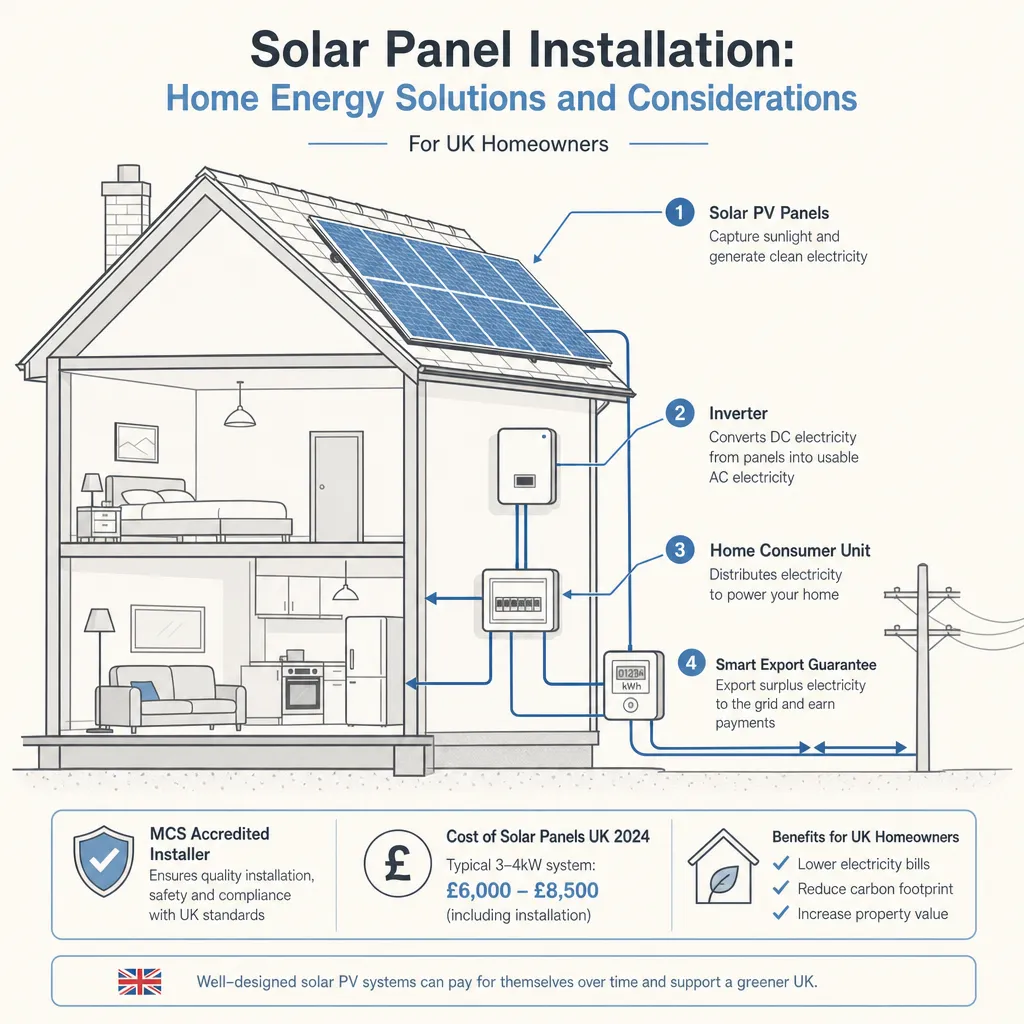
Solar Panel Installation: Home Energy Solutions and Considerations
A typical 4 kWp solar PV system costs £6,000–£9,000 installed and generates around 3,400–3,800 kWh per year on a south-facing roof in southern England.
 Energy & Retrofit
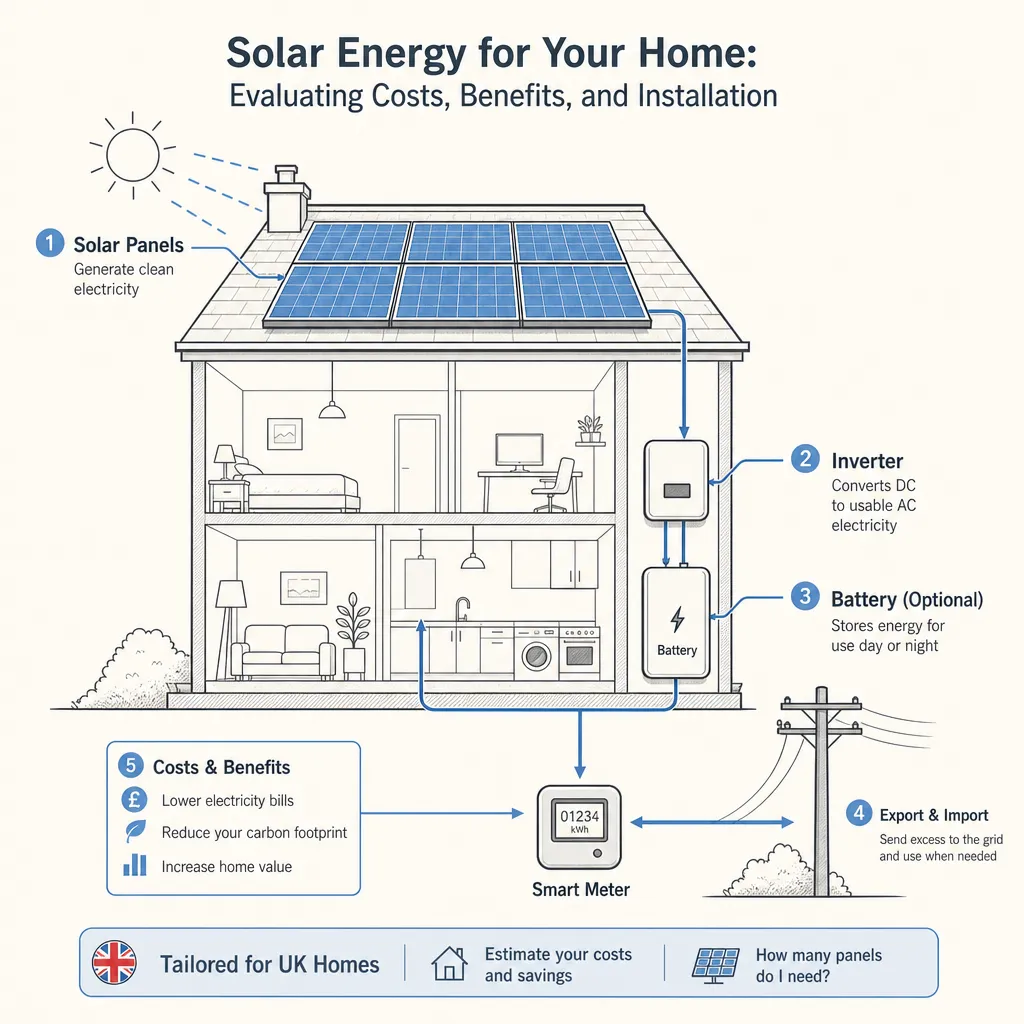
Solar Energy for Your Home: Evaluating Costs, Benefits, and Installation
A typical UK home solar PV system of 3–4 kWp costs approximately £5,000–£8,000 fully installed and can generate 2,600–3,800 kWh per year, covering 40–60% of average household electricity use.
 Energy & Retrofit
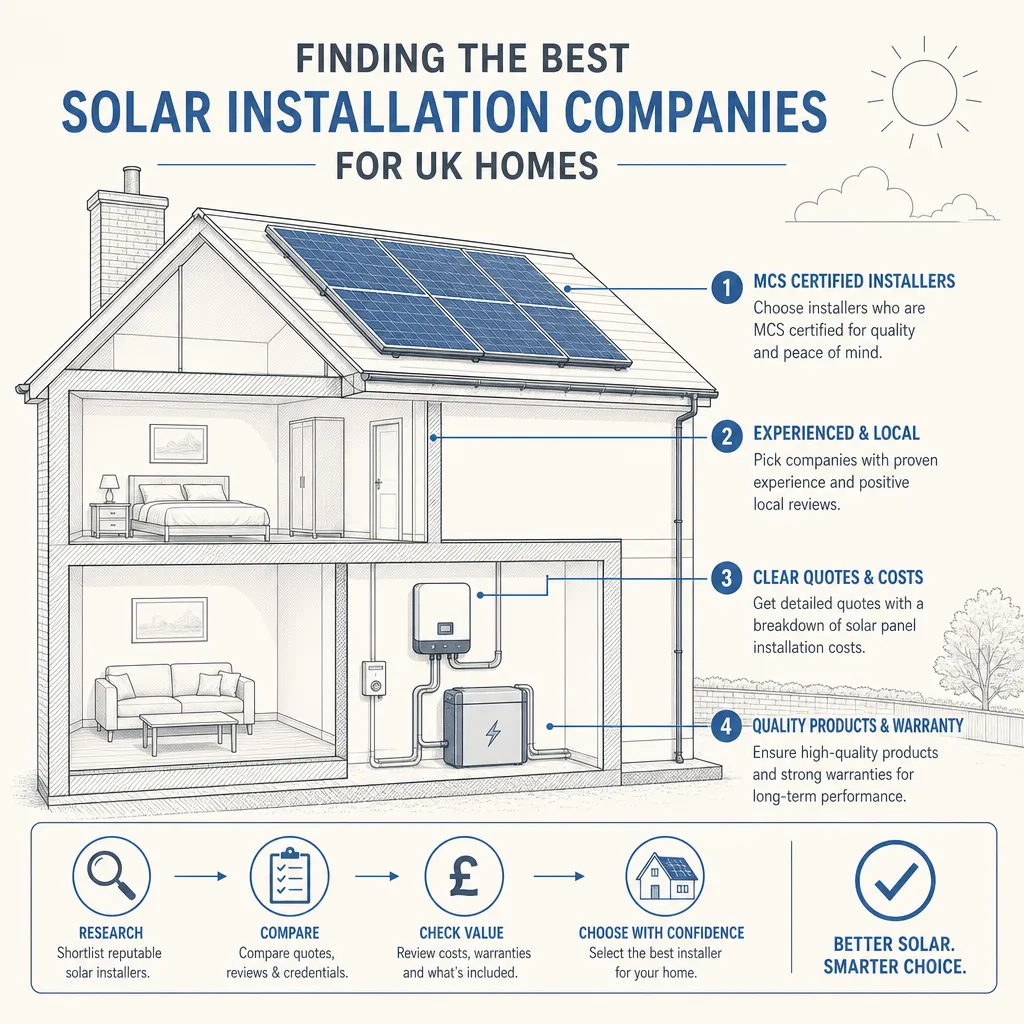
Finding the Best Solar Installation Companies for UK Homes
To find a reliable solar installation company in the UK, look for MCS (Microgeneration Certification Scheme) certification — required for Smart Export Guarantee eligibility — plus NICEIC or NAPIT electrical registration.
 Energy & Retrofit
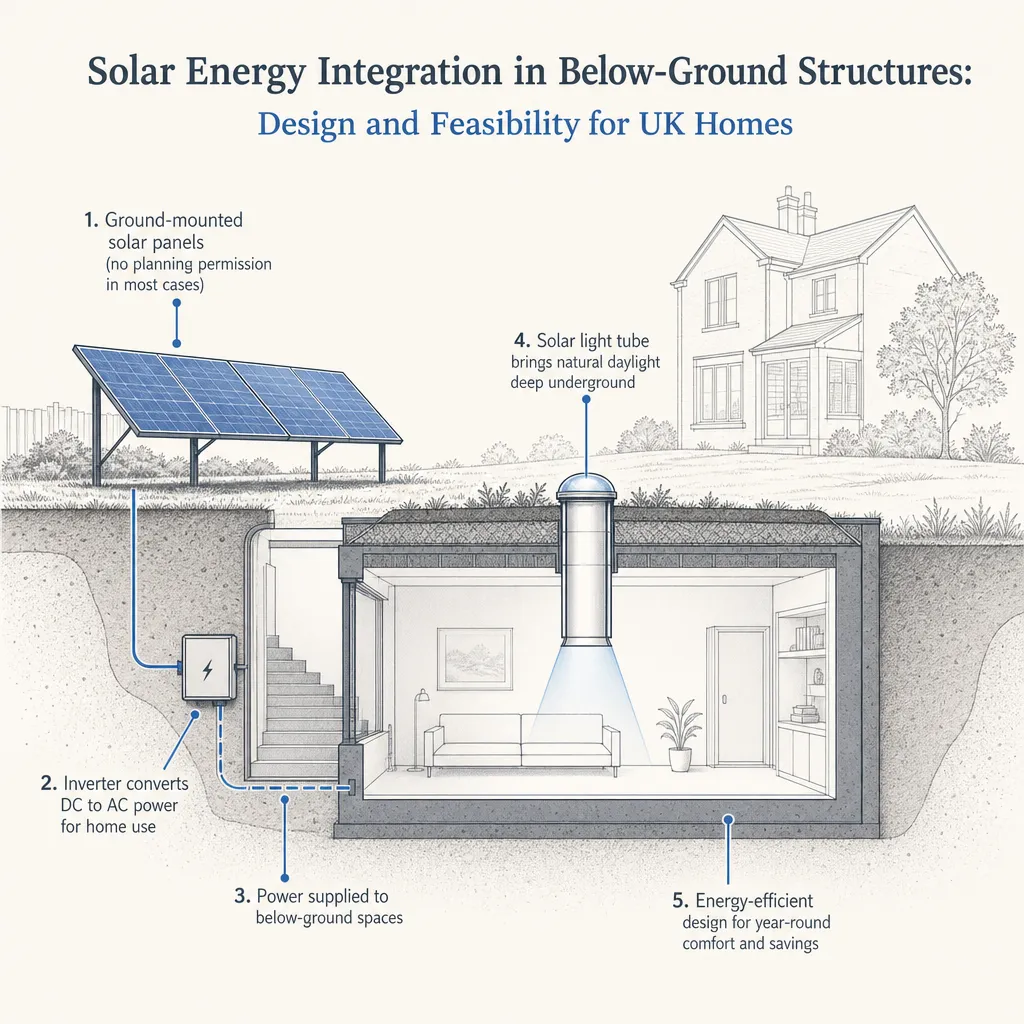
Solar Energy Integration in Below-Ground Structures: Design and Feasibility
Below-ground structures cannot host solar panels on their own roofs but can use surface-mounted panels connected via cable runs, solar light tubes for daylighting, and battery storage.
 Energy & Retrofit
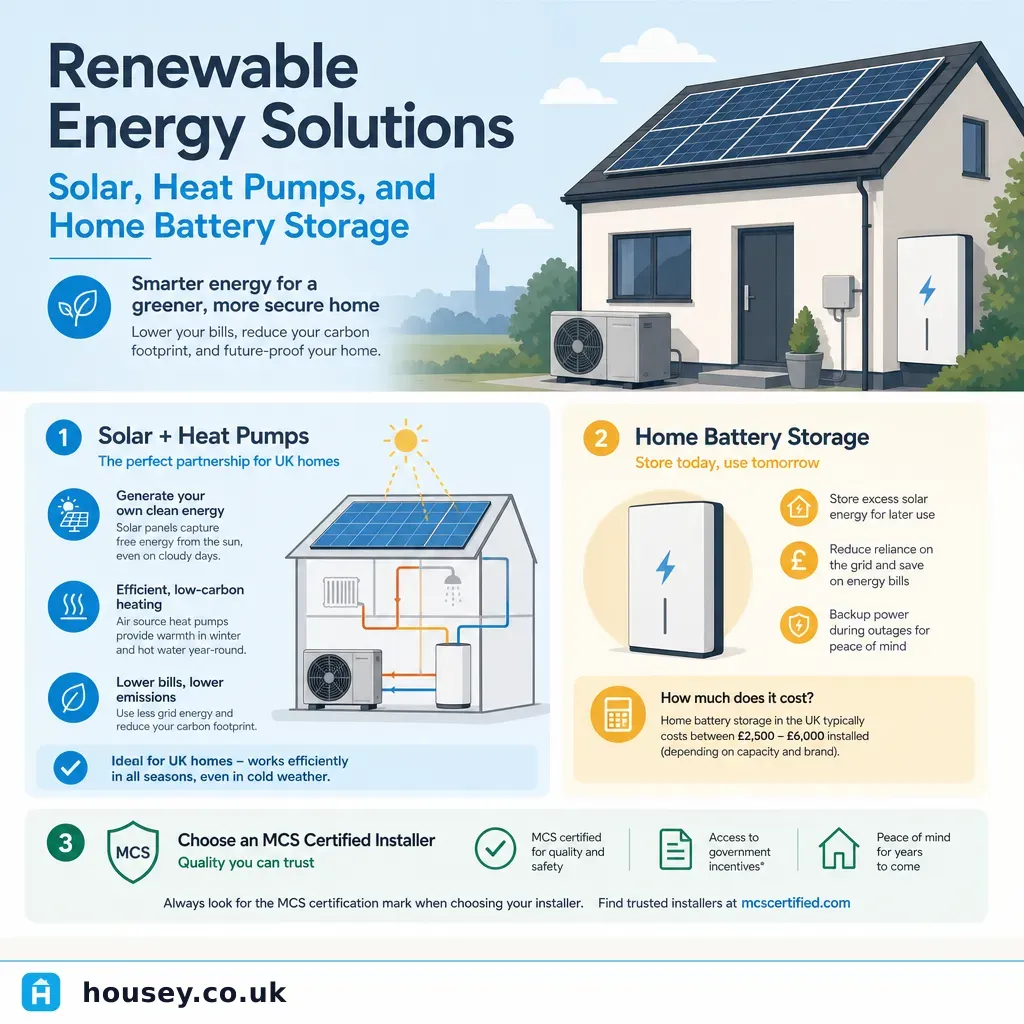
Renewable Energy Solutions: Solar, Heat Pumps, and Home Battery Storage
UK homeowners can reduce energy bills and carbon emissions by combining solar PV panels, air source heat pumps, and home battery storage.