Solar Panel Installation: Home Energy Solutions and Considerations
By Housey · Last reviewed 30th of May 2026
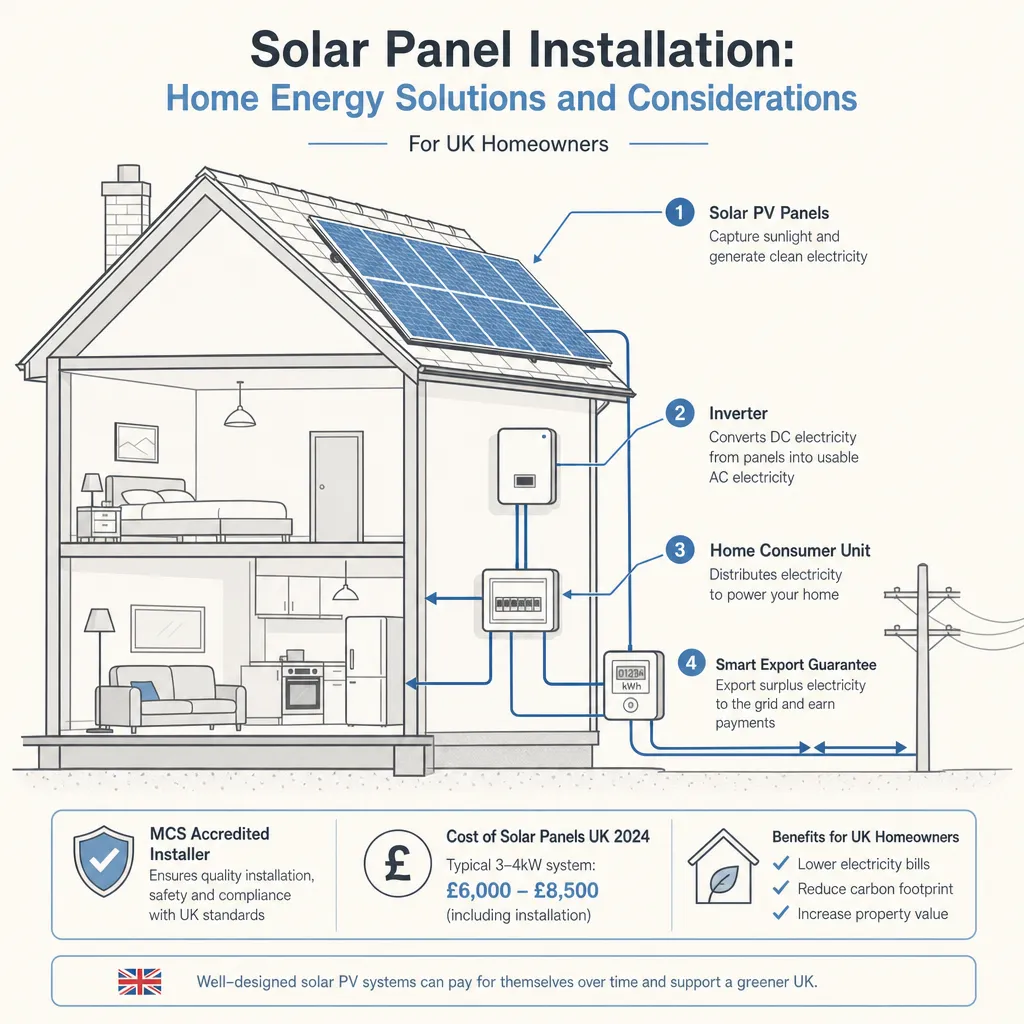
Solar Panel Installation: Home Energy Solutions and Considerations
Solar photovoltaic (PV) panels have become one of the most common home energy improvements in the UK, with well over one million residential installations recorded in Great Britain. For homeowners weighing up the financial and environmental case, the key questions are usually the same: how much does a system cost, how much will it generate, and how long before it pays back? The answers depend on your roof's orientation and condition, your household electricity consumption, and whether battery storage makes sense alongside the panels.
Key points
- Solar PV installations must be carried out by an MCS-accredited installer to qualify for the Smart Export Guarantee (SEG), which pays you for electricity exported to the grid.
- A typical 4 kWp system generates approximately 3,400–3,800 kWh per year on a south-facing roof in southern England, and around 2,800–3,200 kWh in Scotland or northern England, depending on shading and orientation.
- Most domestic solar PV installations on standard roofs are permitted development and do not require a planning application — exceptions apply to listed buildings, Article 4 direction areas, and some conservation areas.
- Adding a battery storage system (typically 5–10 kWh capacity) can increase self-consumption of generated electricity from roughly 30% to 60–70%, improving payback time where export tariff rates are modest.
- A pre-installation solar survey should assess roof condition, structural suitability, orientation, pitch, and shading from nearby trees or buildings before any equipment is specified.
Is solar PV suitable for your home?
Solar PV works best under specific conditions. Before booking a survey, consider the following:
- Choose solar PV if your roof faces south, south-east, or south-west, has a pitch of 20–50°, is in reasonable structural condition, and your electricity bill could be meaningfully offset by daytime self-consumption.
- Still consider solar if your roof faces east or west — generation is around 15–20% lower than a south-facing roof but systems remain financially viable, particularly with battery storage.
- Seek specialist advice if your roof is partially shaded by a chimney, dormer, or neighbouring building — a solar survey will model yield losses and advise on panel layout or microinverters to mitigate the impact.
- Check planning rules first if your property is listed, in a conservation area, or subject to an Article 4 direction. In most cases permitted development rights apply, but confirming with your local planning authority before installation is advisable.
- Consider insulation improvements first if your home has poor thermal performance — raising your EPC rating before installing solar may be a more cost-effective initial step.
System sizes and what they produce
System size | Typical roof area needed | Approx. annual generation (south-facing, England) | Approx. installed cost (2024) | Best for |
|---|---|---|---|---|
2 kWp | 12–14 m² | 1,600–1,900 kWh | £3,500–£5,000 | Smaller roofs or lower-usage households |
4 kWp | 24–28 m² | 3,400–3,800 kWh | £6,000–£9,000 | Average 3–4 bedroom home |
6 kWp | 36–42 m² | 5,000–5,700 kWh | £8,500–£12,000 | Larger homes, EV charging, or heat pump pairing |
10 kWp (max domestic permitted development) | 60–70 m² | 8,000–9,500 kWh | £14,000–£20,000 | Large roofs and high consumption |
Indicative UK costs and generation figures, last reviewed 2026-05-30. Generation varies with location, shading, pitch, and orientation. Source: MCS, Energy Saving Trust.
The Smart Export Guarantee explained
The Smart Export Guarantee (SEG) requires licensed electricity suppliers with over 150,000 customers to offer export tariffs to eligible small-scale generators. To qualify:
- Your installation must be certified under the Microgeneration Certification Scheme (MCS)
- Your installer must be MCS-accredited at the time of installation
- You must have a smart meter installed (your supplier will arrange this)
- Your system must be 5 MW or below — domestic systems are well within this threshold
Export rates vary by supplier and tariff, typically ranging from 4p to 15p per kWh. Comparing SEG rates before signing with a supplier can meaningfully affect long-term returns. Ofgem maintains a list of licensed SEG suppliers and their current tariff offers.
Should you add battery storage?
A solar battery stores surplus generation during the day for use in the evening, when panels are not producing. Without storage, most households export much of their midday generation at SEG rates and draw from the grid at full import rates in the evening.
Factors favouring battery storage:
- Your household electricity use is concentrated in the mornings and evenings, typical for working households
- You are on or plan to move to a time-of-use tariff such as Octopus Agile or Octopus Go
- You have or plan to install a heat pump or electric vehicle charger
Factors where a battery adds less value:
- You work from home and consume electricity throughout the day, reducing the arbitrage opportunity
- Your SEG export rate is close to your import rate, narrowing the economic case for storage
- The upfront battery cost (typically £3,000–£6,000 for 5–10 kWh) would extend payback beyond your planning horizon
Pre-installation checklist
Before your solar survey, gather the following:
When to get professional help
Always use an MCS-accredited installer for the installation itself — unaccredited work is not eligible for SEG payments and may affect your buildings insurance. Additionally:
- If your roof is over 20 years old, have a roofer inspect it before panels are fixed in place
- If your property is leasehold, check your lease for restrictions on exterior alterations before commissioning any survey or works
- If you are unsure about planning status, apply for a Lawful Development Certificate from your local planning authority before starting work
How Housey can help
A solar survey is the right starting point — before accepting any installation quote, an independent survey confirms your roof's suitability, models your likely generation, and identifies any structural or planning considerations. Housey connects you with qualified solar assessors. If battery storage is part of your plan, battery storage installers on the Housey platform can quote alongside your solar system, making it straightforward to compare integrated packages.
Frequently asked questions
Do solar panels need planning permission in the UK?
Most domestic solar PV installations are permitted development under the Town and Country Planning (General Permitted Development) (England) Order 2015. Planning permission is not required provided the panels do not protrude more than 200 mm from the roof plane and are not on a wall or roof slope fronting a highway. Listed buildings, Article 4 direction areas, and some conservation areas are exceptions — check with your local planning authority if in doubt.
How long do solar panels last?
Most panels carry a 25-year performance warranty guaranteeing at least 80–85% of rated output at year 25, with physical lifespan often exceeding 30 years. Inverters typically last 10–15 years and will likely need replacing once during the system's life. Budget approximately £800–£1,500 for an inverter replacement. Panel degradation is gradual and year-25 output remains commercially useful in most cases.
Is scaffolding included in solar installation quotes?
Scaffolding is nearly always required and is typically included in installer quotes, but always confirm this explicitly. Ask for a written breakdown of what is included: scaffolding, electrical upgrades, Distribution Network Operator notification, and commissioning fees should all be itemised separately. A quote providing a single total figure without a breakdown makes it difficult to compare proposals fairly or identify hidden costs.
Can I get a grant for solar panels in the UK?
As of 2026, there is no universal domestic solar grant in Great Britain. ECO4 may fund solar as part of a wider retrofit package for eligible low-income households. Some local authorities run area-based schemes. Scotland has the Home Energy Scotland grant and loan programme. Check current availability via GOV.UK and Home Energy Scotland, as schemes change and eligibility criteria vary by location and household income.
Sources and further reading
- Smart Export Guarantee — Ofgem
- Solar panels — Energy Saving Trust
- MCS Certified — Microgeneration Certification Scheme
- Solar panels on a house — Planning Portal
- Home Energy Scotland — Home Energy Scotland
Useful next reads
 Energy & Retrofit
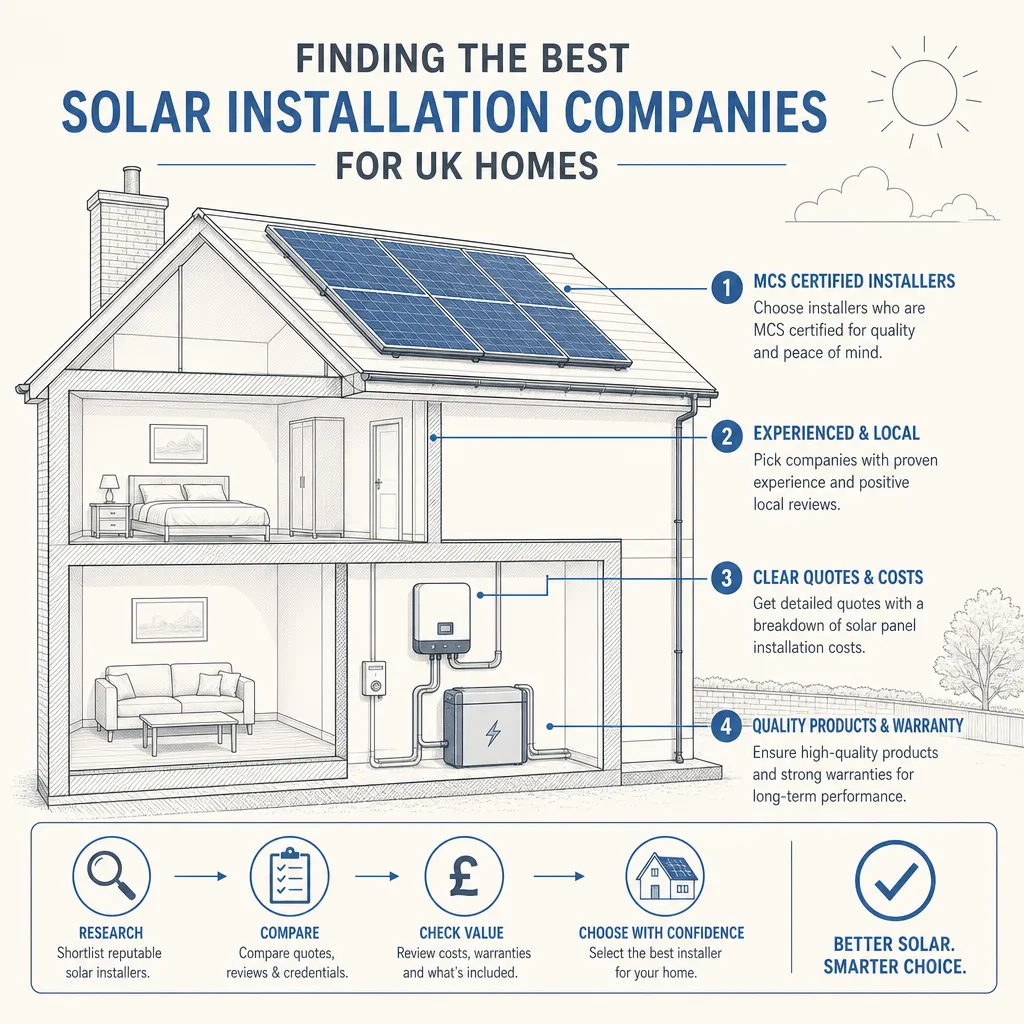
Finding the Best Solar Installation Companies for UK Homes
To find a reliable solar installation company in the UK, look for MCS (Microgeneration Certification Scheme) certification — required for Smart Export Guarantee eligibility — plus NICEIC or NAPIT electrical registration.
 Energy & Retrofit
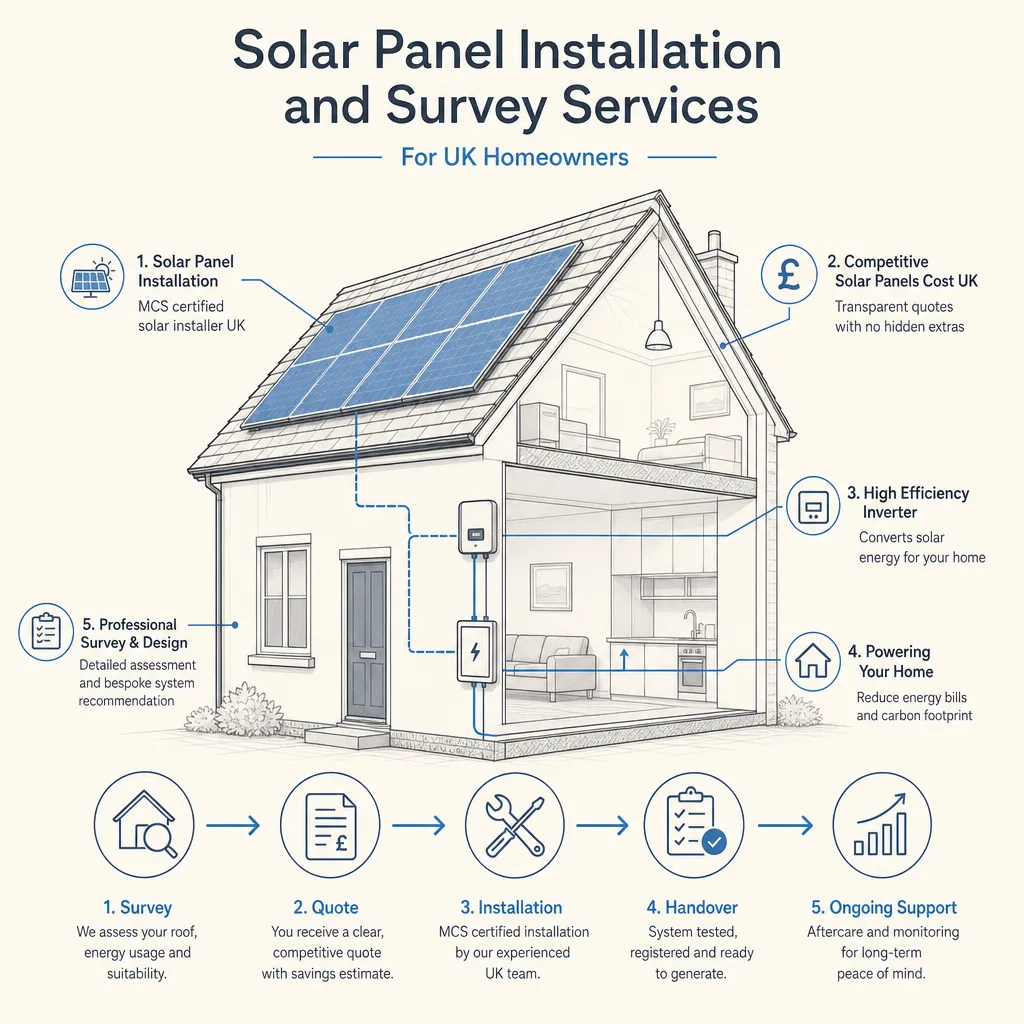
Solar Panel Installation and Survey Services
Solar panel installation in the UK involves a pre-installation roof survey, system design, MCS-accredited fitting, and notification to your Distribution Network Operator (DNO).
 Energy & Retrofit
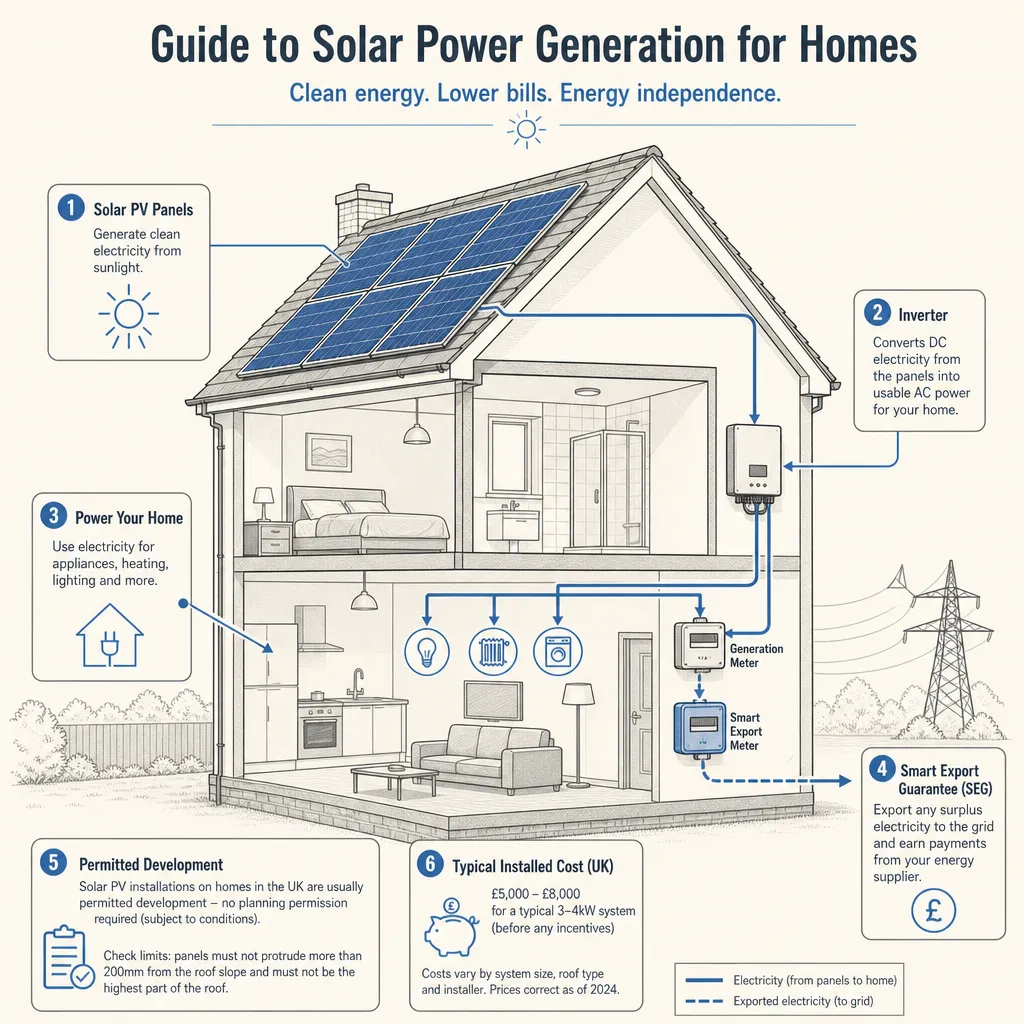
Guide to Solar Power Generation for Homes
Solar photovoltaic (PV) panels convert daylight into electricity and export surplus to the grid via the Smart Export Guarantee (SEG).
 Energy & Retrofit
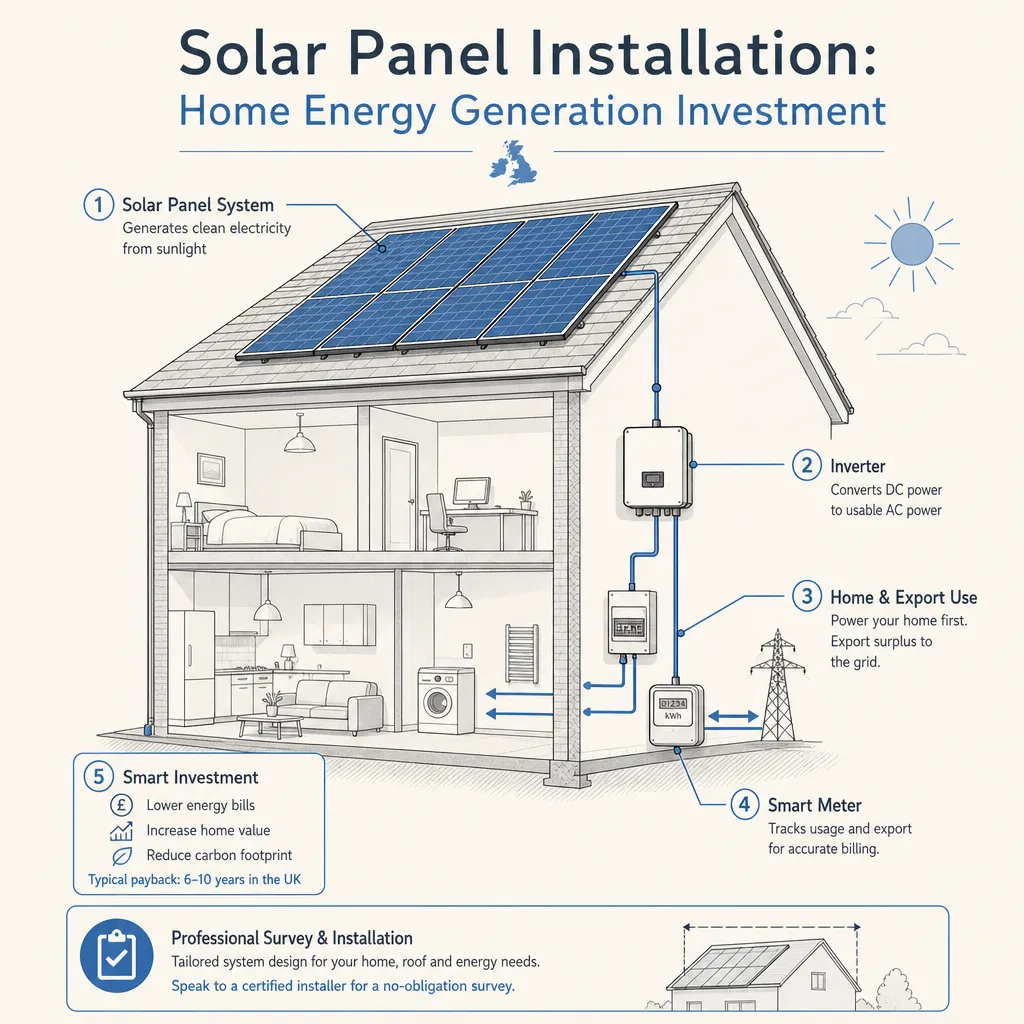
Solar Panel Installation: Home Energy Generation Investment
Solar panel installation in the UK typically costs £5,000–£9,000 for a 3–4 kWp system.
 Energy & Retrofit
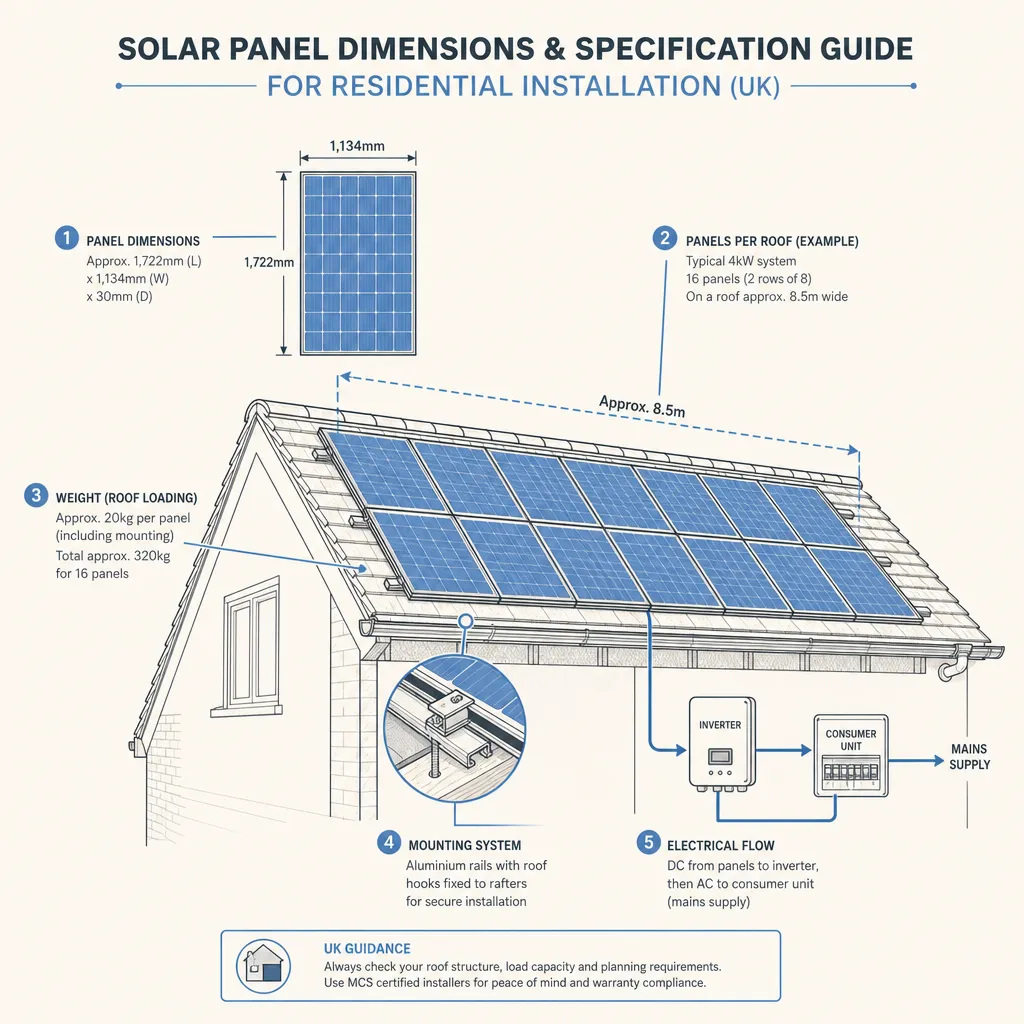
Solar Panel Dimensions and Specification Guide for Residential Installation
A standard residential solar panel measures approximately 1700–1800mm × 1000–1050mm, weighs 18–22 kg, and produces 380–450 W.