Solar Panel Installation: Home Energy Generation Investment
By Housey · Last reviewed 10th of May 2026
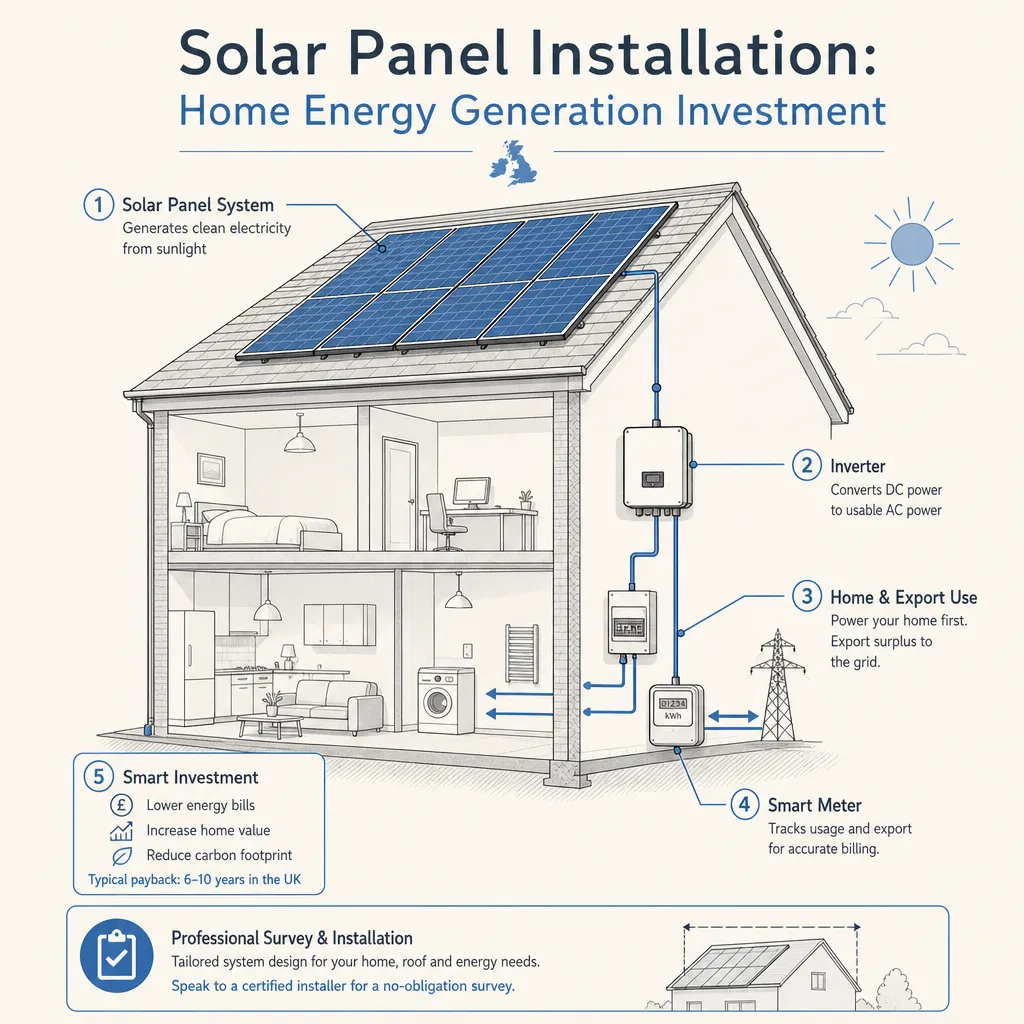
Solar Panel Installation: Home Energy Generation Investment
Solar panels are a growing consideration for UK homeowners looking to reduce energy bills and lower their carbon footprint, particularly as electricity prices remain volatile. The decision typically arises during a home renovation, following an energy assessment, or when a neighbour's installation prompts questions about whether your own roof is suitable. Getting the details right — system size, installer certification, roof condition, and export tariffs — can make a significant difference to the long-term return on your investment.
Key points
- The Microgeneration Certification Scheme (MCS) is the recognised standard for solar installers and equipment in the UK; only MCS-certified installations qualify for the Smart Export Guarantee (SEG).
- Most domestic solar installations do not require planning permission under Class A Permitted Development rights, but exceptions apply to listed buildings, roofs facing a highway in conservation areas, and Article 4 Direction areas.
- A typical 3–4 kWp solar system generates approximately 2,700–3,600 kWh per year in the UK, based on average irradiance figures published by the Energy Saving Trust.
- Under the Smart Export Guarantee, eligible homeowners receive payment for surplus electricity exported to the grid — rates are set by individual suppliers, not by government, and vary between providers.
- A solar survey should assess roof pitch, orientation, shading from trees or chimneys, structural condition, and available roof area before any system is specified.
Is my roof suitable for solar panels?
Not every roof is equally suited to solar installation. South-facing roofs at a pitch of 30–40° typically yield the best output in the UK, but east- or west-facing roofs can still be viable, particularly if battery storage is added to capture generation across a wider part of the day.
Key factors a solar surveyor will assess:
- Orientation and pitch: South-facing at around 35° is optimal; east/west orientations generally reduce output by 15–20%.
- Shading: Nearby trees, chimneys, or adjoining buildings can significantly reduce generation, particularly if they shade panels during peak sunlight hours (typically 10am–3pm).
- Roof condition: Panels are typically warrantied for 25 years; if your roof covering is near end of life, replacing it before installation avoids the cost of removing and reinstalling panels later.
- Structural loading: Most standard roof structures can bear the additional weight, but a solar survey should confirm this, particularly on pre-1945 properties with non-standard roof construction.
- Roof area: A 4 kWp system requires approximately 25–28 m² of usable, unobstructed roof space.
How much do solar panels cost in the UK?
Indicative UK costs, last reviewed 2026-05-10.
System size | Typical annual output | Estimated installed cost | Best suited to |
|---|---|---|---|
2–3 kWp | 1,800–2,700 kWh | £4,000–£6,000 | Smaller homes, 1–2 person households |
3–4 kWp | 2,700–3,600 kWh | £5,500–£8,000 | Average 3-bed semi |
4–6 kWp | 3,600–5,400 kWh | £7,000–£10,000 | Larger homes, high daytime consumption |
| N/A | Additional £2,500–£5,000 | Homes with low daytime occupancy |
Costs vary by installer, region, panel brand, roof complexity, and whether scaffolding is required. VAT on domestic solar installations is currently 0% in Great Britain under HMRC rules introduced in April 2022 — confirm this rate applies to your specific installation before signing a contract. Always obtain at least three quotes.
Do I need planning permission for solar panels?
Most domestic solar installations in England are covered by Permitted Development rights under Schedule 2, Part 14 of the Town and Country Planning (General Permitted Development) (England) Order 2015. Planning permission is not usually required, provided:
- Panels do not protrude more than 200mm beyond the roof plane.
- Panels are not installed on a wall or roof slope that faces a highway, for properties in a conservation area.
- The property is not a listed building — listed buildings require Listed Building Consent before any solar installation.
- Panels will be removed when no longer in use.
Scotland, Wales, and Northern Ireland each have their own planning rules — always check with your local planning authority before proceeding if you are outside England or have any doubt about your property's planning status.
Which option should you choose?
- Choose solar panels only if you are at home during peak generation hours (roughly 10am–3pm) and can use most generated electricity directly rather than exporting it.
- Choose solar panels with battery storage if you are typically out during the day and want to store surplus generation for evening use, or to provide some resilience during grid outages.
- Commission a solar survey first if your roof has any shading, is more than 20 years old, or is non-standard construction — such as a flat roof, thatched property, or concrete interlocking tile system.
- Check with your local planning authority before proceeding if your property is listed, in a conservation area, or in an area where an Article 4 Direction removes standard permitted development rights.
- Consult an MCS-certified installer to confirm that your roof's structural condition is adequate before committing, especially for properties built before 1945.
What to ask before accepting a solar quote
- Is the installer MCS-certified, and will the completed installation be registered on the MCS database?
- What panel brand and warranty is included — typically a 25-year product warranty and a 10–12 year performance warranty?
- What inverter is specified, and what is its warranty period?
- Will a pre-installation solar survey be carried out, and is it included in the quoted price?
- What is the projected annual generation figure, and what assumptions (location, pitch, shading factor) underpin it?
- Are there structural, shading, or access issues that could change the final price?
- Is scaffolding included, and who arranges erection and removal?
- What happens if the roof is found to require repairs before installation can proceed?
- Is VAT at 0% applied to the full supply and installation cost?
- Will you register the system for the Smart Export Guarantee on my behalf, and which export tariff do you recommend?
The Smart Export Guarantee explained
The Smart Export Guarantee (SEG) replaced the Feed-in Tariff — which closed to new applicants in April 2019 — as the mechanism for paying homeowners for surplus solar electricity exported to the grid. Under the SEG, licensed energy suppliers with more than 150,000 customers are required by Ofgem to offer at least one export tariff. Rates are set by individual suppliers, not by government, and vary considerably; comparing SEG tariff rates from multiple suppliers before committing to one account is worthwhile.
To be eligible for the SEG, your installation must:
- Be certified under the Microgeneration Certification Scheme (MCS) or an equivalent approved scheme.
- Have a capacity of 5 MW or below.
- Have a smart meter or other suitable export-measurement meter installed.
When to get professional help
A qualified MCS-certified solar installer and, ideally, an independent solar surveyor should be involved before any system is sized or purchased. Seek professional assessment if:
- Your roof shows signs of sagging, damaged felt, cracked or slipping tiles, or any other structural concern — address roofing issues before panels are installed.
- Your property is in a conservation area, is listed, or you are uncertain about permitted development conditions for your specific building.
- There is significant shading from mature trees that may be subject to a Tree Preservation Order.
- You are considering an installation above domestic scale (above 50 kWp), which has different planning and Distribution Network Operator grid-connection requirements.
- The property is a leasehold flat — freeholder or management company consent is likely required before any installation can proceed.
How Housey can help
A solar survey can confirm your roof's suitability, assess shading, and provide a realistic generation estimate before you commit to a system. If you decide to proceed, Housey can also connect you with qualified battery storage installers to explore whether adding storage would improve the return on your solar investment.
Frequently asked questions
Do solar panels add value to a home in the UK?
Evidence suggests solar panels can add value to UK properties, particularly as energy efficiency becomes a more prominent factor for buyers. An improved EPC rating — solar typically moves a home one or two bands — may support resale value. However, the effect varies by region and property type, and no specific uplift is guaranteed.
How long do solar panels last?
Most solar panels carry a 25-year performance warranty, guaranteeing output at 80–90% of rated capacity by that point. Many systems continue generating beyond 25 years with reduced output. Inverters typically last 10–15 years and may need replacing during the panel's lifetime — factor this into long-term cost calculations when comparing quotes.
Can I install solar panels myself?
Solar installation involves AC electrical connections at the consumer unit and must be carried out by a qualified, competent electrician — in practice by a DNO-notification-compliant or Part P-registered installer. DIY installations do not qualify for MCS certification and are therefore ineligible for the Smart Export Guarantee. Do not attempt self-installation.
Will solar panels work in the UK climate?
Yes. Solar panels generate electricity from daylight, not direct sunshine, so they produce power on overcast days. The UK receives sufficient irradiance for solar to be economically viable across most regions, though output is lower than in Southern Europe. Scotland and northern England generate roughly 10–15% less annually than the South of England.
Do I need a smart meter for solar panels?
A smart meter is required to participate in the Smart Export Guarantee, as it allows your supplier to measure electricity exported to the grid. Your installer or energy supplier can advise on the appropriate meter type and will usually arrange installation as part of the SEG sign-up process.
Sources and further reading
- Smart Export Guarantee (SEG) — Ofgem
- Planning permission for solar panels — GOV.UK
- Solar panels — Energy Saving Trust
- Microgeneration Certification Scheme — MCS
- VAT on energy-saving materials and heating equipment (Notice 708/6) — HMRC
Useful next reads
 Energy & Retrofit
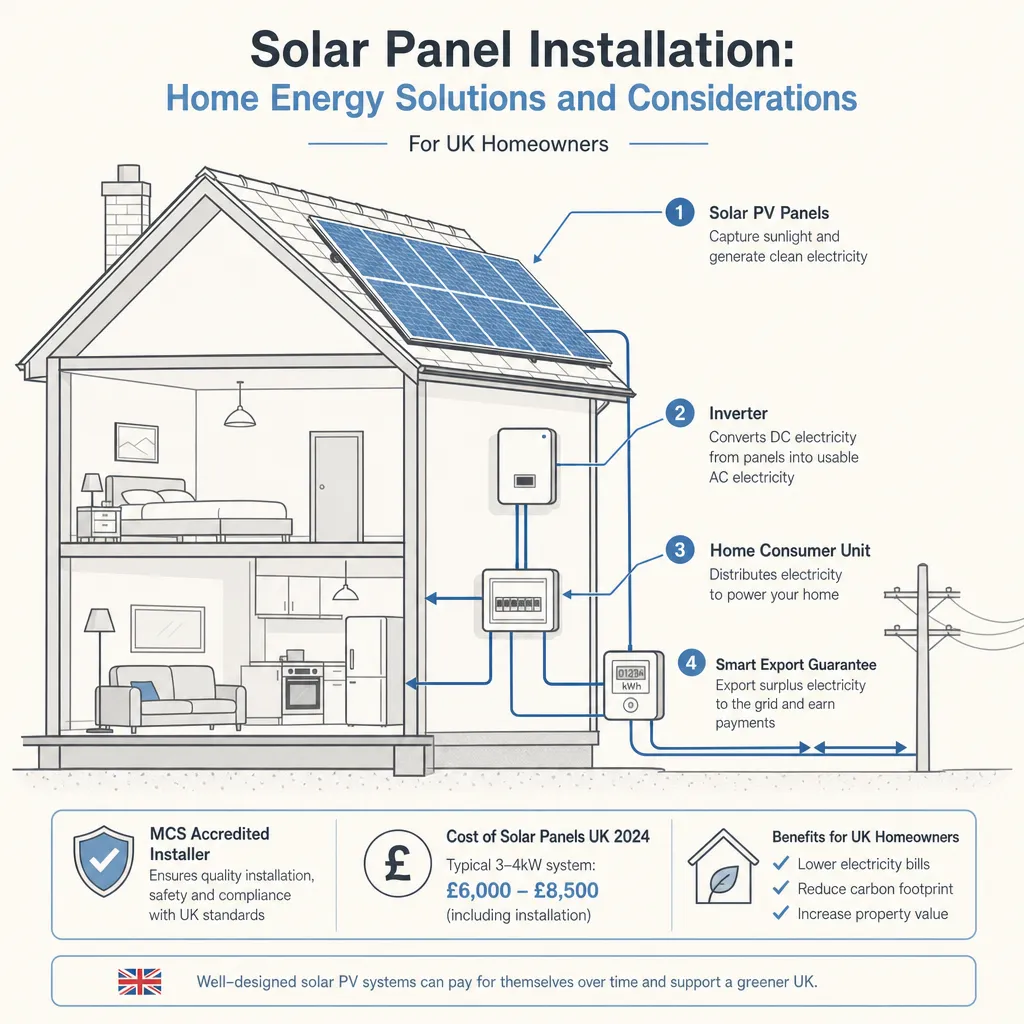
Solar Panel Installation: Home Energy Solutions and Considerations
A typical 4 kWp solar PV system costs £6,000–£9,000 installed and generates around 3,400–3,800 kWh per year on a south-facing roof in southern England.
 Energy & Retrofit
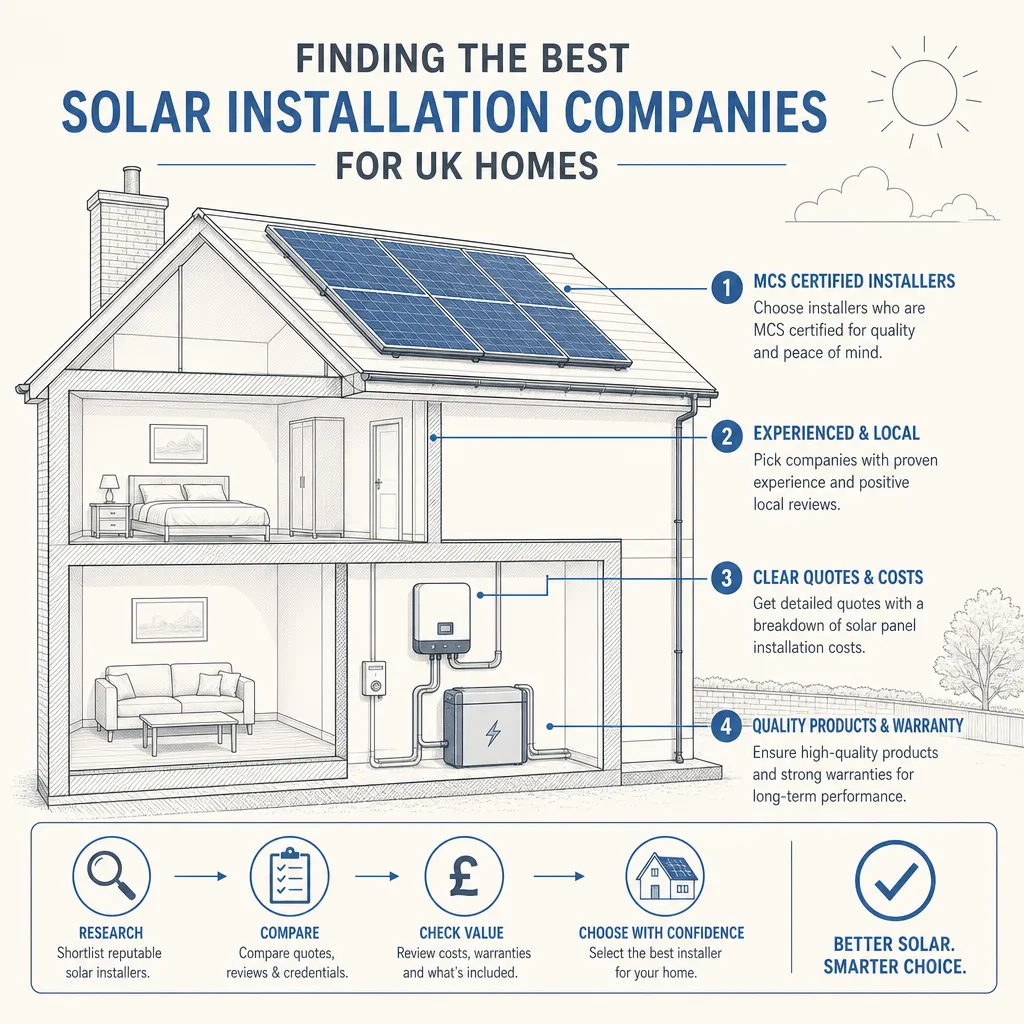
Finding the Best Solar Installation Companies for UK Homes
To find a reliable solar installation company in the UK, look for MCS (Microgeneration Certification Scheme) certification — required for Smart Export Guarantee eligibility — plus NICEIC or NAPIT electrical registration.
 Energy & Retrofit
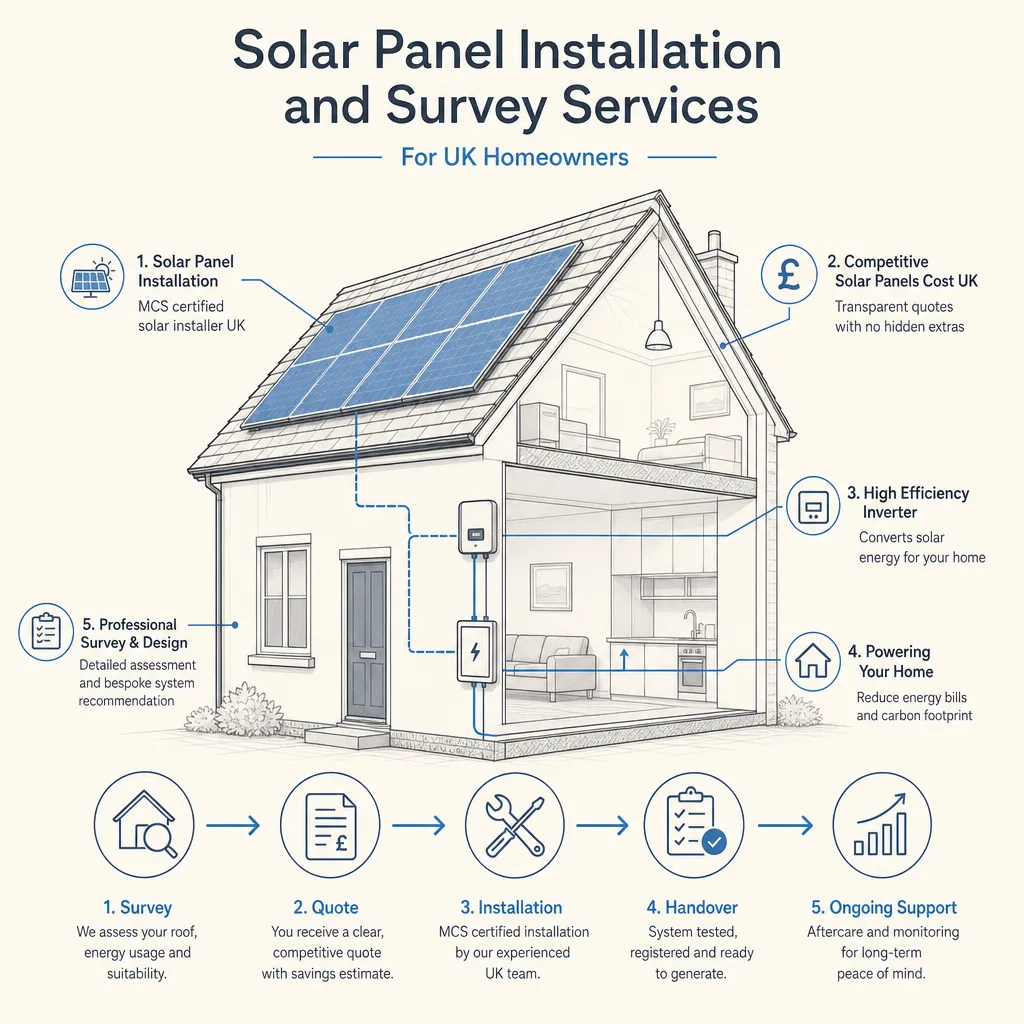
Solar Panel Installation and Survey Services
Solar panel installation in the UK involves a pre-installation roof survey, system design, MCS-accredited fitting, and notification to your Distribution Network Operator (DNO).
 Energy & Retrofit
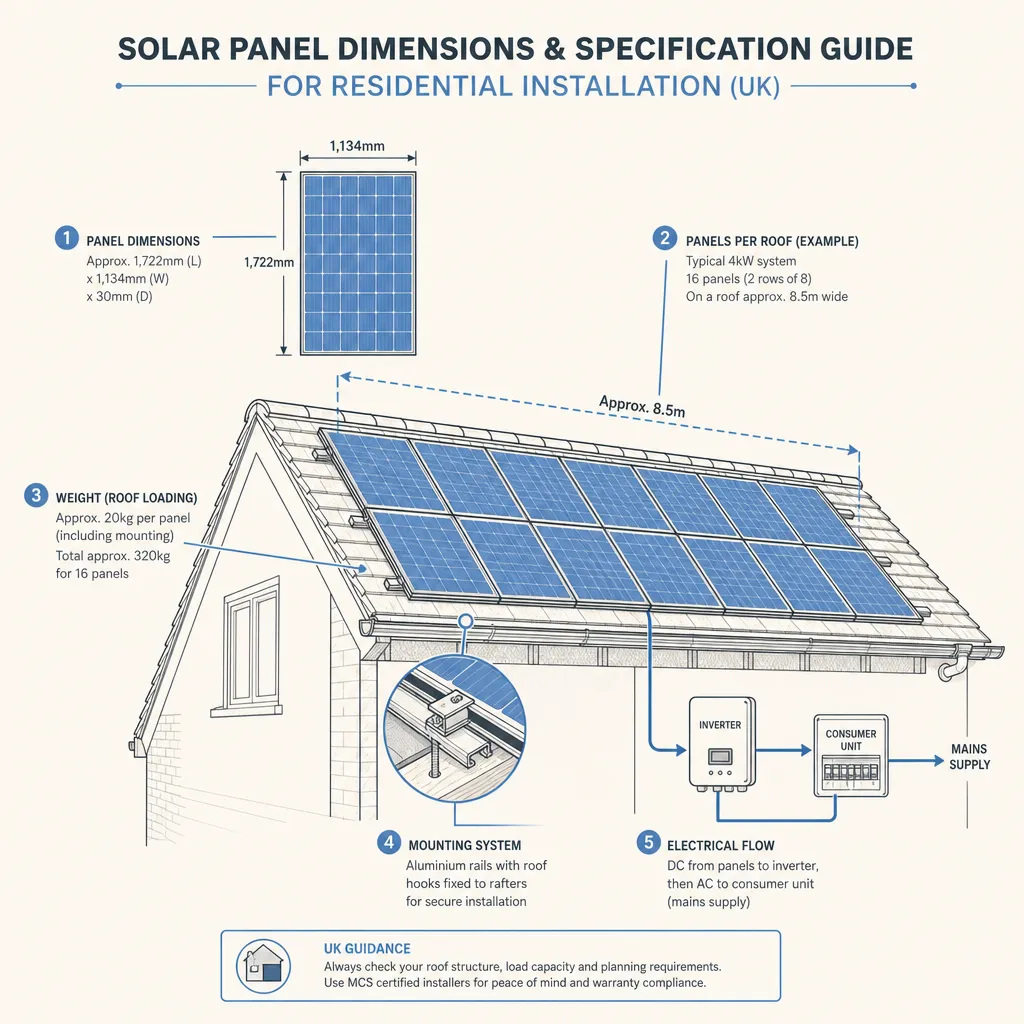
Solar Panel Dimensions and Specification Guide for Residential Installation
A standard residential solar panel measures approximately 1700–1800mm × 1000–1050mm, weighs 18–22 kg, and produces 380–450 W.
 Energy & Retrofit
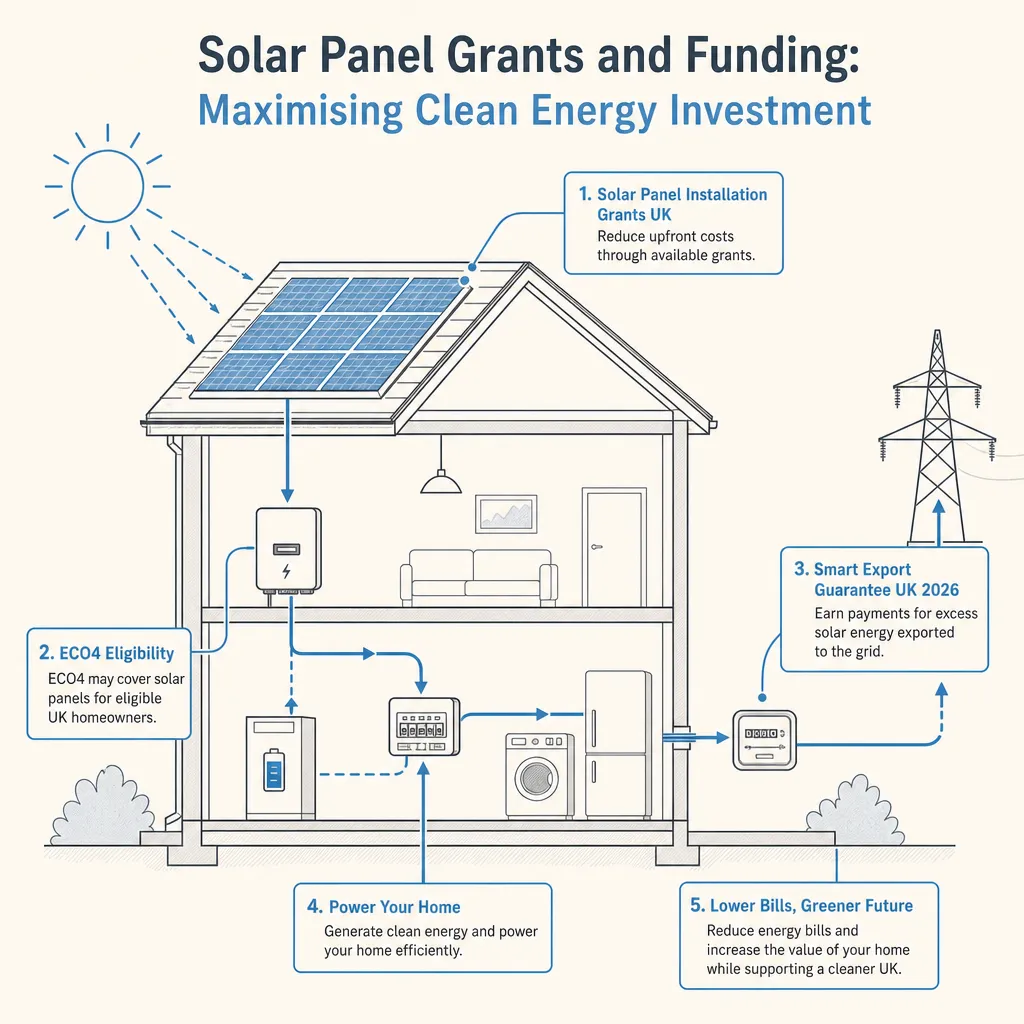
Solar Panel Grants and Funding: Maximising Clean Energy Investment
Several UK solar funding schemes are currently open: the Smart Export Guarantee pays homeowners for surplus electricity exported to the grid, ECO4 can fund free or subsidised panels for eligible low-income households, and 0% VAT on installation applies until at least March 2027.