Finding and Evaluating Properties With Renovation Potential
By Housey · Last reviewed 9th of May 2026
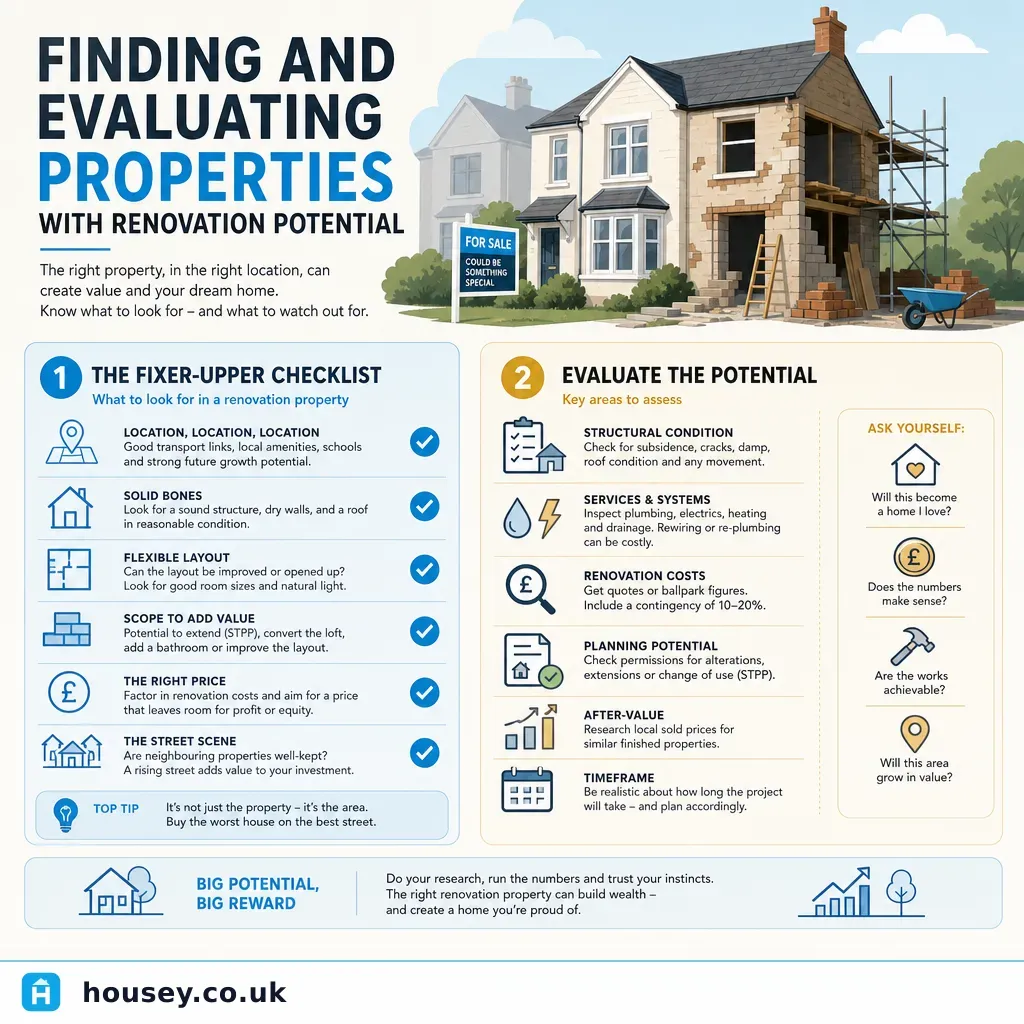
Finding and Evaluating Properties With Renovation Potential
Renovation projects account for a significant share of residential transactions in England and Wales each year, from post-war semis in need of rewiring and fresh insulation to Victorian terraces where visible defects have suppressed the asking price. The decision to buy a project property carries real financial risk: under English property law, condition is not warranted by the seller and the principle of caveat emptor (buyer beware) applies, meaning due diligence rests entirely with you. The cost and complexity of hidden defects makes careful pre-purchase assessment essential before committing to any renovation purchase.
Key points
- A RICS Level 3 Building Survey is the appropriate inspection for any property in poor condition, of unusual construction, or where significant structural works are planned — a Level 2 may miss defects that matter in a renovation context.
- Under the Town and Country Planning (General Permitted Development) (England) Order 2015, single-storey rear extensions require planning permission if they exceed 4m depth for detached houses or 3m for semi-detached and terraced properties.
- Properties built before 2000 may contain asbestos-containing materials (ACMs) in textured coatings, floor tiles, roof sheets, and pipe lagging — these must not be disturbed without a prior UKAS-accredited asbestos management survey.
- Japanese knotweed must be disclosed under the Consumer Protection from Unfair Trading Regulations 2008 and can affect mortgage eligibility with many lenders.
- Properties rated EPC Band F or G cannot currently be legally let in England and Wales under the Minimum Energy Efficiency Standards (MEES) regulations — fabric improvement works are required before rental is permitted.
What makes a property worth renovating?
A property has renovation potential when the cost of purchase plus realistic improvement costs leaves a meaningful margin below its improved market value — or when the improvement serves your own long-term living needs and you plan to stay. The gap between a tired property's asking price and its post-renovation value (often called the uplift) varies significantly by location, property type, and the nature of the works.
Cosmetic renovation — redecoration, new kitchen, bathroom refurbishment, floor covering — is lower risk because costs are more predictable and no regulatory approvals are typically required for like-for-like fitting.
Structural or fabric renovation — underpinning, roof replacement, repointing, damp remediation, rewiring, re-plumbing — carries more risk because hidden defects are common and costs can escalate substantially once work is underway.
Extension or conversion potential (loft, garage, side return) can add significant floor area and value, but requires planning and building regulations compliance that must be costed into the budget from the outset.
Renovation potential checklist — what to assess at viewing
Use this checklist at viewings to prioritise further investigation before making an offer.
Structural and fabric condition
Services and compliance
Planning and permitted development scope
Legal and environmental
Manageable vs costly renovation challenges
Issue | Typical management route | When it becomes serious |
|---|---|---|
Dated décor, kitchen, or bathroom | Cosmetic renovation; no approvals typically needed | — |
Single glazing | FENSA-registered window installer | Listed buildings or conservation areas may need specialist glazing approval |
Worn roof tiles | Qualified roofers, spot repairs or full re-cover | Full structural repair if rafters or sarking are failing |
Minor damp near window or door reveals | Improved ventilation and draught-proofing | Rising or penetrating damp needs specialist diagnosis before any treatment |
Old fuse board | NICEIC or NAPIT-registered electrician | Full rewire if wiring is pre-1970s rubber-insulated |
Suspected ACMs (pre-2000 property) | UKAS-accredited asbestos management survey before any works | Do NOT disturb; use a licensed removal contractor |
Japanese knotweed | PCA-accredited specialist treatment plan, typically 3–5 years | Can affect mortgage eligibility and prompt boundary disputes |
Subsidence cracks | Structural engineer assessment | Ongoing movement may require specialist underpinning |
Indicative UK costs: survey and specialist fees reviewed 2026-05-09. Actual costs vary by property and location — request itemised quotes.
Which survey do I need? Decision guide
- Choose a RICS Level 2 Home Survey if the property is a conventional post-1945 home in reasonable condition and you plan only cosmetic improvements.
- Choose a RICS Level 3 Building Survey if the property is pre-1919, shows visible defects, has had extensions or alterations, is of unusual construction (timber frame, thatched, concrete panel), or you plan significant structural works.
- Commission a structural survey if there are cracks suggesting movement, evidence of subsidence, or a general surveyor flags foundation concerns.
- Commission a specialist CCTV drainage survey if the property is Victorian or Edwardian and no recent drainage records exist — collapsed drains are a common and costly hidden defect.
- Commission an asbestos management survey via a UKAS-accredited surveyor before any intrusive works on a property built before 2000.
- Check with your local planning authority before assuming permitted development rights are available, particularly if previous extensions or outbuildings are already present.
Extension and conversion potential
Many buyers specifically target properties with unrealised space — a loft that could become a bedroom, a garage suitable for habitable conversion, or a side return that could extend the ground floor kitchen. Understanding the planning position before making an offer is essential.
Under the Town and Country Planning (General Permitted Development) (England) Order 2015, single-storey rear extensions up to 4m deep (detached) or 3m (semi-detached or terraced) can be built under permitted development without a full planning application. Extensions between 4–8m (detached) or 3–6m (semi-detached) require Prior Approval via neighbour consultation. These rights do not apply in conservation areas, World Heritage Sites, or to listed buildings, and may have been partially or fully used by previous owners.
A measured building survey — typically carried out by an architectural technologist or architect — produces accurate scaled floor plans and elevations as the starting point for any extension or conversion design and planning application.
Worked UK property scenario
Property: 1930s semi-detached, three bedrooms, outer southeast London. Asking price £480,000. Average post-renovation comparable on the same road: approximately £620,000.
Visible at viewing: Original metal Crittall windows, dated kitchen and 1970s bathroom, cracked render to rear elevation, single-skin garage, boiler replaced 2018, relatively modern consumer unit.
Survey findings (RICS Level 3 Building Survey, cost approx. £800): Render crack superficial — previous pointing failure, no structural movement detected; roof timbers sound; minor rising damp to rear bay; electrical wiring circa 1980 — functional but aged; textured ceiling coating (Artex) in one bedroom confirmed as containing asbestos fibres — noted, do not disturb.
Renovation scope identified: Render repair, window replacement (planning consent required — property is adjacent to a conservation area, confirmed via local planning authority portal), bathroom and kitchen refurbishment, partial rewire, damp treatment, garage conversion under permitted development rights. Pre-tender budget estimate: £80,000–£100,000.
Outcome: Purchaser negotiated a £25,000 reduction based on survey findings. Garage conversion tendered through extension builders. Total project underway within agreed budget envelope.
When to get professional help
Always commission a RICS Level 3 Building Survey before purchasing any property in poor condition or where significant renovation is planned. A survey fee of a few hundred pounds can identify defects costing tens of thousands pounds to remediate.
Seek specialist professional advice if:
- Visible cracking in external walls suggests structural movement
- The property predates 2000 and you plan any intrusive works (asbestos risk)
- Japanese knotweed or other invasive species are present or suspected
- The property is listed or in a conservation area
- You are relying on permitted development rights — verify they have not been used by previous owners
- A drain, roof, or electrical concern is flagged at survey — specialist surveys provide detail a general building survey cannot
How Housey can help
Housey connects buyers and homeowners with vetted professionals across the UK. Whether you need a RICS Level 3 Building Survey to understand a property's true condition, a structural survey for a property showing signs of movement, quotes from roofers for roof remediation, or extension builders to price up your renovation scope, you can request quotes from verified local providers through the Housey marketplace.
Frequently asked questions
How do I know if a property has good renovation potential?
Look for properties where cosmetic condition has suppressed the asking price below comparable improved homes nearby. Confirm the structure is sound (survey essential), planning constraints are manageable, and your total purchase-plus-renovation budget leaves a margin below finished comparable values. Research recent sold prices for similar finished properties locally using HM Land Registry data before committing to an offer.
Do I need planning permission to renovate a house in the UK?
Internal renovation work generally does not require planning permission. Extensions, roof alterations, and external changes to listed buildings or properties in conservation areas usually do require consent. Permitted development rights allow certain extensions without full planning permission, subject to size limits, location restrictions, and prior use by previous owners. Always check with your local planning authority before starting any external works.
What surveys do I need before buying a renovation property?
A RICS Level 3 Building Survey is strongly recommended for any property in poor condition or where significant works are planned. Depending on findings and property age, you may also need a structural engineer's report, CCTV drainage survey, or asbestos management survey. Budget approximately £700–£1,000 for a Level 3 survey on a typical house; specialist reports are additional. Costs are indicative, last reviewed 2026-05-09.
Can I get a mortgage on a derelict or uninhabitable property?
Standard residential mortgages are generally unavailable on properties deemed uninhabitable by lenders. Specialist renovation and bridging finance products exist but carry higher rates and arrangement fees. Some self-build mortgage products release funds in stages tied to build milestones. A whole-of-market mortgage broker experienced in renovation finance can advise on the most suitable products for your specific purchase.
What is a measured building survey and when do I need one?
A measured building survey produces accurate scaled floor plans, elevations, and sections of an existing property. It is the essential starting point for any extension, loft conversion, or significant alteration, giving your architect or architectural technologist the precise data needed for planning applications and design drawings. Costs typically start from around £500–£800 for a modest house; larger or more complex properties cost proportionally more.
Sources and further reading
Useful next reads
 Improvement & Build
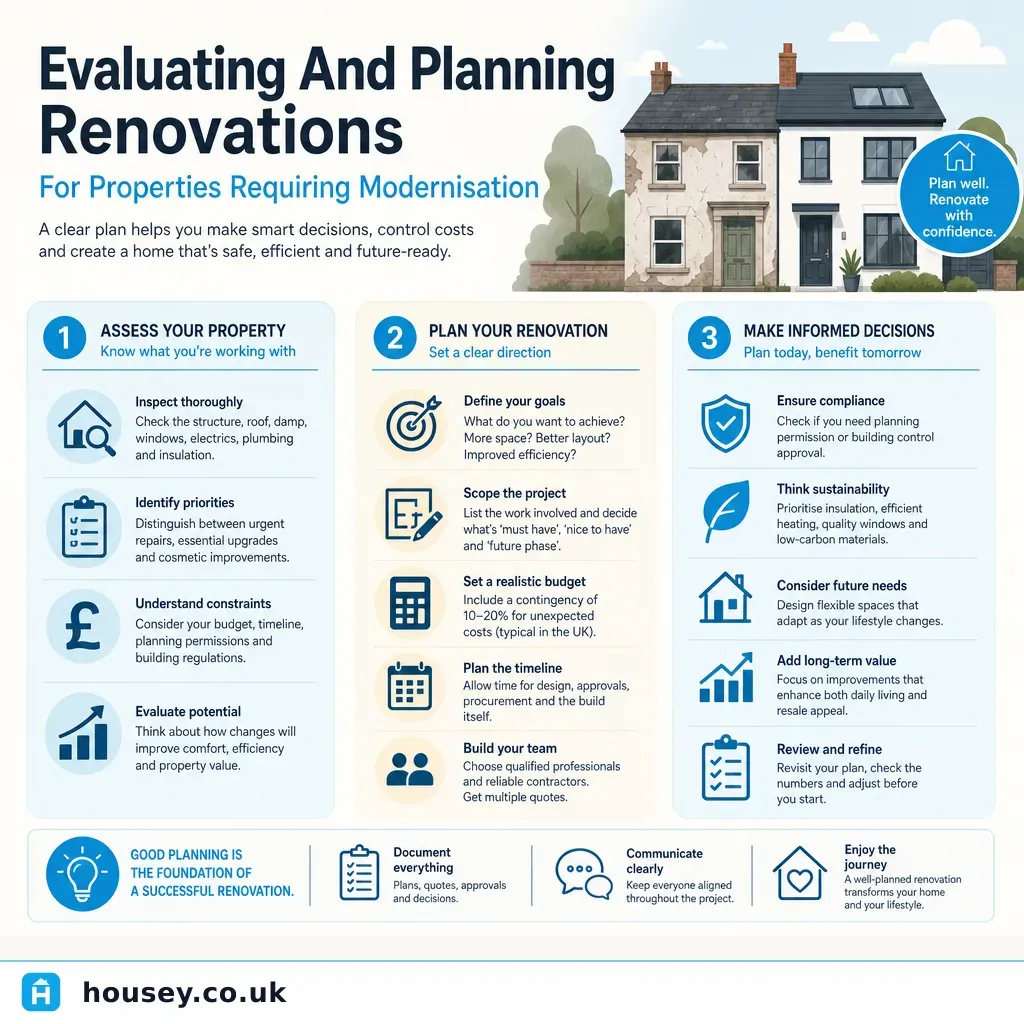
Evaluating And Planning Renovations For Properties Requiring Modernisation
Start by commissioning a condition survey — RICS Level 3 for pre-1919 properties — to identify structural defects, damp, and services issues before finalising a budget.
 Improvement & Build
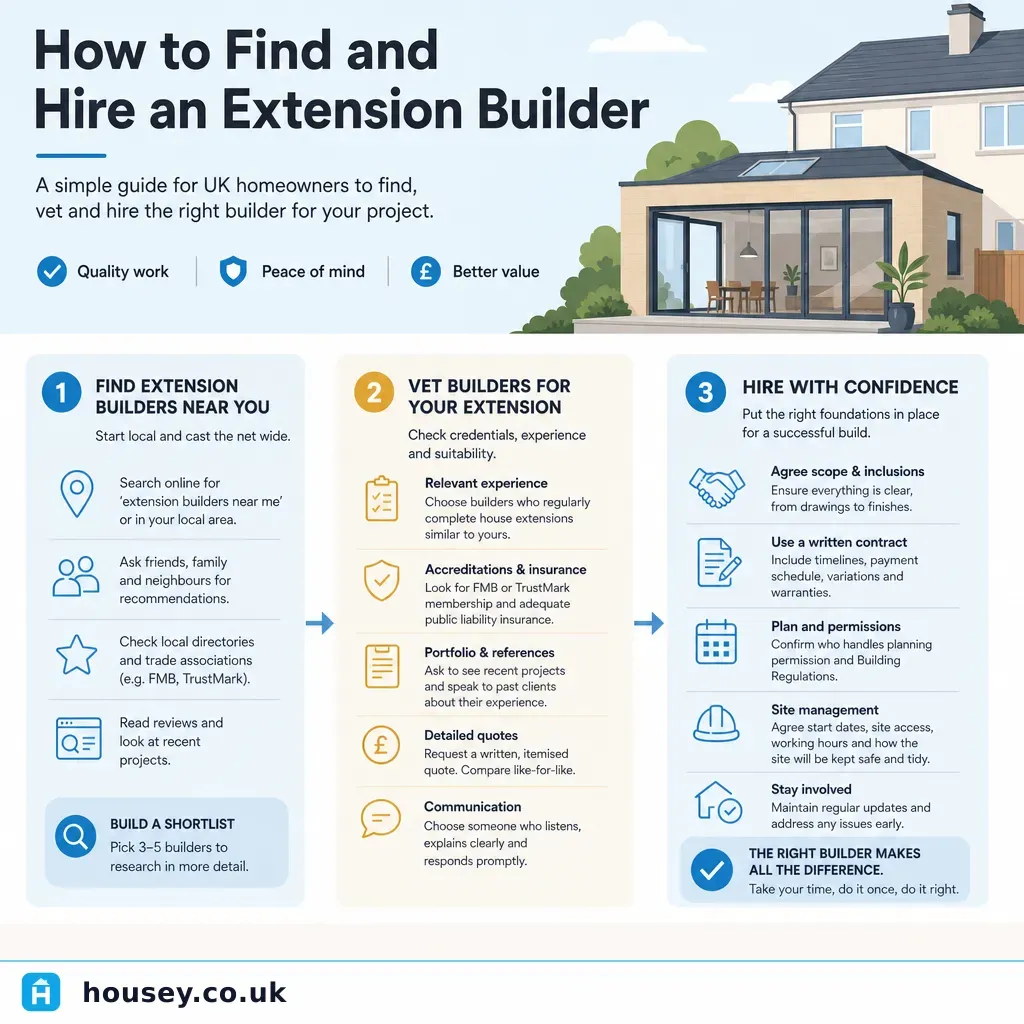
How to Find and Hire an Extension Builder
To hire a reliable extension builder, get at least three detailed written quotes from contractors with documented experience of similar projects.
 Improvement & Build
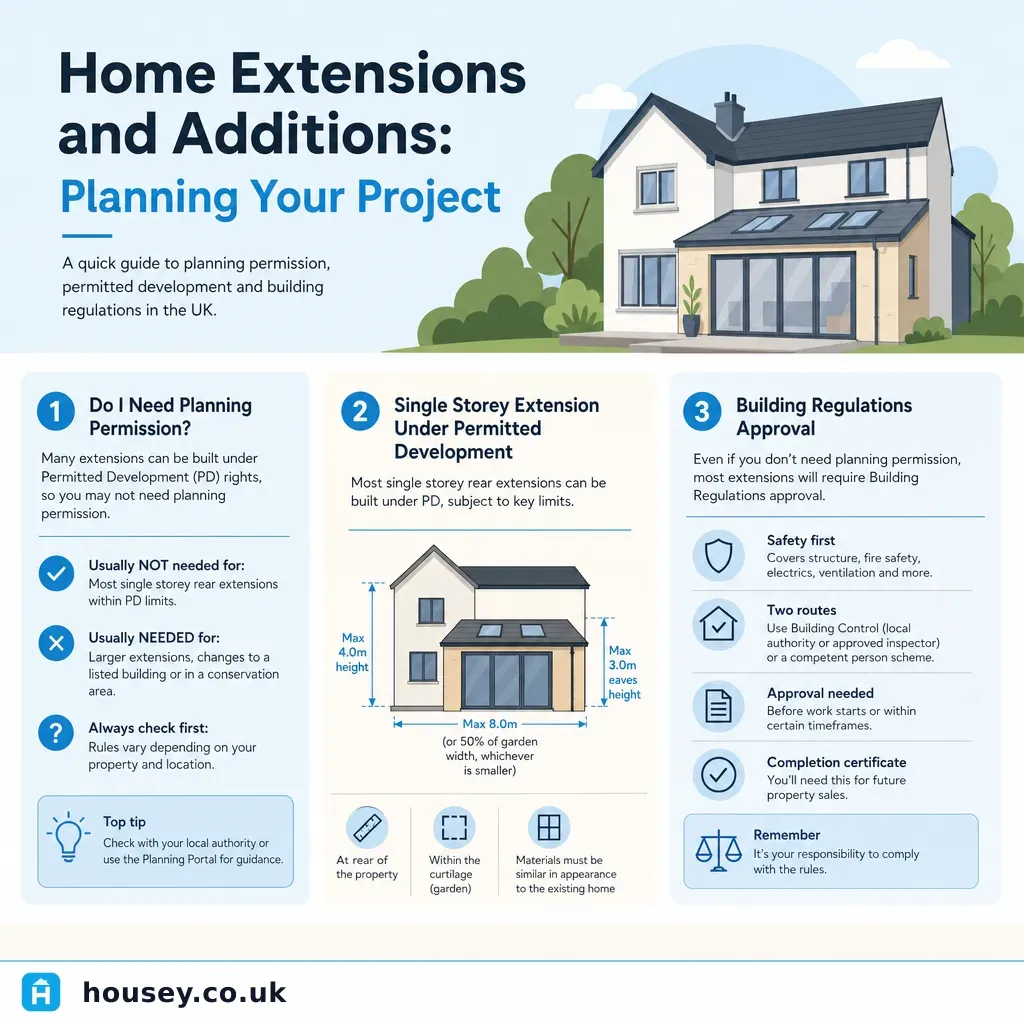
Home Extensions and Additions: Planning Your Project
Most single-storey rear extensions can be built under permitted development without a full planning application, provided they stay within depth limits of 4 m for detached or 3 m for semi-detached and terraced properties.
 Improvement & Build
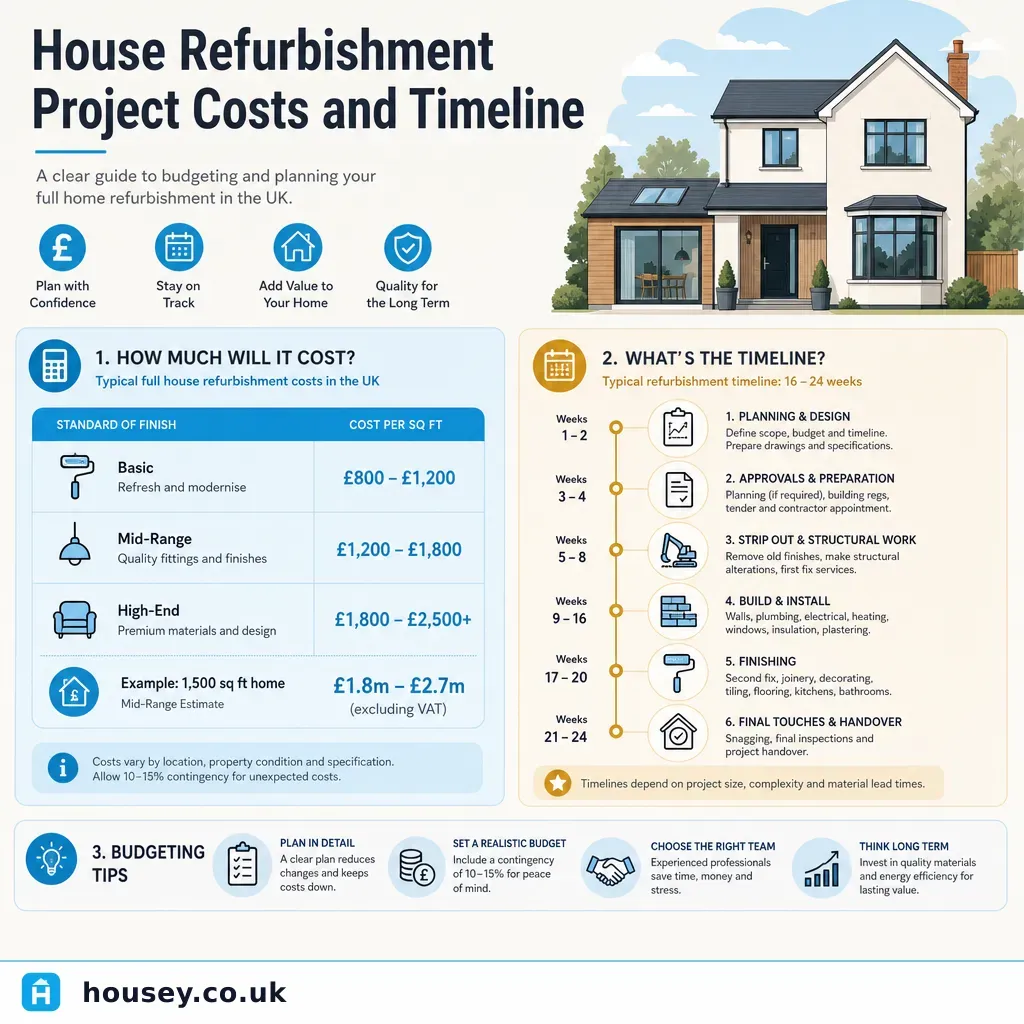
House Refurbishment Project Costs and Timeline
A full house refurbishment in the UK typically costs £30,000–£225,000+ depending on property size, scope, and location.
 Improvement & Build
Building During Wet Weather: Managing Construction in Rain
Rain affects different construction stages differently.