Finding Extension Builders For Your Home Addition
By Housey · Last reviewed 31st of May 2026
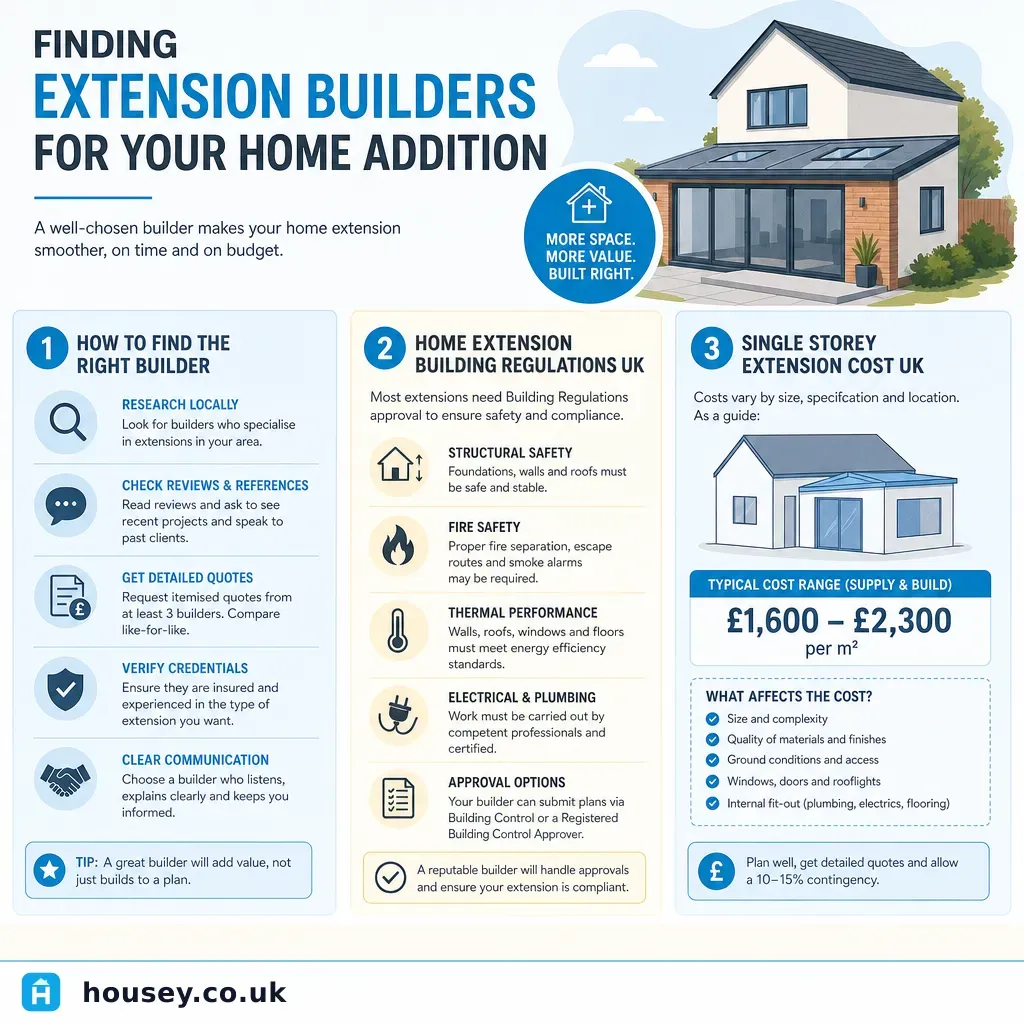
Finding Extension Builders For Your Home Addition
Home extensions account for tens of thousands of planning applications each year in England alone, and many more proceed under permitted development without formal planning consent. Choosing the right builder — rather than just the cheapest quote — is one of the most consequential decisions in any extension project, affecting structural safety, build quality, regulatory compliance, and your ability to sell or remortgage the property in future.
Key points
- Building Regulations approval is required for virtually all home extensions in England, Wales, Scotland, and Northern Ireland, regardless of whether planning permission is needed; work must be inspected by building control or a registered competent person scheme.
- Extension contracts should always be in writing; the JCT Minor Works Building Contract (or similar) provides a standard framework for payment stages, variations, defects liability, and dispute resolution.
- Builders working on extensions do not require a specific statutory licence in England (unlike gas or electrical work), so vetting credentials, insurance, and references is the homeowner's primary safeguard.
- The Construction Industry Training Board (CITB) levy applies to contractors with an annual wage bill above £120,000; using a CITB-registered contractor is one indicator of a legitimate, established business.
- A structural engineer will typically be required to sign off on RSJ (Rolled Steel Joist) beam calculations where an internal wall is being removed as part of the extension design — this is a separate appointment from the builder.
What type of extension are you building?
The first step is to be clear about the scope of the project, as this determines which professionals you need and in what order.
Single-storey rear extension
The most common type. Under permitted development in England, a single-storey rear extension up to 3 m deep (attached house) or 4 m deep (detached house) can proceed without planning permission, subject to conditions including height limits and proximity to boundaries. Extensions beyond these depths require a householder planning application. Building Regulations apply in all cases.
Double-storey or two-storey extension
Almost always requires a planning application. The proximity of the extension to neighbouring properties and the impact on party walls become more significant. A structural engineer's involvement in beam and foundation design is standard.
Side extension or wrap-around extension
Side extensions under permitted development must not result in a building wider than half the width of the original dwelling. Wrap-around extensions (rear plus side) require careful design to avoid creating an unduly dominant addition — a potential grounds for planning refusal.
Loft conversion with rear dormer
Technically a roof alteration rather than a ground-floor extension, but often delivered by the same type of contractor. Specific structural, fire safety, and means-of-escape requirements apply under Building Regulations Part A and Part B.
Single-storey versus double-storey: a comparison
Feature | Single-storey rear | Double-storey |
|---|---|---|
Planning permission (typical) | Not usually required within PD limits | Usually required |
Building Regulations | Always required | Always required |
Structural engineer | Often needed for steelwork and foundations | Almost always needed |
Party Wall Act | May apply if within 3–6 m of neighbour's foundation | Likely applies |
Typical build duration | 10–16 weeks | 16–28 weeks |
Indicative cost range | £25,000–£60,000+ (varies by size, spec, region) | £50,000–£150,000+ |
Indicative UK costs, last reviewed 2026-05-31. Costs vary significantly by region, specification, site conditions, and market conditions. Obtain at least three quotes.
How to find and vet extension builders
The absence of statutory licensing for general builders in England means that the vetting process falls squarely on the homeowner.
Where to find candidates
- Personal recommendation from neighbours, family, or friends who have had similar work done recently is the highest-quality source.
- FMB (Federation of Master Builders) — members are independently vetted and sign up to a code of conduct and dispute resolution scheme. Search the FMB Find a Builder tool at fmb.org.uk.
- TrustMark — government-endorsed quality scheme for home improvement work. Find registered firms at trustmark.org.uk.
- Local architect or structural engineer recommendation — if you are using a designer, ask which builders they have worked with successfully on similar projects.
- Review platforms — useful for initial research, but verify reviews independently and check that the company matches the registered legal entity on Companies House.
Key checks before inviting tenders
- Verify the business exists at Companies House (free search). Check how long it has been registered and whether any prior companies associated with the directors have been dissolved.
- Ask for a copy of public liability insurance (minimum £2 million for most extension work) and employers' liability insurance (legally required where the contractor employs staff).
- Check that they have experience in comparable projects — a builder who specialises in new-build commercial work may lack experience with the particular constraints of domestic extensions in existing properties.
- Ask for references from two or three recent similar projects and follow them up with a phone call.
What to ask before accepting a quote
Use this checklist when comparing quotes from extension builders:
- What is included and excluded? (Foundations, steelwork, roofing, glazing, internal finishes, electrics, plumbing — which trade elements are covered?)
- Who will carry out the structural work, and will beam calculations be provided and signed off by a structural engineer?
- Who will liaise with building control and manage inspections throughout the project?
- What payment stages are proposed, and does the contract provide for a retention (typically 2.5–5%) held back until the end of the defects liability period?
- What is the proposed start date and programme, and what are the provisions if the project runs over?
- Is VAT included in all figures?
- What is the procedure if unexpected groundwork or structural conditions are found?
- Will you be given a copy of the building control completion certificate at the end?
Procurement routes: which approach suits your project?
There is more than one way to manage an extension project, and the right approach depends on the scale, your confidence as a client, and whether you have already appointed a designer.
Traditional (design, then tender)
You appoint an architect or designer separately to produce detailed drawings and a specification. You then obtain tenders from builders based on those drawings. The designer can also act as contract administrator, reviewing progress and certifying payments. Most appropriate for larger or complex projects.
Design and build
You appoint a single contractor who handles both design and construction. Simpler and sometimes faster, but you lose independent oversight of design quality. Most appropriate for straightforward single-storey extensions with standard specifications.
Self-managed and direct labour
You appoint individual trades yourself (groundworker, bricklayer, joiner, electrician, plumber, plasterer) and manage the programme. Can reduce costs but places project management responsibility entirely on you. Not recommended for first-time clients or complex projects. If you are uncertain how to manage the process, a project manager can oversee the contractor on your behalf.
When to get professional help
Specialist professional input is not optional on most extensions — it is a regulatory or practical necessity. Seek advice before starting work if:
- Any internal walls are being removed, which requires a structural engineer to design the beam and specify foundation requirements.
- The extension is within 3 m of a shared boundary or 6 m of a neighbour's foundation at the same depth (Party Wall etc. Act 1996 likely applies — seek a party wall surveyor).
- The project involves flat roof construction, underpinning, or significant below-ground drainage diversions.
- You are uncertain whether your project falls within permitted development limits.
- You are in a conservation area, Article 4 direction area, or own a listed building (additional restrictions apply).
How Housey can help
Housey makes it straightforward to find vetted extension builders and project managers in your area. Submit your project details once and compare quotes from experienced local contractors, including full scope, programme, and references.
Frequently asked questions
Do I need an architect before finding a builder for an extension?
Not necessarily, but it is usually advisable for anything other than a very simple single-storey extension. An architect or architectural technologist produces the drawings needed for planning permission (where required) and Building Regulations submission. These drawings form the basis of your builder's quote, so having them prepared before tendering usually results in more accurate and comparable quotes.
What insurance should an extension builder have?
Extension builders should hold public liability insurance (typically £2 million minimum cover) and employers' liability insurance if they employ staff. Ask for a copy of the current certificate from the insurer, not just a verbal confirmation. You may also consider a structural warranty (such as an NHBC product or similar) for larger projects, which can assist with mortgage lender requirements and protects against future latent defects.
How long does a typical single-storey extension take to build?
Indicative timescales, last reviewed 2026-05-31. From breaking ground, a typical single-storey rear extension takes 10–16 weeks to reach practical completion, depending on size, specification, and the pace of trades. The pre-build phase — planning (if required), Building Regulations drawings, structural engineering, and tendering — typically adds 6–14 weeks before site work begins, so allow 4–8 months from project initiation to practical completion.
What is a building control completion certificate and why do I need it?
A building control completion certificate (or final certificate if using an approved inspector) is issued at the end of a project to confirm that the work has been inspected and meets Building Regulations. It is routinely requested by mortgage lenders and solicitors during property sales and remortgages. Without it, the extension may be considered unauthorised building work, which can complicate or delay a future sale.
Sources and further reading
- Permitted development rights for householders: technical guidance — GOV.UK
- Building Regulations approval — GOV.UK
- Party Wall etc. Act 1996: explanatory booklet — GOV.UK
- FMB Find a Builder — Federation of Master Builders
- TrustMark registered businesses — TrustMark
- JCT Minor Works Building Contract — JCT
Useful next reads
 Improvement & Build
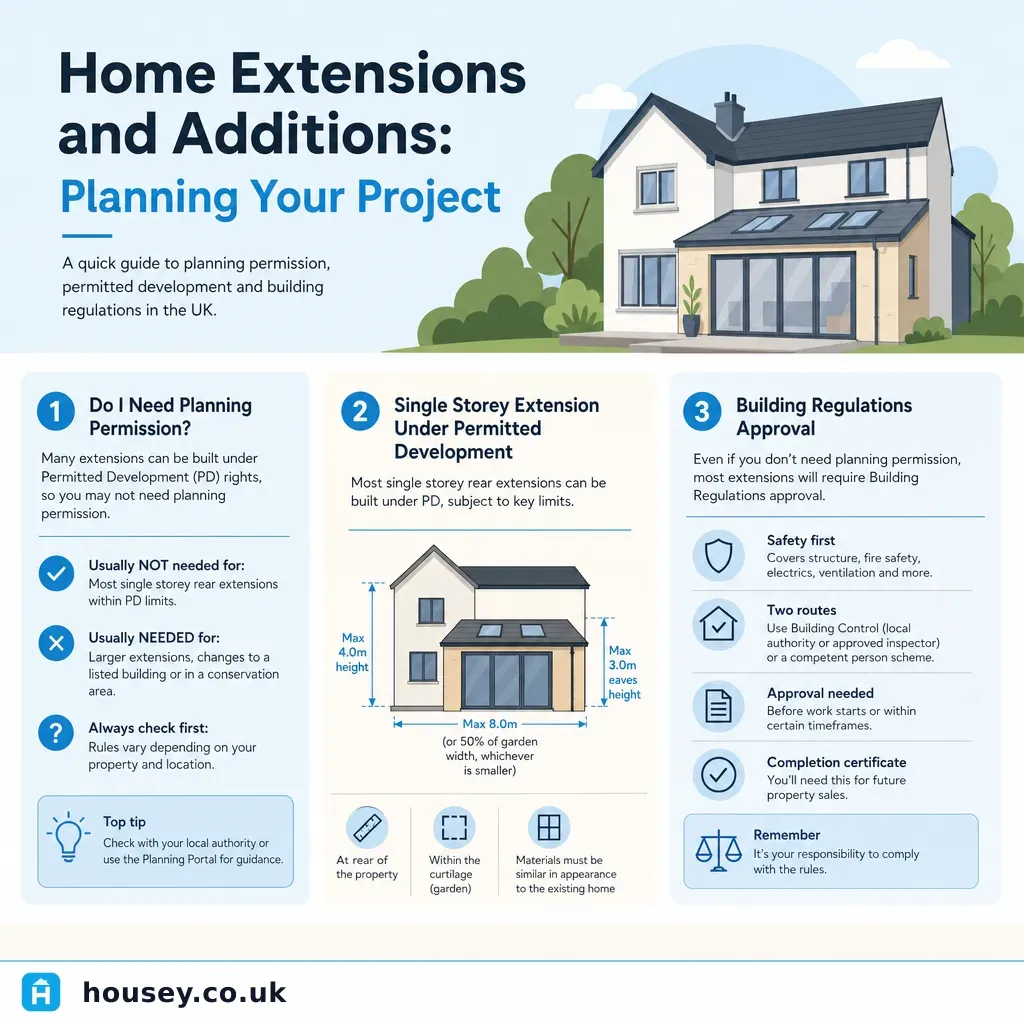
Home Extensions and Additions: Planning Your Project
Most single-storey rear extensions can be built under permitted development without a full planning application, provided they stay within depth limits of 4 m for detached or 3 m for semi-detached and terraced properties.
 Improvement & Build
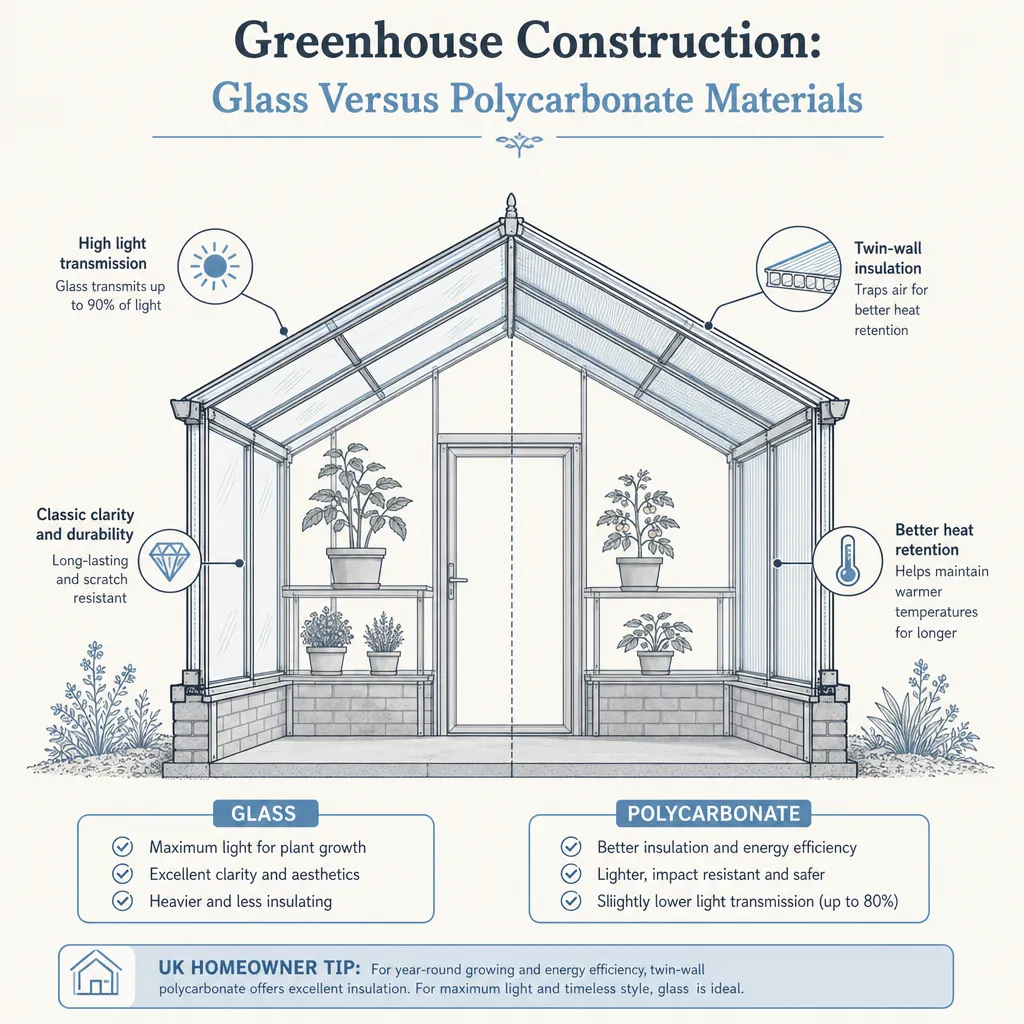
Greenhouse Construction: Glass Versus Polycarbonate Materials
Glass transmits around 90% of available light and lasts indefinitely if unbroken, but insulates poorly and shatters into sharp fragments.
 Improvement & Build
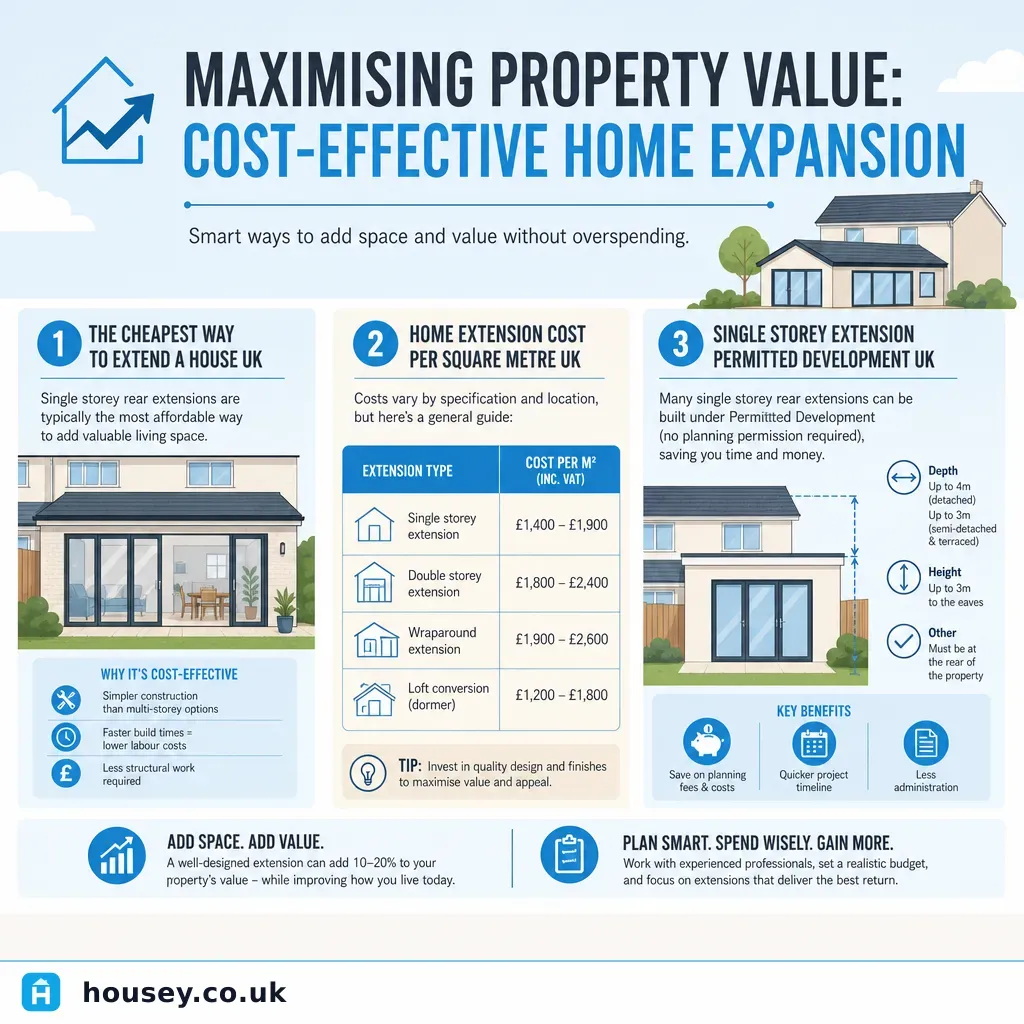
Maximising Property Value: Cost-Effective Home Expansion
A cost-effective home extension in the UK typically starts with a single-storey rear extension under permitted development, using an extension builder or design-and-build firm to control costs.
 Improvement & Build
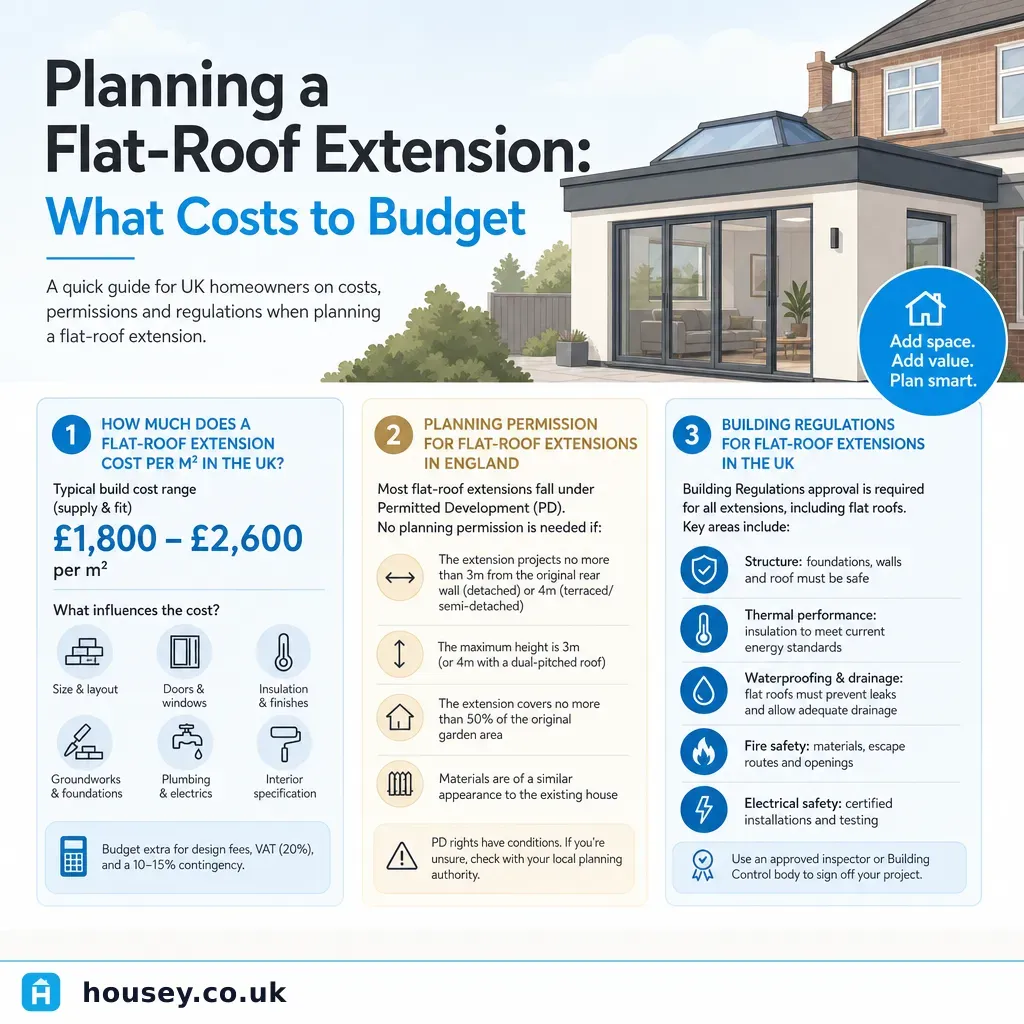
Planning a Flat-Roof Extension: What Costs to Budget
A flat-roof single-storey extension typically costs £1,500–£3,000 per m² in the UK, depending on size, specification, location, and roof membrane choice.
 Improvement & Build
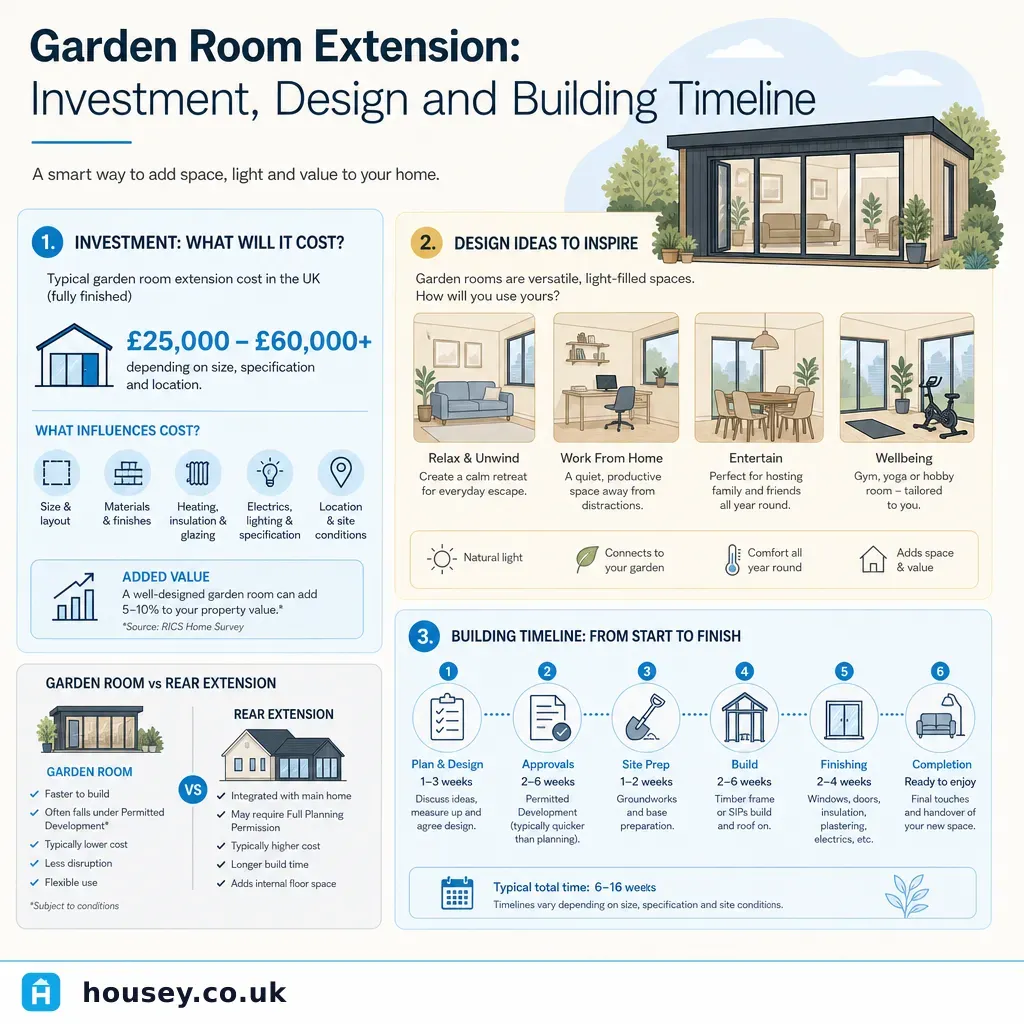
Garden Room Extension: Investment, Design and Building Timeline
A garden room or garden extension can add usable year-round space without always requiring planning permission.