Maximising Property Value: Cost-Effective Home Expansion
By Housey · Last reviewed 8th of May 2026
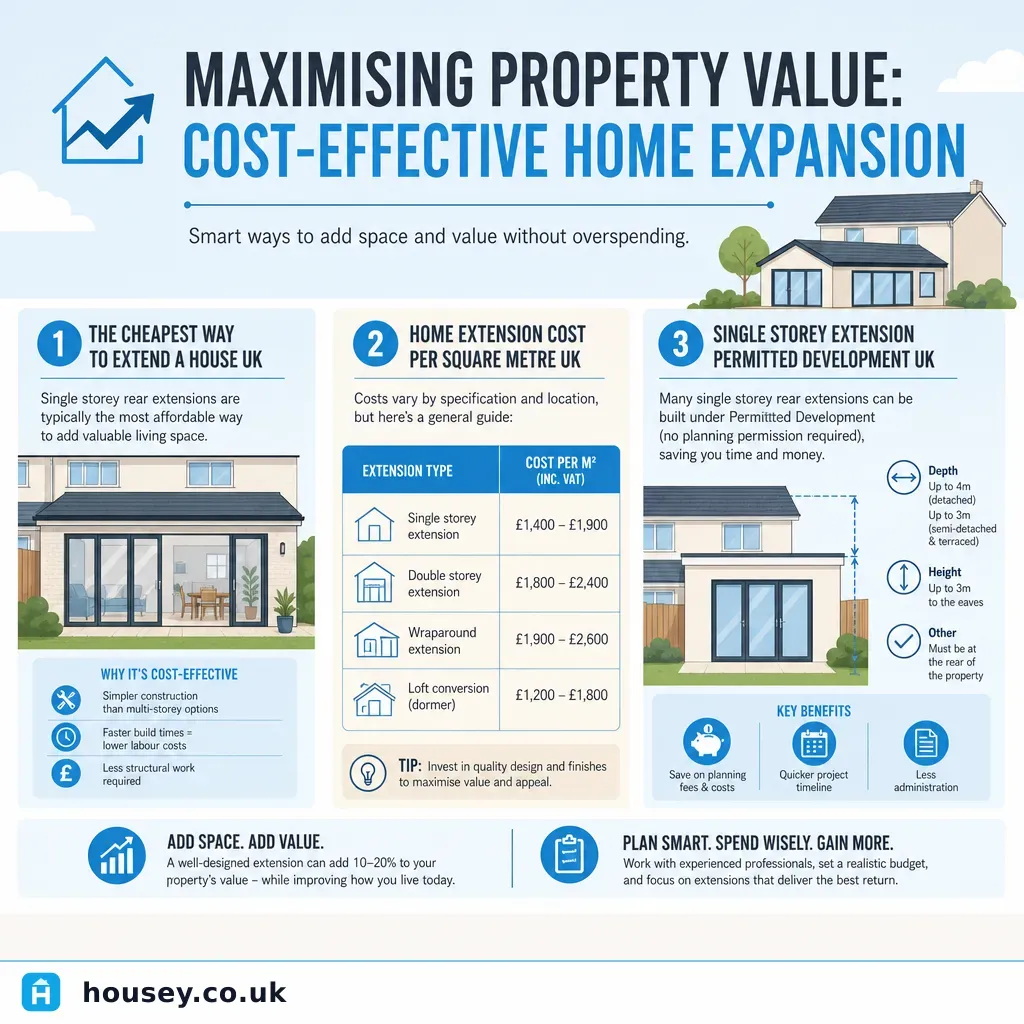
Maximising Property Value: Cost-Effective Home Expansion
When a household needs more space, the choice of expansion route involves more than build cost — it affects planning risk, disruption, timescale, and the value the market will place on the result when the property eventually sells. The difference between a project that adds genuine value and one that absorbs budget without proportionate return usually comes down to decisions made before a spade enters the ground: the choice of expansion type, the quality of the cost estimate, and the clarity of the specification before contractors are approached.
Key points
- Single-storey rear extensions up to 4m deep (detached houses) or 3m deep (semi-detached and terraced) often qualify as permitted development in England, avoiding a formal planning application.
- Building Regulations approval is required for all extensions regardless of permitted development status — covering structural integrity, thermal performance (Part L), fire safety (Part B), and drainage.
- Indicative UK build costs range from approximately £1,500–£2,500 per m² for a basic single-storey extension, rising to £3,500+ per m² for high-specification or two-storey work (Indicative UK costs, last reviewed 2026-05-08; regional variation is significant).
- A professional build cost estimate produced before design is finalised is the single most effective way to prevent the most common cause of project overruns: scope agreed without a reliable budget.
- Adding a bedroom — particularly converting a two-bedroom to three, or three to four — typically produces the most measurable impact on sale value in most UK housing markets.
Comparing home expansion options
Not all home expansions deliver the same value-for-money. The right choice depends on your property's structure, planning history, local constraints, and how the extra space will be used.
Expansion type | Permitted development likely? | Indicative cost per m² | Best suited to | Main risk to manage |
|---|---|---|---|---|
Single-storey rear extension | Often yes (with conditions) | £1,500–£2,500 | Kitchen-diner enlargement, utility, family room | Ground conditions; drainage diversions |
Double-storey rear extension | Usually requires planning | £1,800–£2,800 | Adding bedroom plus living space | Party Wall Act; neighbour objections |
Side-return extension | Sometimes yes (conditions apply) | £1,800–£3,000 | Victorian and Edwardian terraces | Narrow build; foundations; drainage |
Loft conversion (dormer) | Often yes (conditions apply) | £1,200–£2,000 | Adding bedroom and bathroom upstairs | Structural load; head height; party wall |
Garage conversion | Often yes (conditions apply) | £800–£1,500 | Home office, playroom, ground-floor bedroom | Insulation; damp; loss of parking |
Wrap-around (side + rear) extension | Usually requires planning | £2,000–£3,500 | Larger combined rear and side transformation | Planning scrutiny; higher cost complexity |
Indicative UK costs, last reviewed 2026-05-08. All figures are approximate and vary by region, specification, and site conditions. London and the South East typically run 20–40% higher than the Midlands and North. Obtain at least three detailed quotes before setting a budget.
Planning and permitted development: what to check first
Permitted development rights allow many common extensions without a formal planning application, subject to conditions. For single-storey rear extensions in England under Schedule 2, Part 1 of the Town and Country Planning (General Permitted Development) (England) Order 2015:
- Maximum depth of 4m for detached houses; 3m for semi-detached and terraced houses
- Maximum height of 4m, or 3m if the extension is within 2m of a boundary
- The extension must not project beyond the principal elevation fronting a highway
- The property must not be in a conservation area, Area of Outstanding Natural Beauty, or National Park for the larger allowances
Prior Approval (neighbour consultation scheme) allows extensions between 4–8m deep (detached) or 3–6m deep (other houses) without a full planning application, provided no valid neighbour objections arise within 21 days of council notification.
For any extension that cannot meet permitted development conditions — including those on listed buildings, in conservation areas, or where previous extensions have used the allowance — a full planning application is required. Article 4 Directions can also remove permitted development rights in specific areas; always verify with your local planning authority before starting work.
Controlling build costs: the decisions that matter most
The most common cause of home extension projects exceeding budget is scope changes during construction and design committed to without a credible cost check.
Before design is finalised
- Commission a build cost estimate from a quantity surveyor or cost consultant before approving the final design — this establishes a realistic budget while changes are still inexpensive.
- Decide on specification early: glazing quality, kitchen specification, flooring, and finishes can together vary the total cost by tens of thousands of pounds.
- Clarify what is included and excluded: groundworks, drainage diversions, Party Wall Act surveyor fees, structural engineer fees, and Building Regulations application fees are frequently omitted from early contractor estimates.
Quote comparison checklist
Before accepting any quote for a home extension, confirm the following in writing:
- Is VAT included? Most builders quote exclusive of VAT — add 20% to the net figure.
- What does the groundworks allowance cover, and what assumptions is it based on?
- Are Building Regulations application fees and inspection visits included?
- Who is responsible for producing structural engineer's drawings?
- What drainage assumptions has the contractor made?
- If the extension is close to a shared boundary, are Party Wall Act surveyor costs included?
- What is the payment schedule, and is there a retention arrangement?
- What is the procedure if unforeseen conditions arise — deeper foundations, hidden drainage, or contaminated ground?
- What warranties or insurance-backed guarantees (IBGs) are provided on completion?
Which professional do you need?
Use this decision tree to match your project to the right professional:
- Choose a design-and-build firm if you want a single contract covering design and construction, prefer a fixed-price arrangement, and the project is of standard type and scale.
- Choose an architect or architectural technologist plus a separately tendered builder if you want independent design input, intend to go to competitive tender, or the project involves planning complexity or significant internal remodelling.
- Choose an extension builder if you already have approved planning drawings, a Building Regulations specification, and want to proceed directly to construction quotes.
- Commission a build cost estimating service if you are in early planning and need a reliable budget figure before committing to design fees or a purchase decision.
- Appoint a project manager if the project is multi-phase, involves multiple separate contractors, you cannot be present on site regularly, or the contract value is significant.
- Consult your local planning authority if your property is in a conservation area, is listed, or has had previous extensions that may affect remaining permitted development allowance.
What the market actually rewards
Extensions are not automatically the highest-value spend per pound. General principles that apply across most UK housing markets:
- Adding a bedroom (particularly two-bedroom to three, or three to four) has the most consistently measurable impact on sale value. The extra bedroom expands the buyer pool.
- Open-plan kitchen-diners remain popular, but the value premium depends heavily on local market and buyer profile — in some areas it is well rewarded; in others, buyers prefer defined rooms.
- Loft conversions with en-suite bathrooms add value in most urban and suburban markets and typically cost less per m² than a ground-floor extension.
- Garage conversions add practical space at low cost per m², but in areas where off-street parking is scarce, removing a garage may reduce appeal to buyers.
Value projections should be treated with caution. Estate agents can give informal guidance, but no renovation carries a guaranteed return, and build costs can significantly erode margins in lower-value markets.
When to get professional help
Every extension requires at minimum a Building Regulations application — this is not optional and applies regardless of permitted development status. For anything beyond a simple single-storey addition to a standard house on unconstrained ground, commission a structural engineer and a quantity surveyor or cost consultant before agreeing a contract.
If you are uncertain whether planning permission is required, a pre-application enquiry to your local planning authority — or a brief consultation with a planning consultant — costs far less than retrospective enforcement action.
How Housey can help
Housey makes it straightforward to find and compare vetted professionals for your home extension project. Whether you need extension builders to price your approved drawings, a build cost estimating service to sanity-check your budget, design-and-build firms for a single-contract solution, or project managers to oversee a complex programme, you can request and compare quotes from local professionals in one place.
Frequently asked questions
Do I need planning permission for a single-storey rear extension?
Not necessarily. Many single-storey rear extensions qualify as permitted development under Schedule 2, Part 1 of the Town and Country Planning (General Permitted Development) (England) Order 2015, provided they meet conditions on depth, height, and location. Properties in conservation areas, National Parks, or Areas of Outstanding Natural Beauty have more restricted rights. Always check with your local planning authority before starting work.
How much does a home extension cost in the UK?
Indicative UK build costs range from approximately £1,500–£2,500 per m² for a basic single-storey extension, up to £3,500 per m² or more for high-specification or two-storey work. London and the South East typically run 20–40% higher than the Midlands and North. Always obtain at least three quotes based on the same specification and drawings (Indicative UK costs, last reviewed 2026-05-08).
Do I need Building Regulations approval for an extension?
Yes — all extensions require Building Regulations approval regardless of whether they need planning permission. Building Regulations cover structural integrity, thermal performance (Part L), fire safety (Part B), drainage, and ventilation. Your builder or a building control consultant will manage the application and inspection process.
What is the cheapest type of home expansion?
Garage conversions typically offer the lowest cost per m², with indicative costs of £800–£1,500 per m², as they use existing structure and foundations. Loft conversions range from approximately £1,200–£2,000 per m² depending on type. Both require Building Regulations approval and may need planning permission depending on the works and location (Indicative UK costs, last reviewed 2026-05-08).
How do I avoid going over budget on a home extension?
Commission a build cost estimate before finalising your design; obtain at least three quotes based on the same written specification; set a contingency of at least 15–20% for unforeseen works; avoid scope changes once construction starts; and confirm in writing exactly what each quote includes — particularly VAT, groundworks assumptions, and Building Regulations fees.
Sources and further reading
- Permitted development rights for householders: technical guidance — GOV.UK
- Town and Country Planning (General Permitted Development) (England) Order 2015 — legislation.gov.uk
- Building Regulations: when you need approval — GOV.UK
- RICS Building Cost Information Service (BCIS) — RICS / BCIS
- Planning Portal: Extensions and loft conversions — Planning Portal
Useful next reads
 Improvement & Build
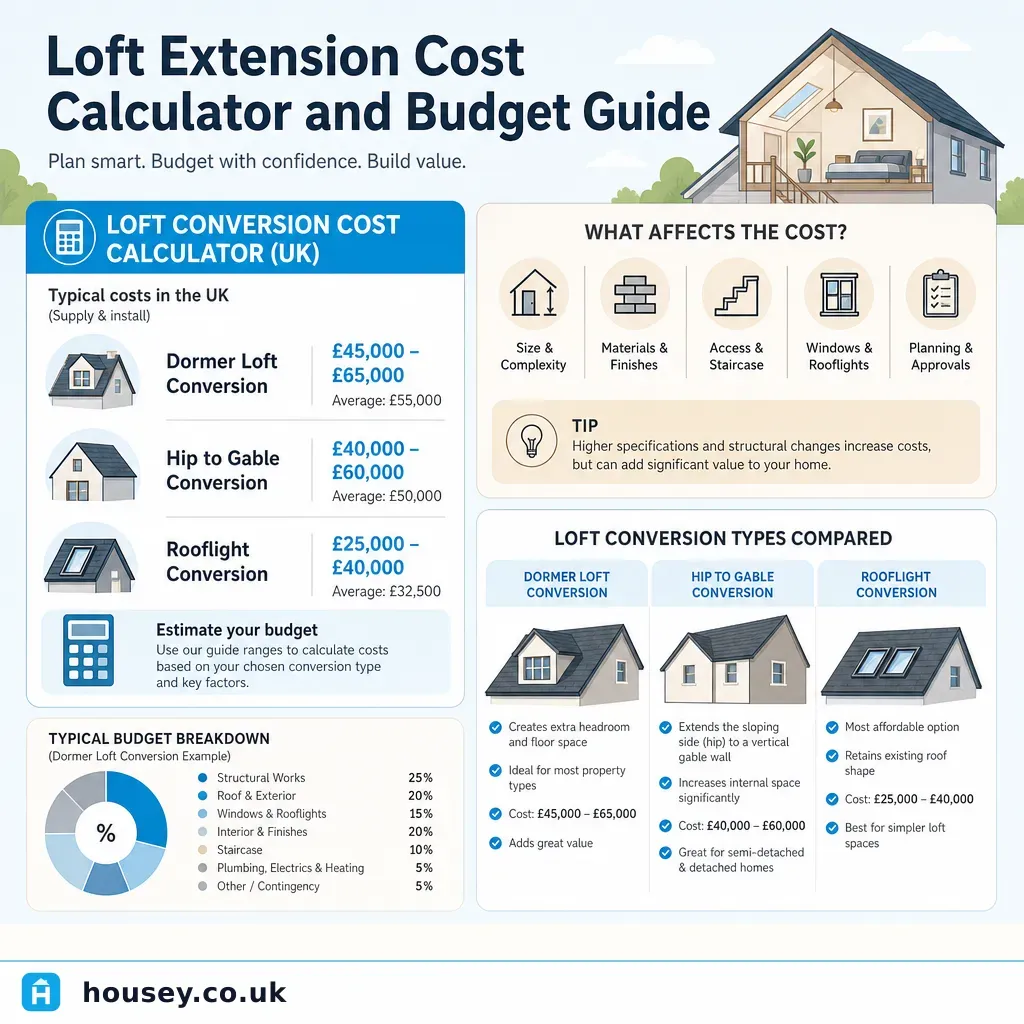
Loft Extension Cost Calculator and Budget Guide
Loft extension costs in the UK typically range from £15,000 for a basic Velux conversion to £75,000 or more for a mansard or L-shaped dormer.
 Improvement & Build
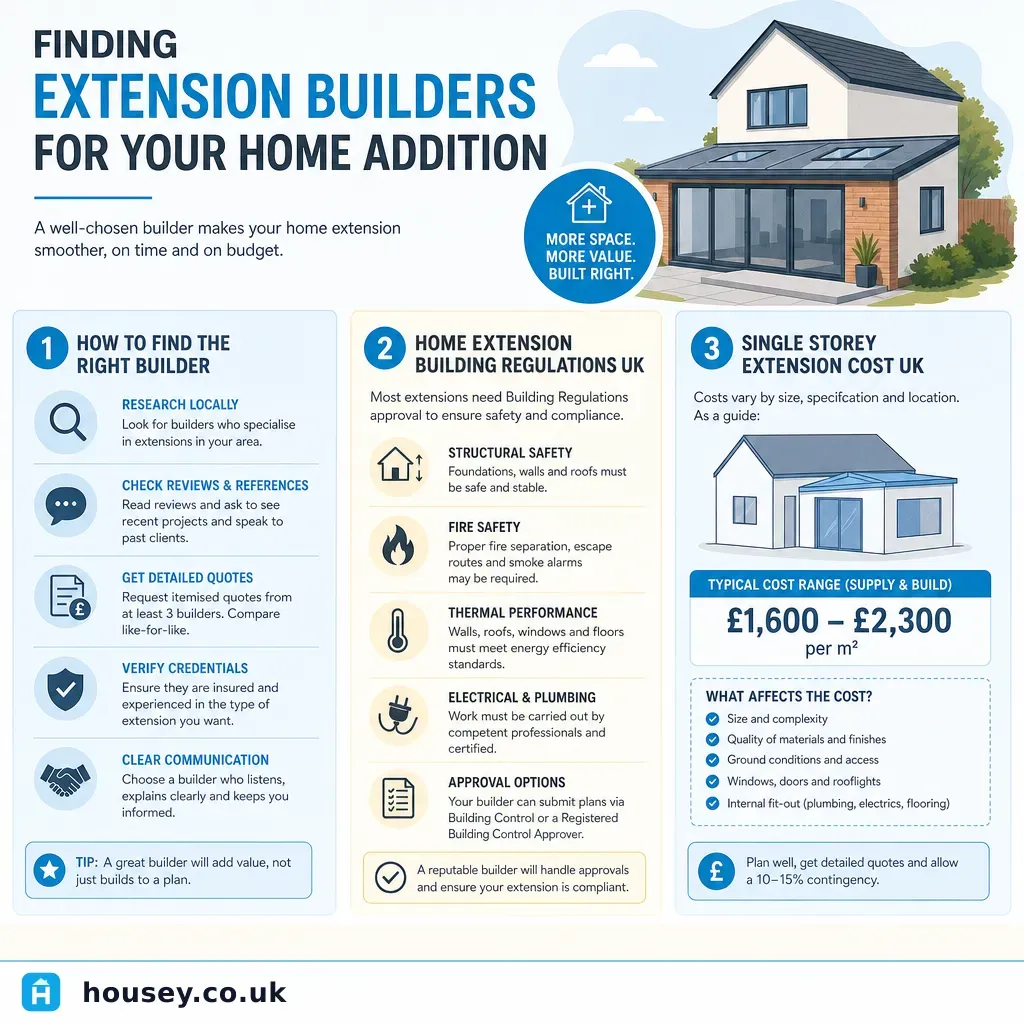
Finding Extension Builders For Your Home Addition
Finding the right extension builder means checking public liability insurance, FMB or TrustMark membership, recent references, and getting quotes on a full written specification.
 Improvement & Build
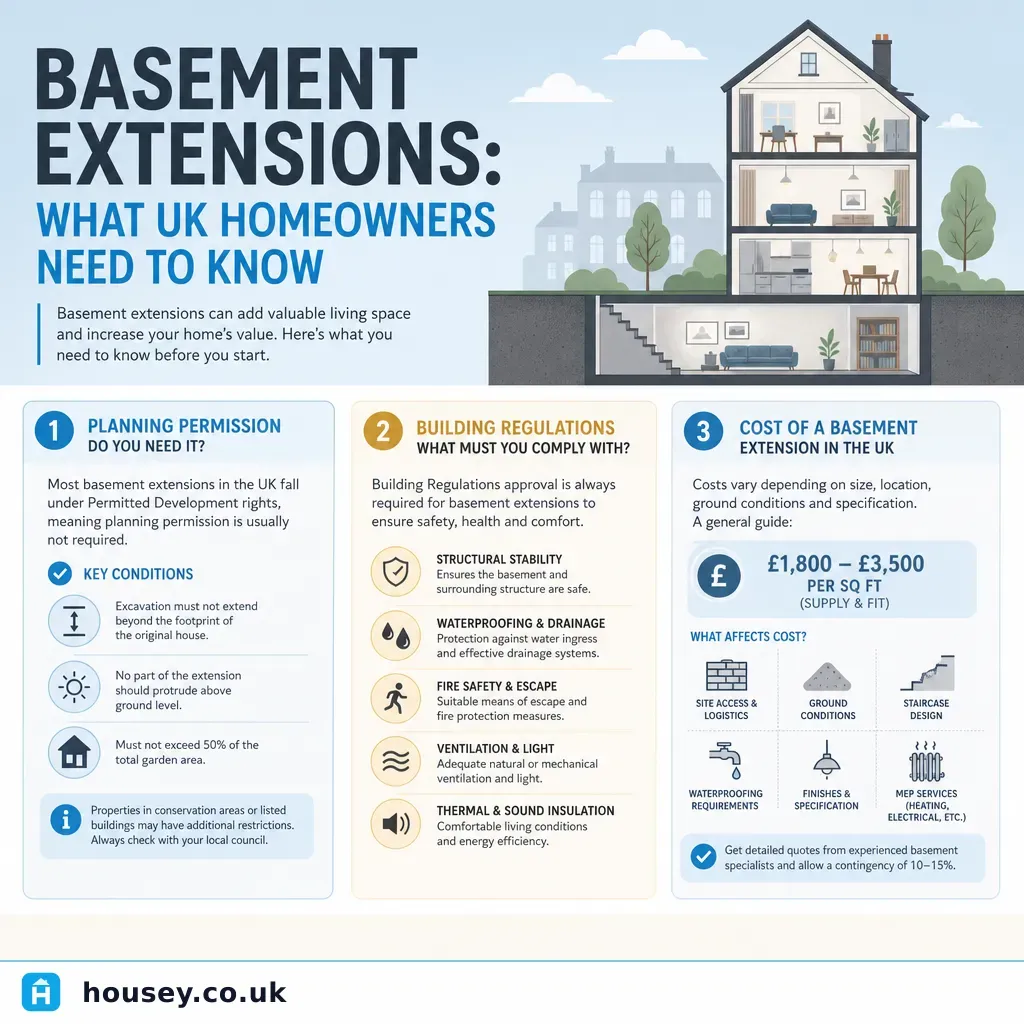
Basement Extensions: What UK Homeowners Need to Know
Most basement extensions in the UK require full planning permission and Building Regulations approval under Parts A, C, F, H, and L.
 Improvement & Build
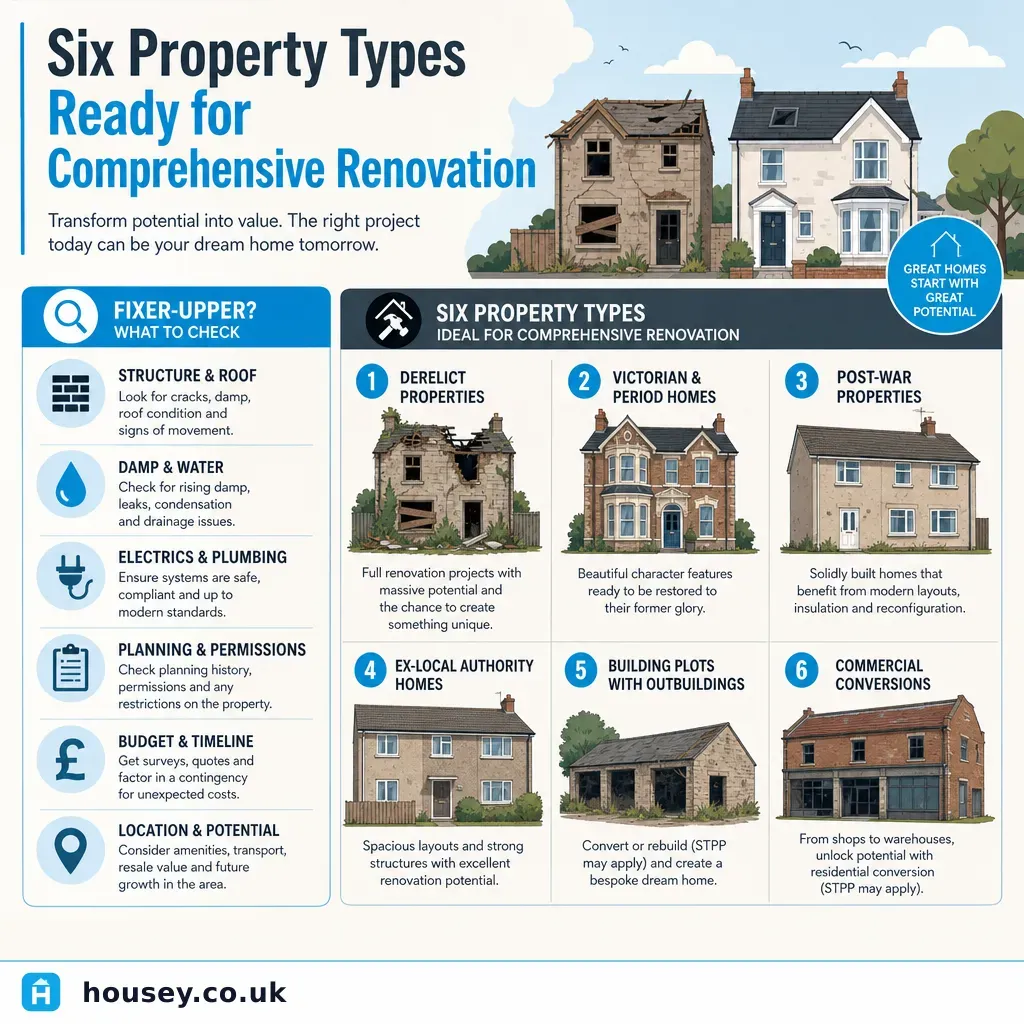
Six Property Types Ready for Comprehensive Renovation
Renovation-ready properties in the UK range from Victorian terraces with outdated services to 1970s semis with poor insulation and derelict rural cottages.
 Improvement & Build
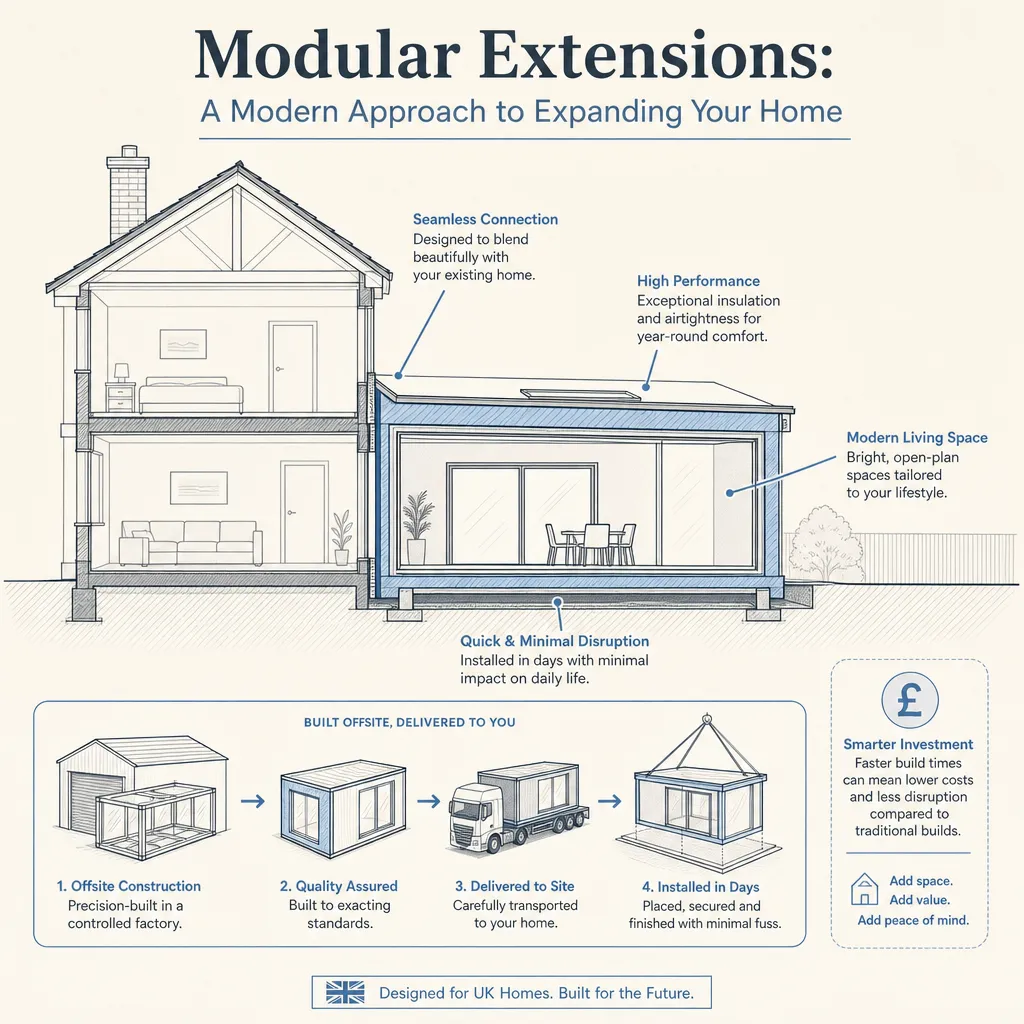
Modular Extensions: A Modern Approach to Expanding Your Home
A modular extension is manufactured offsite in a factory and craned into position on your property, typically cutting on-site build time to 2–6 weeks.