Fire Brick and Firebox Construction: Building Efficient Fireplaces
By Housey · Last reviewed 11th of May 2026
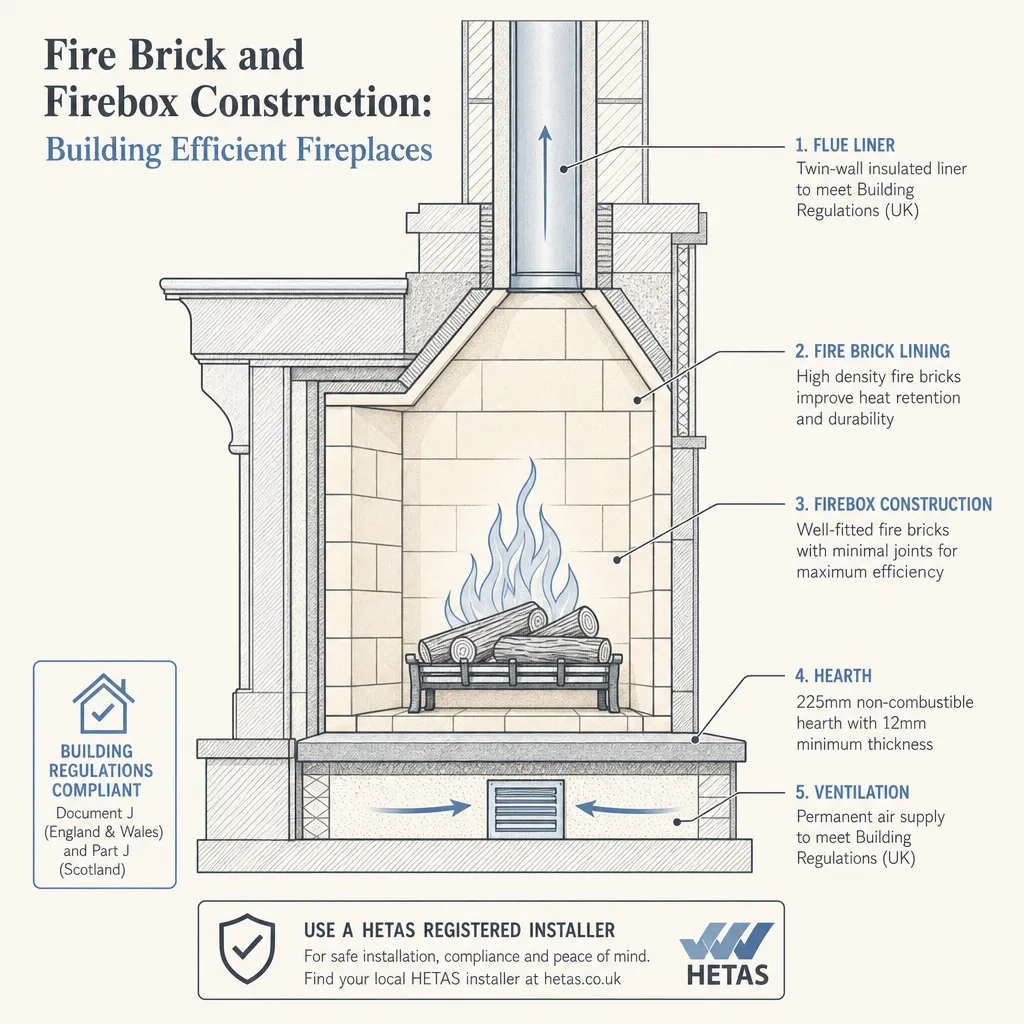
Fire Brick and Firebox Construction: Building Efficient Fireplaces
Fireplaces remain a focal point in millions of UK homes, from Victorian terraces with original chimney breasts to newly built extensions incorporating a wood-burning stove. Whether you are restoring a derelict hearth, replacing a damaged firebox, or installing a new open fire, the construction must meet the requirements of Building Regulations Approved Document J — and in many cases must be notified to your local building control body or carried out by a registered competent person.
Key points
- Building Regulations Approved Document J (Combustion Appliances and Fuel Storage Systems) governs firebox, hearth, and flue construction in England and Wales.
- A constructional hearth must be at least 125 mm thick of non-combustible material and project at least 300 mm in front of the fireplace opening and 150 mm to each side.
- Fire bricks (refractory bricks) are rated to withstand temperatures exceeding 1,000°C; ordinary house bricks should never be used inside a firebox.
- Solid fuel and wood-burning installations must be notified to building control, or carried out by a HETAS-registered installer who self-certifies the work.
- A carbon monoxide (CO) alarm conforming to BS EN 50291 is required within 1–3 m of any solid fuel appliance under Approved Document J (2010 edition, 2013 amendments).
What is a firebox and why do fire bricks matter?
A firebox is the enclosed chamber within a fireplace where combustion takes place. Its walls, floor, and back must withstand sustained radiant heat — typically 600–900°C in normal use — as well as thermal shock from repeated heating and cooling cycles.
Standard house bricks and mortar fail rapidly under these conditions. They spall, crack, and can disintegrate, potentially allowing combustion gases (including carbon monoxide) to migrate into the structure or living space. Fire bricks — also called refractory bricks — are manufactured from high-alumina fireclay, giving them the thermal mass and refractory properties the environment demands.
Refractory mortar (not ordinary sand-and-cement or lime mortar) must be used for all fire brick joints inside the firebox. The correct product is a heat-resistant calcium aluminate-based mix rated for the application.
Fire brick types compared
Type | Composition | Temperature rating | Best for | Limitations |
|---|---|---|---|---|
Standard fireclay brick | 25–40% alumina | Up to ~1,000°C | Traditional open fires | Not ideal for very high-output stoves |
High-alumina brick | 40–80% alumina | Up to ~1,500°C | High-output installations | Higher cost; harder to cut |
Insulating fire brick (IFB) | Low-density refractory | Up to ~1,300°C | Lining behind primary fireback | Lower structural strength |
Vermiculite fireback panel | Moulded vermiculite compound | Up to ~900°C | Replacement liners in cast-iron grates | Pre-formed; quicker but less bespoke |
What Building Regulations require for fireplace construction
Approved Document J sets out minimum constructional requirements for open fires and appliances in England and Wales. Similar provisions apply under Scottish Building Standards Technical Handbook and Welsh Government guidance.
Hearth dimensions
The constructional hearth must:
- Be at least 125 mm thick of non-combustible material (typically concrete).
- Extend at least 300 mm in front of the fireplace opening and at least 150 mm to each side.
- Be clearly distinguishable from the surrounding floor to warn of the heat zone.
A superimposed hearth (decorative finish on top) does not count towards the structural minimum but must not raise combustible materials above the constructional hearth level within the 300 mm front zone.
Flue sizing
The flue must be sized to at least the minimum cross-sectional area specified in Approved Document J. For open fires, this is typically a 225 mm × 225 mm brick flue or an equivalent circular liner of at least 200 mm diameter. An undersized flue is a common cause of smoking fireplaces and increased chimney fire risk.
Notification and competent persons
Under Schedule 3 of the Building Regulations 2010, combustion appliance installation is notifiable work in England and Wales. Two compliant routes exist:
- Building control notification: Submit a building notice or full plans application to your local authority building control (LABC) or an approved inspector before work begins.
- Competent person self-certification: Use a HETAS-registered installer. HETAS is the government-authorised competent persons scheme for solid fuel heating; a registered installer can self-certify their work, notifying building control on your behalf.
For gas-fired fireplaces or gas log-effect fires, the installation must be carried out by a Gas Safe-registered engineer — HETAS registration does not cover gas work.
Decision tree: which approval route do you need?
- New open fire or solid fuel appliance → Notify building control, or use a HETAS-registered installer.
- Replacing a damaged fireback within an existing fireplace (same geometry) → Minor repair; confirm with your LABC whether notification is required.
- Relining the flue → Usually notifiable; use a HETAS-registered installer where possible.
- Inserting a stove into an existing open fireplace → Always notifiable; must meet Approved Document J and DEFRA smoke control zone rules where applicable.
- Gas fire or gas log-effect appliance → Gas Safe engineer required regardless of building control route.
- Conservation area or listed building → Seek advice from your LPA and building control before starting; additional consents may apply.
Smoke control zones
Many UK urban areas are designated Smoke Control Zones under the Clean Air Act 1993. In these zones, you may only use an appliance exempted by the Secretary of State, burning an authorised fuel. Check GOV.UK's smoke control area checker to confirm whether your property is affected. Using a non-exempted appliance in a smoke control zone can result in a fine of up to £1,000.
Homeowner checklist: before building or restoring a firebox
Important limitations
This article provides general information about fire brick and firebox construction under Building Regulations in England and Wales. Requirements differ under Scottish Building Standards, Northern Ireland Building Regulations, and Welsh Government guidance. Structural condition of chimney breasts, flues, and shared party walls can significantly affect what is safe and permissible. Nothing here constitutes professional building control, structural, or fire safety advice. A qualified professional should assess your specific property before any firebox construction, alteration, or restoration commences.
When this becomes urgent
- Cracked or deteriorating firebox walls with visible open joints — stop using the fire until professionally inspected.
- Smoke spilling into the room rather than drawing up the flue — may indicate a blocked, damaged, or undersized flue.
- Soot staining on walls or ceilings near the chimney breast — possible smoke or combustion gas escape through a failed flue or cracked stack.
- Carbon monoxide alarm activation — evacuate immediately, ventilate, and call the Gas Emergency Service (0800 111 999) if gas-related; call 999 if CO poisoning is suspected.
- Structural cracking or visible movement in the chimney breast or external stack.
What to ask a qualified professional
- Are you HETAS-registered for solid fuel installations, or Gas Safe-registered for gas appliances?
- Will you notify building control, or should I submit a building notice separately?
- Can you carry out a flue condition survey (CCTV or smoke test) before quoting for the firebox work?
- Will the construction meet Approved Document J hearth and throat dimensions for my planned appliance?
- Is my property in a smoke control zone, and if so, which appliances and fuels are permitted?
- What refractory materials and mortar specification do you use, and why are they appropriate for this installation?
When to get professional help
Firebox construction is regulated work under Building Regulations — professional involvement is not optional. Even experienced DIY builders cannot legally sign off this work themselves.
Red flags that mean you should stop and call a professional:
- Spalling or crumbling brickwork at the back or sides of an existing firebox.
- White or brown staining on chimney breast walls, which may indicate flue leakage or salt crystallisation from moisture ingress.
- A chimney breast that has been partially or fully removed in a previous conversion — structural implications must be assessed by a chartered surveyor or structural engineer before any reinstatement.
- Any suspicion of asbestos-containing materials in a pre-1985 fire surround, back panel, or fireback — do not disturb the material; arrange a survey with a licensed asbestos professional.
How Housey can help
If you are planning a fireplace installation as part of a larger building project, Housey can connect you with experienced extension builders and design-and-build firms who understand Building Regulations Part J and can coordinate HETAS-registered specialist installers within a managed build programme.
Frequently asked questions
Can I install a wood-burning stove in an existing fireplace myself?
Only if you notify building control and have the work inspected and signed off, or engage a HETAS-registered installer who self-certifies. The installation — including the firebox, hearth, and flue liner — must comply with Approved Document J. Uninspected installations may invalidate home insurance and create a fire safety risk.
What is the difference between a fire brick and a normal brick?
Fire bricks are made from refractory materials (typically high-alumina fireclay) that withstand temperatures exceeding 1,000°C without cracking or losing structural integrity. Standard house bricks are not manufactured for sustained high heat and will fail — sometimes rapidly — creating a fire hazard and structural damage to the firebox.
Do I need planning permission to reinstate a fireplace?
In most cases, internal fireplace reinstatement is a building regulations matter, not a planning one. However, if a chimney breast was removed externally in a previous conversion, reinstating it may require planning permission. In conservation areas or listed buildings, any external changes are likely to require consent from the local planning authority.
How long does firebox construction take?
A straightforward firebox rebuild using fire bricks and refractory mortar typically takes one to two days for the masonry, plus curing time before the first fire — usually 24–48 hours for initial drying, followed by a series of small conditioning fires to fully cure the refractory mortar.
Sources and further reading
- Approved Document J: Combustion appliances and fuel storage systems — GOV.UK
- HETAS: the official body for solid biomass and solid mineral fuel — HETAS Ltd
- Smoke control area checker — DEFRA
- Gas Safe Register — Gas Safe Register
- Building Regulations 2010, Schedule 3 — legislation.gov.uk
Useful next reads
 Improvement & Build
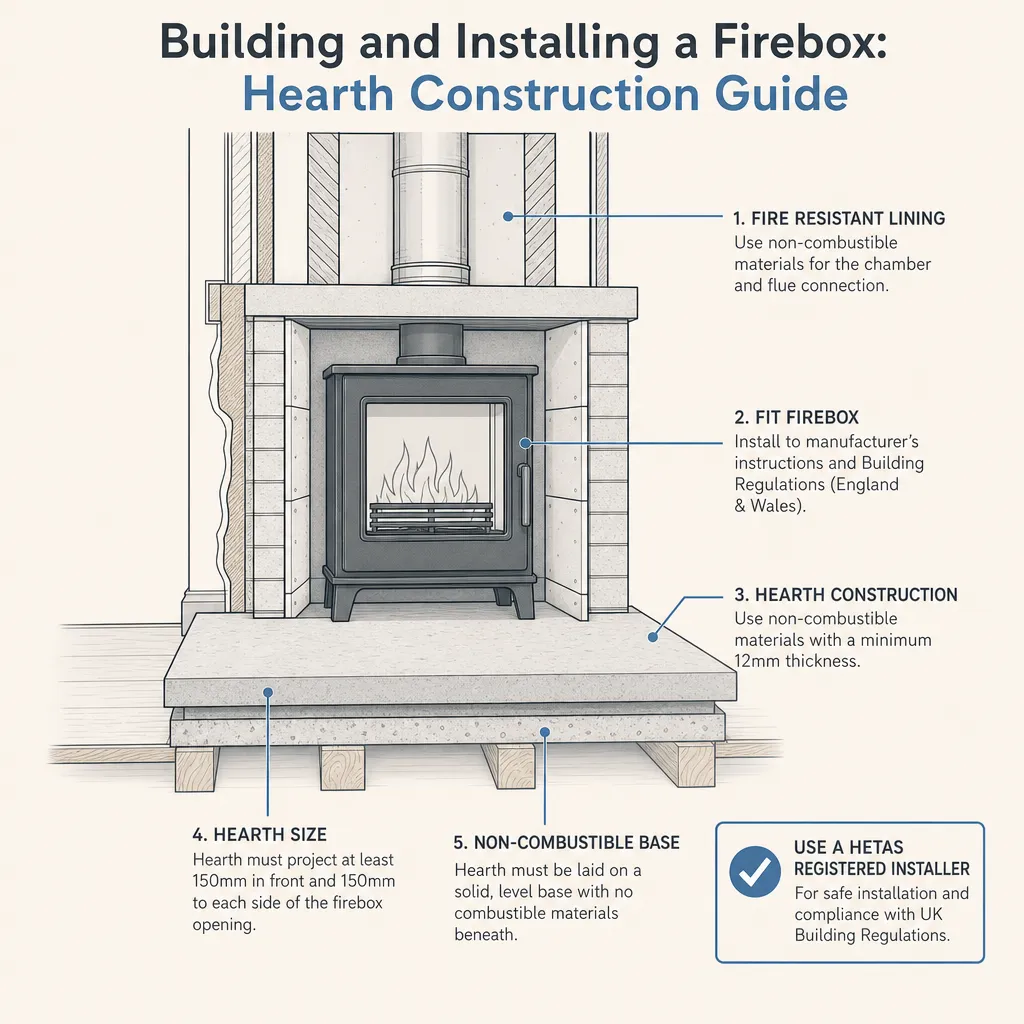
Building and Installing a Firebox: Hearth Construction Guide
In the UK, any new firebox and hearth must comply with Building Regulations Approved Document J, which sets minimum standards including a 125mm non-combustible hearth and 200mm clearance to combustibles.
 Improvement & Build
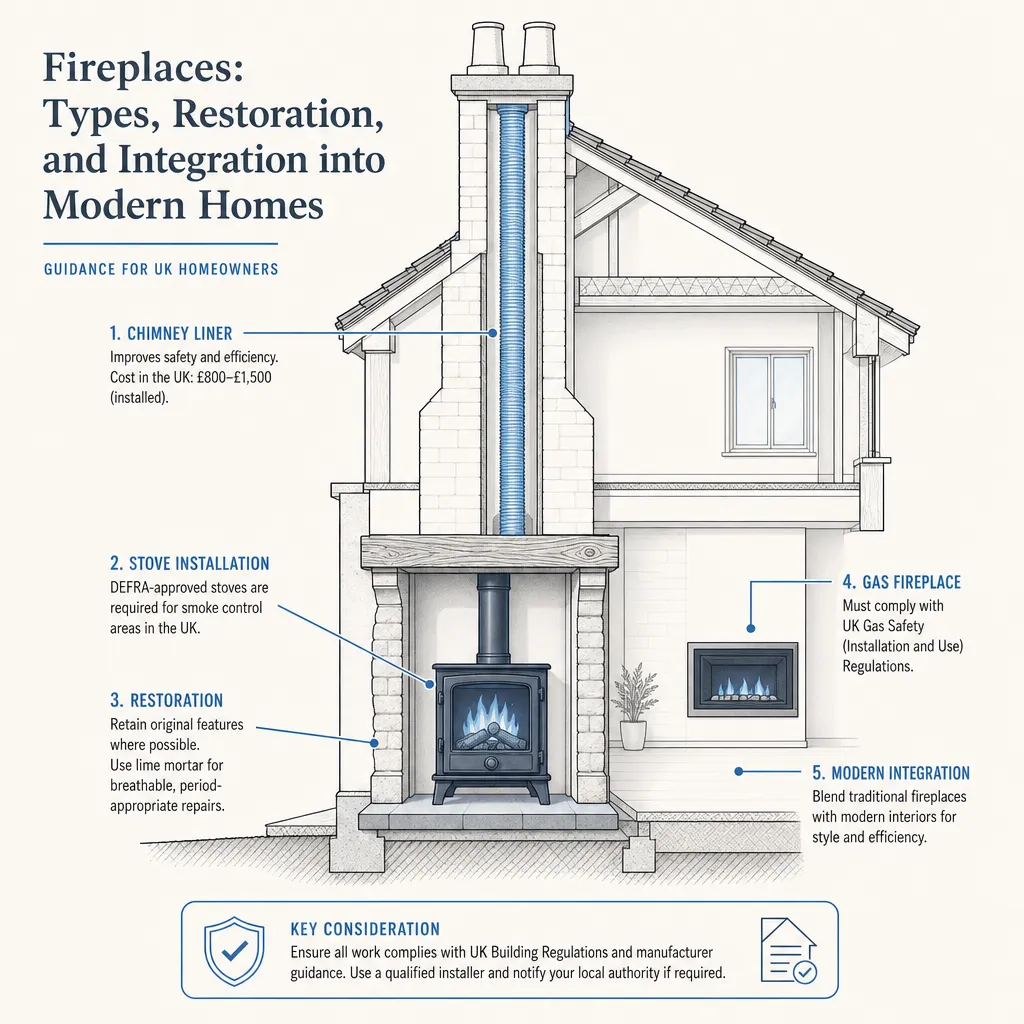
Fireplaces: Types, Restoration, and Integration into Modern Homes
UK fireplaces come in four main types: open fires, wood-burning stoves, gas fires, and electric fires.
 Improvement & Build
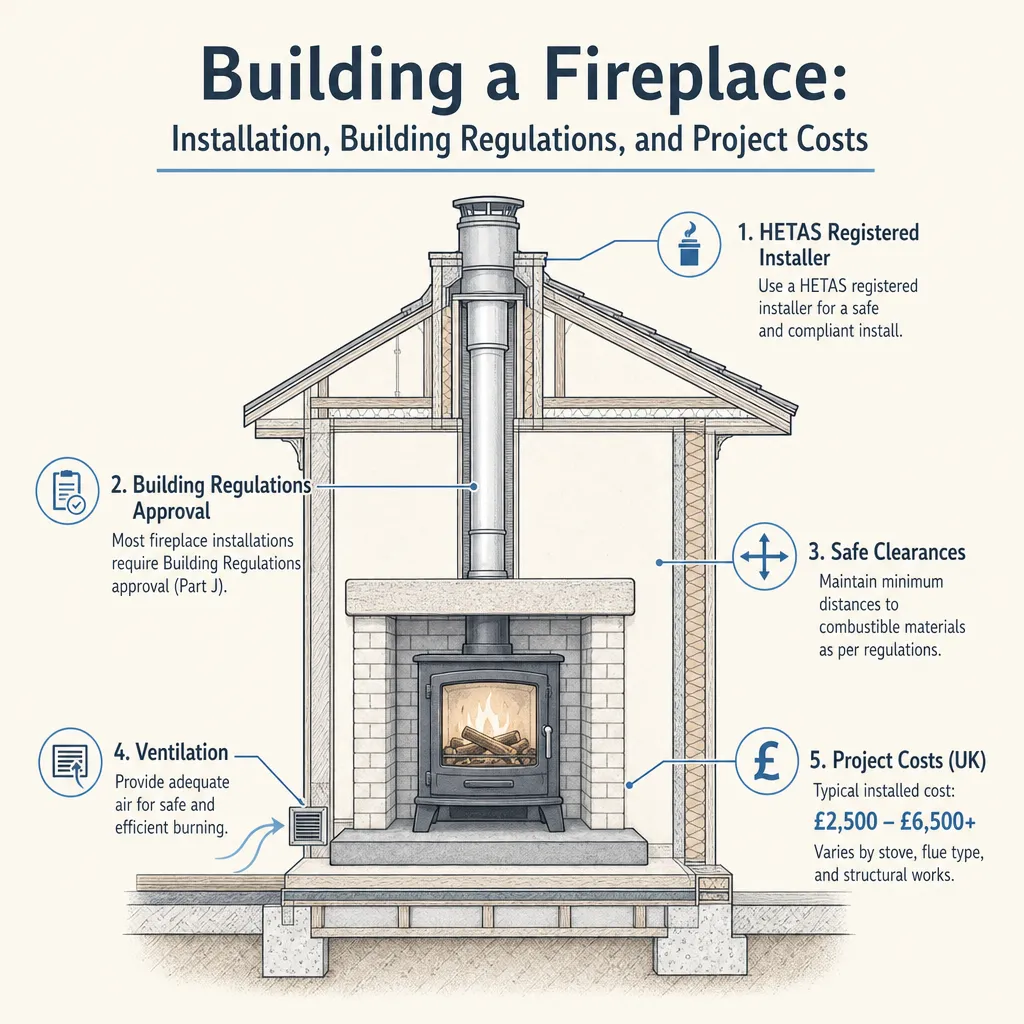
Building a Fireplace: Installation, Building Regulations, and Project Costs
Installing a fireplace or wood-burning stove in a UK home is notifiable work under Building Regulations Part J.
 Improvement & Build
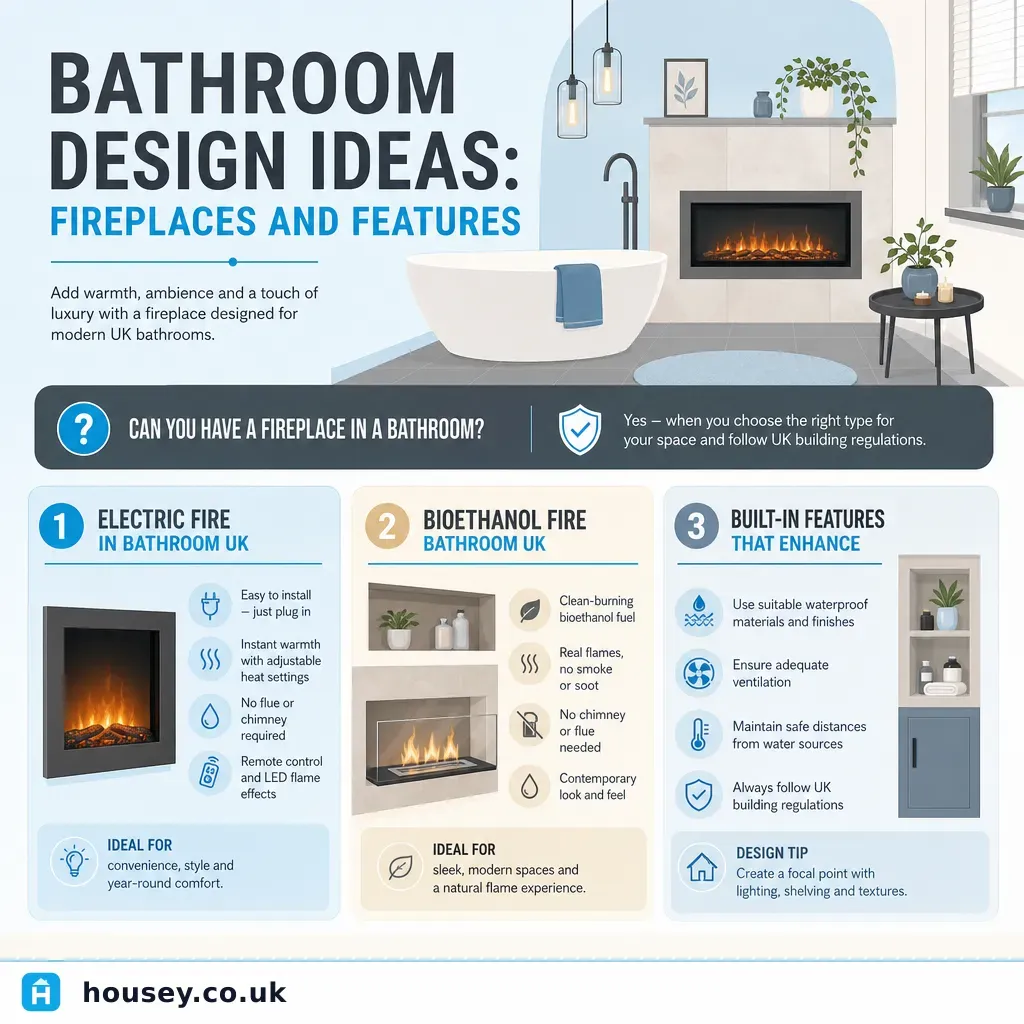
Bathroom Design Ideas: Fireplaces and Features
Gas fires in UK bathrooms are effectively prohibited under the Gas Safety (Installation and Use) Regulations 1998.
 Improvement & Build
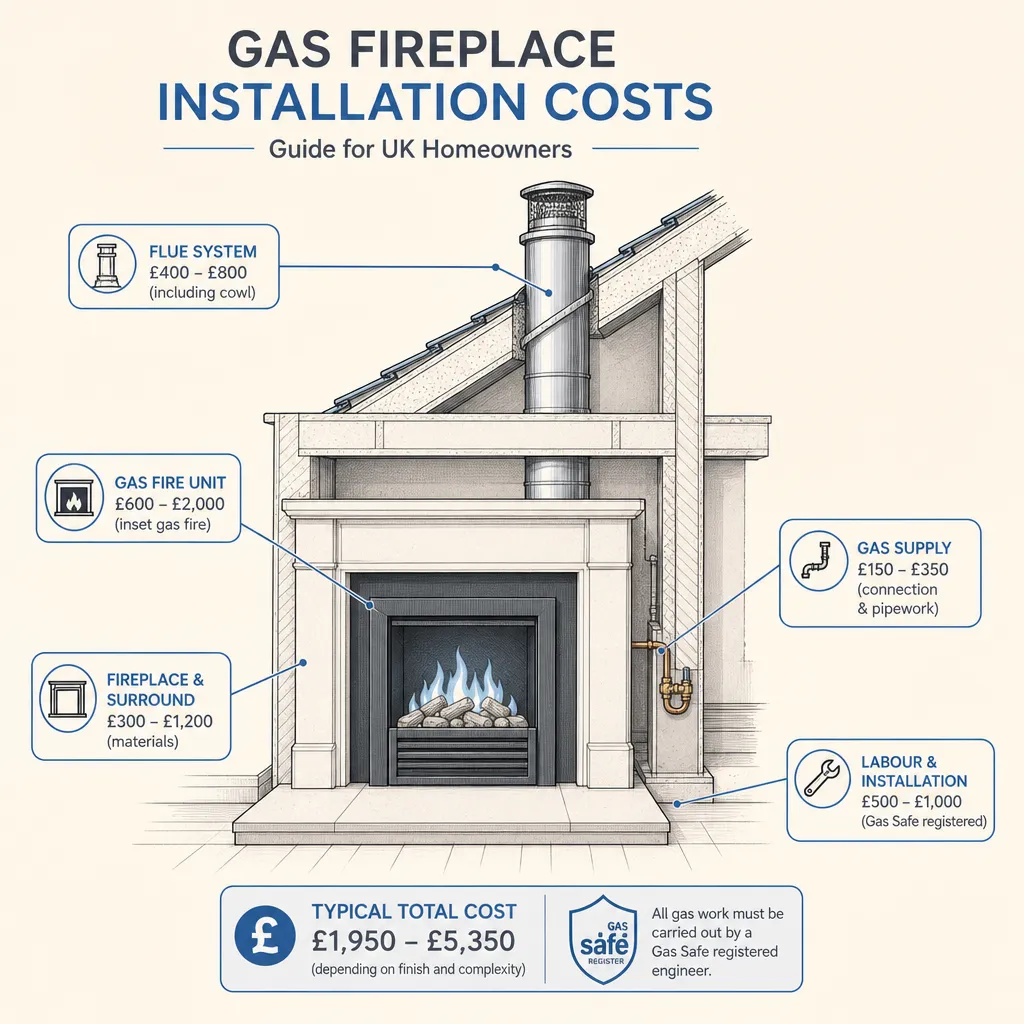
Gas Fireplace Installation Costs
Gas fireplace installation in the UK typically costs between £600 and £3,500 or more, depending on appliance type, flue requirements, and the complexity of the work.