Structural Assessment of Failing Masonry Foundation Walls
By Housey · Last reviewed 25th of May 2026
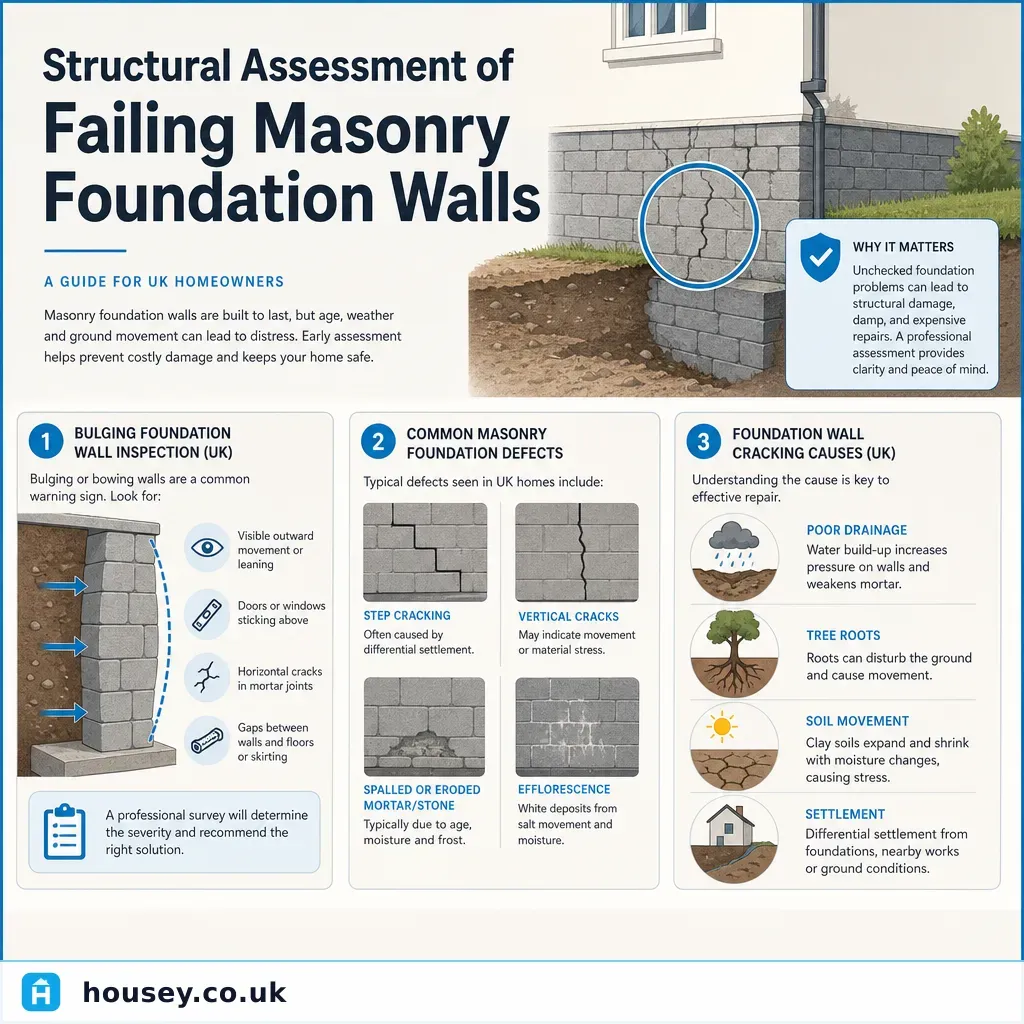
Structural Assessment of Failing Masonry Foundation Walls
Foundation wall failure is among the most serious structural defects a UK homeowner can encounter. It often surfaces during a RICS Level 3 building survey, when redecorating a cellar or sub-floor space, or after noticing crack patterns that persist despite routine repair. The consequences of leaving failing masonry foundations unassessed range from accelerating decay to sudden structural failure, and remediation costs rise sharply the longer deterioration continues unchecked.
Key points
- A RICS Level 3 Building Survey is the appropriate starting point for suspected foundation defects; a structural engineer report is usually required as a follow-on commission where defects are confirmed.
- Masonry foundation walls in UK properties pre-dating 1919 were commonly built in lime mortar with brick or stone rubble — materials that behave very differently from modern cement-mortar brickwork under load and moisture cycling.
- Bulging, bowing, or outward-leaning masonry foundation walls may indicate wall-tie failure, mortar loss, lateral earth pressure, or a combination — each requiring a different remediation approach.
- NHBC Standards Chapter 4.1 and BS EN 1996-1-1 (Eurocode 6) provide the technical basis for masonry structural design and assessment in the UK.
- Dense cement re-pointing applied over deteriorated lime mortar is a common aggravating factor, trapping moisture and accelerating frost damage rather than stabilising the wall.
Why masonry foundation walls fail
Foundation walls — the below-ground or semi-basement masonry supporting a building — are exposed to conditions that above-ground brickwork is not: constant soil pressure, groundwater infiltration, freeze-thaw cycling at or near ground level, and sometimes concentrated loading from internal floors or partition walls.
The most common failure mechanisms in UK residential stock are:
Mortar loss and delamination: Lime mortar, used almost universally before the 1920s, erodes over time. As bed joints hollow out, individual masonry units lose lateral support and the wall's composite action degrades. Dense cement re-pointing applied over deteriorated lime is a frequent aggravating factor — it traps moisture and accelerates frost damage from within.
Bowing and bulging: Outward movement of the wall face indicates that lateral forces are exceeding the wall's residual strength. In semi-basement construction, inadequate internal propping, removal of internal walls, or excavation work near the foundation line are common triggers.
Settlement cracking: Diagonal, stepped, or vertical cracks in foundation brickwork can indicate differential settlement. The pattern, width, progression, and location of cracks all carry diagnostic information — a qualified engineer interprets these holistically, not in isolation.
Wall-tie corrosion: Cavity masonry introduced from approximately 1920 used metal ties connecting inner and outer leaves. Steel ties corrode over time, expanding as they rust and forcing horizontal cracking at regular vertical spacings through the outer leaf.
Rising damp and salt crystallisation: Chronic dampness causes salts from the ground and building materials to crystallise within the masonry pore structure, progressively disaggregating the surface and weakening the substrate over many years.
Comparison of assessment options
Assessment type | What it covers | Typical output | Best for | Limitations |
|---|---|---|---|---|
RICS Level 3 Building Survey | Whole-property condition including visible foundation wall defects | Condition ratings 1–3, repair priorities, estimated urgency | First inspection; pre-purchase; pre-renovation | Does not open up concealed areas; structural conclusions are advisory only |
Specific defect survey | Targeted investigation of one identified defect (e.g. bulging foundation wall) | Defect diagnosis, likely causes, repair options | When a specific concern has already been identified | Narrow scope; may need follow-on structural engineer |
Structural engineer report | Structural assessment, load-path analysis, remediation design | Technical report; may include calculations | Complex failure; party wall works; building control requirements | Cost; may require intrusive investigation to confirm findings |
Intrusive investigation | Opening up concealed areas, trial pits, mortar sampling | Factual data to support engineer's analysis | Where concealed conditions are the critical unknown | Invasive; requires making good; additional programme and cost |
Which assessment do you need? A decision guide
- Choose a RICS Level 3 Building Survey if you are buying a property and have noticed possible foundation defects but have not yet commissioned specialist advice. It will risk-rate defects and indicate whether a structural engineer is needed.
- Commission a structural engineer report if a Level 3 survey has flagged masonry foundation defects as Category 3 (requiring urgent attention), or if you already own the property and visible failure appears to be progressing.
- Request intrusive investigation if the engineer cannot reach a confident diagnosis from surface inspection alone — common where rubble-fill construction, concealed sub-floor voids, or buried drainage are suspected.
- Engage a building control consultant if remediation will involve structural alterations, underpinning, or basement conversion — Building Regulations approval is required for structural work and for changes affecting loadbearing elements.
- Instruct a damp and timber surveyor if masonry decay is accompanied by wet rot in floor joists, sub-floor timbers, or plasterwork — damp penetration and biological decay frequently co-occur with foundation wall failure.
Red flags requiring urgent professional attention
The following signs suggest the situation may be beyond routine monitoring and warrant immediate professional assessment:
- Cracks in foundation masonry that are widening progressively — photograph with crack gauges or coin-sized markers at regular intervals to establish whether movement is ongoing.
- Stepped cracking through mortar joints that continues above ground-floor level into the main superstructure.
- Bulging or bowing of any masonry wall face visible to the eye — any deviation from plumb warrants investigation rather than watching and waiting.
- Sticking or dropped doors and windows on the ground floor, particularly if recently worsened.
- Evidence of previous underpinning or structural repair without documentation — prior intervention without records creates uncertainty about current load paths.
- Sudden inward or outward movement of a wall leaf, or audible cracking sounds from walls or floors.
Important limitations
This article provides general information about the types of assessment available for failing masonry foundation walls in UK residential properties. It does not constitute structural engineering advice. Foundation wall failure is a complex structural topic where the risks, causes, and remediation options depend heavily on construction type, load paths, ground conditions, adjacent structures, and the extent of deterioration — all of which require physical inspection and professional judgement to assess. Always instruct a qualified structural engineer (MIStructE or CEng member of the ICE) or a RICS-registered building surveyor for any suspected structural defect.
When this becomes urgent
Stop relying on this guide and seek professional help immediately if:
- A wall is visibly bulging, leaning, or separating from adjacent structure.
- Cracking is new and rapid — appearing or widening over days rather than months.
- There are signs of floor or ceiling movement above the affected area.
- Neighbouring properties or shared structures (party walls, shared foundations) may be affected.
- You are planning any excavation, drainage work, or structural alteration within 3 m of the affected wall.
If there is an apparent risk of imminent structural failure, contact your local authority building control department or a structural engineer directly, and consider whether temporary propping is needed while an assessment is arranged.
What to ask a qualified professional
Before instructing a structural engineer or RICS surveyor for a foundation wall assessment, ask:
- Are you a chartered structural engineer (MIStructE or ICE CEng) or a RICS-registered surveyor with structural specialism?
- Will the inspection involve any intrusive investigation, or is it limited to visual surface assessment?
- If you cannot reach a confident diagnosis visually, what further investigation do you recommend and at what additional cost?
- Will your report include a remediation specification, or just a diagnosis?
- If underpinning or structural repair is required, will you produce a specification suitable for a Building Regulations submission?
- What access do you need, and will occupants need to vacate during the inspection or works?
- How quickly can you attend, given the apparent urgency?
- Are you covered by professional indemnity insurance for structural assessments of this type?
When to get professional help
Any suspected masonry foundation wall failure should be assessed by a qualified professional. The red-flag list above is not exhaustive — if you are uncertain, err on the side of caution and obtain a structural assessment before carrying out any works or proceeding to exchange of contracts. Foundation problems discovered after exchange can be very costly to address and difficult to pursue through warranty claims without a pre-purchase survey record.
How Housey can help
Housey connects UK homeowners and buyers with experienced professionals for structural surveys, damp and timber surveys, and building control consultants who understand the challenges of older and complex UK residential stock.
Frequently asked questions
How do I know if my foundation wall is showing cosmetic wear or actually failing structurally?
Cosmetic wear involves surface mortar loss, staining, or minor efflorescence — common in older UK properties and generally manageable. Structural failure indicators include progressive cracking through the full depth of mortar joints, outward bowing visible to the eye, horizontal cracking at regular vertical intervals (a sign of wall-tie corrosion), and movement that correlates with sticking doors or windows nearby. A chartered structural engineer or RICS Level 3 surveyor can distinguish between the two.
Do I need building regulations approval to repair a foundation wall?
Like-for-like maintenance — re-pointing, replacing individual masonry units — does not generally require Building Regulations approval. Structural repair, underpinning, or any work that alters the load-bearing arrangement will require a Building Regulations application and sign-off from your local building control body or an approved inspector. If you are unsure whether your proposed work crosses this threshold, contact your local building control authority before starting.
Will a standard homebuyer survey pick up foundation wall problems?
A RICS Level 2 Home Survey may flag visible signs of concern, but it is not a structural inspection and does not require the surveyor to assess concealed areas or reach engineering conclusions. For properties with visible cracks, damp, or suspected structural issues, a RICS Level 3 Building Survey — or, where a specific defect is already identified, a targeted structural engineer assessment — will provide more reliable findings.
What does underpinning a foundation wall cost?
Underpinning costs vary widely depending on access, depth required, method (mass concrete, mini-piles, beam and base), soil conditions, and the extent of affected wall. Indicative UK costs, last reviewed 2026-05-25, range from approximately £1,000–£3,000 per linear metre for traditional mass concrete underpinning; more complex methods cost more. Always obtain at least three quotes from structural contractors with relevant experience and professional indemnity cover.
Can I sell a property with failing foundation walls?
Yes, but the defect must be disclosed during conveyancing — concealing a known material defect may give rise to legal liability. A remediation specification from a structural engineer, or a documented repair history, will help significantly with the sales process and may be required by a buyer's mortgage lender. Obtain advice from a solicitor if you are uncertain about your disclosure obligations.
Sources and further reading
- RICS Home Survey Standard — RICS
- BS EN 1996-1-1: Eurocode 6 — Design of masonry structures — BSI
- NHBC Standards Chapter 4.1: Foundations — NHBC
- Building regulations approval — GOV.UK
- Find a structural engineer — Institution of Structural Engineers
- Practical Building Conservation: Earth, Brick and Terracotta — Historic England
Useful next reads
 Surveys & Inspections
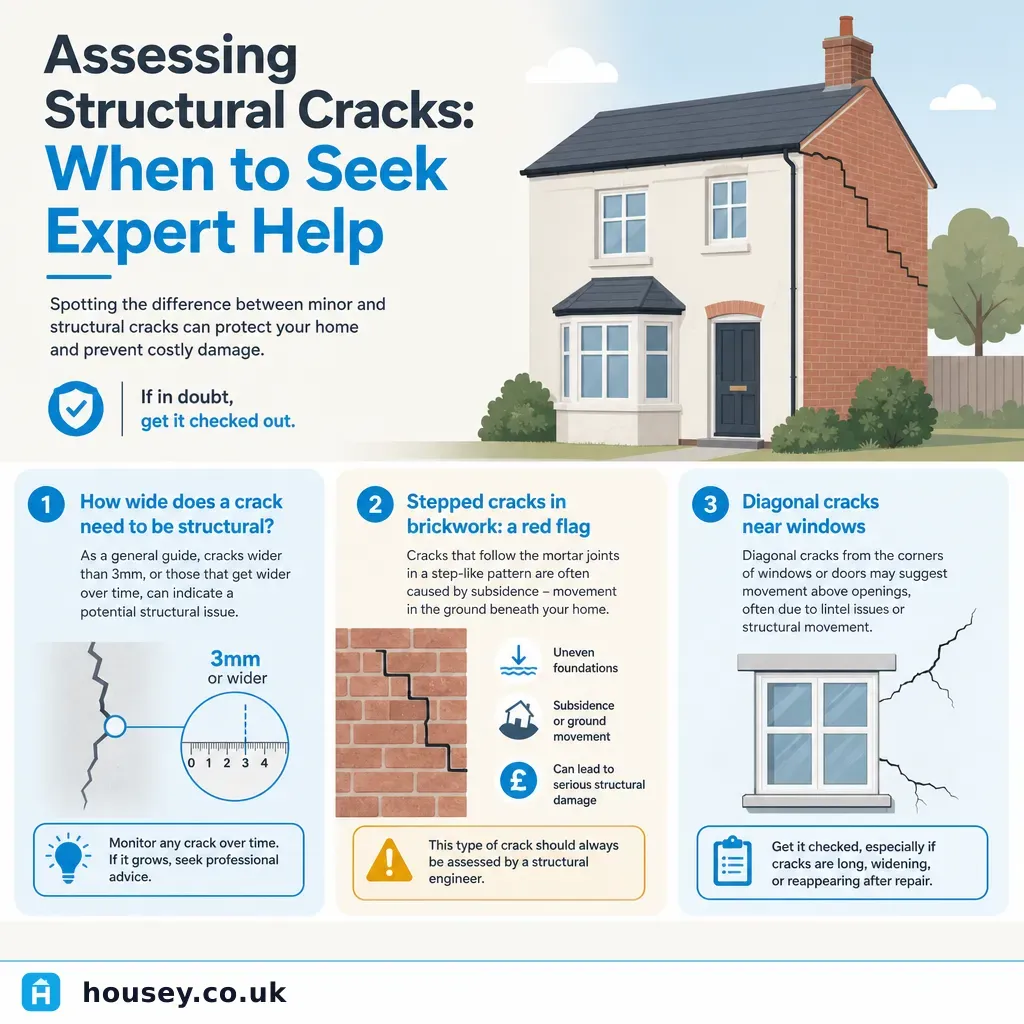
Assessing Structural Cracks: When to Seek Expert Help
Structural cracks range from harmless shrinkage hairlines to signs of subsidence or foundation movement.
 Surveys & Inspections
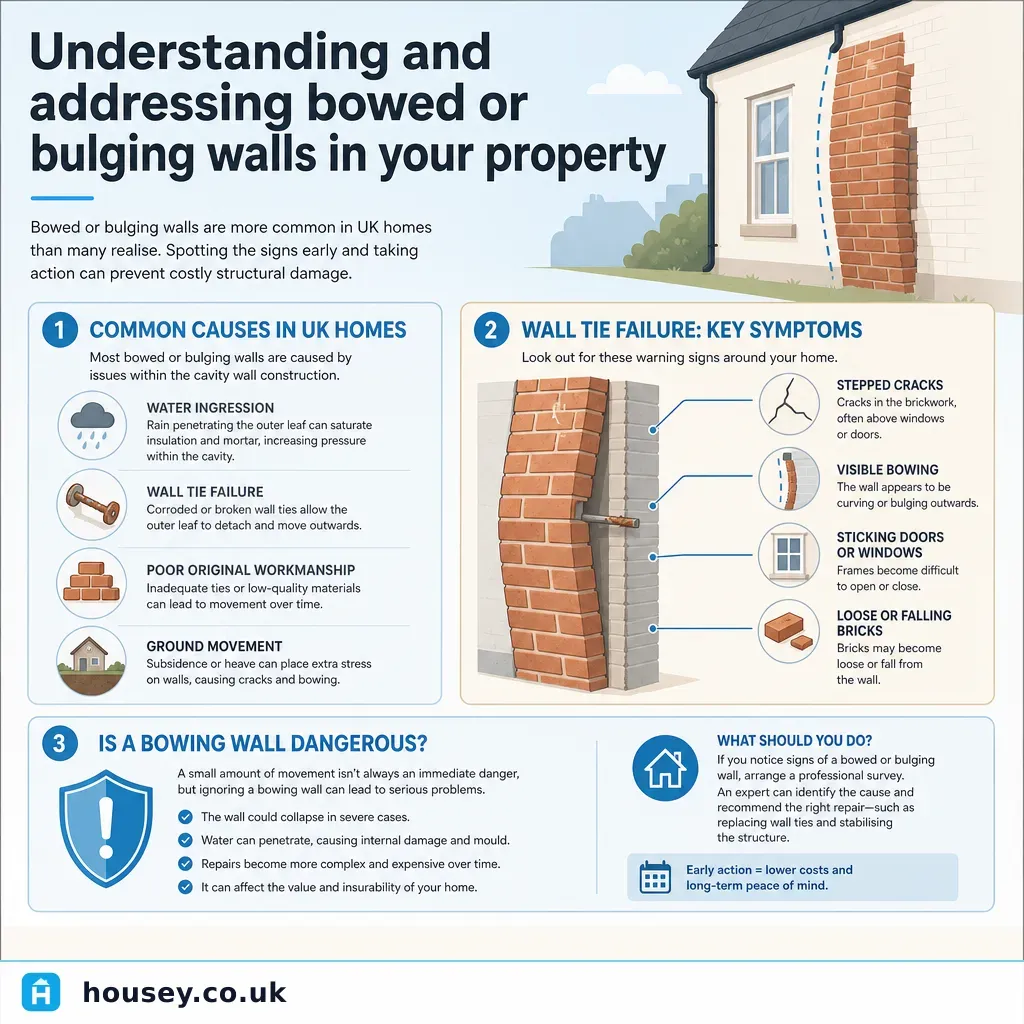
Understanding and addressing bowed or bulging walls in your property
A bowed or bulging wall may indicate wall tie failure, foundation movement, or overloading.
 Surveys & Inspections
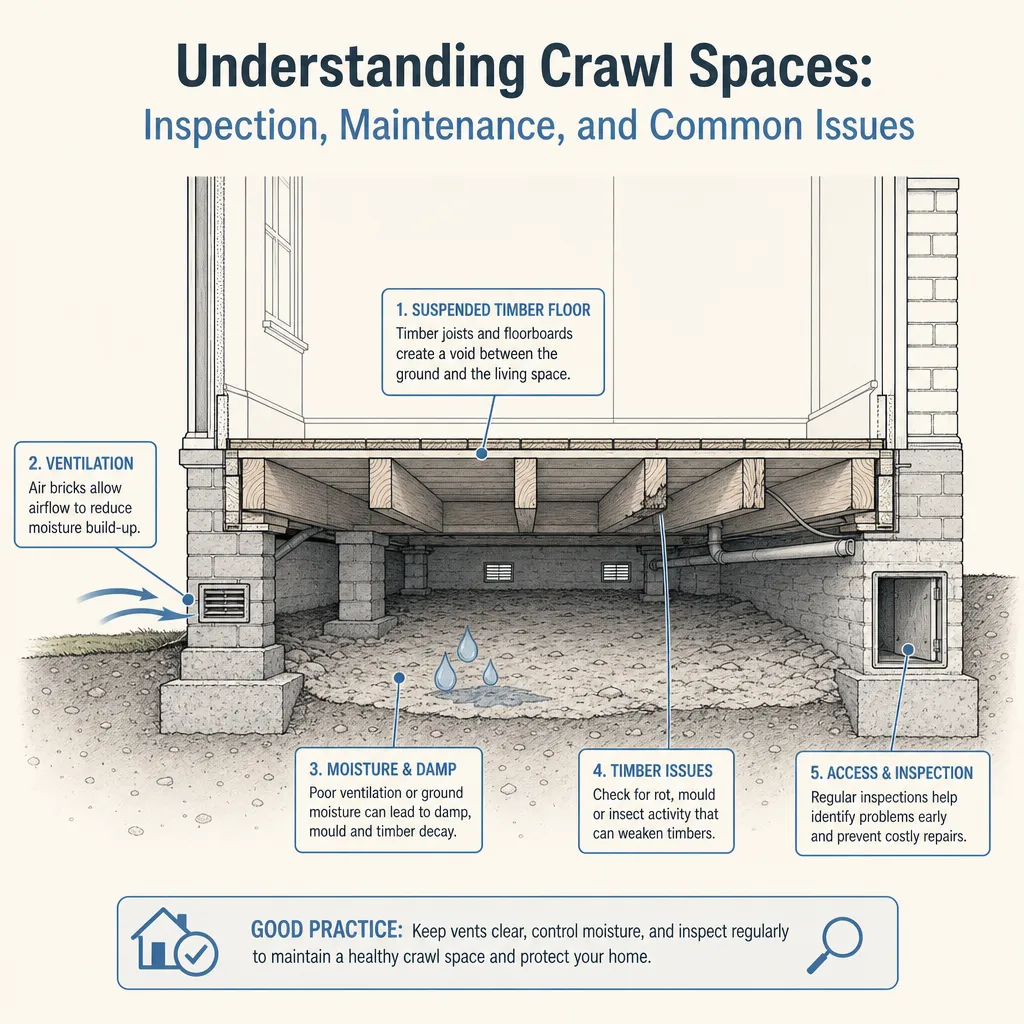
Understanding Crawl Spaces: Inspection, Maintenance, and Common Issues
Sub-floor voids beneath suspended timber ground floors in pre-1960 UK homes need cross-ventilation through airbricks to prevent dry rot and wet rot in floor timbers.
 Surveys & Inspections
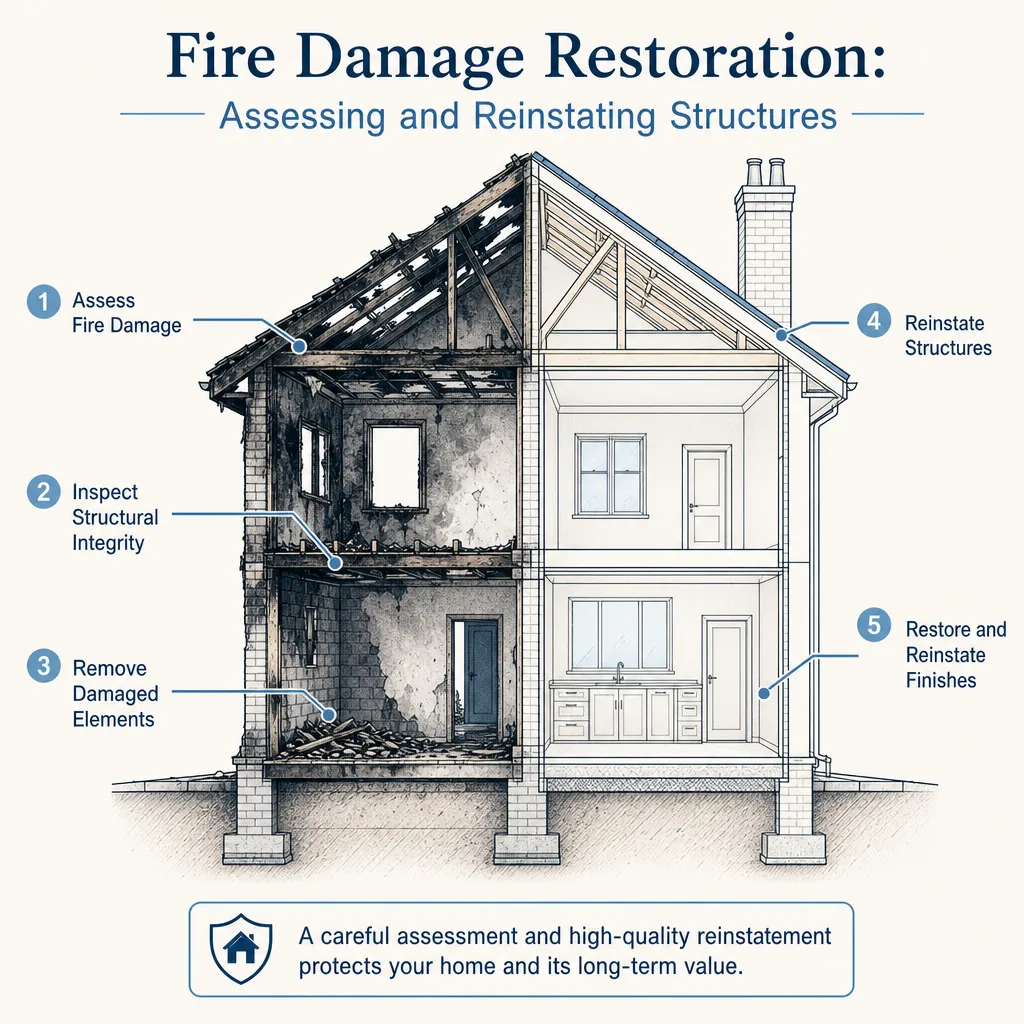
Fire Damage Restoration: Assessing and Reinstating Structures
Fire damage restoration starts with a structural engineer assessing which elements can be repaired and which must be replaced.
 Surveys & Inspections
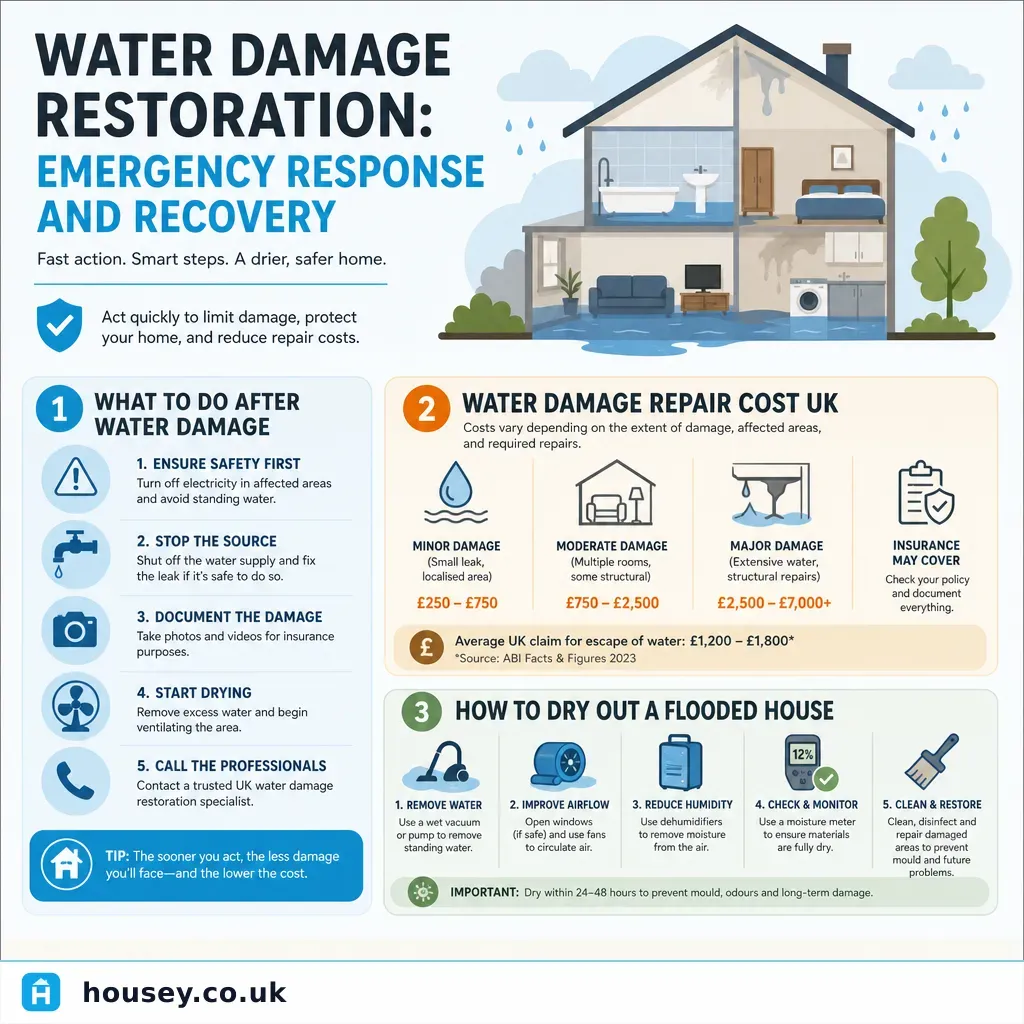
Water Damage Restoration: Emergency Response and Recovery
After a water event, act within hours: stop the water source, switch off electricity if safe, photograph the damage, and contact your insurer promptly.