Fire Door Installation: Safety Standards and Building Regulations
By Housey · Last reviewed 19th of May 2026
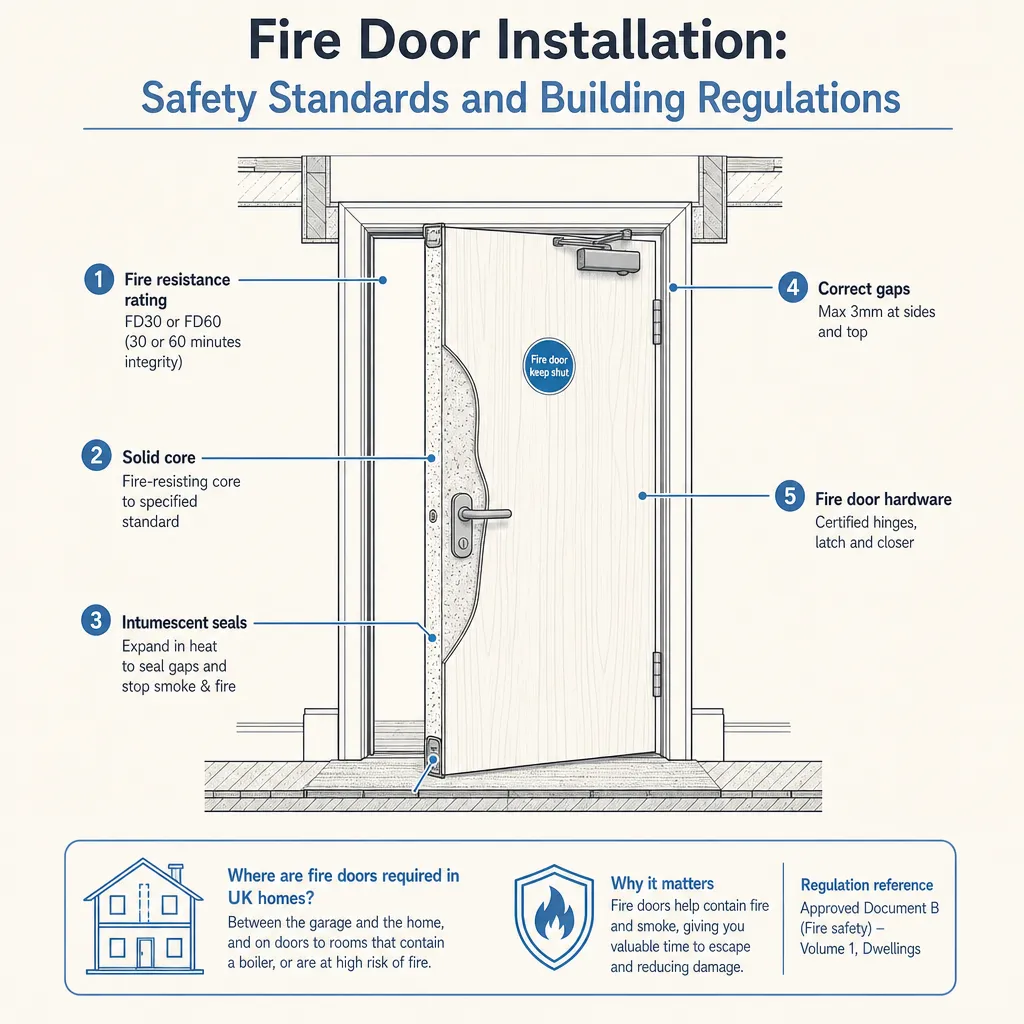
Fire Door Installation: Safety Standards and Building Regulations
Fire door failures are among the most common fire safety deficiencies identified in local authority HMO inspections and post-incident investigations across the UK. Whether you are fitting a new fire door as part of a loft conversion, meeting an HMO licensing condition, or replacing a non-compliant door following a survey, understanding the certification requirements, installation standards, and notification obligations is essential — an incorrectly fitted fire door may fail entirely in a fire, regardless of its specification on paper.
Key points
- Approved Document B (Fire Safety) of the Building Regulations 2010 requires fire-resisting doors between an integral or attached garage and the dwelling (minimum FD30S), on escape routes in loft conversions, and in many conversion and change-of-use projects.
- Fire door sets must carry UKCA or CE marking confirming third-party testing, and ideally hold an accredited product certification mark such as BWF-CERTIFIRE or BM TRADA Q-Mark.
- FD30 provides 30 minutes of fire resistance; FD60 provides 60 minutes. The letter S appended to a rating (FD30S, FD60S) denotes smoke-sealing capability, which is required on most designated escape routes.
- Gaps around the door leaf greater than 3 mm at the head and jambs — or 8 mm at the threshold — can compromise the door's tested performance, even where the door itself is correctly specified.
- Fire door installation as part of a new build, conversion, extension, or material alteration is notifiable work under Building Regulations in England and Wales, requiring a building control application or a registered competent person certificate.
What Building Regulations require
Approved Document B (Volume 1 for dwellings) sets out fire door requirements by building type and situation. The key scenarios homeowners most commonly encounter are:
Attached and integral garages: A minimum FD30S self-closing fire door is required between an attached or integral garage and any habitable part of the dwelling.
Loft conversions creating a new storey: The escape route from the new floor — typically the stair enclosure down to the final exit — must be protected with fire-resisting self-closing doors at each floor level on the stairway.
HMOs (Houses in Multiple Occupation): Local authority HMO licensing conditions typically require FD30S fire doors to all letting room doors and to kitchen and living areas in the common parts. Specific requirements appear in the property's fire risk assessment and the licence conditions issued by the local housing authority.
Conversion to flats or change of use: Any conversion that increases the number of dwellings or changes the building's use category generally triggers a full compartmentation review, usually requiring fire doors throughout the means of escape.
Extensions: Whether a household extension requires fire doors depends on the layout, escape strategy, and how the extension connects to the existing circulation route. Building control should confirm requirements at the design stage.
FD30 vs FD60: choosing the right fire resistance period
The required fire resistance period is specified by a building control officer or fire engineer based on the building's evacuation strategy, travel distances, and occupancy risk. Do not substitute a lower-rated door without written confirmation from building control or a fire engineer.
Door type | Fire resistance | Smoke seal required | Typical residential application |
|---|---|---|---|
FD30 | 30 minutes | Not always required | Internal doors in a dwelling not on a designated escape route |
FD30S | 30 minutes + smoke | Yes | Escape routes, HMO letting rooms, garage-to-house doors |
FD60 | 60 minutes | Not always required | Higher-risk compartments or where specified by a fire engineer |
FD60S | 60 minutes + smoke | Yes | Higher-risk escape routes; commercial-to-residential interfaces |
Who should install a fire door?
Fire door installation involves a sequence of interdependent details — any one of which can negate the door's tested performance if incorrect.
Professional | Relevant accreditation | When to use |
|---|---|---|
BWF-CERTIFIRE Approved Installer | British Woodworking Federation / Certifire scheme | New installations where third-party verified competence is required by building control or HMO licence |
BM TRADA Q-Mark Fire Door Installer | BM TRADA third-party certification | HMO licensing, commercial premises, or where auditable competence records are required |
Experienced joiner with fire door training | No mandatory scheme, but demonstrated training required | Simple domestic replacements under a competent person scheme covering this scope |
Fire engineer (IFE or FIFireE) | Institution of Fire Engineers membership | Specifying requirements in complex, higher-risk, or unusual building situations |
For HMO licensing compliance, many local authorities now expect evidence of third-party certified installation. Check your local authority's specific requirements before instructing work.
Important limitations
This article provides general information about fire door requirements in England and Wales. Building Regulations obligations depend on your specific property type, age, construction, number of storeys, occupancy, and the exact scope of works. Local authority HMO licensing requirements vary between councils. Scotland operates under separate building standards (Scottish Building Standards Technical Handbooks); Northern Ireland under its own Building Regulations. This article does not constitute legal or technical advice. A qualified professional — a building control officer, fire safety consultant, or RICS-accredited building surveyor — should assess your specific situation before you make installation decisions.
When this becomes urgent
Seek qualified professional advice without delay if:
- A fire risk assessment has identified non-compliant or defective fire doors in a property you own, manage, or are about to purchase
- Your local authority has issued an improvement notice, prohibition notice, or HMO licensing condition relating to fire doors
- An existing fire door is visibly damaged, has missing or deteriorated intumescent strips, or cannot self-close fully and evenly under its own closer
- You are planning a conversion or extension and are uncertain which openings will require fire-resisting doors
- You are buying a property and cannot verify that installed fire doors are correctly specified and certified
What to ask a qualified professional
Before instructing a fire door installer, ask:
- What certification scheme are you registered with — BWF-CERTIFIRE, BM TRADA Q-Mark, or equivalent?
- Can you provide the product data sheet confirming the tested door set specification (leaf, frame, ironmongery, intumescent seal system) as a matched tested assembly?
- Is this installation notifiable under Building Regulations? If so, will you issue a competent person certificate, or should we make a formal building control application?
- What gap tolerances will you be working to, and how will you verify them on completion?
- Will you carry out a final operational check of the self-closer, intumescent strips, and cold smoke seals before sign-off?
- What workmanship warranty do you provide, and does it cover the fire performance of the installation?
When to get professional help
A fire safety professional or building control surveyor should assess fire door requirements before any installation if you are uncertain about specification or scope. Particular concerns include:
- Existing frames that are out of square, of unknown construction, or previously altered — a correctly rated door leaf in a non-rated frame provides no meaningful fire protection
- Buildings that have been extended, converted, or altered where the original compartmentation strategy may have been compromised
- Listed buildings or conservation area properties where external fire doors may also require listed building or conservation area consent
How Housey can help
Housey can connect you with certified window and door installers experienced in fire door specification and installation, alongside professionals who can carry out fire risk assessments and prepare building regulations drawings for notifiable work.
Frequently asked questions
Do all internal doors in a house need to be fire doors?
No. In a standard single-family dwelling, fire doors are required between an integral garage and the house, on escape routes in loft conversions, and where specified by building control for extensions or alterations. They are not required on every internal door in a typical two- or three-storey terraced or semi-detached house without a loft conversion or attached garage.
Can I install a fire door myself?
Building Regulations do not prohibit a competent homeowner from installing a fire door in all circumstances, but the installation must meet all performance requirements and notifiable work must be signed off by building control or a registered competent person. Given the safety implications of an incorrectly fitted fire door, professional installation by an accredited fitter is strongly advised.
What is an intumescent strip and why does it matter?
An intumescent strip is a heat-activated material fitted into a groove around the door edge or frame rebate. In a fire it expands rapidly, sealing the gap between the door and frame against hot gases and flames. Without a correctly specified, undamaged strip, an FD30 door will not achieve its rated 30-minute fire resistance regardless of the quality of the door leaf itself.
How much does fire door installation cost in the UK?
A single fire door supply and installation by an accredited installer typically costs £300–£800 including a new frame set; replacing a like-for-like leaf in an existing certified frame may cost £150–£400. Costs depend on specification, access, and whether making-good to plasterwork is required. Indicative UK costs, last reviewed 2026-05-19; always obtain written quotes.
Sources and further reading
- Approved Document B: Fire Safety — Volume 1 (Dwellings) — GOV.UK
- BWF-CERTIFIRE Fire Door Alliance — British Woodworking Federation
- BM TRADA Q-Mark fire door installer scheme — BM TRADA
- Fire Door Safety Week guidance — Fire Door Safety Week
- HSE — Fire safety at work — Health and Safety Executive
Useful next reads
 Improvement & Build
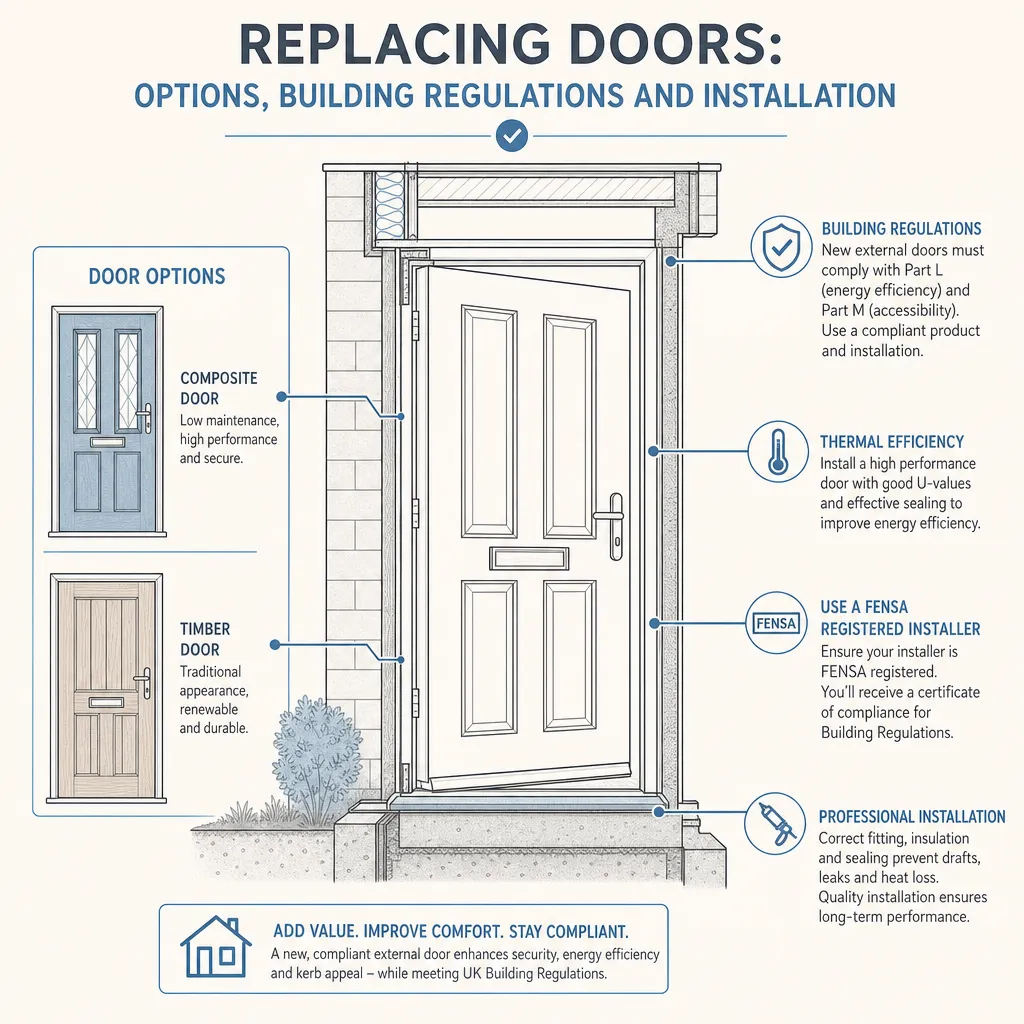
Replacing Doors: Options, Building Regulations and Installation
Replacing an external door in England requires compliance with Building Regulations Part L (minimum U-value 1.
 Improvement & Build
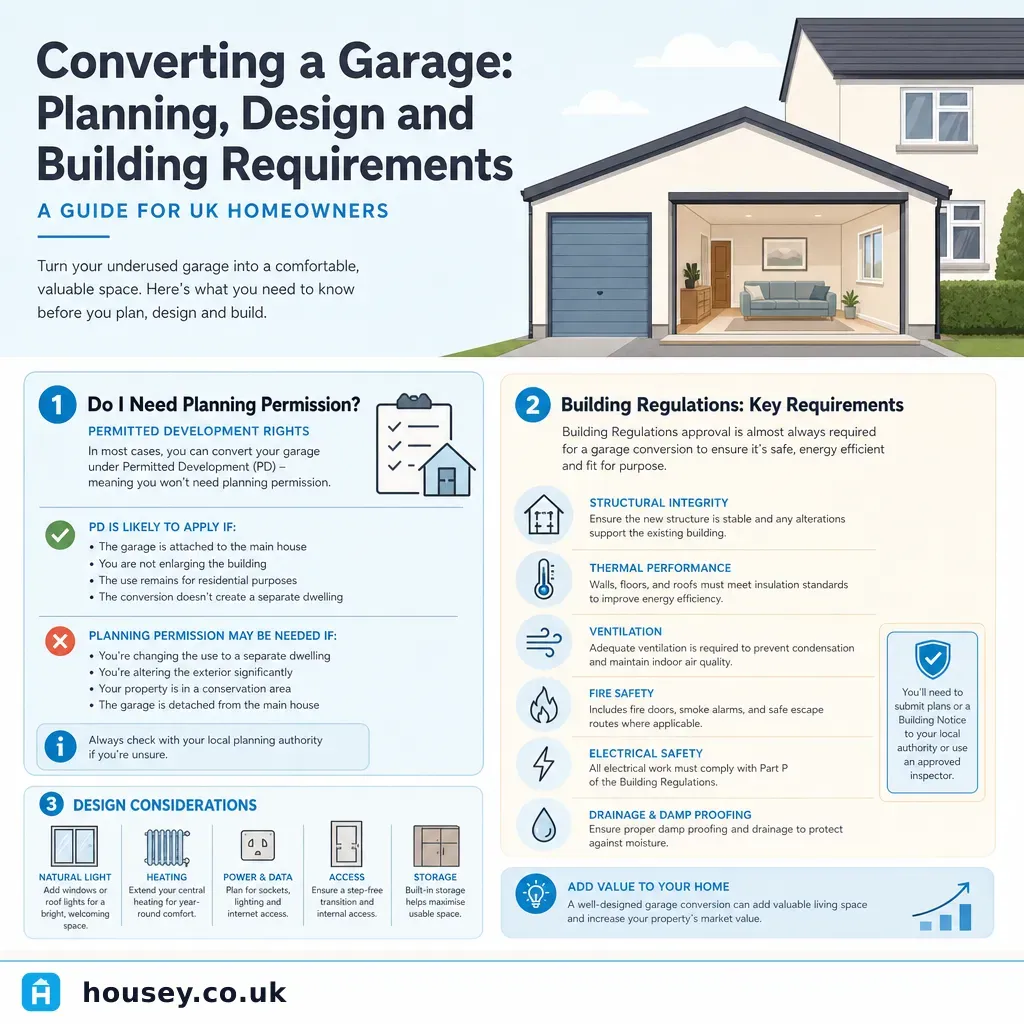
Converting a Garage: Planning, Design and Building Requirements
Most garage conversions in England do not need planning permission under permitted development rights, but all conversions require Building Regulations approval covering structure, thermal insulation, fire safety, and ventilation.
 Improvement & Build
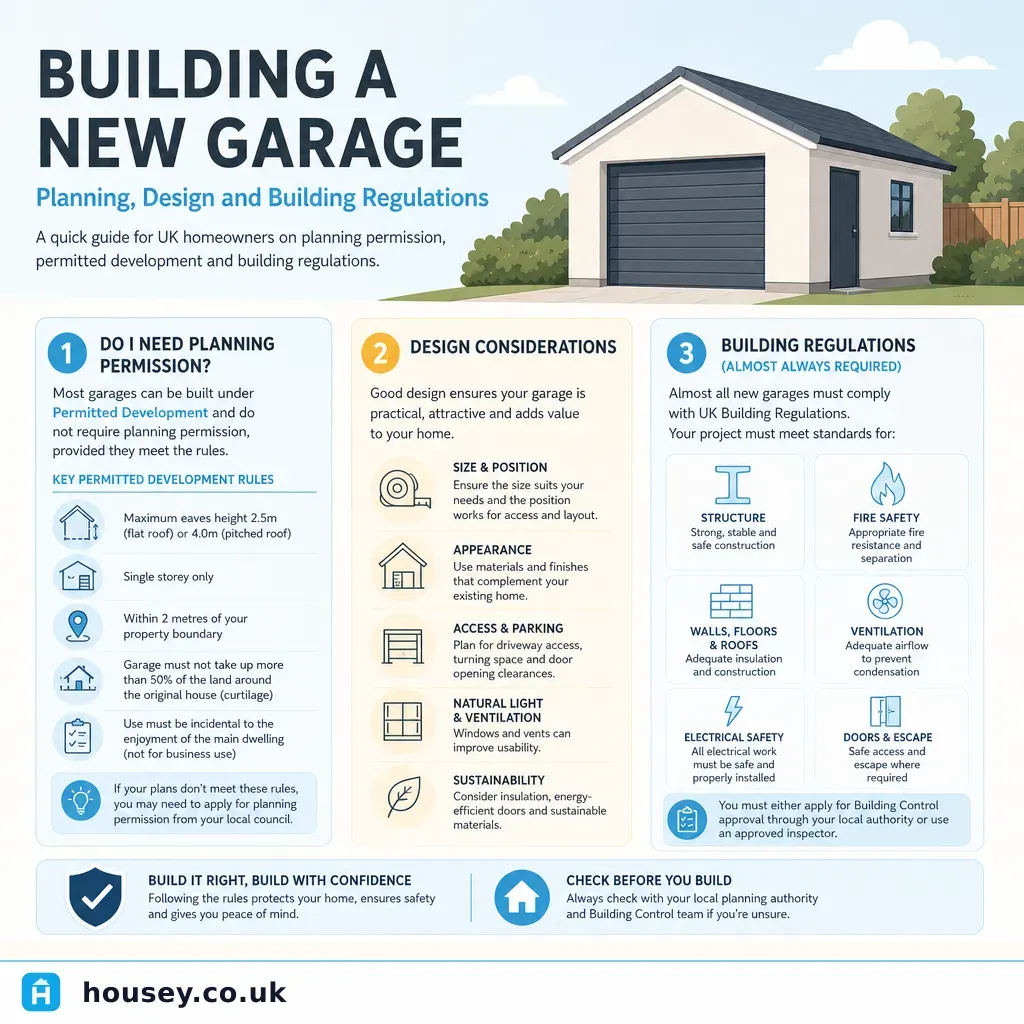
Building a New Garage: Planning, Design and Building Regulations
Most new detached garages in England qualify as permitted development and do not need planning permission, provided they stay within size, height, and coverage limits and are not within 5m of the dwelling.
 Improvement & Build
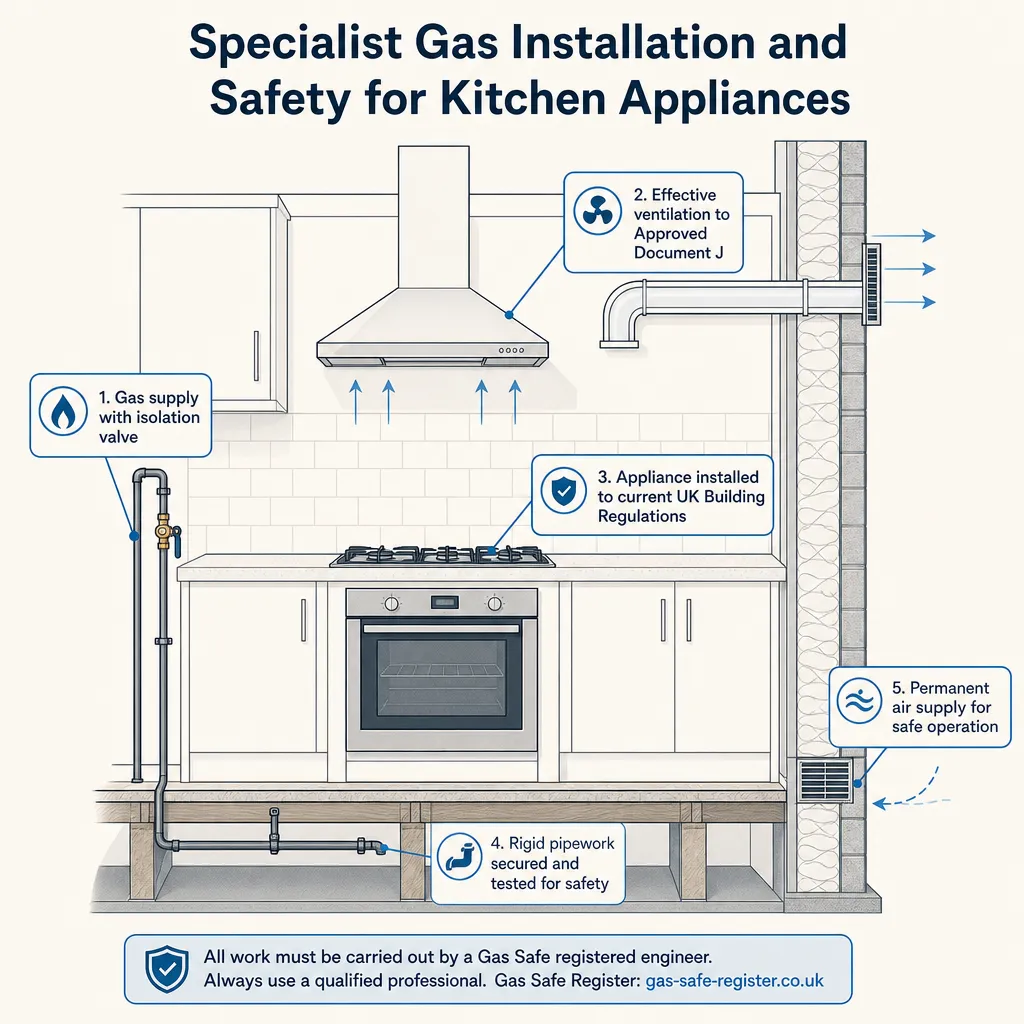
Specialist Gas Installation and Safety for Kitchen Appliances
All gas work on kitchen appliances in the UK must be carried out by a Gas Safe registered engineer.
 Improvement & Build
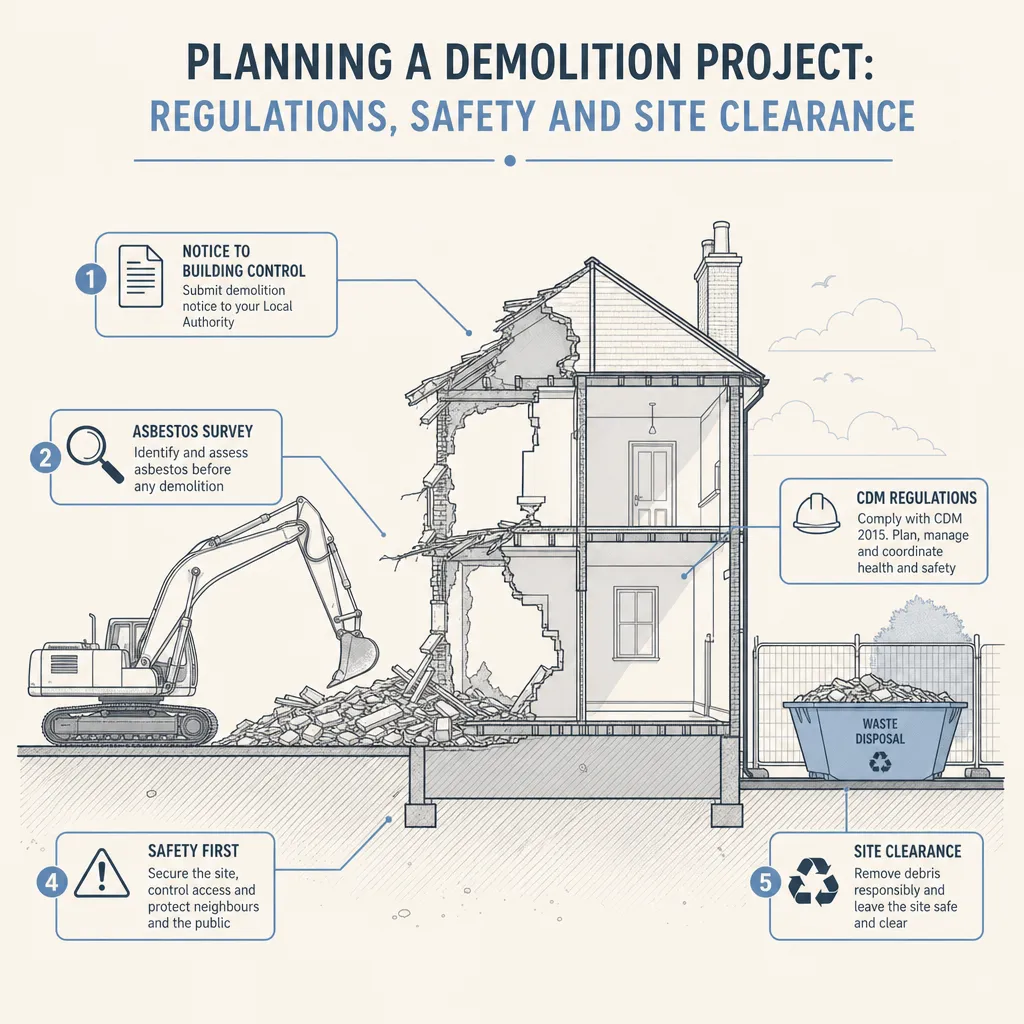
Planning a Demolition Project: Regulations, Safety and Site Clearance
Demolishing a building in England requires a Section 80 building control notice served at least six weeks before work starts, a Refurbishment and Demolition asbestos survey before any demolition begins, and compliance with CDM 2015.