Replacing Doors: Options, Building Regulations and Installation
By Housey · Last reviewed 19th of May 2026
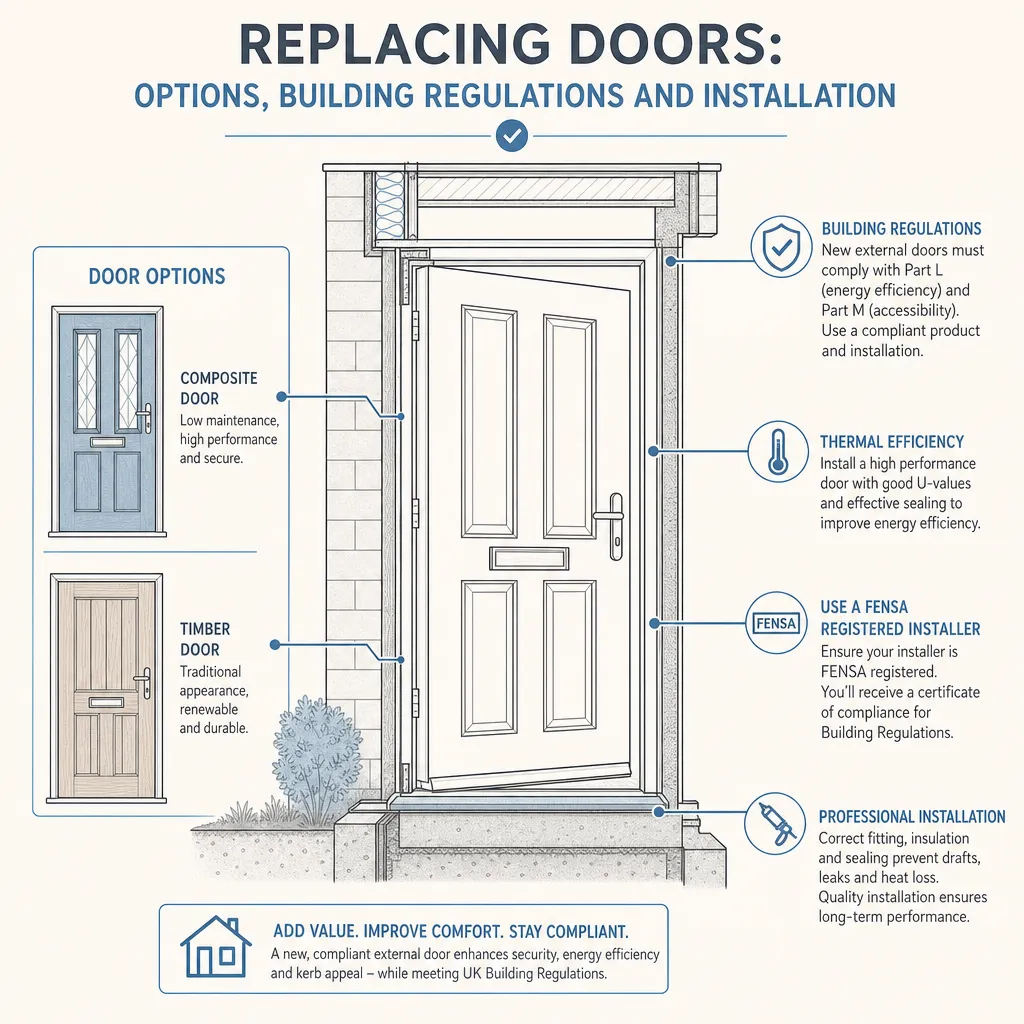
Replacing Doors: Options, Building Regulations and Installation
Door replacement comes up for many UK homeowners — a draughty front door before winter, a back door that no longer locks properly, or an internal fire door needing an upgrade following a garage conversion. In England, replacing an external door is not simply a purchase-and-fit exercise: it triggers Building Regulations requirements on thermal performance and security, and certain internal installations — particularly doors separating a garage from the living space — carry specific fire safety obligations under Approved Document B. Understanding the regulatory position before you order can save considerable expense later.
Key points
- Replacement external doors in England must meet a minimum U-value of 1.4 W/m²K under Building Regulations Approved Document L (2021 edition).
- Part Q of the Building Regulations requires external doors to resist physical attack to PAS 24:2016 standard — primarily for new dwellings and extensions, but strongly advisable for all replacements.
- FENSA and CERTASS are government-authorised competent-person schemes; registered installers can self-certify compliance without a separate building control application.
- Fire doors between an attached or integral garage and the habitable part of a house must achieve at least FD30 (30 minutes' fire resistance) under Approved Document B, fitted with intumescent strips, smoke seals, and a self-closing device.
- Listed buildings and properties in conservation areas may need listed building consent or conservation area consent before replacing external doors — check with your local planning authority.
Which door material is right for your property?
The main external door materials available in the UK are timber, uPVC, aluminium, and composite. Each suits different property types, budgets, and performance priorities.
Material | Best for | Not ideal for | Typical lifespan | Security notes |
|---|---|---|---|---|
Timber (hardwood) | Period properties, listed buildings, high aesthetic value | Buyers wanting minimal maintenance | 30+ years with regular maintenance | Can meet PAS 24 with correct locks, hinges, and cylinder |
uPVC | Modern and post-war homes, budget-conscious buyers | Conservation areas, listed buildings | 20–30 years | Many profiles available with PAS 24 certification |
Aluminium | Contemporary new builds, slim sightlines, large apertures | Period properties requiring a traditional look | 30–40 years | Multi-point locking standard on most profiles |
Composite (GRP skin over insulated core) | Most property types; balances looks, performance, security | Very traditional period homes where timber is specified | 25–35 years | Most achieve Part Q and PAS 24 as standard |
For most modern and post-war homes, a composite door offers the most practical balance of thermal performance, security, and low maintenance. For Victorian and Edwardian terraces, a timber door — properly specified and maintained — better preserves the character that conservation officers and buyers often expect.
Building Regulations: what applies to door replacement?
Part L — thermal performance
Under the 2021 edition of Approved Document L (Conservation of Fuel and Power), a replacement external door in an existing dwelling must achieve a U-value of no worse than 1.4 W/m²K. Doors with a significant glazed area may also need to meet solar gain and overall opening area limits. Ask the manufacturer or supplier for the tested U-value of any door you are considering before placing an order.
Part Q — security
Part Q primarily applies to new dwellings and dwellings created by a material change of use or extension. For straightforward like-for-like replacements in existing homes, Part Q is not formally triggered — but choosing a door certified to PAS 24:2016 is strongly advisable. Many home insurers now require PAS 24 or equivalent (such as Secured by Design certification) as a condition of contents and buildings cover.
Self-certification via competent-person schemes
If your installer is registered with FENSA or CERTASS — both government-authorised for window and external door installation — they can self-certify compliance with Part L and Part Q without a separate building control application. The installer must issue a certificate within 30 days of completion. Keep this document: buyers' solicitors routinely request it on a property sale. If your installer is not scheme-registered, you or the installer must notify your local building control body before work begins.
Internal doors and fire safety
Not all internal door replacements have regulatory implications, but some situations carry genuine obligations.
An FD30 fire door is required between a garage and the house when:
- The garage is integral to (built within the footprint of) the house.
- The garage is attached (sharing a wall) with the dwelling.
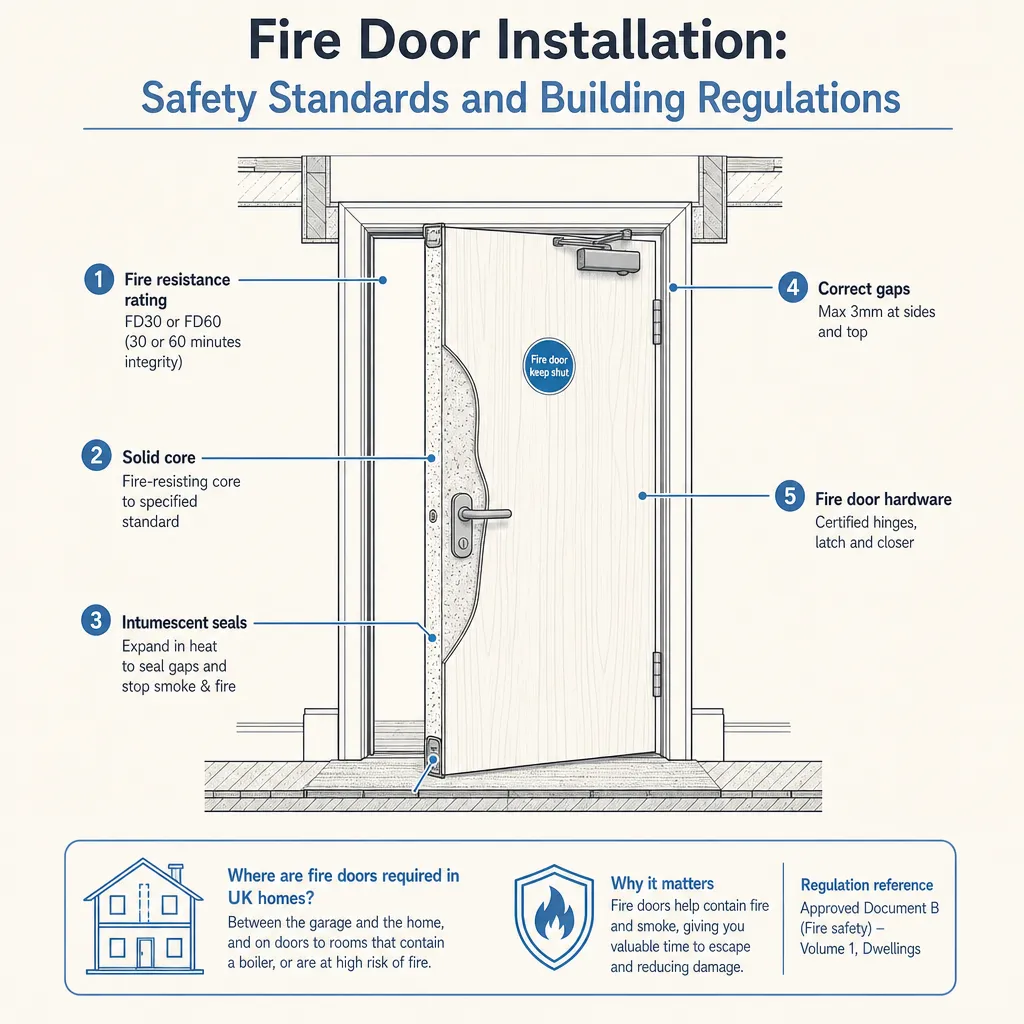
An FD30 door must be hung in a correctly specified frame with intumescent strips, cold smoke seals, three fire-rated hinges, and a self-closing device. Replacing just the door leaf without attending to the frame, seals, and ironmongery will not achieve compliance and does not provide the intended level of protection.
Fire doors are also required in Houses in Multiple Occupation (HMOs) subject to licensing conditions and fire risk assessment, and as specified in building control approval documentation for loft conversions and garage conversions.
Decision tree: do I need planning permission for a door replacement?
- Listed building? → Apply for listed building consent before any replacement, including like-for-like in timber.
- Conservation area with Article 4 direction? → Check with your local planning authority; changes to external appearance may require consent even under permitted development.
- Standard house outside a protected area, replacing like-for-like? → No planning permission needed; Building Regulations apply.
- Changing the size or position of the opening? → Structural and building regulations implications arise; planning may be needed if the opening is on a principal elevation.
- Flat — replacing the front door? → Check your lease and seek freeholder or managing agent consent before proceeding.
Red flags: when to pause and get advice
- The existing frame or surrounding masonry shows signs of movement — cracked render or brickwork above the aperture, a sagging head, or a door that has recently become difficult to open or close.
- You are in a listed building or conservation area and have not yet consulted the planning department.
- The door was specified in a loft or garage conversion building control certificate — confirm any replacement meets that original specification.
- Your installer cannot provide a FENSA or CERTASS registration number and has not arranged building control notification.
- The proposed opening is wider than the existing one — this almost certainly requires a structural engineer to assess the lintel requirement.
What to ask before accepting a quote
- What U-value does this door achieve, and can you confirm it meets Part L 2021 (1.4 W/m²K or better)?
- Is the door PAS 24:2016 certified?
- Are you FENSA or CERTASS registered, and will you issue a self-certification certificate on completion?
- Does the quote include the frame, threshold, ironmongery, and all making-good to the reveal?
- If this is a fire door, does the specification include the correct frame, intumescent strips, smoke seals, and a compliant self-closer?
- Is VAT included?
- What happens if the existing frame is found to be rotten or the lintel shows signs of distress?
When to get professional help
Most door replacements are straightforward jobs for a competent, scheme-registered installer. Seek professional input when:
- There is evidence of structural movement around the existing opening.
- You want to create a new or enlarged door opening — a structural engineer should assess the lintel requirement before any masonry is cut.
- The property is listed or in a conservation area and you are unsure of the consent position.
- The installation involves a fire door on an escape route or in an HMO.
- A previous conversion's building control certificate specifies a particular fire door performance standard that must be matched or exceeded.
How Housey can help
Housey connects you with vetted window and door installers who hold FENSA or CERTASS registration and can manage Part L and Part Q compliance on your behalf. If your project involves a structural alteration to create or widen a door opening, you may also need building regulations drawings prepared before work begins.
Frequently asked questions
Do I need building regulations approval for a like-for-like door replacement?
Yes, in most cases. Replacement external doors must comply with Part L (minimum U-value 1.4 W/m²K) and, for new dwellings or extensions, Part Q (security to PAS 24). If your installer is FENSA or CERTASS registered, they self-certify compliance and issue a certificate within 30 days. If not, you must notify your local building control body before work begins.
Can I replace my front door without planning permission?
Usually yes. Replacing an external door without changing the size or position of the opening is normally permitted development. Exceptions apply in listed buildings, conservation areas where an Article 4 direction removes PD rights, and flats where the front door forms part of the common parts. Always check with your local planning authority if you are unsure.
What is a composite door and is it a good choice for a UK home?
A composite door has a glass-reinforced plastic (GRP) outer skin bonded over a solid insulated core, combining a timber-like appearance with low maintenance. Most composite doors achieve PAS 24:2016 security certification and U-values well below 1.4 W/m²K. For most post-war UK homes they offer a strong balance of thermal performance, security, and longevity, though at a higher upfront cost than uPVC.
Do I need a fire door between my garage and the house?
Yes, if the garage is integral to or attached to the dwelling. Approved Document B requires a minimum FD30 fire door between the garage and the habitable area, installed in a correctly specified frame with intumescent strips, cold smoke seals, and a self-closing device. Replacing just the door leaf without these components will not achieve compliance.
What is FENSA and why does it matter for door replacement?
FENSA (Fenestration Self-Assessment Scheme) is a government-authorised competent person scheme for window and external door installation. Registered installers can self-certify compliance with Building Regulations Part L and Part Q without a separate building control application and must issue a certificate on completion. Conveyancers routinely request this certificate on a property sale. CERTASS is an equivalent scheme with the same authority.
Sources and further reading
- Approved Document L: Conservation of Fuel and Power (2021) — GOV.UK / MHCLG
- Approved Document Q: Security — GOV.UK / MHCLG
- Approved Document B: Fire Safety — GOV.UK / MHCLG
- FENSA — competent person scheme for windows and doors — FENSA
- CERTASS — competent person scheme — CERTASS
Useful next reads
 Improvement & Build
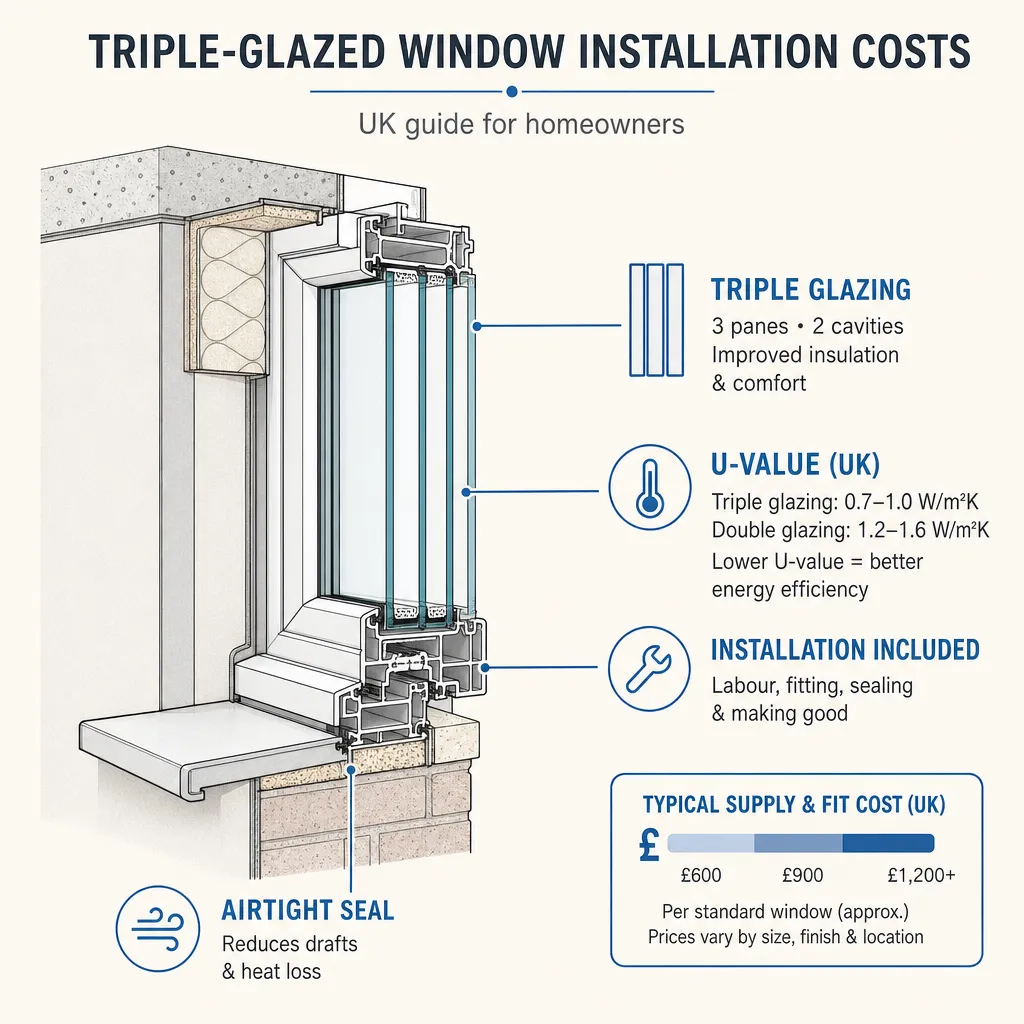
Triple-Glazed Window Installation Costs
Triple-glazed window installation in the UK typically costs £800–£1,800 per window, depending on size, frame material, and glazing specification.
 Improvement & Build
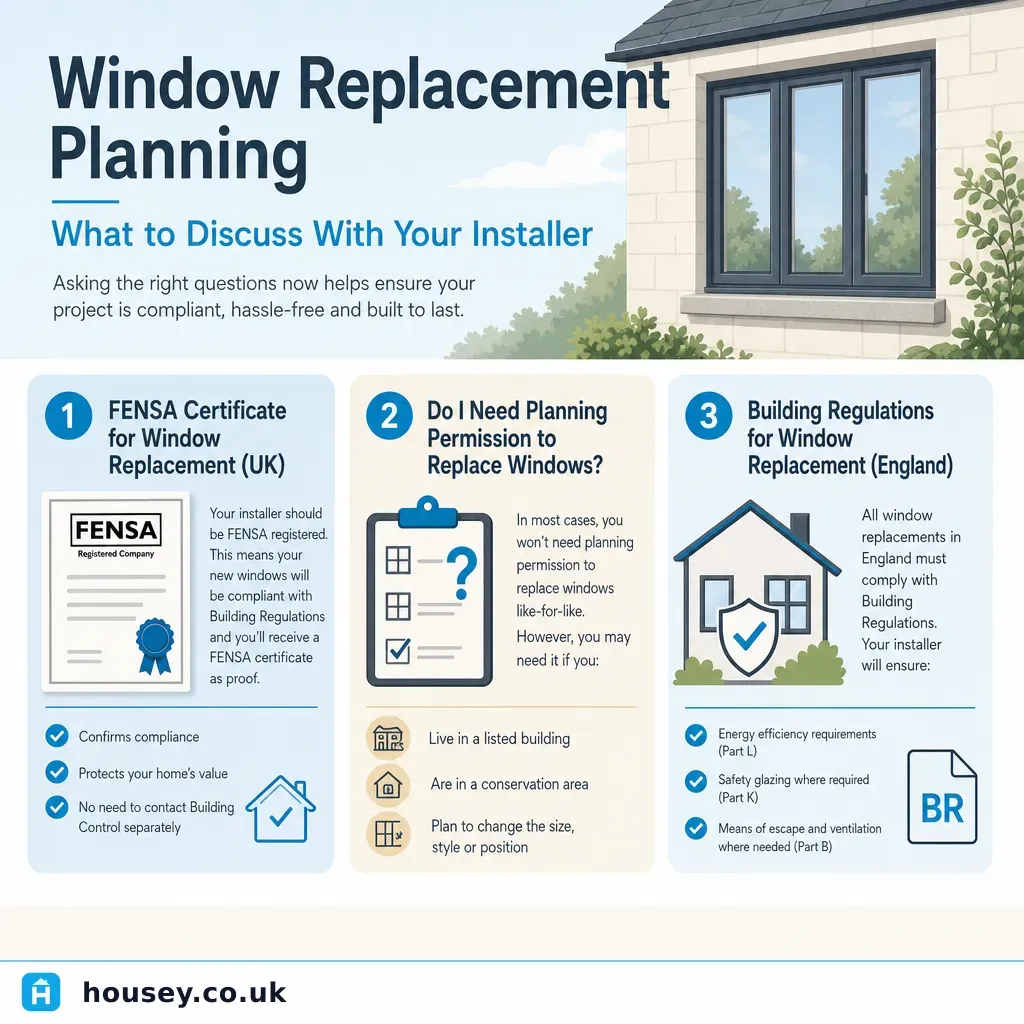
Window Replacement Planning: What to Discuss With Your Installer
Most window replacements in England fall under permitted development rights and do not require planning permission, but they must comply with Building Regulations Part L and Part K.
 Improvement & Build
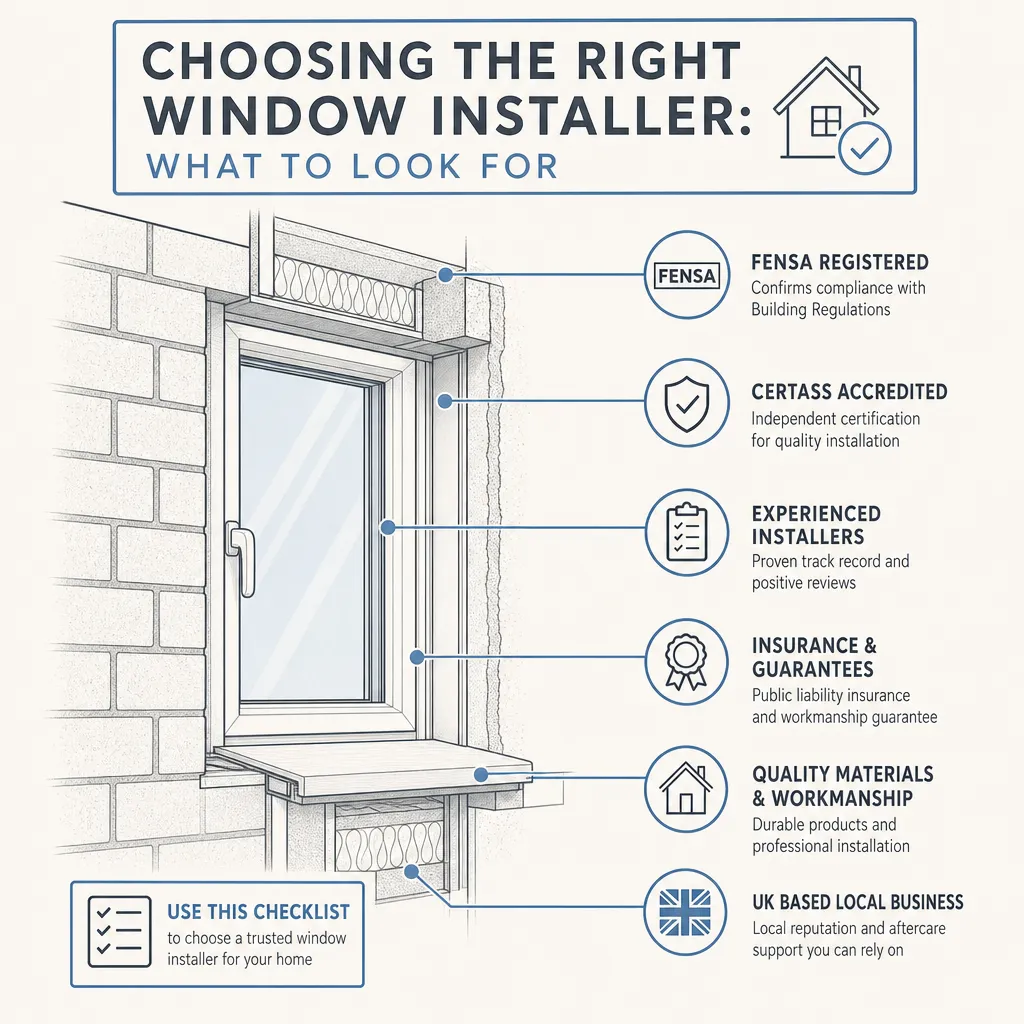
Choosing the Right Window Installer: What to Look For
When choosing a window installer in the UK, verify FENSA or CERTASS registration first — these schemes allow installers to self-certify Building Regulations compliance and issue the completion certificate you will need at resale.
 Improvement & Build
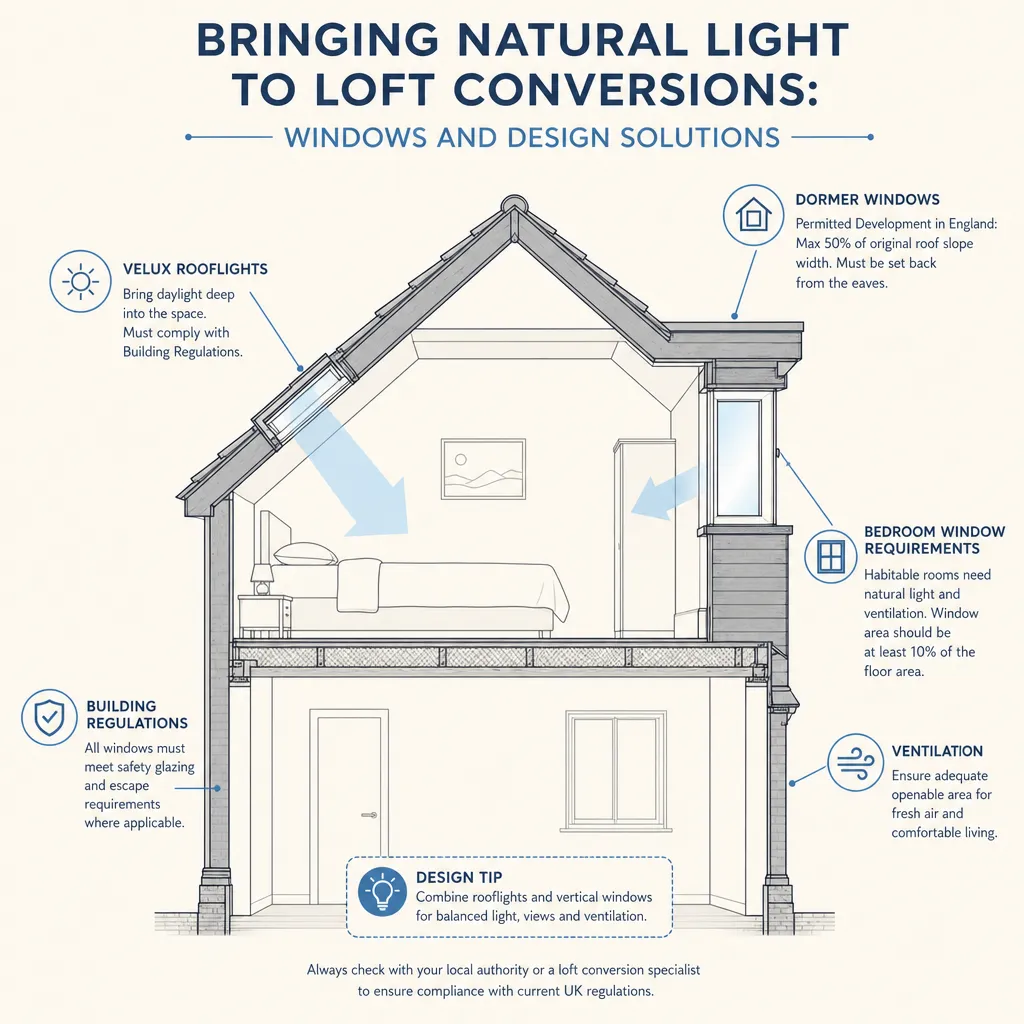
Bringing Natural Light to Loft Conversions: Windows and Design Solutions
Natural light in a loft conversion is usually achieved through roof lights, dormer windows, or gable-end glazing.
 Improvement & Build
Fire Door Installation: Safety Standards and Building Regulations
Fire doors in UK homes are required by Building Regulations on escape routes, between integral garages and living space, and throughout HMOs.