Retiling a Pitched Roof: Building Regulation Requirements and Permit Necessity
By Housey · Last reviewed 4th of May 2026
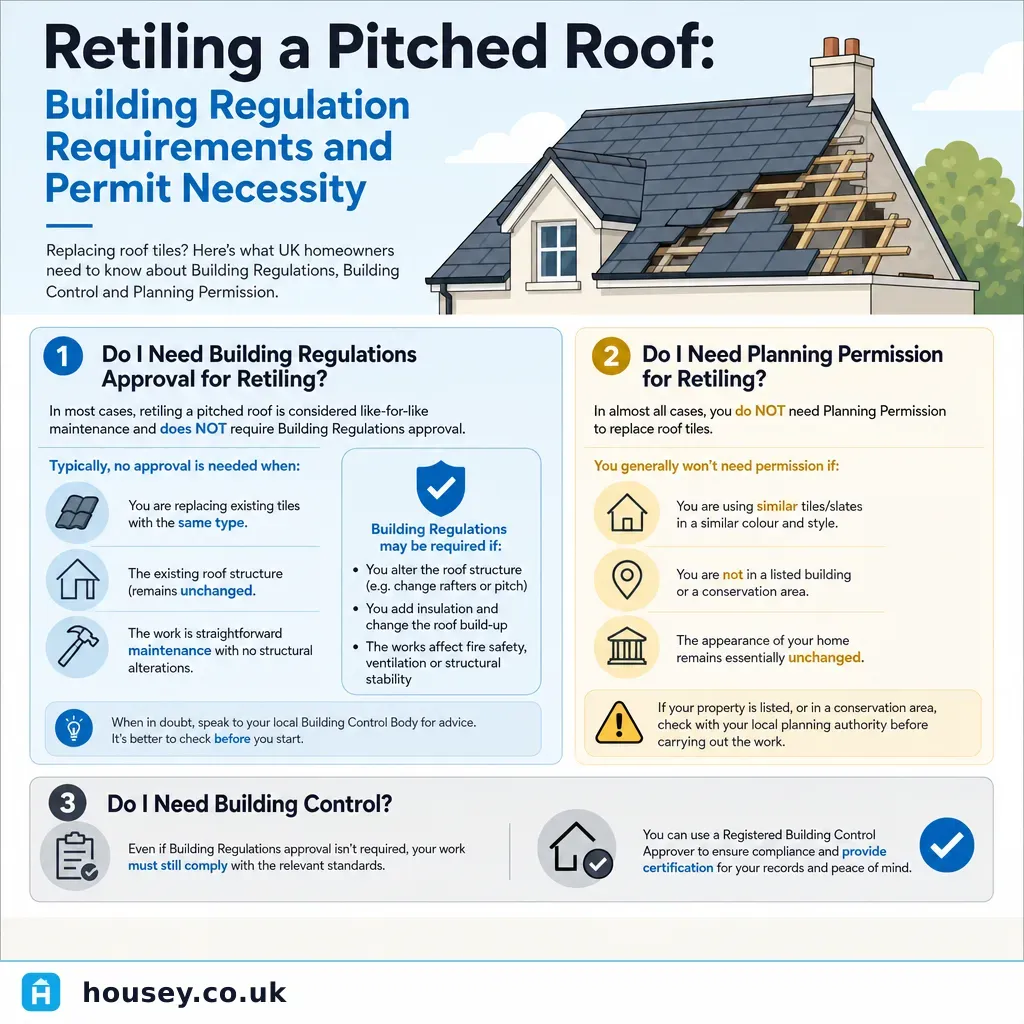
Retiling a Pitched Roof: Building Regulation Requirements and Permit Necessity
A pitched roof that has reached the end of its useful life — typically 60–100 years for clay or concrete tiles, and 50–80 years for natural slate — will eventually need full or partial retiling. The central regulatory questions for most homeowners are whether a planning permit is required and whether building control needs to be involved. The answers depend on the scope of work, the property type, and whether the tile specification is changing. Getting this wrong before scaffold is erected can create enforcement problems and complications when selling.
Key points
- Like-for-like retiling (same tile type, same weight, no structural changes) on an ordinary house in England does not normally require a building regulations application or planning permission.
- Changing tile specification to a materially heavier covering may trigger Building Regulations Approved Document A (Structure), because increased dead load affects the roof structure.
- Properties in conservation areas or Areas of Outstanding Natural Beauty may require planning permission even for replacement roofing where the original material is changing.
- Listed buildings require listed building consent for any external roofing works where the character of the building could be affected.
- Where re-roofing involves stripping to the rafters and replacing insulation, the new insulation must achieve the Approved Document L target U-value of 0.16 W/m²K for pitched roofs where reasonably practicable.
Does retiling need planning permission?
In England, replacing roof tiles is generally treated as permitted development under Class A of Schedule 2, Part 1 of the Town and Country Planning (General Permitted Development) (England) Order 2015. No planning application is required for most ordinary houses.
Permitted development rights are removed or restricted in some circumstances:
Property or area type | Permitted development for retiling? | Action required |
|---|---|---|
Ordinary house, no designations | Yes — like-for-like usually permitted | None, unless changing material significantly |
Conservation area | Restricted — material change may need consent | Check with local planning authority (LPA) |
AONB or National Park | May be restricted | Check with LPA before specifying tile |
Listed building | No — external works may affect character | Apply for listed building consent |
Article 4 direction area | Rights may have been removed | Check planning history with LPA |
Flat in a block | Building-level rules apply; lease may also govern | Check lease and consult freeholder |
Conservation area restrictions typically focus on works visible from a highway. Retiling a rear slope with a matching material may not require consent in many cases. Always confirm with your LPA.
Does retiling require building regulations approval?
For like-for-like repair and maintenance — replacing tiles of the same type and weight — building regulations generally do not apply. Regulation 3 of the Building Regulations 2010 defines notifiable building work, and routine maintenance is excluded.
Building regulations do apply in these situations:
- Change of tile weight or type that materially increases dead load. This engages Approved Document A (Structure); the roof must be assessed and shown to remain adequate.
- Insulation replacement during the re-roofing project. Where insulation is stripped and replaced, Approved Document L requires 0.16 W/m²K or better where reasonably practicable.
- Replacement of structural roof members — rafters, purlins, or ridge components replaced rather than repaired require building control notification and structural compliance.
- New rooflights or structural openings formed at the same time, which are notifiable as new building work.
Decision tree: do you need approval?
- Replacing tiles with identical specification on an ordinary house? → Building regulations likely not required; planning not required unless conservation area or listed.
- Changing tile type with a different dead load? → Building regulations may apply — consult a structural engineer or building control before specifying.
- Property in a conservation area, AONB, or National Park? → Contact your LPA before committing to a tile specification.
- Property listed? → Apply for listed building consent before any external roofing works.
- Replacing insulation at the same time? → Approved Document L applies — confirm U-value compliance.
- Replacing structural members (rafters, purlins, ridge)? → Notify building control or confirm your roofer can certify structural adequacy.
What about switching to a different tile?
Switching from concrete interlocking tiles to natural or synthetic slate to reduce loading on an ageing structure is a common scenario. In this case:
- Natural Welsh slate weighs approximately 30–35 kg/m² compared with concrete interlocking tiles at 40–55 kg/m². Going lighter may not require formal approval; going heavier usually does.
- In a conservation area, changing from clay to synthetic slate may affect visual character and require planning consent even if the weight change is minor.
- A roof survey before specifying the replacement provides an independent assessment of the roof structure's capacity and condition.
Important limitations
This article provides general guidance for England. Building regulations and planning rules differ in Scotland (governed by the Building (Scotland) Act 2003 and Scottish Building Standards), Wales, and Northern Ireland. Rules also depend on the specific property, its planning history, conditions attached to prior approvals, and LPA interpretation. Nothing here constitutes professional advice. For any project involving a listed building, a change of specification, structural uncertainty, or a designated area, seek advice from a building control consultant, structural engineer, or heritage professional.
What to ask a qualified professional
Before your roofer starts work:
- What is the weight per m² of the proposed replacement tile, and how does this compare to the existing covering?
- If the weight changes significantly, is a structural assessment needed and will you notify building control?
- Is the property listed or in a conservation area? If so, has the correct consent been obtained?
- Will the project involve insulation replacement? If so, what U-value will be achieved under Approved Document L?
- Are any structural members in a condition requiring replacement? If so, how will this be certified?
- Will I receive a building control completion certificate or compliance record on completion?
- Is VAT included in the quoted price?
When to get professional help
Seek specialist input if:
- You are unsure whether your property is in a conservation area or subject to Article 4 directions — check with your LPA or the Planning Portal before specifying materials.
- Your roofer identifies structural damage (sagging rafters, failed purlins, ridge movement) — a structural engineer should assess before the new covering is installed.
- The project involves a significant change of tile weight — a building control consultant can advise on whether a building notice is required.
- The property is listed — a heritage consultant or conservation architect should be involved before any external works proceed.
Before committing to a contractor, consider arranging a roof survey to establish the existing structure's condition, and use experienced roofers with a demonstrable track record in the tile type you are specifying.
How Housey can help
Housey can help you find qualified professionals for your retiling project. Request quotes from experienced roofers, arrange a pre-works roof survey to assess the existing structure, or speak to building control consultants if your project triggers regulatory requirements.
Frequently asked questions
Does retiling a roof need building regulations approval?
Not for simple like-for-like tile replacement on a standard house in England, where the same tile type and weight is used and no structural members are changed. Building regulations apply if the tile specification changes significantly, if insulation is replaced at the same time under Part L, or if structural components are altered. When in doubt, check with your local authority building control before work begins.
Do I need planning permission to retile my roof?
In most cases, no. Retiling a house roof is normally permitted development in England, requiring no planning application. Exceptions include listed buildings, which require listed building consent, properties in conservation areas where the roof material is changing, and homes subject to Article 4 directions that remove permitted development rights. Check with your local planning authority if in any doubt.
What happens if I change the tile type when retiling?
Changing tile type may alter the dead load on the roof structure. Switching to heavier tiles requires structural assessment under Approved Document A and potentially building control notification. Changing material in a conservation area may also require planning consent. Always confirm the weight comparison between old and new tiles and discuss the implications with your roofer and building control if relevant.
Do I need a structural engineer for roof retiling?
Not for straightforward like-for-like replacement on a structurally sound roof. A structural engineer's input is advisable if you are switching to a materially heavier tile specification, if your roofer identifies structural damage during the works, or if the project involves replacing structural roof members such as rafters or purlins. A pre-works roof survey will help determine whether assessment is warranted.
Sources and further reading
- Town and Country Planning (General Permitted Development) Order 2015 — legislation.gov.uk
- Building Regulations 2010 — legislation.gov.uk
- Approved Document A: Structure — GOV.UK
- Approved Document L: Conservation of Fuel and Power — GOV.UK
- Planning Portal: Roof alterations guidance — Planning Portal
Useful next reads
 Planning & Pre-Build
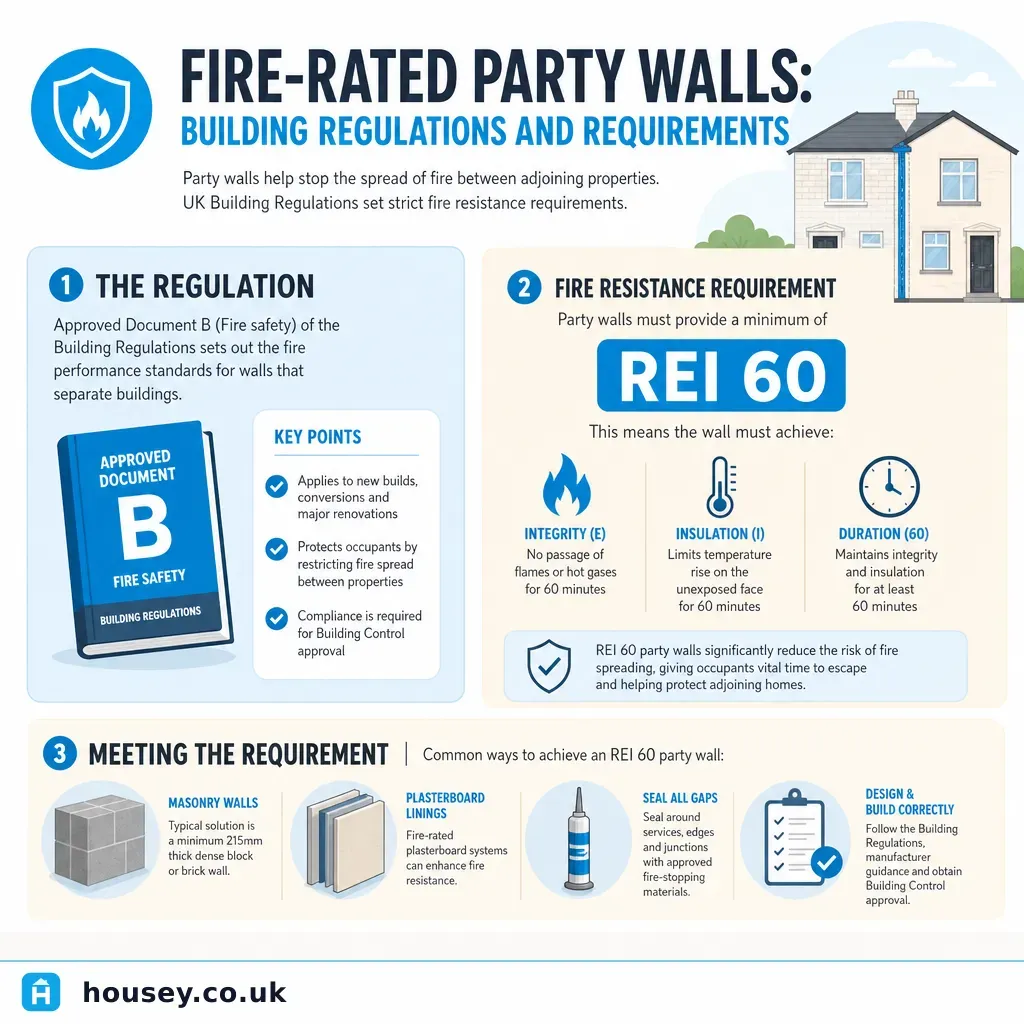
Fire-Rated Party Walls: Building Regulations and Requirements
Party walls between dwellings must achieve at least 60 minutes' fire resistance, expressed as REI 60, under Building Regulations Approved Document B.
 Planning & Pre-Build
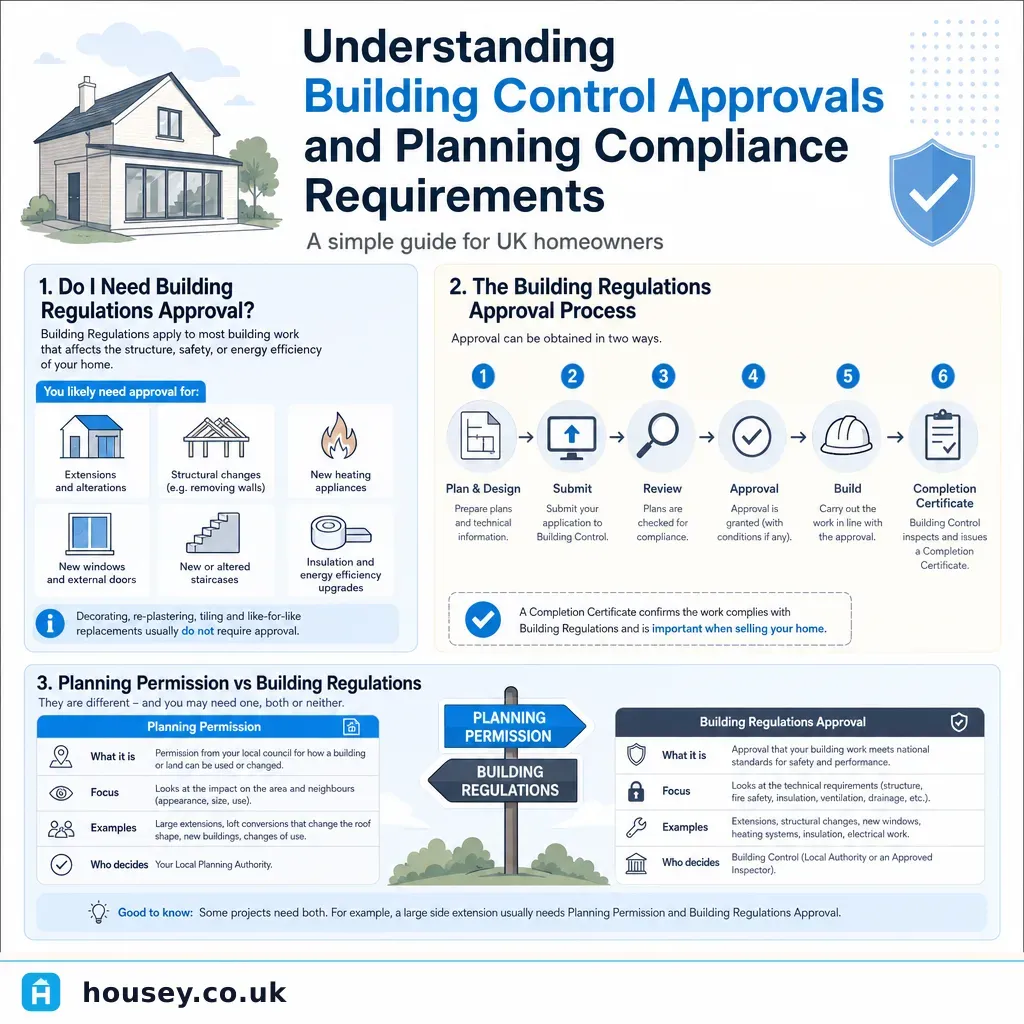
Understanding Building Control Approvals and Planning Compliance Requirements
Planning permission and building regulations are separate consents.
 Planning & Pre-Build
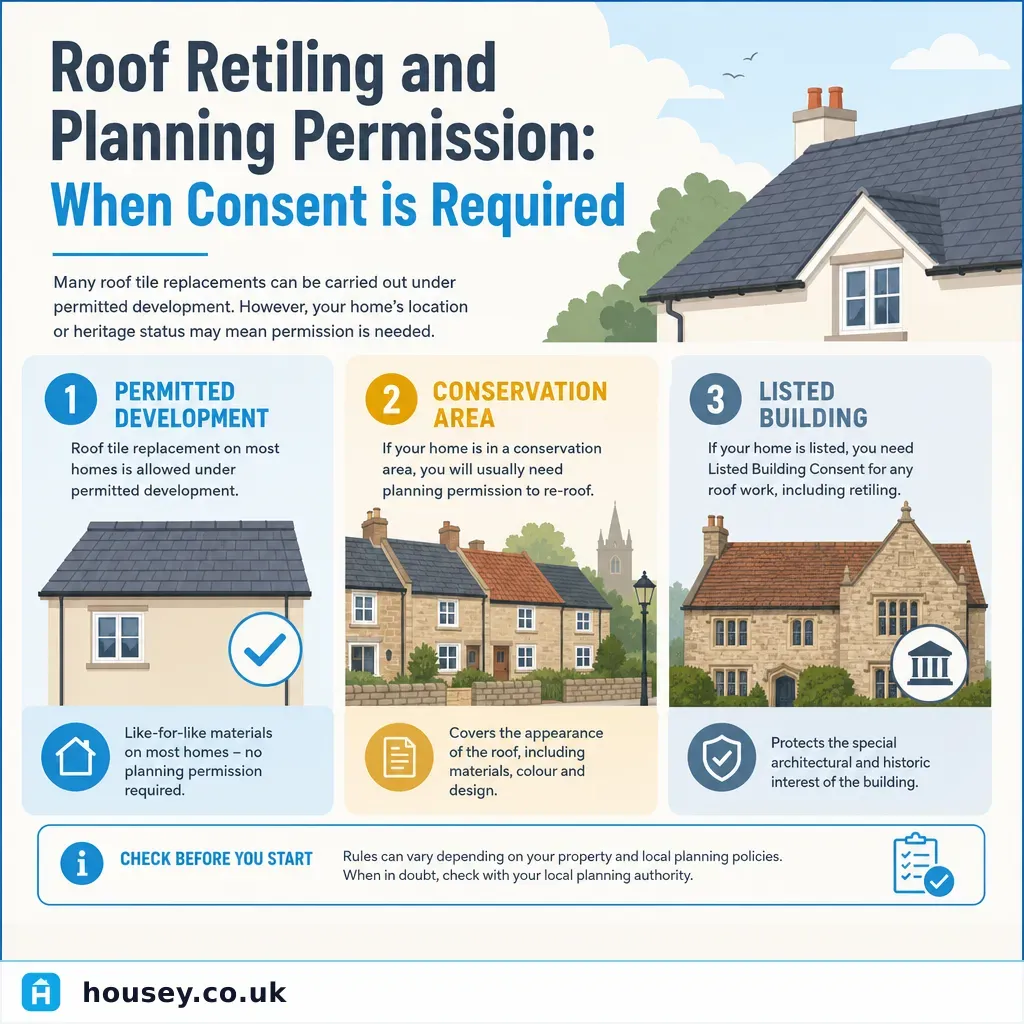
Roof Retiling and Planning Permission: When Consent is Required
Replacing roof tiles with materials of similar appearance is generally permitted development in England and does not need planning permission.
 Planning & Pre-Build
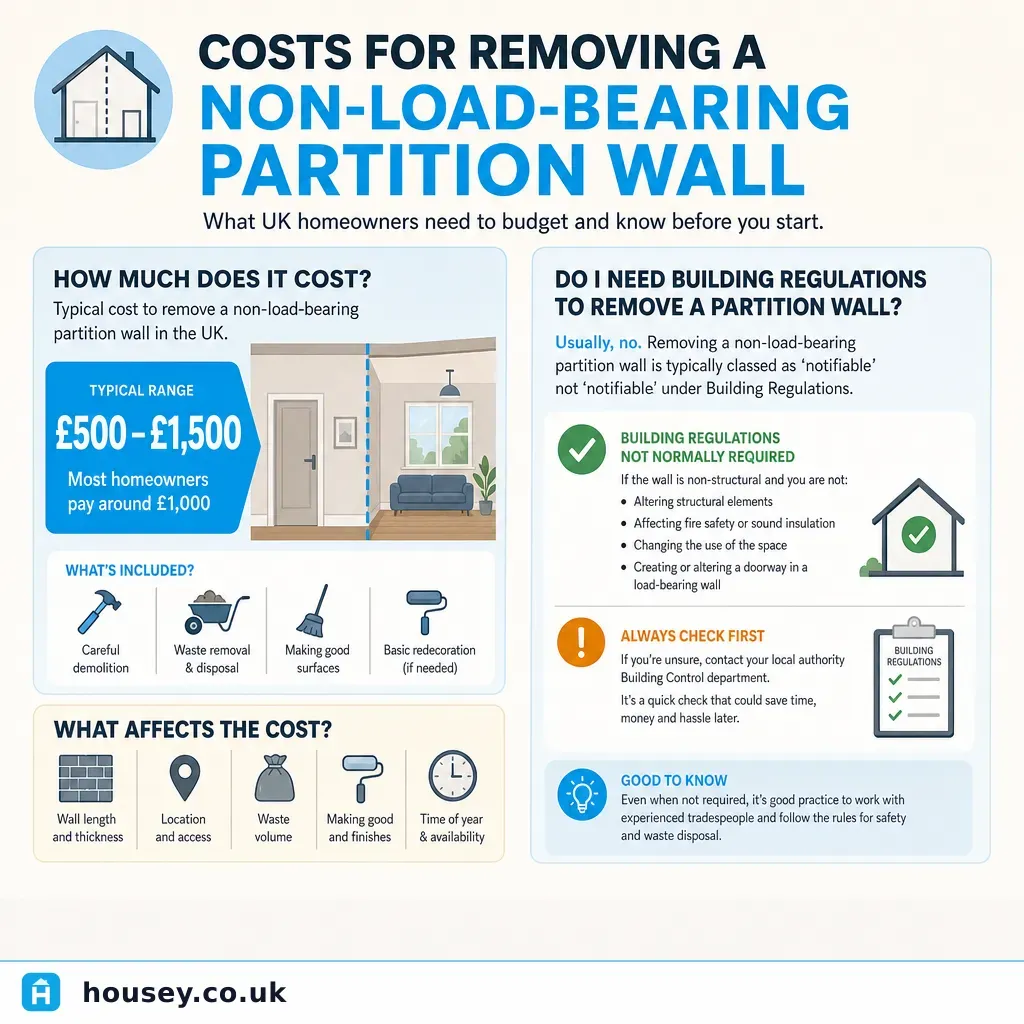
Costs for removing a non-load-bearing partition wall
Removing a non-load-bearing partition wall in a UK home typically costs £300–£1,500 in labour, plus £200–£600 or more for replastering and making good.
 Planning & Pre-Build
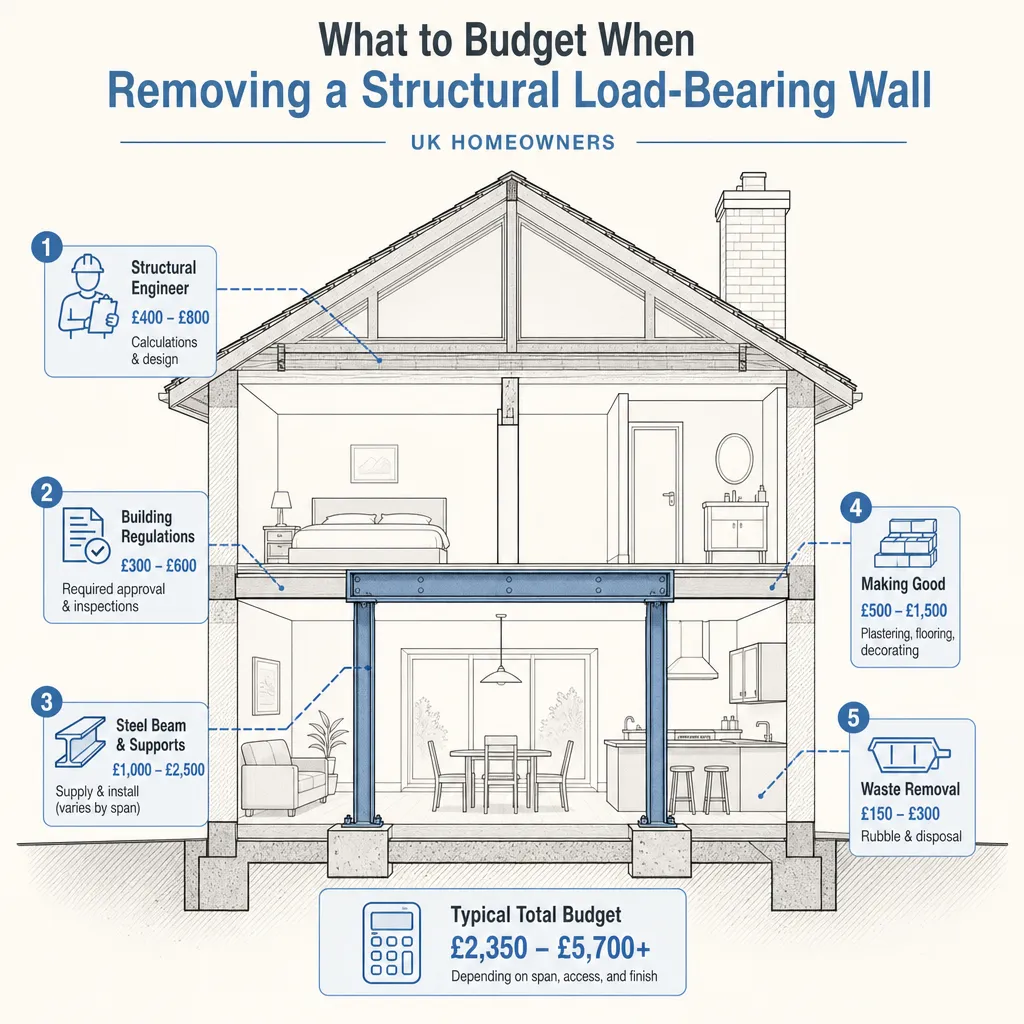
What to Budget When Removing a Structural Load-Bearing Wall
Removing a load-bearing wall in a typical UK home costs £2,500–£8,000 or more in total, covering a structural engineer's calculations, Building Regulations approval, the steel beam, builder's labour, and replastering.