Fire Resistance of Concrete Masonry: Understanding Safety Ratings
By Housey · Last reviewed 11th of May 2026
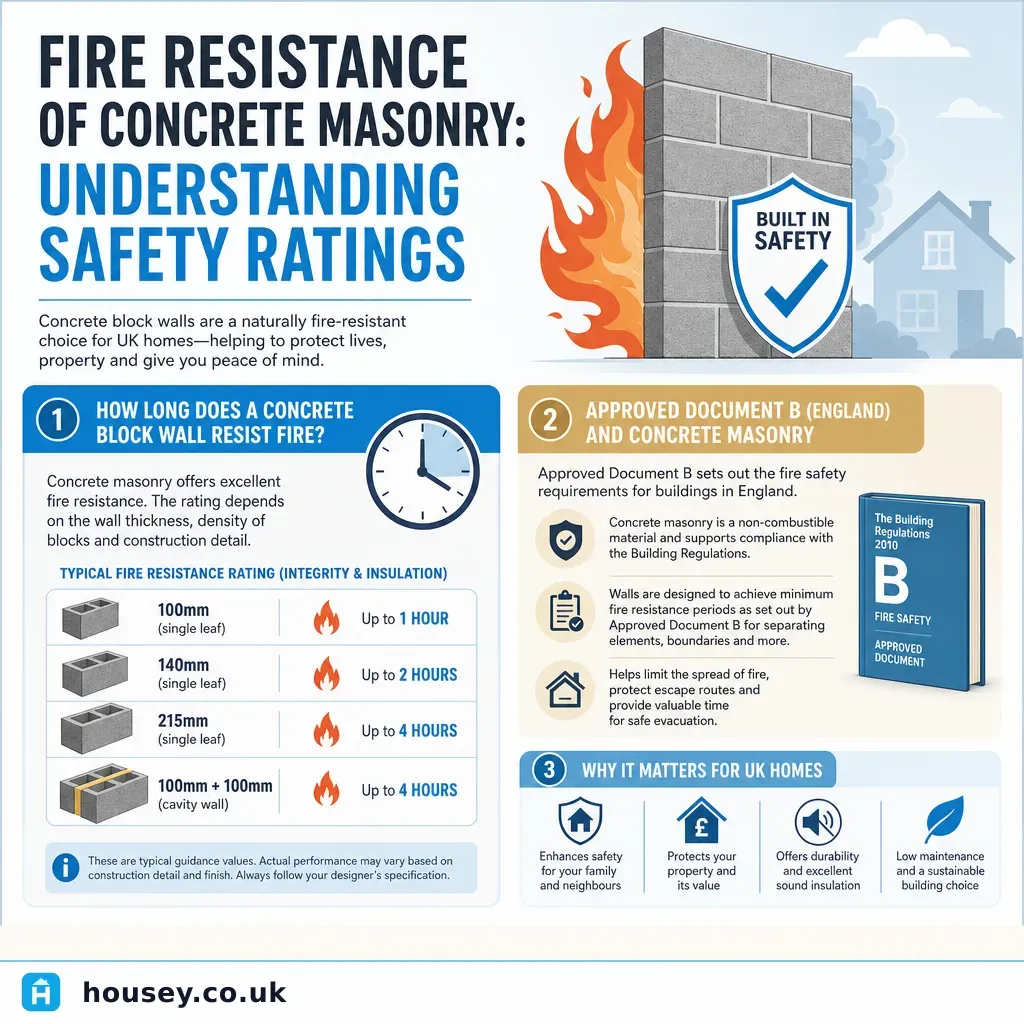
Fire Resistance of Concrete Masonry: Understanding Safety Ratings
Concrete masonry is a common structural and partition material in UK homes, commercial buildings, and extensions built across multiple eras. Questions about fire resistance typically arise during a structural survey, a fire risk assessment, or when planning works that change compartmentation — such as converting a garage, opening up a ground floor, or adding a loft conversion. Getting fire resistance wrong can have serious consequences: insufficient rated walls and floors undermine both the means of escape and the structural integrity of a building under fire conditions.
Key points
- Fire resistance in UK buildings is governed by Approved Document B (ADB) of the Building Regulations for England, with separate but similar instruments in Scotland (Technical Handbooks), Wales, and Northern Ireland.
- Concrete masonry fire resistance is expressed using the REI classification: R (load-bearing capacity), E (integrity — preventing flame and hot gas passage), and I (insulation — limiting heat transfer). A wall rated REI 120 maintains all three for 120 minutes.
- A 100 mm dense aggregate concrete block wall (unplastered) typically achieves a minimum of REI 60; increasing to 140 mm or adding a 13 mm plaster finish can raise this to REI 90 or REI 120.
- The principal design standard for masonry fire performance is BS EN 1996-1-2 (Eurocode 6: Fire Design of Masonry Structures), supported by the PD 6697 UK National Annex.
- Aggregate type affects fire resistance: dense aggregate (gravel or crushed rock) and lightweight aggregate (aerated or expanded clay) blocks perform differently under sustained heat; manufacturer data sheets and NHBC Standards Chapter 6.1 provide material-specific guidance.
What fire resistance ratings mean in practice
Fire resistance is not a simple pass/fail certificate stamped on a wall — it is a performance period, tested or assessed to BS EN 1363-1, representing how long a structural element maintains the REI criteria under standardised fire exposure. In the UK, ADB specifies minimum fire resistance periods by building use and element type. A separating wall between a house and an attached garage must typically achieve REI 30 to REI 60, while a compartment floor in a purpose-built flat conversion may require REI 60 to REI 90.
Concrete masonry performs well in fire compared with many other materials because:
- It does not combust or contribute to fire spread.
- Thermal mass slows heat transfer through the wall.
- Dense concrete retains structural integrity at high temperatures better than unprotected steel.
However, performance is sensitive to construction quality: mortar joints, wall ties, service chasings, and penetrations all affect the integrity (E) component of the rating.
How wall thickness and aggregate type affect ratings
The table below summarises typical fire resistance periods for common concrete masonry configurations used in UK residential and light commercial construction. These are indicative — always consult manufacturer test data and Approved Document B Tables A1–A2 for the specific application.
Wall configuration | Aggregate type | Typical fire resistance (REI) |
|---|---|---|
100 mm block, unplastered | Dense aggregate | REI 60 (1 hour) |
100 mm block, 13 mm plaster both faces | Dense aggregate | REI 90–120 |
140 mm block, unplastered | Dense aggregate | REI 90–120 |
215 mm solid block, unplastered | Dense aggregate | REI 120–240 |
100 mm block, unplastered | Lightweight/aerated | REI 90–120 |
200 mm block, unplastered | Lightweight aggregate | REI 120–180 |
Indicative values based on BS EN 1996-1-2 and manufacturer data; actual performance depends on mortar class, joint quality, and boundary conditions. Last reviewed 2026-05-11.
Lightweight aggregate blocks generally achieve better thermal insulation performance (the I component) because of lower thermal conductivity. This means a thinner lightweight block wall can sometimes meet the insulation criterion that a denser block of the same thickness would not.
Where fire resistance requirements apply in UK homes
Most homeowners encounter fire resistance requirements in three situations:
- Separating elements — walls and floors between separate dwellings (flats, terraced houses, maisonettes) must typically achieve REI 60 under ADB Table A1, with higher periods required for taller buildings.
- Garage-to-habitable space boundaries — an integral garage wall or floor separating from living accommodation must achieve REI 30 as a minimum; converting a garage to habitable use triggers a full compliance review under the Building Regulations.
- Loft conversions and floor compartmentation — a new habitable floor added above two storeys requires the floor structure to achieve REI 30–60 depending on building height and use.
In listed buildings or buildings within conservation areas, the approach to fire resistance may need to balance heritage constraints against modern safety requirements. Historic England and the local planning authority can provide guidance on acceptable solutions.
Important limitations
This article provides general information about concrete masonry fire resistance based on published standards and guidance. The fire resistance of a specific wall or floor in your building depends on construction details, condition, modification history, and regulatory jurisdiction. Only a qualified professional — such as a fire engineer, chartered building surveyor, or BAFE-registered fire risk assessor — can confirm whether a particular element meets the fire resistance required for its use.
Rules and thresholds vary by building type, occupancy, height, and location. England, Scotland, Wales, and Northern Ireland each operate under separate regulatory instruments. This article does not constitute professional fire safety or structural advice.
When this becomes urgent
Seek professional advice without delay if:
- You are aware of penetrations, chasings, or modifications that have broken the continuity of a fire-resisting wall or floor.
- A structural survey or fire risk assessment has flagged inadequate fire compartmentation.
- You are converting, extending, or changing the use of a building that includes masonry separating elements.
- You are buying or selling a property with a fire safety remediation notice or an unresolved EWS1 or fire risk assessment issue.
- A masonry wall has been damaged by impact, damp, or structural movement and you are unsure whether fire performance has been compromised.
What to ask a qualified professional
Before instructing a fire engineer, structural surveyor, or fire risk assessor, ask:
- What standard or Approved Document will you use to assess this element?
- Will you test or calculate fire resistance, or rely on manufacturer data sheets?
- If the element is deficient, what upgrade options exist without removing the wall entirely?
- How will service penetrations, junctions, and movement joints be addressed in the assessment?
- What documentation will I receive, and will it satisfy building control or a future EWS1 process?
- Are you BAFE-registered or a chartered member of RICS, the Institution of Fire Engineers (IFE), or a recognised fire engineering body?
When to get professional help
Concrete masonry fire resistance is a technical and regulated area. You should involve a professional if:
- You are carrying out building work that touches any fire-resisting wall or floor element.
- A survey or assessment has identified fire resistance as a concern.
- You are planning a change of use, extension, or conversion that affects compartmentation.
- You are a landlord with a legal duty under the Regulatory Reform (Fire Safety) Order 2005 to maintain adequate fire precautions in non-domestic premises.
How Housey can help
Housey connects you with qualified professionals for fire risk assessments and structural surveys. Whether you need a compartmentation review for a conversion, a fire resistance assessment for a proposed extension, or a full fire risk assessment for a residential building, Housey can match you with accredited local specialists.
Frequently asked questions
Does a standard 100 mm concrete block wall meet UK fire regulations?
A 100 mm dense aggregate concrete block wall typically achieves around REI 60 (one hour), which satisfies many domestic separating-wall requirements under Approved Document B. Whether it meets the requirement for your building depends on the element's function, building use class, and height. A fire engineer or building control officer should confirm compliance for your specific situation.
What is the difference between fire resistance and fire protection?
Fire resistance is the intrinsic performance of a building element — how long a wall or floor maintains load capacity, integrity, and insulation under fire. Fire protection refers to measures applied to improve that performance, such as intumescent coatings or fire-rated boarding. Concrete masonry walls often achieve fire resistance through inherent mass and composition without added protective materials.
Do I need a fire risk assessment when converting a garage with block walls?
A garage conversion typically triggers a Building Regulations application, which includes a check of fire resistance at the boundary between the garage and the rest of the dwelling. Building control will assess compartmentation as part of the full plans or building notice process. A formal fire risk assessment under the Regulatory Reform (Fire Safety) Order 2005 is generally required for non-domestic premises rather than single private dwellings.
Who can carry out a fire resistance assessment on masonry?
A fire engineer chartered with the Institution of Fire Engineers (IFE), a BAFE-registered fire risk assessor, or a chartered building surveyor with fire safety experience can assess fire resistance. For complex or higher-risk buildings, a specialist fire engineering firm may be needed. Both RICS and the IFE maintain public registers of qualified professionals.
Sources and further reading
- Approved Document B: Fire Safety (Volume 1 — Dwellinghouses) — Ministry of Housing, Communities and Local Government
- Regulatory Reform (Fire Safety) Order 2005 — legislation.gov.uk
- Institution of Fire Engineers (IFE) — professional body for fire safety professionals
- NHBC Standards Chapter 6.1: External masonry walls — NHBC
- Historic England: Fire Safety in Historic Buildings — Historic England
Useful next reads
 Surveys & Inspections
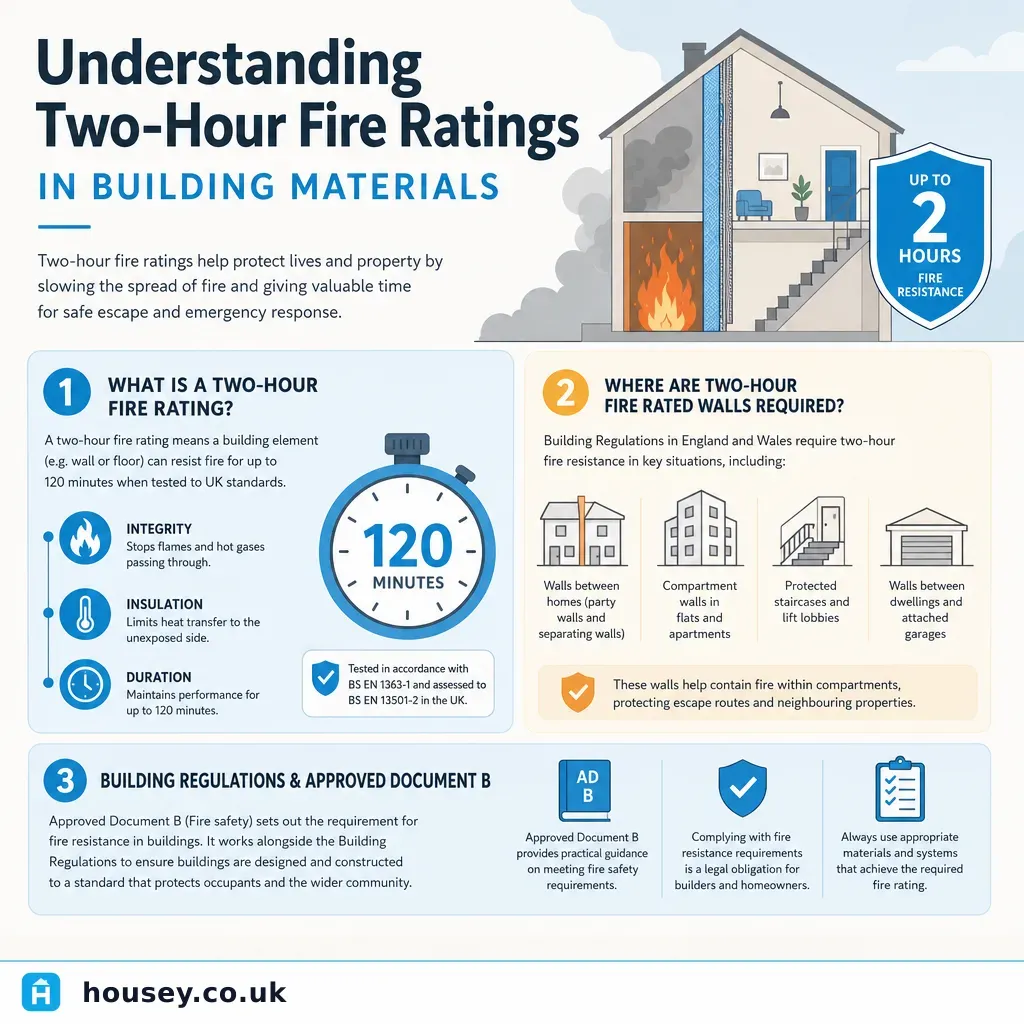
Understanding Two-Hour Fire Ratings in Building Materials
A two-hour fire rating — FR 120 or REI 120 — means a building element maintains loadbearing capacity, resists flame penetration, and limits heat transfer for 120 minutes under standardised test conditions to BS EN 13501-2.
 Surveys & Inspections
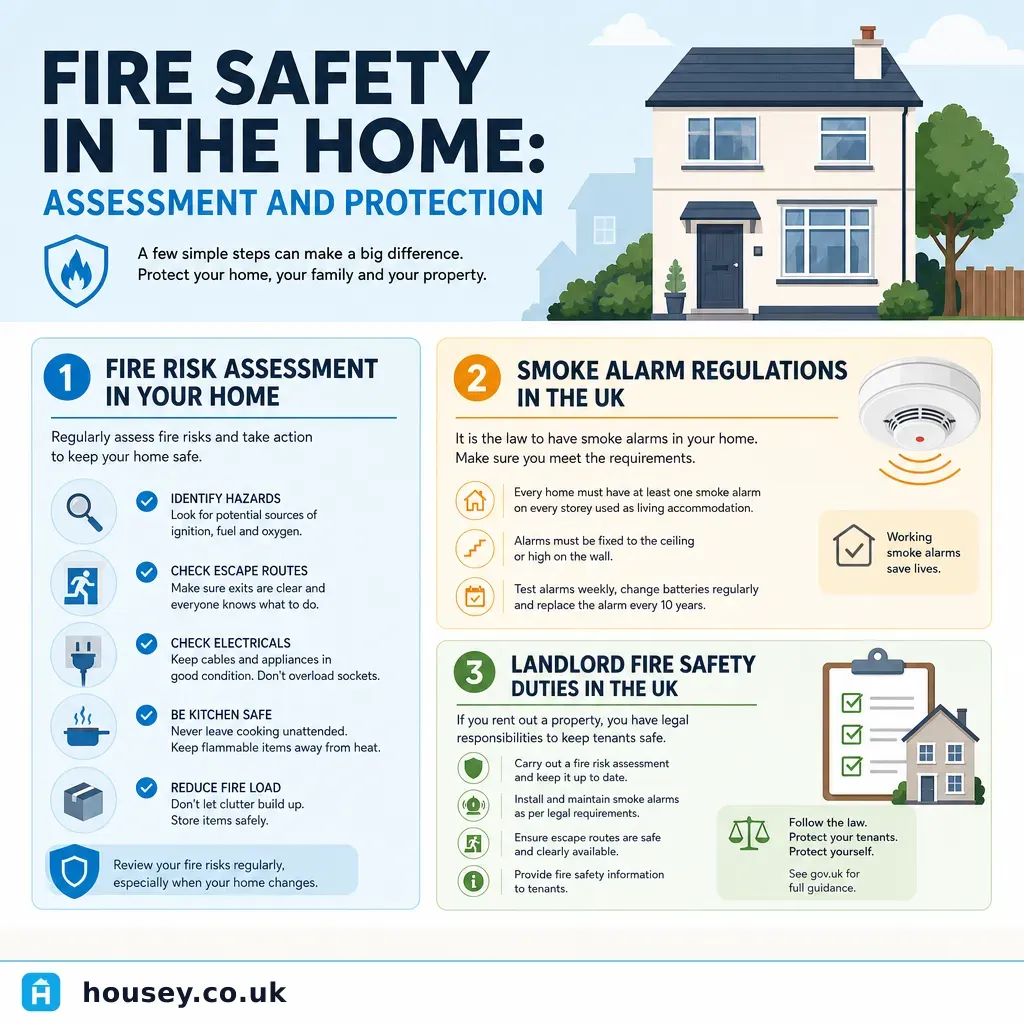
Fire Safety in the Home: Assessment and Protection
Most UK owner-occupied homes are the homeowner's responsibility to make fire-safe, while landlords have a legal duty to carry out fire risk assessments under the Regulatory Reform (Fire Safety) Order 2005.
 Surveys & Inspections
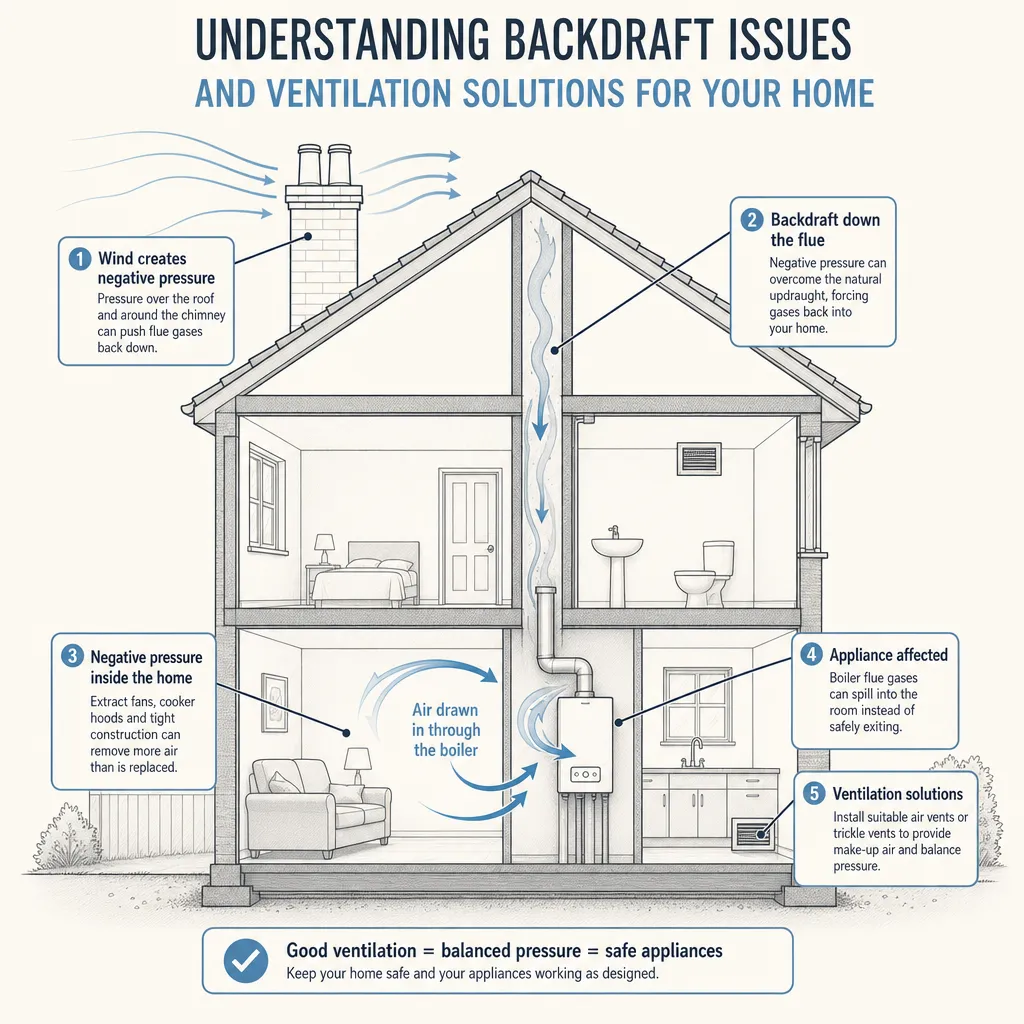
Understanding backdraft issues and ventilation solutions for your home
Backdraft occurs when negative pressure inside a building draws combustion gases back through a flue or chimney instead of expelling them outside.
 Surveys & Inspections
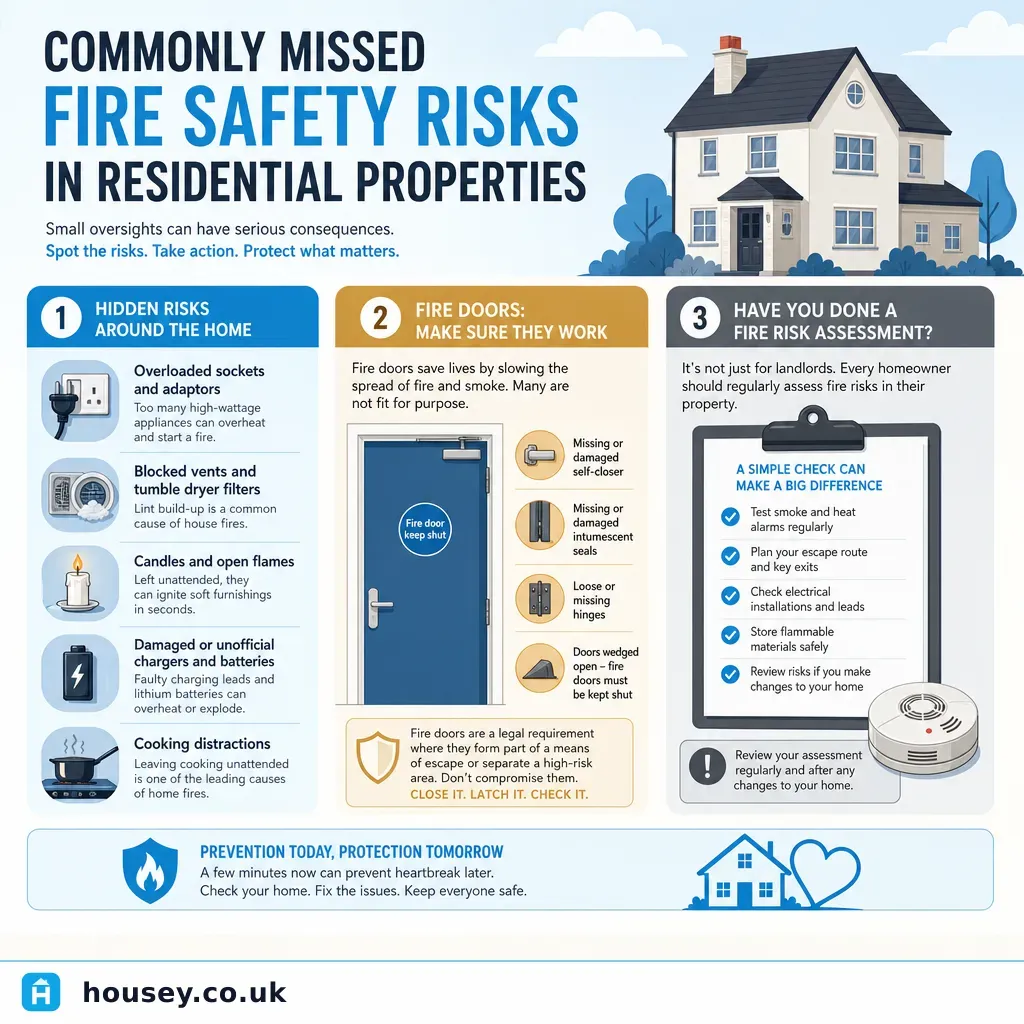
Commonly Missed Fire Safety Risks in Residential Properties
Commonly missed fire safety risks in UK homes include damaged fire doors without intumescent strips, breached compartmentation in roof spaces and floor voids, daisy-chained extension leads, and recessed downlighters without fire-rated covers.
 Surveys & Inspections
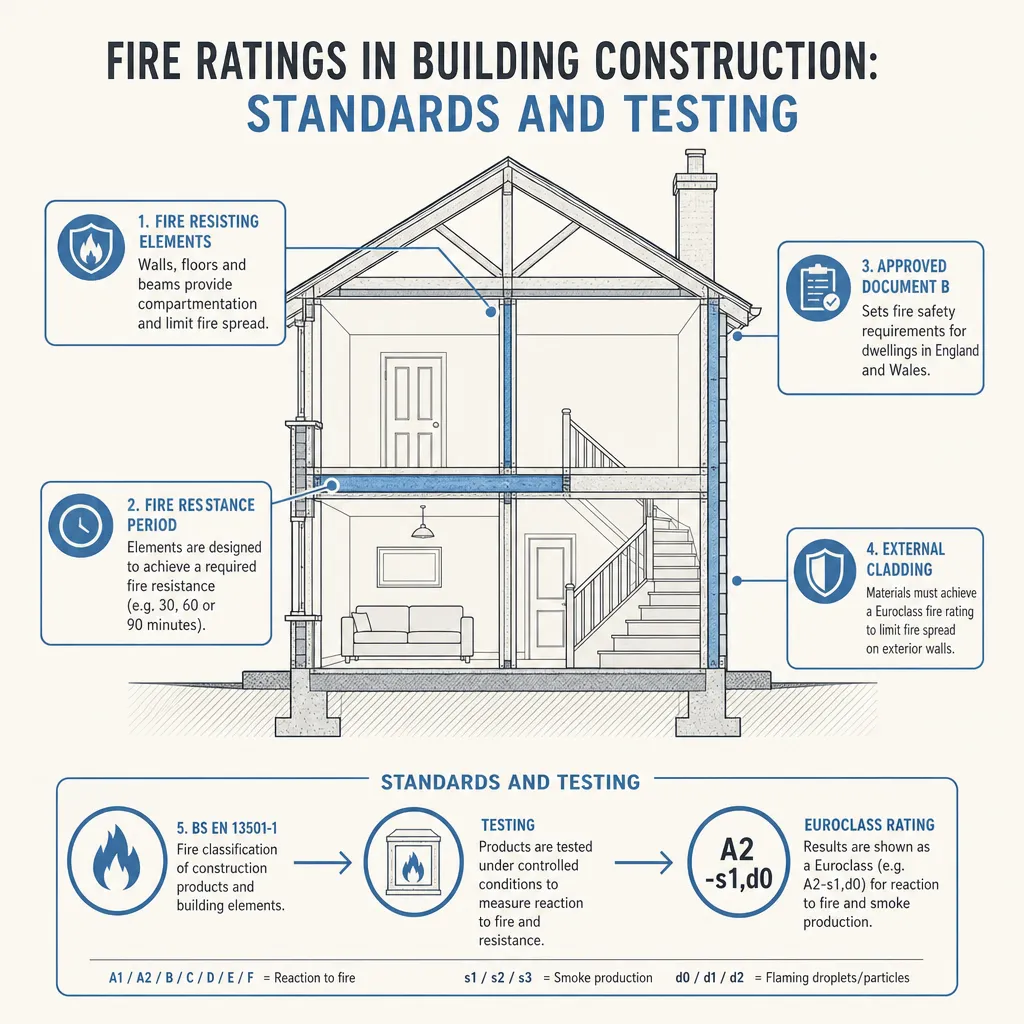
Fire Ratings in Building Construction: Standards and Testing
In UK construction, fire ratings describe how long a structural element or building assembly maintains load-bearing capacity, integrity, and insulation when exposed to a standard fire test — typically 30, 60, 90, or 120 minutes.