Fire Resistance Testing and Performance Prediction in Building Materials
By Housey · Last reviewed 24th of May 2026
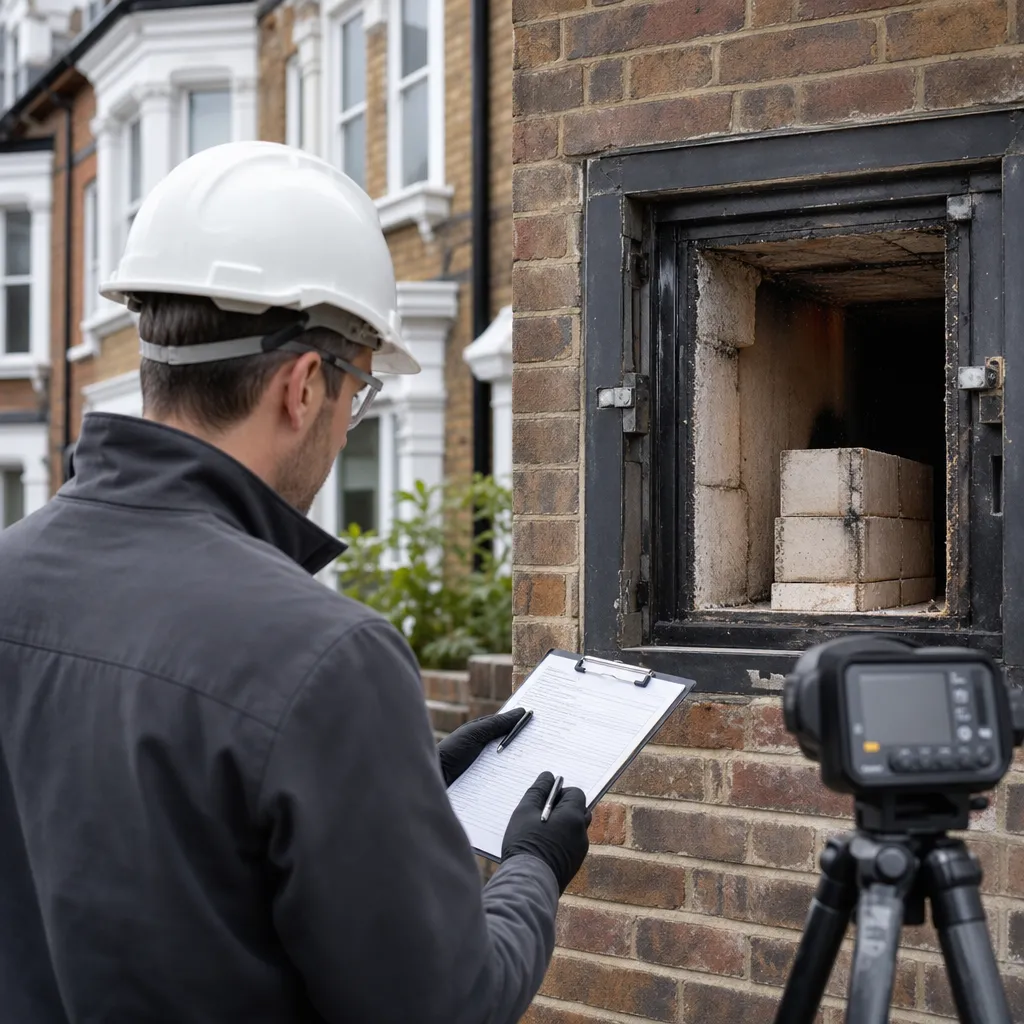
Fire Resistance Testing and Performance Prediction in Building Materials
When building owners, facilities managers, and design teams select materials for walls, floors, ceilings, and structural elements, the fire performance data underpinning those choices can be difficult to interpret without specialist knowledge. Questions about fire resistance testing most often arise during new-build design, refurbishment projects, and — with increasing urgency since the Grenfell Tower fire in 2017 — during remediation of existing buildings where the adequacy of passive fire protection is under regulatory scrutiny. Understanding what fire resistance ratings mean, how they are established, and where their limits lie is essential for anyone making or approving material choices that affect life safety.
Key points
- Fire resistance in the UK is classified under BS EN 13501-2, using criteria of Loadbearing capacity (R), Integrity (E), and Insulation (I), each rated in minutes — for example, REI 60 or EI 30.
- Standard fire resistance tests follow BS EN 1363-1, exposing specimens to the ISO 834 standard temperature-time curve; this does not replicate all real fire scenarios, including hydrocarbon fires or slow smouldering.
- Approved Document B (Fire Safety) — Volumes 1 and 2 — sets minimum fire resistance periods for structural elements and compartment walls under the Building Regulations 2010.
- The Building Safety Act 2022 introduced the Higher-Risk Buildings (HRB) regime for buildings over 18 m or 7 storeys in England, requiring Building Safety Case registration and ongoing Safety Case Reports.
- Third-party certificates from bodies such as the British Board of Agrément (BBA) and UKAS-accredited laboratories apply only to the specific configurations tested — the scope must always be verified against the actual proposed installation.
What fire resistance testing measures
Fire resistance testing assesses how a building element — a wall, floor, door, glazed partition, or structural member — performs when exposed to a standardised fire. Three performance criteria are evaluated:
R — Loadbearing capacity: the element continues to support its design load throughout the test period.
E — Integrity: the element prevents the passage of flames and hot gases to the unexposed face.
I — Insulation: the temperature on the unexposed face does not rise excessively (typically no more than 140°C average or 180°C at any single point above initial ambient temperature).
An element classified REI 60 maintains all three properties for at least 60 minutes under the test conditions. An EI 30 fire door resists integrity and insulation failure for 30 minutes but is not tested for loadbearing performance.
The standard test fire follows the ISO 834 temperature-time curve, which reaches approximately 840°C at 30 minutes and 925°C at 60 minutes. This curve represents a cellulosic (paper, wood, textile) fire in a compartment and does not replicate hydrocarbon fires, slow smouldering, or the full dynamics of real compartment fires.
Fire classification vs fire resistance: understanding the difference
A common source of confusion is the distinction between reaction to fire (how a material behaves when burning) and fire resistance (how a constructed element performs as a barrier to fire spread).
Classification type | Standard | What it tests | Typical application |
|---|---|---|---|
Euroclass reaction to fire (A1, A2, B, C, D, E, F) | BS EN 13501-1 | Ignitability, flame spread, heat release, smoke production, flaming droplets | Cladding, insulation, internal linings, floor coverings |
Fire resistance (R, E, I in minutes) | BS EN 13501-2 / EN 1363-1 | Performance of a constructed element as a fire barrier | Walls, floors, doors, glazing, structural members |
Legacy fire resistance | BS 476 Parts 20–23 | UK test standard used before EN adoption; still referenced on older certificates | Products tested before EN transition; certificate currency must be confirmed |
When a specification calls for a 30-minute fire-resisting partition, it refers to EN 13501-2 (or legacy BS 476) fire resistance — not Euroclass reaction-to-fire classification. Confusing the two can result in incorrect product selection with serious consequences for life safety.
How performance is predicted when test data is incomplete
Not every product configuration can be physically tested — there are too many variables in thickness, substrate type, joint details, fixings, and cavity conditions. Fire performance in practice therefore often relies on:
Extended application of test results (EXAP): a formal engineering methodology described in CEN TR 15110 that extrapolates from a tested configuration to a related but untested one. This should only be carried out by a qualified fire engineer or specialist test laboratory, not inferred from a standard product certificate.
Third-party product certification: bodies such as the British Board of Agrément (BBA), FM Approvals, and UKAS-accredited test houses issue certificates for specific product configurations. These are not blanket approvals — the certificate scope must be read to confirm it covers the actual installation conditions.
Structural fire engineering calculations: for steel and concrete members, BS EN 1993-1-2 (Eurocode 3, fire design) and BS EN 1992-1-2 (Eurocode 2, fire design) provide calculation methods for predicting structural performance in fire. These require a qualified structural or fire engineer.
Limitations of standard fire testing
Standard fire test data has important limitations that building owners and design teams must understand before relying on it for compliance decisions:
- One set of conditions. The ISO 834 curve does not replicate all fire scenarios. Hydrocarbon fires heat far faster; slowly developing fires may not reach the temperatures assumed by the test within the rated period.
- Laboratory vs installed conditions. Services penetrations, abutting constructions, fixings, and cavity details can all affect real-world performance compared to a clean laboratory specimen.
- Age and condition matter. Passive fire protection installed decades ago may have been disturbed, incorrectly maintained, or installed using products that have since been superseded or withdrawn from market.
- Rated period is a minimum, not a precise prediction. The classification indicates the minimum assured performance under test conditions — real-world behaviour may differ under different fire scenarios.
Important limitations
This article provides general background information on fire resistance testing and classification in the UK. Fire safety is a complex, regulated discipline where errors in specification or installation can have serious consequences for life safety. Nothing in this article constitutes professional fire safety advice, structural advice, or a determination of compliance for any specific building or product.
Requirements for a particular building depend on its use, occupancy, height, construction type, local authority requirements, and planning conditions. Always instruct a qualified fire engineer, approved inspector, or building control body to confirm compliance for your specific project.
When this becomes urgent
Seek urgent professional advice if:
- You manage a Higher-Risk Building (over 18 m or 7 storeys in England) and have not yet registered with the Building Safety Regulator or prepared a Building Safety Case.
- You have received a building safety notice, remediation order, or prohibition notice from a competent authority.
- You have identified a suspected failure of passive fire protection during refurbishment — for example, unsealed penetrations through fire-resisting compartment walls or floors.
- You are relying on a product certificate that has expired, been withdrawn, or does not clearly cover your specific installation conditions.
- Works have been carried out on a building where fire-resisting construction may have been disturbed without proper reinstatement.
What to ask a qualified professional
Before instructing a fire engineer, fire safety consultant, or building control body on a project involving fire resistance:
- What qualifications and accreditations do you hold? (Look for chartered membership of the Institution of Fire Engineers (IFE), CABE membership, or listing on the Register of Fire Safety Professionals.)
- Does your scope cover all passive fire protection details — compartmentation, fire-stopping at penetrations, and fire door hardware — as well as active systems such as sprinklers and alarms?
- Where test data does not exactly match the proposed configuration, will you carry out or commission a formal Extended Application assessment?
- Are you familiar with the specific requirements of Approved Document B for this building type, use, and height category?
- For Higher-Risk Buildings: are you able to assist with Building Safety Case preparation and the Gateway 2 or Gateway 3 design scrutiny process?
When to get professional help
Fire resistance questions almost always require a qualified professional. A general guide, product datasheet, or fire test certificate cannot substitute for a site-specific assessment by a competent fire engineer or building control body — particularly for Higher-Risk Buildings, cladding or insulation system projects, or any building where existing passive fire protection may have been disturbed.
How Housey can help
Housey connects building owners and managers with vetted professionals who can carry out fire risk assessments covering passive fire protection, compartmentation surveys, and compliance with the Regulatory Reform (Fire Safety) Order 2005. Request and compare quotes from qualified fire safety professionals in your area.
Frequently asked questions
What does REI 60 mean for a wall or floor element?
REI 60 means the element has demonstrated all three fire resistance criteria — Loadbearing capacity (R), Integrity (E), and Insulation (I) — for at least 60 continuous minutes under the BS EN 1363-1 standard fire test. All three criteria must be maintained throughout the rated period for the full classification to apply.
Is a BS 476 fire test report still valid under current Building Regulations?
BS 476 is the legacy British Standard predating the Euroclass system. Approved Document B references both BS EN 13501 and BS 476 classifications, and many existing products retain BS 476 certificates. New products are generally tested under the EN 1363/13501 regime. Confirm with your building control body which standard applies to your specific project and product.
Does a fire resistance certificate cover all installation conditions?
No. A certificate or test report applies only to the tested configuration — specific wall construction, fixings, junction details, and dimensions. Configurations that differ from those tested require a formal Extended Application assessment. Always read the scope section of a certificate carefully before specifying a product for a particular installation.
What changed for fire safety under the Building Safety Act 2022?
The Building Safety Act 2022 introduced the Higher-Risk Buildings regime for buildings over 18 m or 7 storeys in England, including mandatory registration with the Building Safety Regulator, a building safety case process, a dutyholder regime, and enhanced design and construction gateways. It also strengthened accountability under the Building Regulations 2010 for all residential buildings.
Sources and further reading
- Approved Document B: Fire Safety — GOV.UK / MHCLG
- Building Safety Act 2022 — legislation.gov.uk
- Building Safety Regulator — Higher-Risk Buildings registration — HSE / Building Safety Regulator
- Regulatory Reform (Fire Safety) Order 2005 — legislation.gov.uk
- BRE Group — fire performance research and guidance — BRE Group
Useful next reads
 Surveys & Inspections
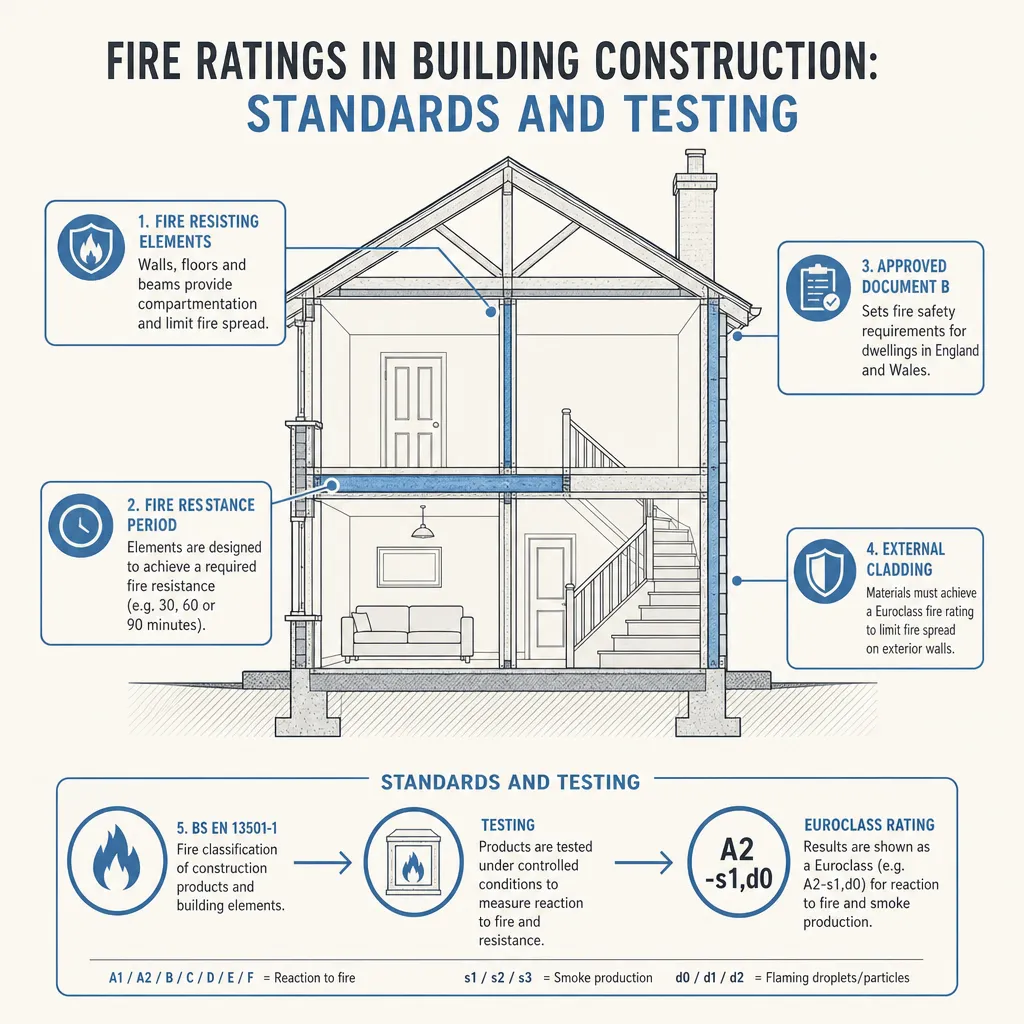
Fire Ratings in Building Construction: Standards and Testing
In UK construction, fire ratings describe how long a structural element or building assembly maintains load-bearing capacity, integrity, and insulation when exposed to a standard fire test — typically 30, 60, 90, or 120 minutes.
 Surveys & Inspections
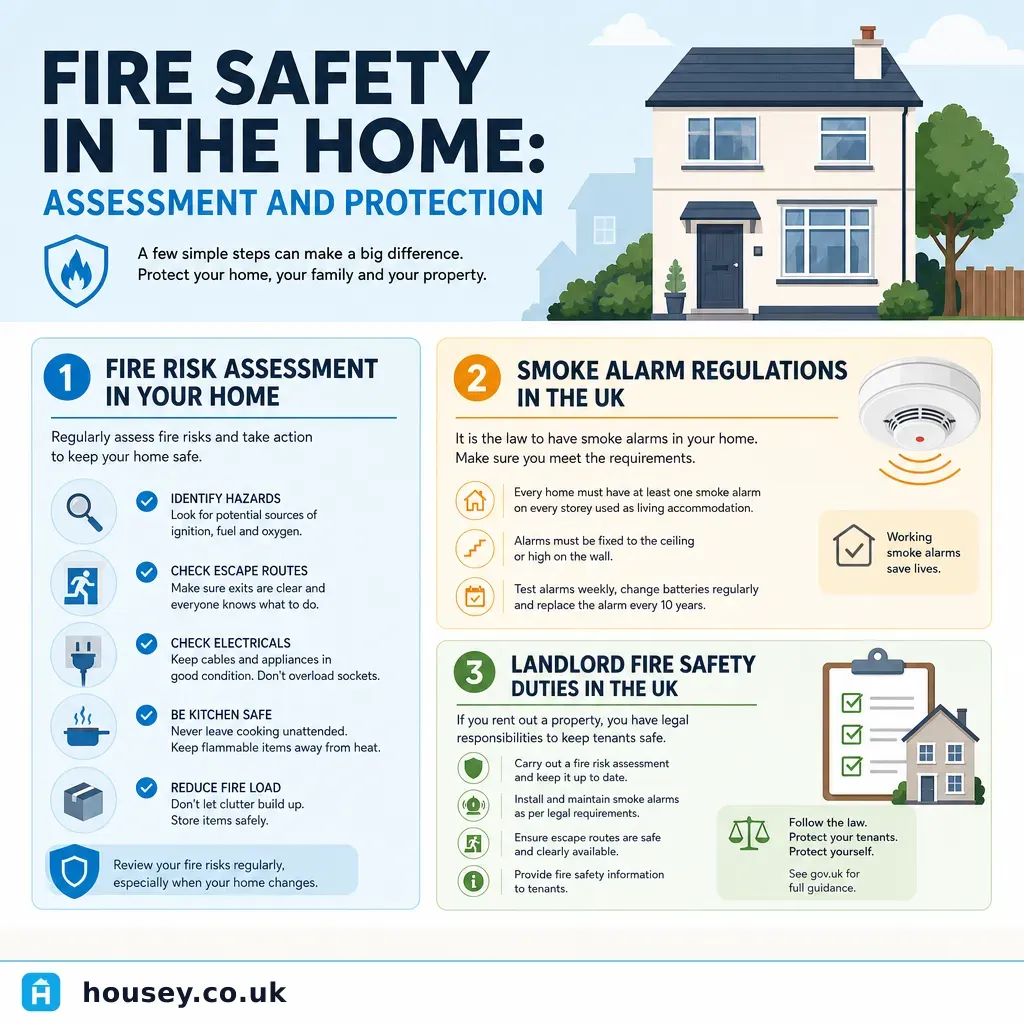
Fire Safety in the Home: Assessment and Protection
Most UK owner-occupied homes are the homeowner's responsibility to make fire-safe, while landlords have a legal duty to carry out fire risk assessments under the Regulatory Reform (Fire Safety) Order 2005.
 Surveys & Inspections
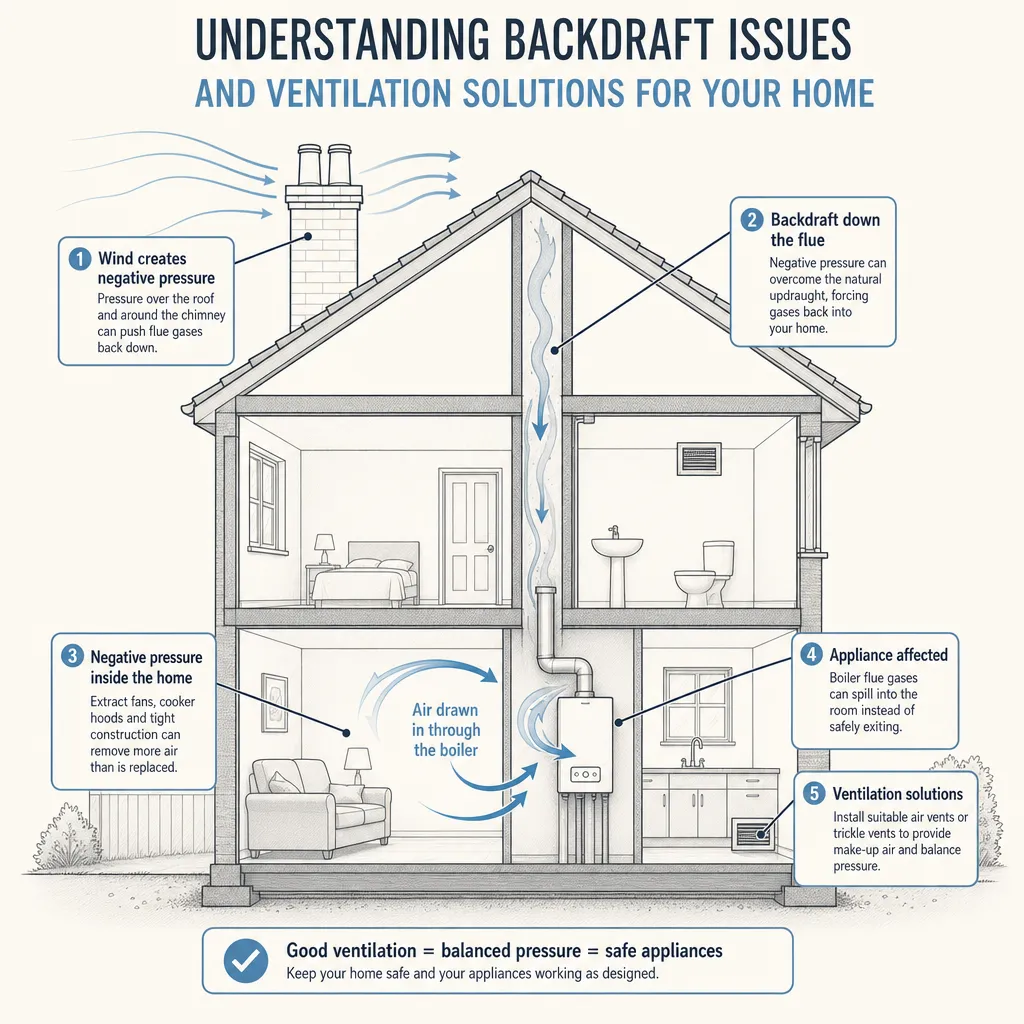
Understanding backdraft issues and ventilation solutions for your home
Backdraft occurs when negative pressure inside a building draws combustion gases back through a flue or chimney instead of expelling them outside.
 Surveys & Inspections
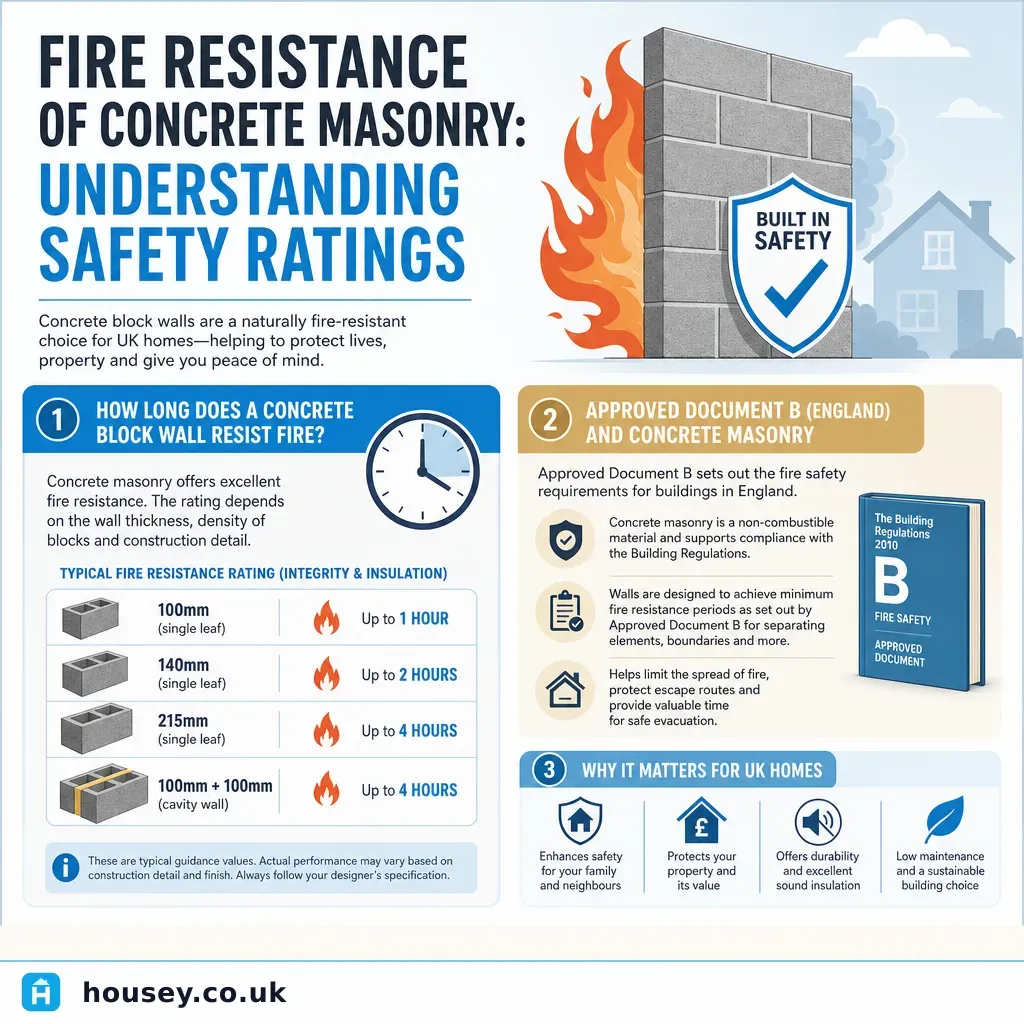
Fire Resistance of Concrete Masonry: Understanding Safety Ratings
Concrete masonry walls typically achieve 60 to 240 minutes of fire resistance depending on thickness, aggregate type, and construction method.
 Surveys & Inspections
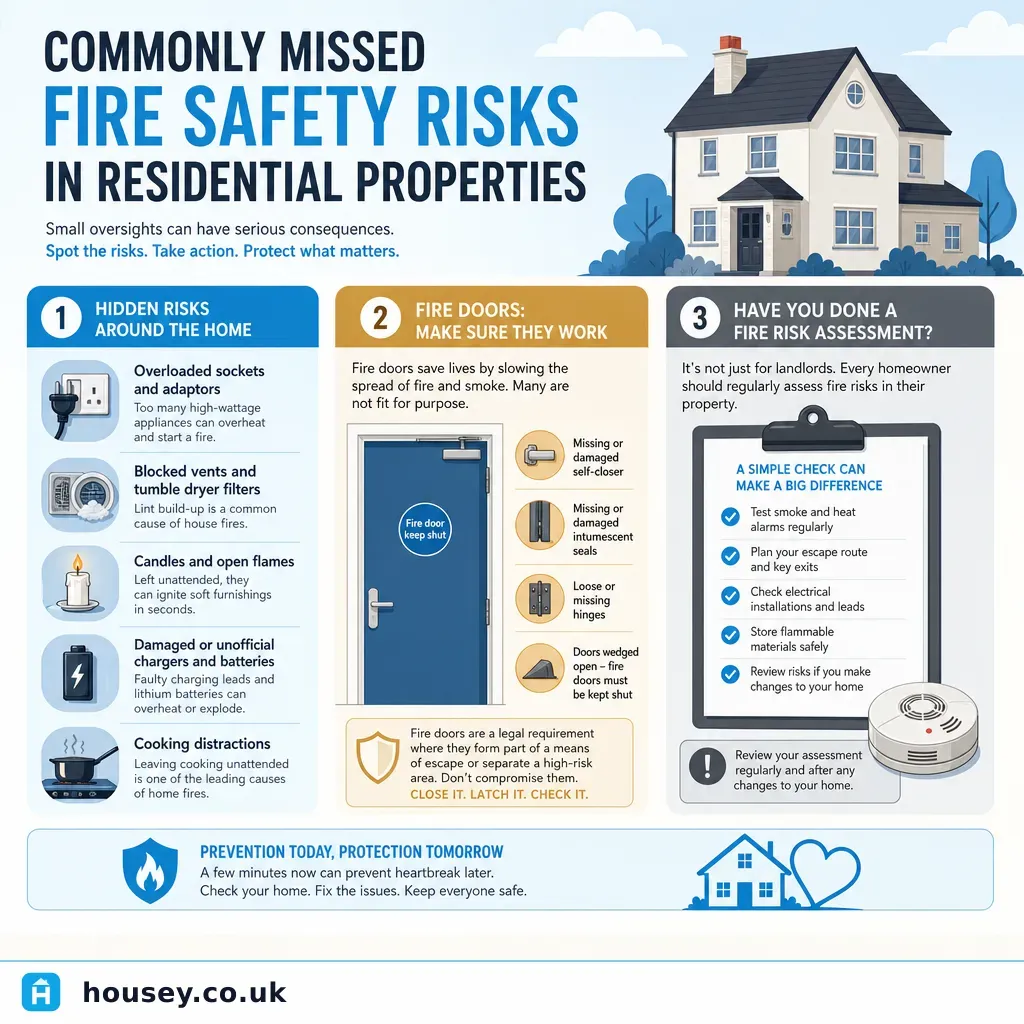
Commonly Missed Fire Safety Risks in Residential Properties
Commonly missed fire safety risks in UK homes include damaged fire doors without intumescent strips, breached compartmentation in roof spaces and floor voids, daisy-chained extension leads, and recessed downlighters without fire-rated covers.