Fire Safety Barriers in Lofts and Roof Spaces: Compliance and Responsibility
By Housey · Last reviewed 4th of May 2026
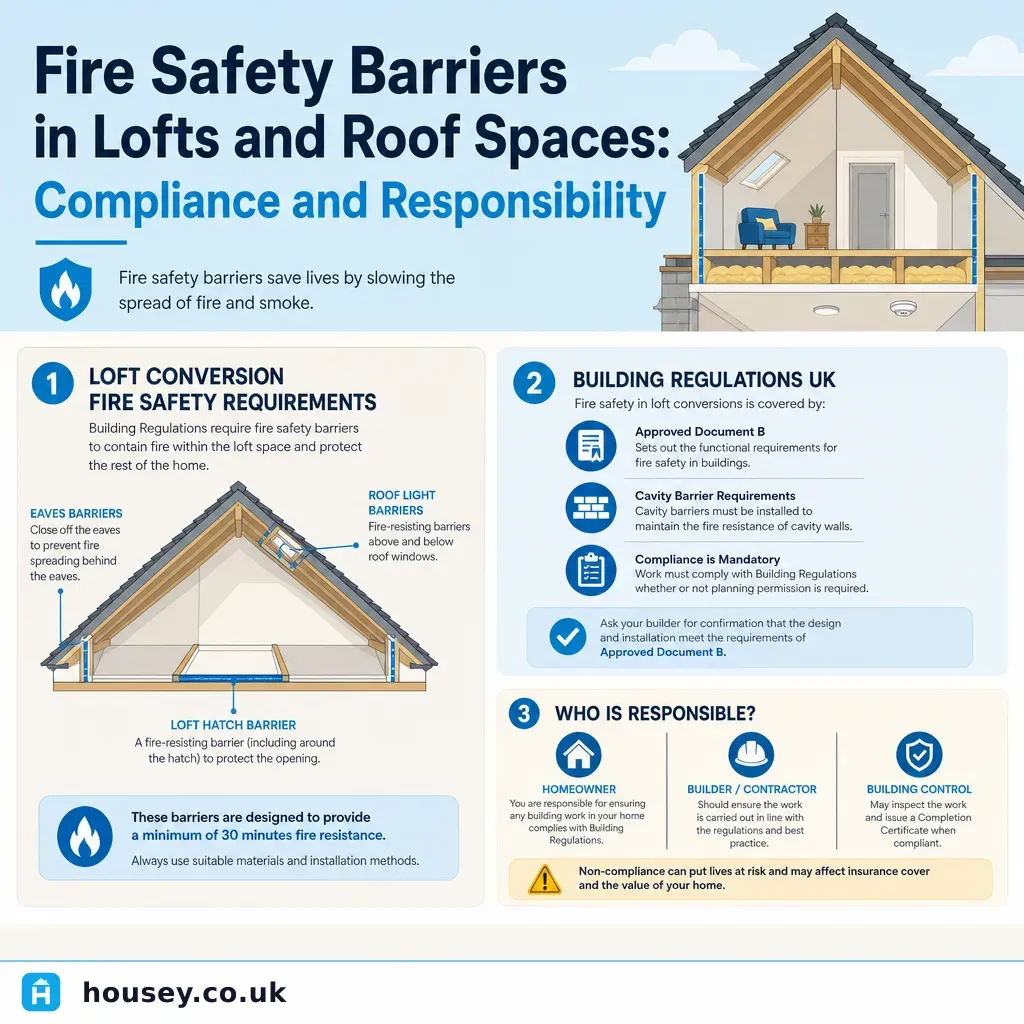
Fire Safety Barriers in Lofts and Roof Spaces: Compliance and Responsibility
Fire safety in roof spaces affects a wide range of UK homeowners — from those in terraced houses sharing a roof void with the property next door, to owners undertaking loft conversions, to landlords managing houses in multiple occupation. The subject often comes to light during a survey before purchase, when loft insulation is installed under a grant scheme, or when a loft conversion is assessed for building control sign-off. The consequences of missing or incorrectly installed fire barriers can be severe: a fire can spread through a roof void rapidly, giving occupants in adjacent properties little warning.
Key points
- Approved Document B (Fire Safety), Volume 1, of the Building Regulations requires cavity barriers in roof voids to restrict fire and smoke spread, with specific requirements at party wall junctions in terraced and semi-detached houses.
- In terraced and semi-detached properties, the party wall cavity must be fire-stopped at eaves level — one of the most frequently absent items following loft insulation works carried out without adequate oversight.
- A loft conversion creating a new habitable room typically requires 30-minute fire-resisting construction on the new floor and a protected escape route from the loft room to a final exit.
- Cavity barriers must be installed by competent persons and are subject to building control inspection; work carried out without approval may require a retrospective regularisation application.
- The Regulatory Reform (Fire Safety) Order 2005 imposes fire risk assessment duties on responsible persons for common parts of HMOs and multi-occupancy buildings, including roof void compartmentation.
What are fire safety barriers in roof spaces?
Cavity barriers and fire-stopping materials are passive fire protection elements installed within the concealed spaces of a building — including loft voids, eaves cavities, and the junctions between floors and external walls — to compartmentalise the structure and slow the spread of fire and hot gases.
Cavity barriers are physical barriers, typically mineral wool batts, intumescent strips, or proprietary purpose-made systems, fitted within roof voids and cavities. They close or restrict a cavity's cross-section, cutting off the route that fire and hot gases can travel through concealed spaces.
Fire-stopping refers to the sealing of penetrations through fire-separating elements — for example, where a cable, pipe, or duct passes through a party wall cavity or through a cavity barrier.
The key UK regulatory framework is Approved Document B: Fire Safety, Volume 1 (Dwellings), published by the Ministry of Housing, Communities and Local Government (MHCLG). This sets out functional requirements for cavity barriers, their maximum spacing (generally no more than 20 metres in any direction in a roof void), and specific requirements at party wall junctions and at the junction between a cavity wall and the roof covering.
When are fire barriers required in a roof space?
New builds and material alterations
Any new dwelling or material alteration to an existing dwelling must comply with Approved Document B. If you are extending into the loft, converting a roof space, or making alterations that affect concealed cavities, building control will expect cavity barriers to be in place in accordance with current standards.
Terraced and semi-detached houses
One of the most frequently overlooked requirements is fire-stopping at the party wall and roof junction. Where a party wall meets the underside of the roof covering, there must be a fire barrier closing the cavity at that junction. Without this, a fire in one property can pass directly into the shared roof void and spread into the neighbouring home.
This requirement applies to:
- All new terraced and semi-detached dwellings
- Existing properties where the roof is stripped and replaced, which constitutes notifiable building work
- Properties receiving loft insulation under government or utility schemes — ECO4 and similar programmes require installers to maintain existing fire barriers, and any disturbance must be properly reinstated
Loft conversions
A loft conversion creating a new habitable room is a material change of use requiring full compliance with Building Regulations Part B. Requirements typically include:
- 30-minute fire-resisting construction for the new floor, separating the loft from the storey below
- A protected stairway providing a safe escape route to a final exit
- Self-closing fire doors at specified locations on the escape route
- Interlinked smoke alarms on every floor and in the loft room itself
HMOs and rented properties
Houses in Multiple Occupation (HMOs) are subject to additional fire safety requirements under the Housing Act 2004. Roof void fire barriers are one element a formal fire risk assessment will examine, alongside means of escape, alarm systems, and emergency lighting provisions.
Types of cavity barrier: a comparison
Barrier type | Typical application | Key property | Limitation |
|---|---|---|---|
Mineral wool (rock wool) batts | General roof void cavity closure | Non-combustible, Euroclass A1 or A2 rated | Must be correctly compressed and fixed to close the cavity fully — gaps reduce effectiveness |
Intumescent strips | Junctions, penetrations, and openings around services | Expands on heat to close gaps automatically | Must be correctly specified for the gap width in question |
Proprietary rigid cavity closers | Eaves and party wall junctions | Factory-dimensioned to standard cavity sizes | Less adaptable to non-standard or older construction details |
Intumescent mastic or sealant | Pipe, cable, and duct penetrations | Seals irregular and circular openings | Not suitable as a primary cavity barrier on its own |
Loft conversions: fire safety responsibilities in practice
When a loft conversion is carried out under a full building regulations application — the correct route for any habitable loft room — the building control body will inspect fire safety measures at key stages, including:
- The fire-resisting construction of the new floor separating the loft from below
- The fire-resisting enclosure around the escape stair
- Cavity barriers at eaves and party wall junctions
- Smoke alarm installation, type, and interlinking between floors
Work carried out without building control involvement, or where inspections were missed at critical stages, may leave fire barriers absent or incorrectly installed. A building control consultant can advise on retrospective regularisation if you have inherited a conversion that lacks a proper completion certificate.
Important limitations
This article provides general information about the UK Building Regulations framework for fire barriers in roof spaces as at May 2026. Fire safety requirements are complex and depend on your property's specific construction, tenure, use, age, and alteration history. Nothing in this article constitutes a fire safety assessment or professional fire safety advice.
Always instruct a qualified professional — a fire risk assessor, chartered building surveyor, or building control body — to assess your specific property before carrying out any work that affects fire-separating elements. Rules for listed buildings, buildings in conservation areas, purpose-built flats, and HMOs involve additional requirements not fully described here. Requirements can also vary in their interpretation between local building control bodies and approved inspectors.
What to ask a qualified professional
Before instructing a fire risk assessor, building control body, or specialist contractor, consider asking the following questions:
- Does my property require cavity barriers under Approved Document B, and where specifically should they be located?
- If the roof void has been insulated previously, has fire-stopping at the party wall been checked and reinstated to current standards?
- If my loft conversion has no building control completion certificate, what is the regularisation route and what works might be required?
- What standard and specification of cavity barrier is appropriate for my construction type and age of property?
- Will the proposed works require building control notification, and who is responsible for submitting the application?
- For an HMO: does the fire risk assessment specifically address roof void compartmentation and party wall fire-stopping?
- What documentation will I receive on completion — for example, a building control completion certificate or a fire safety record for the property file?
Red flags: signs your roof space may lack compliant fire barriers
The following are indicators that cavity barriers may be absent, incorrectly installed, or damaged, and that a professional inspection is warranted before any further works:
- A loft conversion with no building control completion certificate
- Loft insulation installed under a grant scheme with no evidence that party wall fire-stopping was checked or reinstated
- A terraced or semi-detached property where you can see directly through the roof void into the neighbouring eaves cavity when looking from the loft hatch
- Pipe or cable penetrations through party walls in the roof void that are visibly unsealed
- An older property where the roof has been re-covered without a building control application
- A fire risk assessment report that does not specifically address the roof void or cavity barriers as a separate item
When to get professional help
Seek professional advice before any work that affects roof void construction, including:
- Loft insulation under any government or utility scheme, particularly in terraced or semi-detached properties
- Loft conversion, loft boarding, or full roof replacement
- Purchasing a property with a converted loft that has no building control sign-off
For HMOs and other buildings where a fire risk assessment is a legal requirement under the Regulatory Reform (Fire Safety) Order 2005, a formal fire risk assessment by a competent assessor should specifically address roof void fire barriers and cavity stopping at party wall junctions.
How Housey can help
Housey can connect you with professionals who can assess fire barrier compliance in your property. Request a fire risk assessment from a qualified assessor, or speak with a building control consultant about whether existing loft work meets current standards and how to regularise it if it does not.
Frequently asked questions
Is fire-stopping at the party wall a legal requirement in terraced houses?
Yes, under Approved Document B (Volume 1), cavity barriers are required at the junction of a party wall and a roof cavity. This applies to new construction and to re-roofing works that constitute notifiable building work. Loft insulation installers are also required to maintain, and not remove or damage, existing fire barriers at these junctions.
Who is responsible for installing fire barriers in a loft conversion?
The party carrying out the loft conversion — typically the principal contractor — is responsible for installing fire barriers and other fire safety measures in accordance with the approved building regulations drawings. The building control body inspects and signs off compliance. The homeowner should ensure a building control completion certificate is obtained and kept safely.
Can I check whether my loft has cavity barriers without professional help?
You can look into the roof void from the loft hatch to see whether mineral wool or other barriers are visible at eaves and party wall junctions. However, this is not a reliable substitute for a professional inspection: barriers can appear present but be incorrectly installed or incomplete. A qualified fire risk assessor or surveyor should assess compliance properly.
Does an existing loft conversion need to comply with current Building Regulations?
Not necessarily in full, but the conversion must have complied with the regulations in force at the time it was built. If the conversion was carried out without building regulations approval, a retrospective regularisation application may be made to building control. A building control consultant or chartered surveyor can advise on the process and any remedial works that may be required.
Do fire barriers affect loft ventilation?
Correctly installed cavity barriers are designed to close the fire spread path without sealing the ventilation gaps required under Approved Document F and BS 5250. Mineral wool batts must be fitted tightly enough to restrict fire travel but should not block separate ventilation paths within the eaves. Specification matters — a competent installer should understand both requirements simultaneously.
Sources and further reading
- Approved Document B: Fire Safety, Volume 1 — Dwellings — GOV.UK / MHCLG
- Regulatory Reform (Fire Safety) Order 2005 — legislation.gov.uk
- Loft conversions: guidance for homeowners — LABC
- Fire safety in the home — GOV.UK
- Fire safety guidance for employers and building owners — HSE
Useful next reads
 Planning & Pre-Build
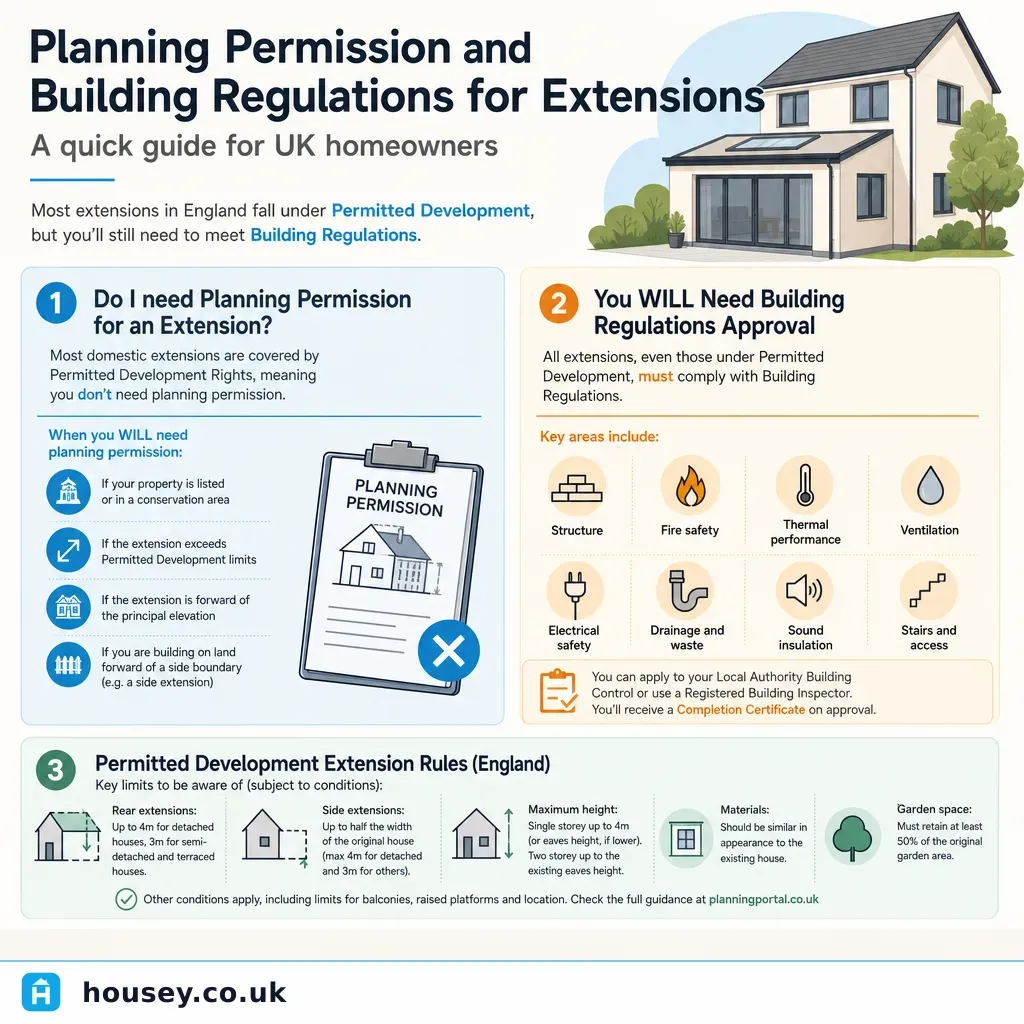
Planning Permission and Building Regulations for Extensions
UK home extensions usually require both planning permission and Building Regulations approval, though most smaller rear extensions qualify as Permitted Development under the GPDO 2015 and need no planning application.
 Planning & Pre-Build
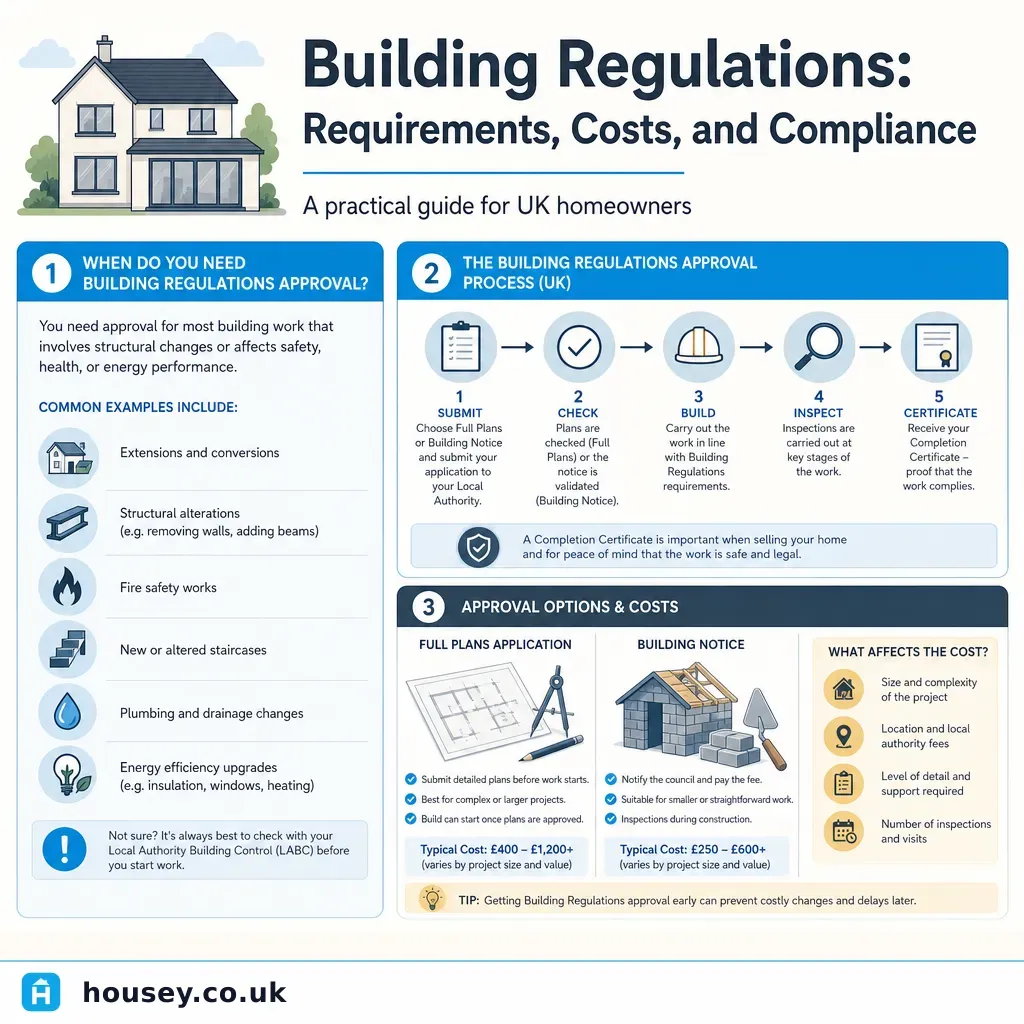
Building Regulations: Requirements, Costs, and Compliance
Building regulations set minimum standards for how construction work is carried out in the UK, covering structural stability, fire safety, energy efficiency, and ventilation.
 Planning & Pre-Build
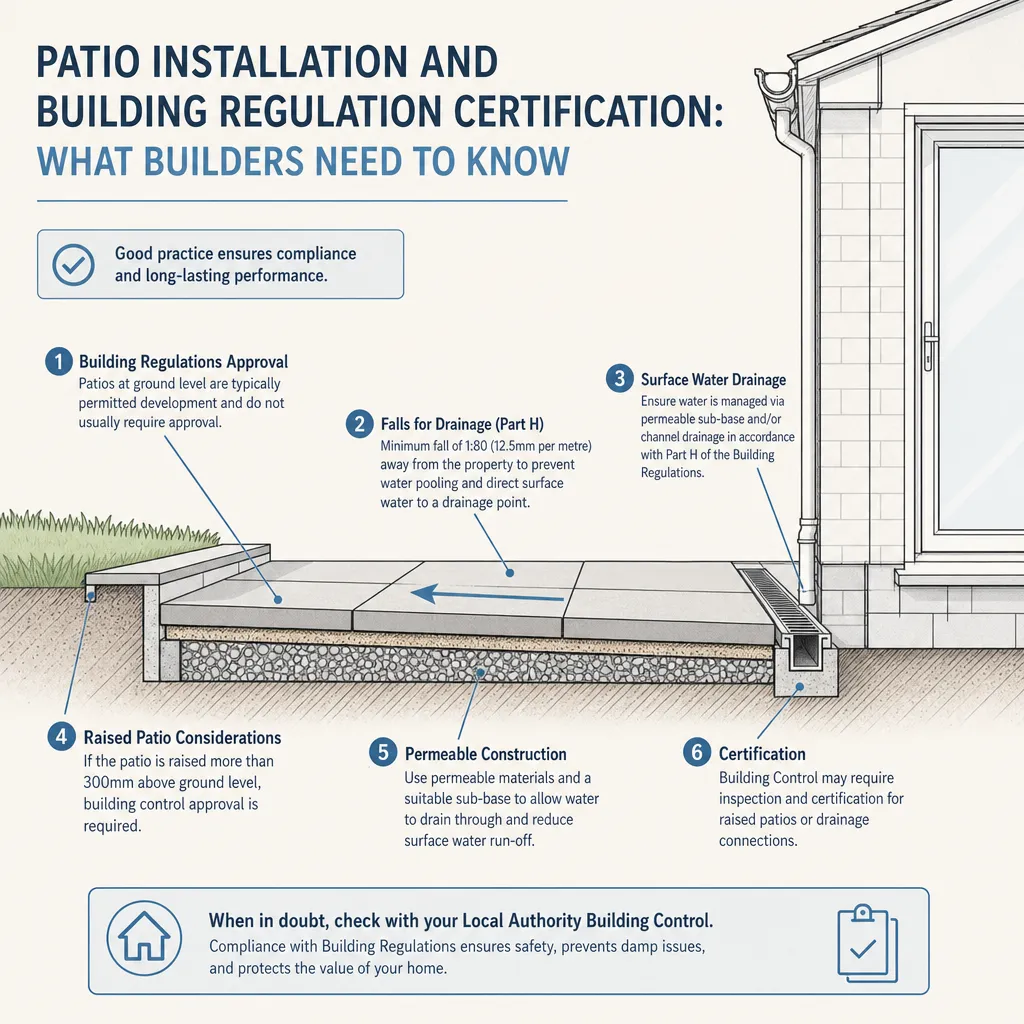
Patio Installation and Building Regulation Certification: What Builders Need to Know
Most ground-level patios in England do not require building regulations approval.
 Planning & Pre-Build
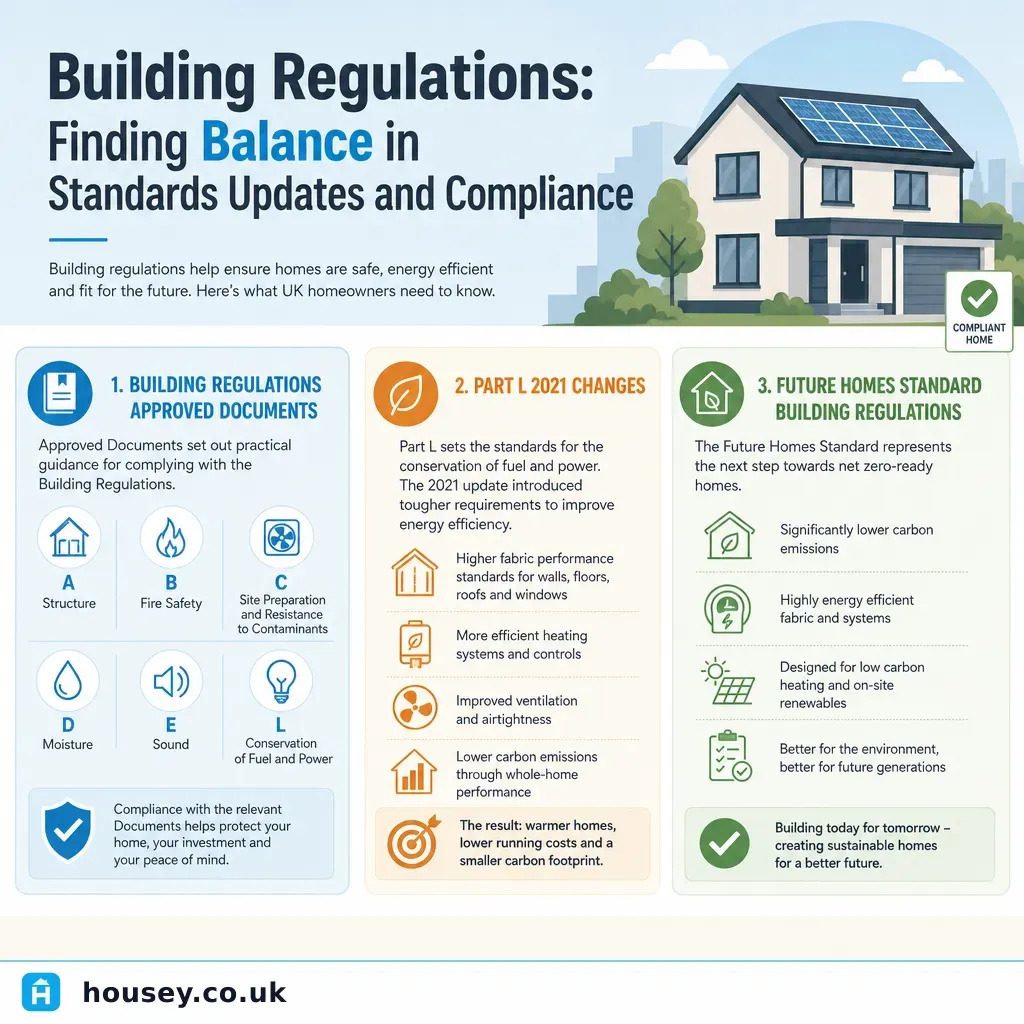
Building Regulations: Finding Balance in Standards Updates and Compliance
Building regulations in England and Wales set minimum standards for construction, covering structure, fire safety, energy efficiency, and ventilation.
 Planning & Pre-Build
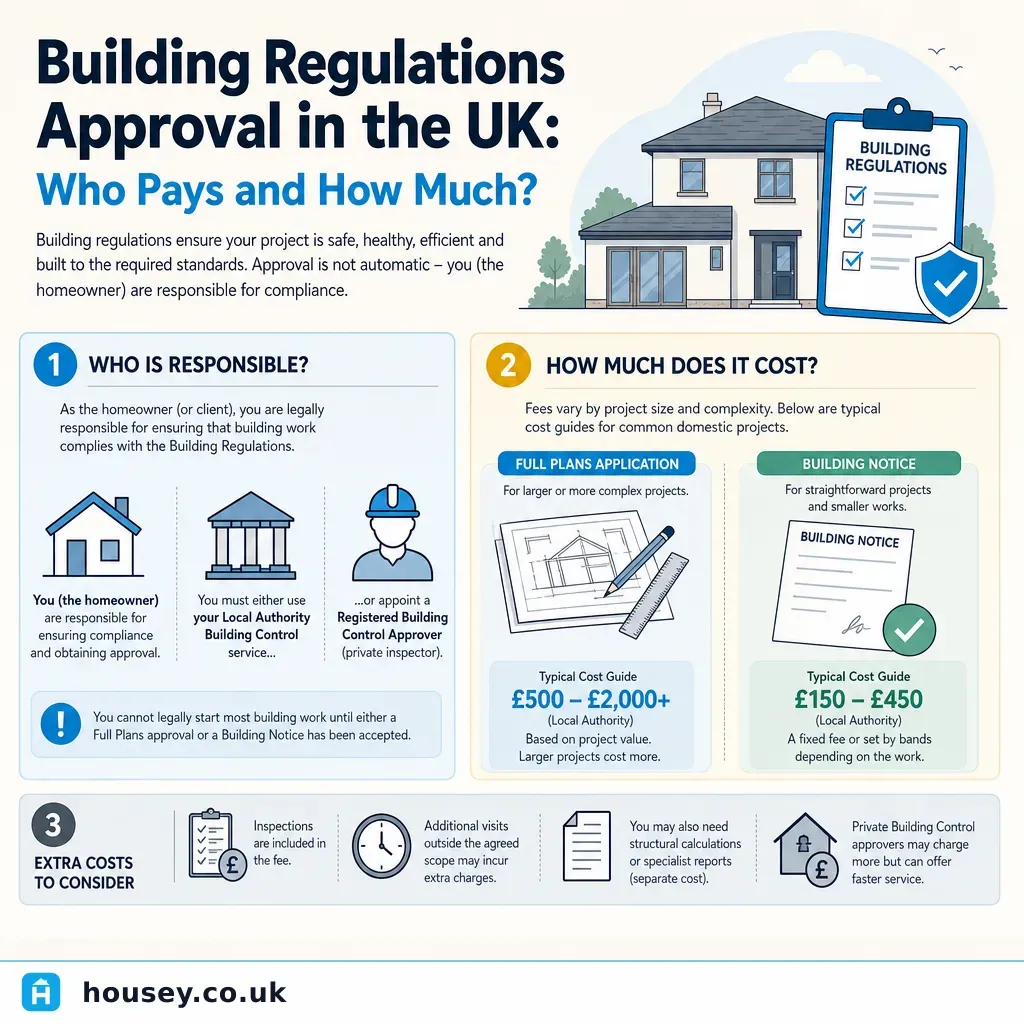
Building Regulations Approval in the UK: Who Pays and How Much?
Building regulations approval fees are almost always paid by the homeowner or the person commissioning the work, not the contractor.