Fire Safety Doors: Compliance Requirements and Installation
By Housey · Last reviewed 1st of June 2026
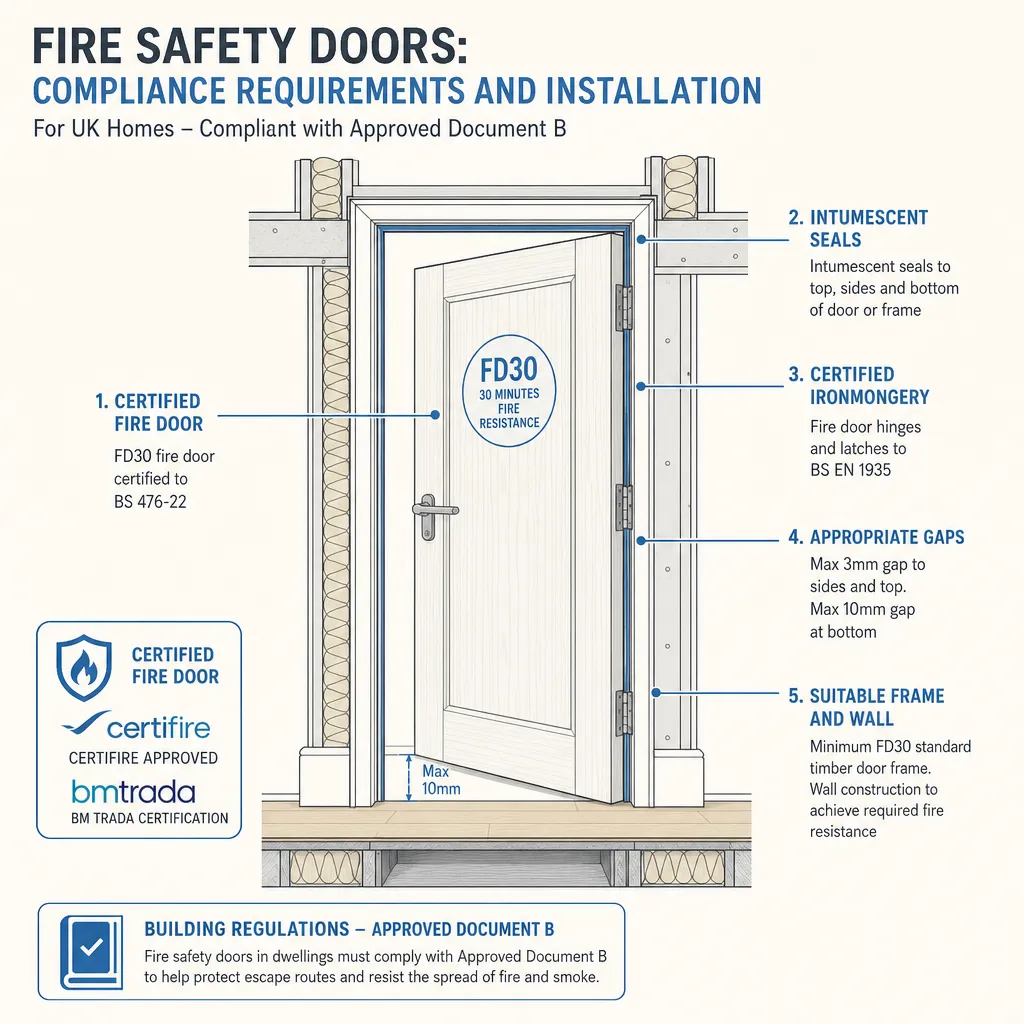
Fire Safety Doors: Compliance Requirements and Installation
Fire doors are a critical passive fire protection element in UK buildings, yet they are also among the most commonly misspecified, poorly installed, and inadequately maintained components found during fire risk assessments and building control inspections. Whether you are constructing a new home, converting a loft, managing an HMO, or responding to a fire risk assessment recommendation, understanding what makes a door assembly legally compliant — and who should install and inspect it — is essential for protecting occupants and avoiding enforcement action.
Key points
- Fire doors must be tested and certified to BS 476-22 (UK test method) or BS EN 1634-1 (harmonised European method) and carry third-party certification from a UKAS-accredited scheme such as CERTIFIRE, BM TRADA Q-Mark, or IFSA.
- Approved Document B (Volume 1 for dwellings, Volume 2 for other buildings) specifies where fire doors are required in new builds and conversions, using FD30 (30-minute integrity) and FD60 (60-minute integrity) designations.
- Under the Regulatory Reform (Fire Safety) Order 2005, the Responsible Person for common areas of multi-occupancy residential buildings — including HMOs and purpose-built flats — must ensure fire doors are maintained in effective working condition at all times.
- From October 2023, under amendments introduced by the Building Safety Act 2022, high-rise residential buildings (18 m or above) in England must carry out quarterly checks of fire doors in common areas and annual checks of flat entrance fire doors.
- A compliant fire door assembly requires intumescent seals, cold smoke seals, a self-closing device complying with BS EN 1154, and compatible tested ironmongery — not just a certified door leaf.
What makes a door a fire door
A fire door is a complete tested assembly, not simply a heavy door leaf with a label. Every component must be compatible with the tested configuration, and substitution of any element can invalidate the declared fire resistance period.
The key components of a compliant fire door assembly are:
- Door leaf: Tested to BS 476-22 or BS EN 1634-1 and certified by a UKAS-accredited scheme
- Door frame and fixings: Must match or be proven compatible with the tested assembly; a different frame can invalidate the fire rating
- Intumescent seals: Expand under heat to seal the gap between door and frame, preventing fire spread
- Cold smoke seals (brush seals): Prevent smoke ingress before the intumescent seals activate; required for all 'S'-designated assemblies
- Self-closing device: Complying with BS EN 1154; must return the door fully to the latched position from any open angle
- Hinges: Minimum three for an FD30 door; must be specified within the tested assembly
- Ironmongery: Handles, locks, and latches must be fire-rated and compatible with the tested configuration
A door that meets the leaf specification but is fitted in an incompatible frame, with non-approved seals, or without a functioning self-closer is not a compliant fire door assembly.
FD30 versus FD60: which rating applies?
Rating | Fire integrity period | Typical application in UK buildings | Approved Document B reference |
|---|---|---|---|
FD30 | 30 minutes | Between integral garage and dwelling; escape routes in three-storey houses; loft conversion staircase protection | Table B1; paragraphs 2.10–2.18 (Vol. 1) |
FD30S | 30 minutes plus smoke control | Common corridors and lobbies in blocks of flats; HMO circulation areas | Table B1; required wherever smoke control is specified |
FD60 | 60 minutes | Compartment walls in multi-occupancy residential buildings; high-risk service areas | Part of building fire strategy |
FD60S | 60 minutes plus smoke control | Higher-risk residential common areas; plant rooms in high-rise buildings | As specified in building-specific fire strategy |
The 'S' suffix denotes a cold smoke seal requirement. Approved Document B should be read alongside any building-specific fire strategy for multi-occupancy properties. Last reviewed 2026-06-01.
Where fire doors are required in domestic properties
Approved Document B sets out requirements for standard house types. In typical new builds and conversions:
- Three-storey new-build houses: FD30S doors are required between every habitable room on the upper floors and the protected staircase enclosure.
- Integral or attached garage: An FD30 door is required between the garage and the dwelling at all property types.
- Loft conversion creating a third storey: The existing staircase must be enclosed with FD30S doors at every level to maintain a protected escape route.
- Basement conversions: FD30S doors are typically required at the head and foot of the basement stair.
HMOs and multi-occupancy buildings
Under the Regulatory Reform (Fire Safety) Order 2005, the Responsible Person — typically the landlord or managing agent — must ensure a current fire risk assessment is in place, fire doors are appropriate to the identified risk, and all doors are maintained in effective working condition. For licensed HMOs, the local authority licensing team may impose additional fire door specifications through licence conditions. Check requirements specific to your licensing authority before replacing or specifying fire doors.
Fire door installation: homeowner checklist
Before installation begins:
After installation:
Important limitations
This article provides general information about fire door regulations and typical compliance requirements in England. Specifications vary significantly depending on building type, construction method, occupancy classification, and the findings of a specific fire risk assessment. The Regulatory Reform (Fire Safety) Order 2005 places legal duties on Responsible Persons that extend well beyond selecting a door to a particular rating. Always obtain professional advice from a qualified fire risk assessor or building control professional before specifying or installing fire doors in any building other than a straightforward owner-occupied house.
When this becomes urgent
Seek immediate professional advice from a qualified fire risk assessor or building control officer if:
- A fire door in your property will not close fully, or is being held open by a wedge, hook, or piece of furniture
- Seals are visibly damaged, missing, or have been painted over so they cannot expand
- A fire risk assessment has identified fire door deficiencies that have not yet been remedied
- You are a landlord and have received a local authority enforcement notice concerning fire door compliance
- You have purchased a property and cannot locate evidence of compliant fire door specification in the common areas
- You manage a high-rise residential building (18 m or above) and cannot confirm that quarterly common-area door inspections are being carried out
What to ask a qualified professional
Before instructing a fire door supplier or installer, ask:
- Is this door assembly third-party certified, and under which scheme — CERTIFIRE, BM TRADA Q-Mark, or IFSA?
- Are the frame, seals, self-closer, hinges, and ironmongery all part of the same tested assembly?
- What rating is required at this specific location, and what is the basis for that specification?
- Does this installation require a building regulations notification, and will you handle the submission?
- Do you hold a recognised installer certification for fire door installation (FIRAS or BM TRADA)?
- What maintenance and inspection frequency do you recommend after installation?
- Is VAT included in the quoted price?
When to get professional help
Fire doors are safety-critical assemblies where installation errors can have serious consequences. Always seek professional guidance when:
- You are unsure of the required fire door rating for your specific property type, occupancy, or escape route design
- You manage an HMO, a block of flats, or any premises subject to the Regulatory Reform (Fire Safety) Order 2005
- A fire risk assessment has identified fire door deficiencies requiring specification or replacement
- You are undertaking a loft conversion, extension, or change of use that may require fire door upgrades throughout the existing building
How Housey can help
If you are unsure whether your property's fire doors meet current requirements, Housey can connect you with professionals for a fire risk assessment to identify any compliance gaps, specify the correct door ratings, and confirm your obligations under the Regulatory Reform (Fire Safety) Order 2005 and Approved Document B.
Frequently asked questions
Do I need a fire door in my house?
In most standard two-storey homes, Building Regulations do not require fire doors within the dwelling. However, fire doors are required in three-storey new builds, between an integral garage and the house, and throughout the escape route in a loft conversion that creates a third storey. If you let rooms or operate an HMO, additional requirements apply under the Regulatory Reform (Fire Safety) Order 2005.
Can I fit a fire door myself?
There is no legal prohibition on a competent homeowner fitting a fire door in their own property. However, correct installation requires close attention to the tested assembly specification — an incorrect gap, a missing seal, or an incompatible frame can invalidate the fire resistance rating entirely. For any building subject to the Regulatory Reform (Fire Safety) Order 2005, installation by a FIRAS or BM TRADA certified installer is strongly advisable to demonstrate compliance.
How do I know if an existing door is a fire door?
Check the top edge of the door leaf for a plug and a certification label showing the fire rating (FD30, FD60) and certification number from CERTIFIRE, BM TRADA, or IFSA. If no label is present, the door cannot be confirmed as a compliant fire door and should be assessed by a competent person before being relied upon as part of a fire strategy.
How often should fire doors be inspected in the UK?
For owner-occupied two-storey homes, there is no statutory inspection frequency, but annual checking is good practice. For buildings subject to the Regulatory Reform (Fire Safety) Order 2005, the Responsible Person must ensure regular inspections as part of the fire risk assessment review. High-rise residential buildings in England must carry out quarterly common area fire door inspections and annual flat entrance door inspections under Building Safety Act 2022 amendments from October 2023.
Sources and further reading
- Approved Document B: Fire safety — GOV.UK
- Regulatory Reform (Fire Safety) Order 2005 — legislation.gov.uk
- Building Safety Act 2022 — legislation.gov.uk
- CERTIFIRE fire door certification — Warringtonfire
- Fire Door Safety Week guidance — British Woodworking Federation
Useful next reads
 Surveys & Inspections
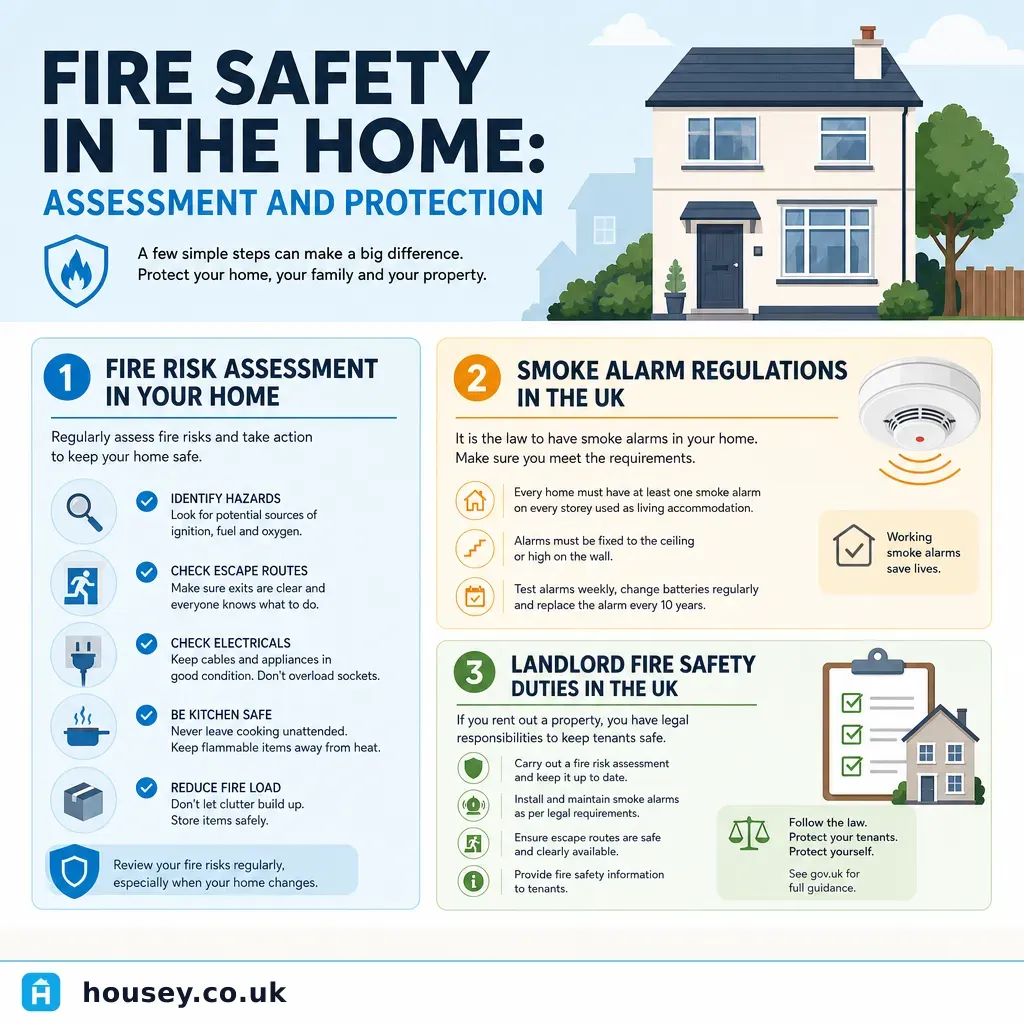
Fire Safety in the Home: Assessment and Protection
Most UK owner-occupied homes are the homeowner's responsibility to make fire-safe, while landlords have a legal duty to carry out fire risk assessments under the Regulatory Reform (Fire Safety) Order 2005.
 Surveys & Inspections
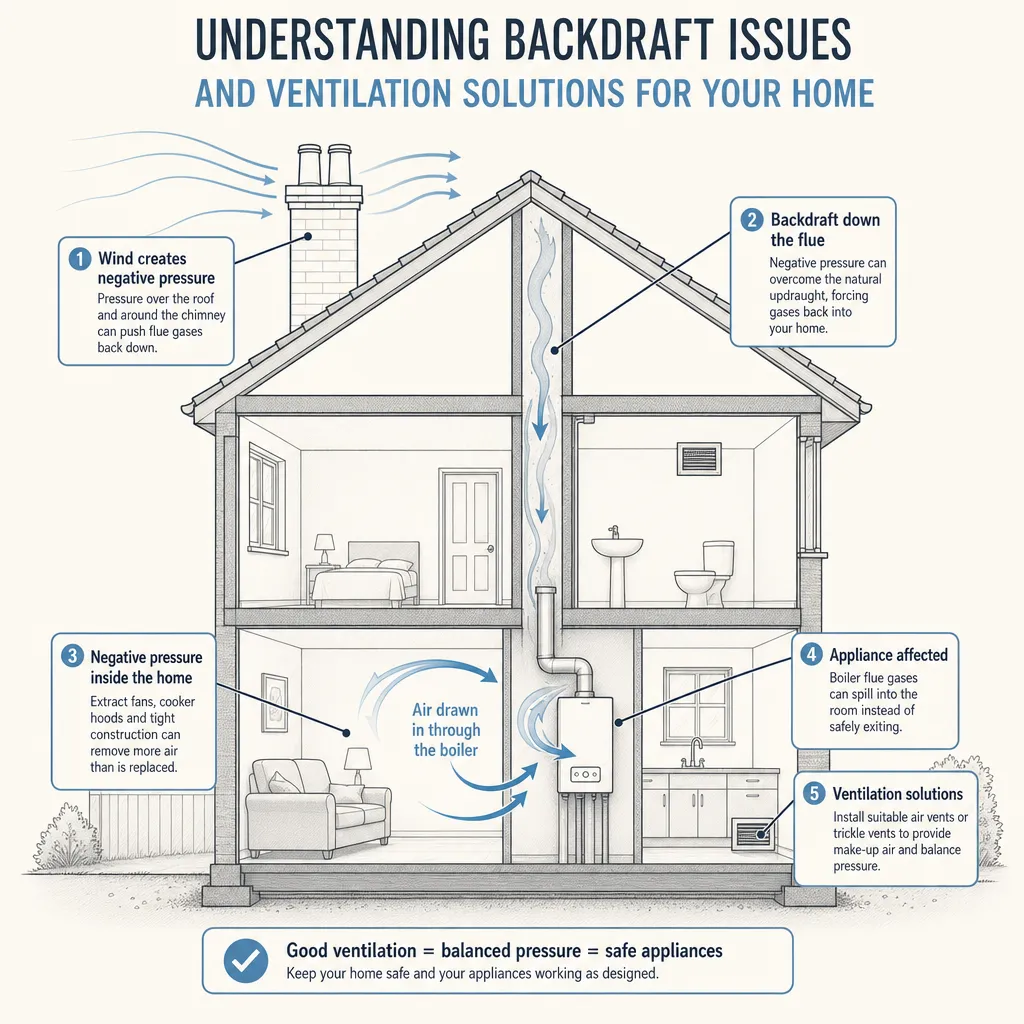
Understanding backdraft issues and ventilation solutions for your home
Backdraft occurs when negative pressure inside a building draws combustion gases back through a flue or chimney instead of expelling them outside.
 Surveys & Inspections
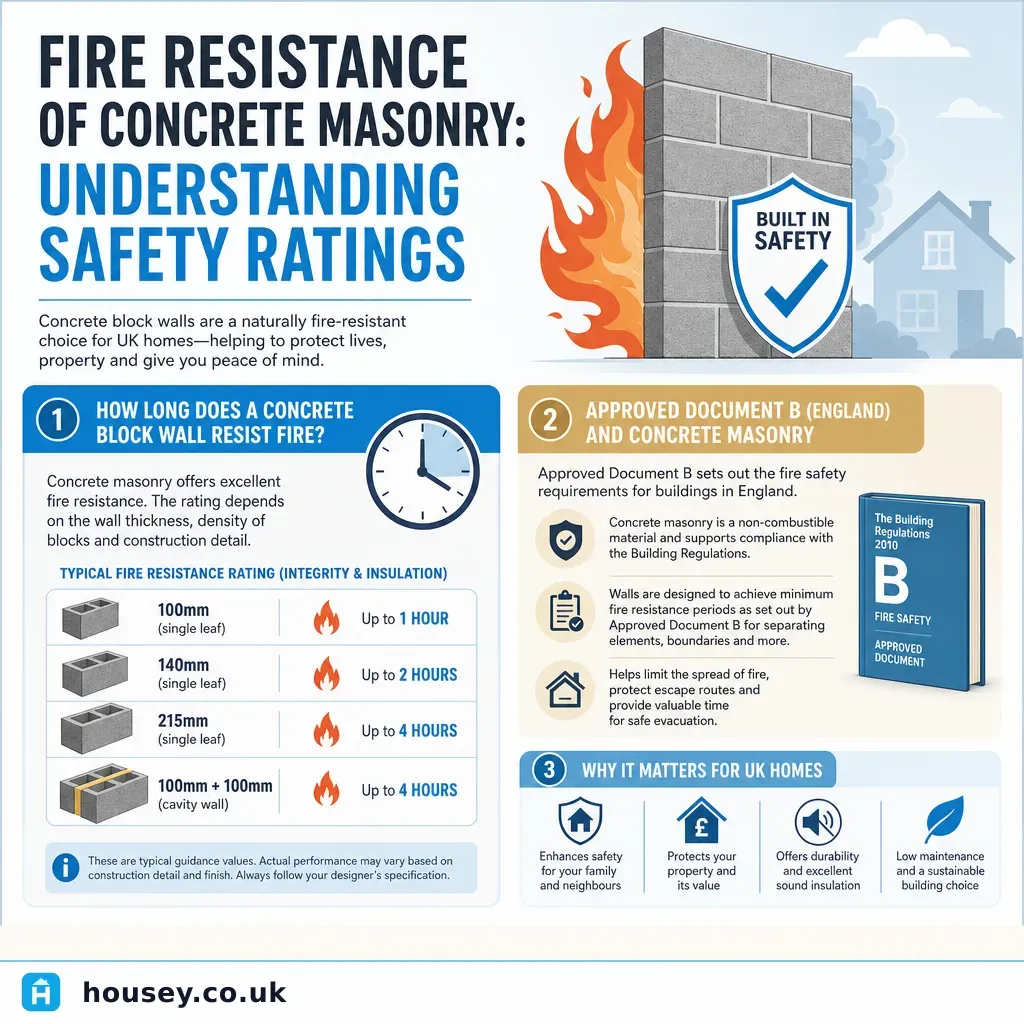
Fire Resistance of Concrete Masonry: Understanding Safety Ratings
Concrete masonry walls typically achieve 60 to 240 minutes of fire resistance depending on thickness, aggregate type, and construction method.
 Surveys & Inspections
Commonly Missed Fire Safety Risks in Residential Properties
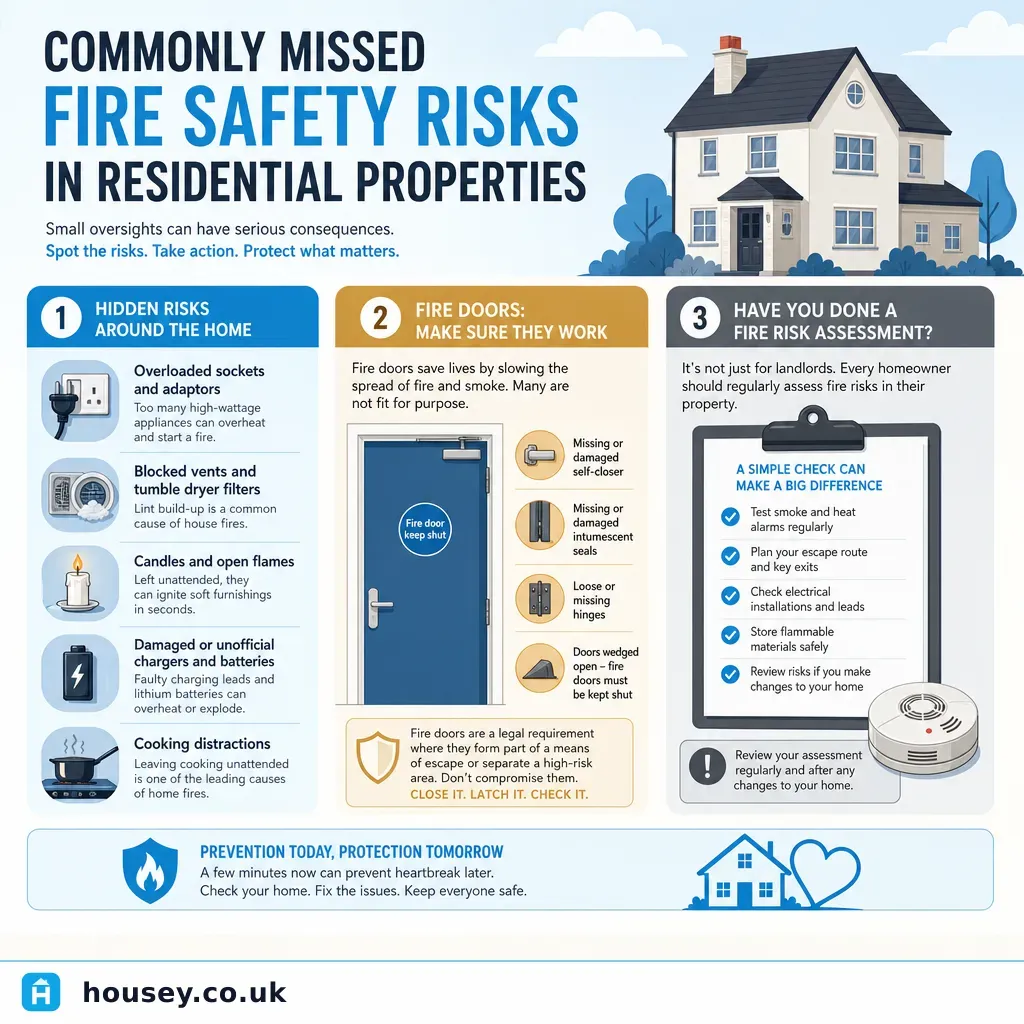
Commonly missed fire safety risks in UK homes include damaged fire doors without intumescent strips, breached compartmentation in roof spaces and floor voids, daisy-chained extension leads, and recessed downlighters without fire-rated covers.
 Surveys & Inspections
Fire Ratings in Building Construction: Standards and Testing
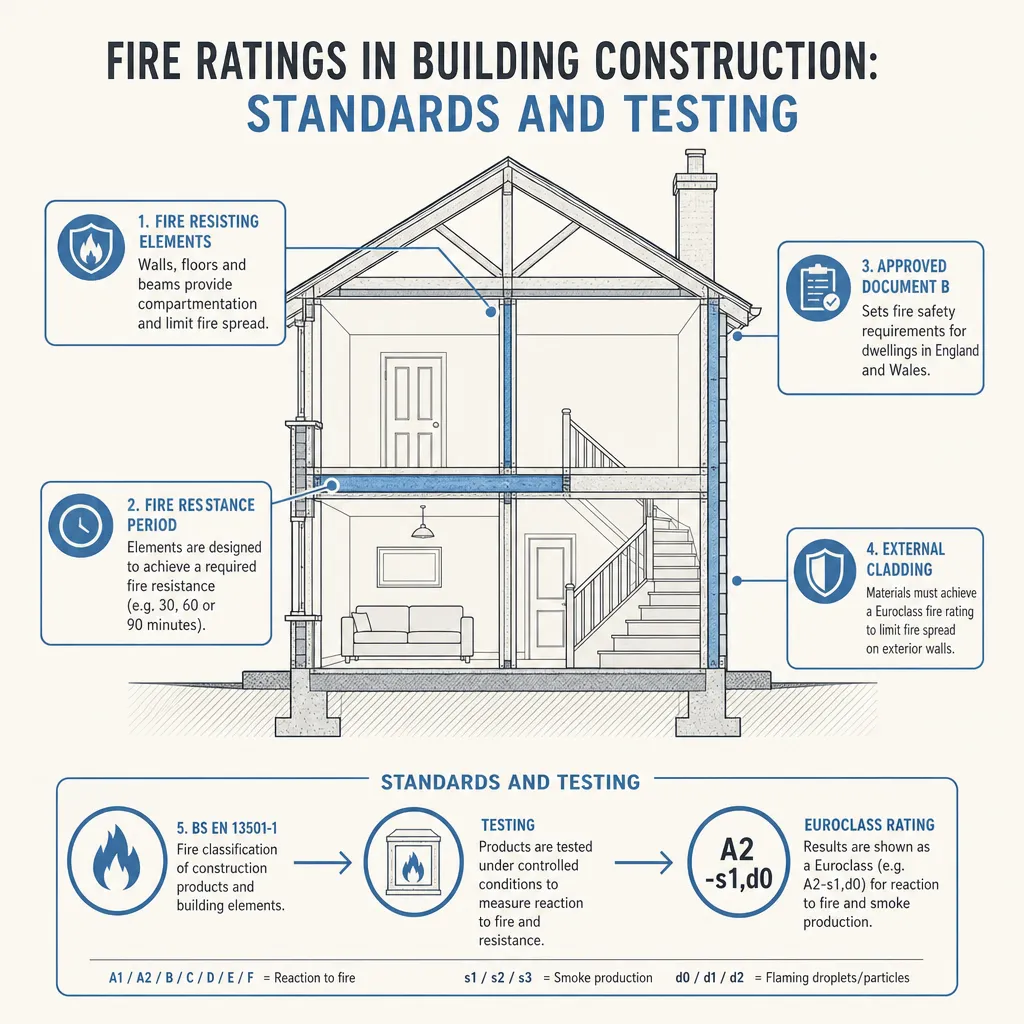
In UK construction, fire ratings describe how long a structural element or building assembly maintains load-bearing capacity, integrity, and insulation when exposed to a standard fire test — typically 30, 60, 90, or 120 minutes.