Fireplace Inserts: Upgrading Heating Efficiency in Period Properties
By Housey · Last reviewed 26th of May 2026
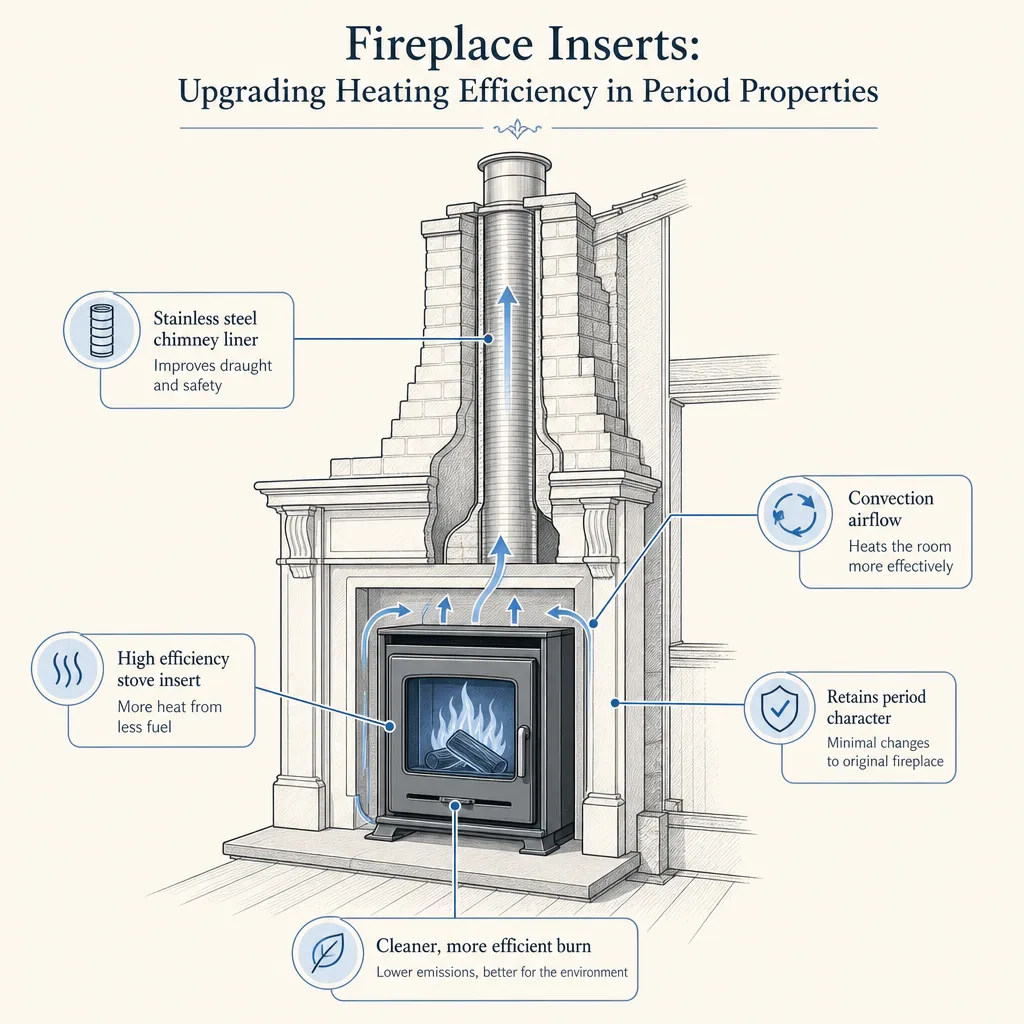
Fireplace Inserts: Upgrading Heating Efficiency in Period Properties
Period homes often have original fireplace openings that have sat unused for decades — blocked off during the shift to central heating, yet structurally intact. For homeowners wanting to add localised heat, visual warmth, or reduce reliance on gas, a fireplace insert or inset stove can be a practical upgrade. The regulatory landscape is more detailed than many expect, and chimney condition, local smoke control rules, and Building Regulations compliance all bear directly on whether a project is straightforward or complex.
Key points
- Any solid fuel, wood, or biomass appliance must comply with Building Regulations Approved Document J (combustion appliances and fuel storage).
- In a designated smoke control area, only Defra-exempt appliances may be used; burning wet wood or standard household coal is prohibited under the Clean Air Act 1993.
- A HETAS-registered installer can self-certify the installation, notifying building control on your behalf — without one, you must submit a separate building notice to the local authority.
- Most period chimney flues require a flexible stainless steel liner (typically 150mm or 175mm diameter) to meet draught and clearance requirements under Approved Document J.
- Log-burning appliances are subject to restrictions in new-build dwellings under Part L 2021 regulations limiting direct combustion heat sources.
What counts as a fireplace insert?
A fireplace insert — sometimes called an inset stove — is a self-contained combustion appliance designed to sit within an existing fireplace opening. Unlike a freestanding wood-burning or multifuel stove placed in front of a hearth, an insert is recessed into the builder's opening, typically sealed with a decorative faceplate covering the surrounding brickwork.
The combustion chamber draws air from the room (or from an external air duct), burns solid fuel or wood, and transfers heat via radiated panels or a built-in convector fan. Flue gases exit through a liner running up the existing chimney stack.
Common insert types include:
- Wood-only inserts — optimised for seasoned or kiln-dried hardwood (moisture content ≤20%)
- Multifuel inserts — accept wood, smokeless fuel, or anthracite; usually have a raised grate and ash pan
- Gas fire inserts — use the existing flue (or a dedicated liner) and connect to the mains gas supply; require a Gas Safe registered engineer
Regulatory requirements for fireplace inserts
Building Regulations Approved Document J
Approved Document J sets minimum standards for:
- Hearth dimensions — non-combustible hearth extending at least 300mm in front of the fire door and 150mm to each side
- Flue size and draw — minimum 175mm liner diameter for most wood and multifuel stoves above 20 kW output; 150mm for smaller appliances
- Air supply — permanent ventilation opening required if the dwelling is well-sealed or the room is below a set volume threshold
- Distance to combustibles — clearances between the appliance and adjacent timbers, plasterwork, and insulation
Smoke control areas
More than half of UK urban postcodes fall within a designated smoke control area. Check your postcode using the DEFRA Smoke Control Area appliance checker. In these areas you must use a Defra-exempt appliance and burn only authorised fuels. Most modern inserts from recognised manufacturers carry Defra exemption as standard — confirm this before purchase.
Conservation areas and listed buildings
If your period property is listed, any alteration to an original fireplace surround, breast, or chimney stack may require listed building consent from your local planning authority. In conservation areas, permitted development rights may also be curtailed. Check with your LPA before committing to a specification.
Chimney condition and lining
The condition of an existing flue is the single largest variable in insert projects. Common issues in pre-1919 properties include:
- Partially or fully collapsed flue sections
- Eroded lime mortar joints along the internal flue lining
- Blocked or capped sections from previous gas appliance use
- Stacks shared with neighbouring properties in semi-detached or terraced settings
A HETAS-registered chimney sweep or installer can carry out a smoke test and camera inspection before quoting for lining work. A flexible twin-wall stainless steel liner is the most common solution: inserted from the top of the stack and connected to the stove collar at the fireplace opening, it creates a properly sealed and correctly sized flue channel.
Comparing insert options
Insert type | Best for | Not ideal for | Typical output | Key regulatory point |
|---|---|---|---|---|
Wood-only insert | Period ambience; rural properties | Smoke control areas without Defra exemption | 5–12 kW | Approved Document J; Defra exemption needed in SCAs |
Multifuel insert | Fuel flexibility; rural properties | Dense urban areas with strict SCA enforcement | 5–14 kW | Authorised fuel list; grate and liner specification |
Gas fire insert (conventional flue) | Easy control; no fuel storage | Properties without gas supply; substandard flues | 3–7 kW | Gas Safe registration required; tightness test |
Gas fire insert (balanced or power flue) | Blocked or missing flues; some flats | Tight masonry chimney restrictions | 3–6 kW | Gas Safe; may require planning for external terminal |
Electric insert | Zero-emission supplementary heat; no flue | Primary heating; high-output requirements | 1–2 kW | No combustion regulations; standard electrical rules |
Indicative output ranges only. Verify with manufacturer documentation.
Important limitations
This article provides general information about the regulatory framework for fireplace inserts in England and Wales. Rules differ under Scottish Building Standards and Northern Ireland Building Regulations, and local authority interpretation can vary. Nothing in this guide constitutes professional advice on chimney safety, structural condition, or Gas Safe compliance.
Chimney condition can only be assessed on-site by a qualified professional. Do not proceed with an insert installation based on visual inspection of the opening alone — internal flue condition is not visible without a camera survey or smoke test.
Gas insert installation is not DIY-eligible under any circumstances. Incorrect installation of any combustion appliance can cause carbon monoxide poisoning, chimney fires, or structural damage.
When to get professional help
Seek qualified advice before proceeding if:
- The chimney has not been swept or inspected in the last two years
- There are visible cracks in the chimney breast, stack, or surrounding masonry
- The property is listed or within a conservation area
- Neighbours in an adjoining property share the chimney stack
- Any previous appliance — particularly a back boiler — was removed without a formal decommission
- The room has poor natural ventilation or an underfloor void that could restrict air supply
What to ask a qualified professional
Before accepting a quote from a HETAS-registered or Gas Safe installer:
- Are you HETAS-registered (solid fuel) or Gas Safe registered (gas)?
- Will you carry out or arrange a chimney camera inspection and smoke test before specifying the liner?
- Is the proposed appliance Defra-exempt, and is my postcode in a smoke control area?
- Will you handle building control self-certification as part of the installation?
- What does the quote include — liner, register plate, hearth, air supply provision, and commissioning?
- What certificate or paperwork will I receive on completion?
- What is your procedure if the camera inspection reveals unexpected flue damage?
How Housey can help
Housey connects homeowners with vetted professionals for hearth upgrade projects. An energy-efficiency consultant can assess whether a fireplace insert is a cost-effective addition to your property's heating strategy. For projects that involve wider structural work to a chimney breast or fireside wall, extension builders on Housey can coordinate the build programme alongside the stove installation.
Frequently asked questions
Do I need planning permission to install a wood-burning stove in an existing fireplace?
Usually not, provided the chimney stack already exists and is not being altered externally. If the property is listed or in a conservation area, however, you may need listed building consent or prior approval before any work to the fireplace surround or chimney breast begins. Always check with your local planning authority first.
Can I use a wood-burning stove in a smoke control area?
Yes, if you use a Defra-exempt appliance and burn only authorised fuels — typically kiln-dried or seasoned hardwood with moisture content ≤20%, or approved smokeless fuels. Check your postcode using the DEFRA smoke control area checker before purchasing an appliance to avoid enforcement action.
What is a HETAS certificate and why do I need it?
A HETAS certificate is issued by the installer on completion of a solid fuel appliance installation, confirming compliance with Building Regulations. Without one, you may face complications when selling the property, making an insurance claim following a chimney fire, or demonstrating building control compliance to a future buyer.
How long does a fireplace insert installation take?
A straightforward installation — existing open chimney, standard liner run, no structural work — usually takes one to two days. Projects requiring masonry repairs, significant relining, or listed building consent will take considerably longer, and lead times for some appliances can extend to several weeks.
Sources and further reading
- Building Regulations Approved Document J — GOV.UK / MHCLG
- DEFRA Smoke Control Areas checker — Department for Environment, Food and Rural Affairs
- HETAS registered appliances and installers — HETAS Ltd
- Clean Air Act 1993 — legislation.gov.uk
- Wood-burning stoves guidance — Energy Saving Trust
Useful next reads
 Improvement & Build
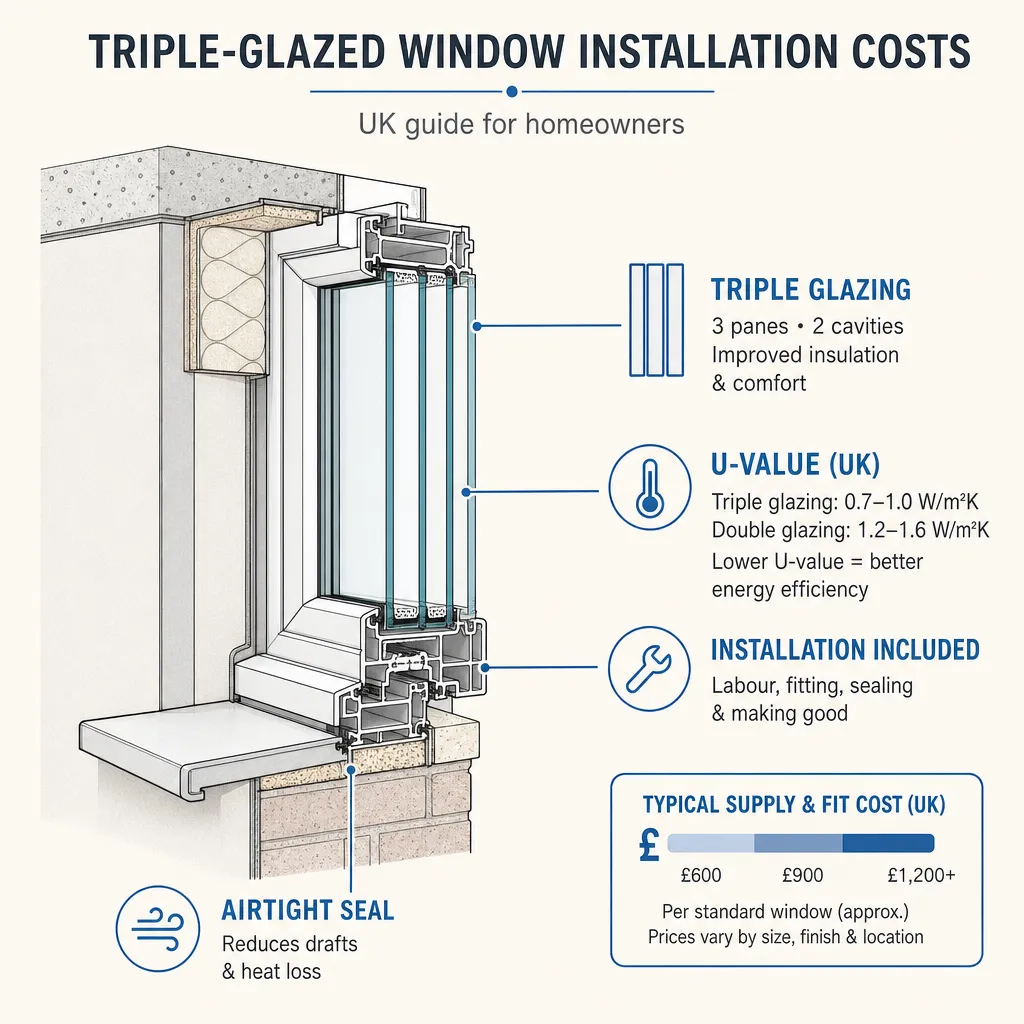
Triple-Glazed Window Installation Costs
Triple-glazed window installation in the UK typically costs £800–£1,800 per window, depending on size, frame material, and glazing specification.
 Improvement & Build
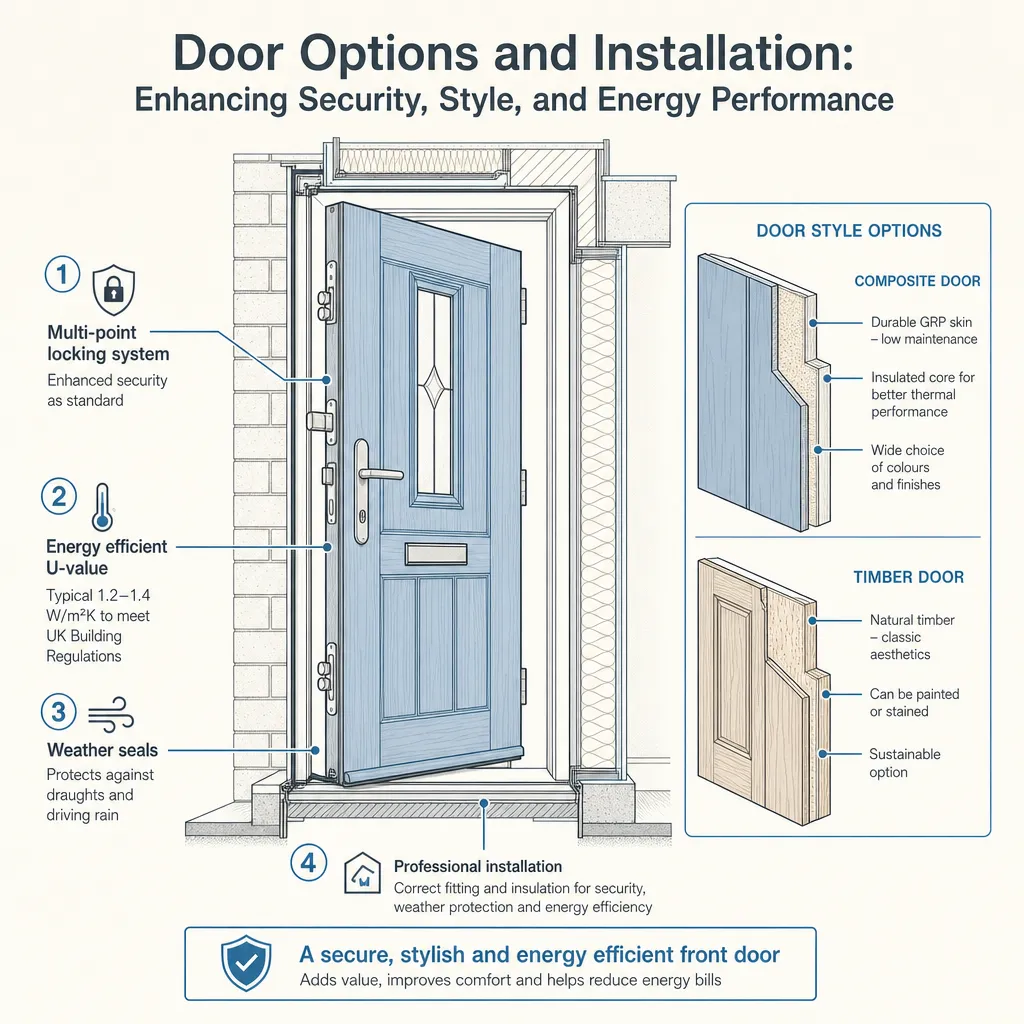
Door Options and Installation: Enhancing Security, Style, and Energy Performance
Choosing a new external door involves balancing security ratings, thermal performance, and style.
 Improvement & Build
Guide to Replacing Timber Sash Windows with Authentic Restoration
Restoring a timber sash window typically costs £150–£400 per window; full replacement costs £800–£2,500.
 Improvement & Build
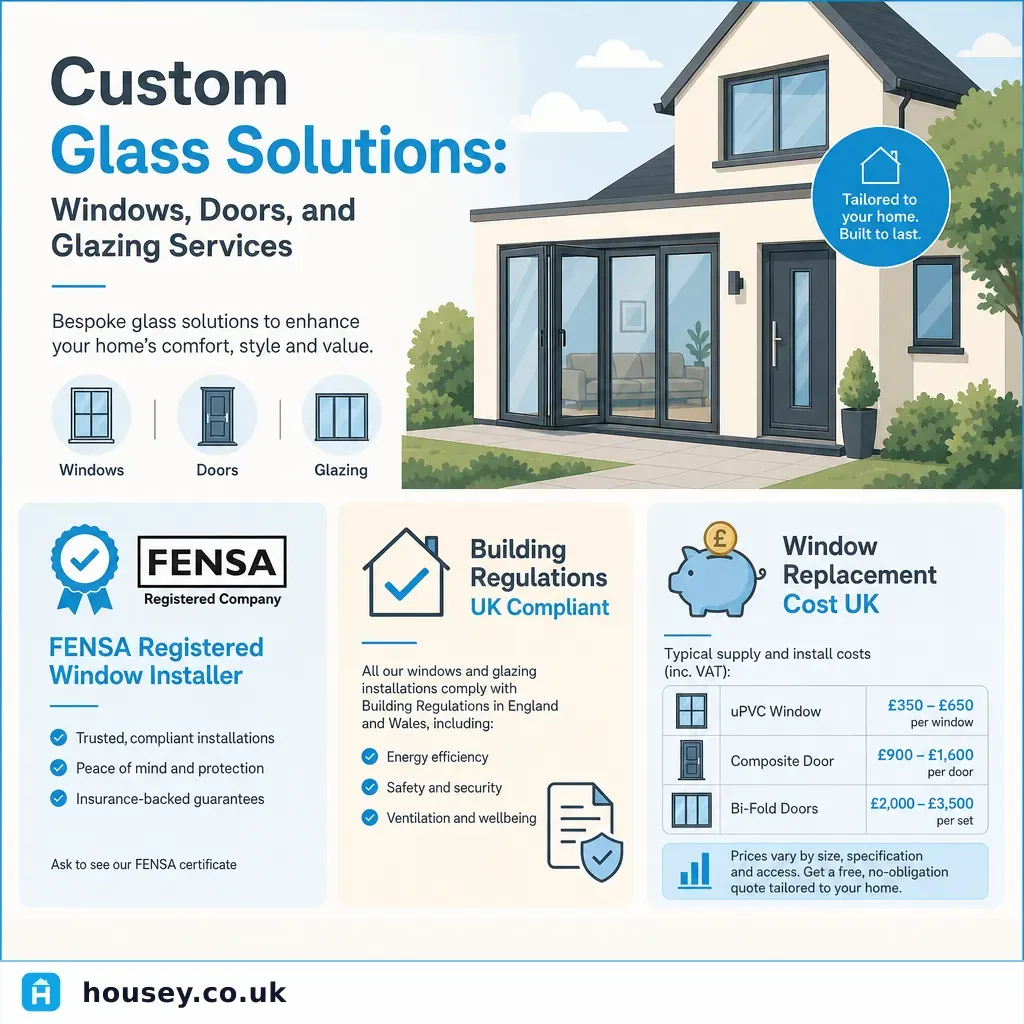
Custom Glass Solutions: Windows, Doors, and Glazing Services
Replacement windows and doors in England and Wales must comply with Building Regulations Approved Document L (2022), requiring a whole-window U-value of 1.
 Improvement & Build
Door Weatherproofing And Sealing: Window And Door Contractors
Door weatherproofing involves fitting draught seals, threshold strips, letterbox brushes, and door sweeps to stop cold air and rain entering around the frame and threshold.