First-Time Buyer vs Established Homeowner: Property Purchase Considerations
By Housey · Last reviewed 1st of June 2026
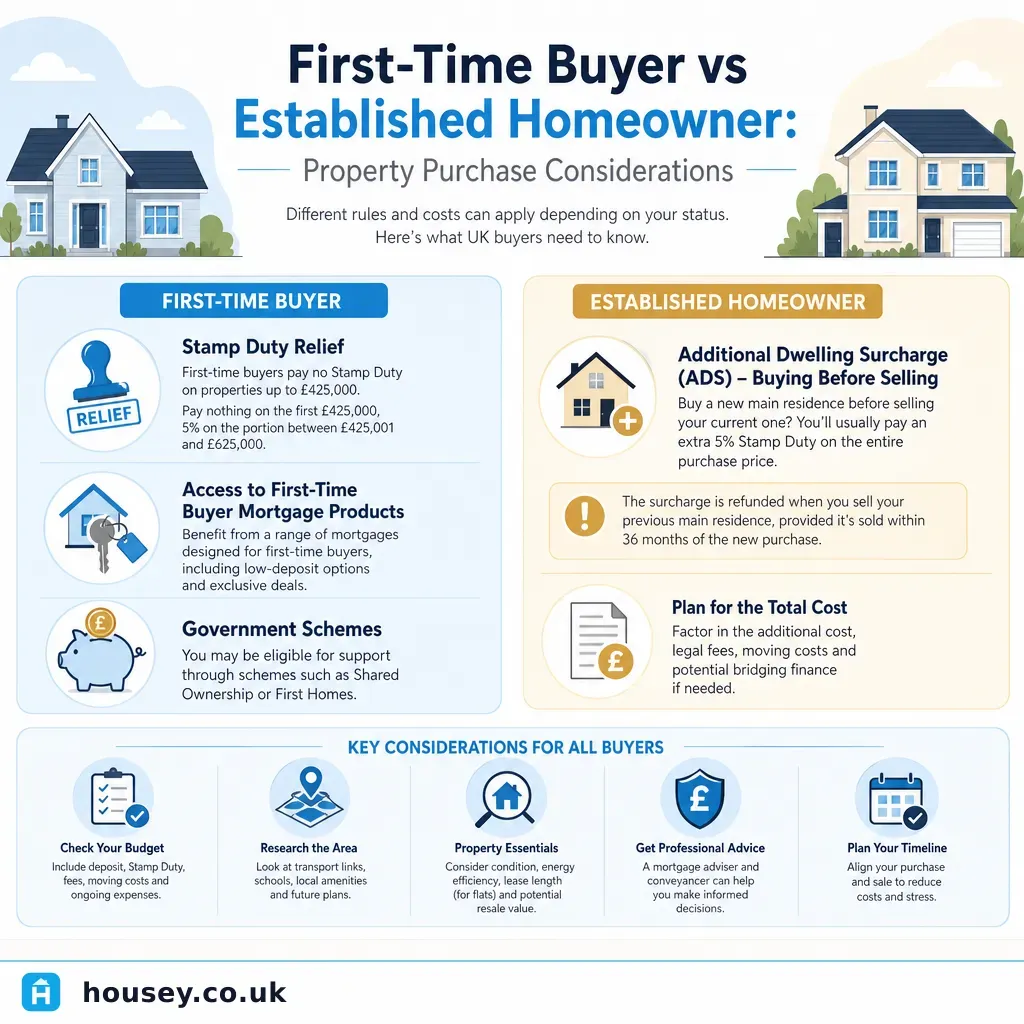
First-Time Buyer vs Established Homeowner: Property Purchase Considerations
Deciding how to approach a property purchase looks different depending on whether you have been through it before. First-time buyers face a distinct set of rules around tax relief, mortgage eligibility, and legal process, while established homeowners must weigh up chain management, equity release timing, and the tax implications of owning two properties simultaneously. Understanding which rules apply to you — and where they overlap — can shape both your budget and your timeline.
Key points
- First-time buyers in England pay no Stamp Duty Land Tax (SDLT) on the first £300,000 of a property valued up to £500,000, under first-time buyer relief in force from 1 April 2025 — check GOV.UK for current rates before exchange.
- Established homeowners who complete a purchase before selling their existing property pay a 3% SDLT surcharge on the entire purchase price; HMRC can refund this if the original home sells within 36 months of the new purchase completion date.
- First-time buyers have no property to sell, removing chain risk and often making their offer more attractive to sellers who need certainty of transaction.
- Both first-time buyers and established homeowners must instruct a solicitor or licensed conveyancer — there is no legal shortcut for the transfer of title.
- A lender's mortgage valuation is not a survey: it protects the lender, not you. Both buyer types benefit from commissioning an independent RICS survey suited to the property's age and condition.
How stamp duty differs for first-time buyers and established homeowners
Stamp Duty Land Tax (SDLT) is charged in England on residential property purchases above certain thresholds. Scotland uses Land and Buildings Transaction Tax (LBTT) and Wales uses Land Transaction Tax (LTT), each with their own rates and reliefs.
From 1 April 2025, when the temporary SDLT thresholds introduced in 2022 reverted, the position in England is as follows:
Buyer situation | 0% nil-rate band | Rate above nil-rate band | Notes |
|---|---|---|---|
Standard buyer | First £125,000 | 2% on £125,001–£250,000; 5% on £250,001–£925,000 | Standard rates apply |
First-time buyer (property up to £500,000) | First £300,000 | 5% on £300,001–£500,000 | No first-time buyer relief for properties above £500,000 |
Additional dwelling (buying before selling existing home) | No reduced band — surcharge applies | Standard rates plus 3% surcharge on all bands | Surcharge refundable if previous main residence sells within 36 months |
Source: GOV.UK SDLT guidance, rates from 1 April 2025. Always confirm current rates with your solicitor before exchange.
First-time buyers purchasing in Scotland should check LBTT first-time buyer relief via Revenue Scotland. Welsh buyers should check LTT rates via the Welsh Revenue Authority.
Mortgage considerations: what changes based on buyer status
Lenders assess both first-time buyers and established homeowners on affordability, credit history, income, and deposit size. A few distinctions apply in practice.
First-time buyers may access specific first-time buyer mortgage products, often at competitive loan-to-value (LTV) ratios. They may also qualify under the government's Mortgage Guarantee Scheme, which allows 95% LTV mortgages where participating lenders offer them — check current availability on GOV.UK. Having no property to sell simplifies the application timeline and removes the risk of a chain collapsing mid-application.
Established homeowners can use equity from their existing property as a deposit, potentially unlocking lower LTV tiers and better rates. Those buying before selling may explore bridging loans or mortgage porting arrangements. Bridging finance typically carries higher interest rates and arrangement fees and should be compared carefully against the alternative of waiting until the existing sale has exchanged.
Speak to an independent mortgage broker to compare products available to your buyer category before making a formal application.
Conveyancing and the legal process: key differences
Both buyer types instruct a solicitor or licensed conveyancer to handle the legal transfer of ownership. The core stages are the same: instruction, searches (local authority, drainage, environmental), enquiries, exchange of contracts, and completion. The practical differences appear in complexity and co-ordination.
First-time buyers have no related sale to manage. Those purchasing a leasehold flat should scrutinise the lease length — fewer than 80 years remaining significantly affects mortgage eligibility and future resale value — alongside ground rent terms and service charge history.
Established homeowners manage a sale and a purchase simultaneously, each with its own solicitor, timeline, and searches. Exchange and completion dates must be synchronised across the chain. Any delay from a third party can affect both transactions. The existing mortgage must be confirmed as dischargeable at completion.
Instructing a conveyancer early — ideally before your offer is accepted — reduces delays at the critical period between offer and exchange.
Which buyer type are you? A decision guide
Confirm which rules apply to your situation before instructing a solicitor.
- Choose first-time buyer status if you have never previously owned a residential property anywhere in the world, including inherited or gifted property. On a joint purchase, both buyers must meet this condition to claim the full SDLT first-time buyer relief.
- Proceed as an established homeowner (moving home) if you own a property that you will sell simultaneously with, or before, your purchase.
- Take legal advice before proceeding if you will own two properties simultaneously at any point during the transaction, to understand the 3% surcharge and refund mechanism.
- Ask a solicitor if you have previously owned property abroad, received property as a gift or inheritance, are purchasing through a trust structure, or are co-buying with someone whose buyer status differs from yours.
Survey and valuation: do requirements differ?
The need for an independent survey does not depend on buyer status — it depends on the property.
Property situation | Recommended survey | Why |
|---|---|---|
New-build with developer warranty (e.g. NHBC Buildmark) | RICS Level 1 or snagging inspection | Standard construction; developer should rectify defects under warranty |
Conventional post-1945 home, no visible defects | RICS Level 2 Home Survey | Proportionate level of detail for lower-risk property |
Victorian or Edwardian terrace, flat conversion, extended or altered home | RICS Level 3 Building Survey | Older or modified construction; higher risk of hidden defects |
Property with visible cracks, damp, or previous structural work | RICS Level 3 or specialist structural engineer | A standard survey may flag concern and recommend further investigation |
High-value purchase or unusual construction | RICS Level 3 Building Survey | Greater financial exposure warrants greater detail |
A lender's mortgage valuation is not a survey — it protects the lender's interest, not yours.
Important limitations
This article provides general information about buyer categories and common property purchase considerations in England. Tax rates, thresholds, and mortgage scheme eligibility change — always confirm the current position with a qualified solicitor or licensed conveyancer before exchange. The rules for Scotland and Wales differ materially from those in England. Individual circumstances — including joint purchases, overseas property ownership, trust arrangements, and leasehold complications — can significantly alter the SDLT, legal, and mortgage position. Nothing in this article constitutes legal, financial, or tax advice.
What to ask a qualified professional
Before instructing a conveyancer:
- Do I legally qualify as a first-time buyer given my full ownership history, including any inherited or overseas property?
- If we are purchasing jointly, what is our combined SDLT position if one buyer has previously owned property?
- What searches do you recommend for this postcode and property type, and what is the likely timeline from instruction to exchange?
- What leasehold due-diligence checks will you carry out for this property?
Before accepting a mortgage offer:
- What first-time buyer products or government schemes am I eligible for based on my deposit and income?
- If I am buying before selling, what bridging or chain-break options are available and what are the total costs and risks?
- Does this offer account for all transaction costs including valuation, legal fees, and moving?
When to get professional help
Seek professional advice before making an offer if:
- You are uncertain whether you legally qualify as a first-time buyer.
- You will own two properties simultaneously at any point during the transaction.
- The property is leasehold with fewer than 80 years remaining on the lease.
- You are purchasing jointly with someone whose buyer status differs from yours.
- A survey reveals structural movement, suspected asbestos, or unexplained damp that the seller cannot account for.
How Housey can help
Whether you are buying for the first time or moving up the ladder, having the right professionals in place early makes a measurable difference. Housey can connect you with qualified conveyancing solicitors who understand buyer-status rules and SDLT implications, and with RICS-registered surveyors for a RICS Home Survey or valuation survey matched to the property you are purchasing.
Frequently asked questions
Does being a first-time buyer give me any advantage when making an offer?
Yes — practically speaking. You have no property to sell, which removes chain risk and can make your offer more attractive to a motivated seller, even if your headline price matches a competing offer from a buyer in a chain. Sellers who need certainty often favour chain-free purchasers.
Can I claim first-time buyer stamp duty relief if I am buying jointly with someone who has owned property before?
No. In England, both buyers on a joint purchase must each qualify as a first-time buyer to claim the full SDLT relief. If one buyer has previously owned residential property, standard rates apply to the entire purchase. Check GOV.UK or ask your conveyancer to confirm your specific position.
If I pay the 3% additional dwelling surcharge, when can I claim a refund?
HMRC allows a refund of the additional 3% SDLT if you sell your original main residence within 36 months of completing your new purchase. You must apply within 12 months of selling the previous main residence, or within 12 months of the SDLT return filing date, whichever is later. Your solicitor can handle the application.
Do I need a survey as a first-time buyer?
No law requires you to commission an independent survey, but it is strongly advisable. Your lender's mortgage valuation protects the lender, not you. A RICS Level 2 or Level 3 survey can reveal material defects that affect your decision to proceed, your negotiating position, or your plans for the property after purchase.
Sources and further reading
- Stamp Duty Land Tax — GOV.UK / HMRC
- Land and Buildings Transaction Tax — Revenue Scotland
- Land Transaction Tax guide — Welsh Revenue Authority
- RICS Home Surveys — RICS
- Mortgage Guarantee Scheme — GOV.UK
Useful next reads
 Buying & Moving
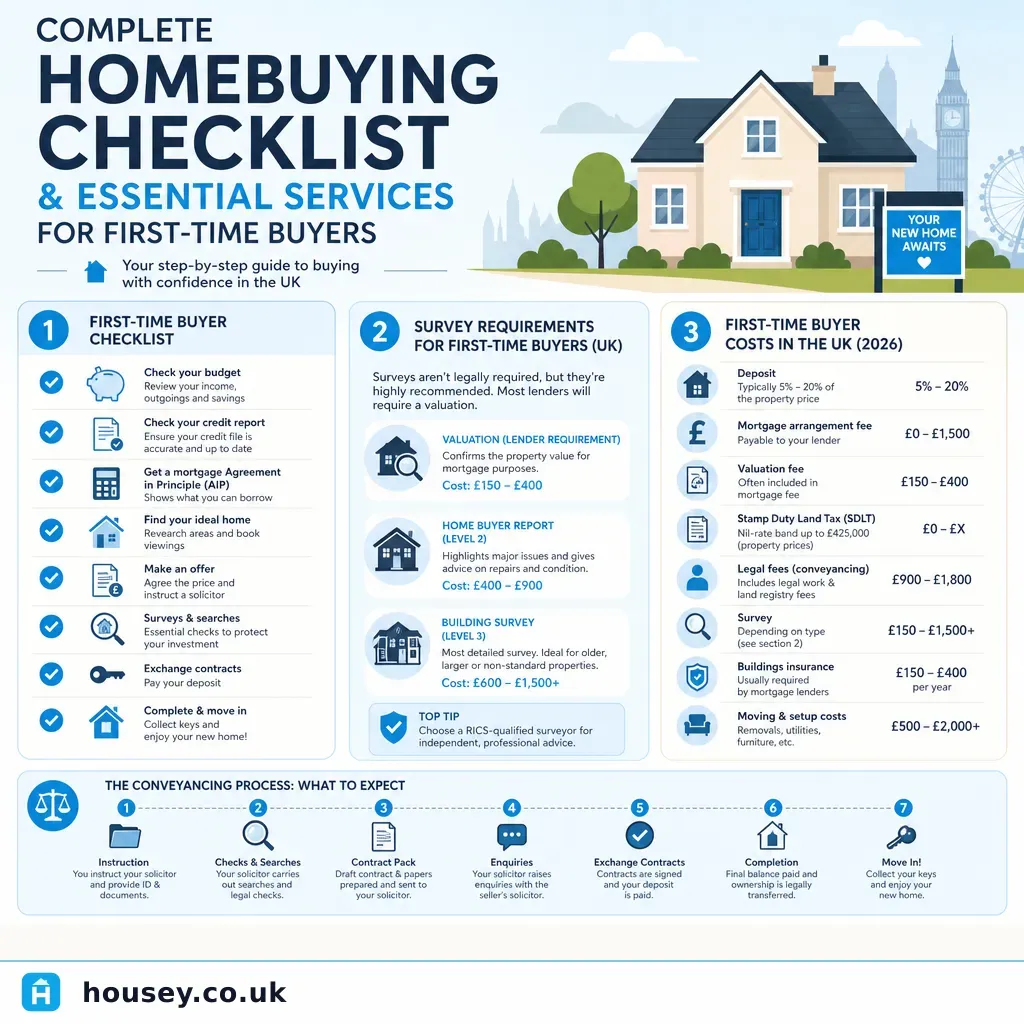
Complete Homebuying Checklist and Essential Services for First-Time Buyers
First-time buyers in the UK should commission an independent RICS Home Survey before exchange — a mortgage lender's valuation does not protect you.
 Buying & Moving
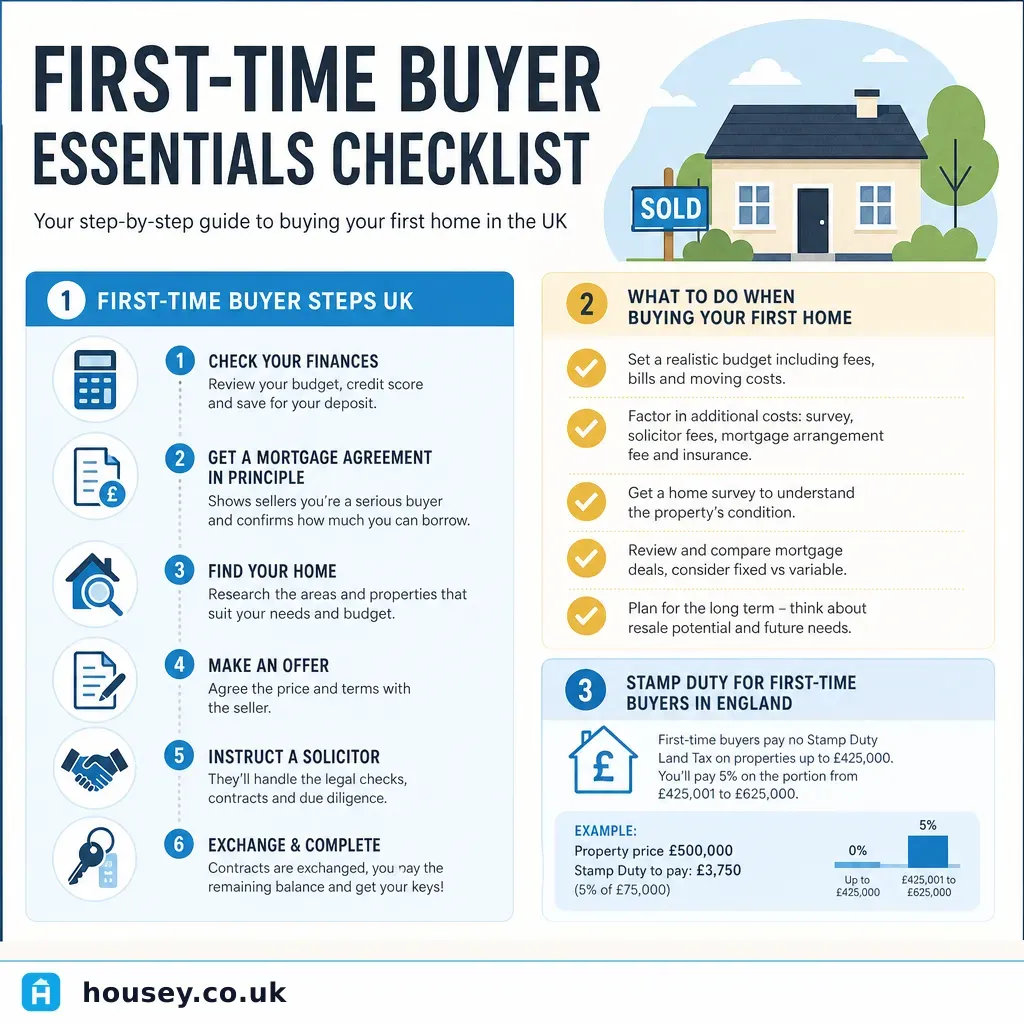
First-Time Buyer Essentials Checklist
Buying your first home involves obtaining a mortgage in principle, making an offer, instructing a solicitor, arranging a survey, and exchanging contracts before completion.
 Buying & Moving
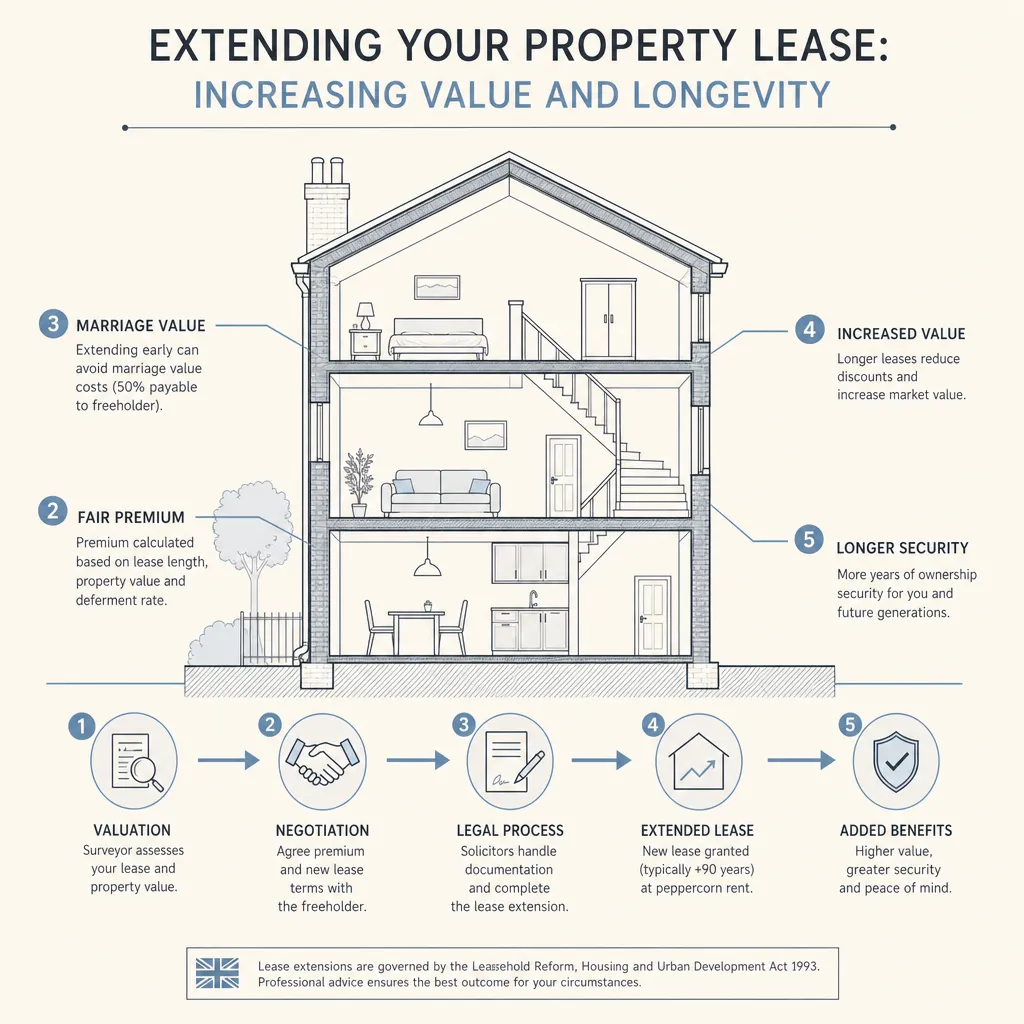
Extending Your Property Lease: Increasing Value and Longevity
Qualifying leaseholders in England and Wales can extend their lease by 90 years at a peppercorn ground rent under the Leasehold Reform, Housing and Urban Development Act 1993.
 Buying & Moving
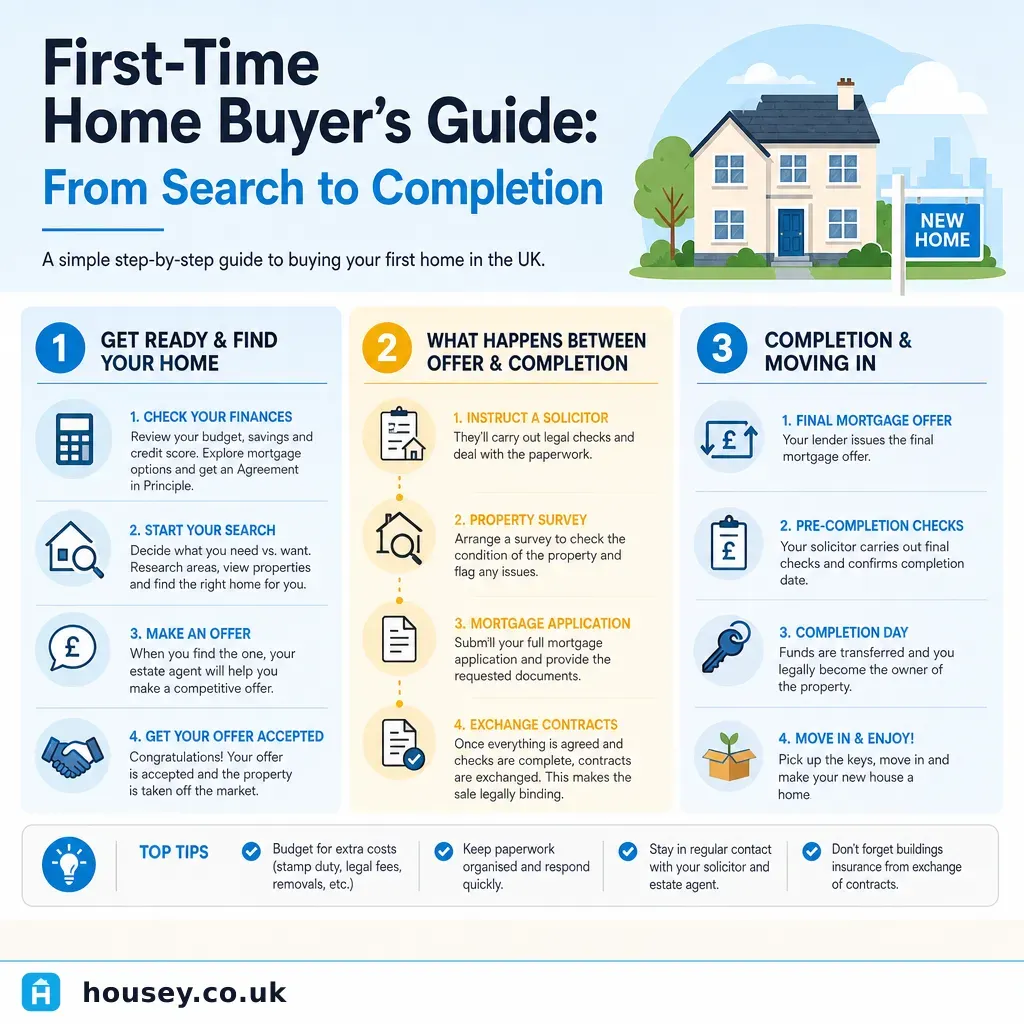
First-Time Home Buyer's Guide: From Search to Completion
Buying your first home in the UK typically takes 3–6 months from offer acceptance to completion.
 Buying & Moving
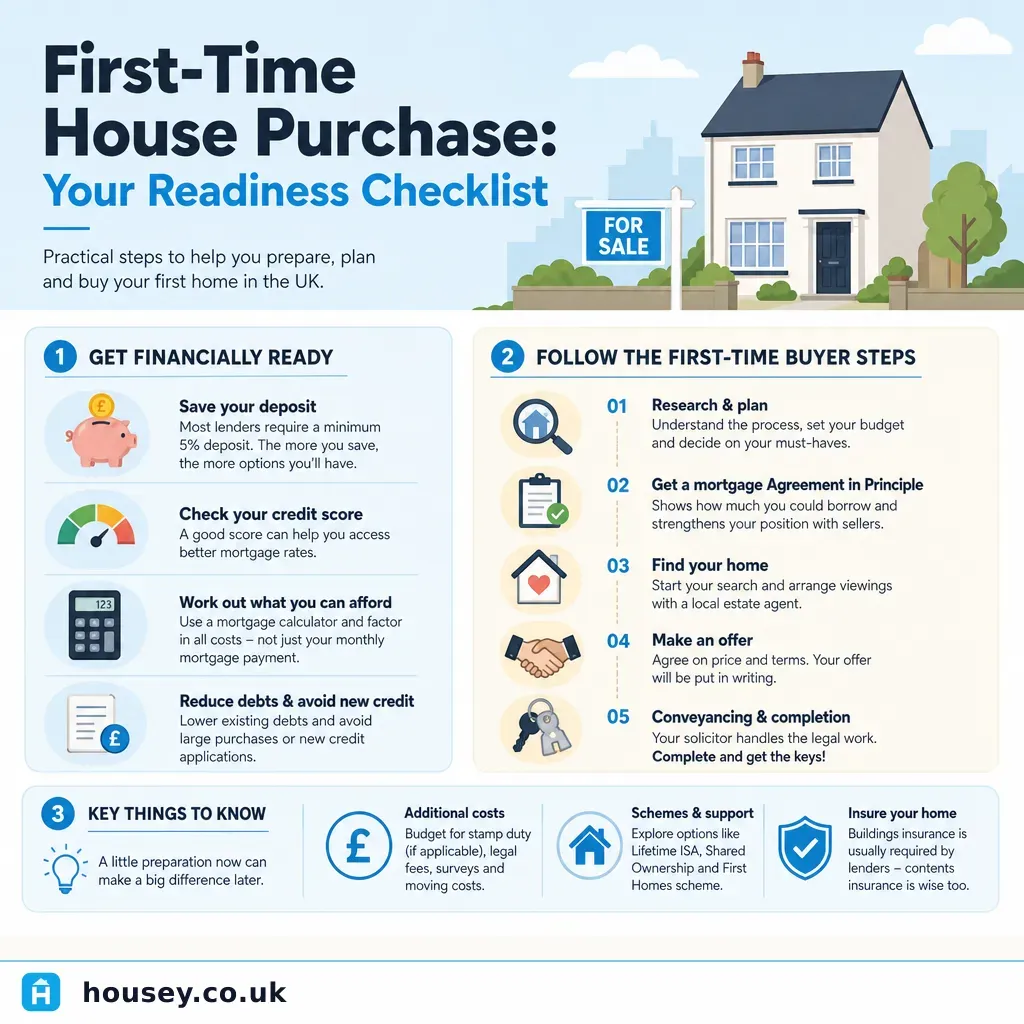
First-Time House Purchase: Your Readiness Checklist
Before making your first offer, have a mortgage agreement in principle, a deposit plus buying costs saved (allow 2–3% of the purchase price beyond the deposit itself), and a conveyancer ready to instruct.