First-Time Buyer Guide: Key Steps for Purchasing Your Home in the UK
By Housey · Last reviewed 10th of May 2026
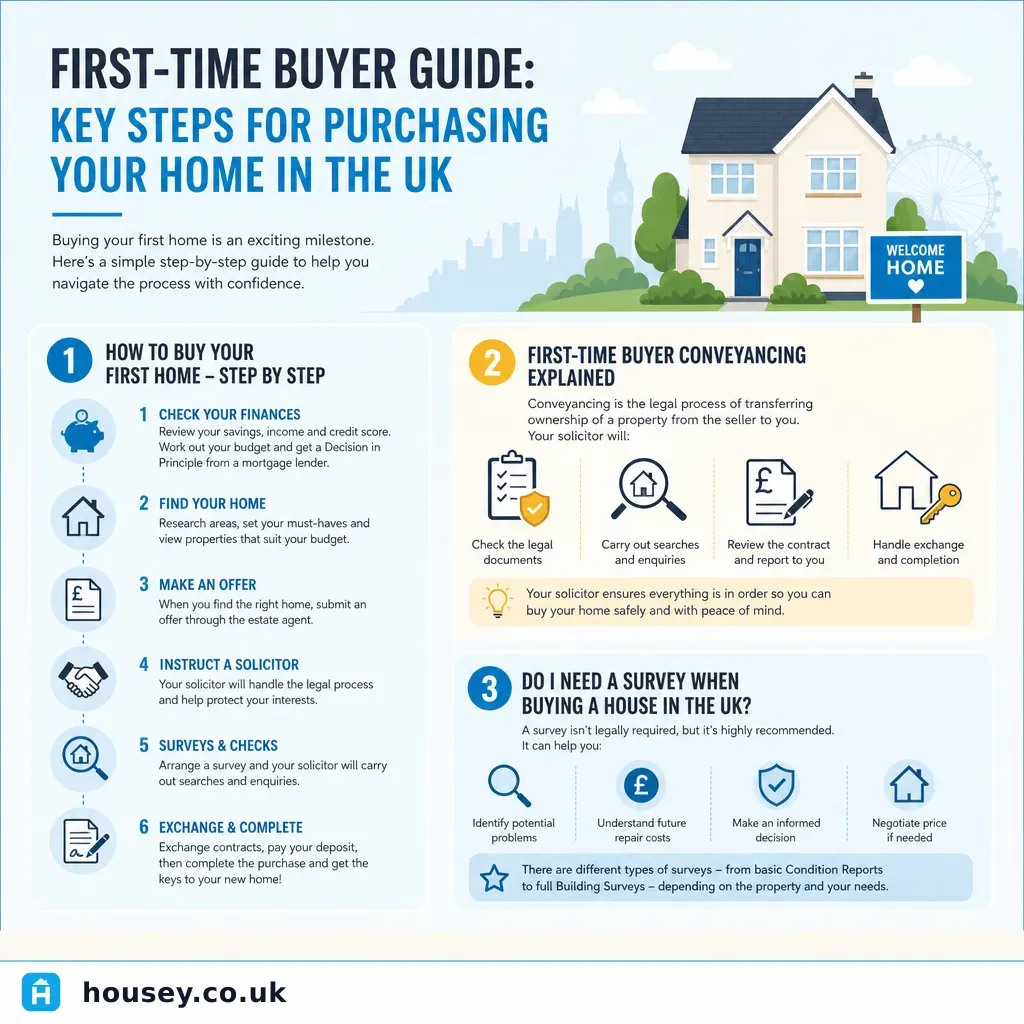
First-Time Buyer Guide: Key Steps for Purchasing Your Home in the UK
Buying your first home in England or Wales involves a longer, more document-heavy process than most buyers expect. The decisions made after an offer is accepted — which survey to commission, which solicitor to instruct, and when to exchange — significantly affect what you pay, what you discover about the property, and how smoothly the transaction completes. Understanding the sequence and the points at which decisions are difficult to reverse puts you in a much stronger position.
Key points
- Stamp Duty Land Tax (SDLT) relief for first-time buyers in England currently applies to the first £425,000 of a property priced up to £500,000 — confirm current thresholds and eligibility with your solicitor, as rates are reviewed in Budgets and may change.
- The purchase is not legally binding in England and Wales until exchange of contracts; either party can withdraw before that point, but the buyer loses their deposit if they withdraw after exchange.
- A mortgage valuation protects the lender, not the buyer — you must commission a separate RICS Home Survey to independently assess the property's condition.
- Your conveyancer must be on your mortgage lender's approved panel; not all firms are, and using one who is not will add cost and delay.
- Local authority searches typically take 3–8 weeks and must be completed before exchange can proceed.
Understanding the buying process step by step
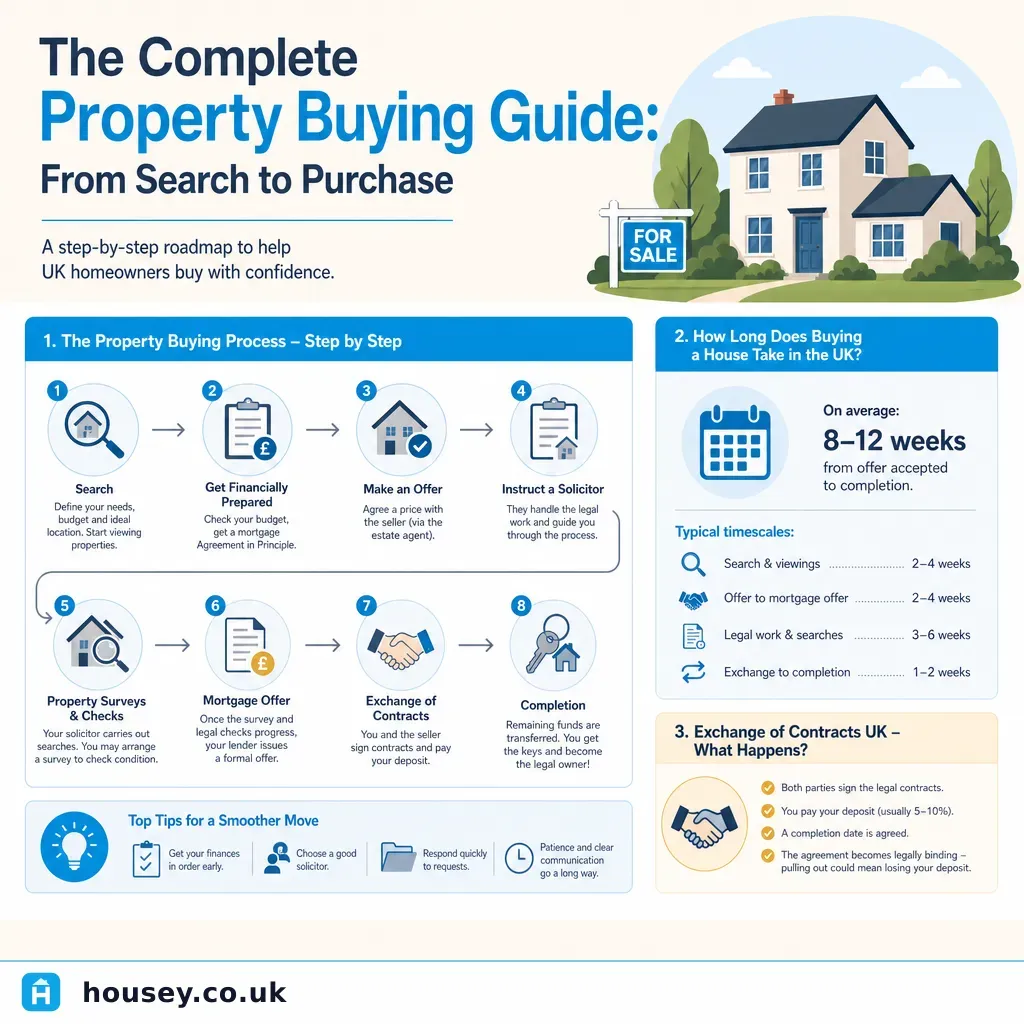
The conveyancing process in England and Wales is non-binding until exchange. Either party can withdraw before that point without legal liability — unlike Scotland, where missives create a binding contract at an earlier stage.
Stage | Who acts | Typical duration |
|---|---|---|
Mortgage in principle | You and lender or broker | 1–5 days |
Property search and offer accepted | You and estate agent | Weeks to months |
Solicitor or conveyancer instructed | You | Before offer if possible |
Survey carried out | You and RICS surveyor | 1–3 weeks from instruction |
Full mortgage application and formal offer | Lender | 2–6 weeks |
Searches completed | Your solicitor | 3–8 weeks |
Enquiries raised and resolved | Both solicitors | Weeks — varies widely |
Exchange of contracts | Your solicitor | Typically 8–16 weeks after offer |
Completion | Both solicitors | Usually 1–4 weeks after exchange |
Indicative timescales. Chain complexity and search delays frequently extend these.
Which survey do you need?
Your lender's valuation confirms the property is adequate security for the loan — it does not protect the buyer and does not identify defects. Commission your own survey separately.
Survey type | Best for | What it covers | Indicative cost (2026) |
|---|---|---|---|
RICS Level 2 Home Survey | Conventional post-1930 properties in reasonable condition | Condition ratings, visible defects, basic repair advice | £400–£900 |
RICS Level 3 Building Survey | Pre-1930 properties, unusual construction, visible defects, significantly altered homes | Detailed defect analysis, repair options, cost implications | £600–£1,500+ |
Specific defect report | A single identified concern flagged by a Level 2 | Single-issue investigation and diagnosis | £250–£600 |
Indicative UK costs, last reviewed 2026-05-10. Costs vary by region, property size, and surveyor. Always request itemised quotes.
Choose a RICS Level 2 survey for a straightforward modern property in apparent good order. Choose a RICS Home Survey at Level 3 for any property built before 1930, or any home showing signs of movement, damp, or significant alteration. If in doubt, Level 3 gives more protection before you commit. A valuation survey that returns below the agreed price is often a prompt to renegotiate before proceeding.
Choosing a conveyancer
Your conveyancer handles the legal transfer of ownership: conducting searches, reviewing title, raising enquiries, managing exchange, and transferring funds on completion. Instructing them before your offer is accepted avoids delay at the moment the estate agent calls.
What to ask before instructing a conveyancer
- Are you regulated by the SRA or the Council for Licensed Conveyancers (CLC)?
- Are you on my mortgage lender's approved conveyancer panel?
- What is your total fee, including searches, bank transfer charges, and Land Registry registration — and is it fixed?
- Are there circumstances in which your fee could increase?
- Who handles my file day-to-day, and what is their current caseload?
- How do you communicate progress, and how quickly do you typically respond to enquiries?
- Do you have experience with leasehold, Help to Buy, or shared ownership transactions, if applicable?
Being on the lender's panel is not optional. A firm not on the panel adds cost and extends the timeline.
What happens between offer and exchange?
Your solicitor works through several parallel streams during this period:
- Title investigation — reviewing Land Registry documents for covenants, easements, rights of way, restrictions, and charges to be discharged on completion.
- Searches — local authority search (planning history, enforcement notices, road adoption), drainage and water search, environmental search (flooding, contamination, radon), and sometimes a chancel repair search.
- Enquiries — written questions to the seller's solicitor about the property's history, planning permissions, boundaries, and any disputes.
- Mortgage offer review — once the lender issues a formal mortgage offer, your solicitor confirms no issues affect the title before you sign.
Arrange buildings insurance to commence from the date of exchange, not completion — risk passes to the buyer at exchange.
Important limitations
This article provides general guidance for first-time buyers in England and Wales. Conveyancing law, SDLT thresholds, and government schemes change regularly and vary by property type and tenure. Nothing here constitutes legal or financial advice. Always instruct a regulated solicitor or licensed conveyancer, and seek independent advice from an FCA-authorised mortgage adviser, for your specific transaction. Rules differ significantly in Scotland, where missives create a binding contract at an earlier stage, and in Northern Ireland.
What to ask a qualified professional
Before instructing a solicitor or conveyancer: Are you regulated by the SRA or CLC? Are you on my lender's approved panel? What is your total fixed fee, and what could cause it to increase?
Before commissioning a survey: What survey level do you recommend for this property type and age, and why? What is excluded from your inspection? Will you discuss findings with me before issuing the report? Are you RICS-accredited?
Before accepting a mortgage product: Have you considered the whole of the market for my circumstances? What are the early repayment charges and when do they apply? What is the reversion rate when the fixed period ends?
When to get professional help
First-time buyers should seek specific professional advice if:
- The property is leasehold with fewer than 80 years remaining on the lease; short leases are harder to mortgage and significantly more expensive to extend.
- The property is listed, in a conservation area, or has planning conditions attached to previous works.
- You are being pressured to exchange before all searches, enquiries, and the survey are fully resolved.
- The seller's solicitor raises issues about title, rights of way, or missing building regulations completion certificates.
- The survey reveals significant defects — obtain contractor quotes before exchange so you can renegotiate or withdraw with accurate information.
How Housey can help
Housey connects first-time buyers with qualified professionals at each stage of a purchase. Request quotes for a conveyancer to manage the legal transfer, a RICS Level 2 survey for a modern property, or a full RICS Home Survey for an older home. A valuation survey can also help you assess whether the asking price reflects the property's condition before you commit.
Frequently asked questions
Do I need a solicitor or a licensed conveyancer to buy a home?
Both are legally qualified for residential conveyancing. Solicitors are regulated by the SRA; licensed conveyancers by the CLC. Either is suitable for most standard purchases. For complex transactions — leasehold, shared ownership, Help to Buy — a solicitor with specialist property experience is often preferable. Always confirm they are on your mortgage lender's approved panel before instructing.
When should I instruct a solicitor as a first-time buyer?
Ideally before your offer is accepted. This avoids delay at the moment the estate agent requests your solicitor's details — which typically happens immediately after acceptance. Instructing early also allows your conveyancer to begin reviewing the draft contract as soon as the seller's solicitor sends the contract pack.
Is a mortgage valuation the same as a survey?
No. A mortgage valuation is for the lender to confirm the property is adequate security for the loan. It does not identify defects and does not protect the buyer. Commission a separate RICS Home Survey — Level 2 for conventional properties, Level 3 for older or complex homes — to independently assess condition before exchange.
What happens at exchange of contracts?
Both parties sign identical contracts; the buyer pays a deposit, typically 5–10% of the purchase price; and a completion date is agreed. After exchange, withdrawing means losing your deposit and potentially facing a claim for the seller's losses. Arrange buildings insurance from the date of exchange, not completion, as risk passes to the buyer at that point.
Can I negotiate on price after my survey reveals defects?
Yes. If the survey reveals defects not apparent during viewings, renegotiate the price, request repairs before exchange, or withdraw entirely. Act before exchange, as the agreed price is legally binding after that point. Obtain contractor quotes for significant remediation to support the renegotiation with evidence.
Sources and further reading
- Buying a home: step-by-step — GOV.UK
- Stamp Duty Land Tax: first-time buyers relief — GOV.UK / HMRC
- RICS Home Surveys — Royal Institution of Chartered Surveyors
- Conveyancing: how it works — Citizens Advice
- Registering land or property with Land Registry — HM Land Registry
- Mortgages: consumer guidance — Financial Conduct Authority
Useful next reads
 Buying & Moving
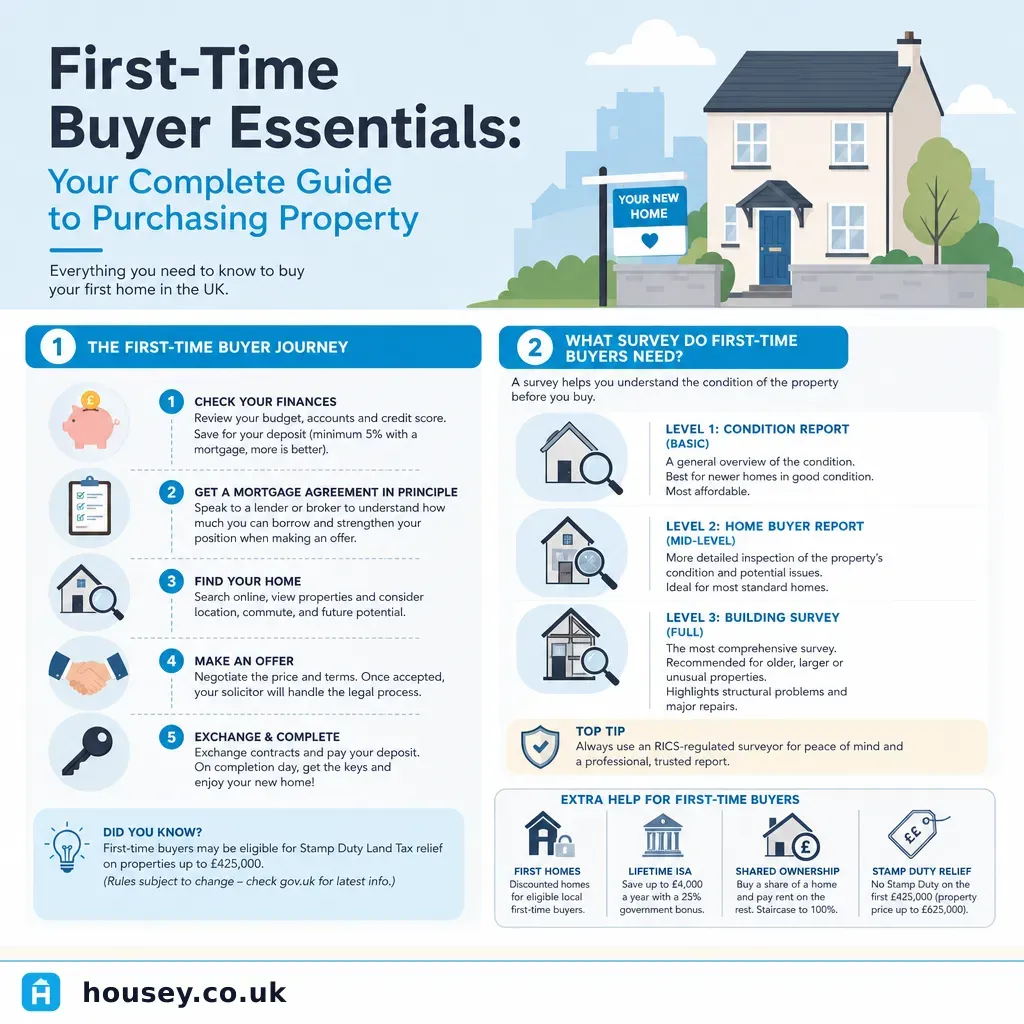
First-Time Buyer Essentials: Your Complete Guide to Purchasing Property
Buying your first UK home involves six key stages: securing a mortgage Agreement in Principle, making an offer, instructing a solicitor, commissioning an independent RICS survey, exchanging contracts (the legally binding point), and completing.
 Buying & Moving
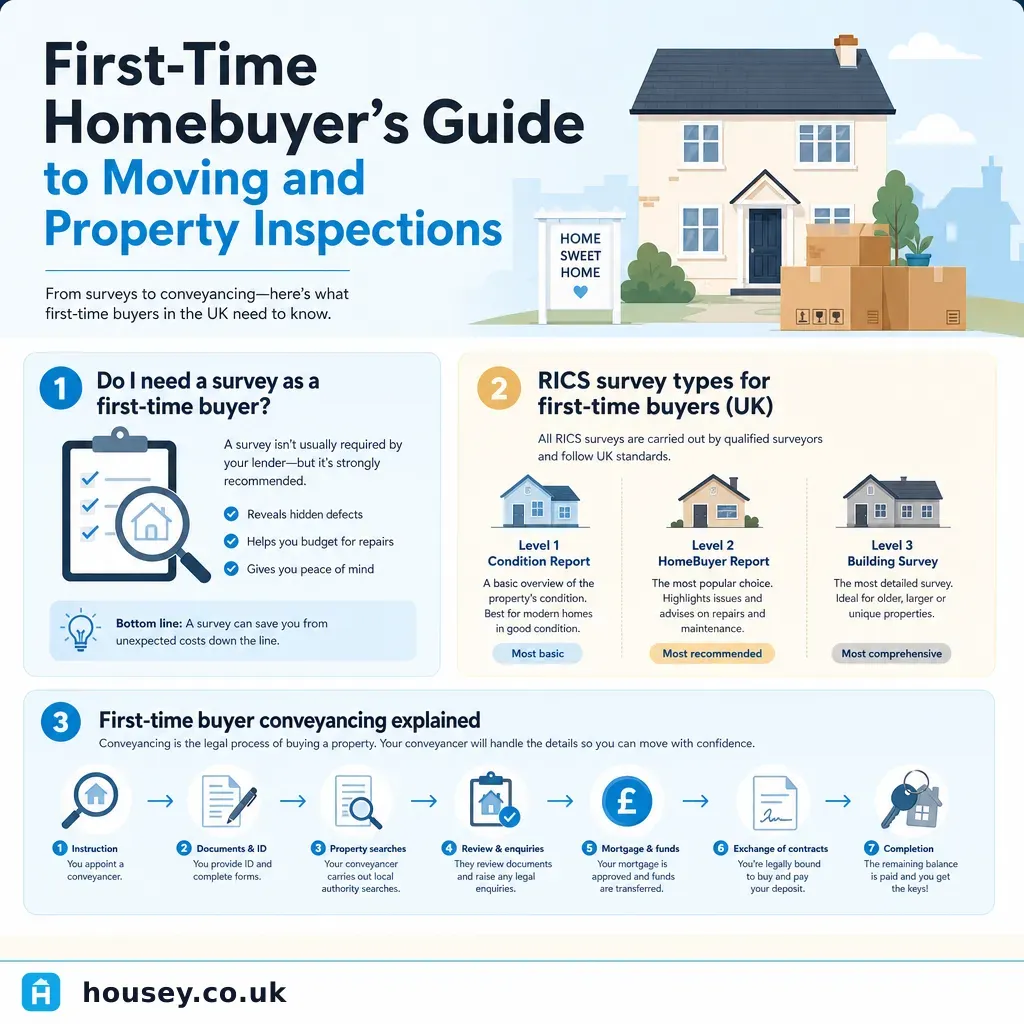
First-Time Homebuyer's Guide to Moving and Property Inspections
First-time buyers in the UK should know that a lender's mortgage valuation is not a property survey and does not protect the buyer.
 Buying & Moving
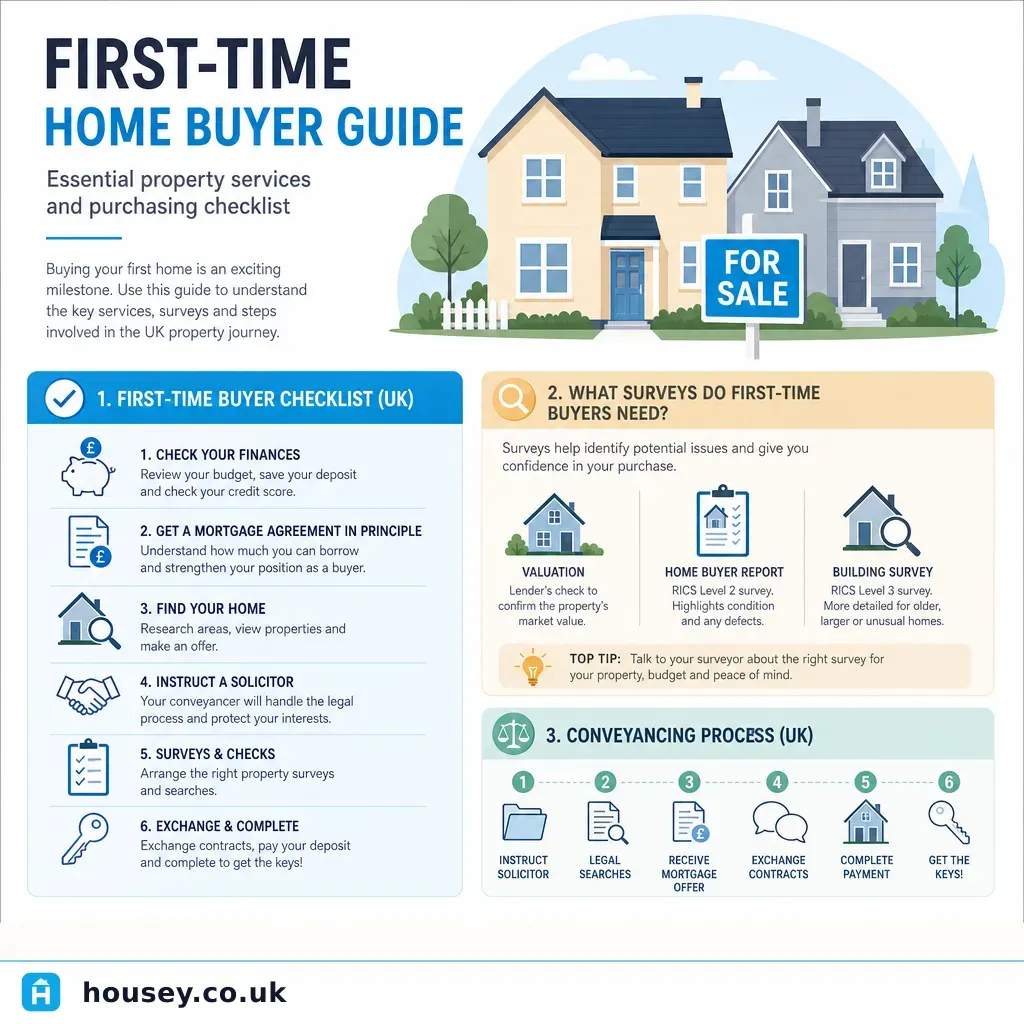
First-time home buyer guide: essential property services and purchasing checklist
Buying your first home in the UK typically takes 12–16 weeks from offer acceptance to completion.
 Buying & Moving
First-Time Buyer Guide: Expert Advice for Your Property Purchase
Buying your first home in the UK typically involves obtaining a mortgage in principle, instructing a conveyancer, commissioning a RICS survey, exchanging contracts, and completing.
 Buying & Moving
The Complete Property Buying Guide: From Search to Purchase
Buying a property in England and Wales typically takes 3–6 months from accepted offer to completion.