First-time home buyer guide: essential property services and purchasing checklist
By Housey · Last reviewed 7th of May 2026

First-time home buyer guide: essential property services and purchasing checklist
Navigating a first property purchase in the UK means dealing with legal, financial, and technical processes that most people encounter only once or twice in a lifetime. From offer accepted to keys in hand, the typical transaction involves at least four professional services — and the order and timing of each one affects both your costs and your ability to exchange contracts safely. Mistakes at this stage can be costly or difficult to reverse after completion.
Key points
- Conveyancing in England and Wales is carried out by a licensed conveyancer or solicitor; Scotland operates a distinct legal framework with its own process and terminology.
- A RICS Level 2 Home Survey suits modern, conventional properties in reasonable condition; a RICS Level 3 Building Survey provides greater detail for older, extended, or visibly defective homes.
- The Stamp Duty Land Tax (SDLT) nil-rate threshold for first-time buyers in England is £425,000 on properties up to £625,000 — verify the current position on GOV.UK before completing, as thresholds can change with Budget announcements.
- An Energy Performance Certificate (EPC), valid for 10 years from issue, must be available before a property is marketed for sale; ratings run from A (most efficient) to G.
- UK property transactions typically take 12–16 weeks from offer acceptance to completion, though chains, survey findings, and solicitor workloads frequently extend this.
The professional services you will need
Most first-time buyers require three core services before completion: a conveyancer or solicitor, a surveyor, and a mortgage adviser. Understanding what each does — and when to instruct them — prevents avoidable delays.
Conveyancing: A licensed conveyancer or solicitor manages the legal transfer of ownership. They carry out searches (local authority, drainage, environmental), review the title, raise enquiries with the seller's solicitor, and manage exchange and completion. Instruct your conveyancer as soon as your offer is accepted.
RICS surveys: A RICS survey is separate from your mortgage lender's valuation. The lender's valuation tells the bank whether the property is adequate security for the loan; it tells you nothing meaningful about condition.
Survey type | Best for | Typical output | Main risk if skipped |
|---|---|---|---|
RICS Level 2 Home Survey | Modern, conventional properties in reasonable condition | Condition ratings (1–3), summary of defects, optional valuation | Missing latent defects affecting value or requiring urgent repair |
RICS Level 3 Building Survey | Older, extended, unusual, or visibly defective properties | Detailed defect analysis, repair recommendations, optional cost estimates | Missing structural problems, damp, or hidden alterations |
Mortgage lender's valuation | Lender's security check — mandatory for mortgage | Lending suitability only | Not applicable — not a substitute for a survey |
Energy Performance Certificate: Every property sold in England, Wales, and Scotland must have a valid Energy Performance Certificate. You are entitled to see it before making an offer. The rating affects running costs and may indicate the scope of future retrofit work.
First-time buyer checklist: offer to completion
Before making an offer
Offer accepted
During conveyancing
Exchange and completion
Indicative buying costs
Indicative UK costs, last reviewed 2026-05-07. Always request itemised quotes — costs vary by property value, location, and provider.
Cost item | Indicative range | Notes |
|---|---|---|
Solicitor or conveyancer fees | £1,000–£2,500 | Plus disbursements: searches, SDLT return, Land Registry fee |
RICS Level 2 Home Survey | £400–£900 | Varies by property size and location |
RICS Level 3 Building Survey | £600–£1,500 | Older or larger properties at the higher end |
Mortgage arrangement fee | £0–£2,000 | Some products fee-free; fee can often be added to loan |
Stamp Duty Land Tax | £0 for first-time buyers on properties up to £425,000 | Use GOV.UK calculator for properties above threshold |
EPC (if a new certificate is needed) | £60–£120 | Seller usually provides; you may need one for remortgage purposes |
Common mistakes to avoid
Relying on the lender's valuation — it confirms lending security, not condition. Only a RICS survey gives you a proper picture of what you are buying.
Instructing a solicitor late — search turnaround and solicitor workload drive the timeline. Delay at the start costs weeks you cannot recover.
Skimming the TA6 form — the seller's Property Information Form contains disclosures about disputes, works, and notices. Your solicitor reviews it legally; reading it yourself often surfaces points worth pursuing.
Giving notice on a rental before exchange — chains collapse and surveys uncover problems. Never serve notice on a tenancy until contracts are exchanged.
Important limitations
This article contains general information only. Property transactions are legally complex and rules vary by tenure (freehold or leasehold), location (England, Wales, Scotland, and Northern Ireland each have distinct legal frameworks), and individual property circumstances. Nothing here constitutes legal, financial, or surveying advice. Always instruct qualified professionals before exchanging contracts.
What to ask a qualified professional
Ask your solicitor or conveyancer:
- What searches will you carry out, and are any additional local searches advisable?
- What does the title reveal about this property's history, and are there any restrictions or covenants?
- What is the likely timeline to exchange, and what are the main risks of delay?
Ask your RICS surveyor:
- Does this property's age and construction warrant a Level 3 rather than a Level 2 survey?
- Are there areas you could not inspect, and what further investigations do you recommend?
- How might the defects identified affect value or insurability?
Ask your mortgage adviser:
- What is the total cost of the mortgage over the initial fixed-rate period, including all fees?
- What happens if the lender's valuation comes in below the agreed purchase price?
When to get professional help
Instruct a solicitor the moment your offer is accepted. Commission a RICS survey before committing to exchange — especially if the property was built before 1920, shows visible cracks or damp, is leasehold with fewer than 80 years on the lease, or has an uncertain planning or building regulations history.
How Housey can help
Housey connects first-time buyers with qualified professionals across every stage of the purchase. Whether you need a conveyancer to handle your legal transfer or a surveyor to carry out a RICS Home Survey, request quotes from vetted UK providers and compare them in one place. Unsure whether Level 2 or Level 3 suits your property? Our RICS Level 2 survey page explains what is included and when to consider upgrading.
Frequently asked questions
Do I need a survey if I am buying a new-build?
New-build properties can still have defects — snagging issues are common. A RICS inspection or specialist snagging survey before legal completion lets you identify problems while the developer is still obligated to remedy them. The NHBC Buildmark warranty covers certain structural defects for 10 years, but it does not replace the value of an independent inspection before you take ownership.
What is the difference between exchange and completion?
Exchange of contracts is the point at which the transaction becomes legally binding. A deposit — usually 10% — is paid and a completion date is agreed. Completion is when the remaining funds transfer, legal title passes, and you collect the keys. The gap between exchange and completion is typically one to four weeks, though this is negotiated between both parties.
Can I pull out of a purchase after my offer is accepted?
In England and Wales, neither party is legally committed until exchange of contracts. You can withdraw before exchange, though you will lose any survey or solicitor fees already incurred. In Scotland, once formal missives are concluded, withdrawal carries legal consequences. Always seek legal advice before withdrawing from a transaction at any stage.
How long does the conveyancing process take?
The average conveyancing transaction in England and Wales takes 12–16 weeks from instruction to completion. Freehold purchases with short chains can complete faster; leasehold or complex titles often take longer. Search turnaround times vary by local authority — some return within days, others take several weeks — which is one of the main variables affecting overall timescales.
What is a leasehold property and why does it matter for a first-time buyer?
Leasehold means you own the property for a fixed term rather than the land it stands on. Flats are usually leasehold. Check the years remaining on the lease — below 80 years can cause mortgage difficulties — and review the annual ground rent and service charge. Your solicitor will raise enquiries about the freeholder or managing agent during conveyancing.
Sources and further reading
- Stamp Duty Land Tax: first-time buyers relief — GOV.UK
- RICS Home Survey Standard — RICS
- Buying or selling your home — GOV.UK
- UK House Price Index Reports — HM Land Registry
- Energy Performance Certificates — GOV.UK
Useful next reads
 Buying & Moving
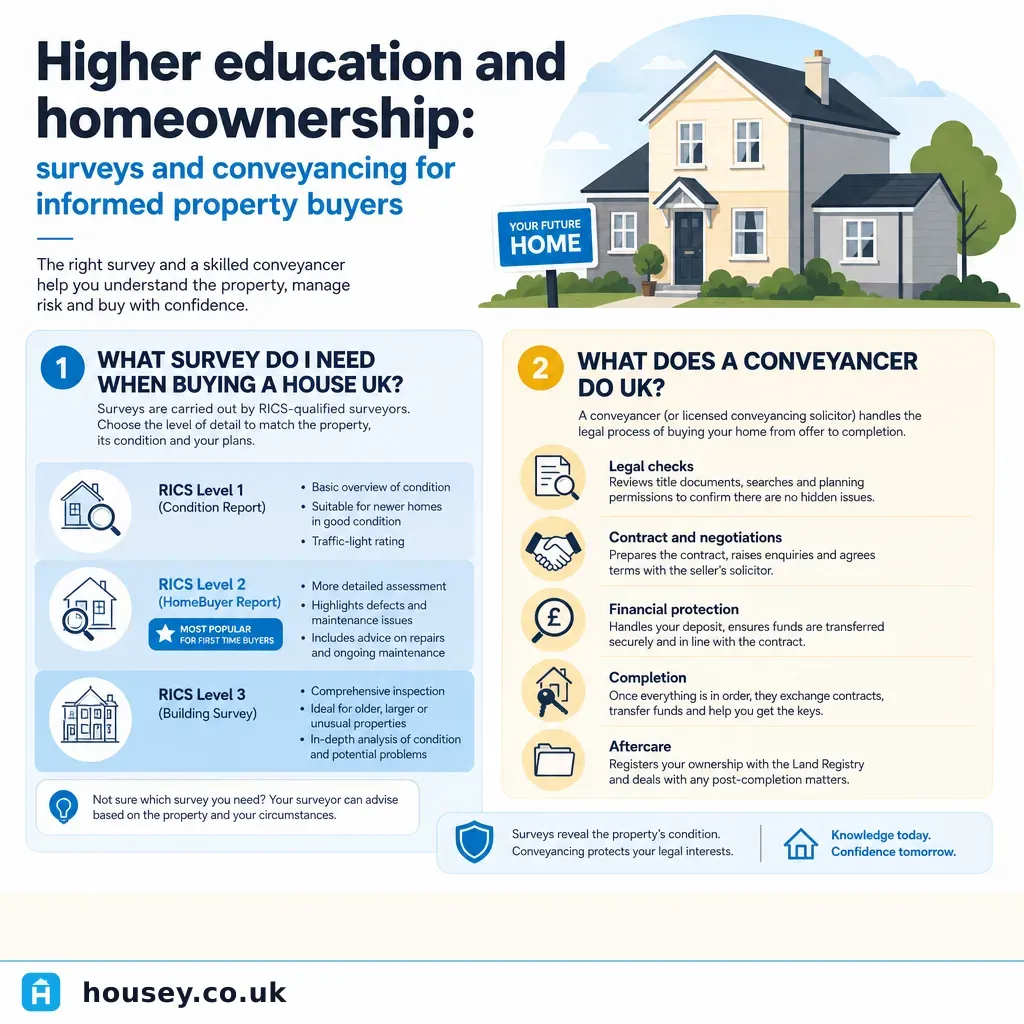
Higher education and homeownership: surveys and conveyancing for informed property buyers
Informed property buyers in the UK typically commission a RICS Level 2 or Level 3 survey before exchange, alongside instructing a conveyancer to carry out legal searches and review title.
 Buying & Moving
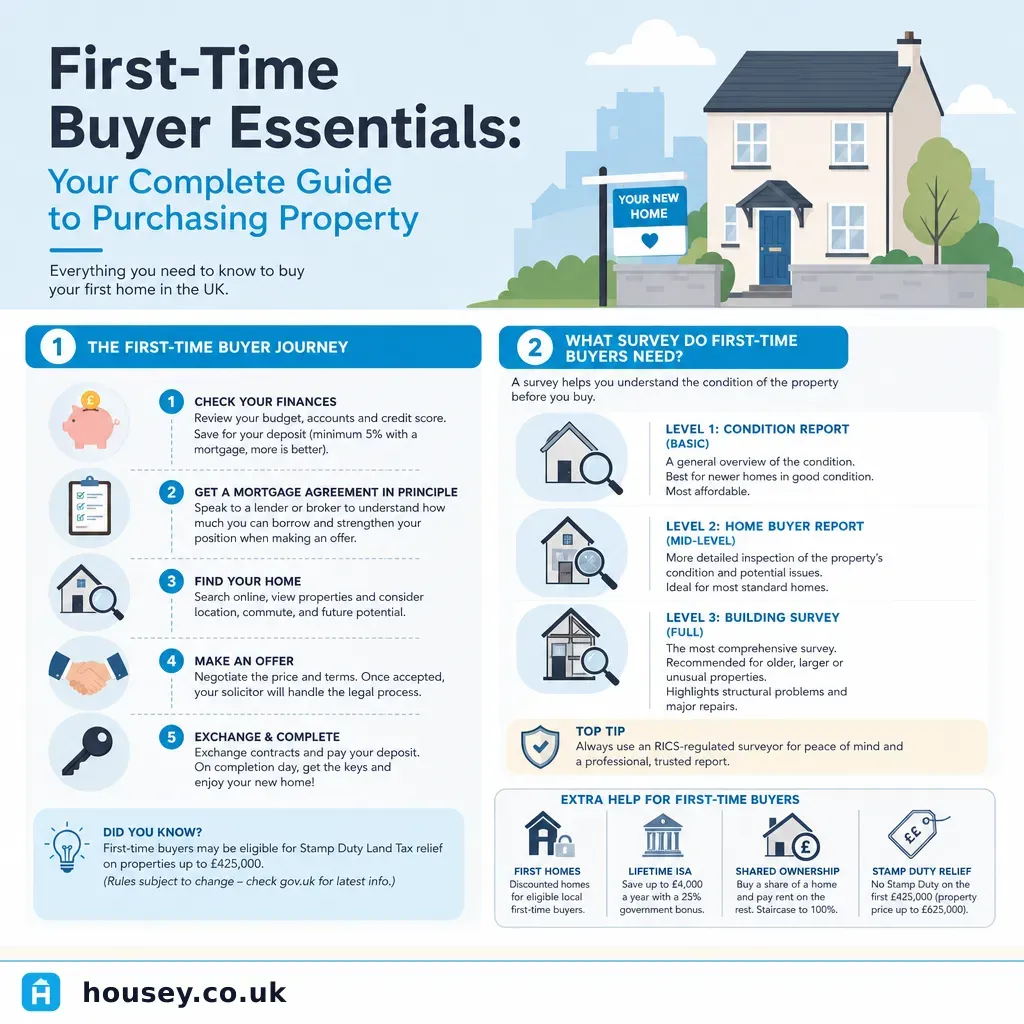
First-Time Buyer Essentials: Your Complete Guide to Purchasing Property
Buying your first UK home involves six key stages: securing a mortgage Agreement in Principle, making an offer, instructing a solicitor, commissioning an independent RICS survey, exchanging contracts (the legally binding point), and completing.
 Buying & Moving
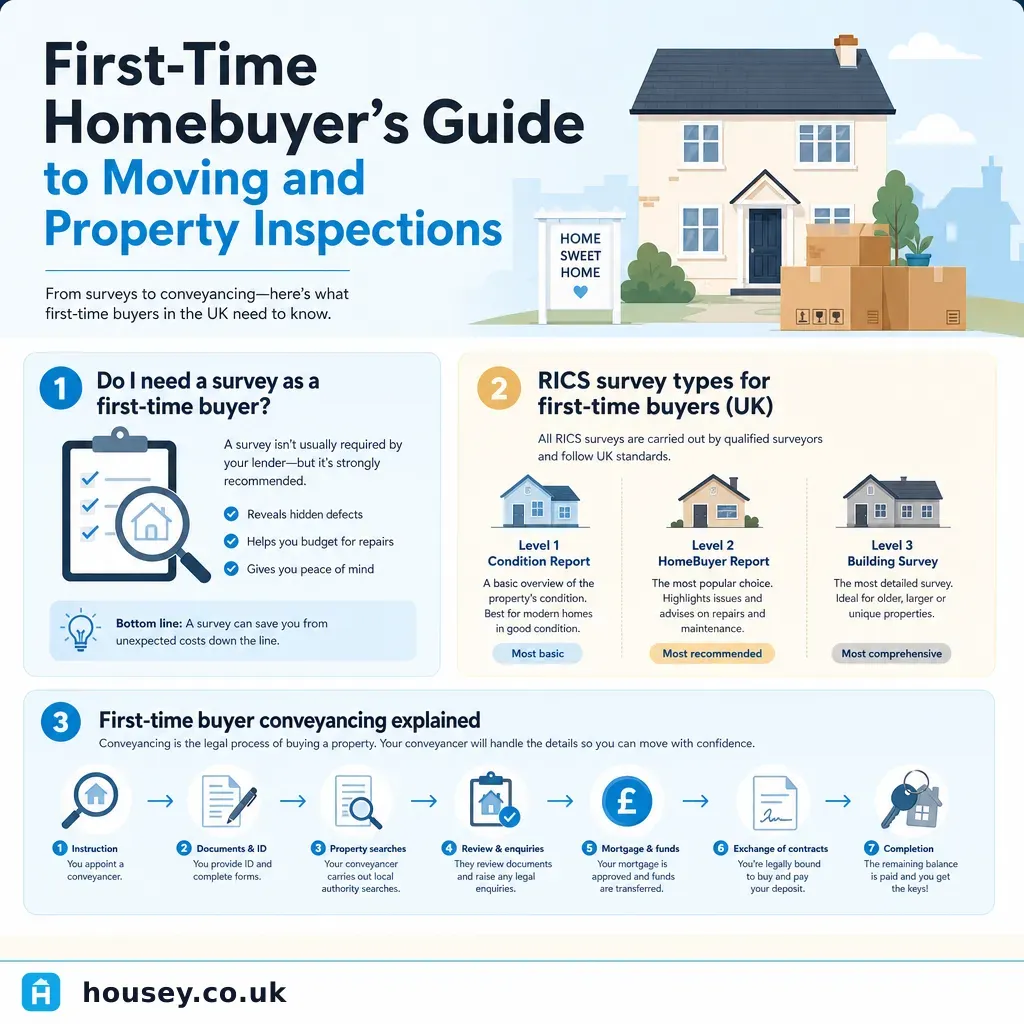
First-Time Homebuyer's Guide to Moving and Property Inspections
First-time buyers in the UK should know that a lender's mortgage valuation is not a property survey and does not protect the buyer.
 Buying & Moving
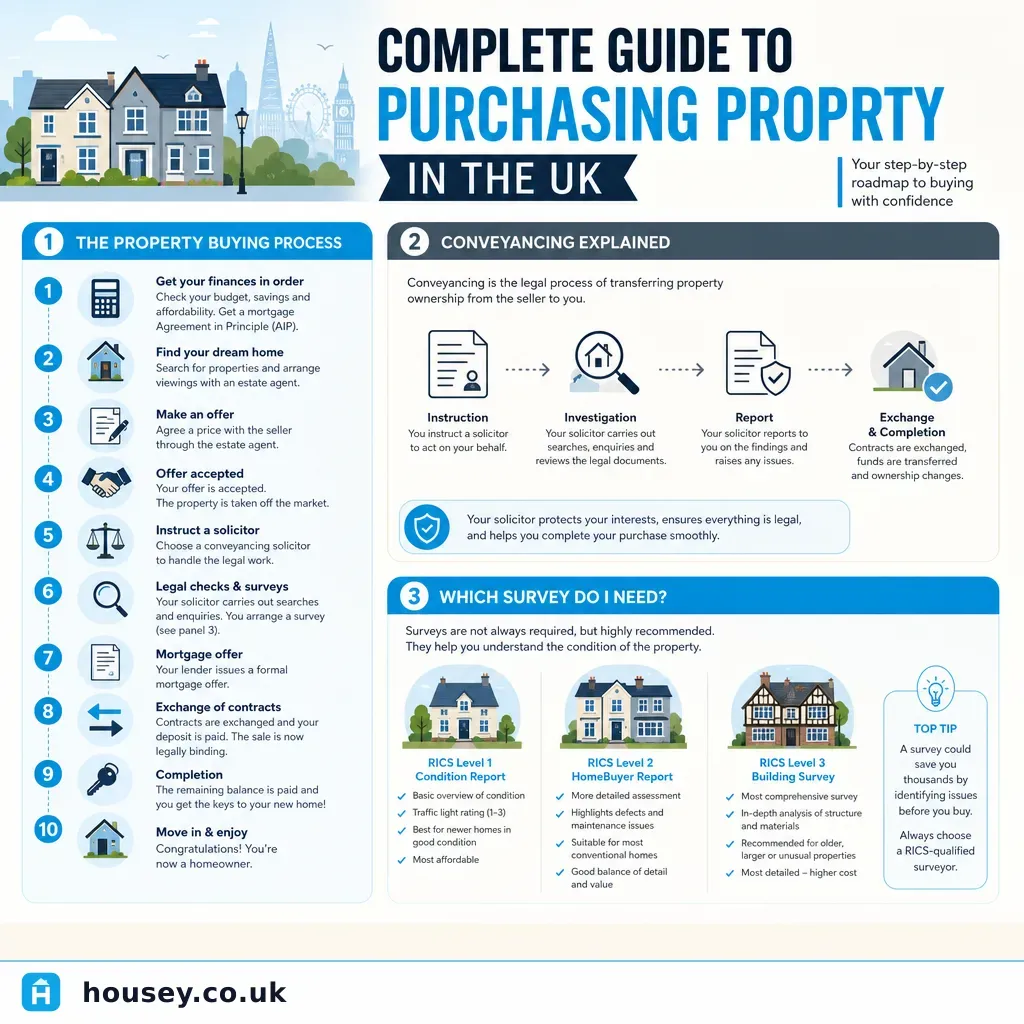
Complete Guide to Purchasing Property in the UK
Buying property in England and Wales typically takes 12 to 16 weeks from offer acceptance to completion.
 Buying & Moving
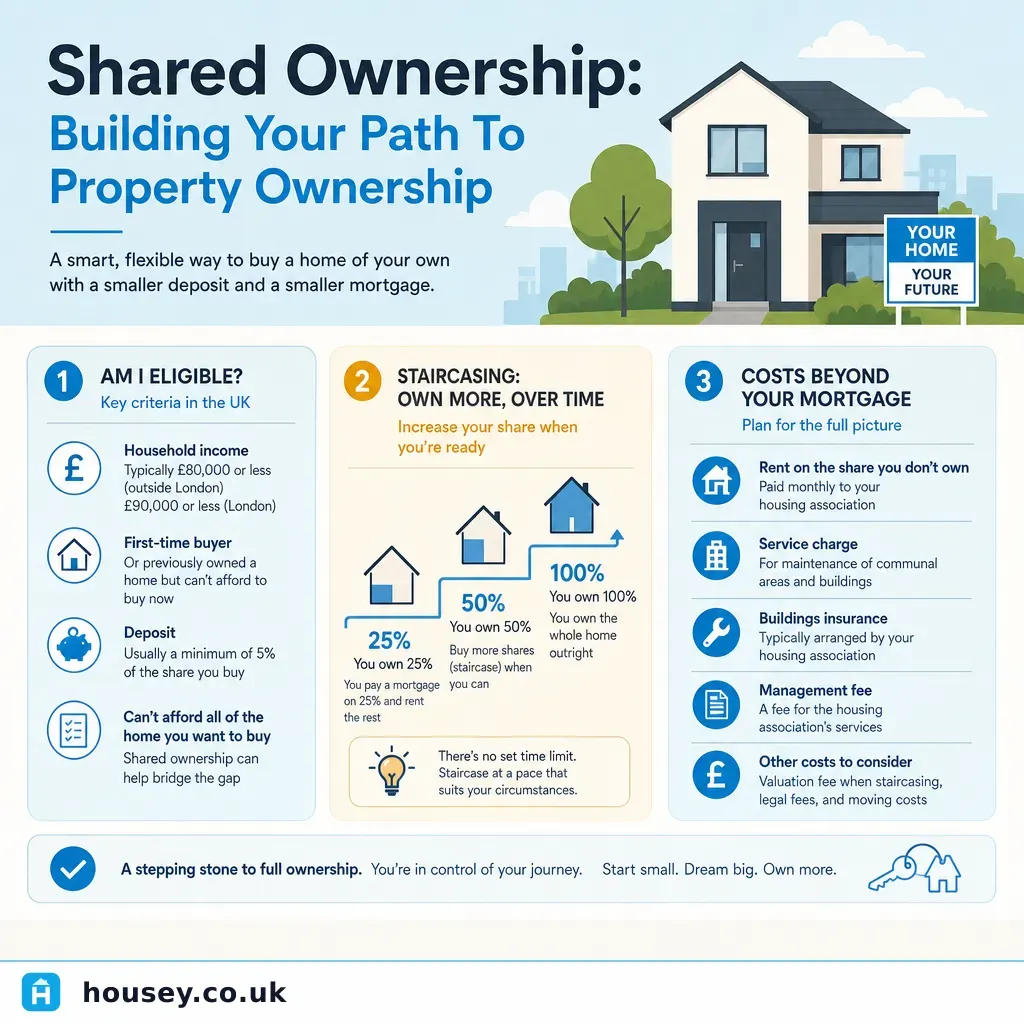
Shared Ownership: Building Your Path To Property Ownership
Shared ownership lets you buy a share of a home — typically 10% to 75% — from a housing association and pay subsidised rent on the remainder.