Higher education and homeownership: surveys and conveyancing for informed property buyers
By Housey · Last reviewed 7th of May 2026
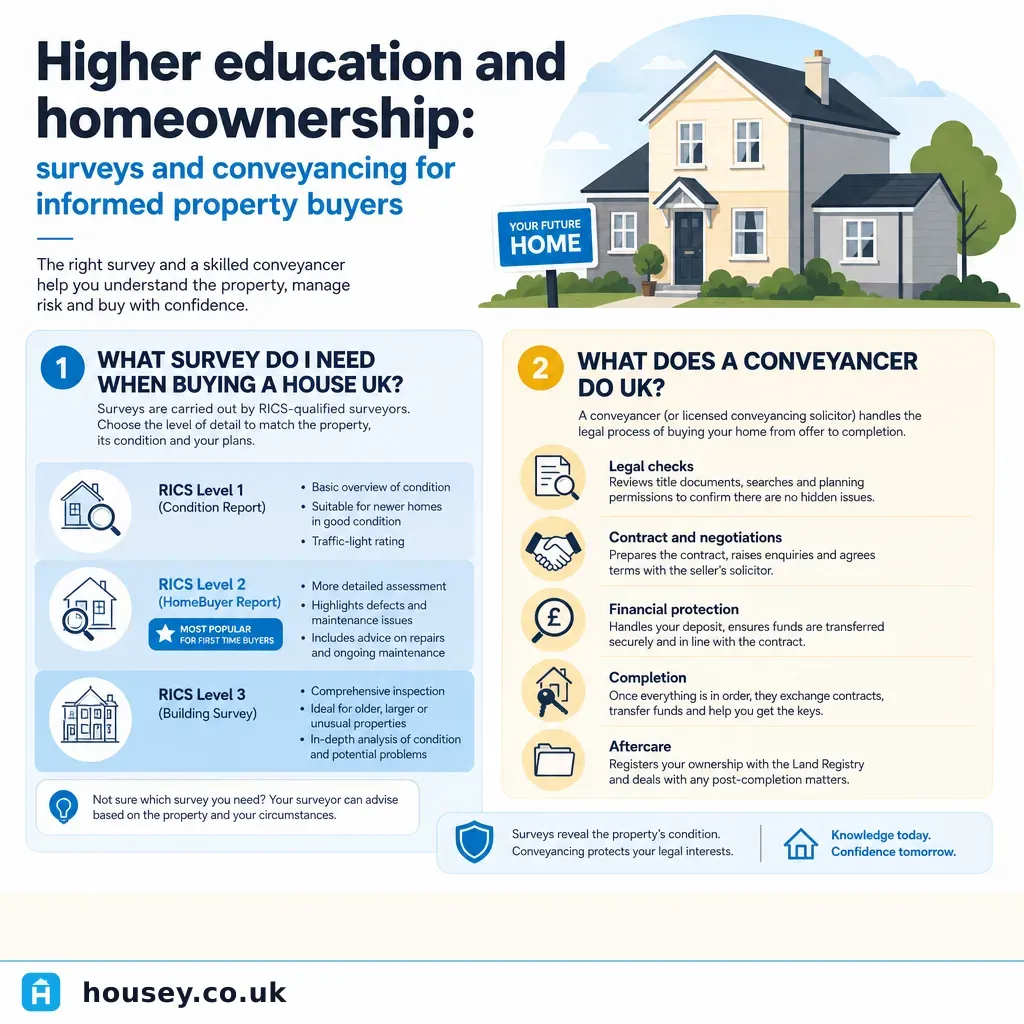
Higher education and homeownership: surveys and conveyancing for informed property buyers
Buying a property rewards preparation. Buyers who understand what a survey will reveal, what a conveyancer will investigate, and what questions to ask before exchange tend to make more confident decisions and are better placed to negotiate when problems emerge. Whether you are purchasing your first home or moving after years of renting, knowing how surveys and conveyancing actually work — rather than just that they exist — is one of the most practical forms of due diligence available in the UK property market.
Key points
- A RICS Level 2 Home Survey is the most widely commissioned survey for conventional properties in reasonable condition; a RICS Level 3 Building Survey is appropriate for older, larger, altered, or visibly defective properties.
- Conveyancing in England, Wales, and Northern Ireland typically takes 8 to 16 weeks from instruction to completion, though complex chains or title issues can extend this significantly.
- Conveyancers must carry out at least four standard searches: local authority, water and drainage, environmental, and often a chancel repair search — each reveals different risks about the property and its surroundings.
- Buyers are not legally required to commission a survey, but the lender's mortgage valuation does not inspect the property on the buyer's behalf and does not protect the buyer's interests.
- Requesting the Energy Performance Certificate (EPC) before making an offer gives buyers early visibility of energy costs and upgrade requirements — particularly relevant for buy-to-let investors subject to Minimum Energy Efficiency Standards.
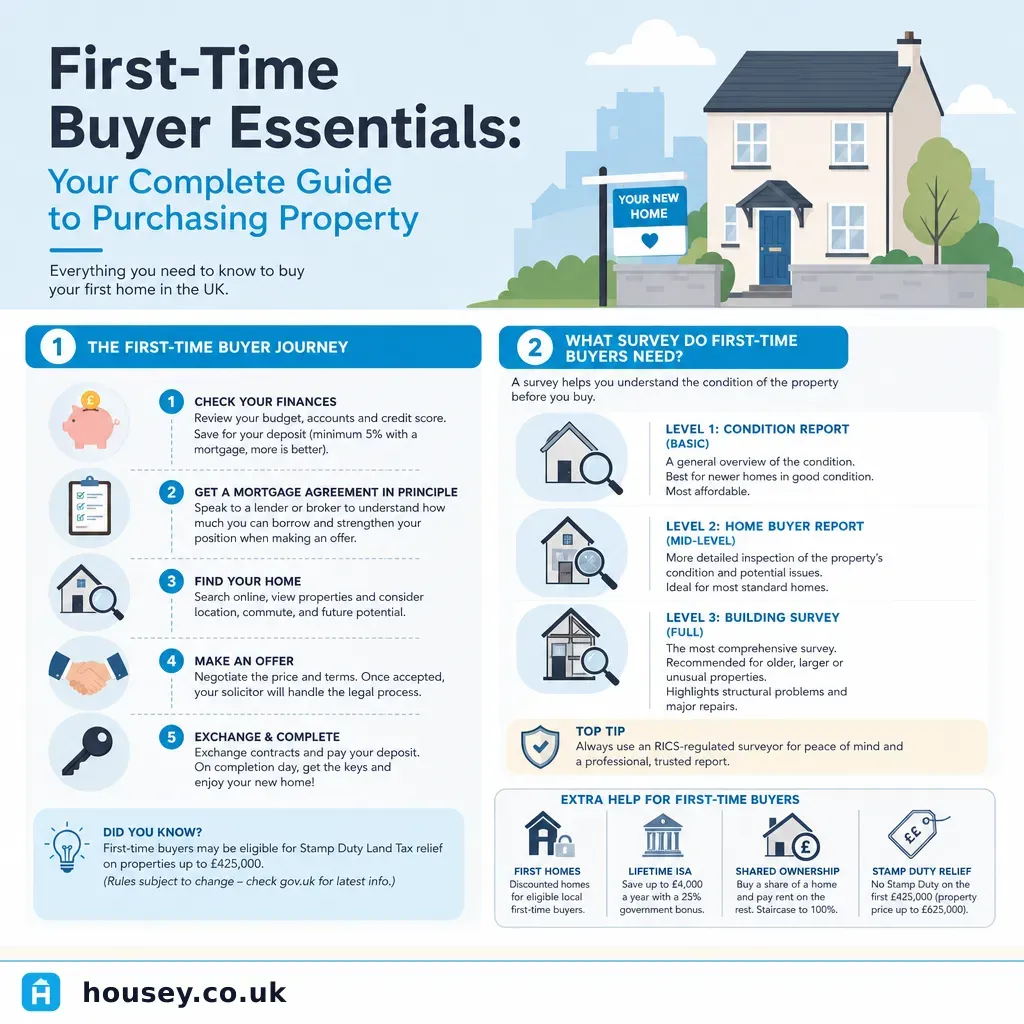
Understanding RICS survey levels: which one do you need?
The Royal Institution of Chartered Surveyors (RICS) defines three levels of residential survey. Each is suited to different property types and buyer needs.
Survey level | Best for | Not ideal for | What it covers | Typical fee (indicative) |
|---|---|---|---|---|
RICS Level 1 Condition Report | New-build properties or those recently built to modern standards | Older, larger, altered, or defective properties | Traffic-light condition ratings; no detailed advice or recommendations | £250–£400 |
RICS Level 2 Home Survey | Conventional properties in reasonable condition, including most 1930s–2000s houses | Properties with clear defects, unusual construction, or significant alterations | Condition ratings, advice on defects, notes on legal issues to raise with conveyancer | £400–£900 |
RICS Level 3 Building Survey | Older, larger, listed, unusual, heavily altered, or defective properties | New-builds where a snagging inspection is more appropriate | Full inspection including construction, cause and extent of defects, and repair options | £600–£1,500+ |
Indicative UK costs, last reviewed 2026-05-07. Fees vary by region, property type, and surveyor. Always request a written scope of service before instructing.
A RICS Home Survey from a qualified chartered surveyor gives buyers independent condition information before committing to exchange. If the survey reveals structural concerns, a specialist report may be needed in addition.
Which survey level is right for you?
- Choose a RICS Level 2 Home Survey if the property is a conventional house or flat built after approximately 1900, in broadly reasonable condition, with no visible structural concerns or significant alterations.
- Choose a RICS Level 3 Building Survey if the property is pre-1900, constructed of non-standard materials, has been heavily extended or altered, shows cracks or signs of movement, or if you want a comprehensive understanding of its condition.
- Consider a specialist defect survey or structural engineer's report if a specific defect — such as suspected subsidence, roof failure, or invasive plant growth — needs investigation beyond a general survey's scope.
- Ask your surveyor for a recommendation if you are unsure which level is appropriate for the specific property you are buying.
For most conventional first homes, a RICS Level 2 survey is a practical starting point. For older or more complex properties, the Level 3 is worth the additional cost.
What conveyancing covers and how long it takes
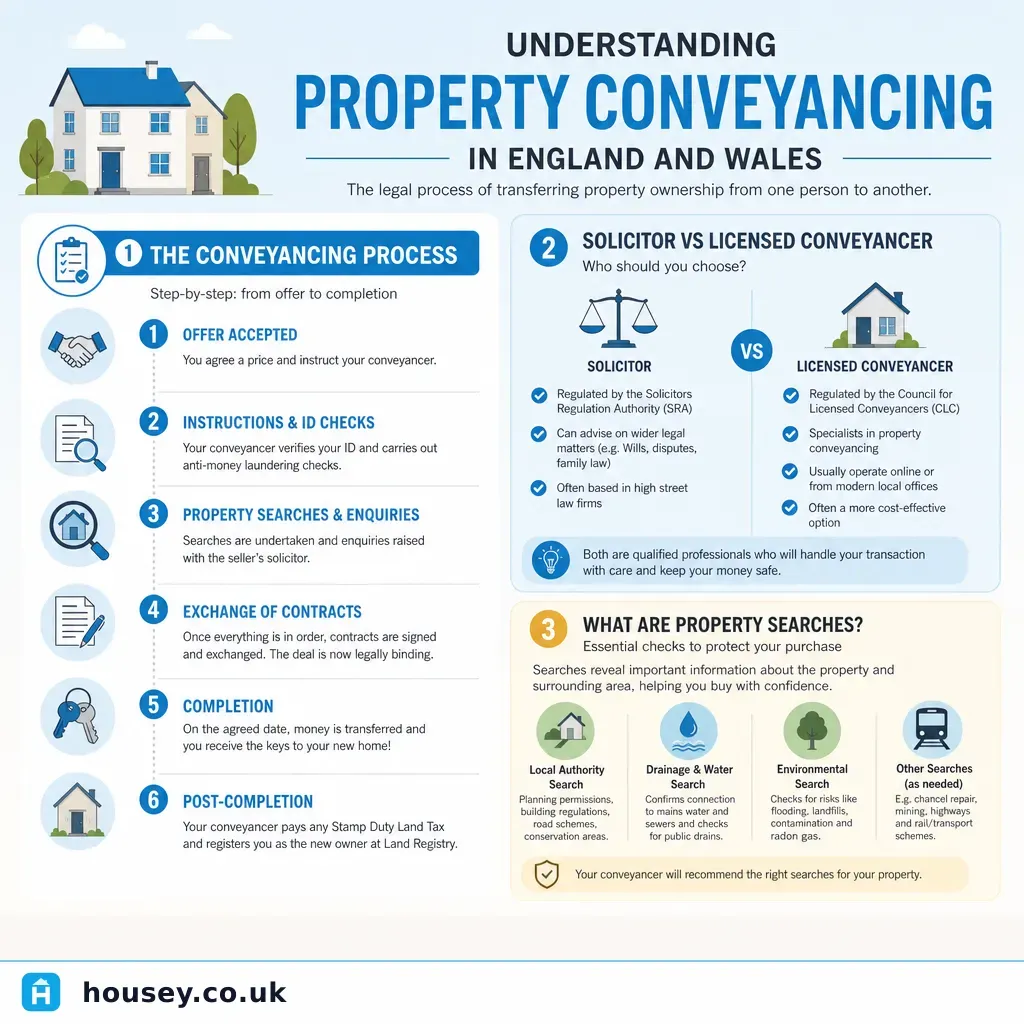
Conveyancing is the legal process of transferring ownership of a property from seller to buyer. In England and Wales, this is handled either by a solicitor or a licensed conveyancer regulated by the Council for Licensed Conveyancers (CLC). Both are qualified to manage residential conveyancing, though the individual handling your matter and their communication style matter as much as the type of qualification.
Key stages in the conveyancing process include:
- Instruction — buyer and seller each instruct their own conveyancer; contracts and title documents are exchanged between legal teams.
- Searches — the buyer's conveyancer orders local authority, water and drainage, environmental, and other relevant searches. Results typically take 2–6 weeks depending on the local authority.
- Enquiries — the buyer's conveyancer raises questions about the title, boundaries, planning history, building works, and any matters arising from the searches.
- Mortgage offer — the lender issues a formal mortgage offer after their valuation; the conveyancer reviews the conditions on the buyer's behalf.
- Exchange of contracts — both parties sign and exchange contracts; the buyer pays their deposit (typically 5–10% of the purchase price); the transaction becomes legally binding.
- Completion — the remaining purchase funds are transferred; keys are released; legal ownership transfers to the buyer.
The time between instruction and completion is typically 8–16 weeks for a straightforward purchase. Chains, title complications, slow searches, or delayed mortgage offers can extend this considerably.
The informed buyer's checklist before exchange
Use this checklist to confirm you have completed your due diligence before committing to exchange of contracts.
Survey and condition
Conveyancing and searches
Tenure and title
Financial
What to ask before instructing a surveyor or conveyancer
Asking the right questions before instructing can prevent surprises and help you compare quotes meaningfully.
Before instructing a surveyor:
- Which RICS survey level do you recommend for this specific property, and why?
- Have you surveyed similar properties in this area, and are you familiar with common defects in properties of this type and age?
- Will you inspect roof spaces, under-floor areas, and outbuildings, or are these excluded from the scope?
- What will the report cover that a standard mortgage valuation would not?
- How quickly can you carry out the inspection and deliver the written report?
- Is VAT included in the quoted fee, and what would trigger additional charges?
Before instructing a conveyancer:
- Are you regulated by the SRA (Solicitors Regulation Authority) or the CLC (Council for Licensed Conveyancers)?
- Who will handle my matter day-to-day, and how will they communicate with me?
- What searches will you carry out as standard, and which are optional extras?
- What is the likely timeline for this transaction, and what factors could extend it?
- Are all fees — including search fees, Land Registry fees, and SDLT if applicable — itemised in the quote?
- What happens if the transaction falls through before exchange of contracts?
You can instruct a conveyancing solicitor and commission a survey independently of each other; in practice they run in parallel during the conveyancing process.
Important limitations
This article provides general guidance on the property-buying process in England and Wales. Conveyancing law, RICS standards, search requirements, and regulatory obligations can vary and change. Individual properties may have specific legal, structural, or environmental characteristics that require tailored professional advice. Nothing in this article constitutes legal advice, financial advice, or a surveying opinion. Always instruct qualified, regulated professionals — a solicitor or licensed conveyancer for legal matters, and a RICS-registered surveyor for survey and condition advice.
What to ask a qualified professional
When meeting your conveyancer or surveyor for the first time, consider raising these questions.
With your conveyancer:
- Are there any features of this title that could make the property harder to sell or remortgage in the future?
- Are there any outstanding planning enforcement notices, conditions, or local land charges?
- Has the seller declared any disputes with neighbours, the freeholder, or the local authority?
With your surveyor:
- Does the property's construction or condition warrant specialist reports beyond this survey's scope?
- Are there any defects that should be reflected in the purchase price negotiation?
- What maintenance should I prioritise in the first year of ownership?
When to get professional help
Seek specific professional advice if:
- The survey identifies structural movement, invasive plant species such as Japanese knotweed, or defects that are not fully explained in the report.
- Searches reveal flood risk, contamination, or proposed nearby development that raises concerns.
- The title has complications — such as missing building regulations certificates, boundary disputes, or restrictive covenants you do not fully understand.
- The lease term on a leasehold property is below 80 years — below this point, lease extension becomes significantly more expensive under the Leasehold Reform, Housing and Urban Development Act 1993.
- You are unsure whether the agreed purchase price remains appropriate in light of survey or search findings.
How Housey can help
Housey connects buyers with qualified professionals across every stage of the purchase. You can request quotes for a RICS Home Survey, instruct a conveyancing solicitor, or arrange an Energy Performance Certificate (EPC) — with clear information on what each service covers before you commit.
Frequently asked questions
Do I legally have to have a survey when buying a house in the UK?
No. There is no legal requirement for a buyer to commission a survey in England, Wales, or Northern Ireland. However, the lender's mortgage valuation is not a survey — it does not inspect the property on your behalf or advise you on condition or repair costs. Commissioning an independent RICS survey is strongly recommended before exchange, particularly for older or non-standard properties.
What is the difference between a solicitor and a licensed conveyancer?
Both are regulated to carry out residential conveyancing. Solicitors are regulated by the Solicitors Regulation Authority (SRA) and can handle a broader range of legal work; licensed conveyancers are regulated by the Council for Licensed Conveyancers (CLC) and specialise in property transactions. For most straightforward purchases, either is appropriate — experience with the property type and local market matters as much as the qualification.
How long does conveyancing take in England and Wales?
Conveyancing typically takes 8–16 weeks from instruction to completion for a straightforward transaction. Transactions involving chains, leasehold complications, slow local authority searches, or delayed mortgage offers can take considerably longer. Your conveyancer should be able to give you a realistic timeline based on the specific circumstances of your purchase.
What does a local authority search reveal?
A local authority search reveals information held by the council about the property, including planning history, enforcement notices, listed building status, conservation area designation, road adoption, and certain financial charges. It does not cover everything that may affect the property — environmental risks, drainage, and chancel repair liability are covered by separate searches.
Should I get a survey if I am buying a new-build property?
New-build homes are not immune to defects. A RICS Level 1 Condition Report or a specialist snagging inspection carried out before legal completion can identify defects the developer should rectify before you move in. The NHBC Buildmark warranty covers structural defects for 10 years, but it does not replace an independent pre-completion inspection.
Sources and further reading
- Buying or selling your home — GOV.UK
- RICS Home Surveys — RICS
- Choosing a conveyancer — Citizens Advice
- Find a licensed conveyancer — Council for Licensed Conveyancers
- Stamp Duty Land Tax — GOV.UK
- How to register land or property with Land Registry — HM Land Registry
Useful next reads
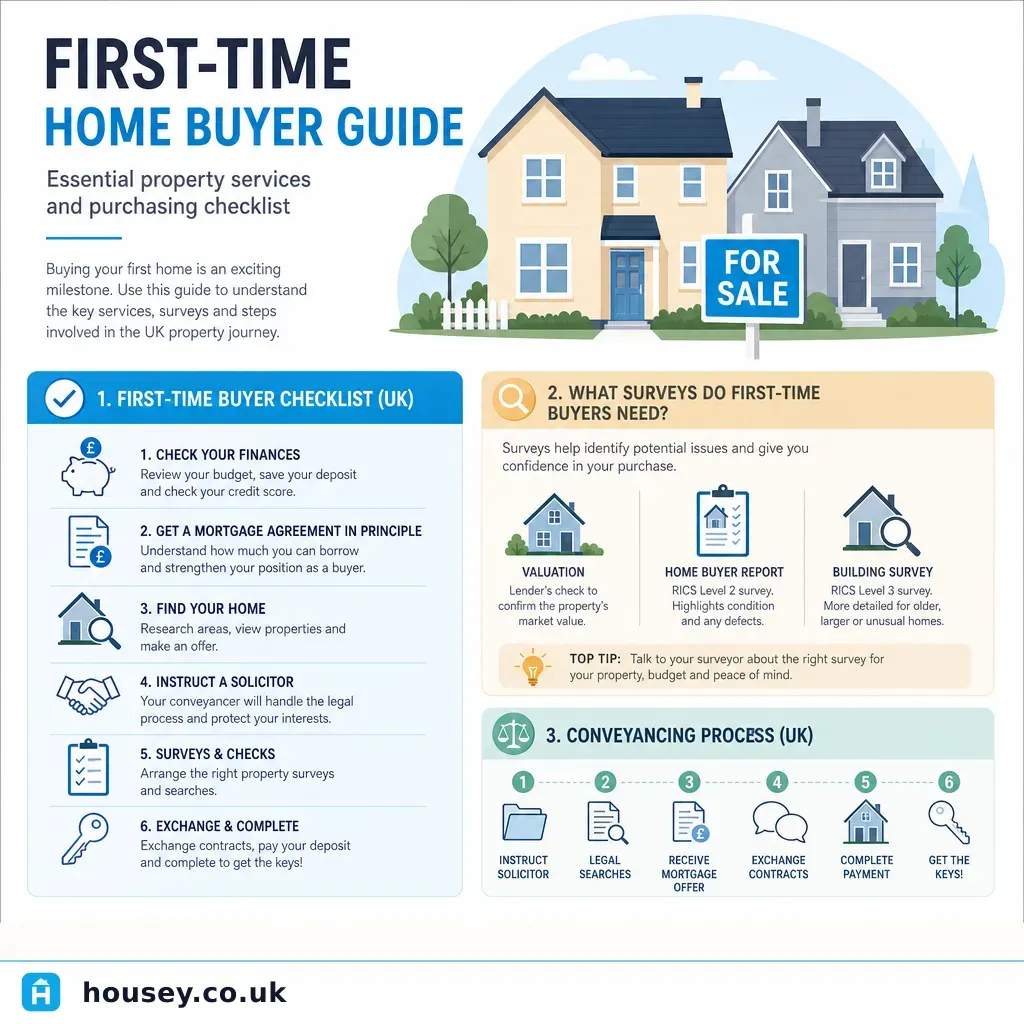 Buying & Moving
First-time home buyer guide: essential property services and purchasing checklist
Buying your first home in the UK typically takes 12–16 weeks from offer acceptance to completion.
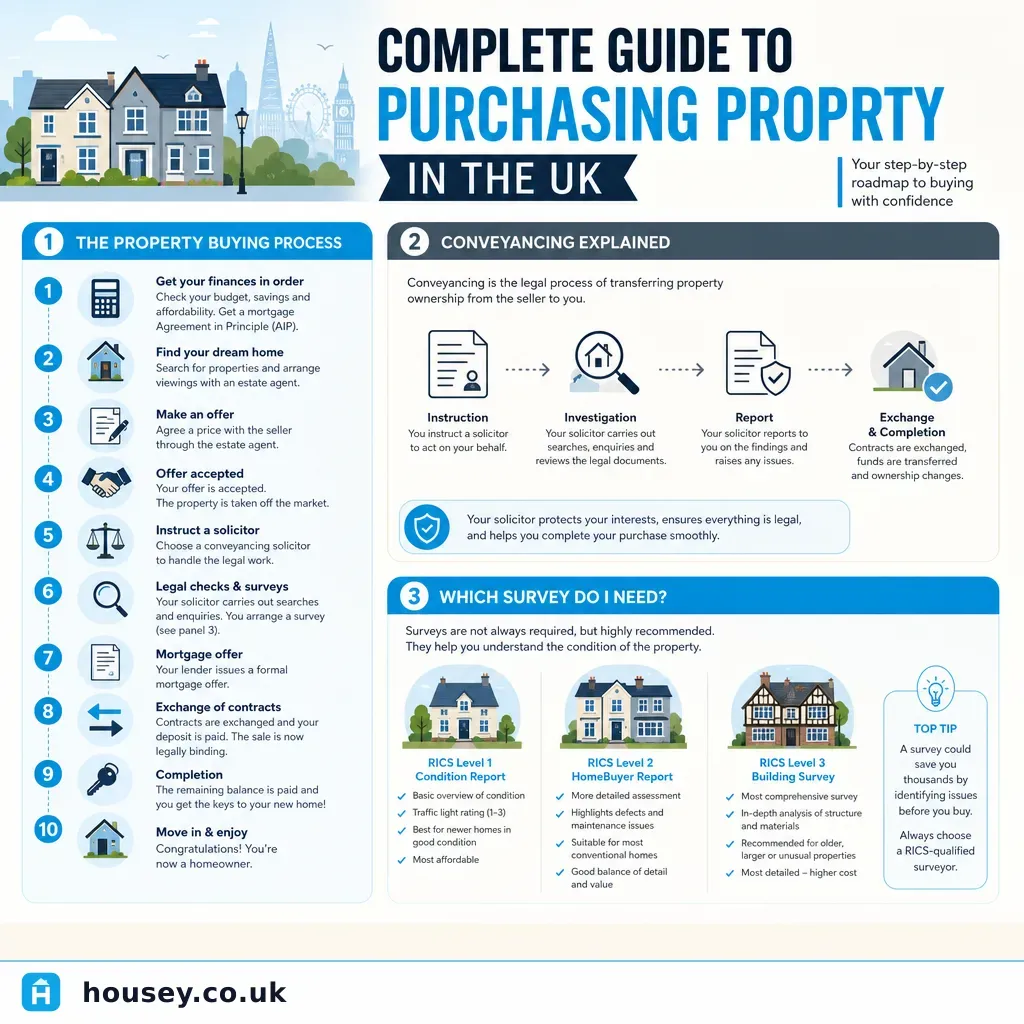 Buying & Moving
Complete Guide to Purchasing Property in the UK
Buying property in England and Wales typically takes 12 to 16 weeks from offer acceptance to completion.
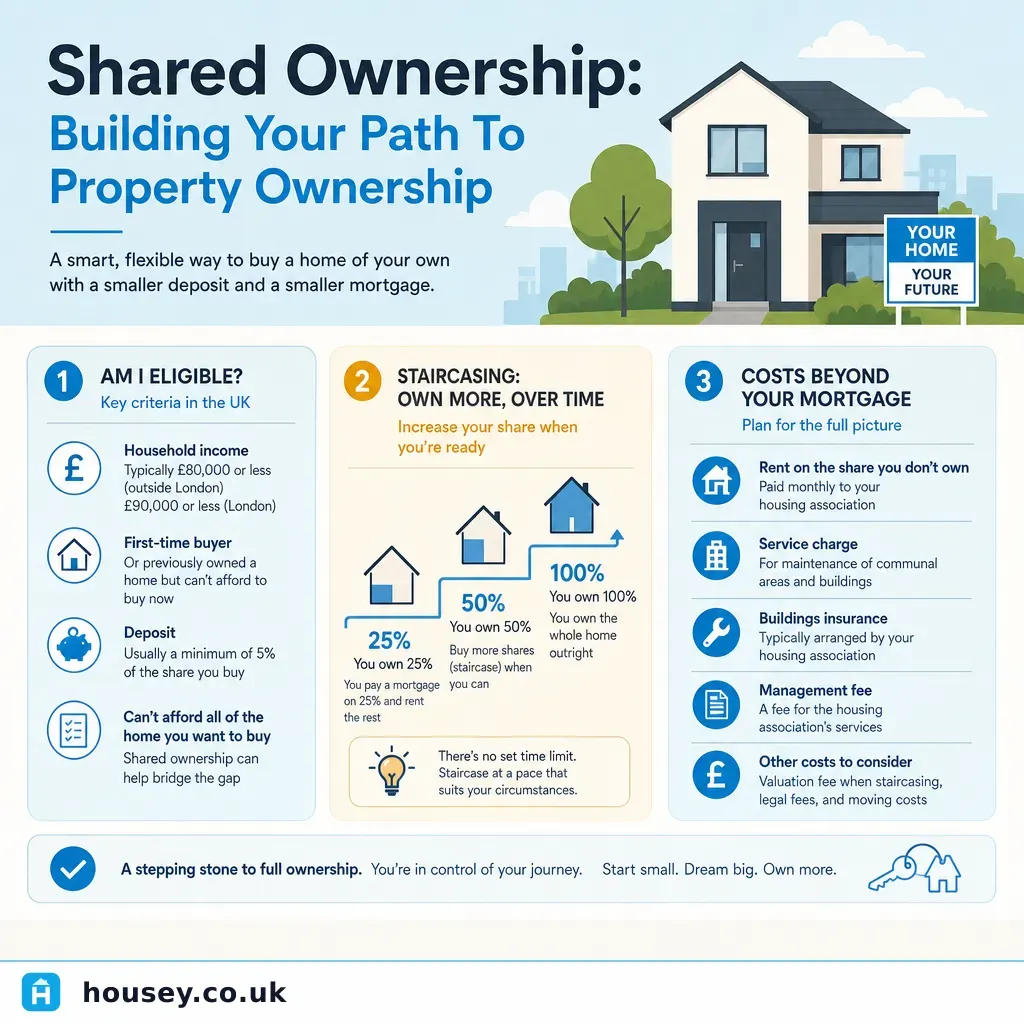 Buying & Moving
Shared Ownership: Building Your Path To Property Ownership
Shared ownership lets you buy a share of a home — typically 10% to 75% — from a housing association and pay subsidised rent on the remainder.
 Buying & Moving
Understanding Property Conveyancing in England and Wales
Conveyancing is the legal process of transferring property ownership in England and Wales.
 Buying & Moving
First-Time Buyer Essentials: Your Complete Guide to Purchasing Property
Buying your first UK home involves six key stages: securing a mortgage Agreement in Principle, making an offer, instructing a solicitor, commissioning an independent RICS survey, exchanging contracts (the legally binding point), and completing.