Fixing Velux Window Leaks: Causes and Repair Solutions
By Housey · Last reviewed 12th of May 2026
Fixing Velux Window Leaks: Causes and Repair Solutions
A leaking Velux window can feel alarming — water penetrating through a roof demands immediate attention — but the cause is often straightforward to identify and frequently does not require full window replacement. The key challenge is distinguishing genuine water ingress from condensation, and then pinpointing whether the fault lies with the flashing, the window seal, the surrounding roof covering, or the underlay beneath the tiles.
Key points
- The most common source of genuine water ingress around a Velux window is a failed or incorrectly installed flashing kit, not the glass or frame itself.
- Condensation forming on the inner glass surface is a ventilation problem, not a roof leak, and is frequently misdiagnosed.
- Velux flashing kits have an expected service life of 15–25 years; lead and aluminium flashings on older installations may need replacing as routine maintenance.
- Approved Document C of the Building Regulations requires roofs to resist weather penetration — a persistent leak may need Building Control notification if substantive structural remedial work is carried out.
- Velux offers a 10-year product guarantee on new windows; installer workmanship guarantees are separate and vary by contractor.
Is it a leak or is it condensation?
Before assuming water is entering from outside, identify where the moisture appears:
Symptom | Most likely cause | Recommended action |
|---|---|---|
Water droplets on the inner glass surface, particularly overnight or in the morning | Condensation — warm moist air meeting cold glass | Improve room ventilation; check extractor fans; consider trickle vent |
Wet patch on lining or plasterboard directly below the window frame | Water ingress — likely flashing or underlay failure | Call a roofer or Velux installer to inspect from roof level |
Dripping at the sides of the frame during or immediately after rain | Failed side flashings or degraded frame weather seal | Inspect flashings from roof level |
Water appearing at ceiling level some distance from the window | Water tracking along rafters from another point on the roof | Full roof inspection needed — source may not be the Velux window |
Misting between the double-glazed panes | Failed IGU seal — a glazing fault, not a roof leak | Order replacement glazing unit |
The most common causes of Velux window leaks
1. Failed or damaged flashing
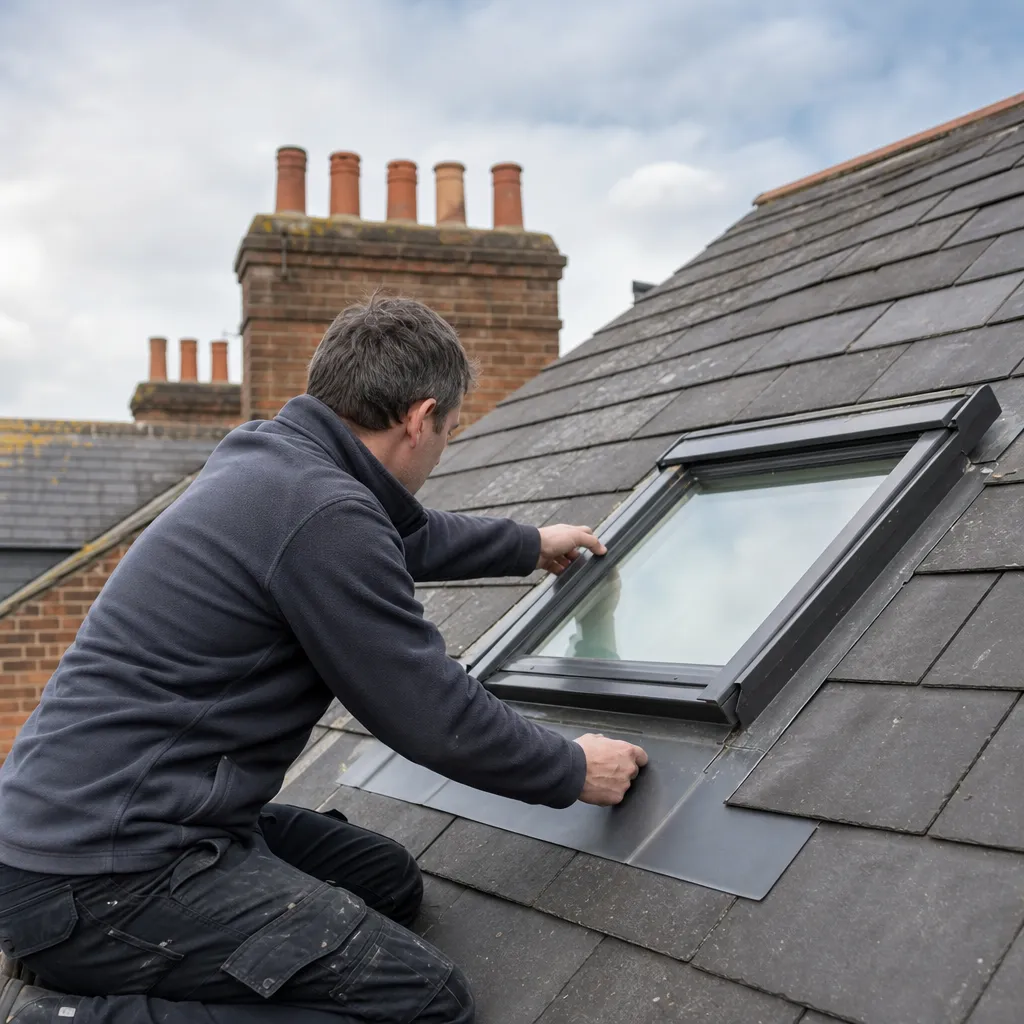
The flashing kit — the metal collar that seals the gap between the window frame and the roof covering — is the most frequent leak point. Flashings are typically aluminium or lead and are designed to channel water away from the frame. They fail because:
- They have reached the end of their service life (around 25 years for lead; 15–20 years for many aluminium kits).
- The original installation used a flashing not matched to the roof pitch or tile profile — Velux manufactures pitch-specific kits, and using the wrong kit is a common cause of premature failure.
- Physical damage from foot traffic, ladder contact, or storm debris.
- Lead flashings can crack in cold conditions if they were not correctly dressed and have insufficient allowance for thermal expansion.
2. Degraded weather seal around the sash
The EPDM rubber seal around the opening sash deteriorates over time, particularly on south-facing windows exposed to UV. A failed seal allows wind-driven rain to penetrate around the closed sash. Signs include visible cracking or compression of the rubber strip, daylight visible around the closed window, or draughts when the window is shut.
3. Incorrectly installed or damaged underlay
The roof underlay beneath the tiles should be cut, folded, and fitted so that water drains away from the window opening. If the original installation was incorrect or the underlay has torn, water can track along the rafters during heavy rain in a way that appears to originate at the window. This is particularly common in installations carried out before modern underlay standards became standard practice.
4. Damaged or displaced tiles adjacent to the window
Cracked, slipped, or missing tiles near a roof window can allow water entry in a manner that makes the Velux window appear to be the fault. A full inspection of the tile course around the window is advisable before concluding the window itself needs repair.
Diagnosing the cause: a decision tree
- Is the moisture only on the inner glass surface? → Likely condensation. Improve room ventilation. No roof repair needed.
- Is there misting between the two panes? → The IGU seal has failed — order a replacement glazing unit. This is not a roof leak.
- Does water appear at the frame during or immediately after rain? → Inspect flashings from roof level; check pitch compatibility and condition.
- Is the rubber seal around the sash visibly cracked or compressed? → Replace the weather seal — this is a standard maintenance item available from Velux UK spare parts.
- Does the leak appear only in very heavy rain, and is the water tracking down from above? → Roof tiles or underlay above the window may be the primary source; a full roof inspection is needed.
- Has the window been recently disturbed, re-flashed, or worked on? → Installation error is likely — contact the contractor who carried out the work.
Red flags: when to act immediately
Certain leak situations require prompt professional attention rather than planned maintenance:
- Water is dripping onto or near electrical fittings or wiring — isolate power to the affected circuit immediately and call both an electrician and a roofer.
- The leak has been present for more than a few weeks — prolonged moisture causes timber rot, mould growth, and structural damage to rafters and structural timbers.
- The ceiling plasterboard is visibly stained, soft, or beginning to bow — this indicates significant accumulated moisture within the ceiling build-up.
- The window no longer closes or latches properly — the frame may have absorbed moisture and swollen, suggesting prolonged water ingress into the frame itself.
- You can see daylight around the window frame from inside the loft — the flashing or underlay has failed and the roof is unprotected.
Repair options and what to expect
Flashing replacement: a Velux-trained installer or experienced roofer will lift the tiles around the window, remove the old flashing, and install a new pitch-matched flashing kit. A typical visit takes half a day to a full day. Indicative cost: £200–£600 supply and fit, depending on access difficulty, flashing specification, and roof covering. Indicative UK costs, last reviewed 2026-05-12.
Weather seal replacement: Velux replacement seals are available as spare parts through the Velux UK spare parts service. A competent window installer can replace the seal without access to the roof covering. Typical cost: £50–£150 fitted.
Underlay repair: requires tiles to be lifted around the window so that the underlay can be repositioned and taped. Usually carried out as part of a flashing replacement visit to avoid two separate tile-lifting operations.
Full window replacement: appropriate when the frame is damaged, the window is more than 20–25 years old with several failing components, or the cumulative cost of individual repairs approaches the cost of a new unit installed.
What to ask before accepting a quote
- Have you inspected the flashing from roof level, or are you quoting on the assumption that replacement is needed?
- Is the new flashing kit matched to my exact roof pitch and tile profile?
- Does the quote include temporary weatherproofing if the work cannot be completed in a single visit?
- Will you inspect the underlay as part of the visit?
- Is VAT included in the quoted price?
- What is your workmanship guarantee period?
- Do you carry public liability insurance, and are you working within the requirements of the Working at Height Regulations 2005?
When to get professional help
Any roof work above 2 metres from ground level must be carried out by a professional under the Working at Height Regulations 2005. Never attempt to inspect or repair flashings using a ladder leaned against guttering or a step ladder on a pitched roof surface.
Contact a professional without delay if:
- Water is near any electrical fitting or consumer unit.
- The roof covering around the window is visibly damaged, displaced, or missing.
- You cannot identify the source of moisture after checking for condensation.
- The leak is worsening rather than remaining stable.
How Housey can help
For Velux leak diagnosis and flashing repair, roofers on Housey can inspect from roof level and provide accurate quotes for flashing replacement or roof covering work. For weather seal replacement or glazing unit issues that do not require roof access, window and door installers on Housey can handle the window-specific elements efficiently.
Frequently asked questions
Why does my Velux window leak only in heavy rain?
Intermittent leaks during heavy or wind-driven rain are usually caused by a flashing not correctly matched to the roof pitch, a partially failed weather seal that allows wind-driven water to penetrate when pressure builds up, or a nearby tile that has slipped and only causes a problem when rainfall volume is high. A roofer should inspect from roof level to identify the exact source.
How long do Velux flashings last?
Lead flashings have an expected service life of around 25 years when correctly installed and undisturbed. Velux's own aluminium flashing kits carry manufacturer durability figures; in practice, installations from the 1990s and early 2000s are now due for inspection and, in many cases, replacement.
Can I reseal a Velux window myself?
Replacing the rubber weather seal around the sash is within the capability of a competent DIYer where the window is easily accessible from inside the loft. Flashing work requires access to the roof covering at height and must be carried out by a professional under the Working at Height Regulations 2005.
Is a leaking Velux window covered by buildings insurance?
Sudden damage from a storm or other insured event may be covered. Gradual deterioration — such as a flashing that has simply aged past its service life — is typically excluded. Report a suspected storm-related leak to your insurer before arranging repairs, as they may require an approved contractor.
Sources and further reading
- Approved Document C — Site preparation and resistance to contaminants and moisture — GOV.UK
- Working at Height Regulations 2005 — legislation.gov.uk
- Working at height — HSE guidance — HSE
- Velux UK spare parts — seals and flashings — VELUX Group
Useful next reads
 Improvement & Build
Fixing Window Leaks from Rain: Causes, Diagnosis, and Solutions
Window leaks during rain are most often caused by failed sealant around the frame, perished or missing weatherstripping, cracked glazing putty, or water tracking down from the roof or lintel above.
 Improvement & Build
Fixing Leaking Back Doors and Water Ingress
Most leaking back doors in UK homes fail at one of three points: the threshold or door sill joint, the frame-to-masonry mastic seal, or the door weatherstrip.
 Improvement & Build
Adjusting uPVC Door Hinges: Alignment and Repair
Most uPVC doors are fitted with adjustable flag hinges that allow fine-tuning in three directions: vertical, lateral, and compression.
 Improvement & Build
Roof Repair: Damage Assessment and Costs
Most roof repairs — replacing slipped tiles, re-bedding ridge tiles, or patching flashing — are straightforward maintenance jobs that do not require planning permission.
 Improvement & Build
What To Do About Leaking Windows: Finding The Right Contractor
Leaking windows in UK homes are usually caused by failed seals, cracked frames, or damaged flashing.