Flat Construction Costs and Building Estimates
By Housey · Last reviewed 7th of May 2026
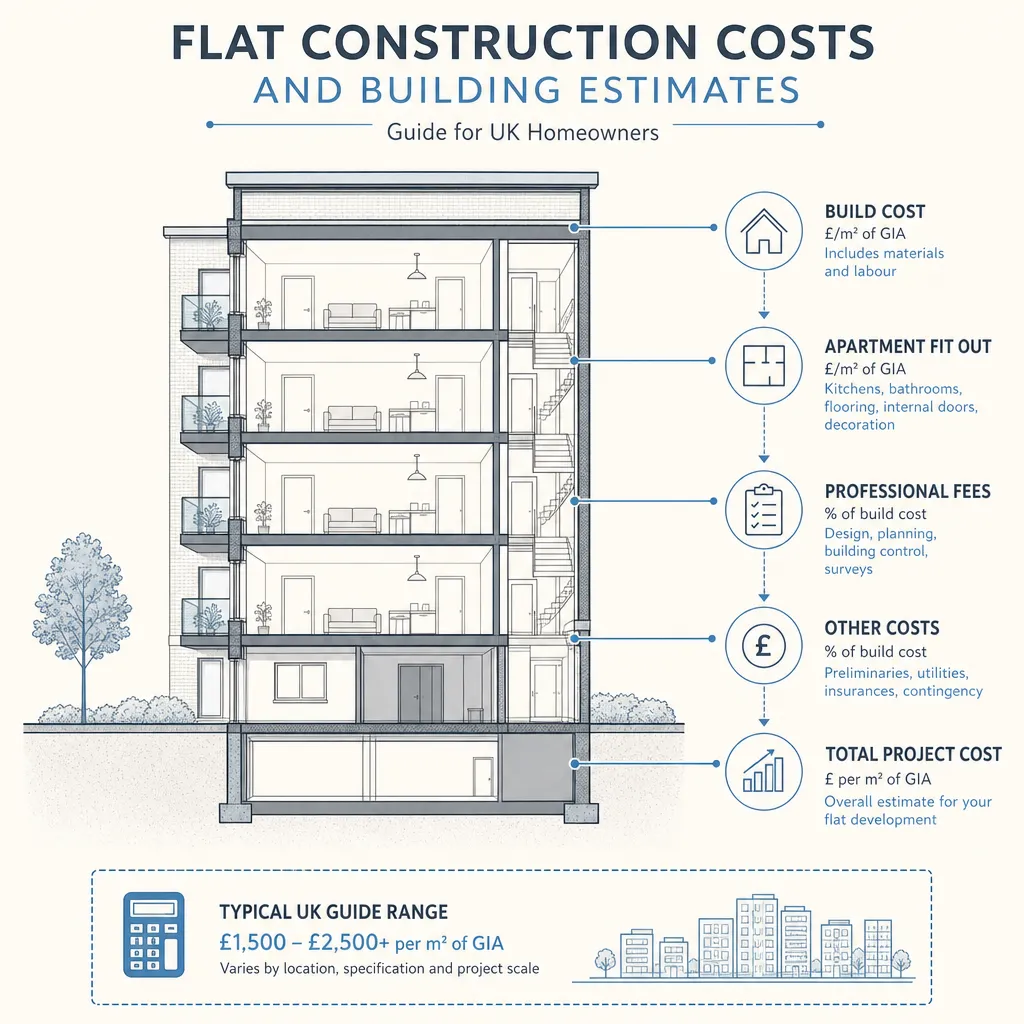
Flat Construction Costs and Building Estimates
Developing a block of flats is among the more complex residential construction undertakings, involving higher upfront costs, stricter regulatory requirements, and greater professional input than a single dwelling. Whether you are a developer testing site viability, a private investor planning a small scheme, or a self-builder considering a multi-unit project, understanding cost structures before committing to a site is essential to avoid budget overruns and abortive professional fees.
Key points
- Structural build costs for a new-build block of flats typically range from £1,500 to £2,500 per square metre of gross internal area (GIA) for a standard mid-specification scheme; high-spec or London schemes often exceed £3,000/m². Indicative UK costs, last reviewed 2026-05-07.
- Professional fees — architects, structural engineers, M&E consultants, and quantity surveyors — typically add 12–18% on top of build costs.
- Community Infrastructure Levy (CIL) and Section 106 obligations can add £5,000–£30,000 or more per unit in high-demand areas and must be factored into development appraisals before site acquisition.
- Building Regulations for flats require compliance under Part B (fire safety), Part E (sound insulation between units), and Part L (energy efficiency), each of which affects specification and cost significantly compared with single dwellings.
- Planning application fees in England for major residential development are approximately £578 per dwelling as of 2024, under the Town and Country Planning (Fees for Applications, Deemed Applications, Requests and Site Visits) Regulations.
Why flat construction costs are hard to pin down
Even two ostensibly similar eight-unit blocks in different towns can diverge by 30–40% in total development cost because of differences in:
- Ground conditions: Poor bearing capacity, high water tables, or contaminated land can add substantial groundworks and remediation costs.
- Structural system: Reinforced concrete frame, cross-laminated timber (CLT), or traditional masonry each carry different cost profiles and lead times.
- Storey count: Multi-storey schemes require lifts (typically £50,000–£120,000 or more per installation), more complex fire-escape provision, and heavier structural systems.
- Specification level: Market-rate private sale flats command materially higher fitout costs than affordable or social rented units.
- Location: Labour and materials in London and the South East are substantially higher than in the North of England, Wales, or Scotland.
A professional cost estimate from a quantity surveyor or build cost consultant is therefore essential before committing capital to a scheme.
Breakdown of flat construction costs
The following provides a high-level breakdown for a typical mid-specification scheme. All proportions are indicative and should not replace a site-specific estimate.
Cost category | Typical proportion of build cost | Notes |
|---|---|---|
Substructure (foundations, ground floor) | 8–18% | Can spike significantly on contaminated or weak-bearing sites |
Superstructure (frame, upper floors, roof) | 20–30% | Varies by structural system chosen |
External envelope (walls, windows, doors, cladding) | 15–20% | Fire-rated cladding requirements can affect cost materially |
Internal fit-out (partitions, finishes, kitchens, bathrooms) | 20–30% | Highly specification-dependent |
Mechanical and electrical (heating, ventilation, electrics, lifts) | 15–25% | MVHR, heat pumps, and lifts push this category higher |
External works (access roads, drainage, bin stores, landscaping) | 3–8% | Planning conditions often specify requirements |
Indicative proportions only; last reviewed 2026-05-07.
Low-spec versus high-spec flat development: a comparison
Factor | Low-to-mid specification | High specification (private sale) |
|---|---|---|
Build cost per m² GIA | £1,300–£1,800 | £2,200–£3,500+ |
Kitchen and bathroom fitout | Builder-grade units | Bespoke or designer specification |
Heating system | Gas combi boiler or communal heat network | Air source heat pump, underfloor heating |
External finish | Brick slip, render, or simple facing brick | Architectural brick, metal cladding, or extensive glazing |
Lift provision | Required from 3+ storeys in most schemes | Expected from 2+ storeys in the private market |
Fire safety specification | Building Regulations Part B minimum compliance | Compliant; may exceed minimum specification |
Indicative UK costs, last reviewed 2026-05-07. Obtain site-specific quotes before financial commitments.
Worked example: 8-unit flat scheme in the East Midlands
To illustrate cost structures, consider a hypothetical 8-unit, three-storey residential block on cleared brownfield land in the East Midlands. Each flat averages 65m² GIA, giving a total GIA of approximately 520m².
Cost item | Indicative range |
|---|---|
Build cost (520m² at £1,700–£2,100/m²) | £884,000–£1,092,000 |
Professional fees at 15% (architect, structural engineer, M&E, QS) | £133,000–£164,000 |
Planning application fee (8 dwellings × ~£578) | ~£4,600 |
Building regulations fee (approximate) | £8,000–£15,000 |
CIL and Section 106 contributions (varies by LPA) | £40,000–£120,000 |
Total indicative development cost (excluding land and finance) | ~£1,070,000–£1,395,000 |
This is a simplified illustration. Real development appraisals require a detailed viability assessment from a qualified quantity surveyor or development cost consultant. Do not use these figures to support financial commitments or site bids.
Professional fees and consultancy costs
Flat developments almost always require a multi-disciplinary professional team:
- Architect or architectural technologist: Design, planning application drawings, and building regulations specification.
- Structural engineer: Foundation design, structural frame calculations, and connection details.
- Mechanical and electrical (M&E) engineer: Heating, ventilation, electrics, lifts, and fire alarm systems.
- Quantity surveyor or cost estimator: Build cost plan, procurement advice, tender analysis, and contract administration.
- Planning consultant: Useful for complex or contested applications; essential for schemes near listed buildings or in conservation areas.
- Building control inspector: Statutory sign-off at each construction stage — either a local authority team or an approved inspector.
For an 8–20 unit scheme, combined professional fees typically total 12–18% of build cost when the full team is engaged.
What to ask before accepting a construction estimate
- Is this estimate based on an elemental breakdown or a benchmark rate per square metre?
- What specification assumptions are built into the figure?
- Have ground conditions, contamination risk, or drainage complexity been accounted for?
- Does the estimate include professional fees, statutory charges, CIL, and Section 106?
- What contingency is included? (Typically 10–15% at outline stage, reducing to 5–10% at detailed design.)
- Is VAT included? New residential construction is generally zero-rated — confirm with your accountant.
- What would trigger a material change to this estimate?
- At what RIBA work stage is this estimate, and when should it next be reviewed?
When to get professional help
Construction cost estimates for flat developments are not tasks for online calculators or general guides. Engage a qualified professional if:
- You are considering a site purchase and need a preliminary viability appraisal before committing
- The scheme involves conversion of an existing building, which carries higher cost uncertainty than new build
- A planning consultant has identified significant structural complexities (e.g., basement car parking, pile foundations)
- Your preliminary estimate suggests the scheme is financially marginal — a detailed QS cost plan at RIBA Stage 2 or 3 is essential before proceeding
Do not instruct contractors or proceed to planning application without a credible cost plan in place.
How Housey can help
Housey connects developers and project teams with specialist consultants across the UK. Request quotes from build cost estimating professionals to test scheme viability at an early stage. Structural engineering consultants and civil engineers can provide technical input on foundations and site infrastructure. For integrated project delivery, design-and-build firms can offer combined design and construction pricing on multi-unit schemes.
Frequently asked questions
How much does it cost to build a block of flats in the UK?
Build costs typically range from £1,500 to £2,500 per square metre of gross internal area for a standard mid-specification scheme, rising to £3,000+ per m² for high-spec or London developments. A full development budget must also include professional fees (12–18%), planning costs, CIL, Section 106, and contingency. Indicative UK costs, last reviewed 2026-05-07.
Do I need planning permission to build a block of flats?
Yes. A new-build block of flats always requires full planning permission. Permitted development rights do not extend to new multi-unit residential buildings. The planning application fee in England is approximately £578 per dwelling for major residential development as of 2024. Requirements vary by local planning authority; engage a planning consultant early for complex or sensitive sites.
What Building Regulations apply to flat developments?
Key Approved Documents include Part A (structural safety), Part B (fire safety — particularly for blocks over 11m in height), Part E (sound insulation between units), Part F (ventilation), Part L (energy efficiency, including thermal performance and low-carbon heating), and Part M (accessibility). Building control sign-off is required at each construction stage.
What is CIL and how does it affect flat development costs?
Community Infrastructure Levy is a charge collected by local planning authorities on new development to fund infrastructure. Rates vary widely — some authorities charge nothing, others charge over £200 per m² of new floorspace. Section 106 obligations may separately require contributions to affordable housing, transport, or community facilities. Both must be factored into a development appraisal before purchasing a site.
Is VAT payable on new flat construction?
New residential construction — building flats where none previously existed — is generally zero-rated for VAT under HMRC Notice 708. Conversions, refurbishments, and mixed-use elements may attract reduced or standard-rate VAT. Rules are complex and property-specific; always seek advice from a VAT-specialist accountant before finalising a development budget.
Sources and further reading
Useful next reads
 Planning & Pre-Build
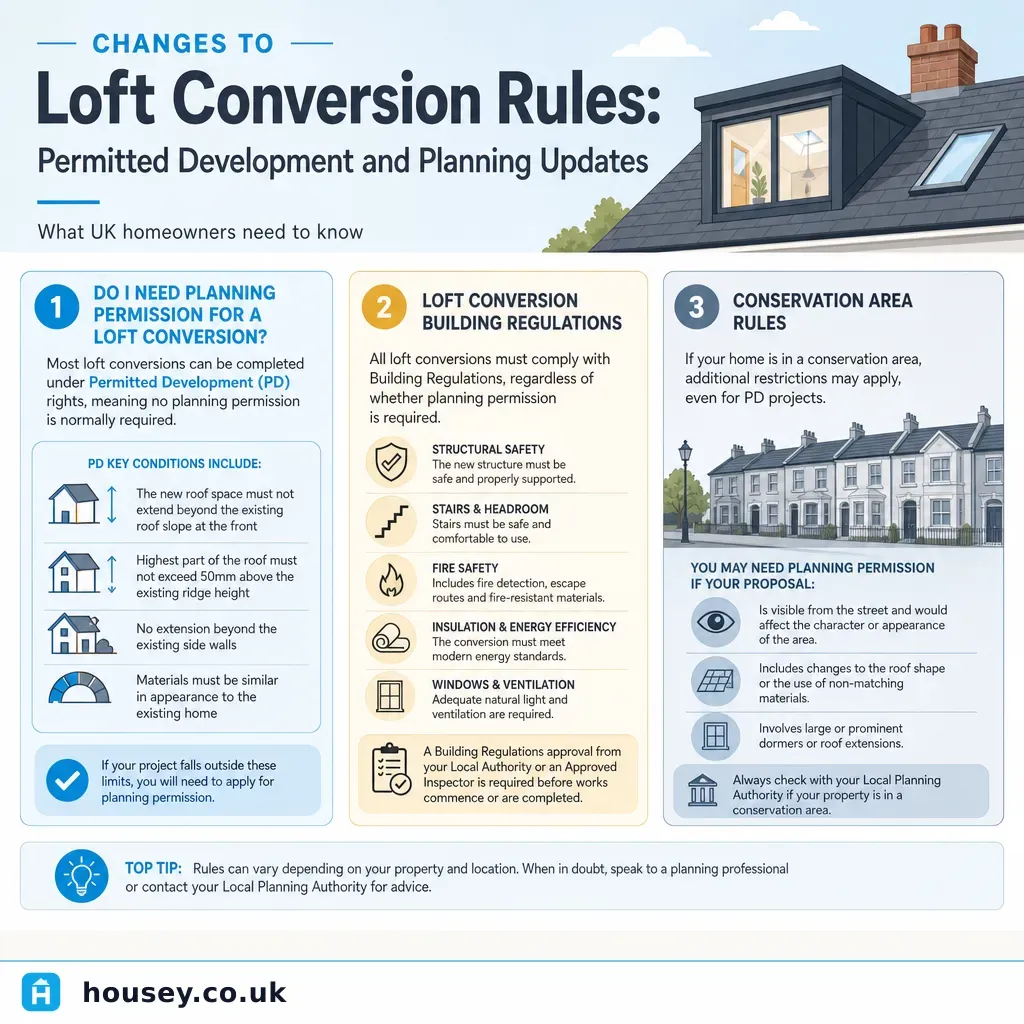
Changes to Loft Conversion Rules: Permitted Development and Planning Updates
In England, most loft conversions on standard houses qualify as Permitted Development under Class B of the GPDO 2015, allowing up to 40 cubic metres (terraced) or 50 cubic metres (detached or semi-detached) without a planning application — if conditions are met.
 Planning & Pre-Build
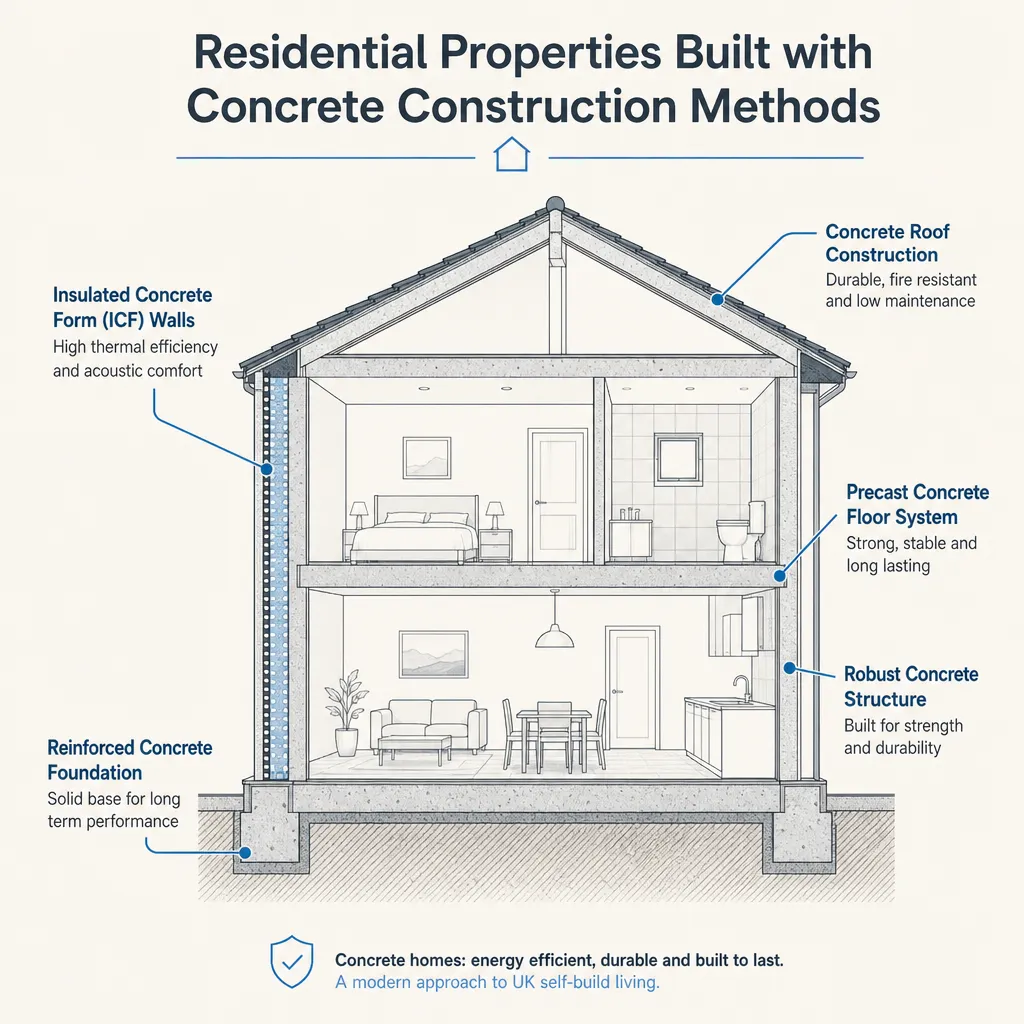
Residential Properties Built with Concrete Construction Methods
UK homes are built using several concrete methods: in-situ cast concrete, precast panel systems, insulating concrete formwork (ICF), and older non-traditional types such as Wimpey No-Fines and Laing Easiform.
 Planning & Pre-Build
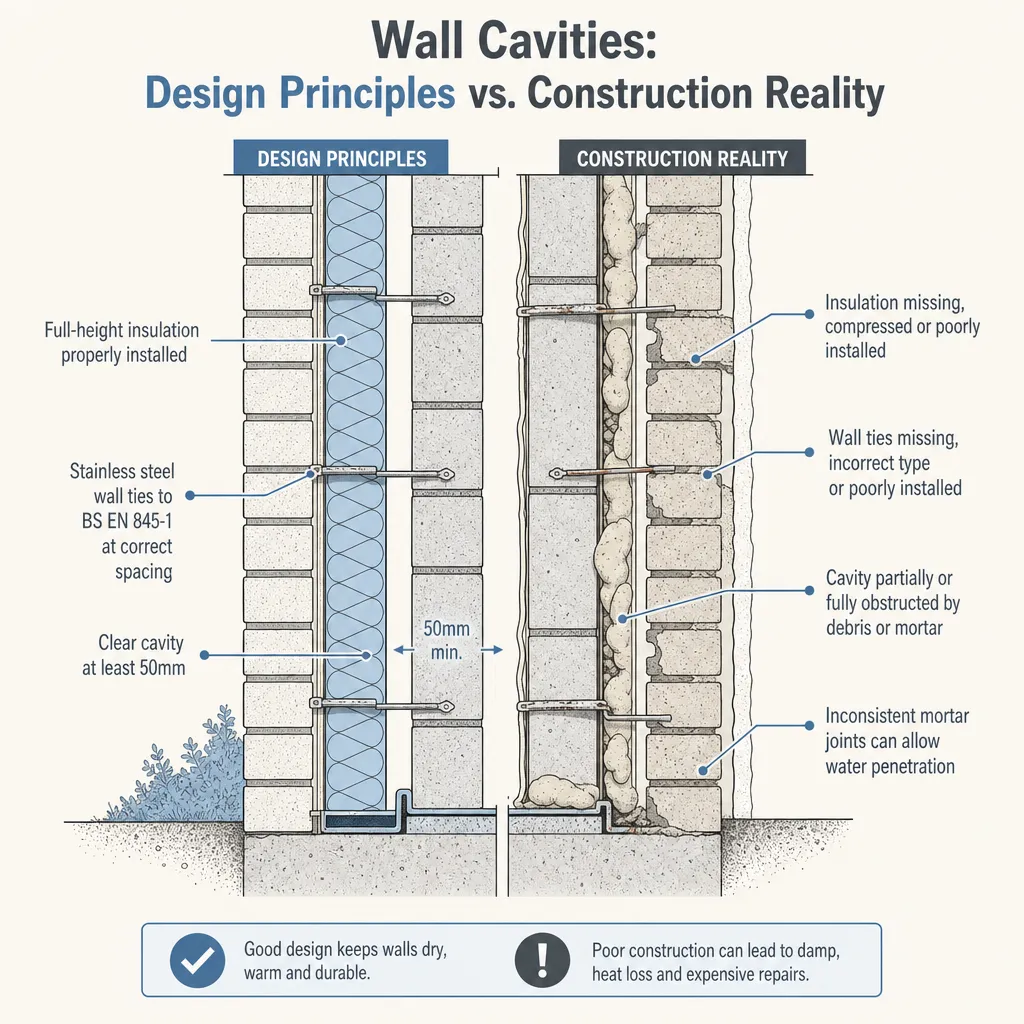
Wall Cavities: Design Principles vs. Construction Reality
A UK cavity wall is designed to resist weather, control heat loss, and structurally link two masonry leaves.
 Planning & Pre-Build
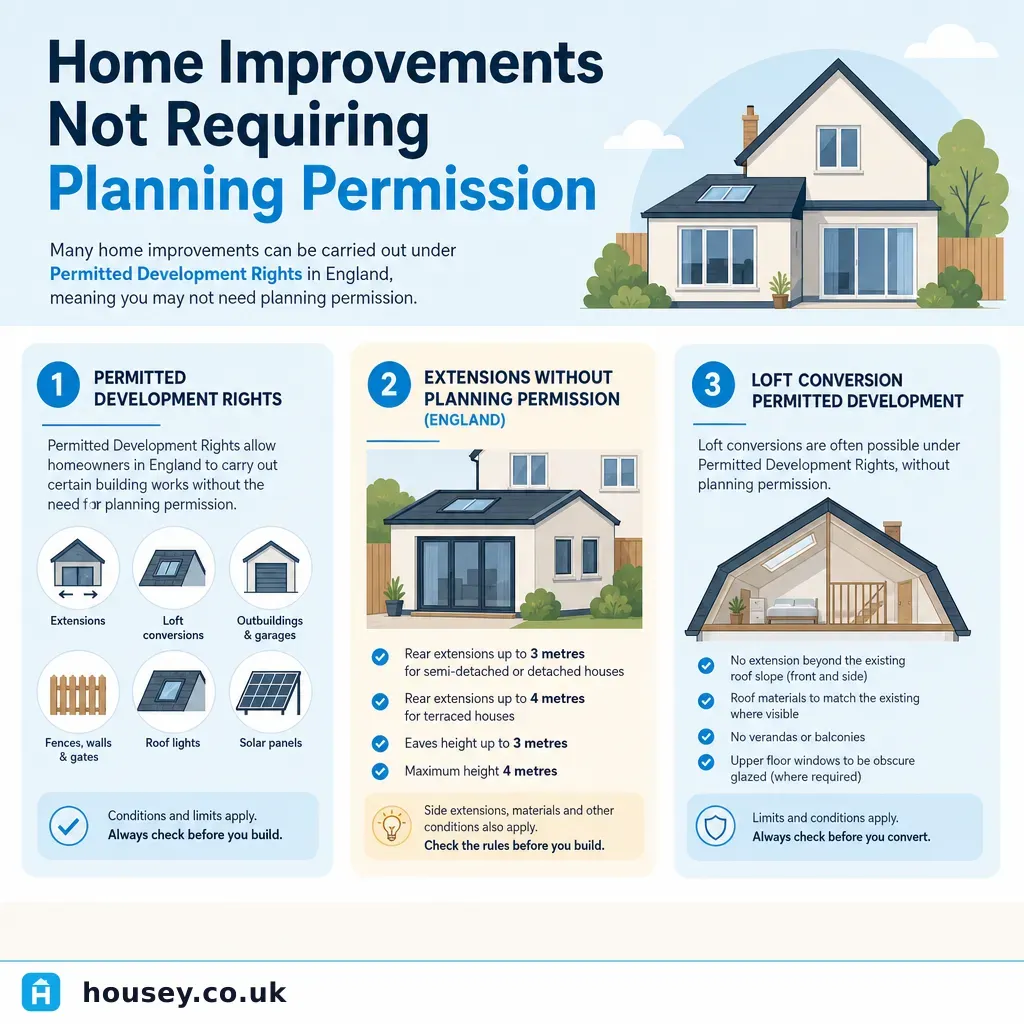
Home Improvements Not Requiring Planning Permission
Many common home improvements in England fall under Permitted Development Rights and do not require a planning application.
 Planning & Pre-Build
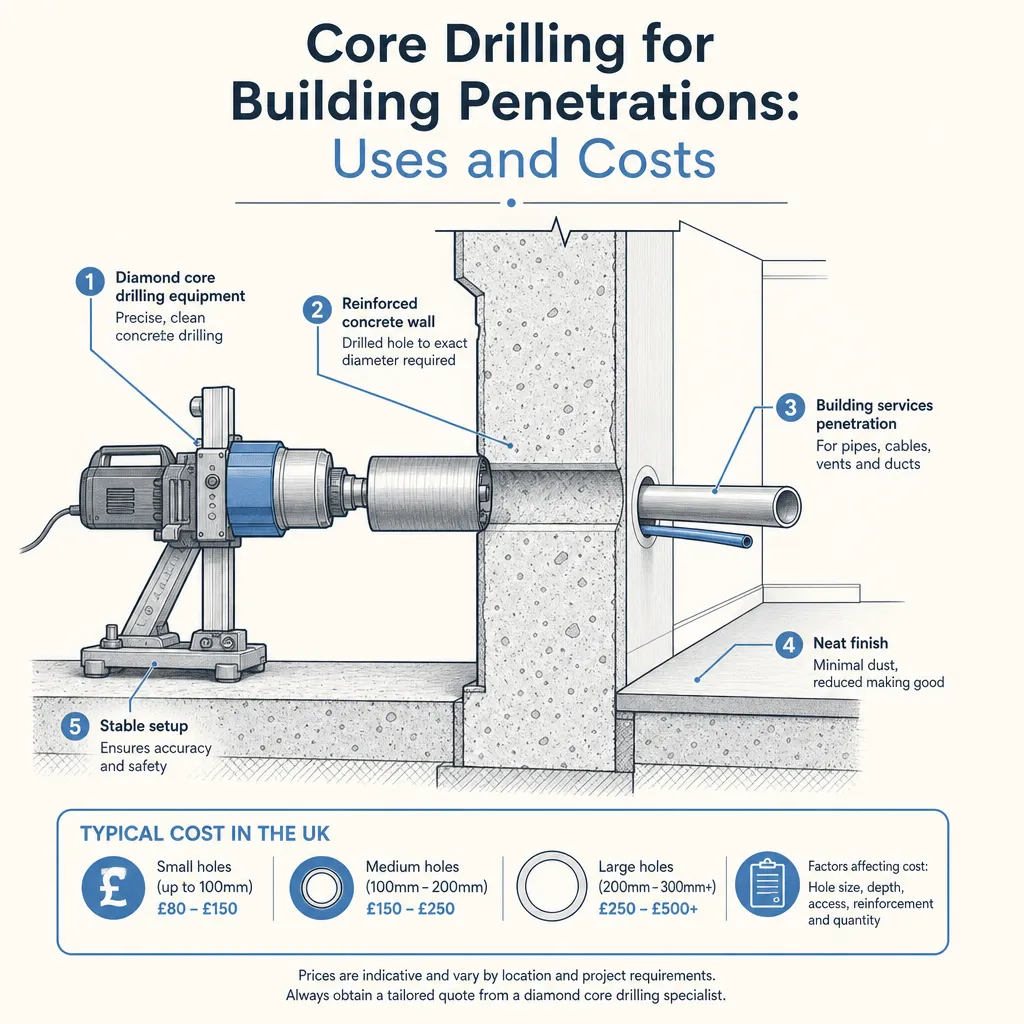
Core Drilling for Building Penetrations: Uses and Costs
Core drilling uses diamond-tipped equipment to cut clean holes through concrete, masonry, or block for pipes, ducts, cables, and building services.