Creating an Overhang on a Flat Roof: Design, Structural, and Aesthetic Options
By Housey · Last reviewed 4th of May 2026
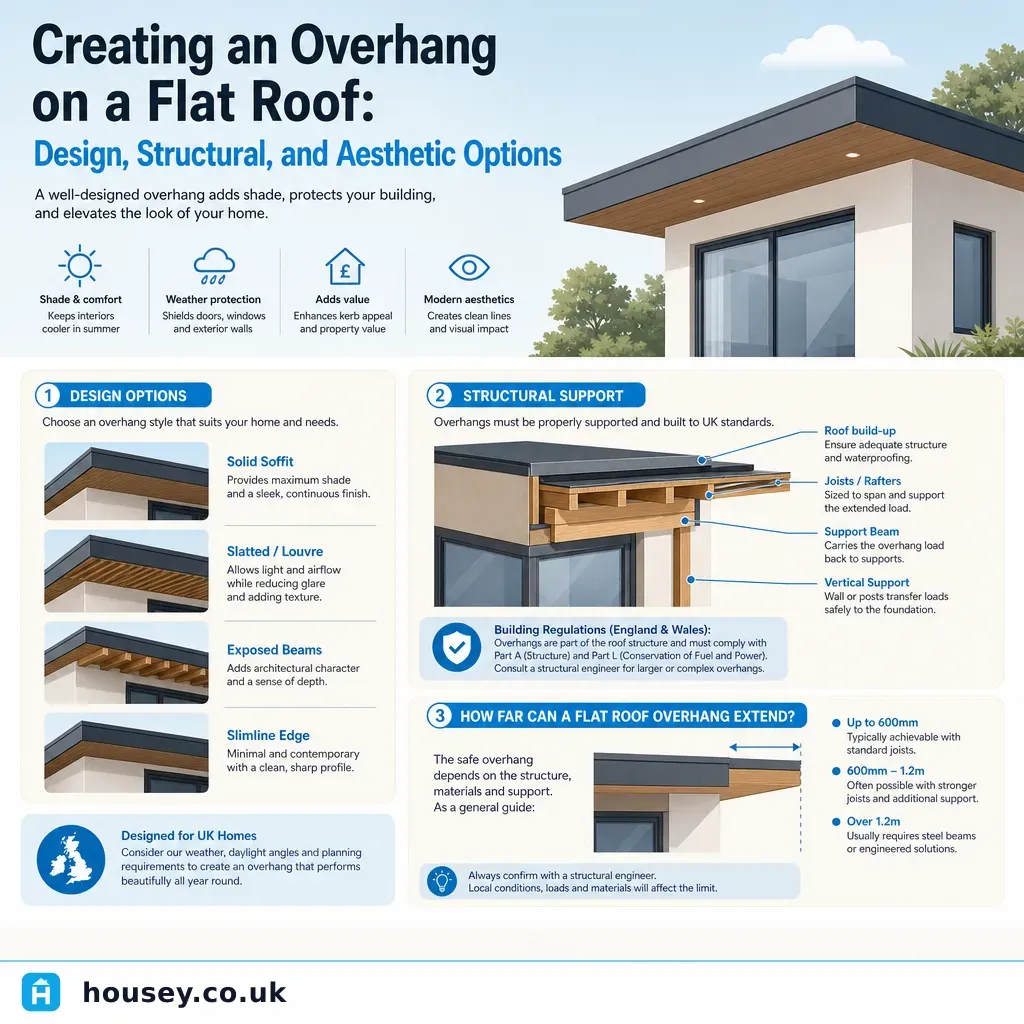
Creating an Overhang on a Flat Roof: Design, Structural, and Aesthetic Options
Flat roof overhangs are a common design detail on modern UK extensions, garden rooms, and single-storey rear additions. The question of how to create one typically arises at the design stage, when a homeowner or architect wants to add weather protection over glazed doors, achieve a contemporary low-profile aesthetic, or direct rainwater away from rendered or clad elevations. Getting the structural approach, projection depth, and edge detailing right from the outset prevents costly remediation and building control problems later.
Key points
- Building Regulations Approved Document A (Structure) requires any cantilevered roof element to be structurally stable under dead loads, wind uplift, and imposed loads — a span-table check or structural engineer's calculation is needed before building.
- The rule of thumb for timber cantilevers is that the internal back-span must be at least twice the projection length; this is a guide only, not a substitute for structural design.
- Approved Document L (Conservation of Fuel and Power) requires overhang junctions to be detailed to avoid cold bridging — thermally broken brackets or continuous external insulation are the usual solutions.
- Approved Document B (Fire Safety) restricts combustible materials and unprotected openings on elevations within 1 m of a boundary, which is relevant if the overhang faces a neighbouring property.
- EPDM, GRP, and liquid-applied membranes are the most common flat roof finishes on UK domestic overhangs; each requires specific drip-edge detailing to prevent water tracking back along the soffit.
Why add a flat roof overhang?
Projecting the roof edge beyond the external wall helps channel rainwater into gutters rather than running down rendered, timber-clad, or brick elevations — particularly relevant in the UK climate. An overhang over bi-fold or sliding doors creates a sheltered threshold and reduces solar gain in summer.
Aesthetically, even a 200–300 mm projection changes the visual character of a flat-roofed extension significantly, giving it a sense of horizontal emphasis and considered detailing rather than an abrupt wall-to-roof junction.
Structural options for a flat roof overhang
The right approach depends on the projection depth, primary roof construction, and any imposed loads.
Structural method | Typical projection | Best for | Key limitation |
|---|---|---|---|
Extended timber joists (cantilever) | 150–450 mm | Standard domestic timber flat roofs | Back-span must be ≥ 2× projection; joist sizing must be checked |
Thermally broken steel brackets | 150–600 mm | Part L compliance; projections over 300 mm | Higher unit cost; specify to BS EN ISO 10211 |
Portal or moment frame | 600 mm+ | Larger architectural overhangs | Structural engineer's design and calculations required |
Cantilevered steel beam | 600 mm–1,200 mm | Statement or commercial-grade residential overhangs | Structural engineer essential; complex connection design |
For most domestic UK extensions, extending the flat roof joists is the simplest method. The 2:1 back-span rule is a practical starting point but does not replace calculations where loads are non-standard — for example, an accessible roof terrace, heavy green-roof substrate, or significant snow loading zone.
How far can a flat roof overhang extend?
There is no single fixed limit in UK building regulations. The permissible projection is determined by the structural system, dead and imposed loads, and the need to maintain a minimum 1:80 drainage fall even under deflection.
As a general guide for standard domestic timber construction:
- Up to 300 mm: typically achievable with C16 or C24 joists at 400–600 mm centres, subject to a structural check.
- 300–600 mm: may require upsized or doubled joists, or thermally broken brackets, plus calculations.
- Over 600 mm: almost always requires a structural engineer; a steel sub-frame or moment connection is likely needed.
A drip batten or aluminium drip trim at the overhang edge is essential to prevent water tracking back along the soffit.
Building regulations and planning
Building regulations
Relevant approved documents include:
- Approved Document A: structural stability of the cantilevered element must be demonstrated via span tables or an engineer's calculations.
- Approved Document C: the wall-head junction must prevent water ingress at the membrane upstand.
- Approved Document L: thermal bridging at the overhang must be minimised; thermally broken brackets or external insulation continuity are standard solutions.
- Approved Document B: if the overhang faces a boundary within 1 m, restrictions apply to combustible materials and unprotected openings.
Planning
An overhang forming part of a new rear extension usually falls within Class A of the Town and Country Planning (General Permitted Development) (England) Order 2015, provided the overall extension meets conditions on depth, height, and boundary distances. Conservation areas, listed buildings, Article 4 directions, and properties where PD rights have been removed will need a full planning application.
Flat roof finish and drip-edge options
Finish | Suitable for overhangs? | Edge detail | Approximate lifespan |
|---|---|---|---|
EPDM (rubber membrane) | Yes | Aluminium trim or fold-over drip | 30–50 years |
GRP (fibreglass) | Yes | Integral GRP drip trim | 20–30 years |
Liquid-applied membrane | Yes — good for complex geometry | Manufacturer-specific specification | 20–25 years |
Modified bitumen felt | Yes | Lead flashing or aluminium drip | 15–25 years |
Indicative UK lifespans, last reviewed 2026-05-04. Costs and performance vary by specification and installer — request detailed quotes.
The soffit is commonly finished in painted timber, fibre cement board, or aluminium panels. Cold roof build-ups require a ventilated soffit; warm roof (inverted) constructions generally do not.
Which approach should you choose?
- Choose extended timber joists if the projection is 300 mm or less and the roof is standard domestic timber construction.
- Choose thermally broken steel brackets if Part L cold-bridging compliance is needed, or the projection exceeds 300 mm.
- Ask a structural engineer if the overhang exceeds 450 mm, the roof carries imposed loads, or you are unsure whether span tables apply.
- Instruct an architect if the overhang is part of a wider extension design where aesthetics, planning, and building regulations need coordinating from the outset.
- Check with your LPA before starting if the property is listed, in a conservation area, or if permitted development eligibility is uncertain.
When to get professional help
Seek specialist input when:
- The planned overhang exceeds 450 mm in depth.
- The roof deck is intended to be walked on as an accessible terrace.
- The existing flat roof shows signs of deflection, ponding water, or membrane deterioration — a roof survey is advisable before any extension begins.
- The overhang faces a boundary within 1 m and Part B compliance needs confirming.
- The roof finish manufacturer requires a design specification for their warranty to be valid.
Red flags that suggest professional input is overdue:
- A roofer proposes cantilevering joists without reference to any structural check.
- No thermal break is detailed at the wall-head junction.
- No drip edge is specified at the overhang's leading edge — water tracking on an unprotected soffit causes persistent staining and eventual rot.
How Housey can help
If you are designing an extension with a flat roof overhang, Housey can connect you with qualified professionals across the UK. An architect or architectural technologist can coordinate the overhang design with the overall extension, handle planning compliance, and specify the correct finish and detailing. Where the projection is substantial, a structural engineer can produce the calculations required for building control sign-off. If the condition of an existing flat roof needs assessing before work begins, a roof survey is a practical first step.
Frequently asked questions
Do I need planning permission for a flat roof overhang on an extension?
Usually not, if the overhang is part of a rear extension that falls within Class A permitted development under the GPDO 2015. Conservation areas, listed buildings, Article 4 directions, and properties where PD rights have been removed by planning condition will require a full application. Always check with your local planning authority before starting work.
Can I extend existing flat roof joists to create an overhang?
In many cases, yes. For modest overhangs up to around 300 mm, extending the joists as a cantilever is common. The back-span should be at least twice the overhang length as a guide, and joist sizes should be verified against span tables or engineering calculations. For larger projections, additional structural support is usually required.
How does a flat roof overhang affect insulation and energy efficiency?
If the junction is not carefully detailed, structural members can create a cold bridge, reducing thermal performance and risking condensation. Approved Document L requires thermal bridges to be minimised. Thermally broken brackets or a continuous external insulation layer are the standard solutions.
What is the best soffit material for a flat roof overhang in the UK?
Fibre cement board, aluminium soffit panels, and treated or hardwood timber are all widely used. The choice depends on aesthetic preference, maintenance tolerance, and whether ventilation is required. All materials should be specified for exterior exposure in the UK climate.
How much does adding an overhang to a flat roof cost?
Costs vary with projection depth, structural method, finish, and regional labour rates. A simple extended-joist overhang is often included in the overall roof build cost; thermally broken brackets and premium finishes add to the specification. Indicative UK costs, last reviewed 2026-05-04 — request detailed quotes from qualified roofers and builders for your specific project.
Sources and further reading
- Building Regulations Approved Document A (Structure) — Ministry of Housing, Communities and Local Government
- Building Regulations Approved Document L (Conservation of Fuel and Power) — Ministry of Housing, Communities and Local Government
- Building Regulations Approved Document B (Fire Safety) — Ministry of Housing, Communities and Local Government
- Town and Country Planning (General Permitted Development) (England) Order 2015 — legislation.gov.uk
- Planning Portal: Permitted Development — Extensions — Planning Portal
Useful next reads
 Planning & Pre-Build
Removing Chimney Breasts: Structural Considerations and Building Regulations
Removing a chimney breast in England and Wales almost always requires building regulations approval because it is structural work.
 Planning & Pre-Build
Designing vaulted ceilings for residential spaces
Creating a vaulted ceiling in an existing home involves restructuring the roof timbers that form the structural triangle, which always requires a structural engineer's calculations and Building Regulations approval under Approved Document A.
 Planning & Pre-Build
Bay Window Foundations: Structural Design and Support Requirements
Bay window foundations must transfer the bay's structural load to the ground independently of the main wall.
 Planning & Pre-Build
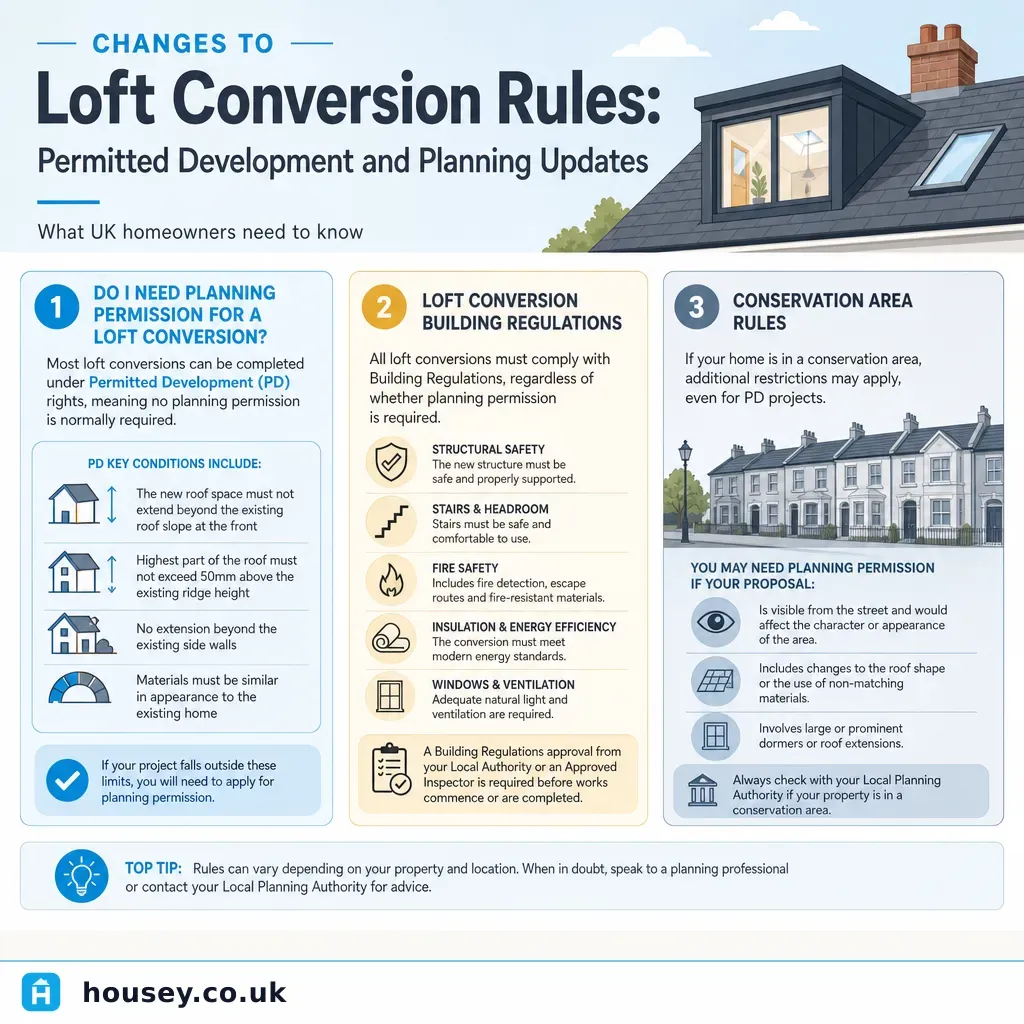
Changes to Loft Conversion Rules: Permitted Development and Planning Updates
In England, most loft conversions on standard houses qualify as Permitted Development under Class B of the GPDO 2015, allowing up to 40 cubic metres (terraced) or 50 cubic metres (detached or semi-detached) without a planning application — if conditions are met.
 Planning & Pre-Build
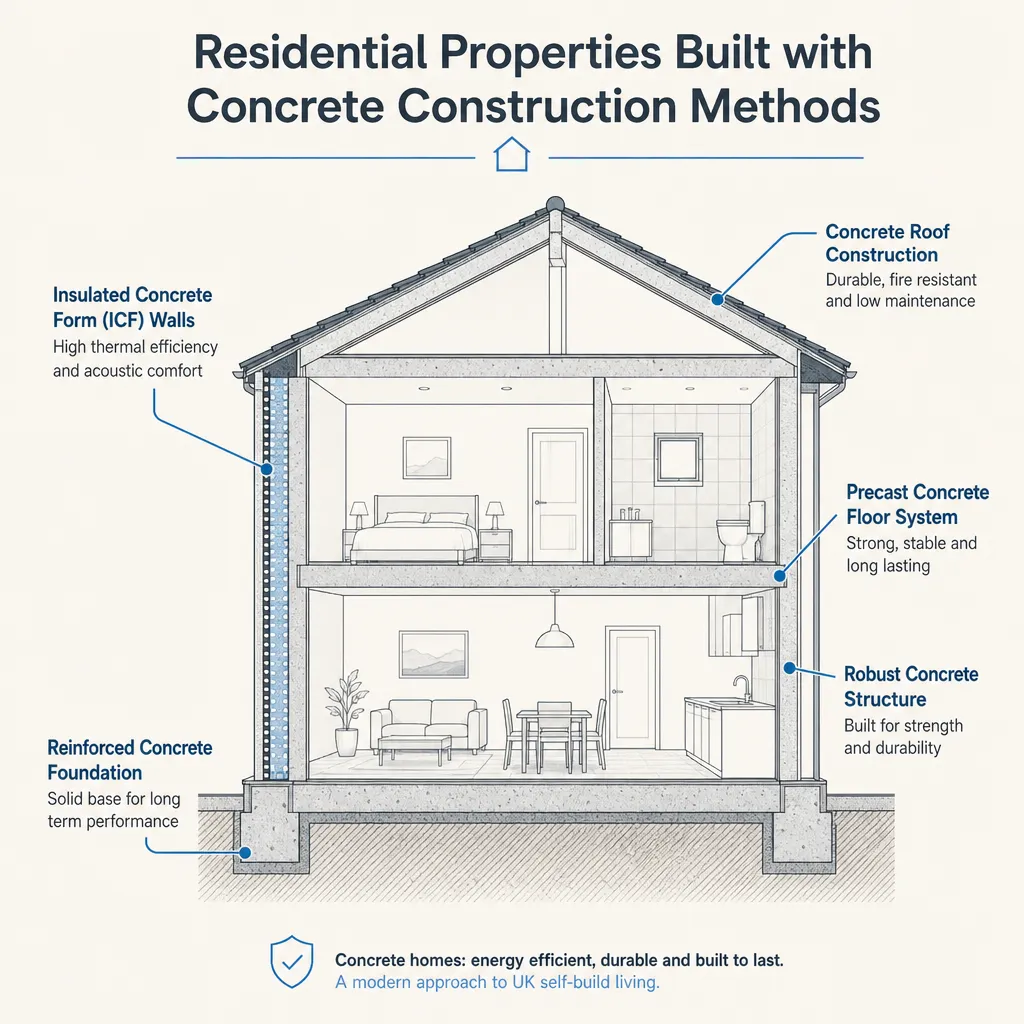
Residential Properties Built with Concrete Construction Methods
UK homes are built using several concrete methods: in-situ cast concrete, precast panel systems, insulating concrete formwork (ICF), and older non-traditional types such as Wimpey No-Fines and Laing Easiform.