Maintaining Weep Holes: Effective Drainage Solutions for Cavity Walls
By Housey · Last reviewed 11th of May 2026
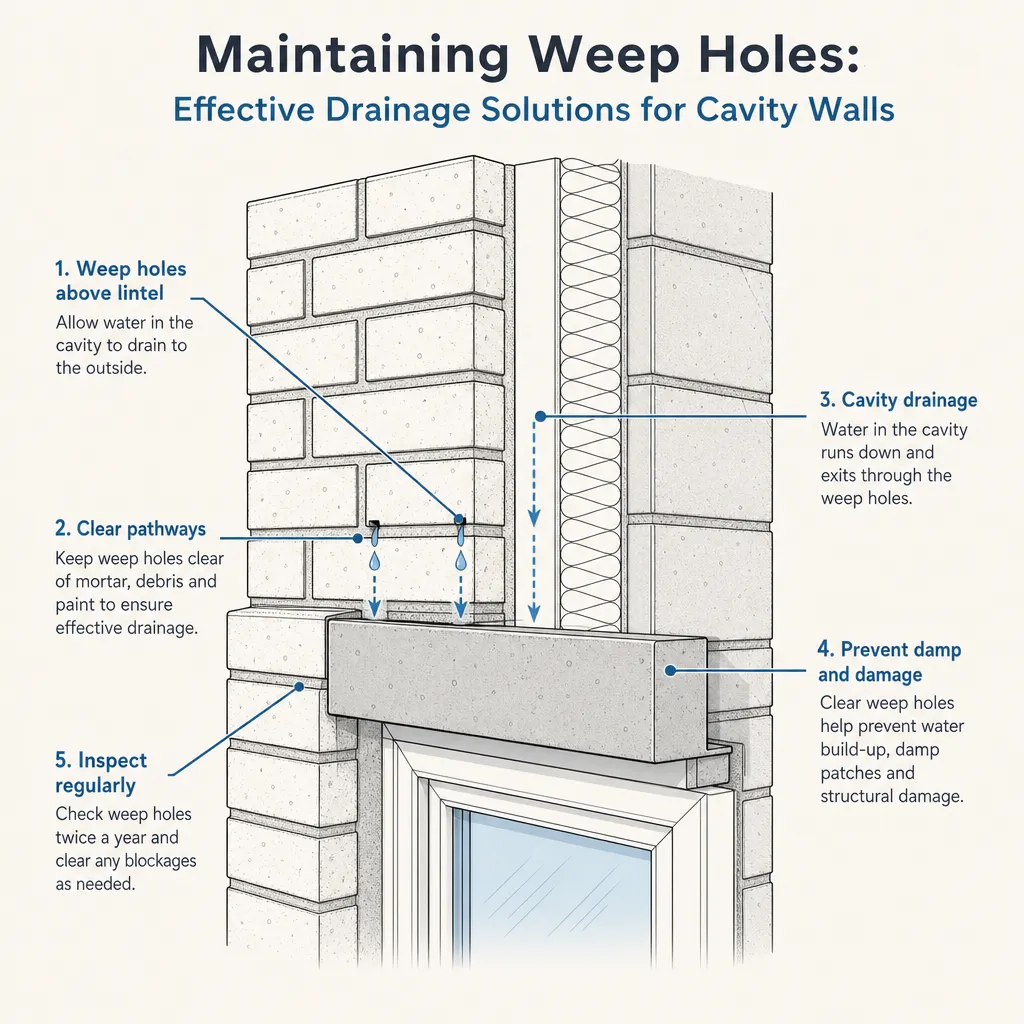
Maintaining Weep Holes: Effective Drainage Solutions for Cavity Walls
Weep holes are one of the less visible but more consequential features of UK cavity wall construction, and blocked or absent openings appear as a routine finding in damp and timber surveys on homes built from the 1920s through to modern construction. When a surveyor flags weep holes as a concern, homeowners often underestimate the relevance — yet inadequate cavity drainage is a well-documented cause of penetrating damp that can damage internal wall finishes, ground floors, and floor joists, particularly in properties that have had cavity wall insulation retrofitted.
Key points
- Building Regulations Approved Document C (Site preparation and resistance to contaminants and moisture) requires that cavity wall construction includes provision for drainage of moisture from within the cavity.
- Weep holes should typically be provided at maximum 900 mm horizontal centres at each DPC (damp proof course) level, and above every cavity tray at window heads, door heads, and other cavity closures.
- A standard weep hole is a perpend joint (vertical mortar joint) left unmortered in the outer leaf — approximately 10 mm wide by 65 mm high — with purpose-made plastic inserts also widely used in new construction to maintain the opening over time.
- BRE Good Repair Guide 47 identifies blocked perpends above cavity trays as a primary pathway for water to travel inward toward the inner leaf rather than draining to the outside.
- Where cavity wall insulation (CWI) has been installed, CIGA (Cavity Insulation Guarantee Agency) guidance requires that weep holes above lintels and at DPC level remain unobstructed after installation.
What do weep holes actually do?
Cavity walls are designed on the principle that some rainwater will always penetrate the outer leaf, particularly in exposed locations, during heavy driving rain, or where pointing has begun to deteriorate. That moisture needs somewhere to go. The cavity is designed to allow it to run down the inner face of the outer leaf and drain to the outside, rather than bridging across to the inner leaf or accumulating within the construction.
Weep holes serve two functions: they allow moisture to drain outward at the base of the cavity or at any horizontal DPC or cavity tray, and they allow vapour to escape, reducing the risk of moisture-laden air being trapped and condensing within the wall.
In a typical UK cavity wall, weep holes should be present at:
- DPC level — at the base of the cavity, allowing drainage to ground level.
- Above lintels and window and door heads — where a cavity tray intercepts water, a weep hole at each end (and at intermediate positions in wider openings) allows it to exit the wall.
- Above any horizontal cavity obstruction — such as a cavity closer or fire stop, where water might otherwise pond on the obstruction before bridging across to the inner leaf.
Why weep holes become blocked or absent
Blockages are more common than many homeowners realise, and the cause is often inadvertent:
- Repointing: when the external wall is repointed, contractors sometimes fill perpend weep holes alongside deteriorated mortar joints, inadvertently blocking the drainage path.
- Masonry paint or sealant: surface-applied water repellents or multiple coats of masonry paint can seal the opening over time, particularly on older properties with decades of painted finishes.
- Mortar droppings during construction: a recognised fault in new and refurbished builds where mortar accidentally fills the opening during bricklaying.
- Weep holes never installed: on some pre-1950 properties, weep holes above cavity trays may not have been provided, or cavity trays themselves may be absent.
- Cavity wall insulation: blown or injected insulation can partially or fully obstruct weep holes if the installation does not account for their position.
How to check your weep holes — homeowner inspection checklist
A basic visual inspection requires no specialist tools and is best carried out after a period of sustained rainfall, when drainage failures are more apparent.
If you find widespread blockages or suspect weep holes were never provided, commission a damp and timber survey before instructing remedial work — a surveyor can identify whether related moisture damage has already occurred internally.
What not to assume about weep holes
- "Weep holes let in draughts and pests" — this concern is common but largely overstated for standard perpend weep holes, which are small and self-draining. Purpose-made weep hole guards with internal baffles provide additional insect protection if required. Sealing them causes far greater damage than any draught they may allow.
- "No visible internal damp means the weep holes are fine" — blocked weep holes can cause moisture to travel laterally along a cavity tray before finding another entry route. Damage can accumulate within the construction for years before appearing as visible internal staining.
- "CIGA guarantees cover any damp caused by CWI installation" — CIGA guarantees typically require that the property was in suitable condition at the time of installation. Blocked weep holes may complicate or exclude a claim depending on when the blockage occurred.
- "Any builder can reinstate a weep hole" — clearing and correctly reinstating weep holes, especially in older properties or where cavity trays may be absent, requires understanding of the wider cavity drainage arrangement. A qualified damp specialist or experienced mason familiar with cavity wall construction is more appropriate than a general maintenance contractor.
When to get professional help
Arrange a professional survey rather than attempting DIY remediation if:
- Multiple weep holes are blocked across more than one elevation of the building
- There are internal damp patches above window or door openings, or at skirting level adjacent to external walls
- The property has cavity wall insulation and blocked weep holes have been identified at or near the insulation zone
- The property is pre-1945 and no weep holes are visible above lintels, suggesting cavity trays may also be absent
- There is visible bulging, cracking, mortar staining, or salt deposits (efflorescence) on the outer leaf near openings
How Housey can help
Housey can connect you with local damp and timber survey specialists to assess whether cavity drainage issues have caused internal moisture damage, damp proofing specialists to remedy identified problems, and drainage contractors who can advise on external drainage improvements that complement cavity wall maintenance.
Frequently asked questions
How big should weep holes be in a cavity wall?
A standard weep hole is a single perpend joint left unmortered in the outer leaf — approximately 10 mm wide and 65 mm high (the height of a standard brick course). This provides adequate drainage without structurally compromising the wall. Purpose-made plastic weep hole inserts are commonly used in new construction to maintain the correct opening size and exclude debris over time.
Can I seal weep holes to improve thermal performance?
No. Sealing weep holes prevents moisture from escaping the cavity, increasing the risk of penetrating damp and potentially accelerating deterioration of the wall construction. If ventilation through weep holes is a concern, purpose-made weep hole guards with internal baffles allow drainage while reducing air movement. Do not fill them with mortar, expanding foam, or any other material.
How often should weep holes be checked?
As part of a routine external maintenance inspection, every two to three years is a reasonable interval — or immediately after any repointing works, to verify the contractor has not inadvertently filled the openings. After any sustained period of heavy rain that produces new internal damp staining, weep holes above the affected area should be checked promptly.
Does cavity wall insulation affect how weep holes function?
Cavity wall insulation does not eliminate the need for weep holes, and in some situations makes them more critical. If insulation partially obstructs a weep hole, water may be redirected onto the inner leaf rather than draining away. If your property has CWI installed, verify that all weep holes above lintels and at DPC level remain unobstructed — this should have been confirmed as part of the original installation survey.
Sources and further reading
- Approved Document C — Site preparation and resistance to contaminants and moisture — GOV.UK / MHCLG
- BRE Good Repair Guide 47 — Repairing and upgrading cavity walls — BRE (Building Research Establishment)
- CIGA — Cavity insulation guarantee and suitability guidance — Cavity Insulation Guarantee Agency
- NHBC Standards Chapter 6.1 — External masonry walls — NHBC
Useful next reads
 Surveys & Inspections
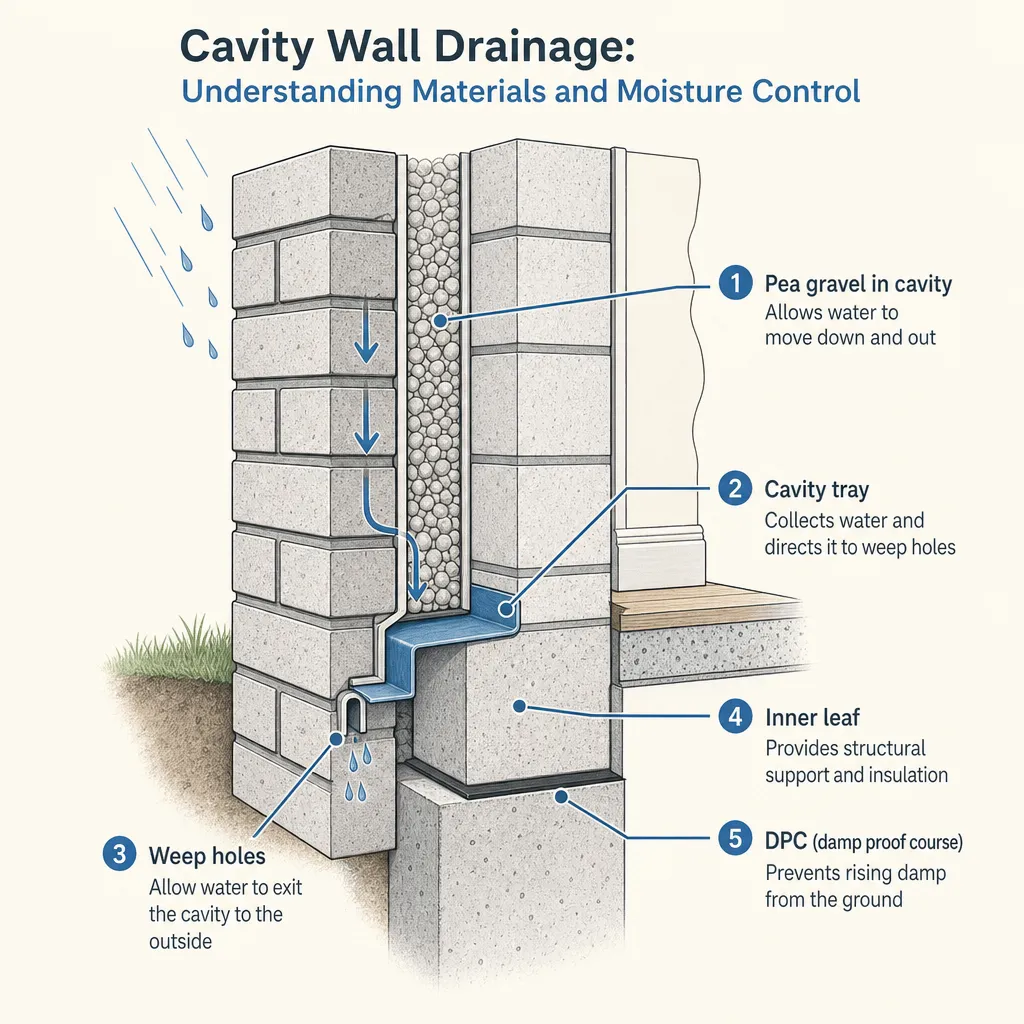
Cavity Wall Drainage: Understanding Materials and Moisture Control
Cavity walls control moisture through a drainage system of weep holes, cavity trays, and DPC at ground level.
 Surveys & Inspections
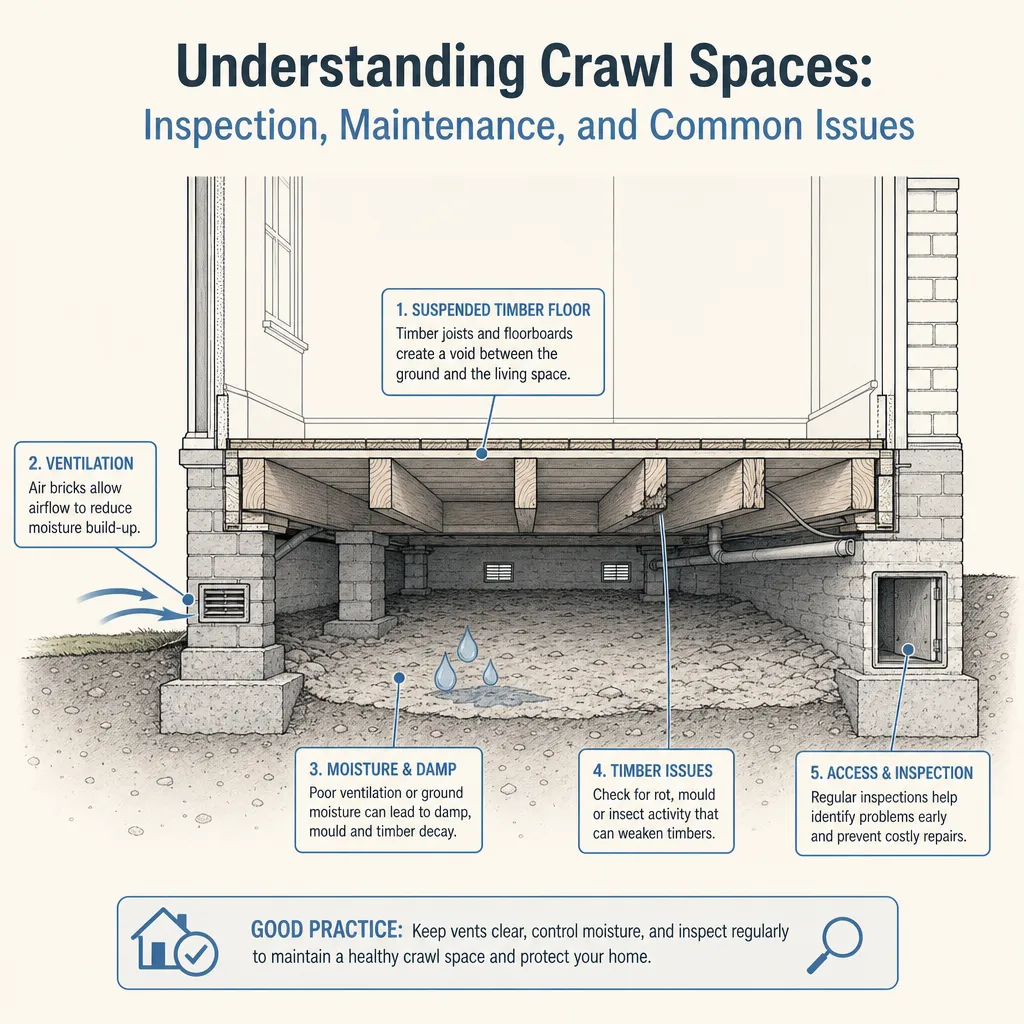
Understanding Crawl Spaces: Inspection, Maintenance, and Common Issues
Sub-floor voids beneath suspended timber ground floors in pre-1960 UK homes need cross-ventilation through airbricks to prevent dry rot and wet rot in floor timbers.
 Surveys & Inspections
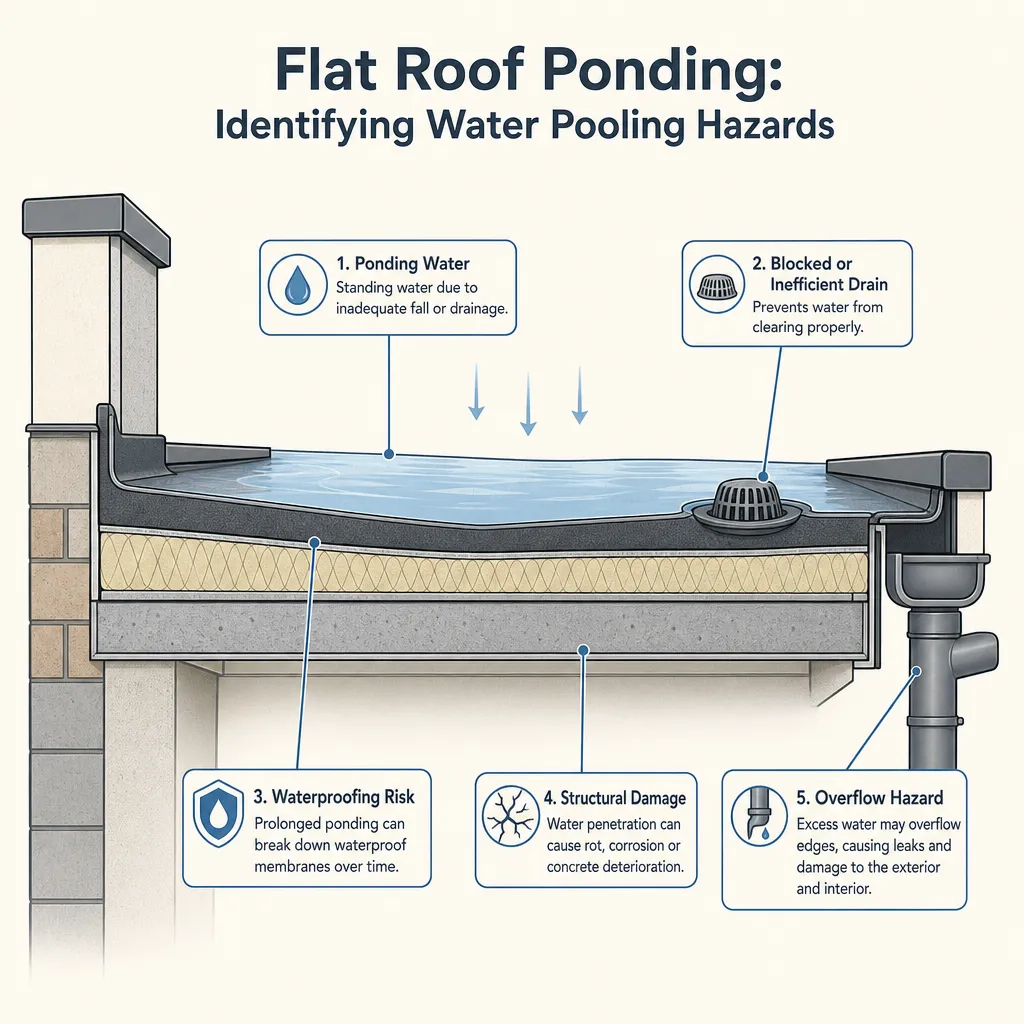
Flat Roof Ponding: Identifying Water Pooling Hazards
Flat roof ponding lasting more than 24–48 hours after rainfall warrants investigation.
 Surveys & Inspections
Annual Home Maintenance Checklist and Schedule
A structured annual maintenance schedule helps UK homeowners catch small problems before they become costly repairs.
 Surveys & Inspections
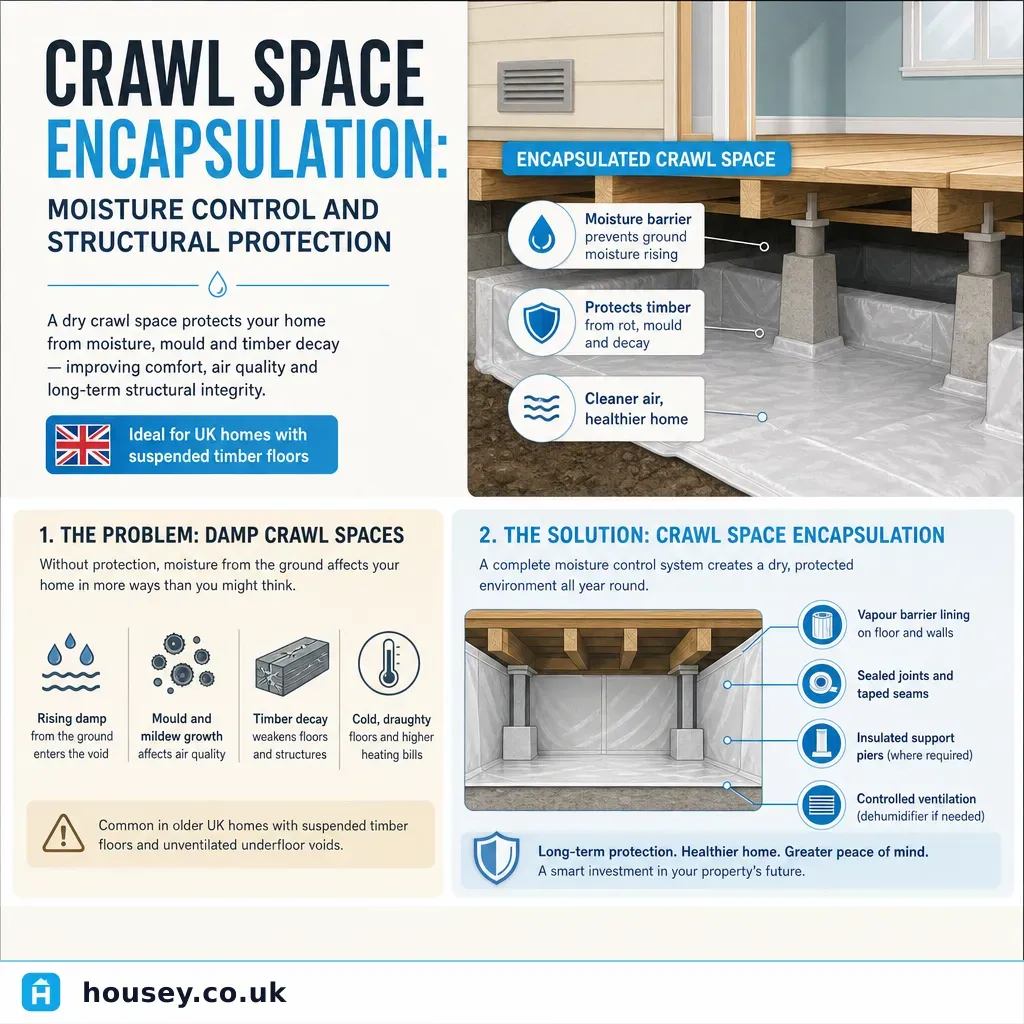
Crawl Space Encapsulation: Moisture Control and Structural Protection
Crawl space encapsulation seals the subfloor void beneath suspended timber floors with a vapour control layer and improved ventilation to prevent rising damp, condensation, timber rot and structural damage.