Flat Roofing: Evaluating Design Options and Trade-offs
By Housey · Last reviewed 18th of May 2026
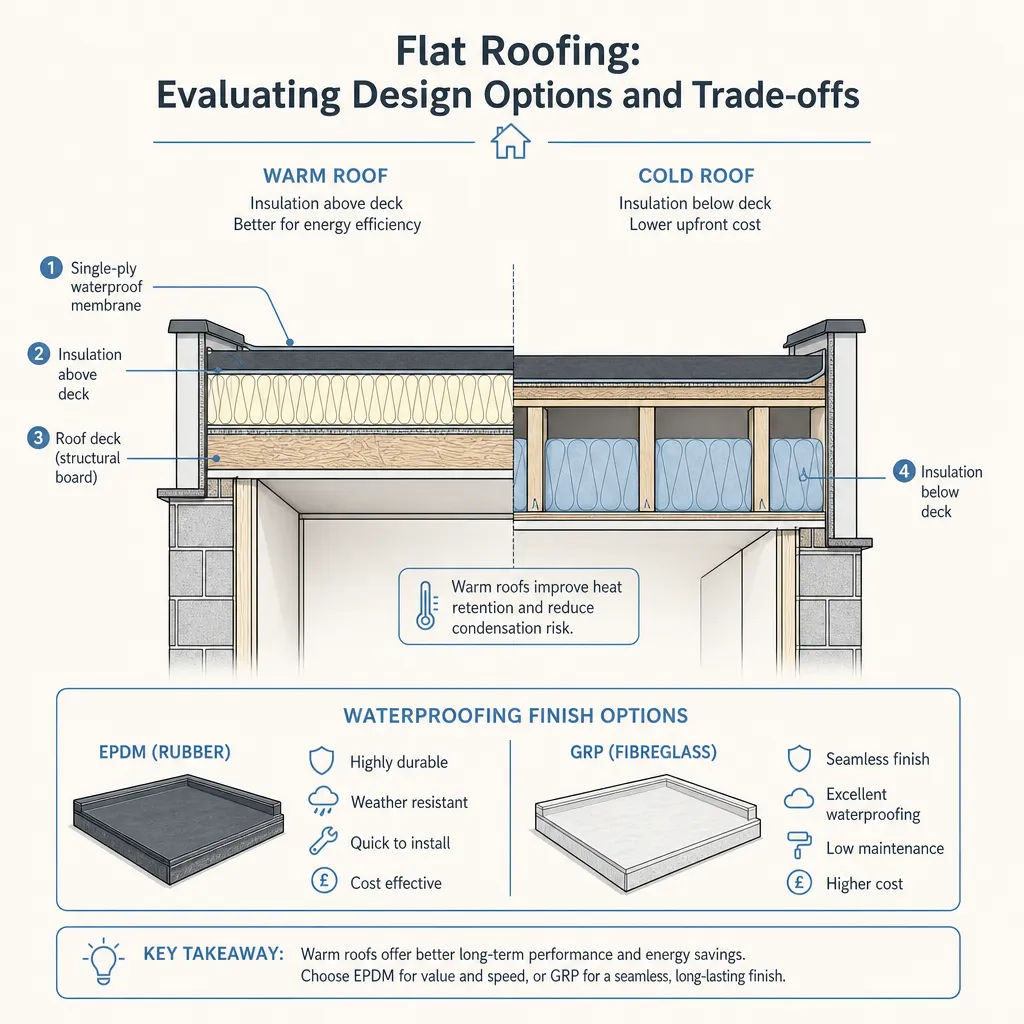
Flat Roofing: Evaluating Design Options and Trade-offs
Flat roofs are a practical solution for extensions, outbuildings, and contemporary new builds across the UK — but choosing the wrong construction method or membrane leads to costly failures, often within a few years. Whether you are replacing an ageing felt roof on a 1970s garage, adding a kitchen extension, or designing a rooftop terrace, understanding the structural and material options before you commit can save considerable time and money.
Key points
- UK building practice requires a minimum drainage fall of 1:80 (approximately 1.25°) on flat roofs, per BS 6229:2003; designing to 1:40 is recommended to account for structural deflection over time.
- Warm deck construction — where insulation sits above the structural deck — is the preferred approach under Building Regulations Approved Document L and eliminates interstitial condensation risk in most cases.
- Cold deck flat roofs require a ventilated airspace of at least 50 mm above the insulation per BS 5250, and are increasingly difficult to detail correctly to meet the current U-value target of 0.18 W/m²K.
- EPDM rubber membranes typically carry a 20–25 year product warranty; GRP fibreglass systems 25 years or more; quality modified bitumen felt (torch-on, three-layer) 15–20 years.
- Inverted warm roofs — where extruded polystyrene insulation sits on top of the waterproof membrane — are the preferred build-up for trafficable terraces and planted roofs, as the membrane is protected from UV and thermal cycling.
What are the main flat roof construction types?
Three principal construction approaches are used on UK residential flat roofs:
Warm deck (above-deck insulation) Insulation is placed on top of the structural deck, below the waterproofing membrane. The dew point falls within the insulation layer rather than at the deck surface, preventing condensation on the structural element. Rigid foam insulation boards — PIR, EPS, or mineral wool — allow Part L U-value targets of 0.18 W/m²K to be met without difficulty.
Cold deck (between-joist insulation) Insulation sits between the roof joists with a ventilated void above. BS 5250 requires at least 50 mm of clear void with cross-ventilation at eaves level. Cold decks are rarely recommended for new-build projects: achieving adequate ventilation and modern U-values simultaneously is technically demanding, and the risk of interstitial condensation is significant if the void is poorly detailed.
Inverted (upside-down) warm deck The waterproof membrane is applied directly to the structural deck first, then extruded polystyrene (XPS) boards are placed on top and held down by ballast — gravel, concrete pavers, or a growing medium. This arrangement suits roof terraces and green roofs well because the membrane is protected from UV and thermal stress. A filter membrane between insulation and ballast prevents fines migration into the drainage layer.
Which waterproofing membrane suits your project?
Membrane type | Typical lifespan | Best for | Limitations | Indicative cost per m² installed |
|---|---|---|---|---|
EPDM rubber (single-ply) | 20–25 years | Extensions, garages, simple flat roofs | Careful detailing required at penetrations and upstands | £80–£120 |
GRP fibreglass | 25+ years | Domestic extensions, complex detailing, parapet roofs | Can become brittle with age; expansion joints needed on large areas | £90–£130 |
Modified bitumen felt (torch-on, 3-layer) | 15–20 years | Refurbishments, replacing older felt roofs | Lower specification than single-ply; UV degradation without mineral cap sheet | £60–£100 |
Single-ply PVC or TPO | 20–30 years | Large roofs, terrace and green roofs | Higher material cost; requires manufacturer-approved installers | £90–£140 |
Liquid applied membrane | 15–25 years | Complex geometry, penetrations, remedial work | Application-sensitive; multiple coats required; skilled labour essential | £70–£120 |
Indicative UK costs, last reviewed 2026-05-18. Prices vary by roof area, access, location, and specification. Obtain at least three quotes from NFRC-registered contractors.
How should a flat roof drain?
Poor drainage is the leading cause of flat roof failure in the UK. Standing water — ponding — accelerates membrane degradation and increases structural loading.
Key drainage principles for UK flat roofs:
- Minimum fall: 1:80 (1.25°) to drainage outlets. BS 6229 recommends designing to 1:40 to account for long-term structural deflection.
- Secondary drainage: Any roof above habitable space should have both primary outlets and secondary overflow outlets or scuppers. A blocked primary drain on a parapet roof can cause internal flooding within hours of heavy rainfall.
- Outlet sizing: Size drainage outlets for a 1-in-100-year rainfall event as a minimum, per BS EN 12056-3.
- Tapered insulation: Rigid tapered PIR boards create drainage falls across a structurally level deck without a separate screed, and integrate neatly with warm deck construction.
- Parapet scuppers: Wall openings near roof level act as secondary overflow relief and should discharge clear of the building facade to avoid staining or water ingress at the wall.
Which flat roof system is right for your project?
- Choose warm deck EPDM or GRP if you need a durable, code-compliant solution for a domestic extension or outbuilding where low maintenance is a priority.
- Choose inverted warm deck with pavers or gravel ballast if you want a trafficable roof terrace — the membrane is protected and the surface can accommodate foot traffic and furniture.
- Choose inverted warm deck with a green roof build-up when biodiversity net gain, stormwater attenuation, or planning conditions favour a planted roof.
- Choose liquid applied membrane when the roof has complex geometry, numerous penetrations, or is a refurbishment where stripping to the structural deck is impractical.
- Ask a structural engineer to verify deck capacity before adding a new build-up to an existing structure, particularly when moving from a lightweight felt system to a heavier inverted or green roof.
- Check Approved Document L for U-value requirements and Approved Document C for moisture control provisions on any new-build or extension roof.
Red flags to watch for
Before accepting a flat roof specification or quote, look out for these warning signs:
- No secondary overflow drainage specified on a parapet roof above a habitable room.
- A "three-layer felt" description where only the cap sheet is torch-bonded, with cold-bonded or self-adhesive layers beneath.
- No tapered insulation plan on a structurally level deck — relying solely on screed for falls adds unnecessary dead load and introduces a secondary moisture interface.
- Absence of a vapour control layer (VCL) in the warm deck specification above a heated room.
- An installer who cannot confirm NFRC membership or manufacturer system approval for the specified membrane.
When to get professional help
Consult a structural engineer before adding any new build-up to a structure not originally designed for that load — particularly when moving to an inverted or green roof system. Further professional input is needed when:
- The roof spans more than 6 m or shows visible signs of deflection.
- You want a trafficable terrace or planted roof, where additional dead and live loads apply.
- Timber rot, water damage, or cracking is visible in the existing deck structure.
- The roof drains internally through the building structure rather than externally to gutters.
- Building control or planning permission is required — most structural roof changes trigger a building control application.
How Housey can help
Housey connects you with NFRC-registered roofers for flat roof replacement, refurbishment, and new-build projects. If you are assessing an existing flat roof before deciding on a specification or budget, roof survey specialists can provide an independent condition report. Describe your project and receive quotes from vetted local contractors.
Frequently asked questions
Do flat roofs need planning permission in the UK?
Most flat roof replacements and extensions fall under permitted development, but adding a roof terrace, raising a parapet, or building a new structure usually requires planning permission. Rules vary by property type, local planning authority, and whether the building is listed or in a conservation area. Always confirm with your local planning authority before starting work.
How long does a flat roof last?
It depends on the membrane and installation quality. A well-installed EPDM or GRP system should last 25 years or more with basic maintenance. Modified bitumen felt typically lasts 15–20 years. Any flat roof should be inspected annually for ponding, membrane splits, and blocked drainage outlets to extend its service life.
What is the difference between a warm roof and a cold roof?
In a warm roof, insulation sits above the structural deck, keeping the deck warm and eliminating condensation risk. In a cold roof, insulation sits between the joists with a ventilated void above — the deck remains cold and is prone to condensation if ventilation is inadequate. Warm roofs are the standard approach for new UK construction.
Can I convert a flat roof to a pitched roof?
Yes, but this is a structural alteration requiring building control approval and usually planning permission. A structural engineer should design the new roof frame, and a party wall surveyor should be consulted if the property is terraced or semi-detached and the proposed works affect a shared wall.
Sources and further reading
- BS 6229:2003 Flat roofs with continuously supported flexible waterproofing systems — BSI
- Building Regulations Approved Document L: Conservation of fuel and power — GOV.UK
- Building Regulations Approved Document C: Site preparation and resistance to contaminants and moisture — GOV.UK
- National Federation of Roofing Contractors: flat roofing guidance — NFRC
- BS EN 12056-3: Gravity drainage systems inside buildings — Roof drainage — BSI
Useful next reads
 Improvement & Build
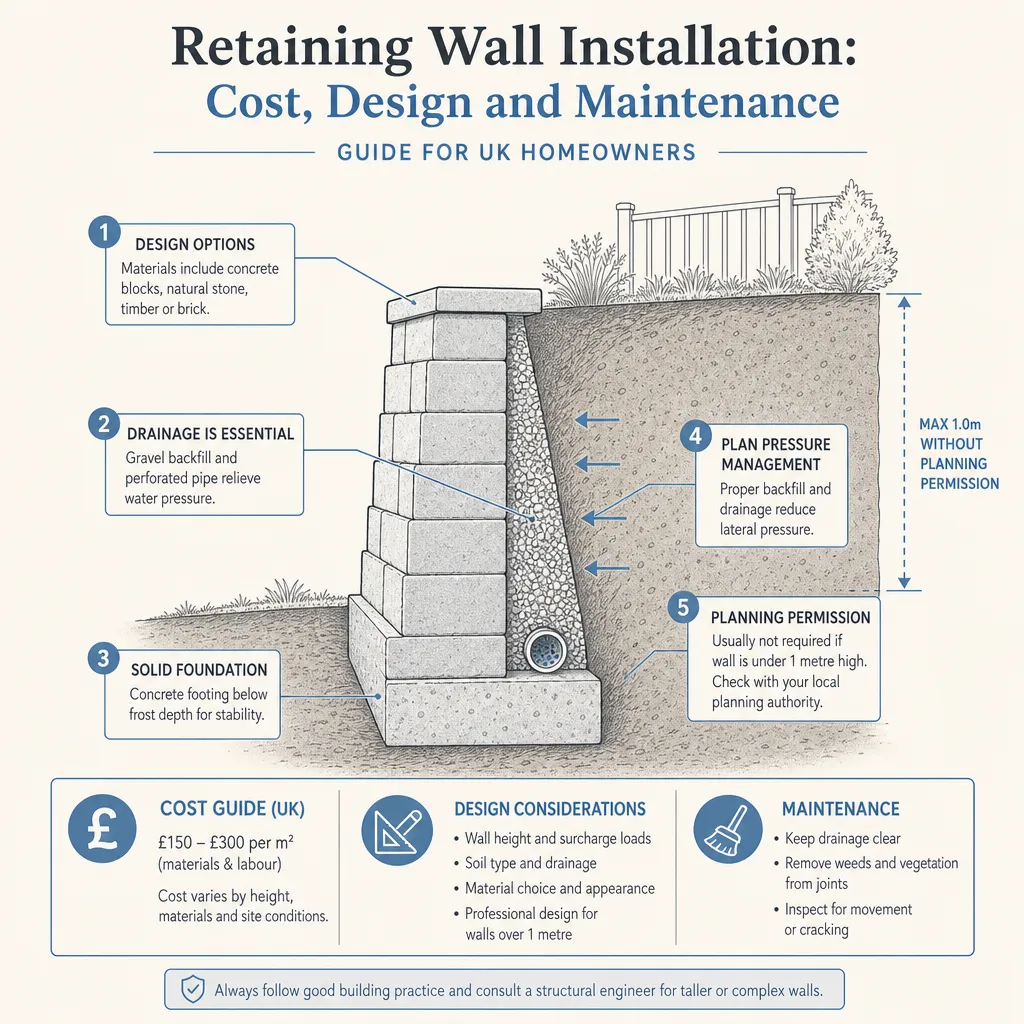
Retaining Wall Installation: Cost, Design and Maintenance
A retaining wall holds back soil on a sloped or banked site.
 Improvement & Build
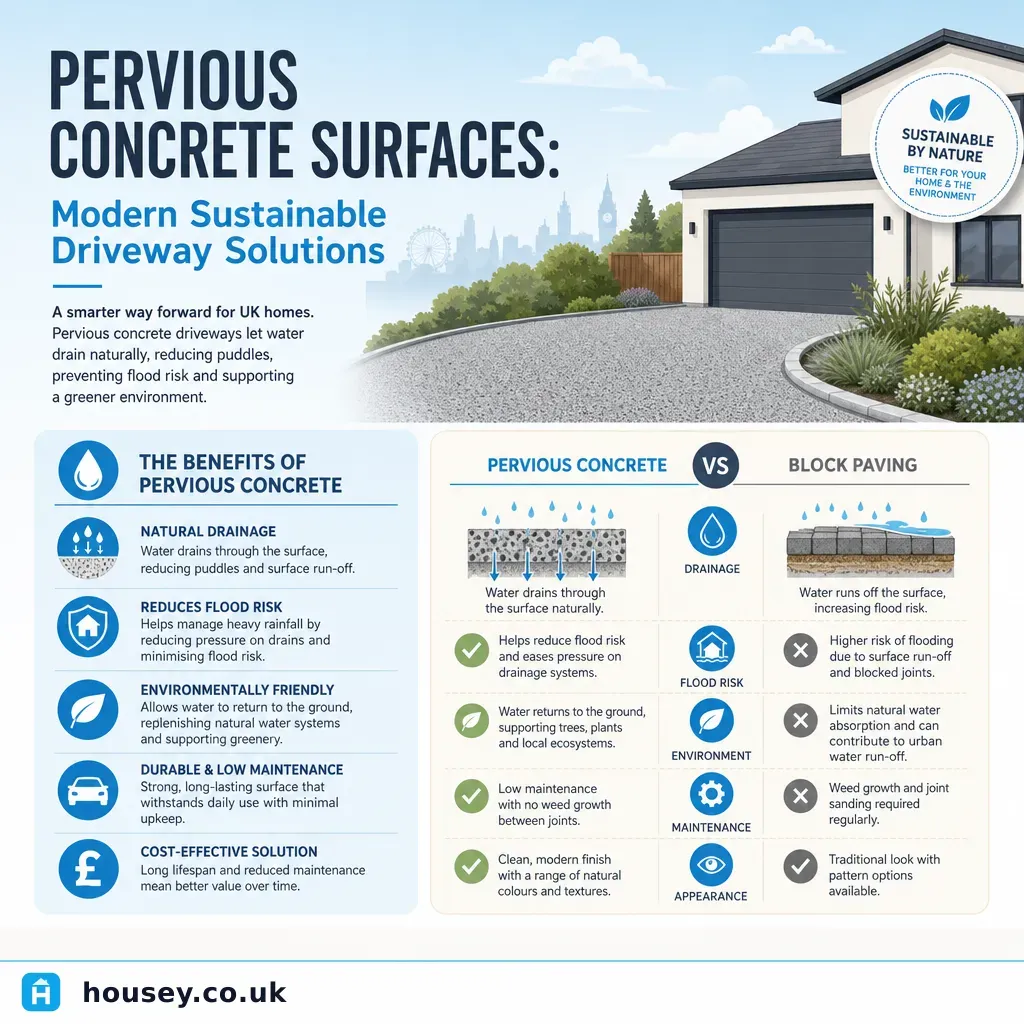
Pervious Concrete Surfaces: Modern Sustainable Driveway Solutions
Pervious concrete (also called porous or no-fines concrete) is a specialist concrete mix with large voids that allow rainwater to pass through the surface and into the sub-base below.
 Improvement & Build
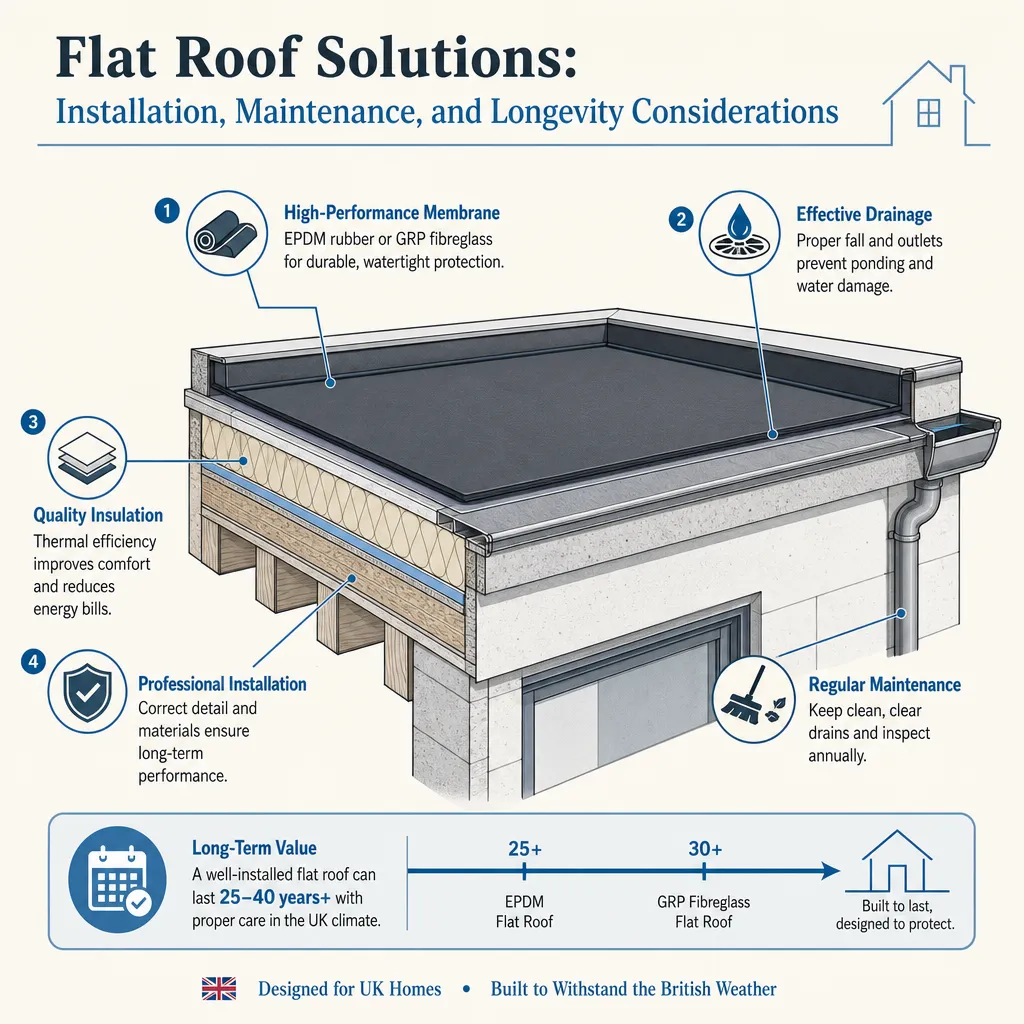
Flat Roof Solutions: Installation, Maintenance, and Longevity Considerations
Flat roofs use several waterproofing systems — EPDM rubber, GRP fibreglass, liquid-applied coatings, modified bitumen felt, lead, and zinc — each with different lifespans and installation requirements.
 Improvement & Build
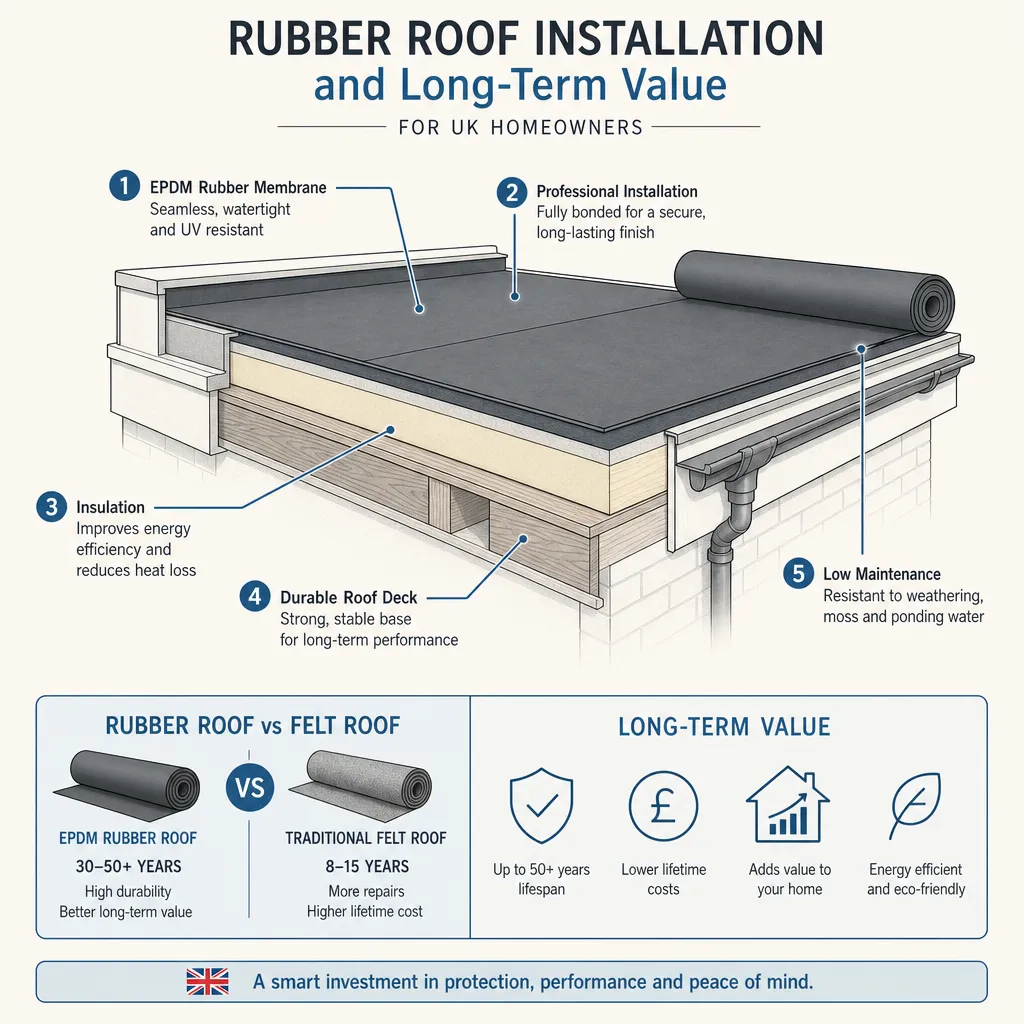
Rubber Roof Installation and Long-Term Value
EPDM rubber roofing is a synthetic membrane for flat and low-pitch roofs that typically lasts 30–50 years with minimal maintenance.
 Improvement & Build
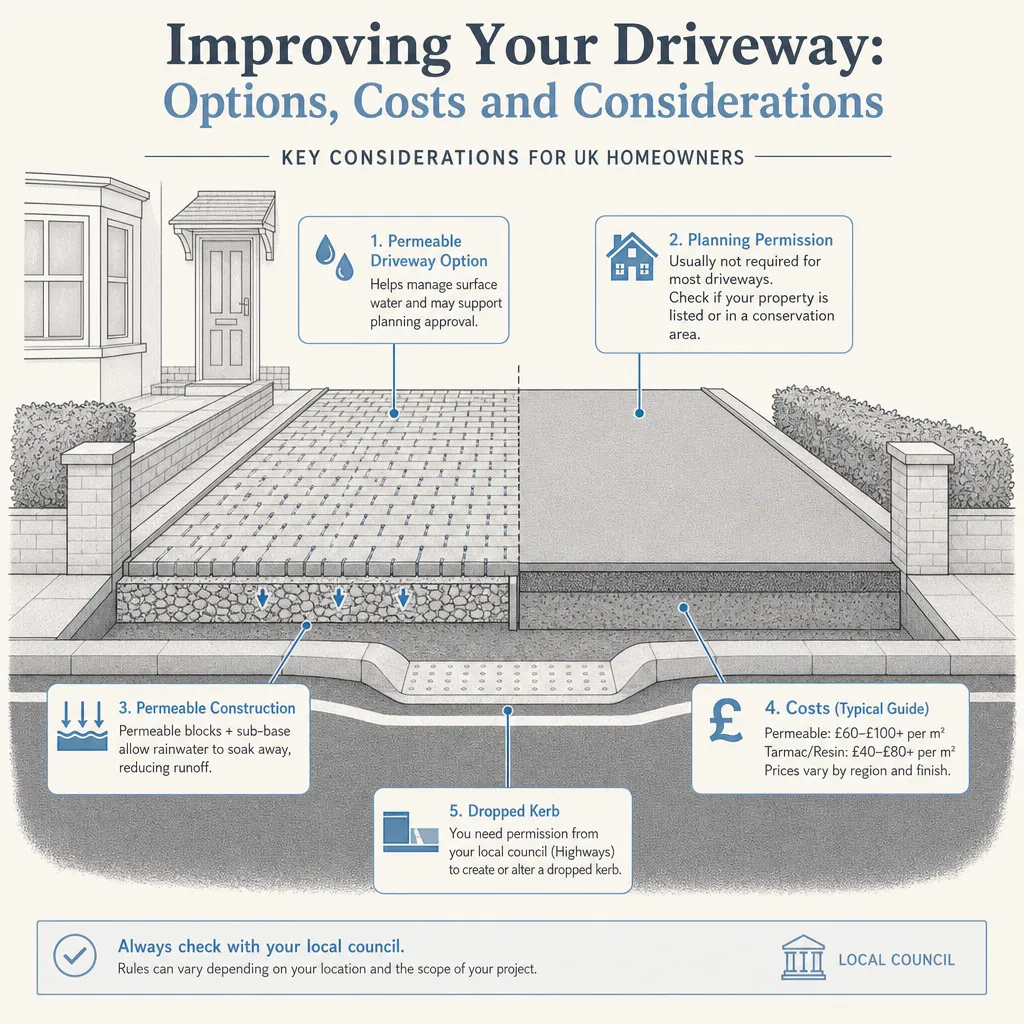
Improving Your Driveway: Options, Costs and Considerations
Installing a new driveway with a non-permeable surface larger than 5m² over a front garden in England requires planning permission unless water drains to a permeable area.