Rubber Roof Installation and Long-Term Value
By Housey · Last reviewed 10th of May 2026
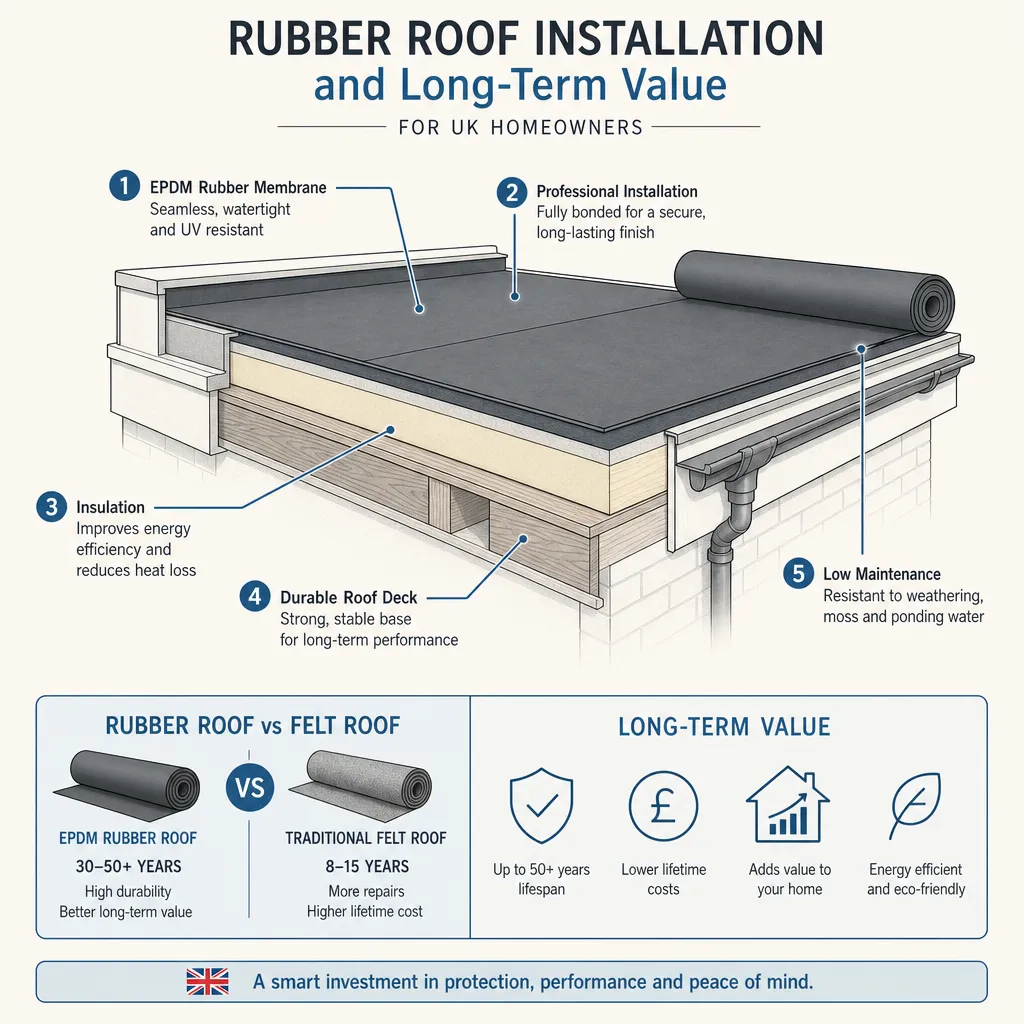
Rubber Roof Installation and Long-Term Value
Flat and low-pitch roofs are common on UK extensions, garages, outbuildings, and some 1960s–1980s properties, and replacing a tired felt roof with a modern membrane is one of the most worthwhile improvements an owner can make. EPDM (ethylene propylene diene monomer) rubber roofing has become the most widely installed flat-roof membrane in the UK domestic market, largely displacing traditional torch-on felt on smaller roofs because of its longer warranty periods and simpler maintenance profile. Choosing the right membrane, installer, and specification — and knowing whether Building Regulations apply — makes a material difference to performance over decades rather than years.
Key points
- EPDM membranes typically carry manufacturer guarantees of 20–30 years; well-installed systems commonly perform for 40–50 years in practice.
- Building Regulations (Approved Document C and Part L) apply when re-roofing an existing flat roof, including a U-value requirement of 0.18 W/m²K for replacement flat roofs on dwellings in England under Approved Document L1B.
- A competent roofing contractor should hold NFRC membership or a manufacturer-approved installer certificate for the specific system being installed.
- EPDM is bonded as a single sheet on most domestic roofs — eliminating seam-failure risk that affects multi-piece felt systems.
- Indicative UK installation costs range from £50–£100 per m² for EPDM on a typical domestic roof; Indicative UK costs, last reviewed 2026-05-10.
EPDM, GRP, or felt: which flat-roof membrane suits your property?
Membrane | Best for | Not ideal for | Typical lifespan | Indicative cost (per m²) |
|---|---|---|---|---|
EPDM rubber | Most domestic flat roofs; extensions; garages; cold climates | Walkable roof terraces requiring a hard surface | 30–50 years | £50–£100 |
GRP (fibreglass) | Walkable roofs; complex geometry; dormer cheeks | Very large roof areas (thermal expansion risk at joins) | 25–40 years | £60–£100 |
Torch-on felt (3-layer) | Budget replacement; larger commercial roofs | Long-term domestic use; fire risk during installation | 15–25 years | £30–£60 |
Liquid applied coating | Patching; irregular shapes; over existing membranes | New installations where longevity is the priority | 10–25 years | £30–£70 |
Indicative UK costs, last reviewed 2026-05-10. Quotes vary by roof size, access, deck condition, and location.
EPDM suits most UK domestic situations because it remains flexible in cold weather — critical for British winters — is UV-resistant without additional surface coatings, and is available in sheets large enough to cover most garage or extension roofs in a single piece.
GRP is preferred where a hard, walkable surface is required (for example a roof terrace) or where the roof has dormers, upstands, and complex penetrations that reward a harder-set finish.
How EPDM rubber roofing is installed
A competent installation typically follows this sequence:
- Deck inspection and preparation. The installer checks the existing deck — usually 18 mm OSB or plywood — for rot, deflection, or poorly secured boards. Damaged sections must be replaced before the membrane is laid.
- Falls and drainage. Building Regulations require a minimum 1:80 fall on flat roofs. A fall below this invites ponding, which shortens membrane life even on EPDM. Tapered insulation boards are often used to achieve adequate falls on an otherwise level deck.
- Insulation layer. For projects triggering Part L (most re-roofs), a continuous layer of rigid insulation board — polyisocyanurate or phenolic foam — is required to meet current U-value targets.
- EPDM sheet placement. The membrane is unrolled and allowed to relax before bonding. On most domestic roofs a single sheet covers the entire area; on larger roofs specialist tape and bonding primer are used at any seams.
- Bonding and perimeter detailing. Water-based contact adhesive is applied to the deck and the membrane underside. The membrane is folded back, adhesive applied, then carefully rolled into position to prevent air pockets. Perimeter trims, upstands, and flashing details are completed with EPDM flashing strips.
- Drip edge and gutters. Aluminium or UPVC edging trims are fitted to direct water cleanly into gutters and prevent water tracking back under the membrane edge.
Quality of detailing around penetrations — pipes, skylights, soil stacks — is the most common source of early failure on rubber roofs. Ask prospective contractors specifically how they handle each penetration on your roof.
Does a rubber roof need Building Regulations approval?
Usually yes, if the work constitutes a material change to the thermal performance of the roof. Key triggers in England:
- Re-roofing more than 25% of the total roof area on a dwelling: Part L requires the refurbished element to meet current U-value standards.
- New flat roof over a habitable room (such as a rear extension): Approved Documents C, A, and L all apply.
- Adding a rooflight or structural penetration: structural and weathertightness compliance is required.
Permitted development rights do not remove the requirement for Building Regulations approval. Your local authority Building Control team or an approved inspector will confirm what compliance evidence is needed. A building control application is advisable even for straightforward re-roofs, as it produces a formal completion record that conveyancers may request when you sell.
Homeowner checklist: before and after EPDM installation
Before work starts:
After completion:
What to ask before accepting a quote
- Does the price include removing the existing membrane and disposing of waste?
- What deck preparation is included, and what happens if rot or structural damage is found?
- Which EPDM system are you using, and what manufacturer warranty does it carry?
- What U-value will the completed roof achieve, and is that compliant with current Part L?
- Will you handle the Building Regulations application, or is that my responsibility?
- Is VAT included in the price?
- Who specifically will carry out the work, and what is their NFRC or accreditation status?
When to get professional help
Rubber roofing installation is not suited to DIY for most homeowners — bonding requires correct surface preparation, working at height, and experience with detailing that directly affects weathertightness. Seek a professional if:
- The existing deck shows structural deflection or rot in joists rather than just the deck board surface.
- There are cracks or movement in parapet or upstand walls.
- The roof drains through an internal downpipe — specialist waterproofing around internal outlets is essential.
- The building is listed — specialist materials and Listed Building Consent may be required.
- The roof is above a habitable room and has no existing insulation — a thermal upgrade is almost certainly required under Building Regulations.
Where there is suspected structural movement beneath a flat roof, a structural engineering assessment is advisable before re-roofing to avoid repeating the job.
How Housey can help
Housey connects you with vetted roofers for flat-roof membrane work who can quote for EPDM and other flat-roof systems, as well as building control consultants for Part L compliance if you need guidance on thermal performance requirements and inspection sign-off.
Frequently asked questions
Does an EPDM rubber roof need regular maintenance?
EPDM requires minimal maintenance compared with traditional felt. An annual visual check of flashings, upstands, and areas around penetrations is good practice, and clearing debris prevents prolonged moisture retention. Most manufacturers recommend a professional inspection every five years to catch any bond or seam issues early.
Can EPDM be installed over an existing felt roof?
Sometimes, but it is not always recommended. If the existing felt is adhered and in sound condition, some installers will apply EPDM over it. However, trapped moisture beneath old felt can reduce adhesion and cause long-term problems. Most quality installations involve stripping back to the deck and replacing any damaged sections before the new membrane goes down.
Will a new rubber roof add value to my home?
A new long-life membrane in good condition removes a negative from survey reports rather than adding measurable value. Buyers and surveyors commonly flag ageing flat roofs — a recent EPDM installation with a valid guarantee and Building Regulations completion certificate is a positive disclosure at sale and may prevent price renegotiation after survey.
How do I know if my flat roof needs replacing rather than patching?
If blistering, splits, or ponding affect more than 20–30% of the surface area, replacement is usually more cost-effective than repeated patching. A roofing contractor can carry out a condition survey. Multiple patch repairs that keep failing suggest the underlying deck or insulation may also be compromised and need investigation.
Sources and further reading
- Building Regulations Approved Document L1B — GOV.UK, thermal performance requirements for existing dwellings
- Building Regulations Approved Document C — GOV.UK, weather and moisture resistance
- National Federation of Roofing Contractors — NFRC, contractor accreditation and roofing standards
- Energy Saving Trust — roof and loft insulation — Energy Saving Trust, insulation guidance for flat and pitched roofs
Useful next reads
 Improvement & Build
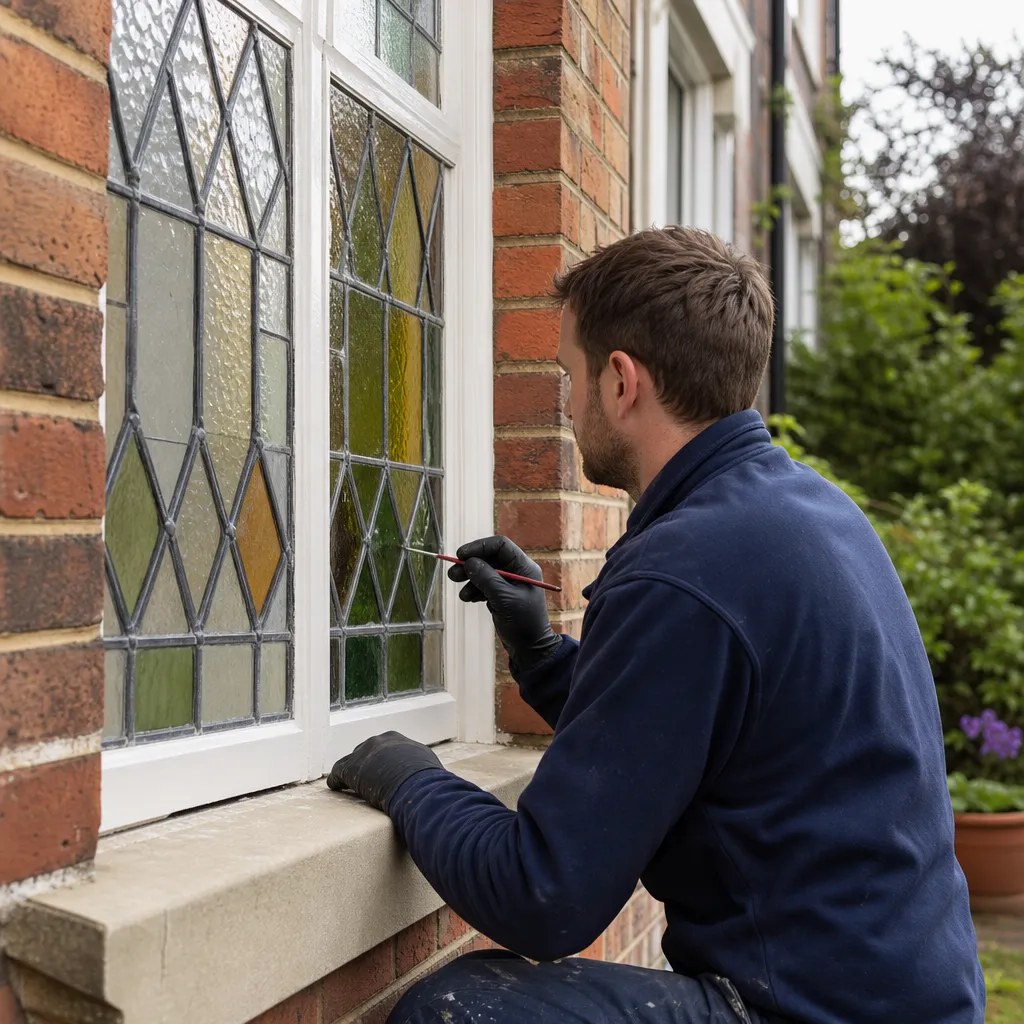
Sealing and Maintaining Historic Leaded Glass Windows: Preservation and Performance
Leaded glass windows are maintained using traditional linseed oil cement — not silicone or modern sealants, which prevent natural movement in the lead came.
 Improvement & Build
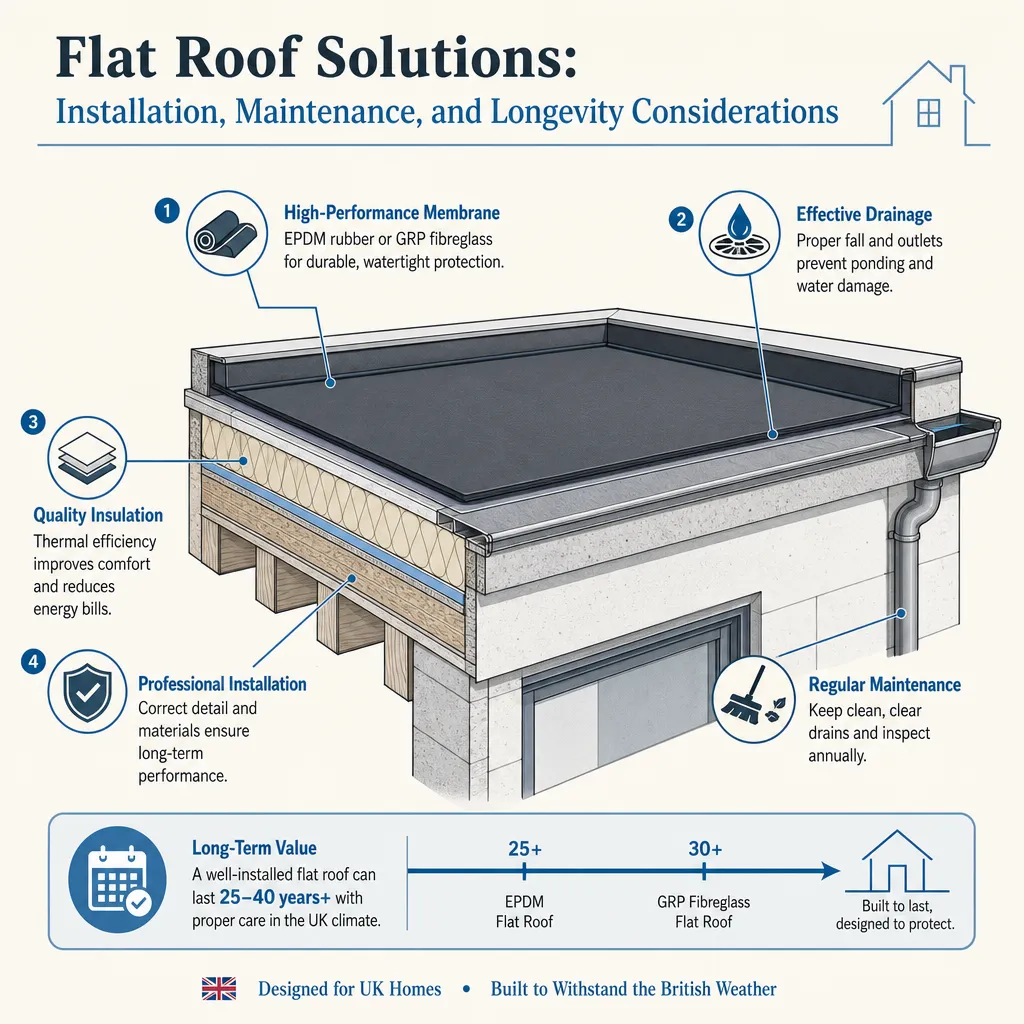
Flat Roof Solutions: Installation, Maintenance, and Longevity Considerations
Flat roofs use several waterproofing systems — EPDM rubber, GRP fibreglass, liquid-applied coatings, modified bitumen felt, lead, and zinc — each with different lifespans and installation requirements.
 Improvement & Build
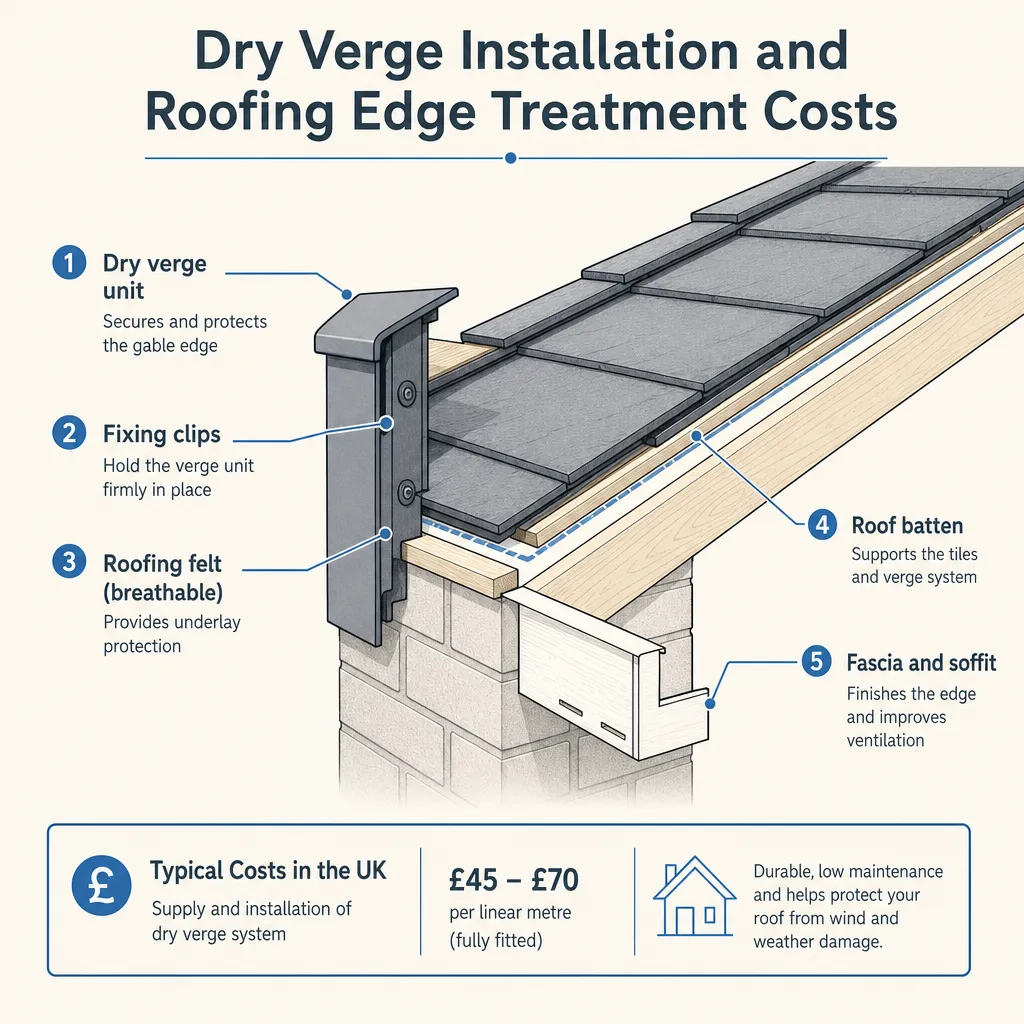
Dry Verge Installation and Roofing Edge Treatment Costs
A dry verge system replaces mortar bedding along the gable edge of a pitched roof with interlocking uPVC or aluminium units.
 Improvement & Build
Silicone Render Application and Maintenance Costs
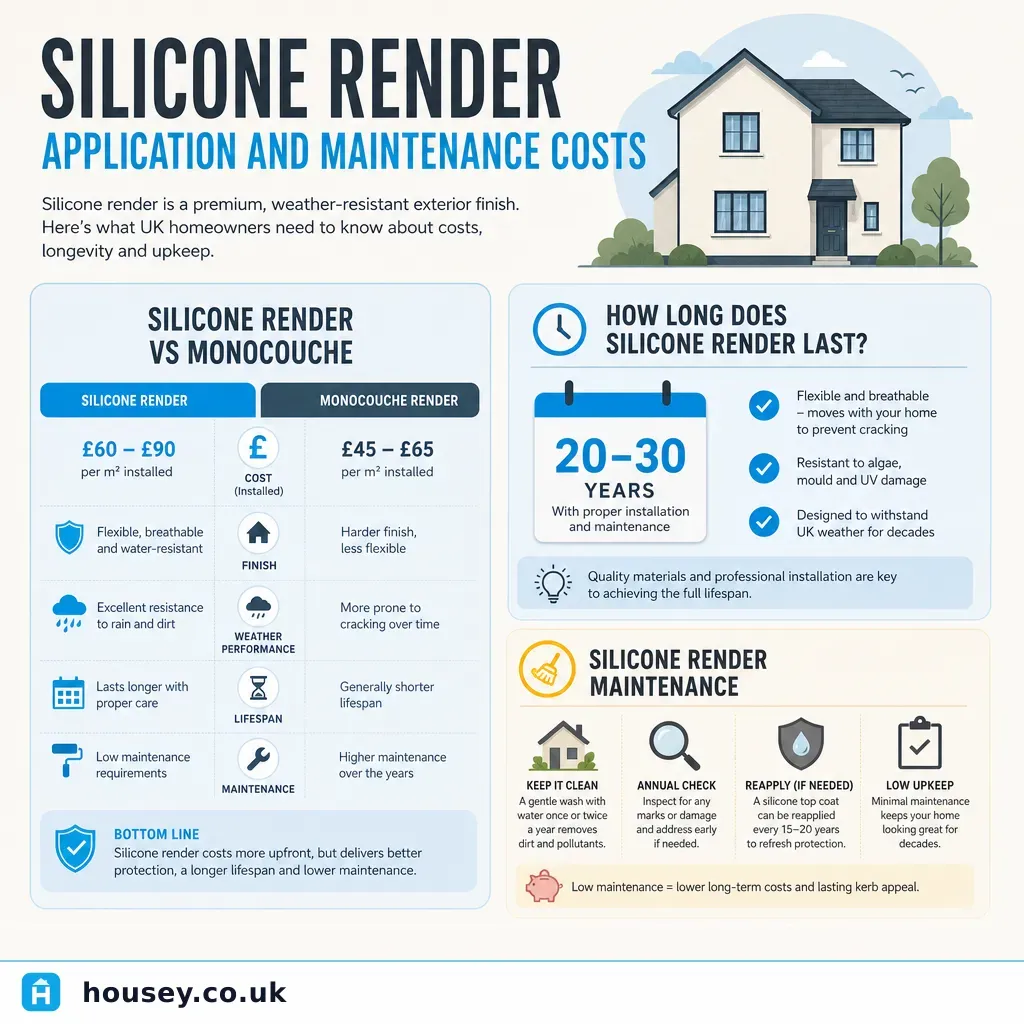
Silicone render typically costs £30–£70 per square metre installed across the UK, making a standard semi-detached house treatment around £3,000–£8,000.
 Improvement & Build
Storm Doors versus Screen Doors: Seasonal Purpose and Protection Compared
Storm doors are secondary outer doors that reduce draughts, rain ingress, and heat loss year-round, while screen doors are lightweight mesh panels that block insects during warm-weather ventilation.