Soundproofing and Acoustic Improvement for Floors
By Housey · Last reviewed 30th of May 2026
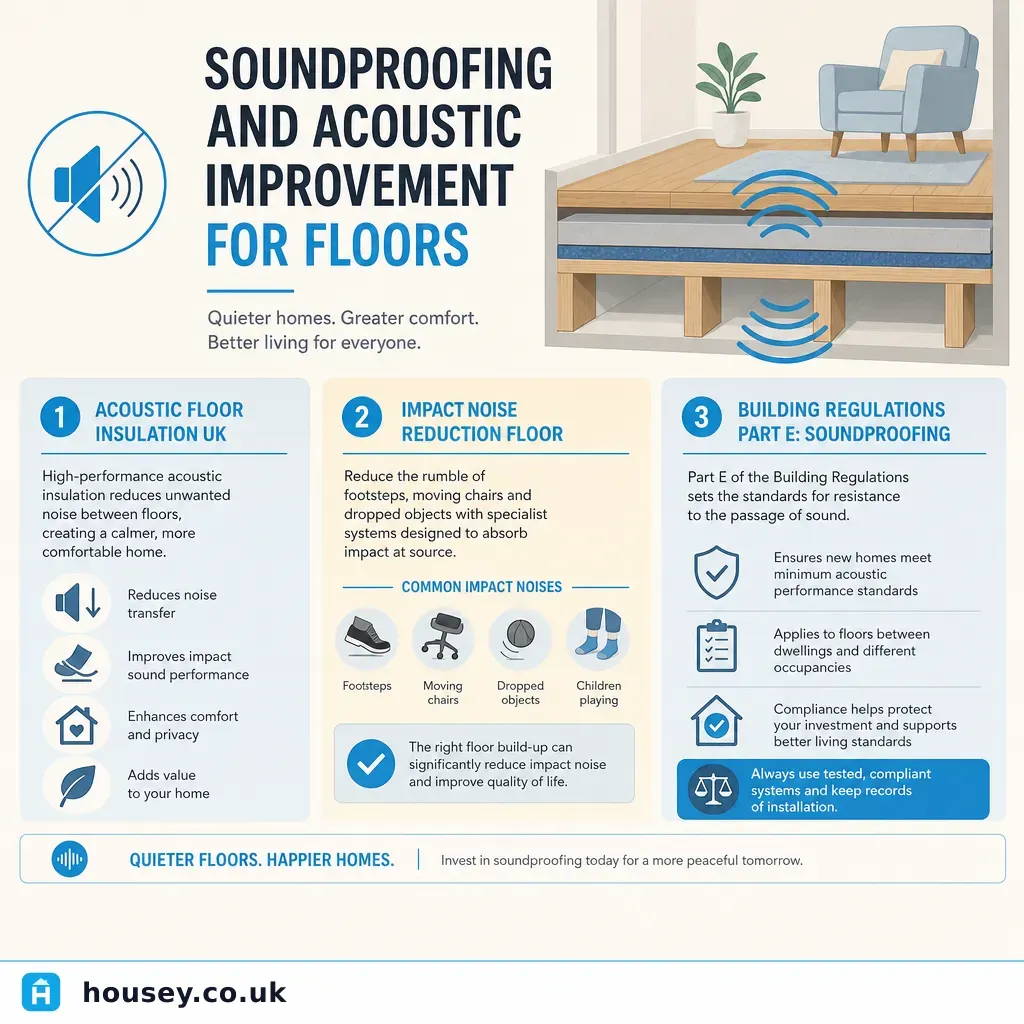
Soundproofing and Acoustic Improvement for Floors
Noise travelling between floors is one of the most common complaints in UK homes, particularly in Victorian and Edwardian terraces converted into flats, older properties with suspended timber floors, and any home where a room above is a bedroom, home office, or open-plan kitchen-diner. Whether you are improving your own home or meeting landlord obligations when converting a property, the right acoustic treatment depends on your floor construction, the type of noise causing the problem, and whether Building Regulations apply to your project.
Key points
- Building Regulations Approved Document E (ADE) sets minimum airborne and impact sound insulation standards for new-build separating floors and for material changes of use — including converting a house into flats.
- Two distinct noise types require different solutions: airborne noise (voices, music, television) and impact noise (footsteps, dropped objects).
- Acoustic underlay can reduce impact noise transmission by 10–25 dB depending on product density and dynamic stiffness; full floating floor systems with acoustic battens achieve greater reductions.
- Robust Details drawings (Robust Details Ltd) provide an approved pre-tested specification that allows builders to bypass pre-completion sound testing under ADE on qualifying new-build and conversion projects.
- Timber joist floors typically perform worse acoustically than concrete slab floors and often require both a floating floor above and a resilient ceiling treatment below to meet ADE thresholds.
Airborne vs impact noise: what you are dealing with
Two types of noise require fundamentally different treatments, and identifying which you are dealing with is the essential first step.
Airborne noise travels as sound waves through the air, passing through gaps, thin structures, and lightweight materials. Voices, television, and music are typical examples. The primary counter-measure is mass — heavier, denser materials that absorb rather than transmit vibration — combined with sealing any gaps around pipes, joists, and perimeter edges.
Impact noise is generated by physical contact: footsteps, moving furniture, a child jumping. It travels as vibration directly through the structure. The counter-measure is isolation — resilient materials that decouple the structure and prevent vibration from propagating.
Most floor treatments address both types to some degree, but a suspended timber floor with gaps between boards will transmit airborne noise through those gaps regardless of how well the surface layer is isolated. Tackling one type without the other often produces disappointing results.
Which floor construction do you have?
Your floor type is the single most important factor in choosing a treatment and estimating cost.
Floor type | Common in | Typical acoustic baseline | Recommended approach |
|---|---|---|---|
Suspended timber joists (original boards) | Pre-1960s houses, Victorian/Edwardian conversions | Poor to moderate | Floating floor + joist cavity infill + resilient ceiling below |
Timber joists with chipboard or plywood deck | 1970s–2000s houses | Moderate | Resilient acoustic underlay + floating floor; consider ceiling treatment |
Concrete slab (solid) | Post-war flats, 1960s–80s blocks | Moderate (airborne); poor (impact) | High-performance resilient underlay or floating screed system |
Beam and block | Many new-build and post-1990s homes | Moderate | Acoustic screed or floating floor with resilient layer |
Precast concrete plank | Purpose-built flats | Good to very good (airborne) | Resilient underlay or acoustic mat usually sufficient |
What treatment options are available?
Acoustic underlay
The simplest and least disruptive option. Foam, rubber, or cork underlays sit beneath floor finishes such as carpet, engineered timber, or luxury vinyl tile. Performance varies significantly by density and dynamic stiffness — a lower dynamic stiffness value (measured in MN/m³) indicates better isolation. Look for third-party test data to ISO 10140 or ISO 717 standards rather than relying on marketing descriptions.
Indicative UK costs, last reviewed 2026-05-30: £3–£15/m² for materials; fitting costs are additional and depend on the floor finish chosen. Quotes will vary by region and installer.
Floating floor systems
A floating floor adds a structurally decoupled layer: acoustic battens or pre-compressed resilient pads raise a plywood or OSB deck off the substrate. These can be combined with a floating screed system on concrete. Floating floors are more disruptive to install — they raise the finished floor level by 50–80 mm in some systems — but produce significantly better results than underlay alone.
Indicative UK costs, last reviewed 2026-05-30: £30–£80/m² installed for a batten-based floating floor system. Quotes will vary by complexity, floor area, and location.
Resilient ceiling treatment below
Often the most effective intervention for timber joist floors, and the preferred approach where installing a new floor above is impractical. Resilient bars or acoustic hangers decouple a new plasterboard ceiling from the joists; mineral wool quilt fills the joist cavity. This combination targets both airborne and impact transmission.
The disruption is significant: the existing ceiling must be stripped, and the room below will be out of use while work is in progress.
Joist cavity infill
Adding acoustic-grade mineral wool — denser than standard loft insulation, typically 45–100 kg/m³ — between timber joists improves airborne sound performance. However, it has limited effect on impact noise unless the floor above is also treated.
Does Building Regulations Part E apply to your project?
For most homeowners improving sound between rooms within their own home, Building Regulations do not apply. However, ADE is required for separating floors created in specific circumstances.
Approved Document E (England and Wales) applies to:
- New-build separating floors between dwellings.
- Material changes of use, including converting a single house into two or more flats — the separating floor must meet minimum weighted standardised level difference (DnT,w) and maximum impact sound pressure level (L'nT,w) values.
- Rooms for residential purposes created adjacent to or above existing habitable spaces in certain conversion scenarios.
In Scotland, the equivalent standard is Technical Handbook Section 5 (Noise). In Northern Ireland, Technical Booklet G applies. Check with your local building control authority if you are uncertain whether your project triggers ADE.
Which treatment should you choose?
- Choose acoustic underlay and dense carpet if the floor is a concrete slab, impact noise is the primary problem, and you want a low-cost, low-disruption solution.
- Choose a floating floor system if you need meaningful improvement on a timber joist floor, are willing to accept a modest increase in floor level, and the room below will remain habitable.
- Choose resilient ceiling below plus joist infill if you want the highest performance from a timber joist floor, or if installing above is not feasible — for example, where the floor above is fully tiled.
- Choose a combined floating floor and resilient ceiling if the project triggers Building Regulations ADE compliance or if noise is seriously affecting quality of life.
- Ask a specialist if you are converting a property into flats, working in a listed building, or if previous treatments have already made no noticeable difference.
When to get professional help
DIY acoustic products can produce a noticeable improvement in mild cases. For significant noise problems, or where Building Regulations compliance is required, a specialist acoustic contractor will assess the actual noise pathways — which are often non-obvious — specify a tested solution, and arrange pre-completion sound testing if needed.
Red flags that suggest professional advice is needed:
- You are converting a house into flats and need to demonstrate ADE compliance.
- You have tried underlay or carpet and the noise is largely unchanged.
- The noise is structural — a recurring thud or vibration that shakes fittings or pictures.
- You are in a leasehold flat and the issue may involve the floor of the flat above, party wall obligations, or your lease terms.
How Housey can help
Housey connects you with vetted insulation installers experienced in acoustic floor systems, as well as specialists who carry out insulation assessments to identify the most cost-effective route for your property type and budget. If floor soundproofing is part of a wider project — such as a rear extension or loft conversion — our network of extension builders can build acoustic treatment into the specification from the outset.
Frequently asked questions
Does soundproofing a floor also improve thermal insulation?
Often yes. Many acoustic treatments — mineral wool joist infill, floating floor systems incorporating insulation boards — also improve the floor's thermal performance. However, acoustic and thermal products are specified differently: a product optimised for one does not necessarily perform well for the other. Check both the acoustic test data (ISO 10140 standard) and the thermal resistance (R-value) before selecting materials.
Will acoustic underlay alone pass Building Regulations Part E?
Unlikely for a separating floor between dwellings. ADE sets minimum weighted standardised level difference and impact sound level values that typically require a combination of floor and ceiling treatments to achieve. Pre-completion sound testing is mandatory unless you use an approved Robust Details specification, which uses pre-tested construction details to demonstrate compliance without testing.
Can I improve floor soundproofing without lifting the floor?
For timber floors, adding a layer of dense acoustic boarding (such as 18 mm tongue-and-groove OSB or a specialist acoustic board) over the existing boards before laying a new floor finish provides some improvement but raises the floor level slightly. A resilient ceiling treatment applied below is often more effective and does not require touching the floor above, though it involves greater disruption to the room beneath.
How long does acoustic floor treatment take to install?
A simple underlay replacement can be completed in a day. A floating floor system typically takes 2–5 days per room. A full acoustic ceiling treatment — stripping the existing ceiling, installing resilient bars, adding plasterboard and skim coat — may take 3–7 days per room and requires the room below to be vacated and cleared throughout.
Sources and further reading
- Approved Document E: Resistance to the Passage of Sound — GOV.UK / MHCLG
- Robust Details Ltd — approved pre-tested specifications — Robust Details Ltd
- Scottish Building Standards: Technical Handbook Domestic — Section 5 Noise — Scottish Government
- ISO 717-2: Rating of Sound Insulation — Impact Sound Insulation in Buildings — ISO
- CIBSE: Acoustics in Buildings guidance — Chartered Institution of Building Services Engineers
Useful next reads
 Improvement & Build
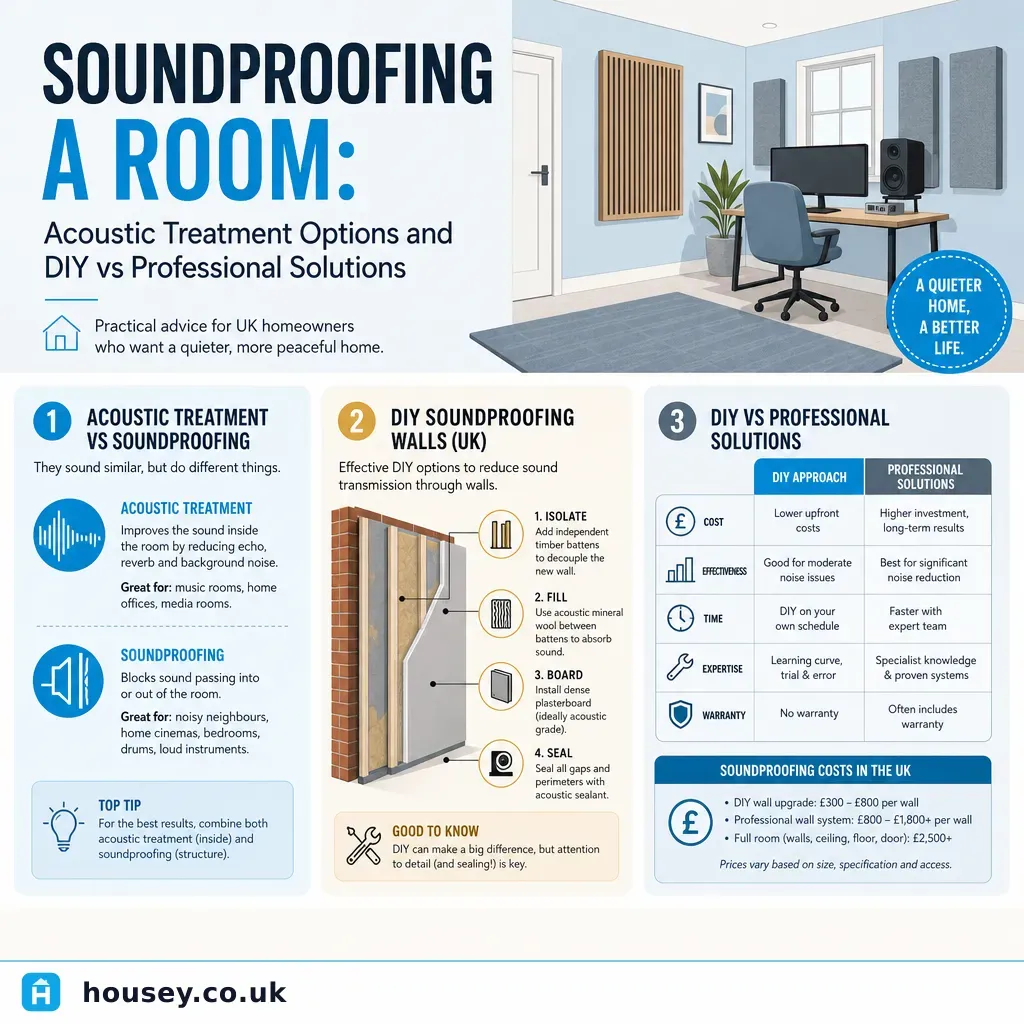
Soundproofing a Room: Acoustic Treatment Options and DIY vs Professional Solutions
Effective room soundproofing relies on four principles — mass, decoupling, absorption, and damping.
 Improvement & Build
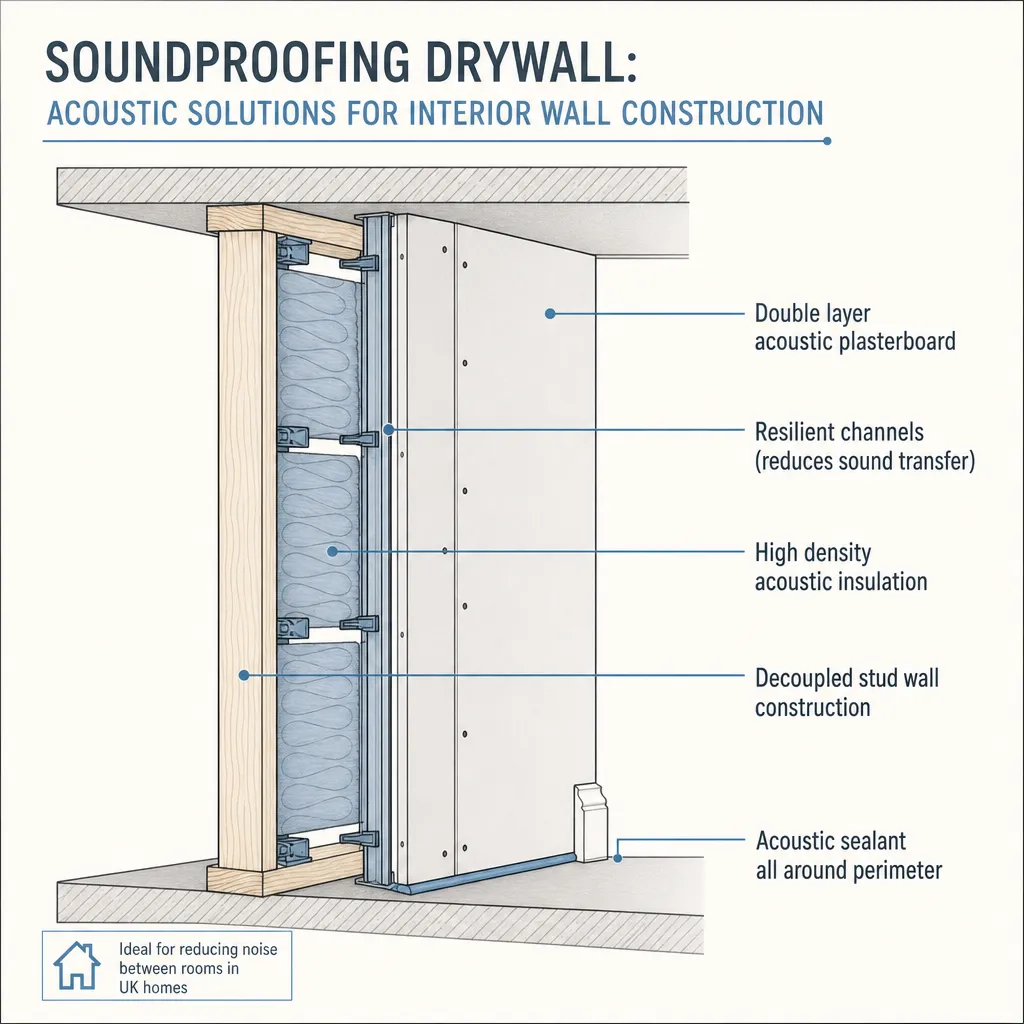
Soundproofing drywall: acoustic solutions for interior wall construction
Soundproofing drywall in UK homes typically combines acoustic plasterboard, resilient bar fixings, and mineral wool cavity fill to reduce airborne and structure-borne noise.
 Improvement & Build
Home Soundproofing: Noise Reduction Strategies for Living Spaces
Sound travels through homes via direct paths — walls and floors — and indirect flanking paths via the structure.
 Improvement & Build
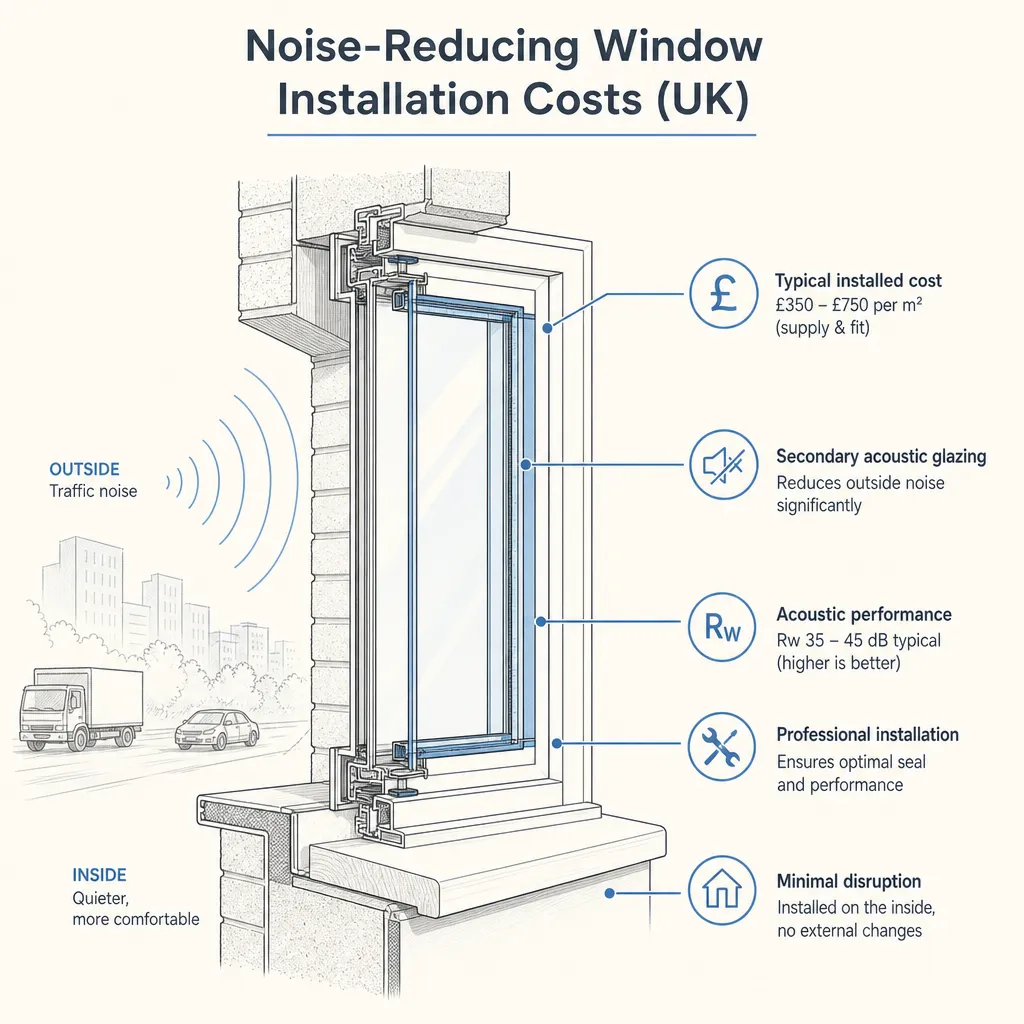
Noise-Reducing Window Installation Costs
Noise-reducing window installation in the UK typically costs £400–£1,500 per window depending on glazing specification, frame material, and property type.
 Improvement & Build
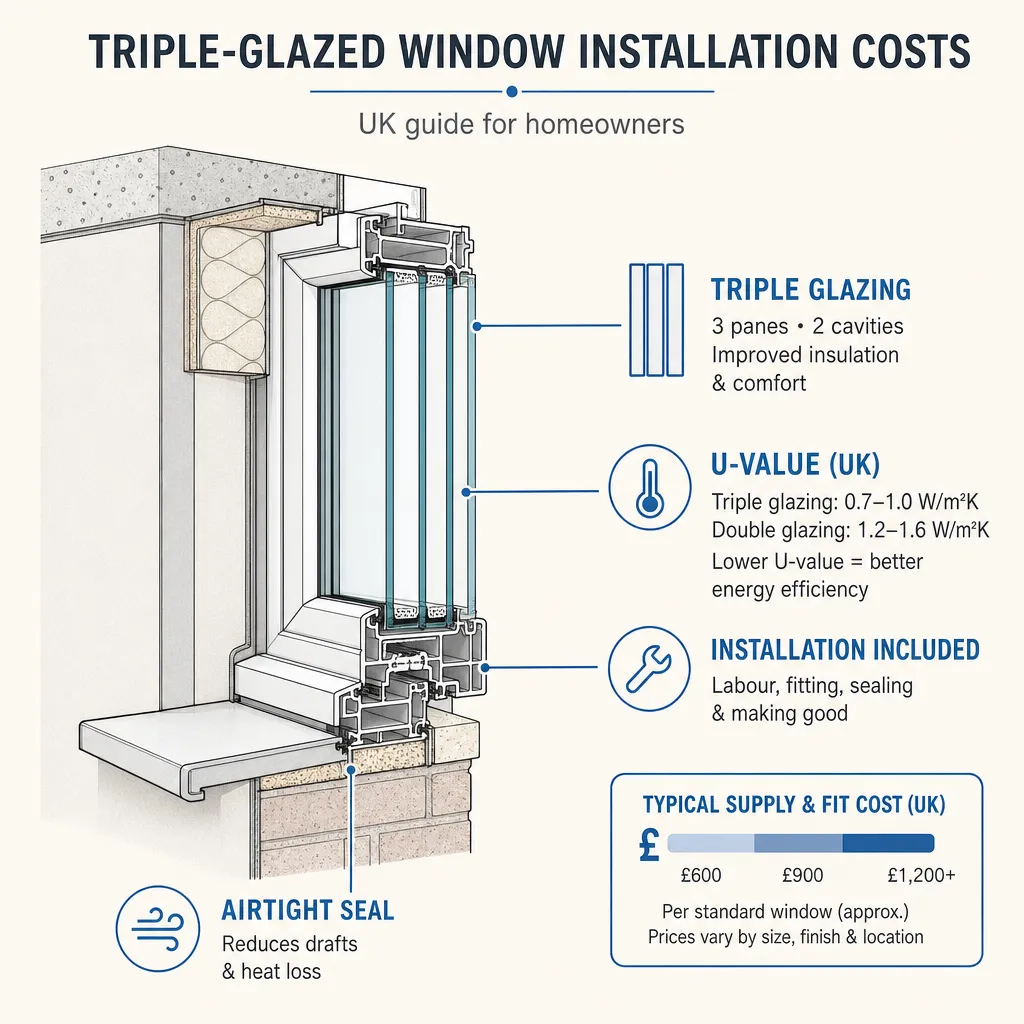
Triple-Glazed Window Installation Costs
Triple-glazed window installation in the UK typically costs £800–£1,800 per window, depending on size, frame material, and glazing specification.