Home Soundproofing: Noise Reduction Strategies for Living Spaces
By Housey · Last reviewed 18th of May 2026
Home Soundproofing: Noise Reduction Strategies for Living Spaces
Noise pollution inside the home takes many forms — traffic rumbling through bedroom windows, conversations carrying between floors, or the persistent thud of footsteps from an upstairs flat. For many UK homeowners and flat dwellers, noise is one of the most consistent quality-of-life issues, yet solutions are frequently misapplied because the source and travel path of the noise have not been properly identified first. Understanding how sound moves through a property is the practical starting point for any effective intervention.
Key points
- Flanking paths — sound travelling indirectly via floors, ceilings, or service runs rather than directly through a treated wall — explain many cases where targeted wall treatment alone fails to resolve a noise problem
- Secondary glazing can reduce airborne noise from outside by 40–45 dB when correctly specified, typically outperforming triple glazing for acoustic applications
- Building Regulations Approved Document E sets minimum sound insulation standards for new-build homes and material change of use conversions; many homes built before 2003 fall short of current standards
- Dense acoustic mineral wool such as Rockwool RW3 or Knauf Earthwool Acoustic in stud wall cavities significantly outperforms standard thermal building insulation for sound reduction
- In leasehold flats, floor and ceiling treatments typically require freeholder or management company consent — always check your lease before starting work
How sound moves through a home
Sound takes the path of least resistance and rarely travels in a straight line through a single building element. In a typical UK house or flat, sound reaches you via:
- Direct paths through walls and floors — the most obvious route; heavier, denser construction performs better but is rarely the only path
- Flanking paths — sound travelling through the structural floor, ceiling, or adjoining walls around a treated element rather than through it; this is why treating a party wall can seem to have little effect when sound is arriving via the floor junction
- Air gaps — electrical sockets on shared walls, gaps under doors, service penetrations, and poorly sealed window reveals can all transmit sound efficiently
- Rigid connections — a pipe running from one flat to another, or a radiator fixed directly to a party wall, can conduct vibration from a neighbour's space without passing through any insulated element
Effective noise reduction targets the dominant path first, which requires correctly diagnosing where the sound is actually travelling from.
Room-by-room noise reduction strategies
Bedrooms
Bedrooms are typically the most noise-sensitive space in the home, and the most common complaints involve external traffic noise through windows and airborne noise through party walls.
External noise: Secondary glazing is the most cost-effective window upgrade for acoustic performance. Unlike replacement double glazing, secondary glazing creates a wide air gap — typically 100–150 mm — between the primary and secondary pane, which is critical for acoustic attenuation. Correctly specified secondary glazing can achieve 40–45 dB reduction in external airborne noise. It is also the preferred solution for listed buildings and conservation areas where replacing the original window is not permitted.
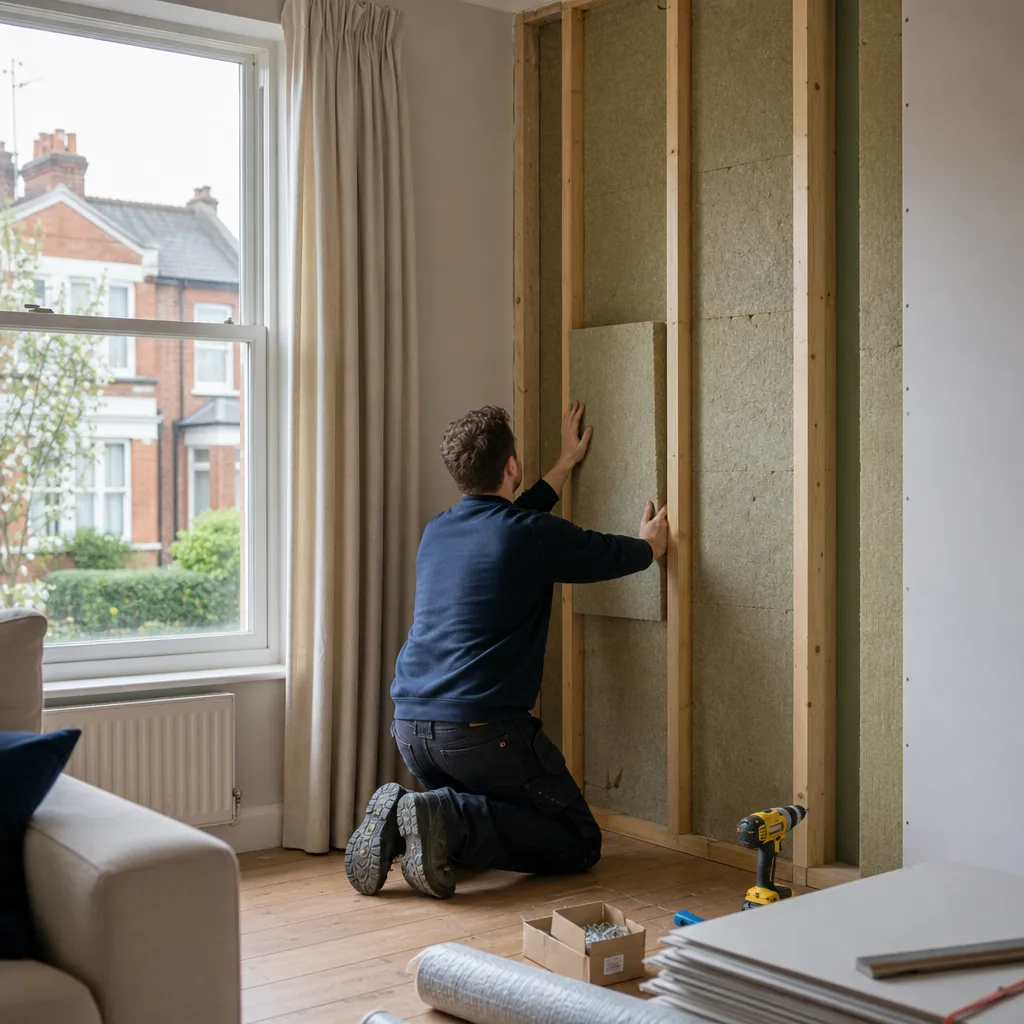
Party wall noise: Adding an independent wall lining — resilient bar decoupled from the existing structure, acoustic board, and dense mineral wool fill — can improve performance noticeably. However, flanking paths via the floor and ceiling frequently limit the gains achievable through wall treatment alone. Where noise is severe, a full independent double-stud wall with proper isolation is the most effective solution, but requires professional installation.
Living rooms and open-plan spaces
Living rooms typically face impact noise from above (in flats) and airborne transmission between adjacent rooms.
For impact noise from a floor above, the most effective approach is to treat the source floor. A floating floor system — a resilient mat below timber flooring, or an acoustic screed — addresses the noise at its origin. If you cannot access the floor above (for example, in a ground-floor flat), a resilient ceiling with isolation clips and acoustic board can help, though flanking paths limit results.
Heavy soft furnishings are often underestimated as a practical measure. Thick rugs, upholstered sofas, and heavy curtains with a thermal lining absorb high-frequency airborne sound within the room and reduce the perception of echo and harshness. They will not prevent loud impact noise from travelling between floors, but they meaningfully improve everyday acoustic comfort.
Home offices and studies
Home offices often need to control noise in both directions: reducing external sound for concentration, and reducing outward noise for calls and video meetings. A combination approach works well:
- Heavy curtains or acoustic blinds on windows facing traffic or a busy street
- A solid-core internal door — substantially heavier than the hollow-core doors fitted in many 1980s and 1990s properties — with a threshold seal to close the gap at floor level
- Fabric-wrapped acoustic panels on the walls behind and beside the desk to reduce echo and improve speech clarity on calls
Kitchens and utility rooms
Appliance noise — washing machines, tumble dryers, dishwashers — travels mainly as impact via the floor and as airborne noise through poorly fitted cabinetry. Anti-vibration mounts and adjustable feet under appliances are a low-cost first step. Ensuring appliances are not in direct rigid contact with walls or units reduces flanking transmission.
Comparison: noise reduction strategies by problem type
Problem | Primary intervention | Supporting measures | Professional needed? |
|---|---|---|---|
External traffic noise through window | Secondary glazing (100–150 mm air gap) | Heavy thermal curtains | Recommended for fitting |
Airborne noise through party wall | Resilient bar, acoustic board, and dense mineral wool fill | Address flanking paths through floor junction | Recommended for significant improvement |
Impact noise from floor above | Floating floor system at source, requires upper floor access | Resilient ceiling if upper floor is inaccessible | Yes for floating floor |
Noise between internal rooms | Solid-core door with acoustic threshold seal | Acoustic lining board to wall if needed | DIY possible for moderate improvement |
Appliance vibration | Anti-vibration mounts under appliances | Isolate from rigid wall and cabinet contact | DIY |
Home office echo and reverb | Fabric-wrapped acoustic panels | Heavy soft furnishings and thick rugs | DIY |
Indicative UK costs, last reviewed 2026-05-18. Obtain quotes for your specific property type and construction.
Common mistakes to avoid
Don't assume treating one surface is enough. If you line a party wall but ignore flanking via the floor junction, you may hear little improvement because sound is arriving via a different path. Always consider the complete sound pathway before committing to a solution.
Don't confuse acoustic foam with soundproofing. Foam panels reduce echo within a room but have no significant effect on sound transmission through walls or floors. They are the right product for a home studio or podcast booth — not for blocking neighbour noise.
Don't assume more layers mean better performance. Layers rigidly fixed to each other can perform worse than fewer properly decoupled layers. It is the isolation and decoupling, not the layer count alone, that drives acoustic performance.
Don't overlook the door. A hollow-core door with a gap at the threshold can undermine expensive wall treatment entirely. Doors and air gaps are frequently the weakest point in an otherwise well-treated room.
Don't start work in a leasehold flat without checking your lease. Alterations to floors, walls, and ceilings in leasehold properties typically require freeholder consent. Starting without consent can lead to remediation requirements and disputes.
Homeowner checklist: diagnosing your noise problem
When to get professional help
Professional help is worth engaging when:
- DIY measures have made no meaningful difference and the noise is affecting sleep or wellbeing
- You need to demonstrate compliance with Building Regulations Approved Document E (for example, for a conversion or a change of use)
- You are in a leasehold property and require a written specification to obtain freeholder consent for the works
- Noise is part of a dispute with a neighbour — an acoustic measurement report from a qualified professional provides objective evidence
- You are planning an extension or conversion and want acoustic performance specified from the outset
The Institute of Acoustics (IOA) and the Association of Noise Consultants (ANC) maintain member directories online.
How Housey can help
If your noise reduction work is part of a larger home improvement project — an extension, a conversion, or a full refurbishment — Housey can connect you with experienced extension builders who understand acoustic requirements and can coordinate with specialist acoustic trades. Request and compare quotes through the Housey platform to find the right team for your project.
Frequently asked questions
How effective is secondary glazing for reducing traffic noise?
Well-specified secondary glazing can reduce airborne noise from outside by 40–45 dB — significantly more than standard double glazing alone. Performance depends on the air gap (at least 100 mm is recommended for acoustic applications), the glass specification, and how well the secondary frame seals to the existing window reveal. Secondary glazing is particularly valuable in listed buildings and conservation areas where replacing the primary window is not permitted.
Does soundproofing a flat require freeholder consent?
In most leasehold flats, works affecting the structure — including floors, party walls, and ceilings — require consent from the freeholder or management company as set out in the lease. Works that add an internal lining without affecting the underlying structure may not need consent, but check with your solicitor or managing agent before proceeding to avoid disputes.
Can I reduce noise from neighbours in a Victorian terrace?
Victorian terraces typically have solid brick party walls (225–335 mm thick) that perform reasonably well for airborne sound but often suffer from flanking via the timber floor structure. Simple measures — thick rugs, heavy bookshelves against the party wall, and door seals — help with moderate noise. For significant noise, an independent wall lining with resilient bar and acoustic board gives the most consistent improvement.
Do I need Building Regulations approval for soundproofing work?
Internal soundproofing to an existing residential room does not usually require Building Regulations approval. If you are converting a garage, loft, or outbuilding into a habitable room, Approved Document E standards will apply. If you are changing the use of a building commercially, check with your local building control authority before starting work.
Sources and further reading
- Building Regulations Approved Document E: Resistance to the Passage of Sound — Ministry of Housing, Communities & Local Government
- Institute of Acoustics: member directory — Institute of Acoustics
- Association of Noise Consultants — Association of Noise Consultants
- Window glazing and noise reduction — Energy Saving Trust
Useful next reads
 Improvement & Build
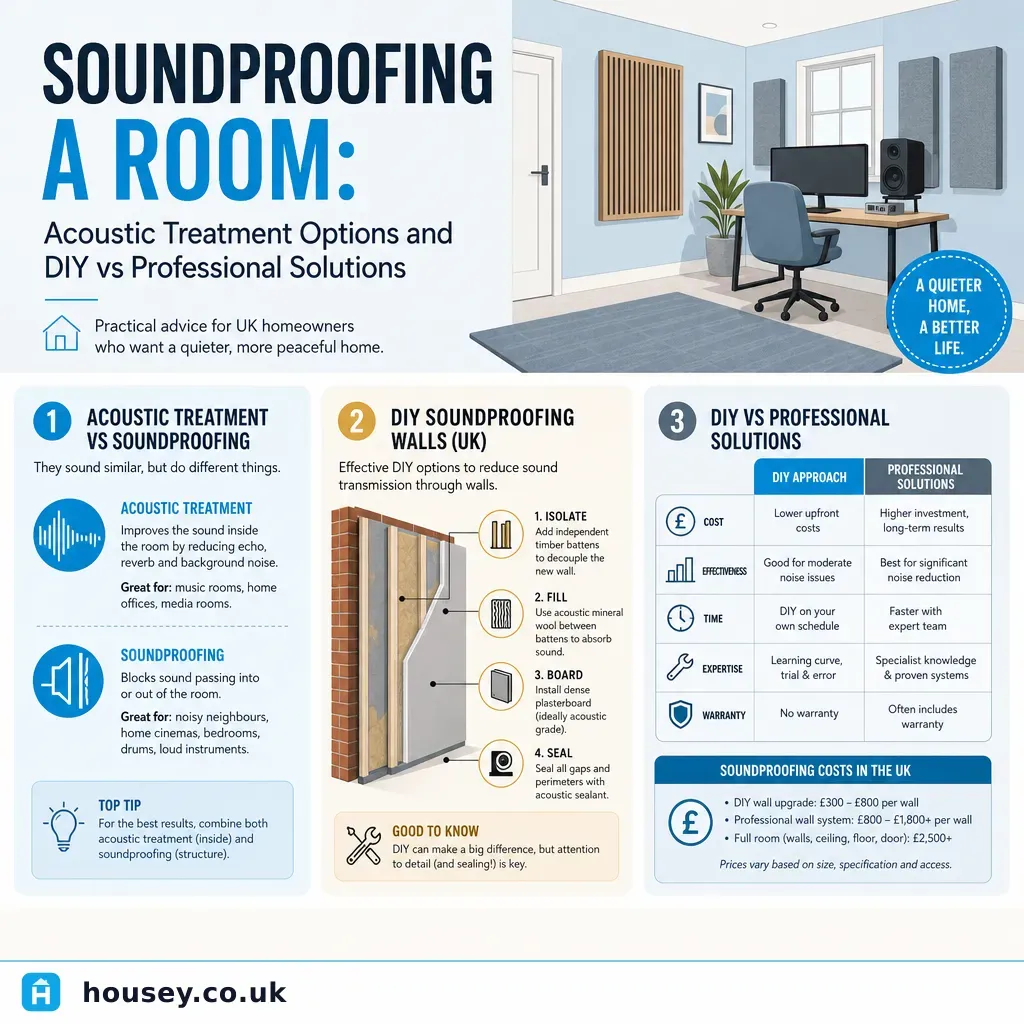
Soundproofing a Room: Acoustic Treatment Options and DIY vs Professional Solutions
Effective room soundproofing relies on four principles — mass, decoupling, absorption, and damping.
 Improvement & Build
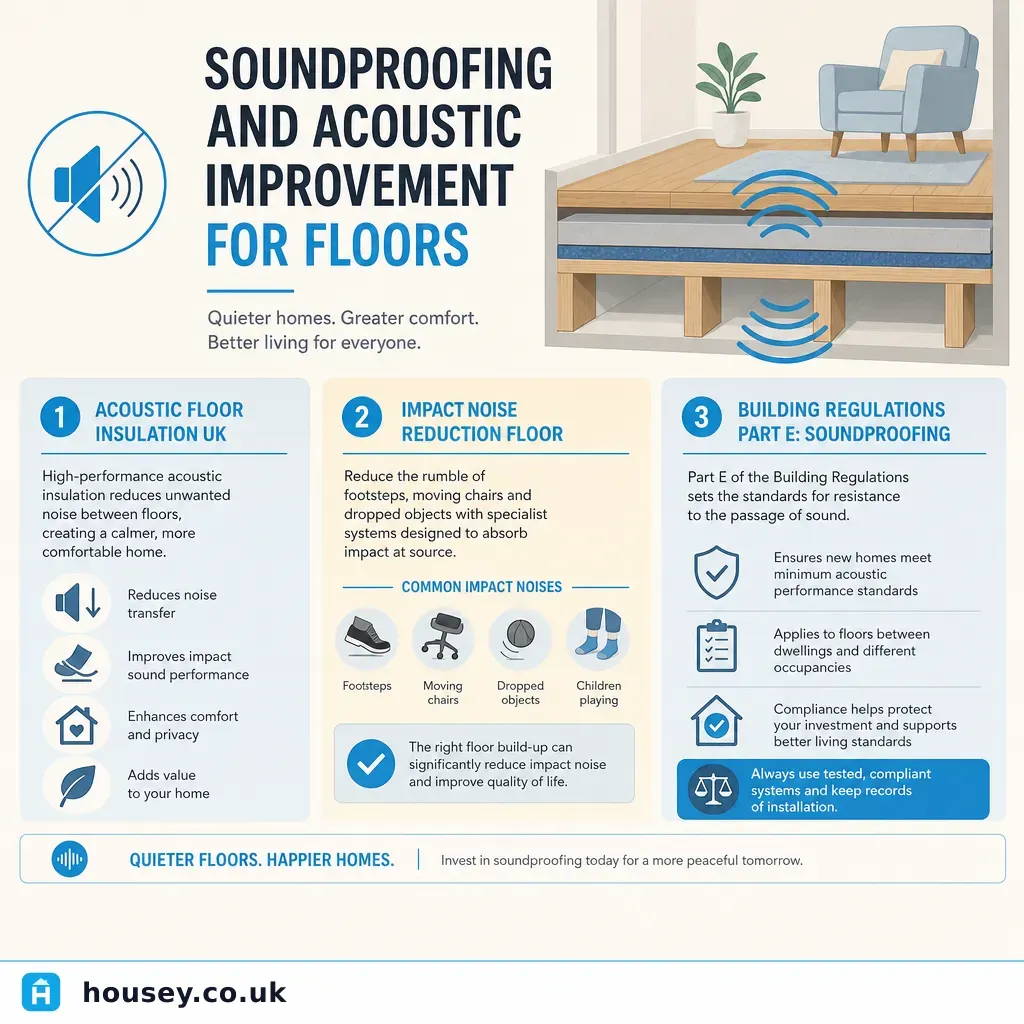
Soundproofing and Acoustic Improvement for Floors
Floor soundproofing requires different treatments for airborne noise (voices, music) and impact noise (footsteps).
 Improvement & Build
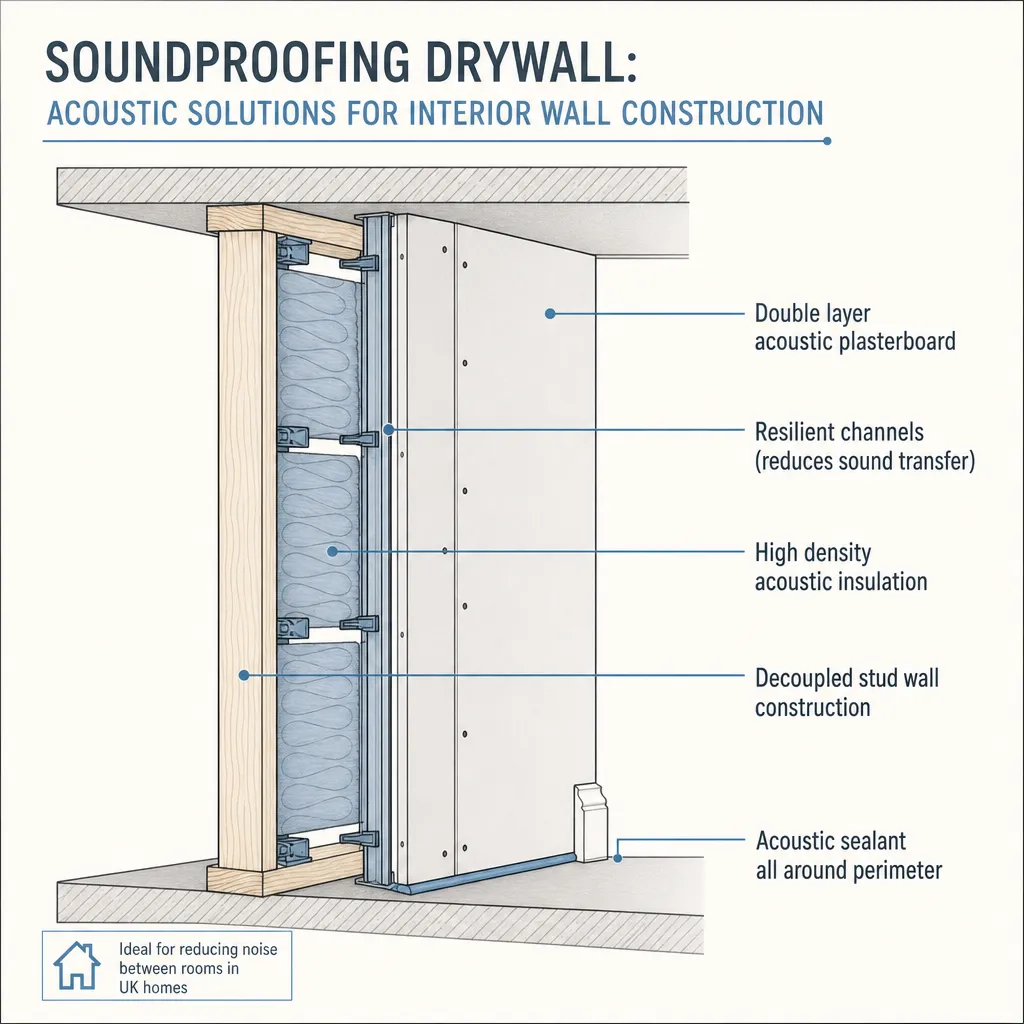
Soundproofing drywall: acoustic solutions for interior wall construction
Soundproofing drywall in UK homes typically combines acoustic plasterboard, resilient bar fixings, and mineral wool cavity fill to reduce airborne and structure-borne noise.
 Improvement & Build
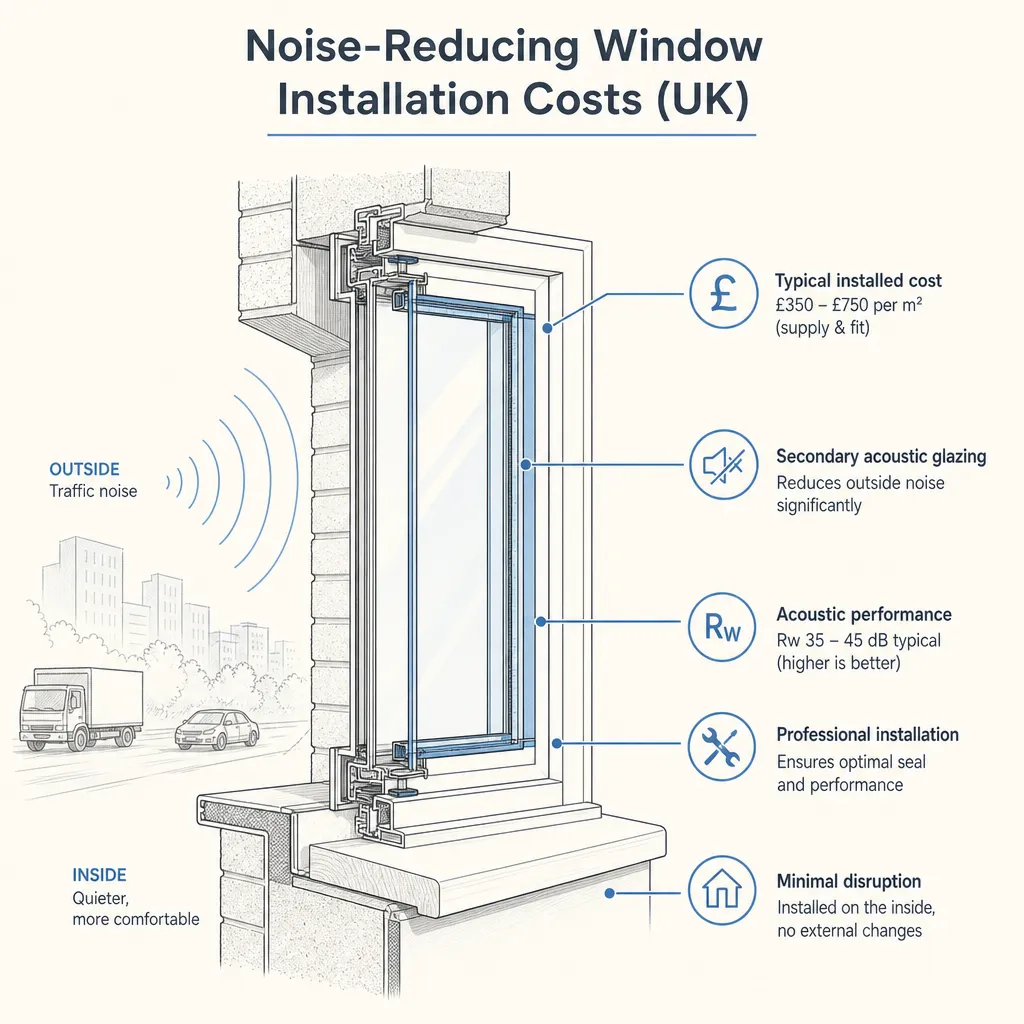
Noise-Reducing Window Installation Costs
Noise-reducing window installation in the UK typically costs £400–£1,500 per window depending on glazing specification, frame material, and property type.
 Improvement & Build
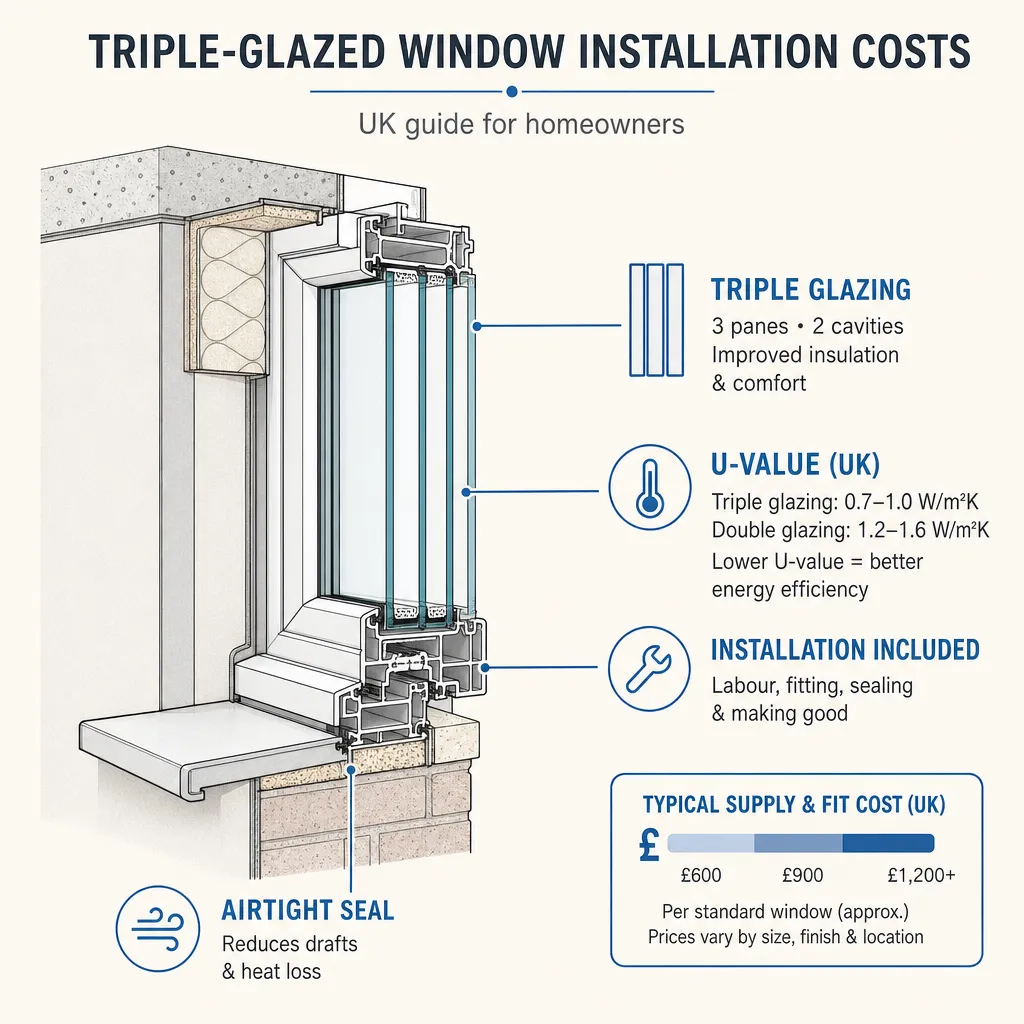
Triple-Glazed Window Installation Costs
Triple-glazed window installation in the UK typically costs £800–£1,800 per window, depending on size, frame material, and glazing specification.