Soundproofing drywall: acoustic solutions for interior wall construction
By Housey · Last reviewed 12th of May 2026
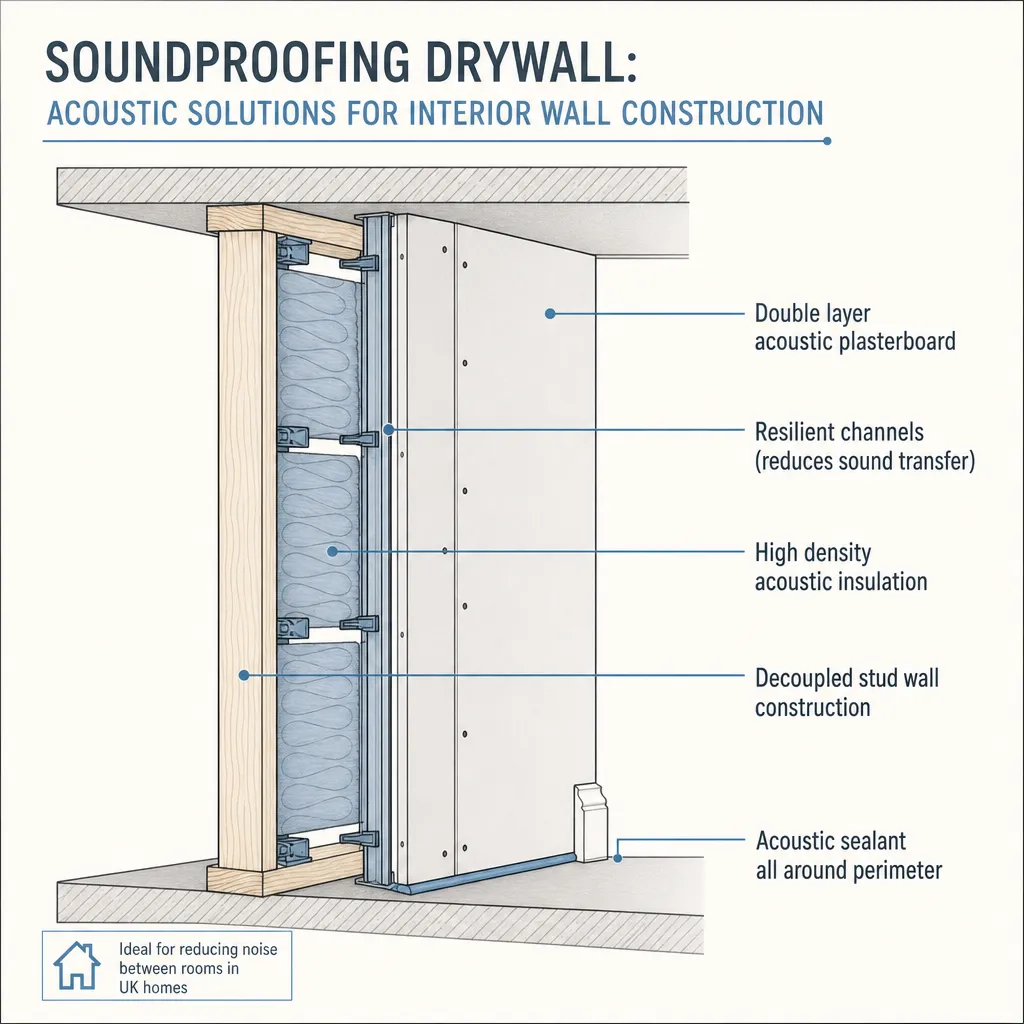
Soundproofing drywall: acoustic solutions for interior wall construction
Noise between rooms or adjacent dwellings is one of the most common quality-of-life complaints UK homeowners raise after building work. Whether you are partitioning a loft conversion, creating a home office, or separating a bedroom from a living area in a Victorian terrace, the drylining system and its installation detailing determine whether the wall genuinely attenuates noise or simply adds bulk. Getting the specification right before work begins saves significant cost and disruption later.
Key points
- Approved Document E of the Building Regulations requires separating walls between dwellings (new builds and conversions) to achieve a minimum 45 dB DnTw + Ctr in field conditions.
- Acoustic plasterboard such as British Gypsum Gyproc SoundBloc is denser than standard 12.5 mm board — mass is the primary mechanism for reducing airborne sound transmission.
- Resilient bar fixings decouple the plasterboard from the stud frame, breaking structure-borne vibration paths that mass alone cannot address.
- Adding 100 mm stone mineral wool (such as Rockwool RWA45) to a stud wall cavity improves sound reduction by approximately 10–15 dB compared with an empty cavity.
- Flanking transmission — noise travelling via floors, ceilings, and structural junctions rather than through the wall — accounts for many acoustic failures in otherwise well-specified drylining systems.
How sound travels through walls
Sound moves through walls via two mechanisms. Airborne sound — voices, music, television — causes the wall surface to vibrate, radiating energy into the next room. Structure-borne sound — footfall, banging pipes, mechanical vibration — travels directly through the building fabric.
Drywall systems address both through three principles:
Mass reduces airborne sound. A heavier board vibrates less readily, absorbing more acoustic energy. Standard 12.5 mm plasterboard has a surface mass of around 10 kg/m²; acoustic-grade boards typically reach 13–14 kg/m². Doubling standard boards is a cost-effective alternative to proprietary acoustic board.
Decoupling addresses structure-borne sound. Resilient bars — thin metal channels fixed horizontally to studs, with plasterboard screwed to the bar only — break the rigid connection between board and frame. Acoustic clips (such as the Genie Clip LB system) offer higher-performance decoupling at greater material cost.
Absorption reduces resonance within the cavity. An empty cavity amplifies certain frequencies. Stone mineral wool fills the space and dissipates energy. Products including Rockwool RWA45 and Isover Acoustic Partition Roll are widely specified for this purpose.
Comparing acoustic drywall systems
System | Best for | Typical Rw improvement | Main limitation |
|---|---|---|---|
Single-layer acoustic plasterboard (rigid-fixed) | Budget upgrades to internal partitions | +3–5 dB over standard board | No decoupling; limited structure-borne benefit |
Double-layer standard plasterboard (rigid-fixed) | Cost-effective mass increase | +5–8 dB | No decoupling; flanking still a risk |
Acoustic board + resilient bar + mineral wool | Bedrooms, home offices, separating walls | +10–18 dB | Screw bridging ruins performance if incorrectly fitted |
Independent twin-stud wall with full cavity fill | High-performance party walls, music rooms | +15–25 dB | Space loss of 100–150 mm depth; careful junction detailing required |
Acoustic clips + multiple board layers | Maximum-performance conversions | +20–30+ dB | Higher material cost; specialist fitting recommended |
Indicative figures only. Actual performance depends on wall construction, flanking paths, and workmanship. Indicative UK costs, last reviewed 2026-05-12.
Building Regulations compliance
For new dwellings and material change of use conversions (such as a house converted to flats), Approved Document E applies. Separating walls must achieve at least 45 dB DnTw + Ctr in field measurement. Pre-completion acoustic testing is required for conversions under Part E.
Internal partitions within a single dwelling do not fall under Part E minima, but may be subject to acoustic requirements imposed via planning conditions — common for properties near busy roads or commercial premises in mixed-use developments.
Always confirm with your building control body and local planning authority whether acoustic conditions apply to your specific project before specifying materials.
Red flags during installation
The most common reasons acoustic drylining underperforms are workmanship failures, not specification failures:
- Screw bridging: screws penetrating the resilient bar into the stud behind, creating a direct vibration path and negating decoupling entirely — the single most frequent installation failure.
- Mineral wool gaps: wool absent or compressed at corners, around pipes, or at electrical back boxes.
- Rigid fixings at junctions: skirting boards, coving, or service pipes carried rigidly through the acoustic break, bypassing it.
- Back-to-back electrical sockets: sockets cut into both faces of a separating wall at the same position, creating a thin weak point in the cavity.
- Unsealed floor and ceiling junctions: acoustic sealant should be applied at all perimeter junctions to close flanking paths through the structure.
- No pre-completion test: required for Part E-notifiable conversions — do not assume compliance without it.
What to ask before accepting a quote
- Does the specification reference a system test certificate (such as a British Gypsum or Knauf certified system), a target Rw value, or Approved Document E compliance?
- How will resilient bars be detailed at floor and ceiling junctions to prevent screw bridging?
- What acoustic sealant will be used at perimeter junctions, service penetrations, and pipe routes?
- Will electrical back boxes be offset on opposite faces of the wall and individually sealed?
- Who notifies building control, and how will pre-completion testing be arranged and paid for?
- Is the mineral wool specified to a density appropriate for acoustic performance (typically ≥33 kg/m³ for partition fill)?
When to get professional help
Most acoustic drylining is standard building work, but performance depends almost entirely on correct detailing. Seek specialist input if:
- The work involves separating walls between dwellings and falls under Part E of the Building Regulations
- Acoustic drylining has already been installed and performance is disappointing — a flanking noise assessment can identify transmission paths before remedial work begins
- Planning conditions specify a numerical decibel performance target
- The property is listed and structural interventions are restricted
- The noise source is mechanical, commercial, or the project involves a music room or home cinema
How Housey can help
For conversions, extensions, or internal remodels where acoustic performance is required from the outset, our extension builders and design-and-build firms can advise on system selection, specification, and Building Regulations compliance before work begins.
Frequently asked questions
Does acoustic plasterboard alone soundproof a wall?
Acoustic plasterboard increases mass and typically improves sound reduction by 3–5 dB over standard board. For meaningful noise reduction — especially against structure-borne sound — it should be combined with resilient bar decoupling and mineral wool cavity fill. Mass alone cannot address vibration transmitted through rigid fixings.
Do internal partitions need to comply with Building Regulations for sound?
Partitions within a single dwelling are not subject to Approved Document E minima. Separating walls between dwellings — including converted flats — must comply with Part E, and pre-completion acoustic testing is required for conversions. Planning conditions may also impose acoustic requirements on specific internal spaces.
How much does acoustic drylining typically cost in the UK?
A basic acoustic stud partition with mineral wool and acoustic plasterboard typically ranges from £60–£120 per m² supplied and installed. Independent twin-stud systems with acoustic clips and multiple board layers can reach £150–£250 per m² or more. Request itemised quotes specifying board grade, cavity depth, and junction treatment. Indicative UK costs, last reviewed 2026-05-12.
What is flanking noise and how do I reduce it?
Flanking noise travels around a wall via connected structural elements — floors, ceilings, adjacent walls, or service penetrations — rather than directly through it. Reduce it by sealing perimeter junctions with acoustic sealant, using resilient fixings throughout, separating skirting and coving from the acoustic break, and routing services within one leaf of the wall.
Sources and further reading
- Approved Document E: Resistance to the Passage of Sound — GOV.UK
- British Gypsum White Book — acoustic system specifications — British Gypsum
- Rockwool UK — acoustic insulation products — Rockwool UK
- Knauf UK — acoustic drywall technical systems — Knauf UK
Useful next reads
 Improvement & Build
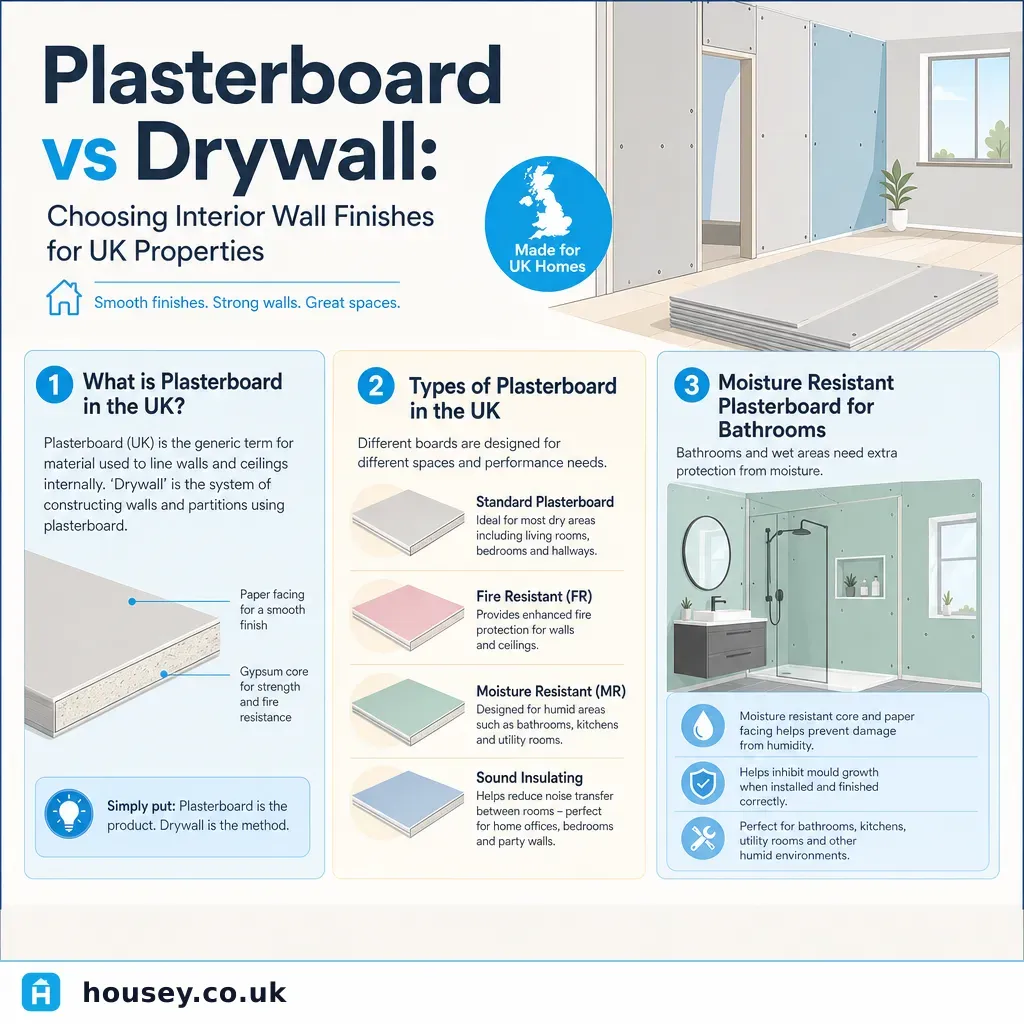
Plasterboard vs Drywall: Choosing Interior Wall Finishes for UK Properties
In the UK, plasterboard and drywall describe the same gypsum-core panel material.
 Improvement & Build
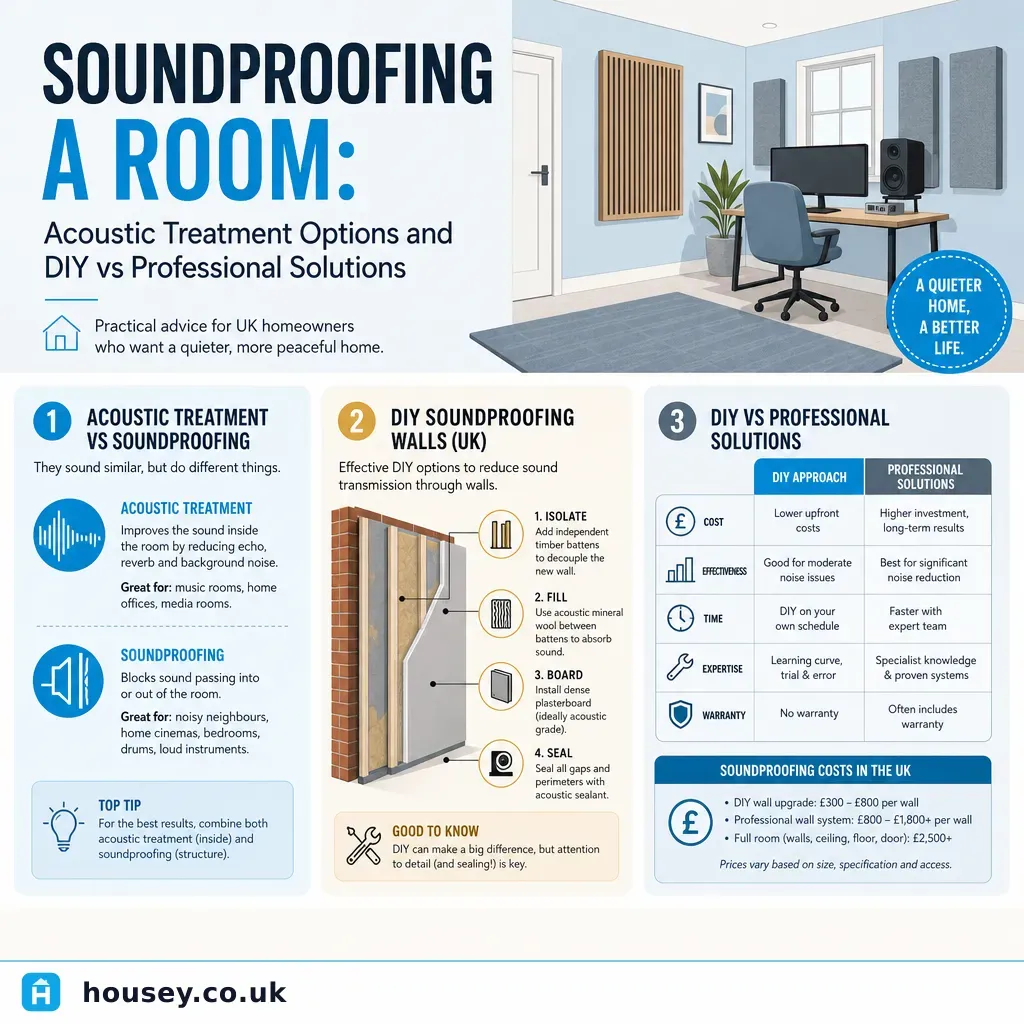
Soundproofing a Room: Acoustic Treatment Options and DIY vs Professional Solutions
Effective room soundproofing relies on four principles — mass, decoupling, absorption, and damping.
 Improvement & Build
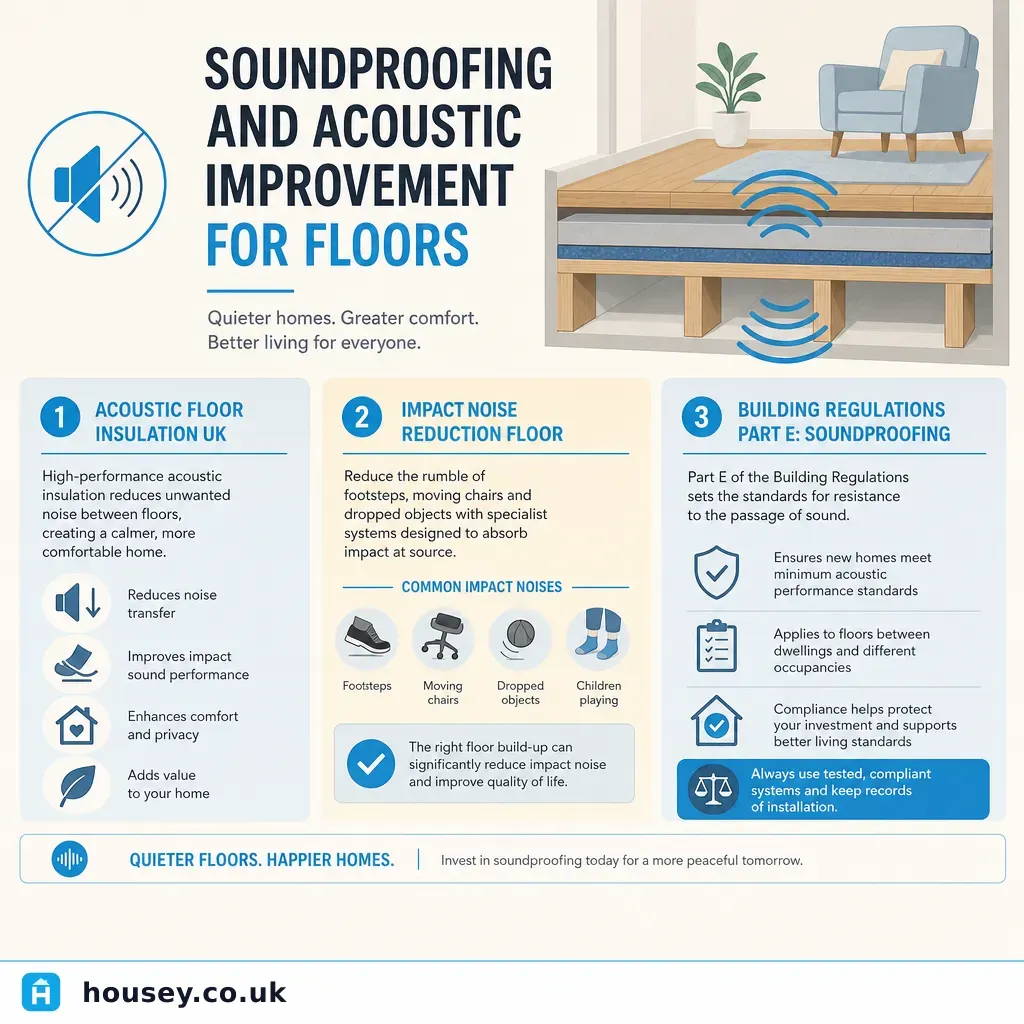
Soundproofing and Acoustic Improvement for Floors
Floor soundproofing requires different treatments for airborne noise (voices, music) and impact noise (footsteps).
 Improvement & Build
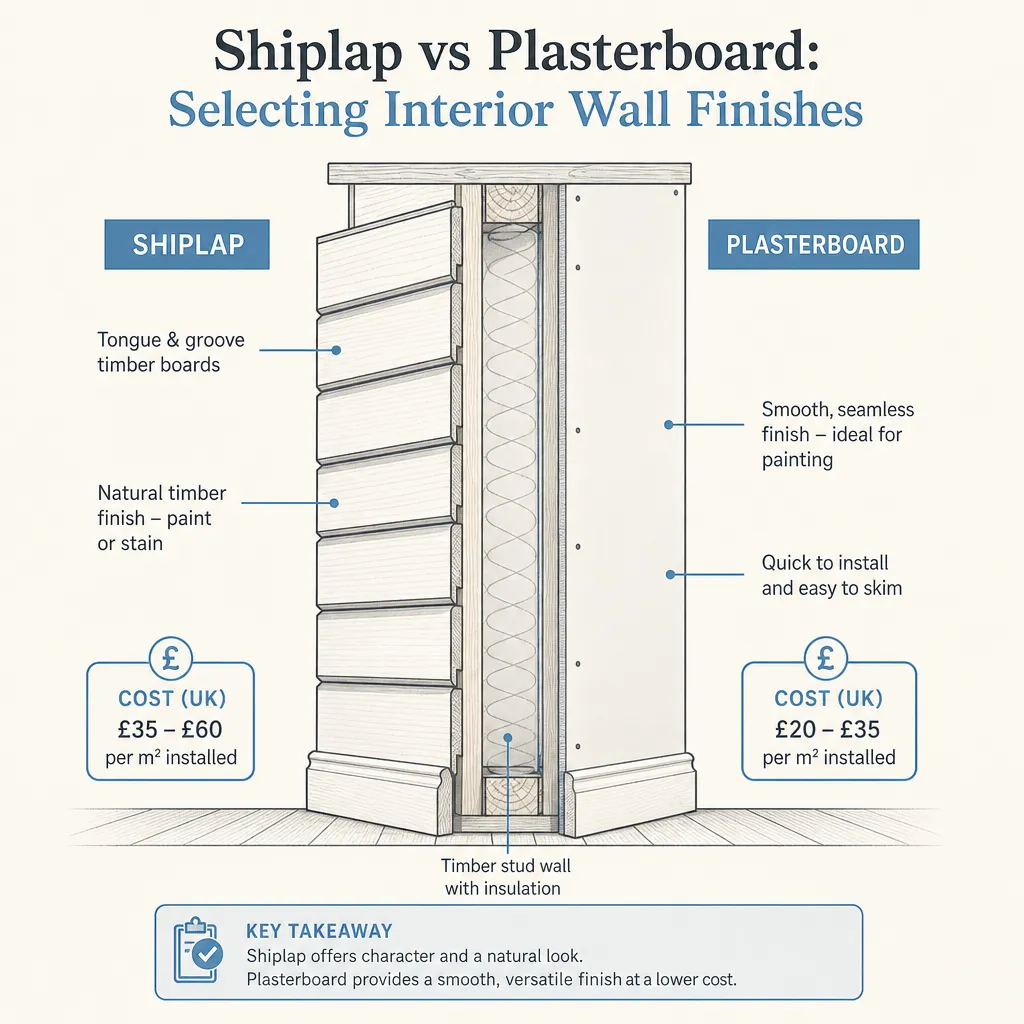
Shiplap vs Plasterboard: Selecting Interior Wall Finishes
Plasterboard is the standard interior wall finish for most UK homes and extensions, offering a smooth, paintable surface at lower cost.
 Improvement & Build
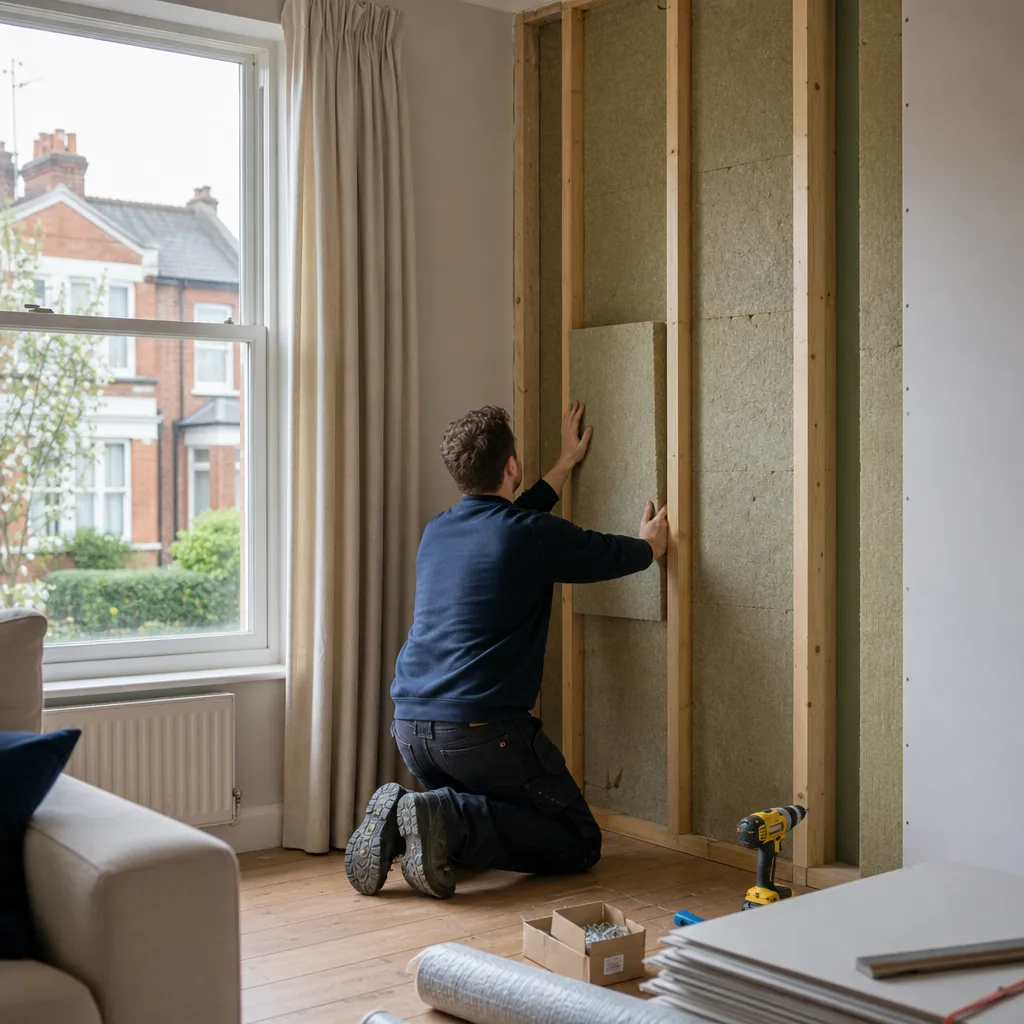
Home Soundproofing: Noise Reduction Strategies for Living Spaces
Sound travels through homes via direct paths — walls and floors — and indirect flanking paths via the structure.