Foundation Piling and Deep Foundation Costs
By Housey · Last reviewed 8th of May 2026
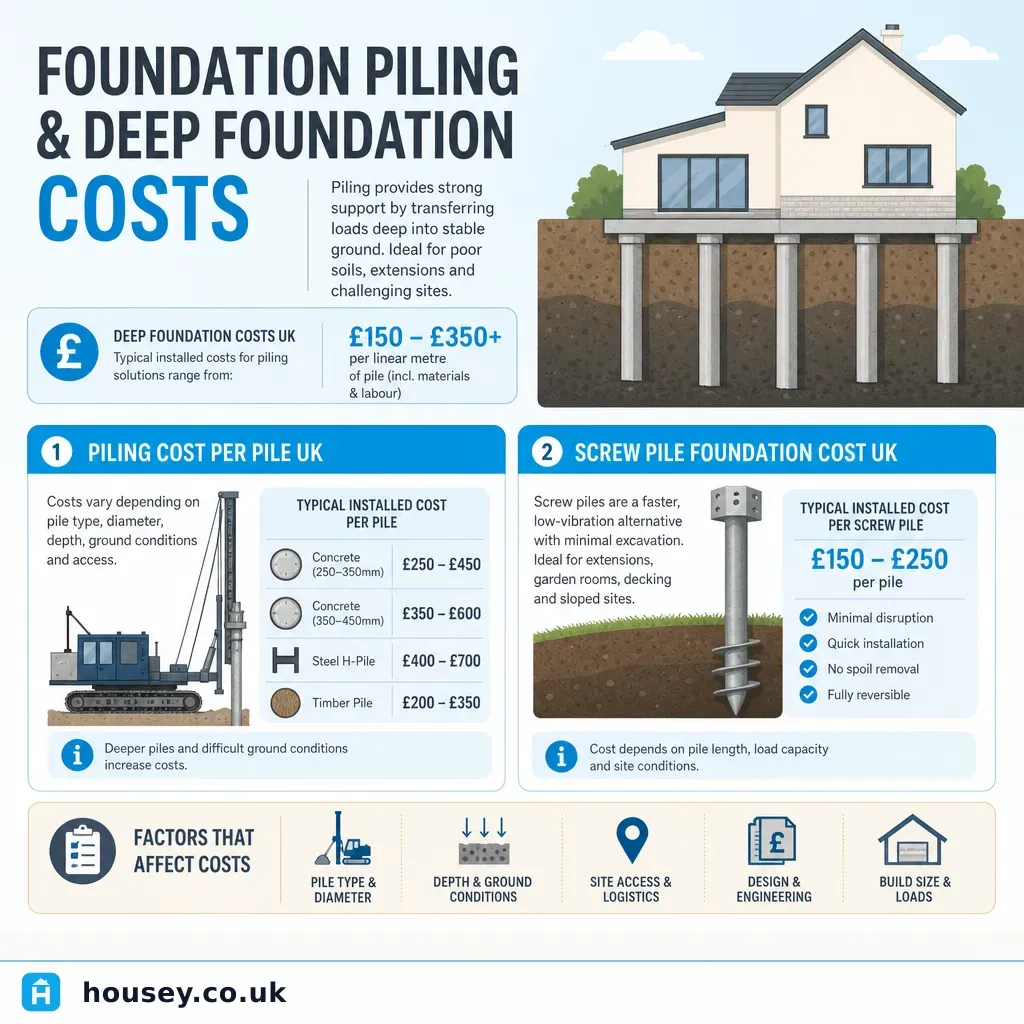
Foundation Piling and Deep Foundation Costs
Deciding whether a project needs piled foundations — and which system to specify — is one of the most consequential pre-build decisions in residential construction. The question typically arises after a ground investigation reveals unsuitable bearing capacity, significant made ground, or the influence of mature trees on shrinkable clay. Getting the specification wrong is expensive to rectify once building has begun, and building control will not sign off foundations that are under-designed.
Key points
- A structural engineer must specify piling requirements; no contractor should design a piled foundation system without a qualified engineer's involvement.
- A ground investigation to BS 5930 — usually a Phase 1 desk study followed by a Phase 2 site investigation with trial pits and boreholes — is required before pile type and depth can be reliably determined.
- Building Regulations Approved Document A (Structure) applies to all piled foundations; building control approval is required before work commences.
- Indicative total costs for domestic piling projects range from approximately £8,000 to £30,000+, depending on pile type, number, depth, and ground conditions (indicative UK costs, last reviewed 2026-05-08).
- The most common systems in domestic construction are screw (helical) piles, mini piles, and CFA (continuous flight auger) piles, each suited to different ground conditions and load requirements.
When are piled foundations needed?
Conventional strip or pad foundations work on stable, competent ground. Piling becomes necessary when:
- Made ground or fill: Land that has been built on, filled, or landscaped over decades may have variable or unstable soil layers unable to support conventional foundations at shallow depth.
- Shrinkable clay: In much of the South East, Midlands, and parts of the North, London Clay and similar shrinkable soils expand and contract with moisture. Nearby tree roots amplify this movement. Building Regulations and NHBC guidance require deeper foundations where trees fall within influence distance.
- High water table: Saturated ground reduces bearing capacity and complicates conventional excavations, particularly on low-lying or riverside sites.
- Brownfield or contaminated sites: Previously developed land often has variable fill, voids, and unknown obstructions that make traditional foundations unreliable.
- Proximity to existing structures: Extensions close to existing foundations may need to go deeper to avoid undermining them.
- Steep or unstable slopes: Slope stability analysis may indicate that only a pile-and-beam system provides adequate resistance to lateral movement.
Which piling system is right for your project?
Decision guide
- Choose screw (helical) piles if ground conditions are soft to medium clays or loose sands, the project is a modest extension or lightweight structure, and noise or vibration must be minimised near neighbouring properties.
- Choose mini piles if access is restricted — inside an existing building, a narrow garden, or under low headroom — or if ground is variable with potential buried obstructions.
- Choose CFA (continuous flight auger) piles if the project involves larger loads, deeper competent strata are required, and a full-sized piling rig can access the site without difficulty.
- Choose driven piles if high load capacity is needed and the vibration impact on adjacent properties and structures has been assessed and found acceptable.
- Ask a structural engineer and geotechnical specialist if ground investigation results are complex, contamination is present, or the building is near a slope, retaining wall, embankment, or existing deep foundations.
Comparison table: domestic piling systems
Pile type | Typical use | Depth range | Noise/vibration | Indicative cost per pile |
|---|---|---|---|---|
Screw (helical) pile | Light structures, extensions | 3–8m | Low | £150–£400 |
Mini pile | Restricted access, variable ground | 5–15m | Low–moderate | £200–£600 |
CFA pile | Larger loads, open access sites | 10–25m | Low | £300–£800 |
Driven (pre-cast) pile | High loads, stable open sites | 10–20m | High | £250–£600 |
Indicative UK cost per pile, excluding mobilisation, pile caps, ground beams, structural engineer fees, and VAT. Last reviewed 2026-05-08. Total project costs will be substantially higher.
What does a domestic piling project cost in total?
Total cost depends on far more than the per-pile rate. Key components include:
- Ground investigation: £1,500–£5,000+ for trial pits, boreholes, and laboratory testing, depending on number of test locations and site complexity.
- Structural engineer fees: £1,500–£5,000+ for pile specification, load calculations, pile cap and ground beam design, and construction-phase inspection.
- Piling contractor mobilisation: Specialist rigs attract a mobilisation charge of £1,000–£3,000 regardless of project scale.
- Pile caps and ground beams: The reinforced concrete elements connecting piles to the structure above can add £3,000–£10,000+.
- Number of piles: A modest single-storey extension might require 6–12 piles; a larger new build may need 20 or more.
Indicative total costs for domestic piling projects (UK), last reviewed 2026-05-08:
Project type | Approximate total cost range |
|---|---|
Single-storey extension (screw piles, straightforward conditions) | £8,000–£15,000 |
Single-storey extension (mini piles, difficult ground) | £12,000–£22,000 |
New domestic dwelling (CFA piles, open access) | £20,000–£45,000+ |
Underpinning via piling (existing building) | £15,000–£40,000+ |
These ranges are for initial budget planning only. Actual costs for your project depend on a specific ground investigation and structural engineer's specification. Obtain at least three competitive quotes based on that documented specification before committing.
Worked UK property scenario
A homeowner in South London plans a two-storey side extension to a 1930s semi-detached property. A large mature oak stands in the rear garden. A Phase 1 desk study flags shrinkable clay (Lambeth Group) and potential root influence. A Phase 2 investigation — two trial pits and one borehole — confirms NHBC Zone 3 classification.
The structural engineer specifies 12 mini piles at 8m depth to reach the stable Thanet Sands below the clay, plus reinforced concrete pile caps and a ground beam ring. The piling contractor quotes £14,500 for installation. Pile caps and ground beams add £6,000. Structural engineering fees and site investigation together cost £4,500.
Total foundation package: approximately £25,000 — a significant premium over the strip foundation cost that would have applied on a stable site, but the only compliant solution given ground conditions and tree influence.
Important limitations
This article provides general cost guidance for UK residential piling projects only. Foundation design is a matter of structural safety and Building Regulations compliance. The appropriate pile type, depth, diameter, and specification can only be determined following a site-specific ground investigation and assessment by a qualified structural or geotechnical engineer. Costs stated here are indicative ranges based on typical UK market data as of 2026-05-08 — actual costs for your project may differ substantially depending on ground conditions, access, location, and contractor availability. Do not commission piling work without building control approval and a structural engineer's written specification.
What to ask a qualified professional
Questions for your structural engineer
- What pile type, diameter, and depth do you recommend based on the ground investigation report?
- What further investigation, if any, do you need before you can finalise the specification?
- What building control submissions will you prepare, and are inspection visits during installation included in your fee?
- Will you design the pile caps and ground beams, or is that a separate scope?
- What records, load test requirements, or integrity test certificates do you expect the piling contractor to provide?
Questions for your piling contractor
- What accreditations do you hold? (Look for CHAS, Constructionline, or SMAS Worksafe as a minimum.)
- What is included in the mobilisation charge, and how is it calculated?
- Who is responsible for pile caps and ground beams — is it in your scope or a separate contractor?
- How will spoil be managed and removed, and are there any surcharges for contaminated material?
- What completion documentation, as-built drawings, and test certificates will you provide?
- Is VAT included in the price quoted?
When to get professional help
Always involve a structural engineer before committing to any piled foundation solution. Seek professional input immediately if:
- Any contractor advises you to proceed with piling without having reviewed a ground investigation report — this is a clear red flag.
- Your site has known or suspected contamination, buried structures, or a history of industrial use.
- You are building within the root protection area of a protected or veteran tree.
- Cracks, settlement, or subsidence are visible in an existing structure you plan to extend.
- The site is in a flood zone, near a watercourse, embankment, or slope requiring stability assessment.
How Housey can help
Housey connects you with qualified civil engineers who can assess your ground conditions and produce a compliant foundation specification, and specialist geotechnical investigation contractors to carry out the site investigation required before any piling design can begin. Request quotes through Housey to compare expertise, scope, and fees from local professionals before committing to any design.
Frequently asked questions
Do I need planning permission for piled foundations?
Planning permission is not usually required for the piling method itself. However, the building project it supports — such as an extension or new dwelling — may require planning permission separately. Building regulations approval is always required for structural foundations, including piling. Check with your local planning authority and building control before starting any work.
How long does a domestic piling project take?
For a modest domestic extension of 8–15 piles, installation typically takes one to three days once the rig is on site. Mobilisation, pile cap construction, and ground beam work add further time — allow two to four weeks for the complete substructure phase. Ground investigation and structural design should be completed several weeks before piling begins.
Can piling be done inside an existing house or with restricted access?
Yes. Mini piling rigs are specifically designed for restricted access, including low-headroom underpinning inside existing buildings and narrow rear gardens. Some rigs operate in openings as small as 900mm wide. Your piling contractor should assess and confirm site access requirements before quoting, as access constraints affect both feasibility and cost.
Is ground investigation always needed before piling?
Yes, in practice. Without a Phase 2 ground investigation — trial pits and boreholes — it is not possible to reliably specify pile type, diameter, or depth. A structural engineer bases their design on this data. Attempting to pile without it risks under-designed foundations, unexpected obstructions, and building control rejection.
What is the difference between screw piles and mini piles?
Screw (helical) piles are rotated into the ground like a corkscrew, producing minimal spoil and low noise. They suit softer soils but can struggle in made ground with buried obstructions. Mini piles are drilled and grouted, making them more versatile in variable or contaminated ground with potential obstructions. Your structural engineer will advise which is appropriate for your site conditions.
Sources and further reading
- Building Regulations Approved Document A: Structure — GOV.UK
- NHBC Standards Chapter 4.2: Building Near Trees — NHBC
- ICE Geotechnical Engineering guidance — Institution of Civil Engineers
- IStructE guidance for housing — Institution of Structural Engineers
Useful next reads
 Planning & Pre-Build
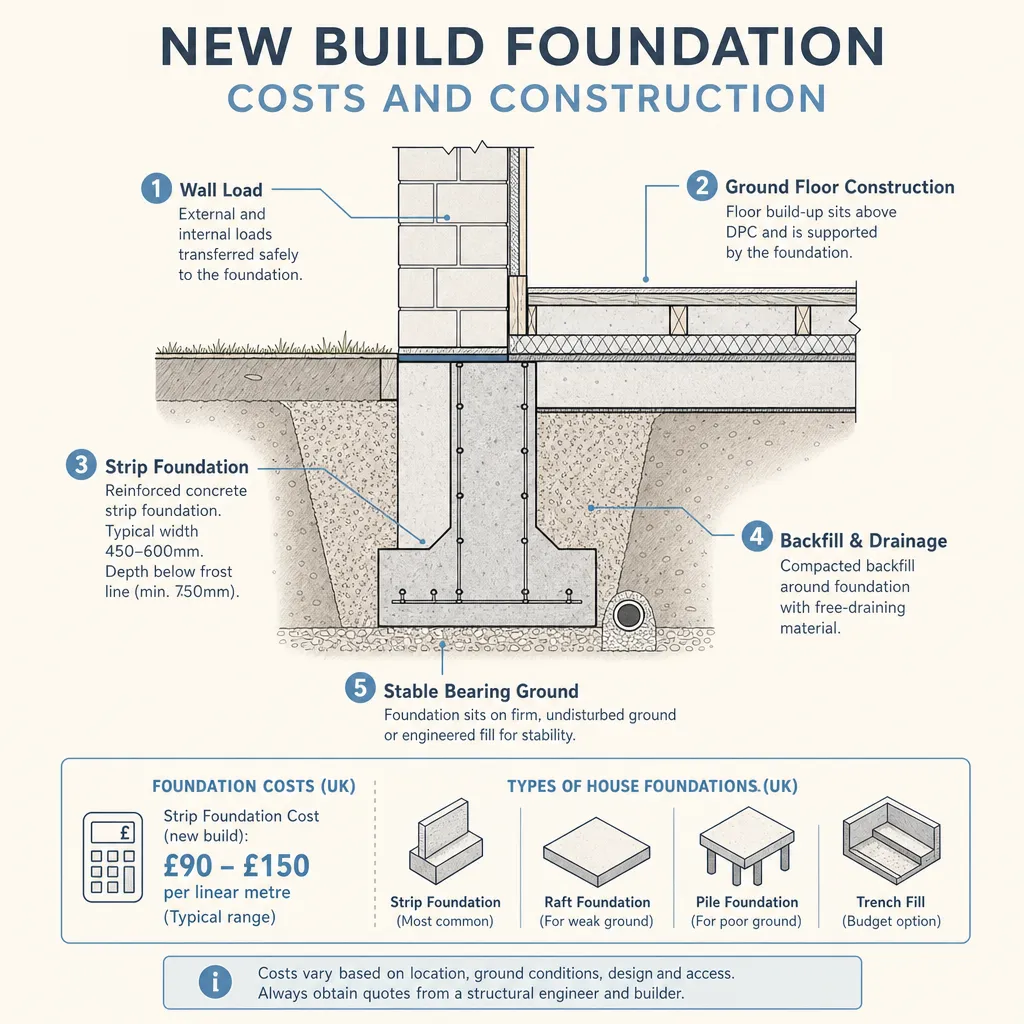
New Build Foundation Costs and Construction
In the UK, new build foundation costs typically range from £5,000 to £30,000 or more, depending on foundation type, site conditions, ground investigation findings, and build size.
 Planning & Pre-Build
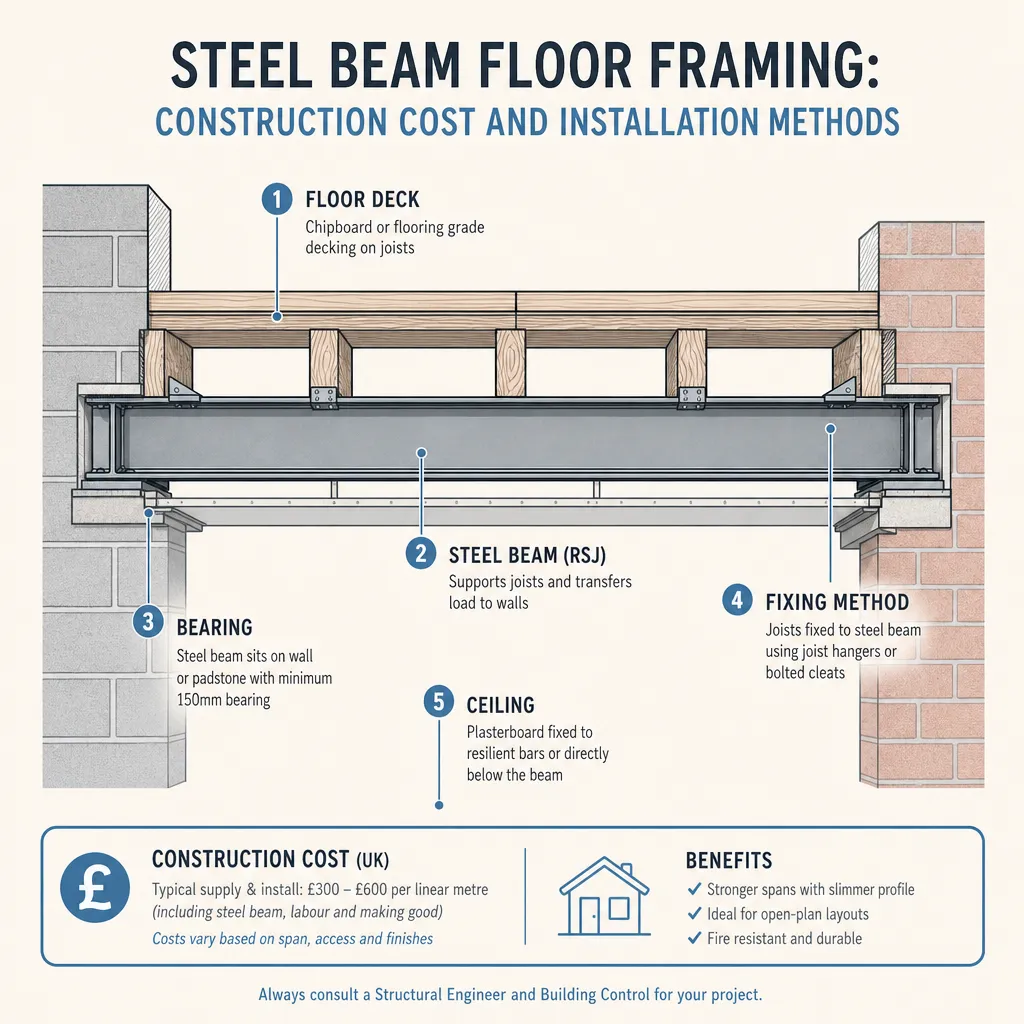
Steel Beam Floor Framing: Construction Cost and Installation Methods
Steel beam floor framing is used in UK homes when spans are too wide for timber joists, or when a load-bearing wall is removed.
 Planning & Pre-Build
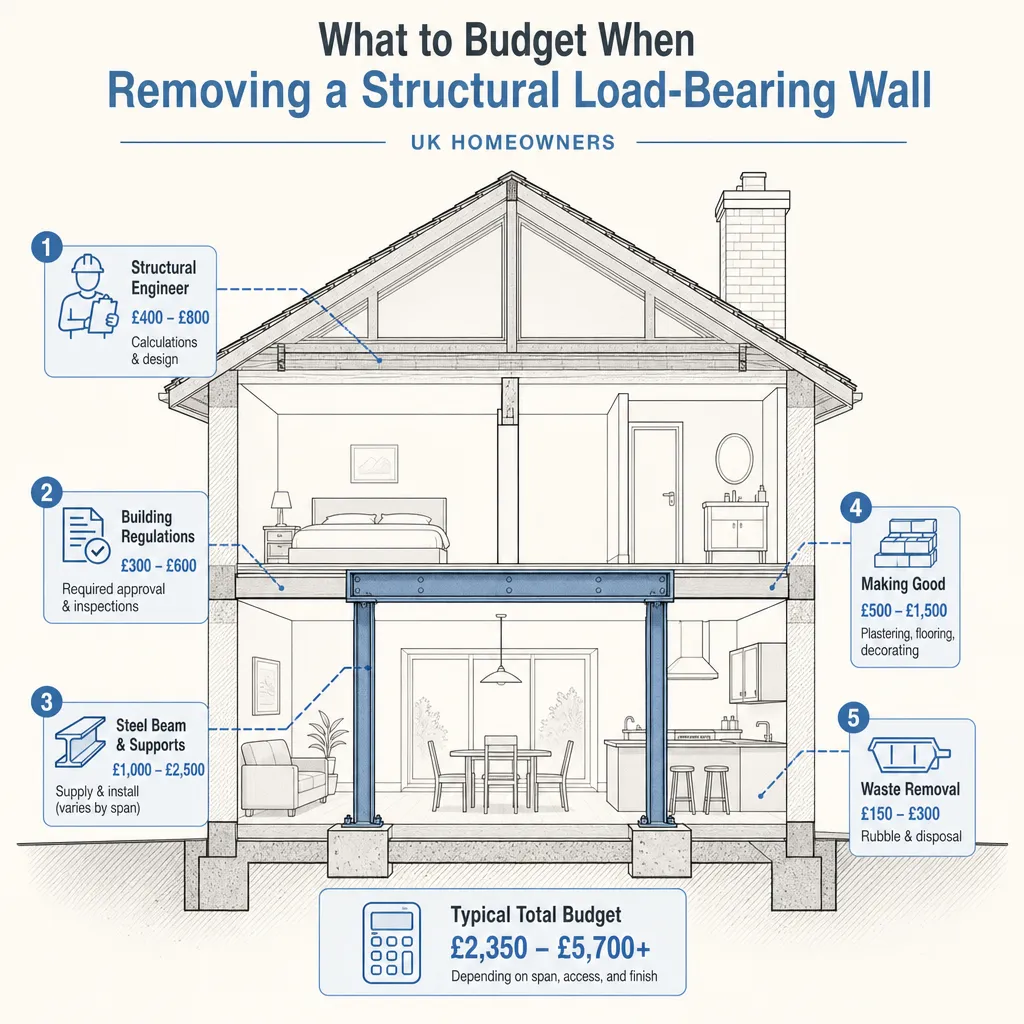
What to Budget When Removing a Structural Load-Bearing Wall
Removing a load-bearing wall in a typical UK home costs £2,500–£8,000 or more in total, covering a structural engineer's calculations, Building Regulations approval, the steel beam, builder's labour, and replastering.
 Planning & Pre-Build
Structural Arching in Walls: Load Distribution and Design
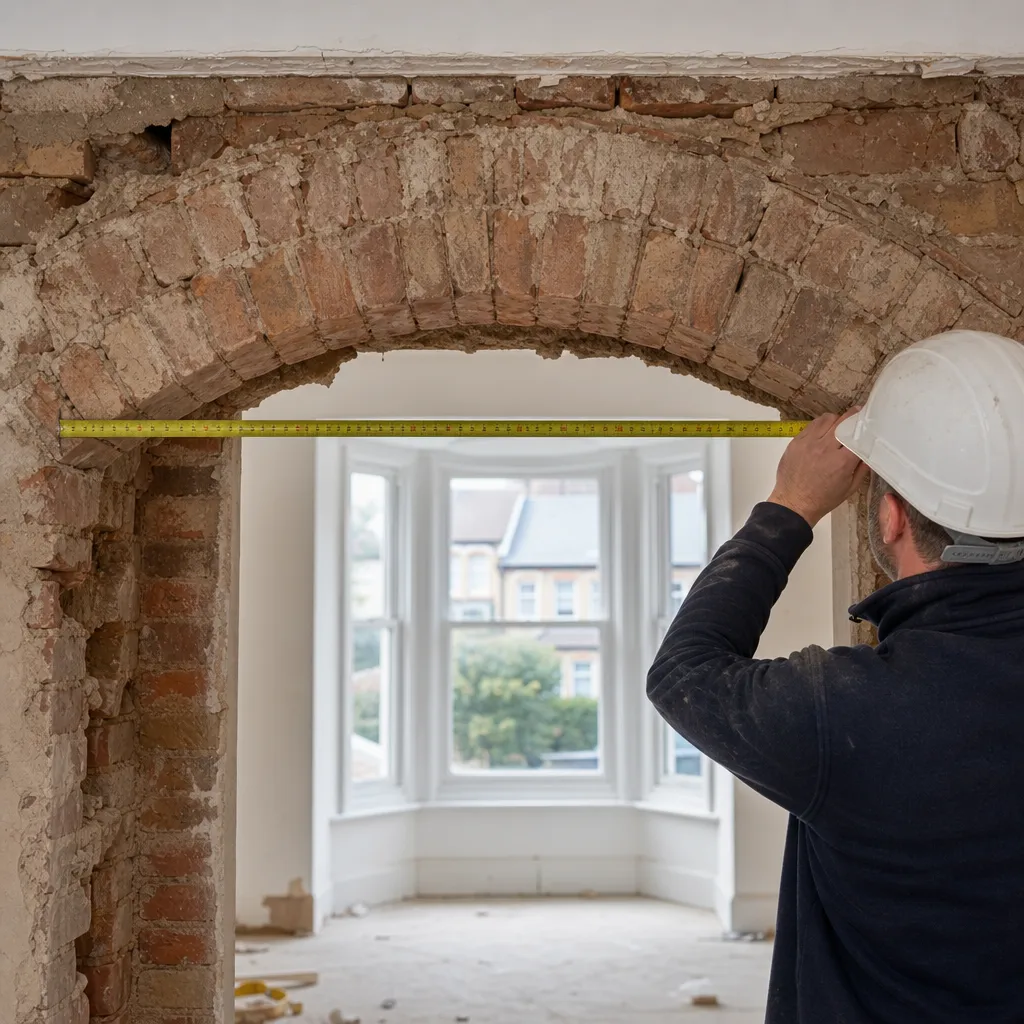
Structural arching occurs when masonry redistributes compressive loads in a triangular or parabolic path around an opening, reducing the load on the lintel below.
 Planning & Pre-Build
Structural Wall Removal: Safety Considerations and Professional Requirements
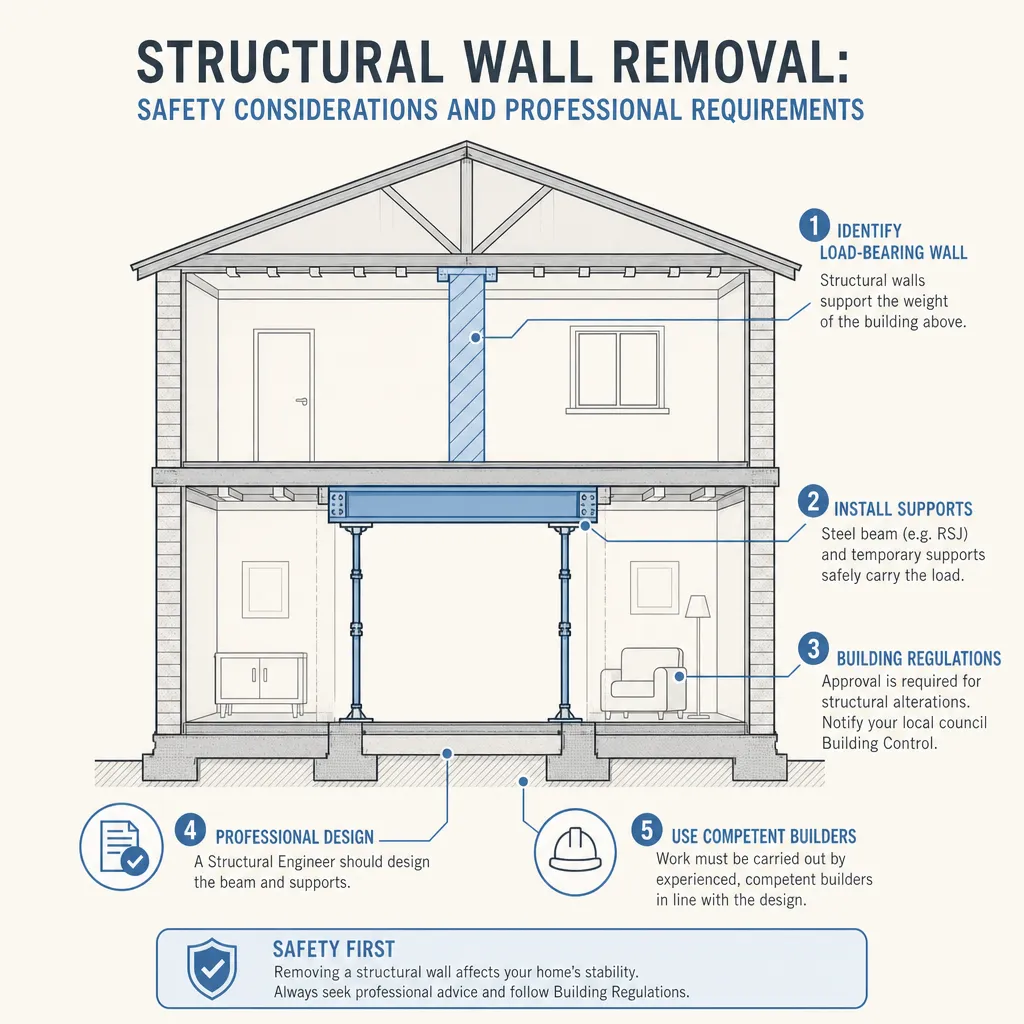
Removing a load-bearing wall in the UK always requires Building Regulations approval under Approved Document A, plus a structural engineer's beam calculation before any demolition begins.