New Build Foundation Costs and Construction
By Housey · Last reviewed 7th of May 2026
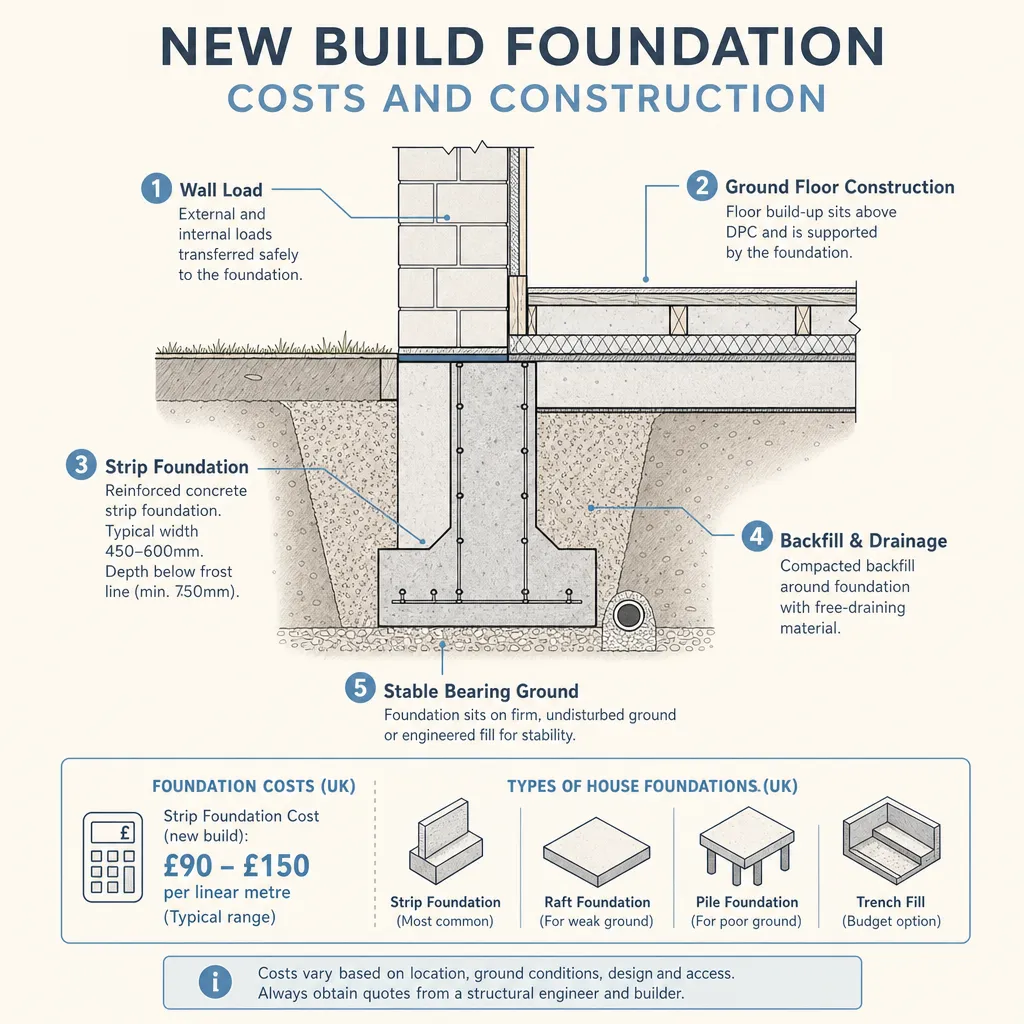
New Build Foundation Costs and Construction
Foundation selection shapes everything that follows in a new build project. Decisions made at this stage affect structural safety, programme length, and total build cost — and they can rarely be revisited cheaply once work is underway. This question typically arises once a site has been acquired, planning is in progress, and the design team begins assessing what the ground can support.
Key points
- Strip foundations — the most common type for conventional residential ground — typically cost between £5,000 and £15,000 for a standard house, depending on depth and concrete volume required (indicative UK costs, last reviewed 2026-05-07).
- Building Regulations Approved Document A (Structure) sets minimum standards for foundations; a structural engineer's design must demonstrate compliance before building control will approve the work.
- A ground investigation is strongly recommended before foundation design is finalised — without site-specific data, the engineer is specifying to assumptions rather than measured ground conditions, which increases cost risk.
- Trees, made ground, high water table, and shrinkable clay soils are the most common reasons a standard strip foundation cannot be used on UK residential plots.
- NHBC Standards Chapter 4 governs foundation design for new residential properties built under NHBC warranty — most mortgage lenders require NHBC or equivalent structural warranty cover for new builds.
Foundation types for UK new builds
The foundation type for a new build is determined by soil bearing capacity, depth to firm strata, proximity to trees and existing services, and the structural loads the building will impose. The table below summarises the main options used in UK residential construction.
Foundation type | How it works | Best suited to | Less suited to | Indicative cost range |
|---|---|---|---|---|
Strip | Continuous concrete strip below load-bearing walls | Stable, uniform ground; conventional masonry construction | Poor or variable ground; tree influence; high loads | £5,000–£15,000 |
Wide strip | Wider strip to spread loads on weaker bearing capacity | Ground with lower bearing capacity than standard strip requires | Very poor or filled ground | £7,000–£18,000 |
Raft | Reinforced concrete slab across full footprint | Poor or variable ground; risk of differential settlement | Sites needing very deep founding levels | £8,000–£25,000+ |
Trench fill | Deep concrete-filled trench; minimal shuttering required | Clay soils with tree influence; faster to construct | Very deep founding requirements; poor access | £6,000–£20,000 |
Piled | Piles drilled or driven to load-bearing strata | Made ground, soft soils, contaminated land, high loads | Straightforward sites where cost can be avoided | £15,000–£50,000+ |
Indicative UK costs, last reviewed 2026-05-07. Costs exclude VAT and vary significantly by region, site access, soil conditions, and build size. Obtain quotes from qualified groundworkers and verify the design with a structural engineer.
What drives foundation costs on a UK new build?
Several factors can move foundation costs significantly above or below any indicative range.
Ground conditions. Clay soils — widespread across central, southern, and eastern England — are shrinkable and require deeper foundations or specific raft designs to manage heave and settlement risk. Made ground, soft alluvial deposits near rivers, and contaminated sites all increase cost and complexity.
Proximity to trees. Root activity causes seasonal movement in clay soils. NHBC Standards Chapter 4.2 provides guidance on required foundation depths relative to tree species and distance. In some cases foundations must extend 3m or more below ground level to reach stable bearing strata.
Depth to stable strata. Where firm ground is shallow, costs are lower. On brownfield sites or areas with deep soft deposits, piling may be the only viable option regardless of build size or configuration.
Structure size and loads. A single-storey garden room has very different foundation demands from a three-storey masonry house. The structural engineer's load calculations determine the minimum bearing requirements and foundation geometry.
Site access. Groundwork plant — excavators and concrete lorries — needs working space. Tight urban plots may require hand-dig elements or specialist compact equipment, adding time and cost to what would otherwise be a straightforward pour.
Concrete specification. Sulphate-bearing ground requires sulphate-resistant concrete specified by exposure class (such as DC-2 or DC-3 under BRE Special Digest 1). The engineer specifies the class following ground investigation; aggressive ground conditions can add meaningful material cost.
Ground investigation: what you need before designing foundations
A ground investigation (also called a geotechnical or soil investigation) provides the measured data that informs sound foundation design. Without it, a structural engineer must make conservative assumptions — often leading to either over-engineered, costly solutions or, in the worst case, an under-engineered design that creates problems after construction.
A typical residential ground investigation includes trial pits or window-sample boreholes, laboratory testing of soil samples, groundwater depth measurement, and a written interpretive report with foundation type recommendations and concrete specification.
Worked UK property scenario: A self-builder purchases a 0.2-hectare plot in Hertfordshire to build a four-bedroom detached house. The site was previously garden land, but a large oak tree on the adjacent property sits within 12 metres of the proposed building line. The structural engineer recommends a ground investigation before issuing foundation drawings. Trial pits confirm shrinkable clay to 2m depth with root presence noted throughout. The engineer specifies a reinforced trench fill foundation to 2.5m depth with DC-1 concrete class. Without the investigation, a strip foundation at 1m depth might have been specified — only for building control to query the founding level at the mandatory inspection stage, causing programme delay and a costly redesign.
Geotechnical investigations for residential plots typically cost £800–£3,500 depending on number of trial pits or boreholes, laboratory testing required, and report complexity. This is modest relative to the cost risk of misjudged foundation design.
Foundation construction: key stages
Foundation construction typically follows this sequence once the structural engineer's design is complete and building control has been notified:
- Setting out — the engineer or surveyor marks foundation positions precisely on site to the approved drawings.
- Excavation — the groundworker excavates to the engineer-specified depth; founding level must be confirmed on site before concrete is placed.
- Building control inspection — a mandatory inspection under Building Regulations occurs before concrete is poured. Do not pour before this inspection is completed and recorded.
- Concrete pour — concrete is placed to the specified depth and exposure class; for trench fill, the trench is typically filled in one continuous pour to avoid cold joints.
- Ground floor preparation — once foundations have adequately cured, hardcore blinding, damp-proof membrane, and insulation layers are laid before the ground floor slab.
- Underground drainage — drainage runs are usually installed in parallel with or immediately following foundation construction.
Important limitations
This article provides general information about foundation types and cost factors for UK new builds. Foundation design is a structural engineering discipline requiring site-specific assessment by a qualified professional. Soil conditions, regulatory requirements, structural loads, and costs vary significantly by location and project. Nothing in this article constitutes engineering advice or replaces a site-specific ground investigation and structural engineer's design. Building control approval must be obtained and mandatory inspection stages followed before foundation concrete is placed.
What to ask a qualified professional
Before instructing a structural engineer or groundworker, ask:
- What ground investigation do you recommend before issuing foundation drawings, and what will it tell us that we do not already know?
- Which foundation type are you proposing, and what assumptions is the current design based on?
- Will the design comply with NHBC Standards Chapter 4 and Approved Document A?
- What concrete class and specification are you recommending, and why?
- At what stage does building control need to inspect, and how will you coordinate that visit?
- What happens if excavation reveals worse ground than expected — would that require a redesign, and at what indicative additional cost?
- Are there any trees, existing drains, or buried services within influence distance of the proposed foundation positions?
When to get professional help
Engage a structural engineer before ground investigation and certainly before any ground is broken. In particular:
- If a ground investigation flags unexpected fill, contamination, soft spots, or high water table — pause and reassess the foundation design before proceeding.
- If building control raises concerns at the mandatory excavation inspection — do not pour concrete until the issue is resolved in writing.
- If cracks appear in an adjacent existing structure during groundwork — stop work and seek independent engineering advice immediately.
- If the site has any history of industrial use — commission contamination screening alongside, not after, the geotechnical investigation.
How Housey can help
Housey can connect you with qualified professionals for every stage of your foundation project. Request quotes from geotechnical and soil investigation specialists to commission a ground investigation before design is finalised, from civil engineers for structural foundation design and building control coordination, and from groundworkers to carry out excavation, concrete, and drainage work on site.
Frequently asked questions
Do I always need a ground investigation before laying foundations?
Building Regulations do not mandate a ground investigation in every case, but it is strongly advisable for any new build. Without one, foundation design is based on assumptions rather than measured data, increasing the risk of unexpected mid-construction costs. Structural warranty providers such as NHBC will often expect one as part of their assessment process.
Can I use the same foundation type for an extension as for a new build?
Not necessarily. An extension must transfer loads safely without causing differential settlement between old and new structure. The right solution depends on existing foundation depth and type, ground conditions, and structural loads involved. A structural engineer should assess each case. Matching an existing strip foundation is often possible on stable ground, but clay sites near trees may need deeper or different solutions.
How long do foundations take to build on a typical new build?
For a standard detached house on straightforward ground, excavation, inspection, and concrete pour typically takes one to two weeks. Piled foundations or complex raft designs can extend this to four to eight weeks. Allow additional curing time before above-ground works begin. Confirm the programme with your groundworker and structural engineer based on the specific design and site conditions.
What happens if bad ground is found once foundation work has started?
Work should pause and the structural engineer be informed immediately. Worse conditions than anticipated — soft spots, unrecorded fill, high groundwater, or voids — may require a design revision: deeper concrete, ground improvement treatment, or switching to a piled solution. This is the principal reason pre-construction ground investigation is valuable: it substantially reduces the risk of costly mid-build redesign.
Sources and further reading
- Approved Document A: Structure — GOV.UK
- NHBC Standards Chapter 4: Foundations — NHBC
- Groundwork safety in construction — Health and Safety Executive
- RICS guidance on ground investigation — Royal Institution of Chartered Surveyors
Useful next reads
 Planning & Pre-Build
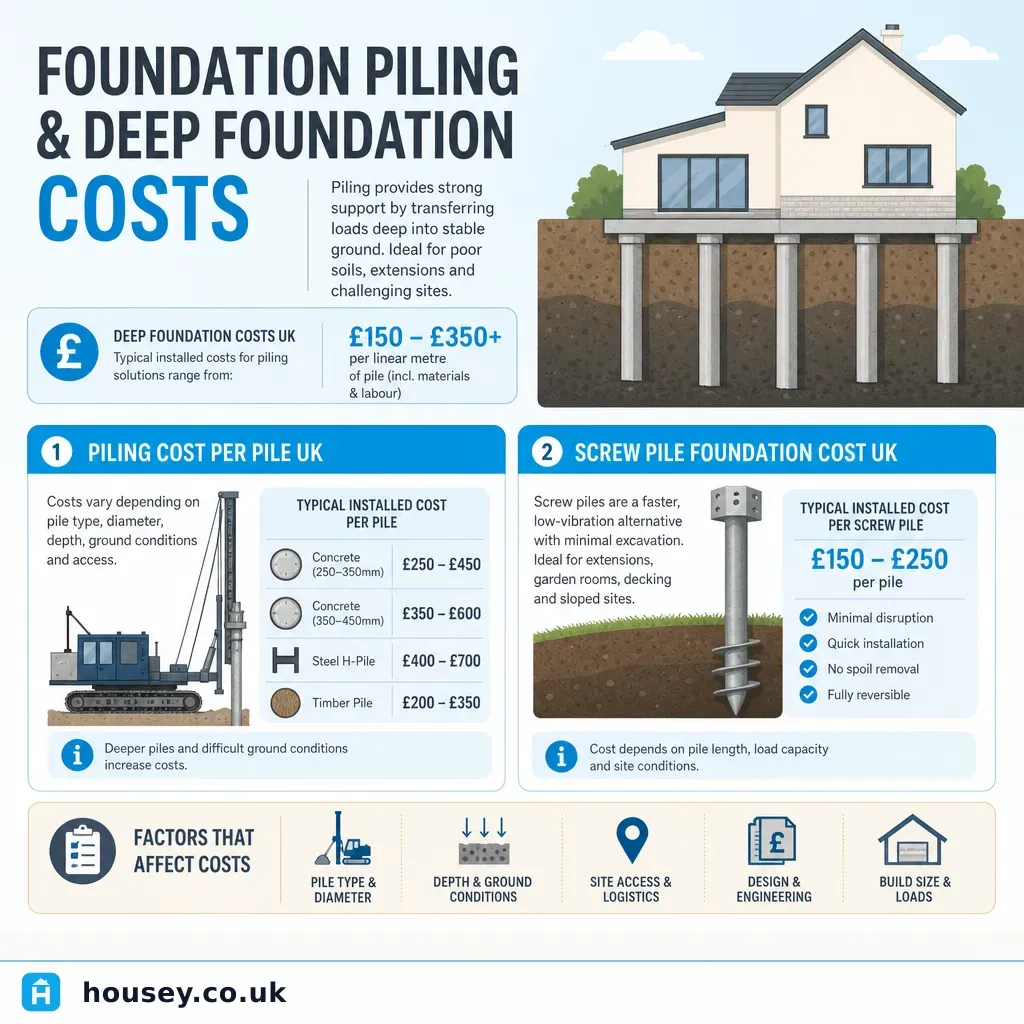
Foundation Piling and Deep Foundation Costs
Foundation piling for a domestic project in the UK typically costs £8,000–£30,000 or more, depending on pile type, ground conditions, depth, and number of piles required.
 Planning & Pre-Build
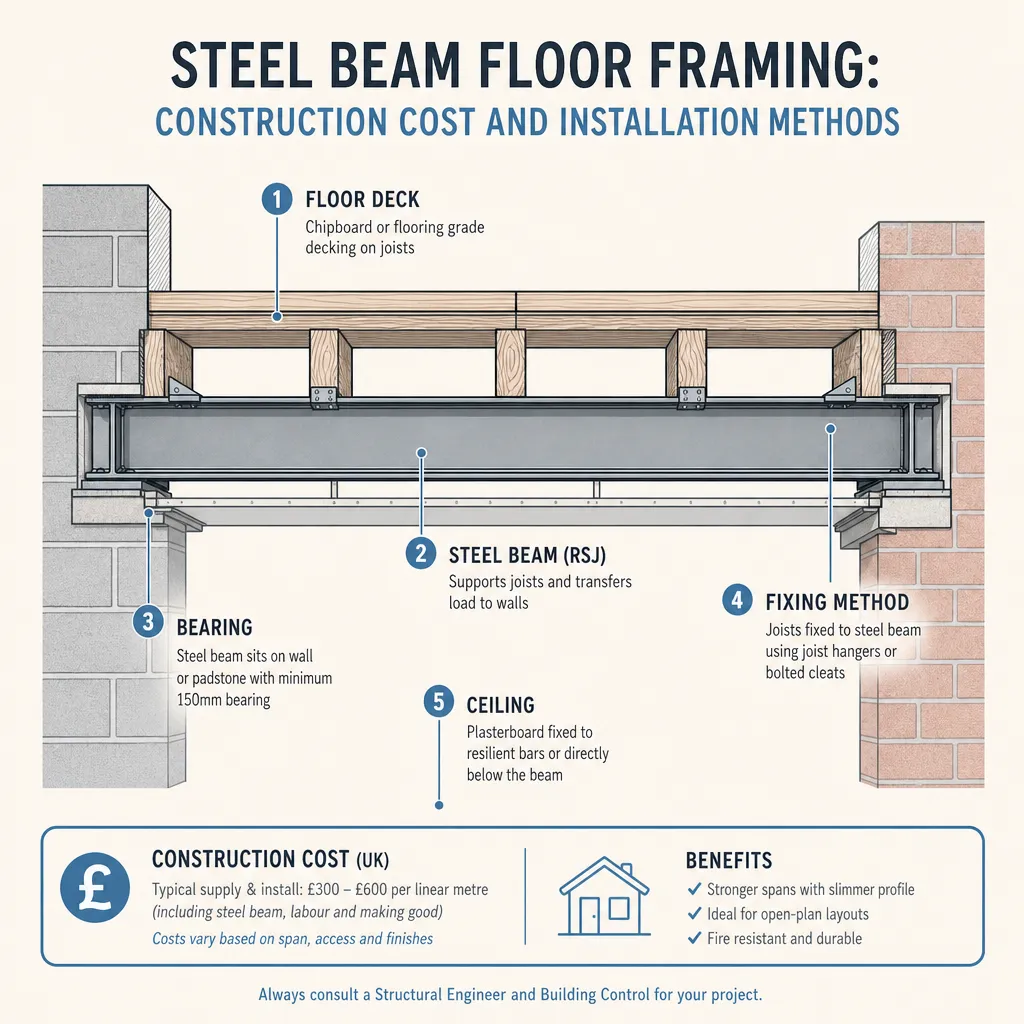
Steel Beam Floor Framing: Construction Cost and Installation Methods
Steel beam floor framing is used in UK homes when spans are too wide for timber joists, or when a load-bearing wall is removed.
 Planning & Pre-Build
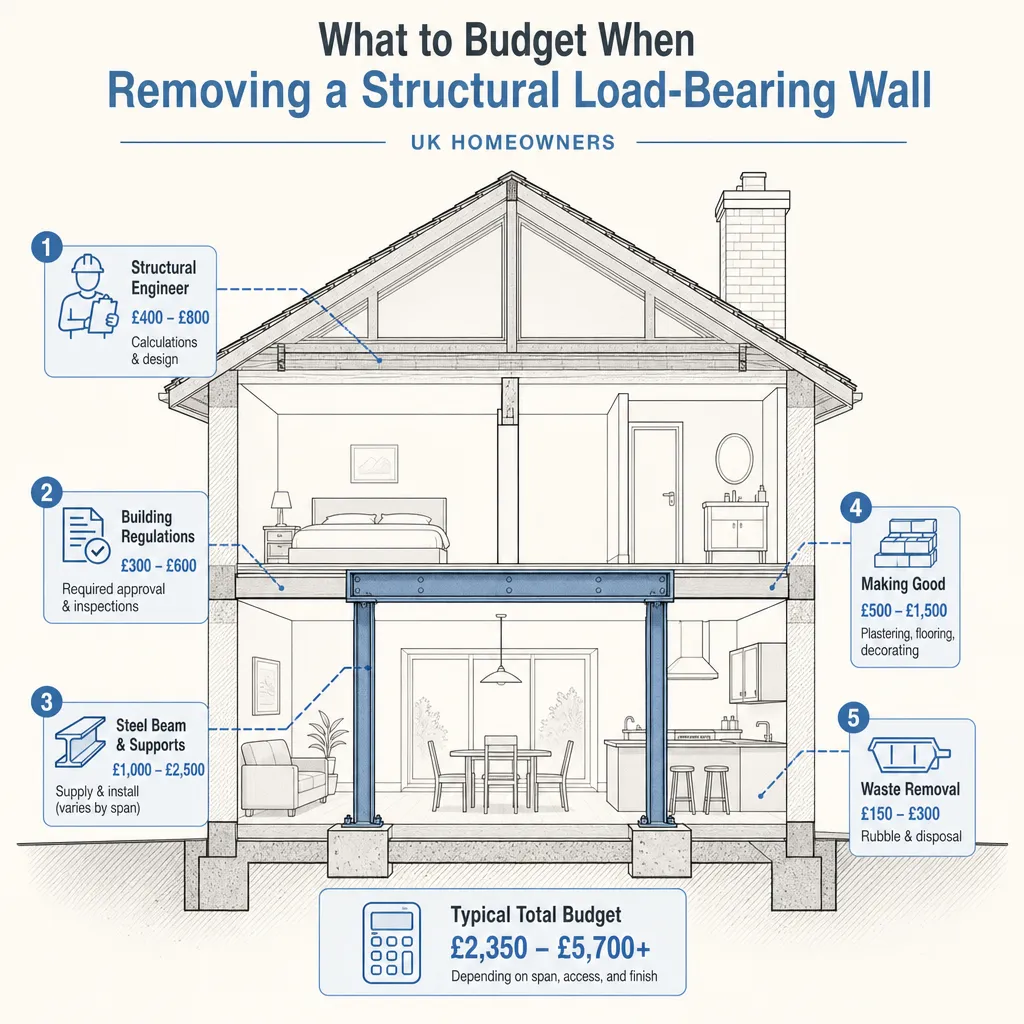
What to Budget When Removing a Structural Load-Bearing Wall
Removing a load-bearing wall in a typical UK home costs £2,500–£8,000 or more in total, covering a structural engineer's calculations, Building Regulations approval, the steel beam, builder's labour, and replastering.
 Planning & Pre-Build
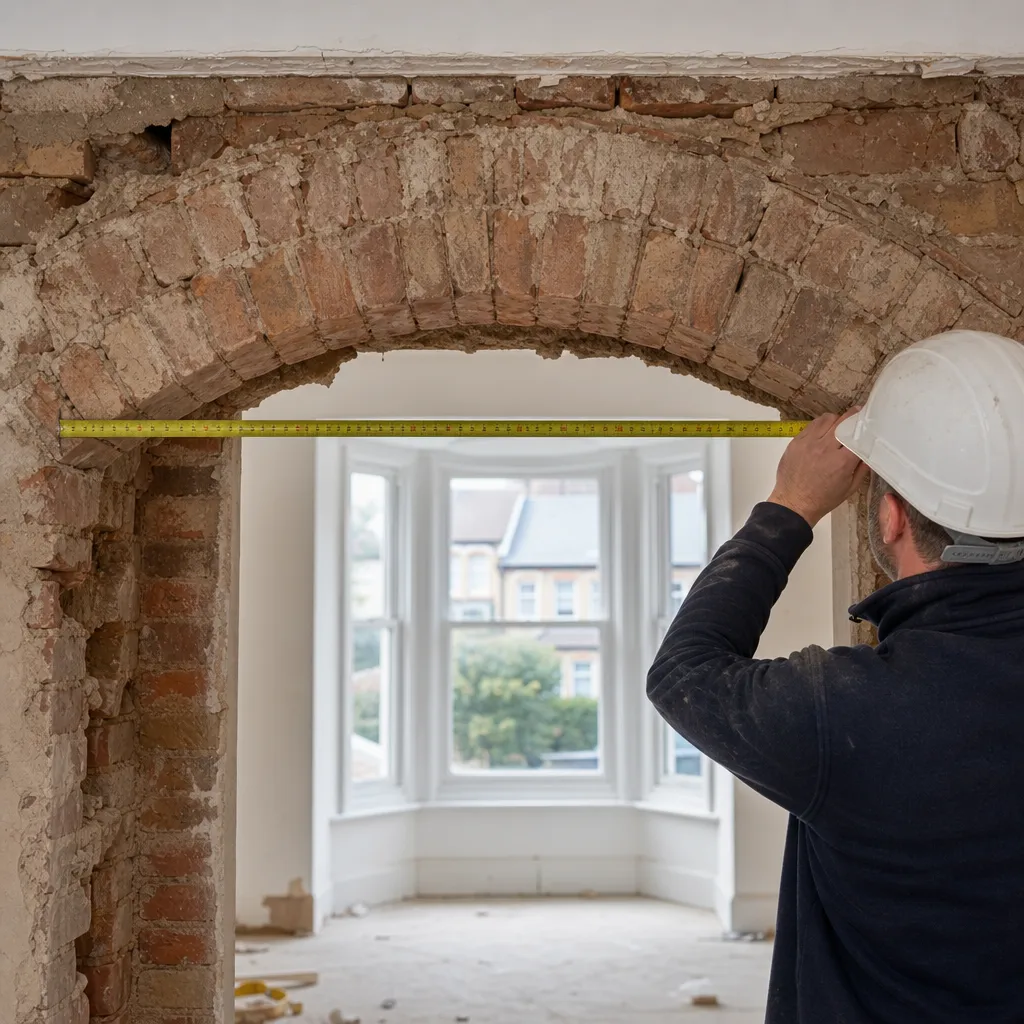
Structural Arching in Walls: Load Distribution and Design
Structural arching occurs when masonry redistributes compressive loads in a triangular or parabolic path around an opening, reducing the load on the lintel below.
 Planning & Pre-Build
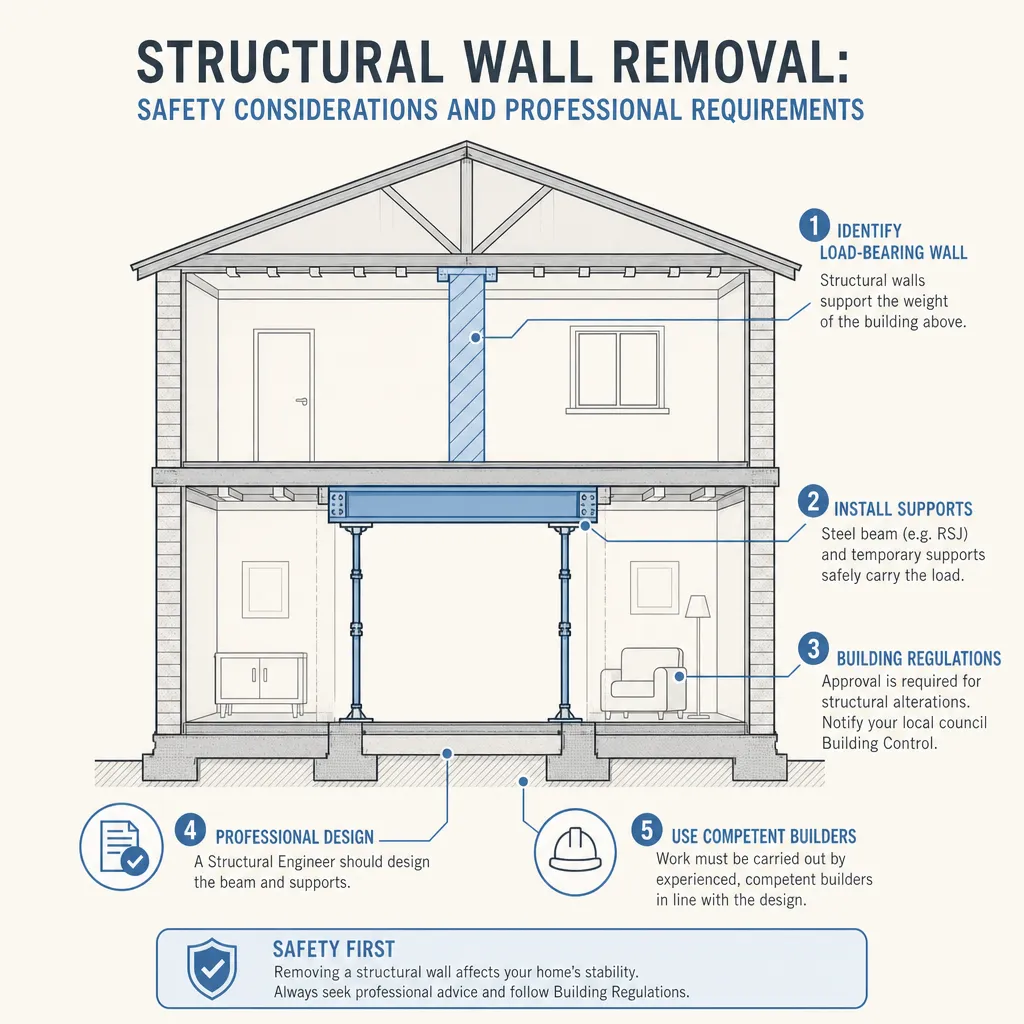
Structural Wall Removal: Safety Considerations and Professional Requirements
Removing a load-bearing wall in the UK always requires Building Regulations approval under Approved Document A, plus a structural engineer's beam calculation before any demolition begins.