Structural Wall Removal: Safety Considerations and Professional Requirements
By Housey · Last reviewed 7th of May 2026
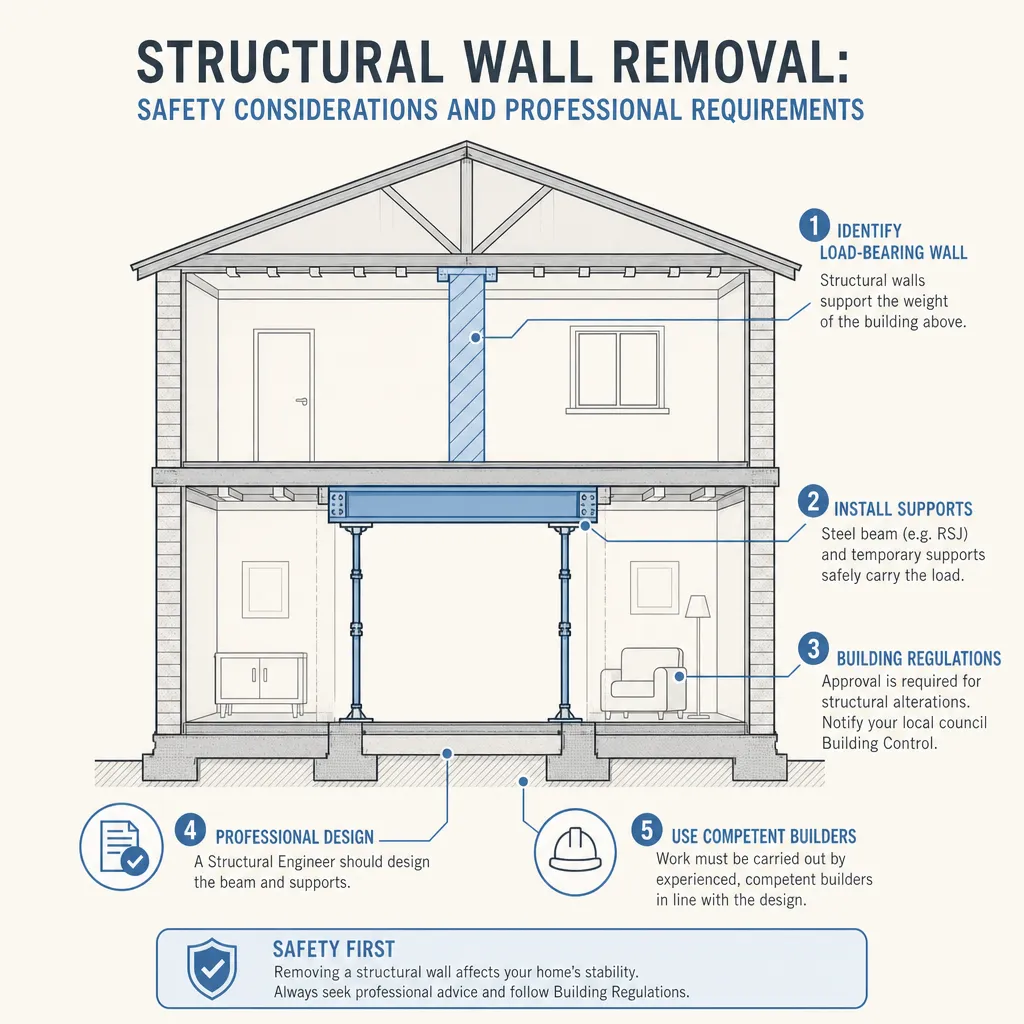
Structural Wall Removal: Safety Considerations and Professional Requirements
Removing an internal wall — particularly between a kitchen and living area, or a hallway and reception room — is one of the most transformative projects a UK homeowner can undertake. Where the wall is structural, the work involves engineering calculations, legal compliance, and coordinated input from more than one qualified professional. In England and Wales, structural wall removal is notifiable work under the Building Regulations, meaning no builder should begin demolition without a structural engineer's written specification and an active building control application in place.
Key points
- Removing a load-bearing wall requires Building Regulations approval under Approved Document A (Structure) in England and Wales; this applies regardless of whether planning permission is also needed.
- A structural engineer must calculate the size and specification of the replacement steel beam — typically an RSJ or flitch beam — before any wall is removed.
- Building control must inspect and sign off the beam installation before it is concealed; the resulting completion certificate is essential for future property sales.
- Properties built before 2000 should have a refurbishment or demolition asbestos survey carried out before any breaking-out begins — disturbing asbestos-containing materials without a prior survey is a legal and safety risk.
- If the wall is or adjoins a party wall, a party wall award under the Party Wall etc. Act 1996 is required separately from, and in addition to, Building Regulations approval.
How to tell if a wall is load-bearing
This is one of the most common sources of confusion for homeowners planning open-plan conversions. Use this decision guide as a starting point — but always have a structural engineer or chartered surveyor confirm the assessment before committing to any works.
Decision guide: is this wall structural?
- Instruct a structural engineer immediately if the wall runs at right angles (perpendicular) to the floor joists above — this orientation typically indicates load-bearing function.
- Instruct a structural engineer immediately if a wall on the floor above appears to sit directly on top of this wall — stacked walls are a strong indicator of structural load transfer.
- Instruct a structural engineer immediately if the wall is built from brick or dense blockwork rather than lightweight timber studwork, though timber-framed walls can also carry loads.
- Ask a structural engineer to confirm before proceeding if the property predates 1919 — Victorian and Edwardian construction often has unconventional framing and irregular load distribution.
- Do not rely on visual inspection alone in any circumstance. No online guide or builder's assessment substitutes for a professional structural determination by a qualified engineer or chartered surveyor.
Which professionals do you need?
Professional | Role | When required | Accreditation to look for |
|---|---|---|---|
Structural engineer | Calculates beam size, padstone dimensions, propping requirements, and connection details | Always, for any load-bearing wall removal | MIStructE, FIStructE, or CEng via IStructE or ICE |
Building control body | Checks compliance with Building Regulations Part A; inspects beam before concealment | Always — notifiable work | Local authority building control or CICAIR-registered approved inspector |
Building or demolition contractor | Carries out temporary propping, demolition, and beam installation | Always for physical works | CSCS-carded operatives; public liability insurance required |
Asbestos surveyor | Identifies asbestos-containing materials before demolition begins | Required for any pre-2000 property | UKAS-accredited body; surveyor should hold P402 qualification |
Party wall surveyor | Serves notices and drafts party wall award where required | Required if wall is or adjoins a party wall | MRICS or member of the Faculty of Party Wall Surveyors |
The structural wall removal process
- Confirm the wall type — commission a structural engineer to assess whether the wall is structural and what loads it carries.
- Asbestos check — for any pre-2000 property, commission a refurbishment or demolition survey before any breaking-out begins.
- Party wall notice — serve written notice on adjoining owners at least two months before work is due to start if a party wall is involved.
- Building Regulations application — submit a Full Plans application (recommended) or Building Notice to local authority building control or an approved inspector.
- Obtain structural engineer's drawings — specifying beam size, padstone dimensions, propping requirements, and bearing-end connection details.
- Temporary propping — contractor installs acrow props or proprietary propping system before any demolition begins.
- Wall removal and beam installation — carried out strictly to the engineer's specification.
- Building control inspection — inspector checks the installed beam before it is concealed by plaster or drylining.
- Completion certificate — issued on satisfactory final inspection; retain this for your property records.
Building Regulations and compliance
All structural wall removal in England and Wales is notifiable under the Building Regulations. The applicable document is Approved Document A (Structure). Applications can be made via a Full Plans application — recommended, as drawings are approved before work begins — or a Building Notice, which carries greater risk as no drawings are pre-approved and the inspector can require remedial work at any stage.
If works were carried out without Building Regulations approval, conveyancing solicitors will identify the gap on any future sale, potentially requiring a Regularisation Certificate, structural indemnity insurance, or — in some cases — opening up the works for inspection.
Important limitations
This article provides general information only. Structural wall removal involves site-specific engineering assessments, legal obligations, and safety considerations that vary with your property's age, construction type, tenure, and the scope of works proposed. Nothing here constitutes structural, engineering, legal, or safety advice. Always engage a qualified structural engineer and a building control body before any structural work begins. Listed buildings and conservation area properties may require additional statutory consents — check with your local planning authority.
When to get professional help
Structural wall removal must not be attempted without professional involvement at every stage:
- Engage a structural engineer before any other steps — do not instruct a contractor to begin until written specifications are in place.
- Notify building control before any notifiable work begins — clarify the notification requirements with your local authority building control or an approved inspector.
- Commission an asbestos refurbishment survey immediately for any pre-2000 property — this must be completed before any breaking out, not during or after.
- Consult a party wall surveyor if there is any possibility the wall is or adjoins a shared party structure.
What to ask a qualified professional
Before instructing a structural engineer or contractor, ask:
- Are you a Member or Fellow of the Institution of Structural Engineers (MIStructE or FIStructE), or chartered with the ICE?
- Will you provide written calculations and drawings suitable for the Building Regulations application?
- Do your drawings specify temporary propping requirements, padstone sizes, and beam bearing details at each end?
- Have you assessed whether the existing foundations can carry the new point loads from the beam ends?
- Will you liaise with the building control body throughout the inspection process?
- What is the procedure if unexpected structural issues — inadequate foundations, hidden voids, or undisclosed past alterations — are found once the wall is opened up?
- If asbestos is discovered during demolition, what is the correct immediate procedure and who should be contacted?
How Housey can help
Housey connects UK homeowners with vetted professionals for each stage of a structural wall removal project. Whether you need a structural engineering assessment to confirm beam specifications and provide drawings, a building control consultant to manage your Building Regulations application, or an experienced demolition and building contractor to carry out the physical works safely and to specification, Housey makes it straightforward to request and compare quotes from qualified providers.
Frequently asked questions
Do I need planning permission to remove a load-bearing wall?
In most cases, removing an internal load-bearing wall is permitted development and does not require planning permission, provided the external appearance of the property is unchanged. Building Regulations approval is always required for structural work. If the property is listed, any internal structural alteration will also require listed building consent — contact your local planning authority to confirm before starting work.
How much does structural wall removal typically cost?
Indicative UK costs, last reviewed 2026-05-07: a structural engineer's assessment and drawings typically range from £500 to £1,500; the contractor's wall removal, beam installation, and making good typically costs £1,500 to £5,000 depending on beam span, access, and finishes. Obtain at least three written quotes, each specifying temporary propping, beam installation, and an allowance for making good, to compare on a like-for-like basis.
What is an RSJ and how is it specified?
RSJ stands for Rolled Steel Joist — the most common steel beam type used to replace a load-bearing wall. The correct size is calculated by a structural engineer based on the span of the new opening, the loads above, and the bearing conditions at each end. Never allow a contractor to select the beam size without written structural engineering calculations; an undersized beam is a serious safety risk.
What happens if structural wall removal was done without Building Regulations approval?
Conveyancing solicitors will identify missing Building Regulations approval during a property sale. Options typically include applying for a Regularisation Certificate (available for work done after 11 November 1985), obtaining structural indemnity insurance, or opening up the work for inspection. None of these is straightforward or inexpensive. Obtaining Building Regulations approval before work begins is considerably easier and less costly.
Can I remove a structural wall in a leasehold flat?
In a leasehold property, structural alterations typically require written consent from the freeholder or management company in addition to Building Regulations approval. Your lease will usually contain a clause requiring landlord consent for structural works. Review your lease terms carefully and seek legal advice before proceeding, as unauthorised structural alterations can have serious legal consequences including breach of lease.
Sources and further reading
- Building Regulations Approved Document A (Structure) — GOV.UK
- Party Wall etc. Act 1996: explanatory booklet — GOV.UK / MHCLG
- Building regulations for internal works — Planning Portal
- Asbestos: the survey guide (HSG264) — Health and Safety Executive
- Find a structural engineer — Institution of Structural Engineers
Useful next reads
 Planning & Pre-Build
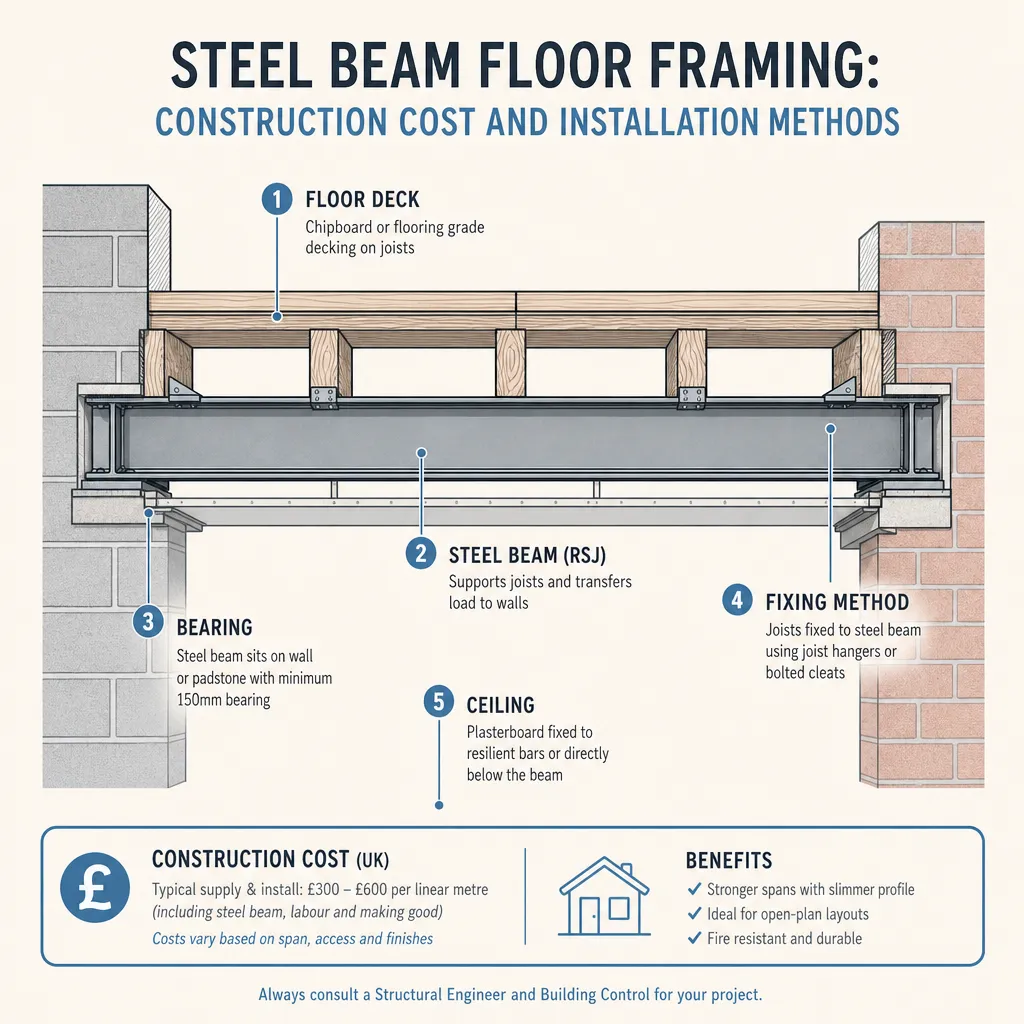
Steel Beam Floor Framing: Construction Cost and Installation Methods
Steel beam floor framing is used in UK homes when spans are too wide for timber joists, or when a load-bearing wall is removed.
 Planning & Pre-Build
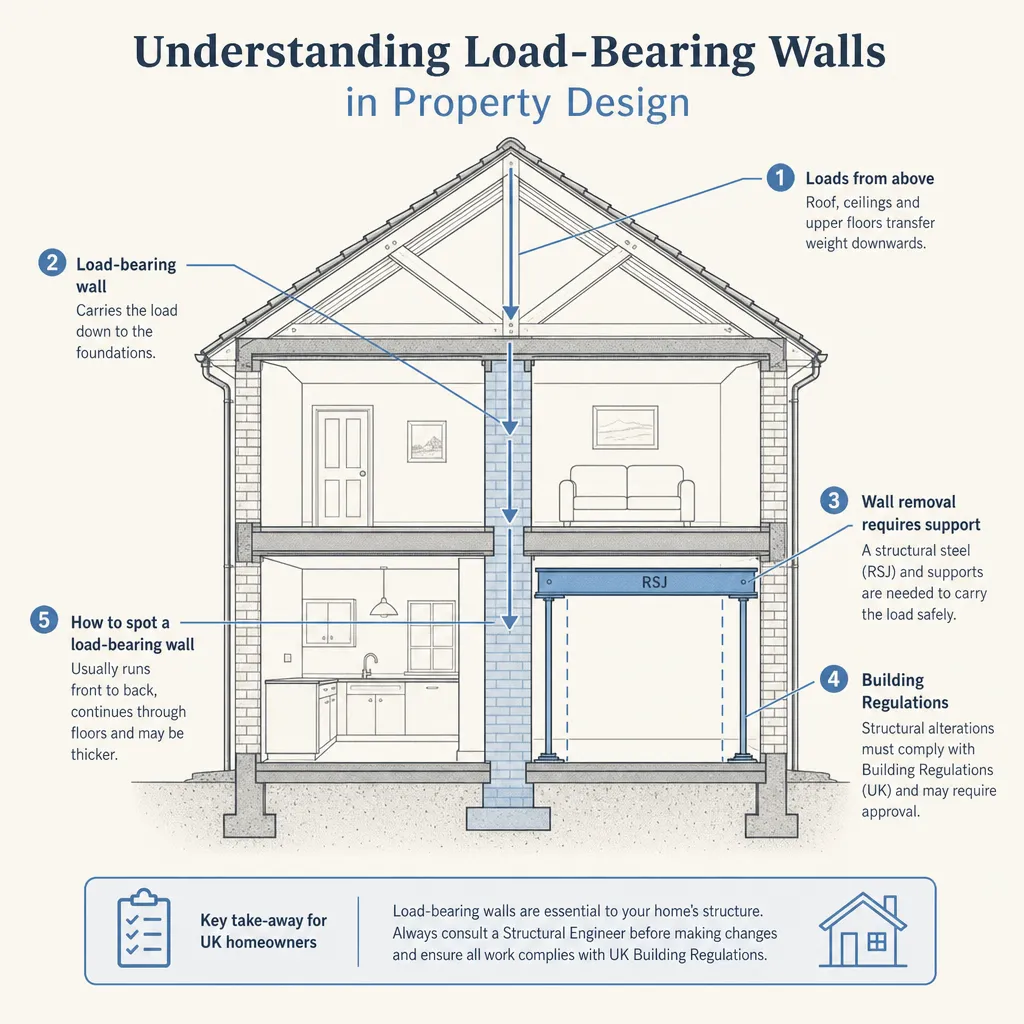
Understanding Load-Bearing Walls in Property Design
A load-bearing wall carries the weight of floors, roofs, or other walls above it down to the foundations.
 Planning & Pre-Build
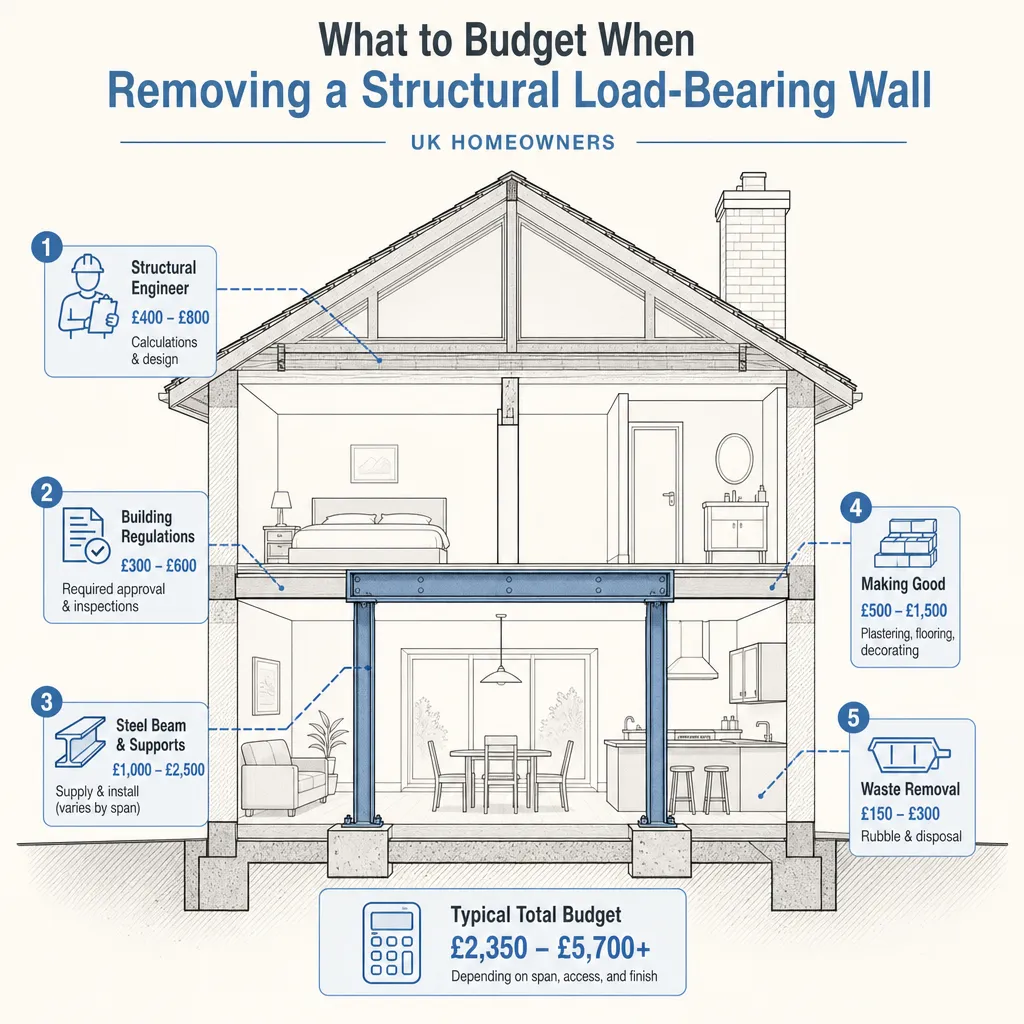
What to Budget When Removing a Structural Load-Bearing Wall
Removing a load-bearing wall in a typical UK home costs £2,500–£8,000 or more in total, covering a structural engineer's calculations, Building Regulations approval, the steel beam, builder's labour, and replastering.
 Planning & Pre-Build
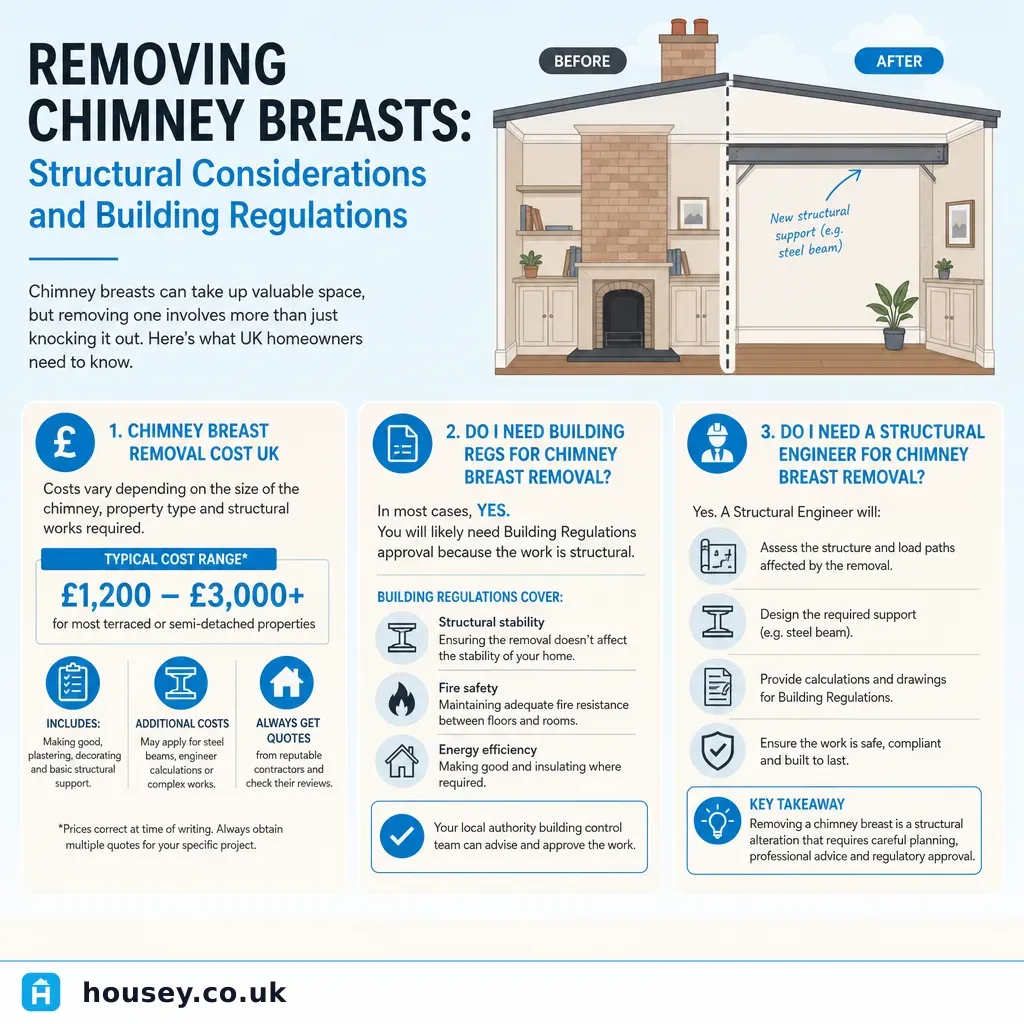
Removing Chimney Breasts: Structural Considerations and Building Regulations
Removing a chimney breast in England and Wales almost always requires building regulations approval because it is structural work.
 Planning & Pre-Build
Barn Conversion Costs: Budget Estimation and Financial Planning
Barn conversions in the UK typically cost £1,500–£3,000 or more per square metre depending on structural condition, specification, and location.