Frameless Shower Doors: Advantages and Installation Considerations
By Housey · Last reviewed 17th of May 2026
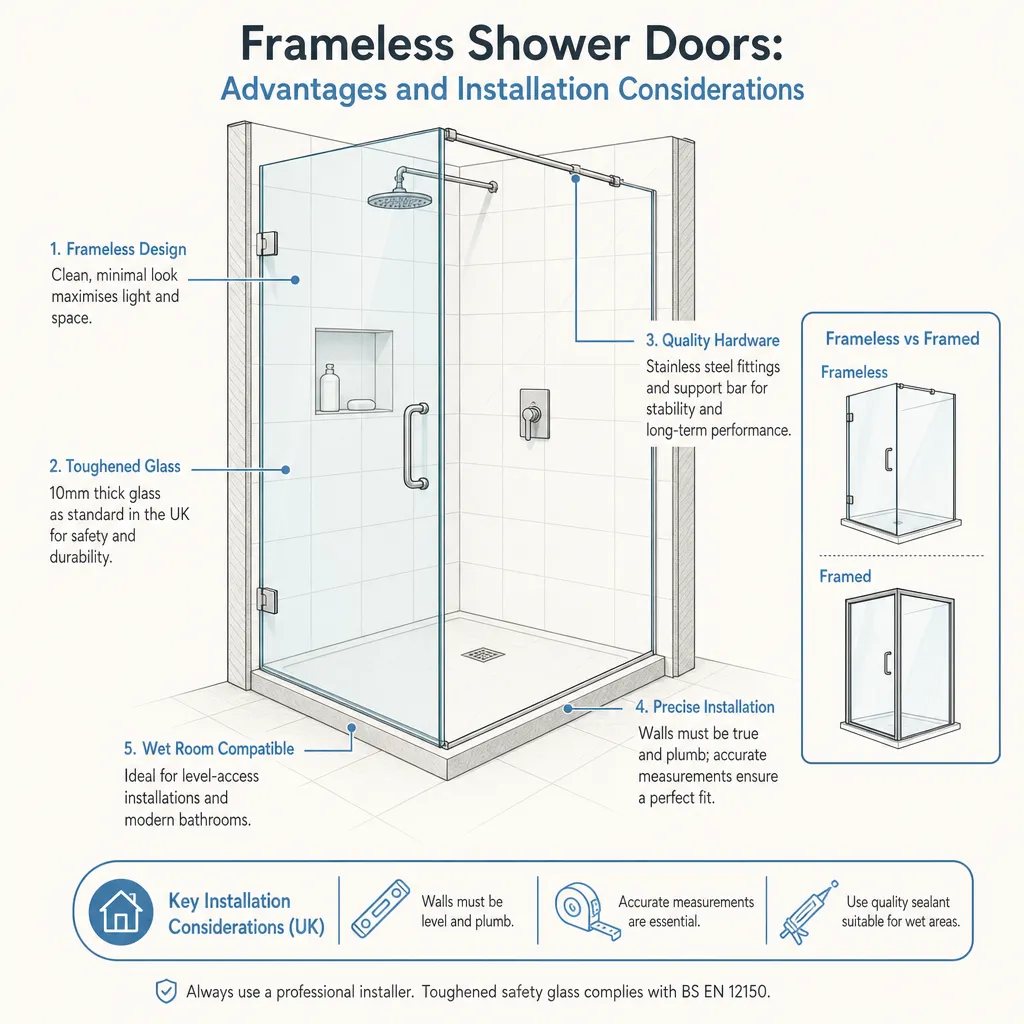
Frameless Shower Doors: Advantages and Installation Considerations
Frameless shower doors have become an increasingly common bathroom upgrade in UK homes, from compact en-suites in post-war semis to full wet-room conversions in Victorian terraces. Without the metal channel that surrounds a conventional framed enclosure, they offer a cleaner visual line and fewer surfaces where limescale and mould can accumulate. Whether a frameless enclosure suits your bathroom depends on the layout, the structural condition of the surrounding walls, and your overall budget.
Key points
- All glass in a shower enclosure must be toughened safety glass (BS EN 12150) or laminated safety glass (BS EN ISO 12543) — ordinary annealed glass is not compliant and presents a serious injury risk if it breaks.
- The minimum glass thickness for a frameless shower panel is typically 8mm; 10mm is widely specified and required by most reputable manufacturers for panels wider than 900mm or taller than 2,000mm.
- Building Regulations Approved Document K (protection from falling, collision, and impact) requires safety glazing in critical locations around baths and showers in England and Wales.
- Frameless panels rely on wall-fixed hardware brackets that concentrate load at relatively few points — fixings must land on studs, blockwork, or reinforced tile backer board, not plasterboard alone.
- Waterproofing (tanking) behind tiles and around the shower tray or wet-room floor must be adequate before any enclosure is installed; inadequate tanking is a leading cause of structural moisture damage in UK bathrooms.
Frameless vs framed vs semi-frameless: a comparison
Enclosure type | Appearance | Maintenance | Minimum glass thickness | Relative supply cost | Installation complexity |
|---|---|---|---|---|---|
Fully framed | Traditional; metal channel around all edges | Higher — channels trap limescale and soap residue | 4–6mm | Lowest | Low–moderate |
Semi-frameless | Frame on fixed panels; door pivot hardware exposed | Moderate | 6–8mm | Moderate | Moderate |
Frameless | No surrounding frame; hardware fittings only | Lower — fewer limescale traps | 8–10mm | Higher | Moderate–high |
Walk-in panel (no door) | Open; minimal hardware | Lowest — no door seals or hinges | 8–10mm | Moderate–high | Moderate |
Indicative UK supply cost comparison, last reviewed 2026-05-17. Installation costs vary by bathroom layout, wall substrate, and whether associated tanking or tiling work is included.
Advantages of frameless shower doors
Cleaner aesthetics. Without a perimeter metal channel, frameless enclosures reduce visual clutter and allow sightlines through the glass that can make a compact bathroom feel more open — an effect particularly valued in the smaller UK bathrooms common in terraced houses and conversions.
Reduced limescale accumulation. Conventional frame channels create horizontal surfaces where water pools and limescale builds. Frameless hardware fittings — hinges, wall brackets, handles — present far fewer such surfaces, which many homeowners find reduces routine cleaning effort.
Durable hardware. Frameless enclosures depend on quality hinges and wall brackets rather than extruded aluminium channels. Properly specified stainless steel or chrome hardware resists the humid bathroom environment well and typically outlasts the seals on cheaper framed products.
Compatible with glass treatments. Frameless panels are well suited to hydrophobic coatings — marketed as easy-clean treatments — that cause water to bead and sheet off the surface. These can be applied at the factory or as aftermarket products and further reduce cleaning frequency.
Configuration flexibility. Because frameless hardware positions the glass more freely than a channel frame, non-standard configurations — sloped ceilings, L-shaped layouts, corner entries — are often more achievable than with rigid framed systems.
Disadvantages and risks to consider
Higher cost. Frameless enclosures are significantly more expensive than framed equivalents at both supply and installation stage. Thicker glass and quality hardware carry a meaningful price premium that should be factored into your budget from the outset.
Demanding waterproofing. Frameless enclosures generally do not seal as tightly as framed products. Water management relies more heavily on an adequate shower tray or wet-room floor design and careful silicone sealing. Any weakness in the underlying tanking system can lead to expensive moisture damage behind tiles.
Structural wall requirements. Wall brackets for frameless panels concentrate load at a small number of fixings. Stud-and-plasterboard walls — common in UK new-build and converted properties — must have adequate blocking or reinforcement at fixing points. An experienced installer will assess this before committing to a layout.
Minor water escape and draughts. Frameless doors do not seal as tightly as fully framed doors. In smaller bathrooms, water spray through the gaps around frameless panels can reach the floor area outside the shower — worth considering where flooring or fittings below would be costly to repair.
Weight. An 8–10mm frameless glass door of standard dimensions (700–900mm wide × 1,900–2,000mm tall) typically weighs 25–40 kg. Hinges must be rated for the door weight, and the swing arc requires adequate clear floor space — a real consideration in the compact UK bathrooms where frameless doors are most popular.
Glass specification: what to look for
All glass in a shower enclosure must be safety glass under Building Regulations Approved Document K. The two compliant options are:
- Toughened glass (BS EN 12150): heat-treated to break into small, blunt fragments rather than sharp shards. This is the standard specification for UK shower doors and fixed panels.
- Laminated safety glass (BS EN ISO 12543): two or more glass layers bonded with an interlayer. If broken, the interlayer holds the glass in place. Less common in showers but preferred where complete fragment containment is important.
When purchasing a frameless enclosure, ask the supplier to confirm the glass specification in writing. Panels should carry a UKCA mark (or CE mark on older stock) referencing the applicable BS EN standard. If a supplier cannot confirm the specification, that is a red flag.
Installation considerations
Accurate measurement is critical. Frameless glass panels are typically made to order and cannot be trimmed on site. Measure the alcove or recess carefully — accounting for tile thickness on each wall — before placing an order.
Substrate assessment. Before installation, the fitter should confirm:
- Whether fixings will land on studs, solid blockwork, or reinforced tile backer board.
- Whether the shower tray or wet-room floor is genuinely level.
- Whether existing tanking is present and in adequate condition.
Tanking. If the shower area is not already waterproofed, a liquid-applied or sheet membrane should be applied before tiling. This is best completed at initial fit-out but can be retrofitted in some cases — a competent installer can advise.
Silicone sealing. The gap between glass and wall, and between glass and tray, must be sealed with a mildew-resistant sanitary silicone rated for wet areas. The quality and completeness of the silicone application has a significant effect on long-term waterproofing performance.
Ventilation. Any shower installation should be paired with adequate extract ventilation. Building Regulations Part F requires a minimum of 15 l/s extraction (intermittent fan) for a bathroom in England. Poor ventilation accelerates mould growth on silicone seals regardless of how well the glass is fitted.
Which shower enclosure type should you choose?
- Choose a frameless enclosure if aesthetics are the priority, your bathroom walls have adequate structural fixing capacity, and you are prepared to invest in a higher-quality installation.
- Choose a semi-frameless enclosure if you want a cleaner appearance than a fully framed product at a lower price point than fully frameless.
- Choose a framed enclosure if budget is the main constraint or the bathroom sees very heavy daily use where a tight door seal is important.
- Choose a walk-in frameless panel if the bathroom layout permits an open shower format and you want to minimise maintenance by eliminating door hardware entirely.
- Consult a qualified bathroom fitter if you are uncertain about wall substrate adequacy, existing tanking condition, or whether the wet-room floor drainage meets current standards.
When to get professional help
Frameless shower door installation is not a straightforward DIY project. Engage a professional if:
- Your walls are stud-and-plasterboard construction and you are unsure whether structural blocking is in place at the required fixing points.
- There is evidence of damp, staining, or mould behind existing tiles — this indicates tanking failure that must be fully resolved before a new enclosure is fitted.
- You are installing a level-access wet room rather than a shower tray, where tanking and drainage-fall specification require greater care and experience.
- Electrical circuits pass through or near the bathroom wet zone — any electrical work in a bathroom must comply with Building Regulations Part P and BS 7671, and must be carried out by a competent person.
- Glass panels are large (over 1,800mm tall or 900mm wide), as heavier panels may require engineered fixing solutions beyond standard hardware.
How Housey can help
Housey can help you find qualified bathroom fitters and tilers for frameless shower door installation across the UK. Whether you are planning a full bathroom renovation or a focused enclosure upgrade, comparing quotes from experienced local tradespeople with proven wet-room and glass installation experience is the right first step.
Frequently asked questions
What glass thickness is required for a frameless shower door in the UK?
Most manufacturers and installers specify a minimum of 8mm toughened glass for frameless shower enclosures, with 10mm recommended for larger panels — typically those wider than 900mm or taller than 2,000mm. Building Regulations Approved Document K requires safety glass complying with BS EN 12150 (toughened) or an equivalent standard. Always check the product specification sheet before purchasing.
Do frameless shower doors require building regulations approval?
The glass must comply with Building Regulations Approved Document K (safety glazing in critical locations), but a like-for-like shower enclosure replacement does not usually require a formal building regulations application. However, if the installation involves any electrical work within the bathroom wet zone — such as moving lighting or adding a shaver socket — that element must be notified under Part P.
How much do frameless shower enclosures cost in the UK?
Indicative UK costs, last reviewed 2026-05-17: supply-only frameless enclosures range from approximately £500 to £2,500 or more, depending on glass thickness, panel dimensions, and hardware quality. Installation costs vary by bathroom complexity, location, and whether tanking or tiling is included in the scope. Request at least three written quotes before committing to any supplier or installer.
Are frameless shower doors harder to keep clean than framed doors?
Frameless enclosures generally have fewer frame channels and horizontal surfaces to trap limescale and soap residue, which most users find reduces day-to-day cleaning effort. The silicone seals around the edges still require periodic attention to prevent mould growth. Applying a hydrophobic glass treatment can further reduce the frequency of glass cleaning.
Sources and further reading
Useful next reads
 Improvement & Build
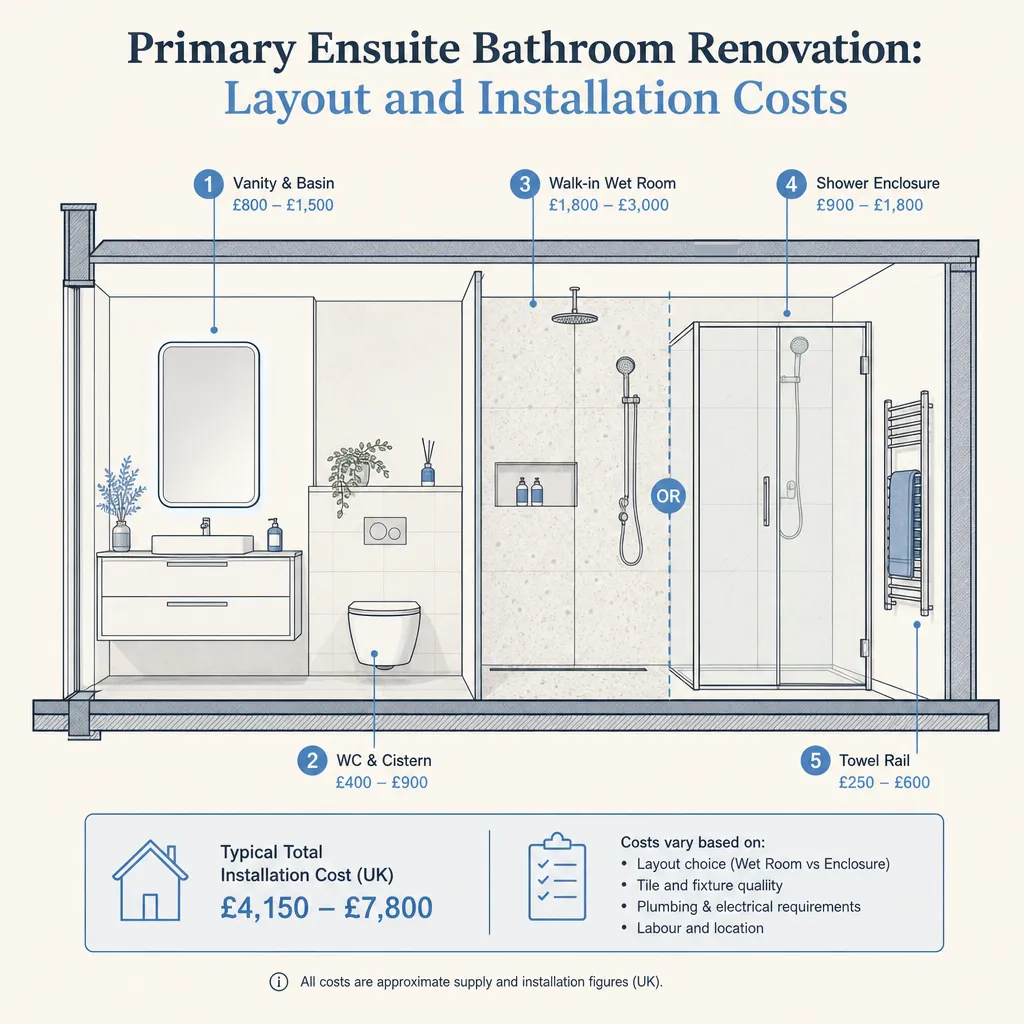
Primary Ensuite Bathroom Renovation: Layout and Installation Costs
A primary ensuite renovation in the UK typically costs between £3,000 and £12,000, depending on size, layout, and specification.
 Improvement & Build
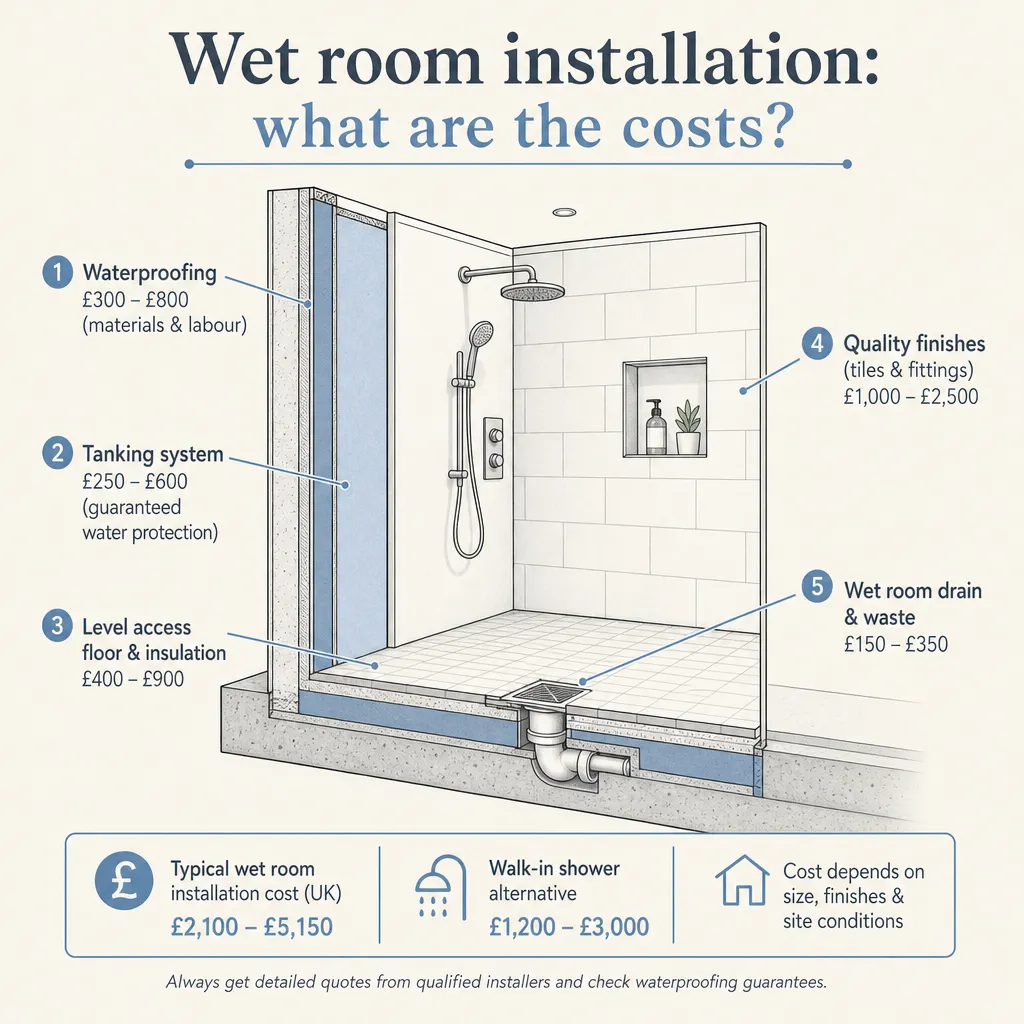
Wet room installation: what are the costs?
A wet room installation in a UK home typically costs between £3,500 and £10,000 depending on room size, materials, and structural requirements.
 Improvement & Build
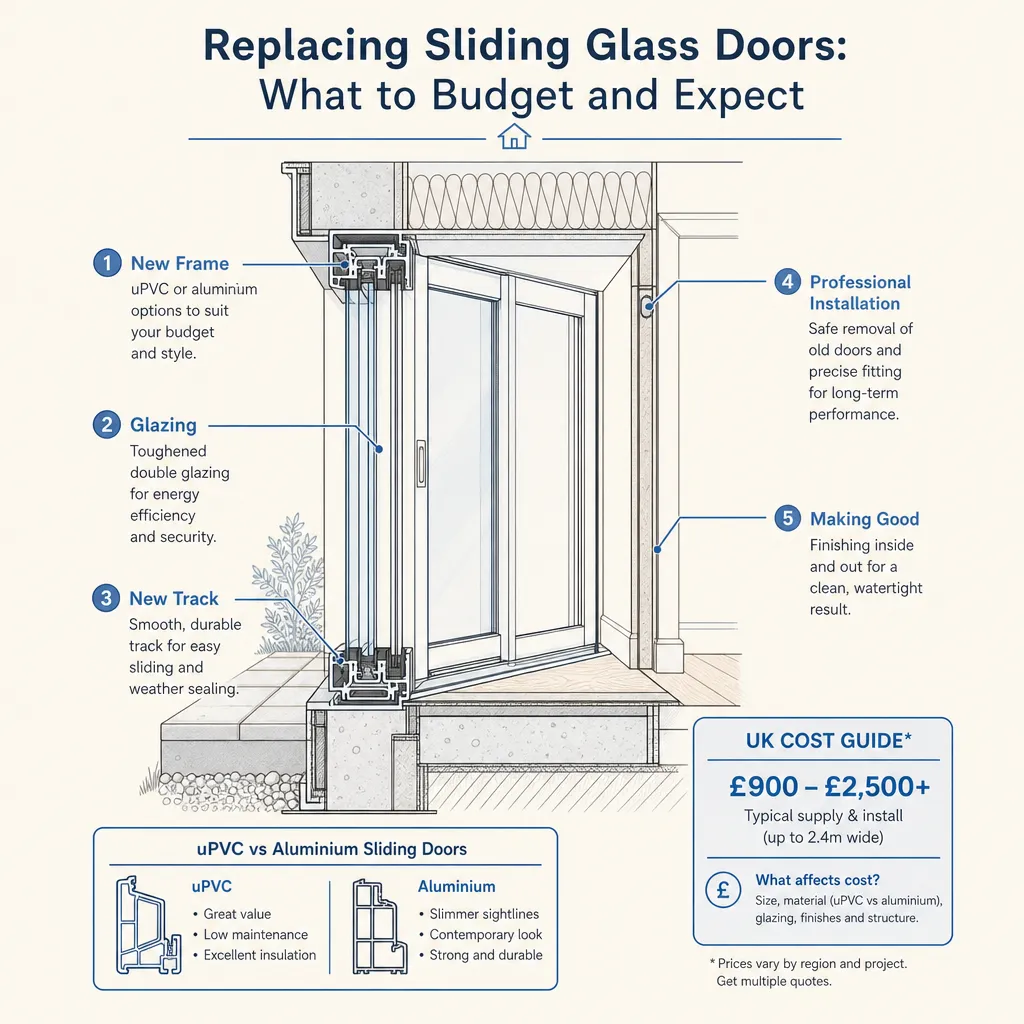
Replacing Sliding Glass Doors: What to Budget and Expect
Replacing sliding glass doors in a UK home typically costs £1,500–£4,500 depending on door size, glazing specification, and frame material.
 Improvement & Build
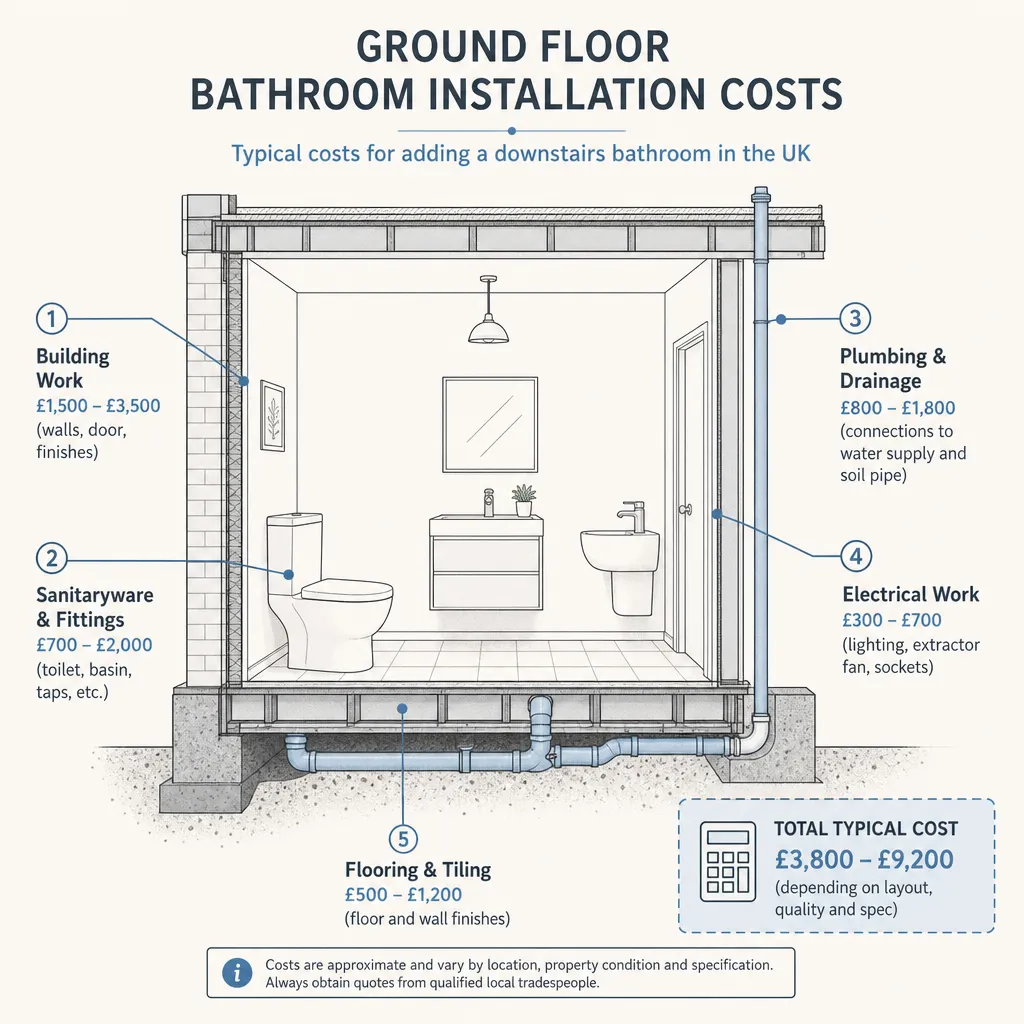
Ground Floor Bathroom Installation Costs
Installing a ground floor bathroom in the UK costs roughly £2,000–£5,000 for a basic cloakroom and £5,500–£15,000 for a shower room or wet room.
 Improvement & Build
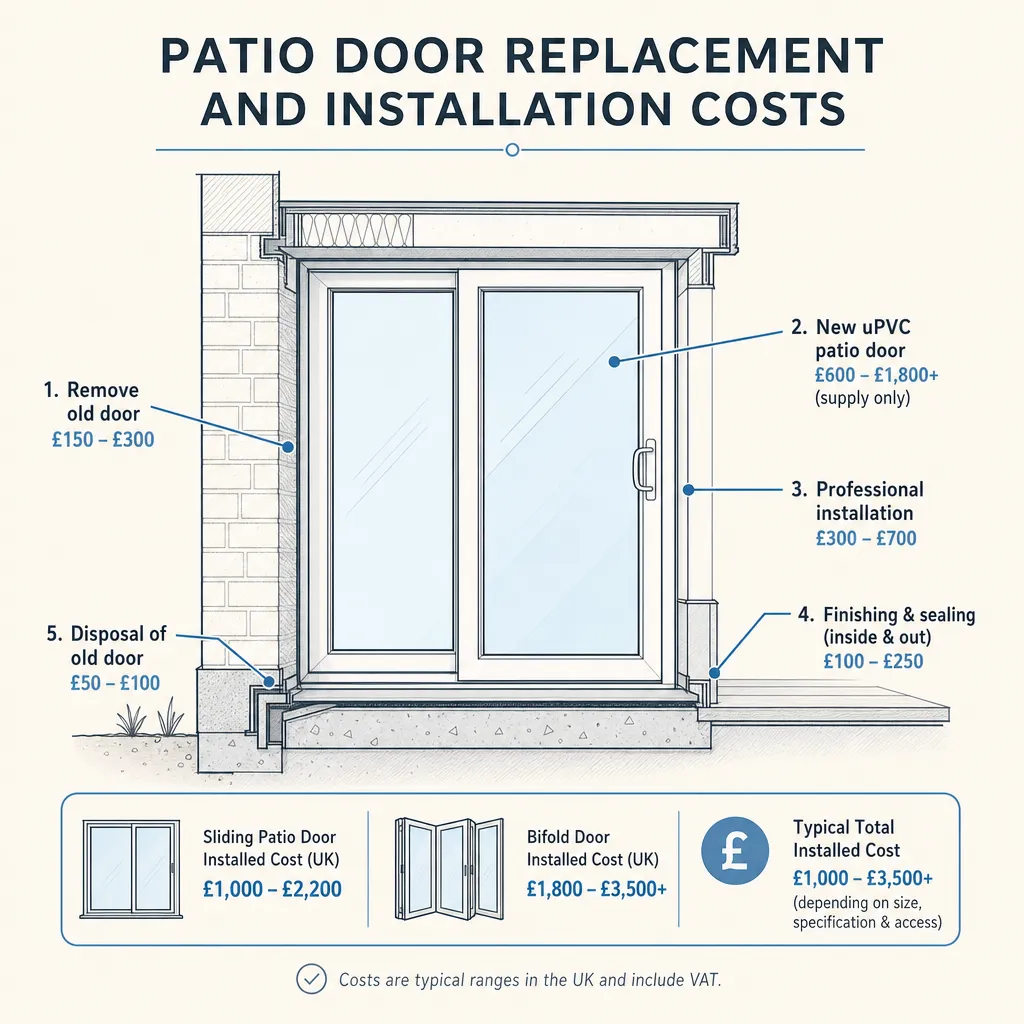
Patio Door Replacement and Installation Costs
Replacing patio doors in the UK typically costs £800–£2,000 installed for a standard uPVC sliding unit, rising to £3,000–£8,000 or more for aluminium bifold doors.