French Door Installation: Types, Costs, and Considerations
By Housey · Last reviewed 5th of May 2026
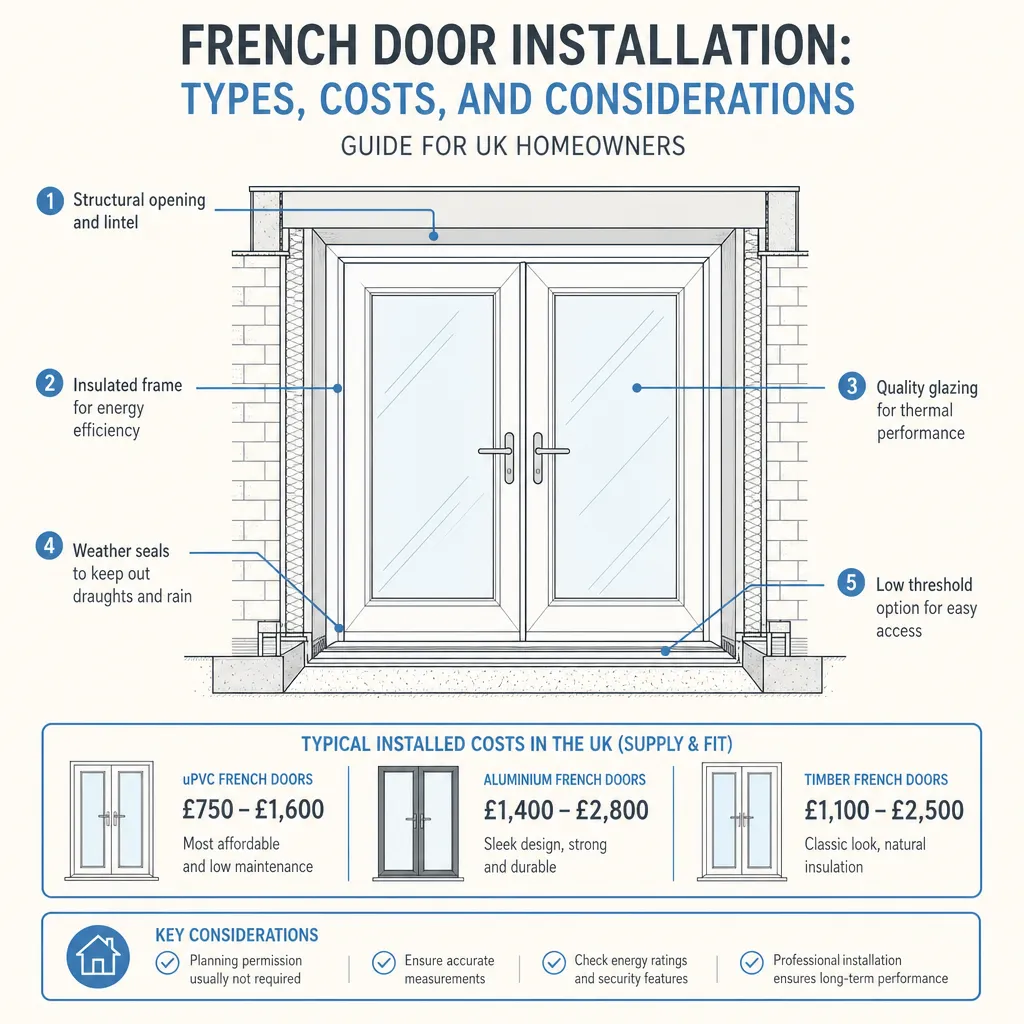
French Door Installation: Types, Costs, and Considerations
French doors — paired, hinged, glazed doors opening from the centre — are among the most popular upgrades for UK homes looking to improve the connection between an interior living space and the garden or patio. The decision to install them typically arises during a kitchen extension, rear living room renovation, or when tired sliding patio doors need replacing. Understanding the cost, material choices, planning rules, and Building Regulations requirements before committing avoids delays and unexpected costs once the project is under way.
Key points
- French doors in the UK cost approximately £1,500–£3,000 for uPVC and £2,500–£6,000+ for aluminium or timber, installed (indicative UK costs, last reviewed 2026-05-05).
- All replacement external doors must comply with Part L of the Building Regulations (thermal performance); use a FENSA- or CERTASS-registered installer to self-certify compliance and receive a certificate.
- Like-for-like replacement on the rear of a standard house usually falls within permitted development; new openings, conservation areas, and listed buildings may require planning consent.
- For new openings in load-bearing walls, a structural engineer should assess lintel requirements before a builder or fitter starts work.
- The compliance certificate issued by a FENSA or CERTASS installer is usually required when you sell the property — always obtain and retain it.
Types of French doors
French doors are available in three main frame materials in the UK. The right choice depends on budget, property type, maintenance preference, and — in some cases — what the local planning authority will permit.
uPVC French doors
uPVC is the most widely installed frame material in the UK. It is low-maintenance, thermally efficient, and competitively priced. Modern uPVC profiles are available in a range of colours and wood-effect foil finishes, making them suitable for a wide variety of property types. Some conservation areas and listed building authorities consider uPVC inappropriate for period properties, so check before ordering.
Aluminium French doors
Aluminium offers a slim profile with a maximised glazed area, which is particularly popular in contemporary extensions and rear elevations. It is more durable than uPVC over the long term, fully recyclable, and available in a wide range of RAL powder-coat colours. Thermally broken aluminium profiles meet current Building Regulations requirements for energy performance.
Timber French doors
Softwood and hardwood timber are the traditional choice and are often specified — or required — for listed buildings or properties in conservation areas. Timber requires more maintenance than uPVC or aluminium (painting or staining every three to seven years depending on exposure and finish) but is preferred for period properties or where the planning authority restricts modern materials.
French door costs: a comparison
The table below gives indicative installed costs for a standard pair of French doors (approximately 1,800mm wide by 2,100mm high), including supply, standard double glazing, and installation.
Frame material | Indicative installed cost | Best for | Maintenance requirement |
|---|---|---|---|
uPVC | £1,500–£3,000 | Most UK homes; budget-conscious buyers | Low (wipe clean) |
Aluminium | £2,500–£6,000 | Contemporary extensions, slim sightlines | Low (powder coat lasts 20+ years) |
Timber (softwood) | £2,000–£4,500 | Period properties, rural settings | Medium–high (repaint every 3–7 years) |
Timber (hardwood) | £3,000–£7,000+ | Listed buildings, high-spec period projects | Medium (oil or paint every 5–10 years) |
Indicative UK costs, last reviewed 2026-05-05. Prices vary by supplier, region, glazing specification, and opening size. Always obtain at least three itemised quotes.
Planning permission and building regulations
When planning permission is not normally needed
Replacing existing French doors with new ones of a similar size on the rear of a house is generally permitted development for a standard residential property in England. The Planning Portal guidance on windows and doors confirms that most like-for-like replacements fall within permitted development rights and do not require a planning application.
When planning permission may be required
- New openings in the side or front elevation of a property.
- Conservation areas: permitted development rights for windows and doors are often restricted by Article 4 Directions. Contact your local planning authority before ordering.
- Listed buildings: Listed Building Consent is required for any changes to windows or doors, and materials and profiles must usually match the original construction closely.
- Flats: permitted development rights do not apply to flats; consent from the local planning authority is usually needed.
Always check with your local planning authority if you are unsure — permitted development rules can depend on the property's history and any prior conditions attached to planning approvals.
Building Regulations: Part L thermal performance
Under Part L of the Building Regulations (conservation of fuel and power), replacement external doors must meet minimum thermal performance standards. In England, replacement doors must currently achieve a minimum whole-unit U-value of 1.4 W/m²K. French doors forming part of a new opening in a wall must also comply with structural requirements under Part A.
Using a FENSA- or CERTASS-registered installer means they can self-certify that the installation complies with Building Regulations and issue a compliance certificate. This certificate is usually required when you sell the property. If your installer is not registered, you must notify your local building control authority before work starts and arrange an inspection.
New openings and structural considerations
If you are creating a new opening in an external wall rather than replacing an existing door, the structural implications depend on whether the wall is load-bearing. In most UK homes, rear external walls are structural. Removing a section to form a French door opening typically requires:
- An assessment by a structural engineer to determine the required lintel size and whether an RSJ (rolled steel joist) is needed above the opening.
- Building Regulations approval under Part A (structure).
- Correct specification of the lintel, padstone, and temporary propping during construction.
Do not assume a builder can assess this without structural engineering input. Incorrectly sized lintels are a common cause of cracking and settlement above new openings, which can be costly to remedy.
What to ask before accepting a quote
Before signing a contract with a French door installer, ask:
- Are you FENSA- or CERTASS-registered, and will you provide a compliance certificate on completion?
- Does the quoted price include removal and disposal of the existing door?
- What glazing specification is included — double or triple glazed, what glass type, and what U-value does the unit achieve?
- What hardware is included — handle set, multi-point locking system, and hinge type?
- How is the internal and external reveal (surround) finished after installation?
- Is VAT included in the quoted price?
- What is the guarantee on the frames, glazing unit, and hardware separately?
- What happens if the opening is found to be non-standard on the day, or if structural work is needed?
- Who is responsible for notifying building control if you are not using a FENSA or CERTASS installer?
Which type of French door should you choose?
- Choose uPVC if you want a low-maintenance, thermally efficient door at a competitive price and your property is not listed or in a conservation area.
- Choose aluminium if you want slim sightlines, a contemporary appearance, or a specific colour match through RAL powder coat.
- Choose timber if your property is listed or in a conservation area, or if the local planning authority restricts modern materials — and you are prepared for higher ongoing maintenance.
- Ask a structural engineer to assess lintel requirements if you are creating a new opening in an existing wall before any builder or fitter starts work.
- Check with your local planning authority if your property is listed, in a conservation area, or if you are uncertain whether permitted development applies to your situation.
When to get professional help
Most like-for-like French door replacements are straightforward when carried out by a FENSA- or CERTASS-registered installer. Seek additional professional input if:
- The wall you plan to open up is load-bearing and a structural engineer has not yet assessed the lintel requirement.
- Your property is listed or in a conservation area — consider engaging a planning consultant or heritage architect before committing to a material or design.
- You notice existing cracking, settlement, or moisture around the current door opening, which should be investigated and resolved before a new door is fitted.
- The installation involves changes to the floor level, threshold detail, or drainage that could affect water ingress or disabled access compliance.
How Housey can help
If you are ready to compare quotes for French door installation, Housey connects you with vetted local window and door installers who can advise on materials, compliance, and structural requirements for your specific property. Use the checklist above when reviewing quotes to make sure you are comparing like for like.
Frequently asked questions
Do French doors need planning permission?
Like-for-like replacement of existing French doors on the rear of a standard house usually falls within permitted development and does not require planning permission in England. Creating a new opening, changing materials on a listed building, or making alterations in a conservation area may all require consent. Always check with your local planning authority if you are in any doubt.
What is the difference between French doors and bifold doors?
French doors are a pair of hinged doors opening from the centre. Bifold doors consist of multiple panels that fold and stack to one or both sides, typically providing a wider clear opening. Bifold doors generally cost more and require a wider structural opening. French doors suit openings of roughly 1.2–2.4 metres wide; bifold doors are better suited to wider spans.
How long does French door installation take?
A like-for-like replacement typically takes half a day to a full day. If a new opening is being formed in a wall, including any structural work, the timeline extends to several days or more, depending on the construction method and whether building control inspections are required at staged intervals.
What U-value do French doors need to meet in England?
As of 2022, replacement external doors in England must achieve a minimum whole-unit U-value of 1.4 W/m²K under Part L of the Building Regulations. Your FENSA- or CERTASS-registered installer should confirm the U-value of the product they are supplying. New openings may have different requirements — check with building control or your installer.
Can I fit French doors myself?
Fitting French doors yourself is possible for a skilled DIY enthusiast, but you must still comply with Part L of the Building Regulations. If you are not a registered competent person under FENSA or CERTASS, notify your local building control authority before starting and arrange an inspection. For new structural openings, building control approval is required regardless of who carries out the work.
Sources and further reading
- FENSA homeowner information — FENSA
- Windows and doors: planning permission — Planning Portal
- Approved Document L: conservation of fuel and power — GOV.UK
- Windows and glazing advice — Energy Saving Trust
Useful next reads
 Improvement & Build
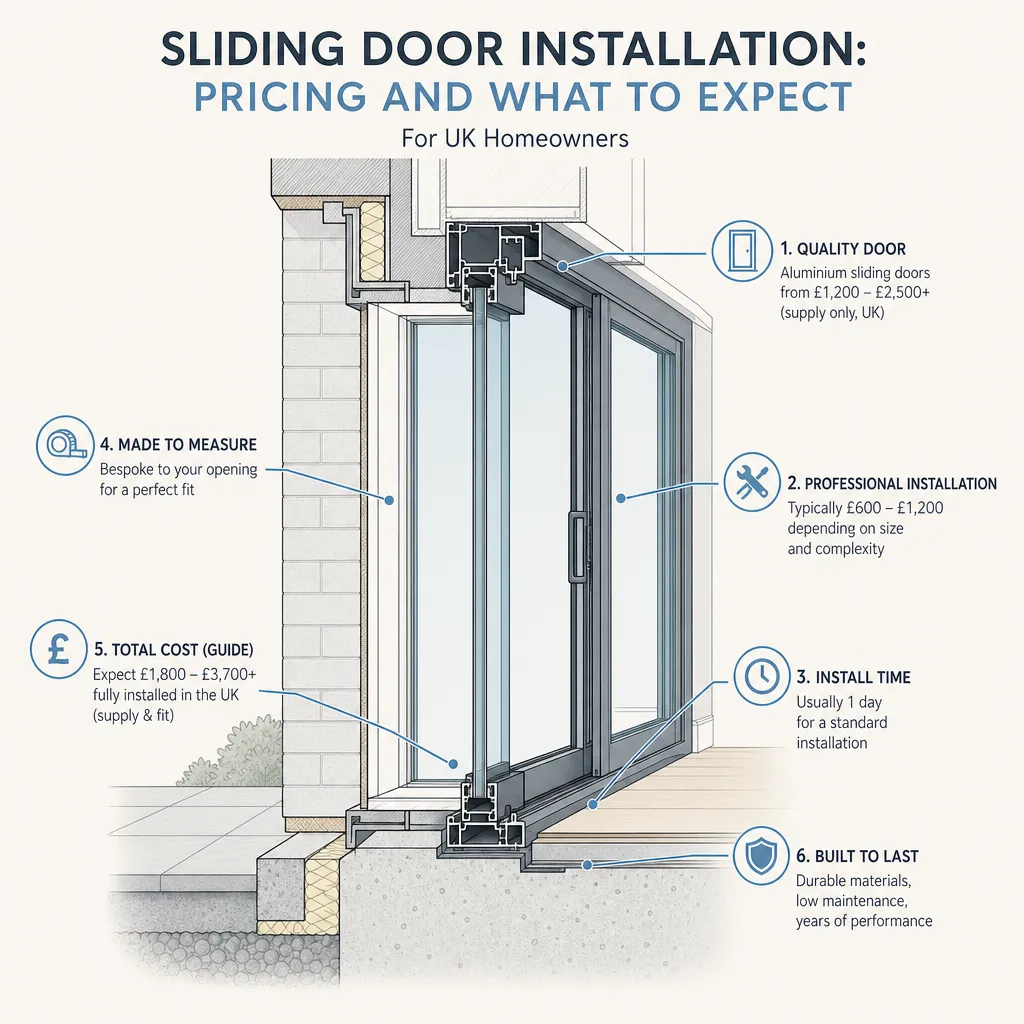
Sliding door installation: pricing and what to expect
A new sliding patio door in the UK typically costs £800–£3,000 fully installed, depending on size, material, and glazing specification.
 Improvement & Build
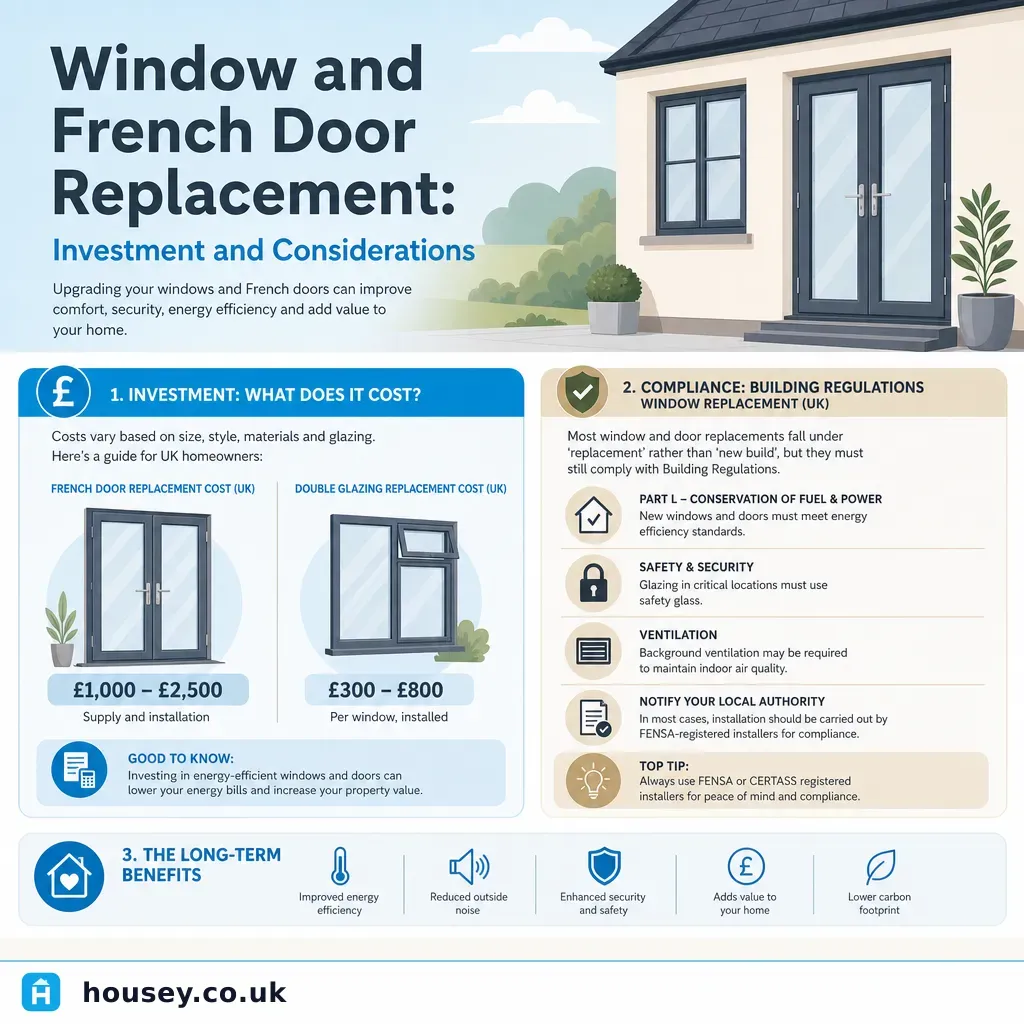
Window and French Door Replacement: Investment and Considerations
Replacing windows and French doors in the UK costs roughly £400–£900 per window and £1,200–£3,500 per set of French doors, depending on material, glazing, and access.
 Improvement & Build
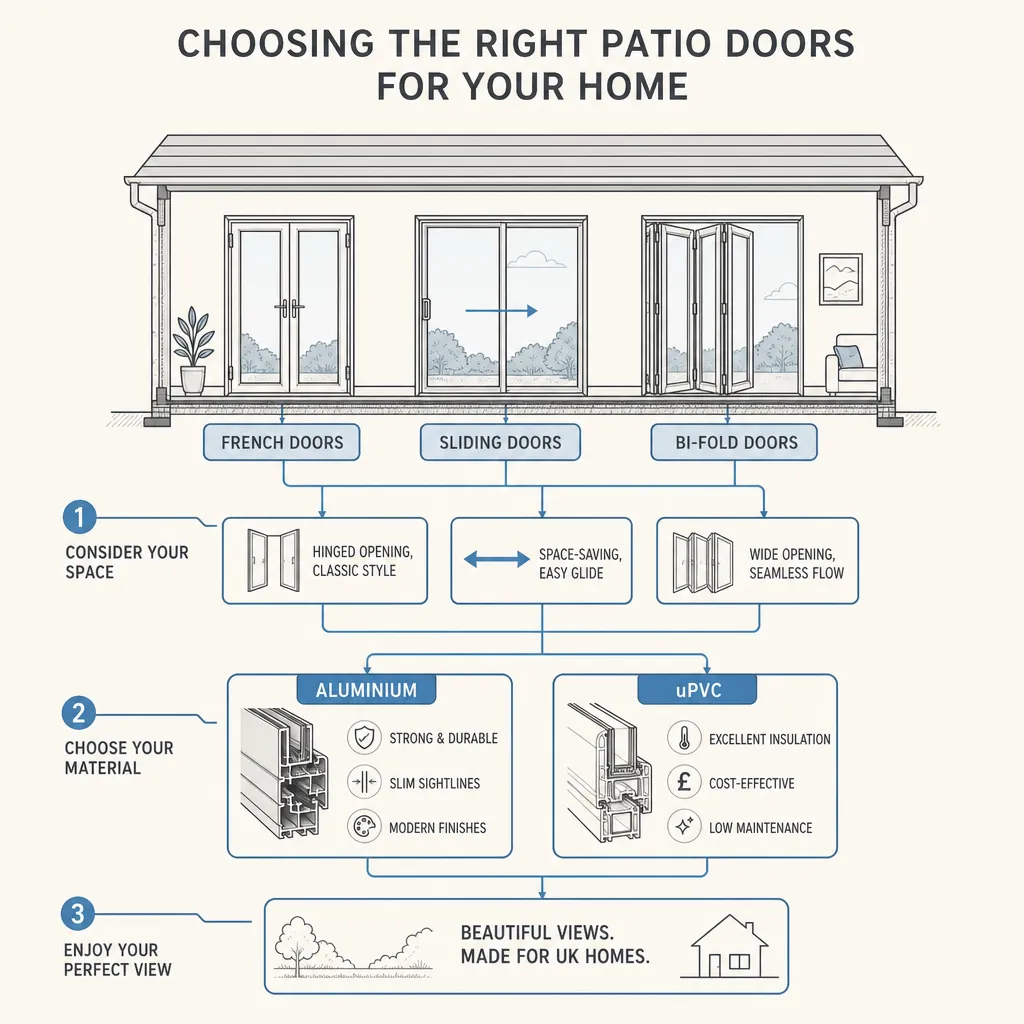
Choosing the Right Patio Doors for Your Home
The right patio doors depend on your opening width, available swing space, home style, and budget.
 Improvement & Build
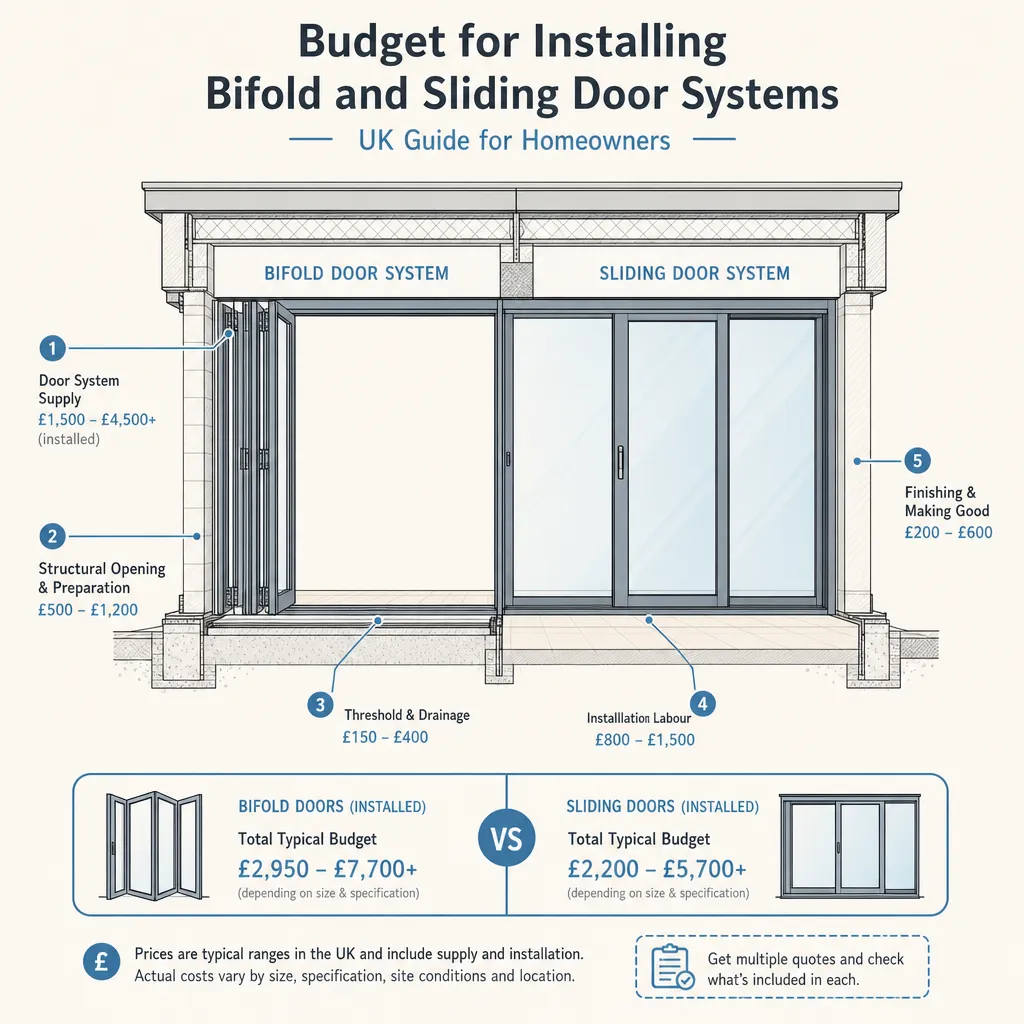
Budget for Installing Bifold and Sliding Door Systems
Aluminium bifold doors typically cost £4,000–£12,000 supplied and installed; uPVC bifolds run £2,500–£6,000.
 Improvement & Build
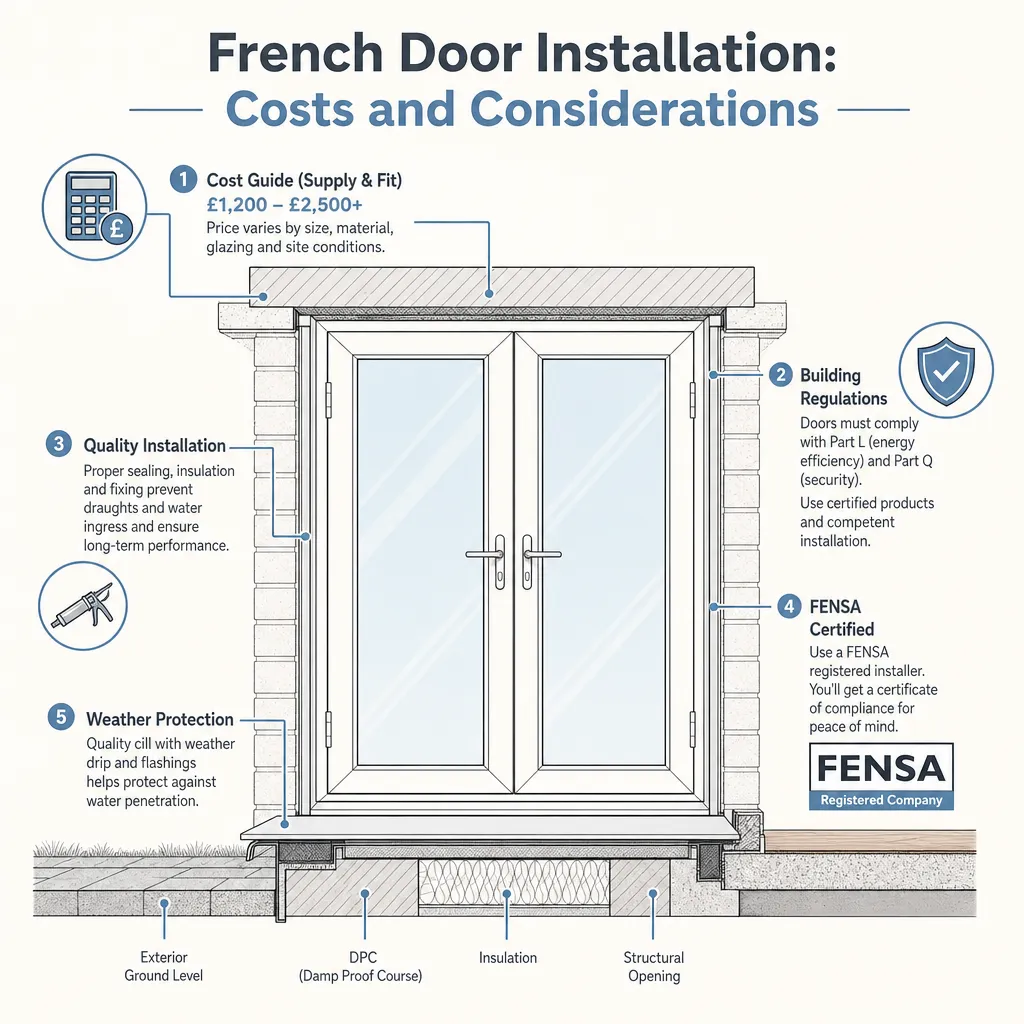
French Door Installation: Costs and Considerations
External French door installation typically costs £1,500–£4,000 in the UK, including supply and fitting, depending on material, glazing specification, and whether structural alterations are needed.