French Drain Installation: Drainage Solutions and Costs
By Housey · Last reviewed 7th of May 2026
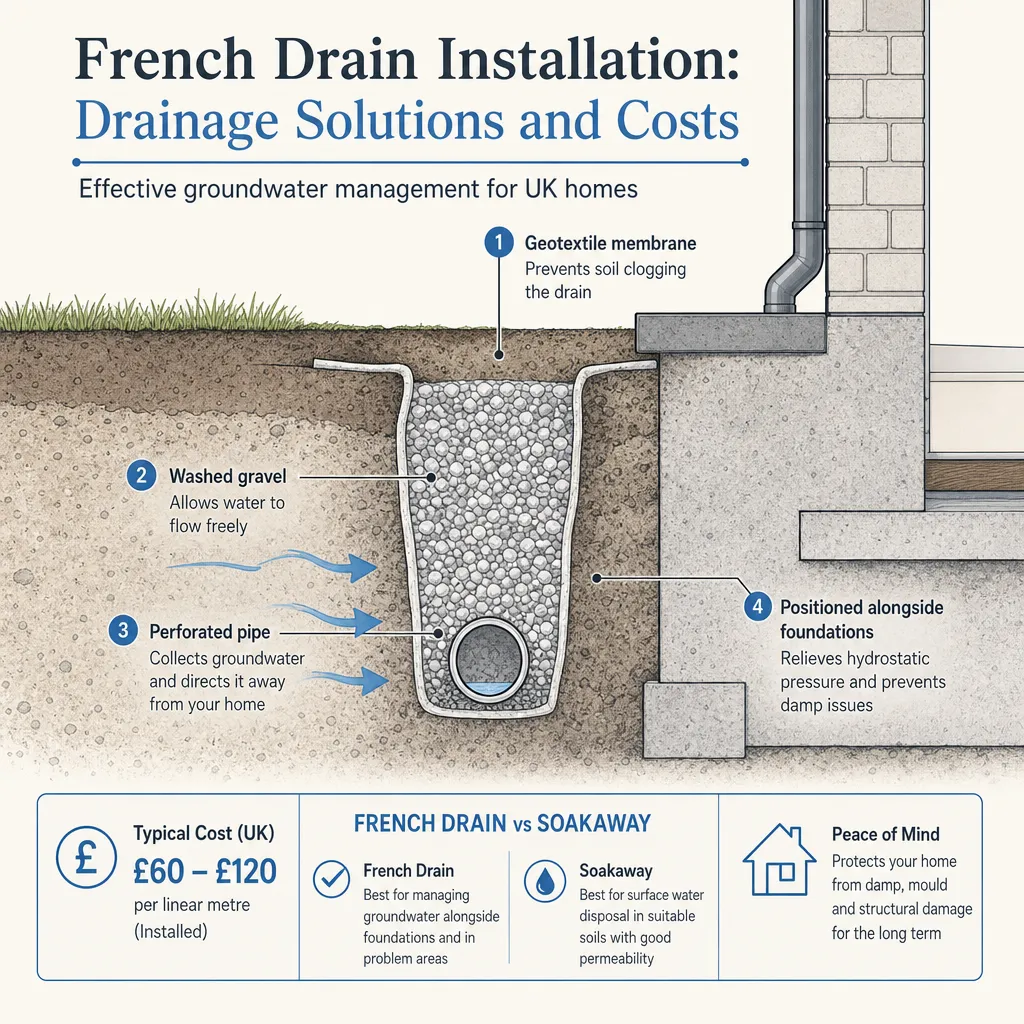
French Drain Installation: Drainage Solutions and Costs
Waterlogged gardens and surface flooding after heavy rain are common complaints in UK properties built on clay-heavy soils or in low-lying areas. A French drain is one of the most widely used subsurface drainage solutions, and understanding when it is appropriate, what it involves, and what it costs helps homeowners avoid expensive recurring damage to their property.
Key points
- A French drain consists of a perforated pipe in a gravel-filled trench, intercepting and redirecting subsurface water before it saturates ground or reaches a building.
- Building Regulations Approved Document H covers drainage requirements; discharging to a watercourse may require Environment Agency consent under the Environmental Permitting Regulations 2016.
- Indicative UK installation costs run from £50 to £100 per linear metre (Indicative UK costs, last reviewed 2026-05-07); most domestic jobs involve 10–30 linear metres.
- Pipes should be laid at a gradient of at least 1:200 to ensure passive gravity flow; depth ranges from 300 mm for shallow garden drainage to 600 mm or more near foundations.
- French drains are unsuitable where subsoils are impermeable clay, the water table is permanently high, or established tree roots are nearby.
How a French drain works
A French drain — sometimes called a land drain or rubble drain — comprises three components: an excavated trench, clean angular gravel (typically 20 mm or 40 mm single-size), and a perforated pipe laid within that gravel. A geotextile filter fabric wraps the assembly to prevent soil migrating into the gravel and blocking the drain over time.
Water enters the pipe through small slots, flows along the gradient, and discharges at a lower point — usually a soakaway, open ditch, or surface-water drain. The system is passive: no pumps or mechanical parts, which suits both rural gardens and urban plots where mains drainage is unavailable or unsuitable.
When is a French drain the right solution?
French drains work well when a garden has persistent boggy patches after rain, when water tracks towards a building or outbuilding, or when a driveway or patio suffers recurring standing water. They are less effective where impermeable clay has no free-draining layer beneath, where the water table is permanently high, or where no suitable discharge point exists within a practical distance.
Which drainage approach suits your situation?
- Choose a French drain along the uphill margin if water pools on a lawn or border after rain, discharging to a soakaway or ditch.
- Choose an interceptor drain across the slope if water tracks towards the house from higher ground.
- Choose a channel drain at the lowest point if a driveway or hard surface floods with no natural gradient to shed water.
- Consider a soakaway pit if there is a boggy area with no clear gravity outfall; a percolation test will confirm suitability.
- Seek a structural waterproofing assessment before any drainage work if water is entering through a wall base or cellar — a French drain alone may not resolve the underlying cause.
- Ask a drainage contractor to assess the site if the cause of waterlogging is unclear before committing to any solution.
French drain installation costs in the UK
Indicative UK costs, last reviewed 2026-05-07.
Cost element | Typical range | Notes |
|---|---|---|
Excavation and pipe laying | £50–£100 per linear metre | Higher for deeper trenches or restricted access |
Soakaway pit (if required) | £300–£800 | Sized according to percolation test results |
Full system (20–30 m) | £1,500–£3,500 | Varies by depth, soil type, and site access |
CCTV drain survey | £150–£400 | Advisable before connecting to existing drainage |
Prices vary by region — London and the South East are typically higher — and by soil type, depth, and distance to the discharge point. Request itemised quotes from at least three contractors.
What to ask before accepting a quote
- What pipe specification will you use (diameter, material, slot size)?
- What gravel grading, and will geotextile fabric be installed throughout?
- What is the proposed discharge point, and do any Environment Agency consents apply?
- Is VAT and trench reinstatement included in the quoted price?
- What warranty applies to workmanship and materials?
Worked UK property scenario
Situation: A 1970s semi-detached in Surrey has a rear garden on a gentle slope towards the house. After heavy rain, water tracks across the lawn and pools against the rear wall, contributing to dampness in the utility room below ground level.
Proposed solution: A 15-metre interceptor drain at 500 mm depth, using 100 mm perforated uPVC pipe in 20 mm angular gravel with geotextile fabric, discharging to an existing soakaway at the garden boundary.
Indicative cost: £750–£1,500 for the drain, plus £300–£600 if the soakaway needs enlarging. A CCTV survey of existing drainage is recommended before connecting to confirm soakaway capacity.
Outcome: The interceptor stops surface water reaching the wall. Combined with brickwork repointing, dampness in the utility room reduces significantly within one wet season. This scenario is illustrative; a drainage contractor should assess your specific situation before work begins.
French drain vs alternative drainage solutions
Solution | Best for | Not ideal for | Indicative cost | Main limitation |
|---|---|---|---|---|
French drain | Subsurface waterlogging, slope interception | Impermeable clay, no outfall | £50–£100/m | Requires a suitable discharge point |
Soakaway pit | Surface and roof runoff disposal | High water table, clay soils | £300–£800 | Percolation test required |
Channel drain | Driveways and hard surfaces | Open ground, large areas | £80–£150/m | Collects surface water only |
Pumped sump | Low-lying sites with no gravity outfall | Power dependency, maintenance | £1,000–£3,000 | Requires electricity and servicing |
Permeable paving | Driveways and paths | Slopes above 1:20, clay subsoil | £60–£120/m² | May require SuDS approval |
Red flags to watch for
- A contractor who quotes remotely without visiting to assess the discharge point and soil conditions.
- No mention of geotextile fabric in the specification — omitting it causes premature blocking by soil migration into the gravel.
- A proposal to discharge to a neighbour's land or a watercourse without confirming legal consent — this creates civil and regulatory liability.
- Quotes that exclude VAT and trench reinstatement, which can add 20–30% to the apparent price.
- No pipe gradient stated in the specification — a flat trench will not drain by gravity.
When to get professional help
Engage a qualified drainage contractor or experienced groundworker when water is affecting foundations or a habitable below-ground space, when the discharge point is a watercourse requiring Environment Agency consent, when the property is in a designated flood-risk area, or when the cause of waterlogging is unclear and a site investigation is needed before any works are committed to.
How Housey can help
Housey connects you with qualified drainage contractors and experienced groundworkers in your area. If drainage forms part of a wider garden project, landscapers on the platform can often incorporate it into a broader design.
Frequently asked questions
Do I need planning permission for a French drain?
In most cases, a French drain in a garden does not require planning permission under permitted development rules. If the drain discharges to a watercourse, consent from the Environment Agency or the relevant Internal Drainage Board may be needed. Check with your local planning authority if the property is listed, in a conservation area, or if drainage changes affect a shared boundary.
How long does a French drain last?
A well-installed French drain with geotextile fabric and the correct gravel specification can last 30–50 years. Drains without fabric, or those near tree roots, may block within 5–15 years. Periodic inspection with a drainage camera and occasional high-pressure jetting can extend the effective life significantly.
Can I install a French drain myself?
Shallow drains on straightforward sites are within the capability of an experienced DIYer. However, trenches deeper than 1.2 m require shoring under HSE guidance, and discharges to watercourses or proximity to building foundations call for professional assessment. Misjudging the gradient or discharge point can worsen the original problem.
What is the difference between a French drain and a soakaway?
A French drain is a linear channel that conveys water along a perforated pipe to a discharge point. A soakaway is a pit or rubble-filled void that receives water and allows it to percolate into the surrounding soil. They are often used together: the French drain conveys water to the soakaway, which then disperses it into the ground.
How deep should a French drain be?
Garden drainage drains typically sit at 300–500 mm depth. Drains designed to intercept water near building foundations may need to be 600 mm to 1 m deep or more. A contractor should determine the required depth from the water table level, soil profile, and the elevation of the problem being addressed.
Sources and further reading
- Approved Document H: Drainage and Waste Disposal — GOV.UK / HM Government
- Water discharge and abstraction licences — Environment Agency / GOV.UK
- Sustainable drainage systems (SuDS) — GOV.UK
- CIRIA C753: The SuDS Manual — CIRIA
Useful next reads
 Improvement & Build
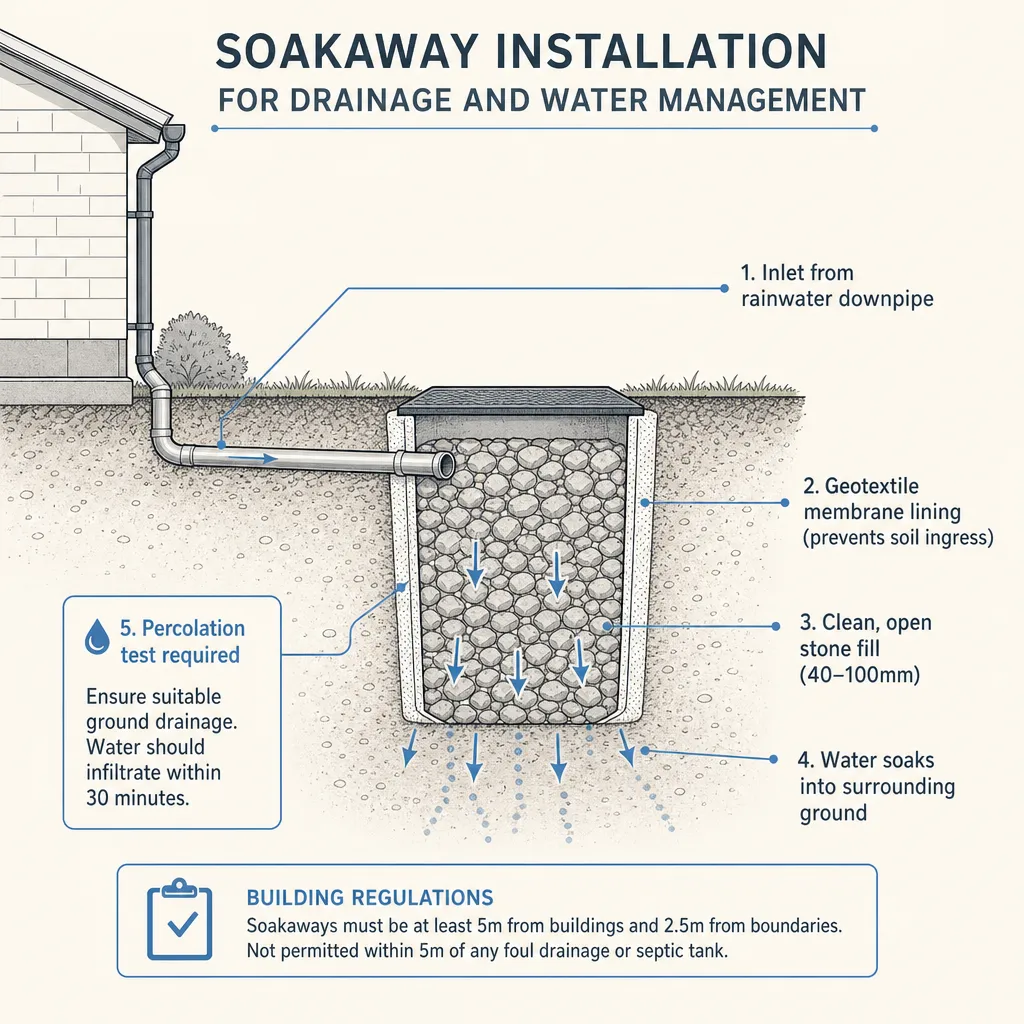
Soakaway Installation for Drainage and Water Management
A soakaway collects surface water or roof drainage and allows it to disperse slowly into the surrounding ground.
 Improvement & Build
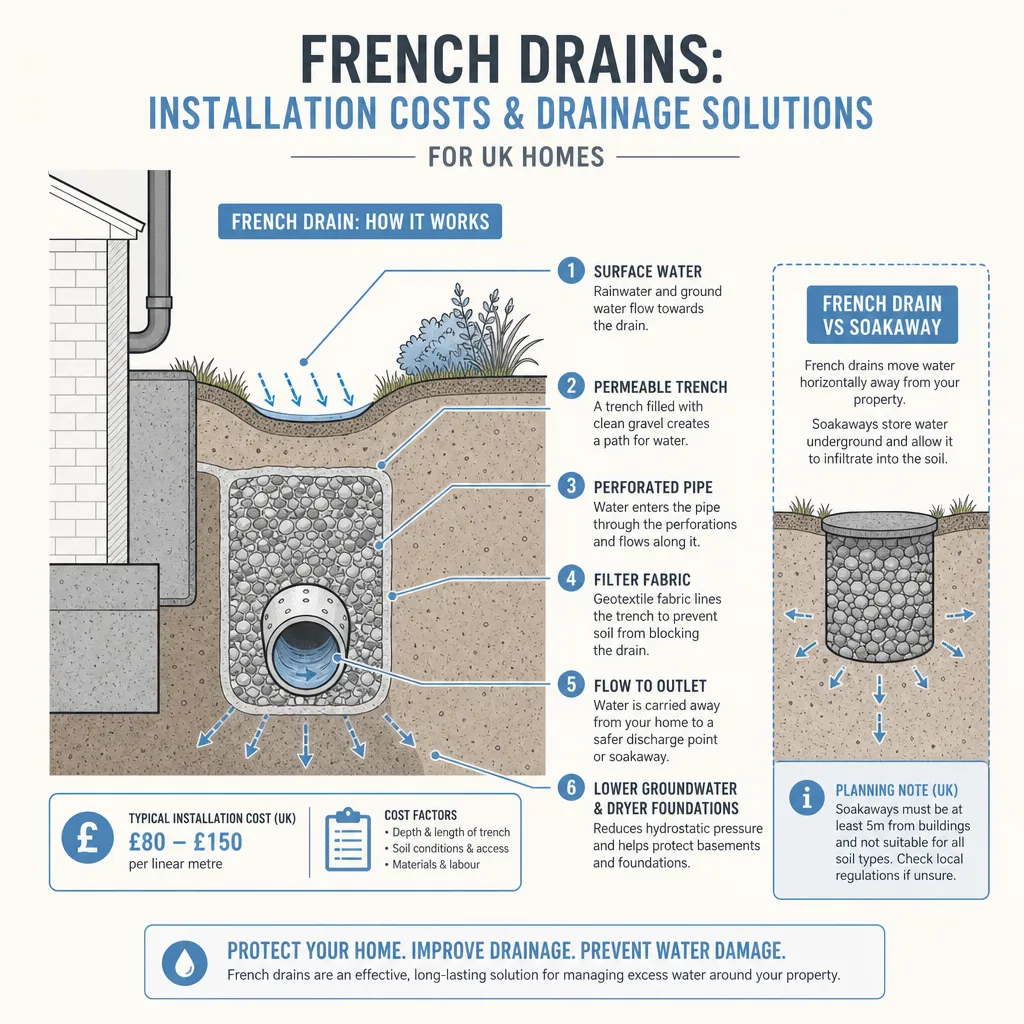
French Drains: Installation Costs and Drainage Solutions
A French drain is a gravel-filled trench with a perforated pipe that redirects groundwater away from a building or waterlogged area.
 Improvement & Build
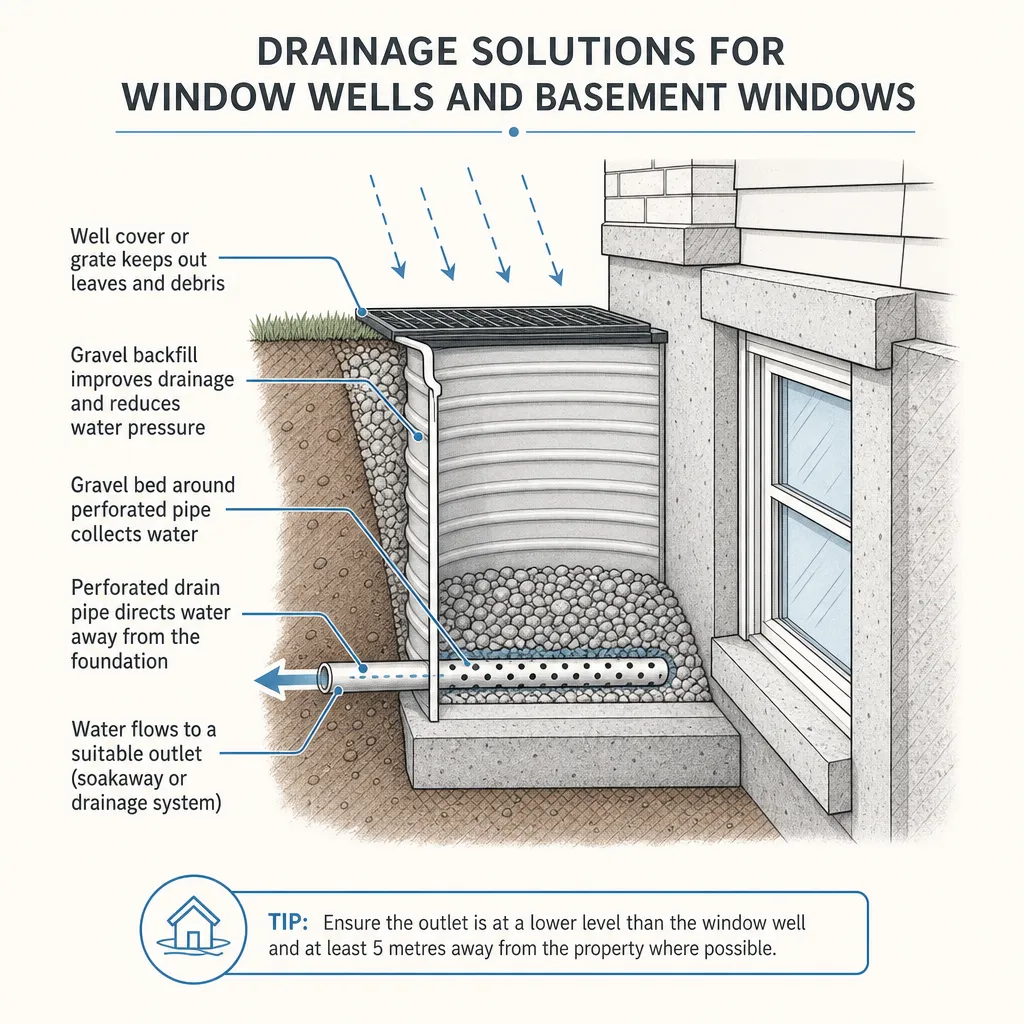
Drainage solutions for window wells and basement windows
Most UK window wells manage water through a gravel-filled sump at least 200 mm deep or a plastic liner fitted with a drain outlet connected to a soakaway or drainage system.
 Improvement & Build
Surface Water Drainage Systems: Design and Installation Methods
Surface water drainage manages rainwater run-off from roofs, driveways, and hard standing.
 Improvement & Build
Installing a Garden Drainage System: Solutions and Costs
Garden drainage problems in UK homes usually stem from clay soil, compacted ground, poor gradient, or failed existing pipes.