French Drains: Installation Costs and Drainage Solutions
By Housey · Last reviewed 10th of May 2026
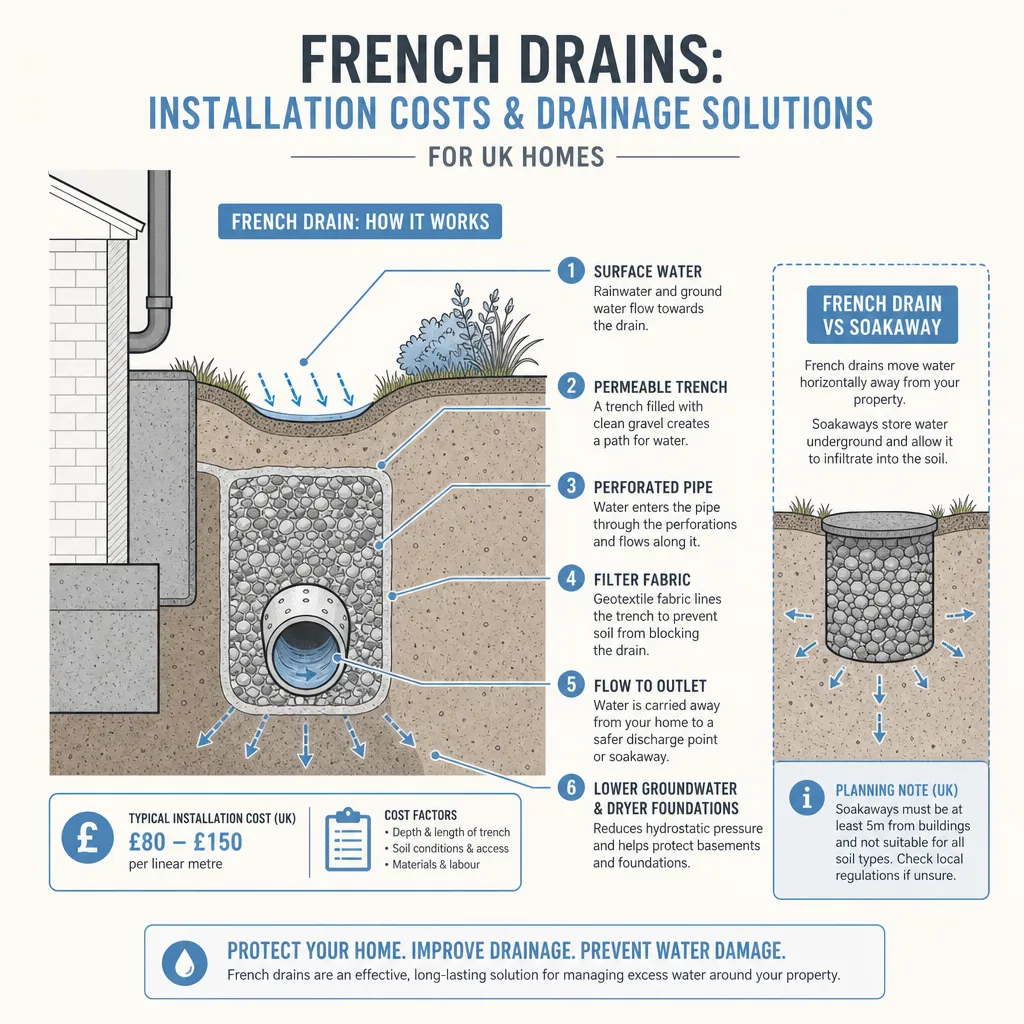
French Drains: Installation Costs and Drainage Solutions
Waterlogged ground is a persistent problem for many UK homeowners, particularly in gardens on clay-heavy soils or where grading causes water to pool against a house wall after heavy rain. A French drain is one of the most widely used solutions — a deceptively simple system that intercepts groundwater and surface water and redirects it to a safe discharge point. Understanding how they work, what they cost, and when they are the right choice can save significant expense compared with trial-and-error drainage attempts.
Key points
- A French drain consists of a perforated pipe laid in a geotextile-lined, gravel-filled trench, sloping at a consistent gradient towards a discharge point such as a soakaway, watercourse, or surface water drain.
- Indicative UK installation costs range from approximately £1,000 to £5,000 for a typical domestic French drain — costs vary considerably by length, depth, soil type, and site access; last reviewed 2026-05-10.
- Connecting a French drain to a public sewer without prior consent from the sewerage undertaker is not permitted under the Water Industry Act 1991.
- In Wales, Schedule 3 of the Flood and Water Management Act 2010 makes Sustainable Drainage Systems (SuDS) approval mandatory for most new drainage through the local authority Statutory SuDS Approving Body (SAB) — check before starting any works.
- On clay soils, soakaways are unlikely to be effective as a sole discharge method; the viability of the discharge route must be confirmed before installation.
How does a French drain work?
A French drain intercepts water before it pools, saturates ground, or reaches a building. The core components are:
- A trench excavated to the required depth — typically 300 mm to 1 m depending on the application and water table
- A geotextile filter membrane lining the trench to prevent soil particles migrating into the gravel and blocking the pipe
- A perforated or slotted pipe (100 mm diameter is typical for domestic use) laid at a consistent fall — usually a minimum of 1:200
- Clean washed angular gravel (commonly 20 mm single-sized) backfilled around the pipe
- A discharge point — a soakaway pit, ditch, watercourse, or (with consent from the sewerage undertaker) a surface water sewer
Water enters the gravel through gaps in the geotextile, flows into the perforated pipe, and travels by gravity to the discharge point. The system works passively, with no mechanical components.
French drain vs other drainage options
Option | Best for | Not ideal for | Approximate UK cost (2026) | Key requirement |
|---|---|---|---|---|
French drain | Intercepting lateral groundwater; protecting foundations; garden drainage | Clay soils with no viable discharge point | £1,000–£5,000 | Suitable discharge point and adequate fall |
Soakaway pit | Dispersing surface runoff into permeable subsoil | Clay or high water-table sites | £500–£2,000 | Permeable soil (percolation test required) |
Linear channel drain | Driveway or patio surface water | Not suited to subsurface groundwater problems | £300–£1,500 | Hard surface with drainage gradient |
Attenuation tank | Storing peak runoff for slow release; new developments | Not a solution for constant groundwater | £1,500–£5,000+ | Space underground; often required by planning |
Pump sump | Basements; sites with no gravity drainage option | Ongoing running costs; requires reliable power | £800–£3,000 | Power supply and regular maintenance |
Indicative UK costs, last reviewed 2026-05-10. All figures vary by region, site access, and specification.
What affects the cost of a French drain?
Several factors can move the final price substantially:
- Length of the drain. A 10 m garden run costs far less than a 50 m perimeter drain protecting a house foundation.
- Depth. Drains protecting below-ground structures may need to reach below floor slab level — deeper excavation can require temporary shoring and increases labour time significantly.
- Soil type. Hard ground or heavy clay is slower and more costly to excavate than loose topsoil or sandy ground.
- Access. Where machinery cannot reach, hand-digging increases labour cost considerably.
- Discharge route. If a new soakaway pit or a connection to a watercourse is required, this adds design and construction cost.
- Reinstatement. Lifting and relaying paving, turf, or ornamental planting adds to the final price and should be itemised in any quote.
What to ask before accepting a quote
- What depth and diameter of pipe is being specified, and what is the rationale?
- What is the proposed discharge point, and has its suitability been confirmed (percolation test, watercourse consent, sewerage undertaker approval)?
- What geotextile specification will be used, and how will it be lapped at joints?
- Is the quote based on machine excavation or hand-dig?
- What is the gravel specification — size, type, and whether it is washed?
- Is VAT included in the quoted price?
- What gradient will the pipe be laid at, and how will this be verified on site?
- Will the finished surface be reinstated, and to what standard?
- What happens if unexpected groundwater or buried services are discovered during excavation?
Permissions and regulations
Most domestic French drains in England do not require planning permission. However, the discharge route is subject to regulation:
- Public sewer connection requires prior approval from the relevant sewerage undertaker (Thames Water, Severn Trent, Yorkshire Water, or similar). Connecting without consent is not permitted under the Water Industry Act 1991.
- Watercourse discharge — including ditches, streams, and rivers — may require consent from the Environment Agency or the local Internal Drainage Board.
- Wales — Schedule 3 of the Flood and Water Management Act 2010 makes SuDS approval mandatory for drainage serving new buildings and extensions. The SAB at the local authority must approve the design; check with your council before starting.
- Conservation areas and listed buildings — any works affecting grounds or structure should be discussed with the local planning authority before proceeding.
When to get professional help
A French drain is not a project to specify from first principles without drainage experience. Instruct a professional drainage contractor if:
- The waterlogging is occurring close to house foundations
- The ground is heavily clay-based and it is unclear whether any discharge option will function effectively
- The water table is high and the problem recurs even after drainage works
- You intend to connect to any existing drainage infrastructure — public sewer, private drain, or watercourse
- The site has restricted access that requires specialist excavation plant
How Housey can help
Housey can connect you with vetted drainage contractors who can assess your site, confirm the right discharge route, specify the correct drain design, and provide comparable written quotes. Compare drainage specialists in your area and check their reviews before committing to any groundworks.
Frequently asked questions
Do I need planning permission for a French drain in my garden?
Planning permission is not generally required for a French drain installed within a domestic garden in England. However, the discharge point matters: connecting to a public sewer requires consent from your sewerage undertaker, and discharging to a watercourse needs Environment Agency or Internal Drainage Board approval. In Wales, Schedule 3 SuDS regulations require SAB approval for most new drainage serving new construction. Always check before starting work.
How long does a French drain last?
A well-installed French drain with correctly specified geotextile membrane and clean angular gravel can remain effective for 30 years or more. The most common cause of failure is fine material — silt or clay — migrating into the pipe over time. Periodic inspection of the outlet and discharge point every few years helps catch any reduction in flow before it becomes a significant problem.
Can I install a French drain myself?
A short, shallow French drain in permeable soil with a clear discharge point is within reach of a competent DIYer with the right tools and materials. However, getting the gradient wrong causes the system to retain water rather than drain it. For drains close to foundations, in heavy clay soil, or requiring connection to existing infrastructure, instruct a qualified drainage contractor.
What is the difference between a French drain and a soakaway?
A French drain is a linear interceptor — it collects water along its length and channels it to a discharge point. A soakaway is a dispersal pit where collected water seeps gradually into surrounding permeable subsoil. The two are often used together: the French drain transports water; the soakaway disperses it. On clay soils, soakaways alone rarely work well and water usually needs directing to a surface water sewer or watercourse instead.
Sources and further reading
- Sustainable drainage systems (SuDS) — GOV.UK
- Flood and Water Management Act 2010 — legislation.gov.uk
- The SuDS Manual (C753) — CIRIA
- Planning Portal: drainage and sewers — Planning Portal
- Water Industry Act 1991 — legislation.gov.uk
Useful next reads
 Improvement & Build
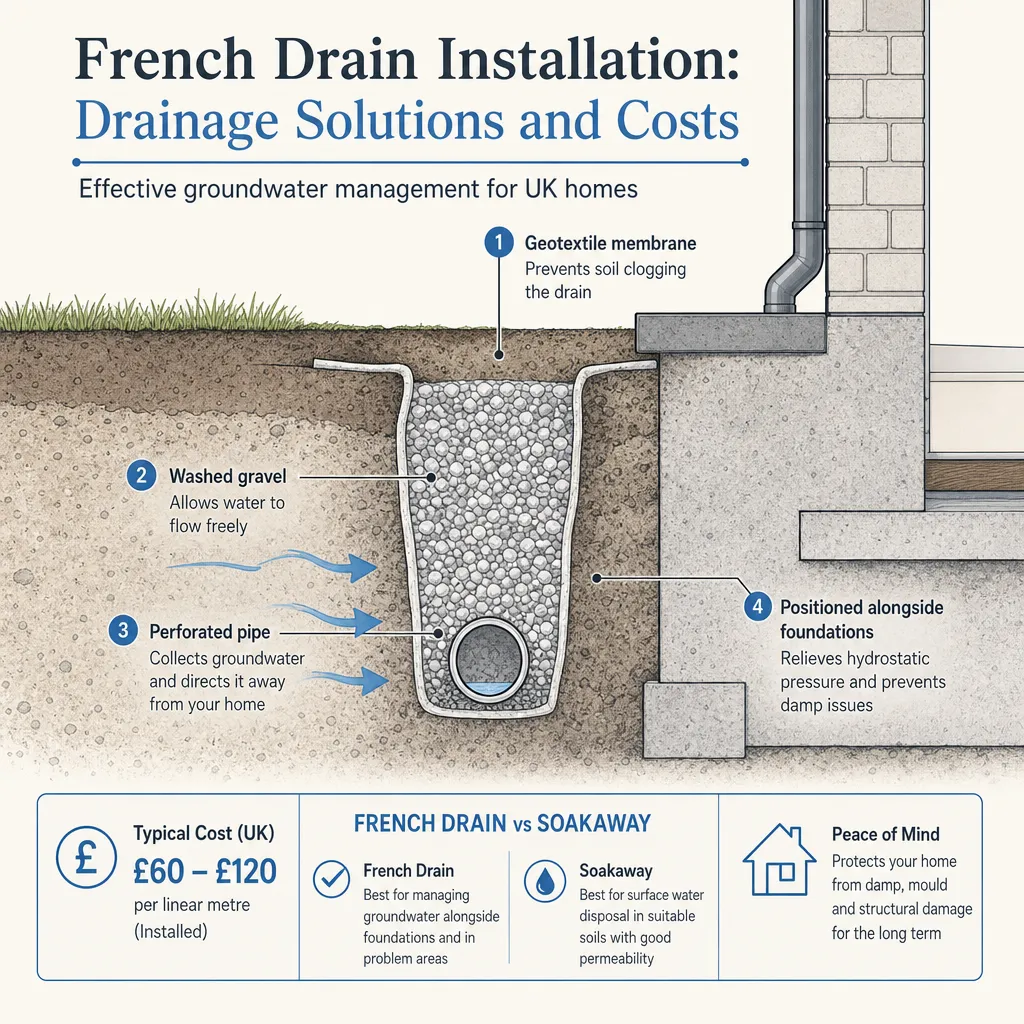
French Drain Installation: Drainage Solutions and Costs
A French drain is a gravel-filled trench containing a perforated pipe that channels subsurface water away from problem areas.
 Improvement & Build
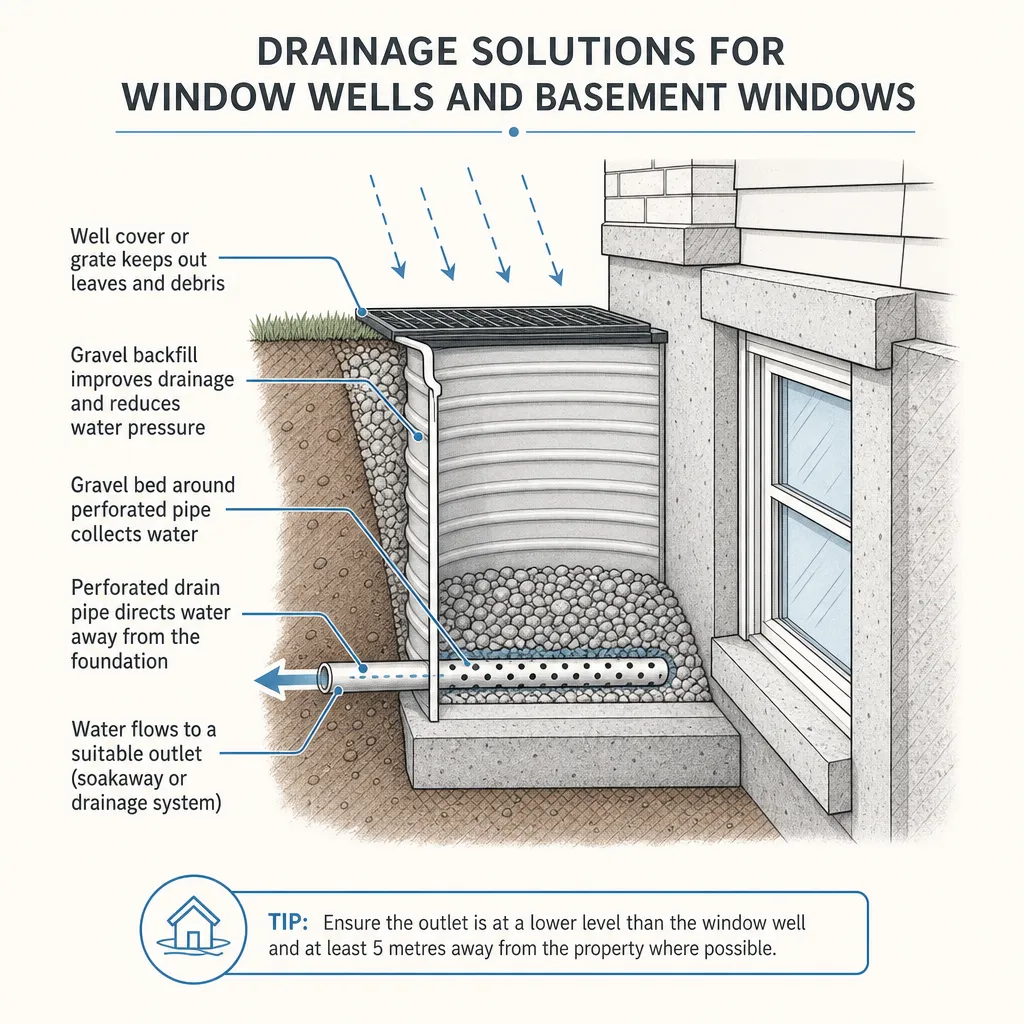
Drainage solutions for window wells and basement windows
Most UK window wells manage water through a gravel-filled sump at least 200 mm deep or a plastic liner fitted with a drain outlet connected to a soakaway or drainage system.
 Improvement & Build
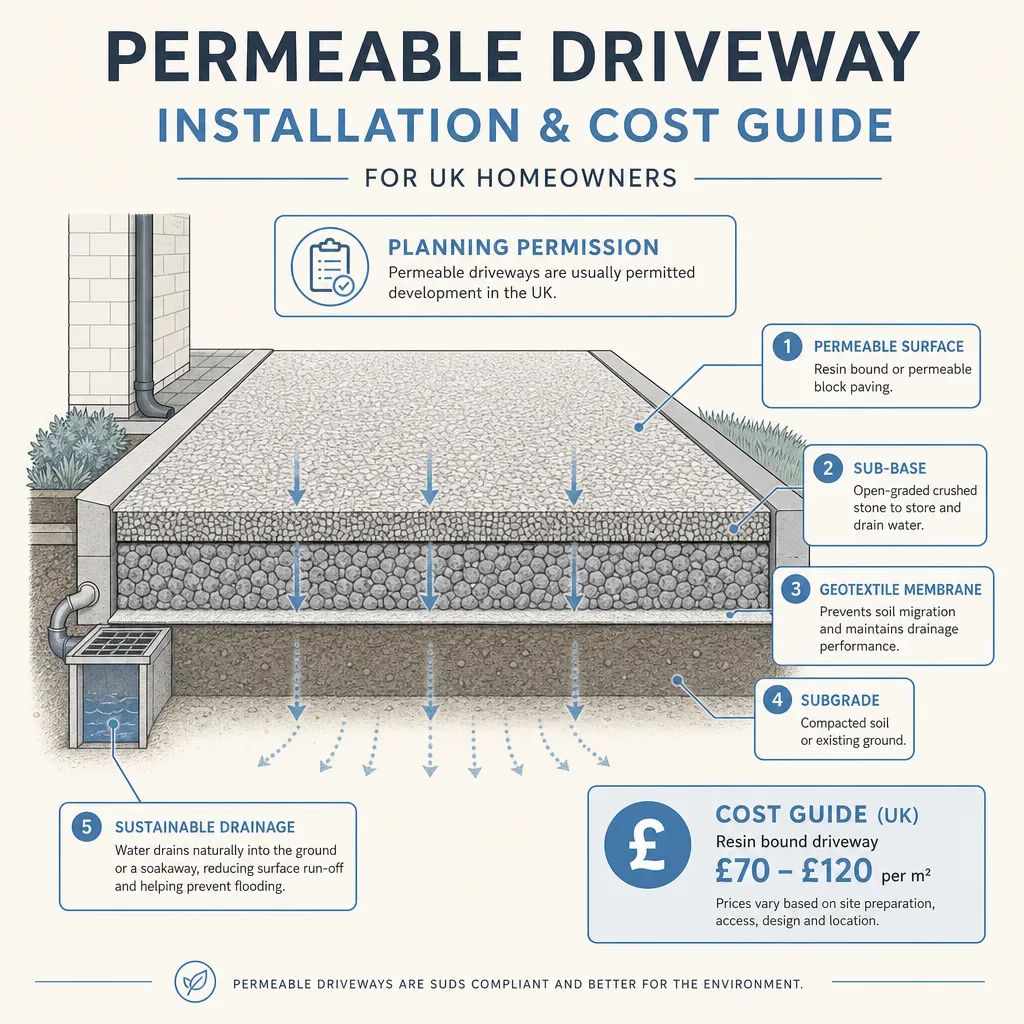
Permeable Driveway Installation and Cost Guide
A permeable driveway lets rainwater drain through or around the surface rather than running off into the road or drainage system.
 Improvement & Build
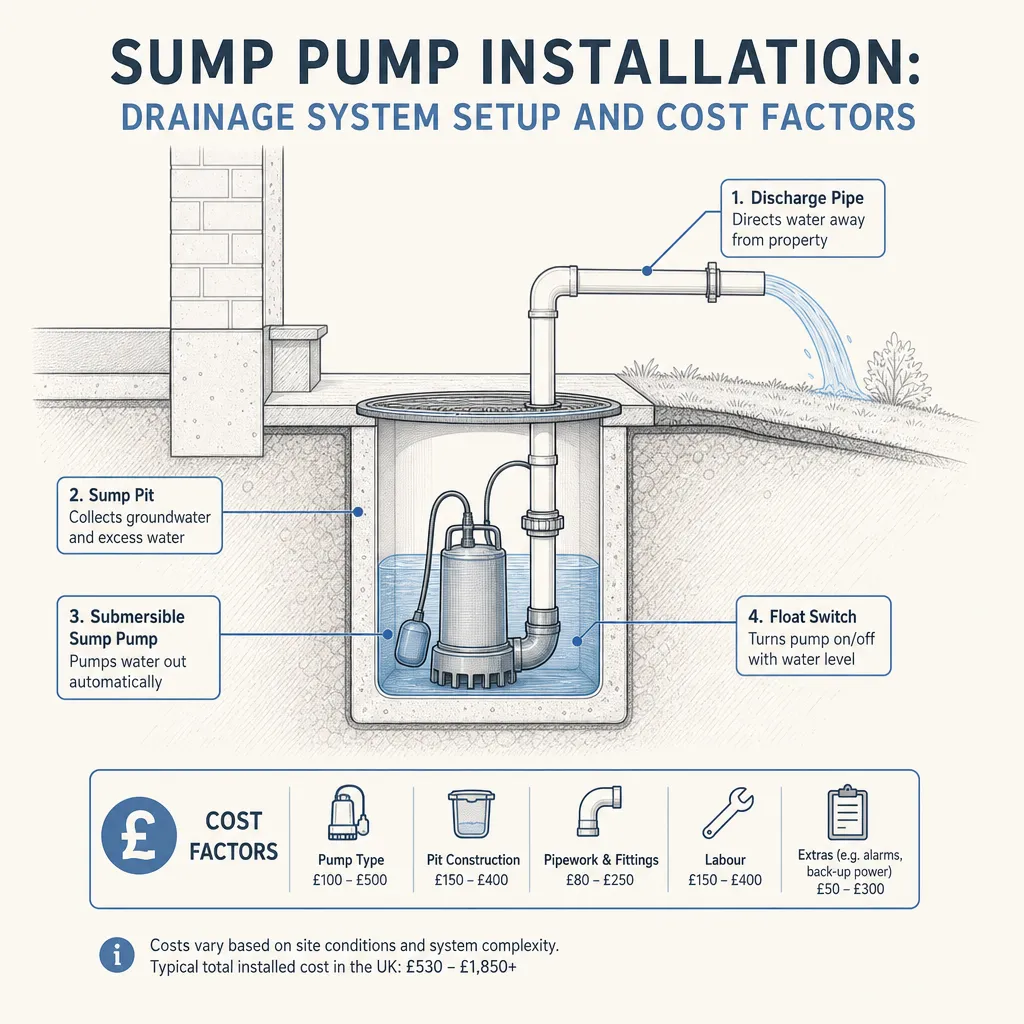
Sump Pump Installation: Drainage System Setup and Cost Factors
Sump pump installation in the UK typically costs £800–£2,500 for a submersible pump in a new or existing pit, including excavation, liner, discharge pipework, and connection to a suitable outlet.
 Improvement & Build
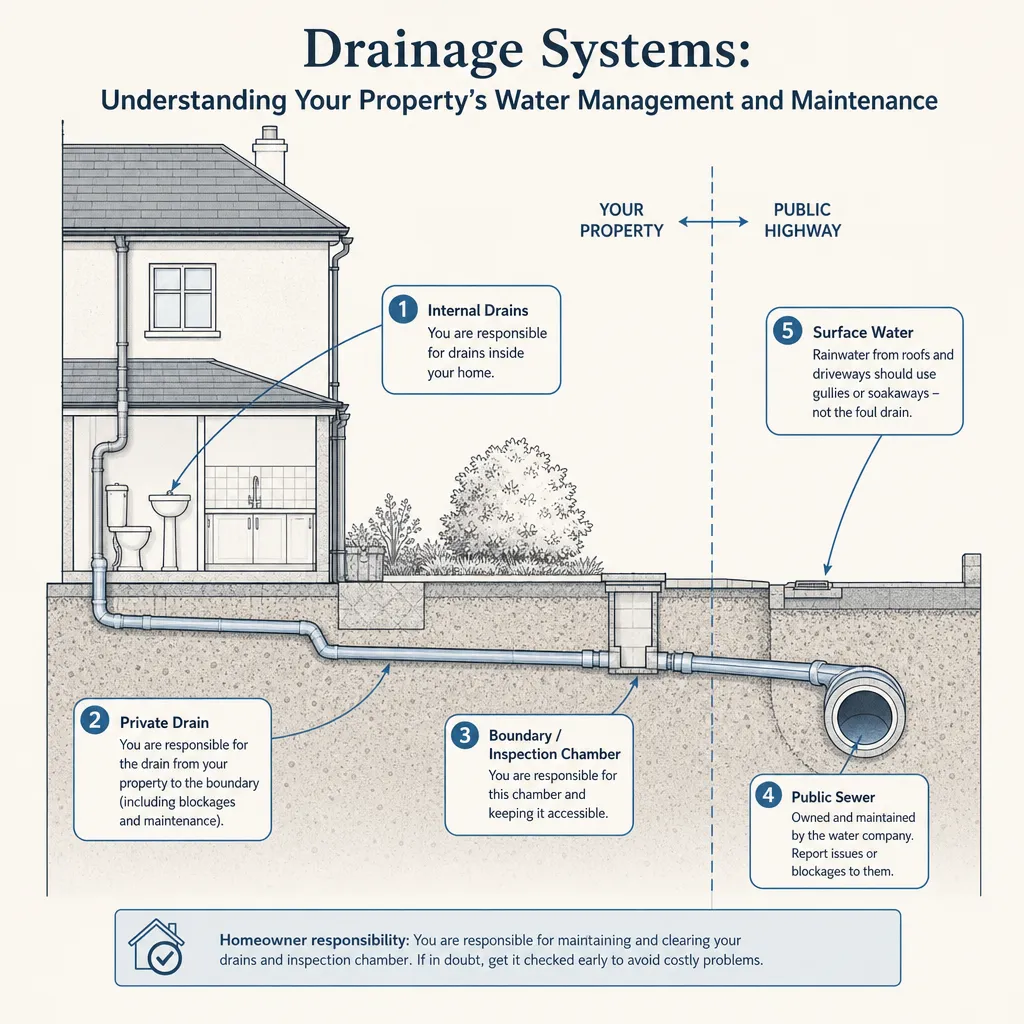
Drainage Systems: Understanding Your Property's Water Management and Maintenance
Most UK homes have separate foul water and surface water drainage systems.