Soakaway Installation for Drainage and Water Management
By Housey · Last reviewed 10th of May 2026
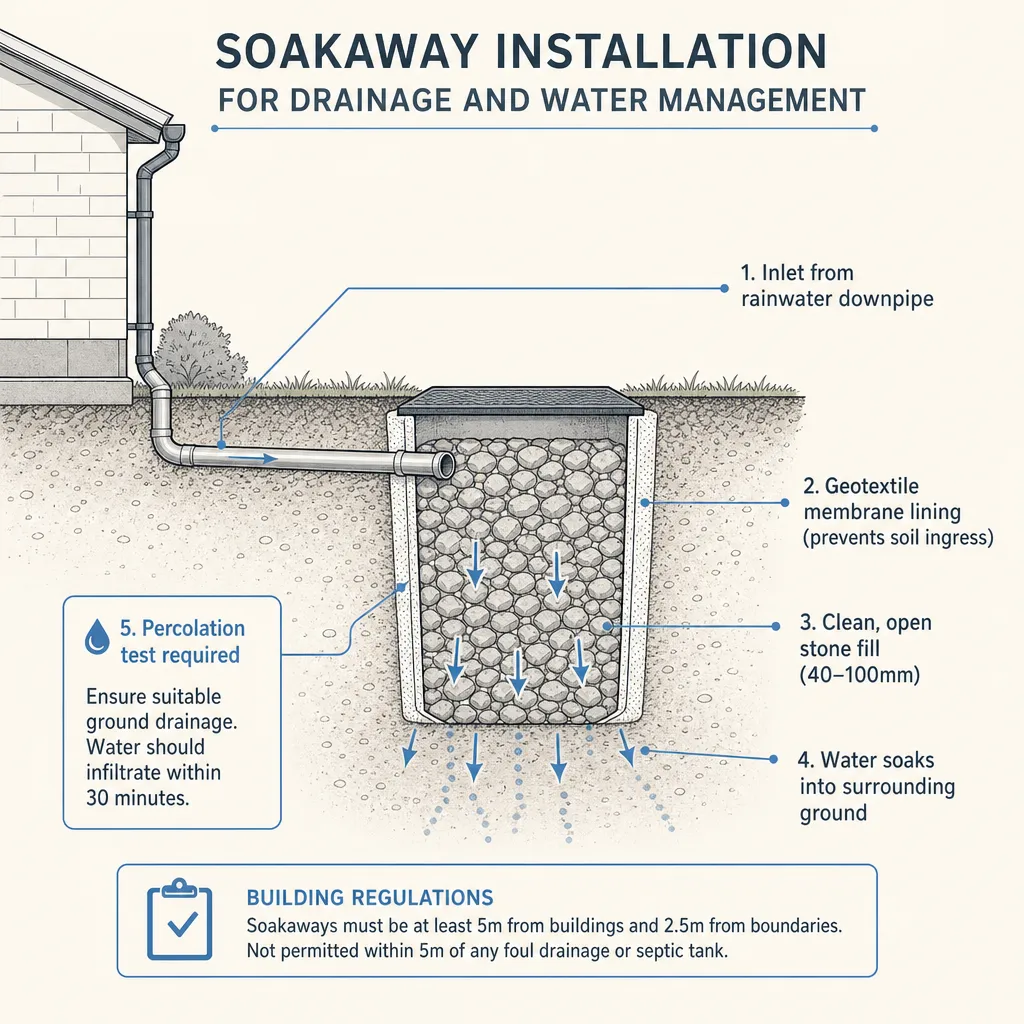
Soakaway Installation for Drainage and Water Management
Soakaways manage surface water and roof drainage by dispersing water slowly into the surrounding ground — a legal requirement where mains sewer connection is not possible. They are common additions to new driveways, extensions, and waterlogged gardens, but they work reliably only where ground conditions are genuinely suitable.
Key points
- Building Regulations Approved Document H requires soakaways to be at least 5 metres from any building and 2.5 metres from a property boundary.
- A percolation test following BRE Digest 365 methodology is essential before design — no reliable sizing can be produced without one.
- The percolation test Vp value must fall between 12 and 100 seconds per millimetre for a soakaway to be viable.
- Modular plastic crate soakaways offer greater void volume than traditional rubble-filled pits and can be inspected after installation.
- Surface water must not enter the foul sewer — a requirement under the Water Industry Act 1991.
Do I need a soakaway?
A soakaway is appropriate when your property cannot connect surface water to a public sewer or approved watercourse, ground permeability is adequate, and the seasonal groundwater table sits at least 1 metre below the soakaway invert. The percolation test confirms whether conditions are suitable — without it, any design is guesswork.
Types of soakaway compared
Type | How it works | Best for | Limitations |
|---|---|---|---|
Traditional rubble-filled pit | Pit filled with coarse stone or gravel | Smaller rural installations | Low void ratio (~30%); difficult to inspect |
Modular plastic crate | Interlocked crates wrapped in geotextile | Most residential applications | Higher material cost; needs careful installation |
Infiltration trench | Gravel trench with perforated pipe | Long driveways and large paved areas | Needs good permeability along full length |
French drain | Perforated pipe redirecting water | Gardens with a slight gradient | Not a true soakaway — water must discharge elsewhere |
For most UK residential projects, modular crate systems are now preferred: they maximise storage volume and can be sized precisely to Building Regulations requirements.
Sizing and percolation testing
BRE Digest 365 describes the percolation test procedure: dig a trial pit to the proposed soakaway depth, fill and drain twice to saturate the soil, then record how long the water level takes to drop 75 mm on three consecutive occasions. A Vp value between 12 and 100 s/mm indicates viable ground. From this value, the catchment area, and a design storm event (typically 1-in-10 year, 1-hour rainfall), a qualified contractor calculates the required storage volume. Undersized soakaways are the most common installation failure.
Permitted development and planning
Soakaways serving a single residential property's surface water are generally permitted development in England. Exceptions apply in flood zones, Source Protection Zones, and where works affect an ordinary watercourse. Modifying an ordinary watercourse requires Lead Local Flood Authority (LLFA) consent under the Land Drainage Act 1991. Always confirm your position with your local authority before starting work.
Decision tree: which drainage solution do I need?
- Choose a soakaway if Vp is 12–100 s/mm, groundwater is more than 1 m below the soakaway invert, and 5 m separation from buildings is achievable.
- Choose an attenuation tank if runoff must discharge at a restricted rate to a watercourse or sewer — check requirements with your LLFA.
- Choose a rain garden if the site has mild permeability and space but fails strict soakaway criteria.
- Consult a drainage engineer if percolation tests fail, the site is in a flood zone, or ground conditions are uncertain or contaminated.
- Do not install a soakaway in heavy clay, contaminated ground, or within a Source Protection Zone.
When to get professional help
Seek a qualified drainage contractor or groundworker when:
- Percolation tests show a Vp outside the 12–100 s/mm range.
- The site is in or near a flood risk area or Source Protection Zone.
- The catchment area exceeds around 100 m².
- Ground conditions are variable, made ground, or potentially contaminated.
- A drainage design report is needed for building control sign-off or a planning application.
How Housey can help
Housey connects you with experienced drainage contractors and groundworkers who can carry out percolation testing, produce a compliant design, and manage installation — from a simple crate soakaway for a new driveway to a more complex scheme for a large extension.
Frequently asked questions
Do I need planning permission for a soakaway?
In most cases, no — a soakaway serving a single residential property's surface water is normally permitted development. However, if your property is in a flood risk area, a Source Protection Zone, or if works affect an ordinary watercourse, you may need consent from your Local Planning Authority or Lead Local Flood Authority. Always check before starting work.
How long does a soakaway last?
A well-designed soakaway with geotextile wrapping should last 20 to 30 years or more. Soakaways can become silted over time, particularly if surface water carries silt from unpaved areas. Modular crate systems can be inspected and, in some cases, jetted to restore capacity.
Can I install a soakaway in clay soil?
Clay soil is generally not suitable because it does not absorb water quickly enough. A percolation test Vp value above 100 s/mm typically indicates unsuitable ground. Alternatives — such as an attenuation tank with restricted discharge to a watercourse — may be required instead.
How far from the house does a soakaway need to be?
Building Regulations Approved Document H requires a minimum of 5 metres from any building and 2.5 metres from a property boundary. This separation prevents ground around foundations from becoming saturated, which could lead to settlement or structural instability over time.
How much does a soakaway cost in the UK?
Indicative UK costs, last reviewed 2026-05-10. A modular crate soakaway for a typical residential property costs £800 to £2,500 installed, depending on size, depth, access, and ground conditions. Larger or more complex schemes can cost considerably more. Obtain at least two or three quotes from qualified contractors.
Sources and further reading
- Building Regulations Approved Document H: Drainage and Waste Disposal — GOV.UK
- BRE Digest 365: Soakaway Design — Building Research Establishment
- Sustainable drainage systems (SuDS) guidance — GOV.UK
- Land Drainage Act 1991 — legislation.gov.uk
Useful next reads
 Improvement & Build
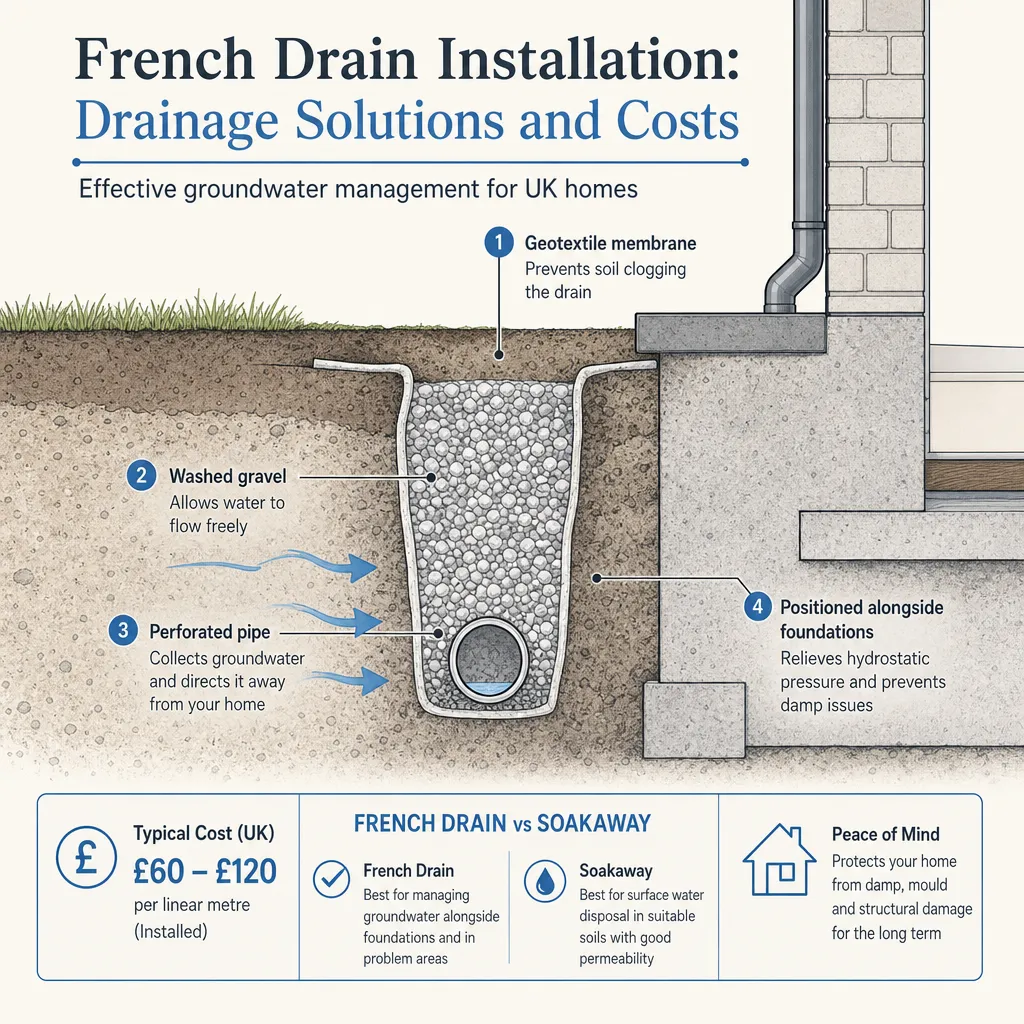
French Drain Installation: Drainage Solutions and Costs
A French drain is a gravel-filled trench containing a perforated pipe that channels subsurface water away from problem areas.
 Improvement & Build
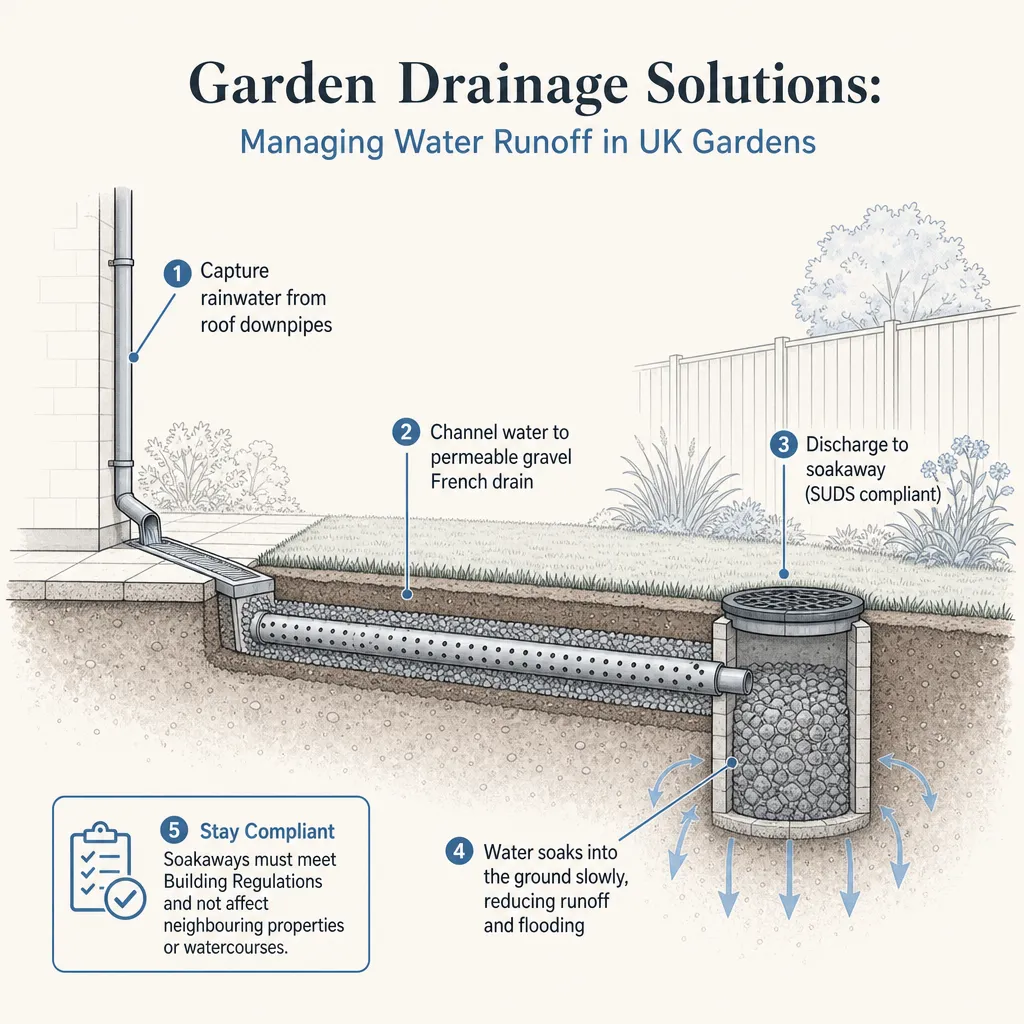
Garden Drainage Solutions: Managing Water Runoff in UK Gardens
Poor garden drainage in the UK is usually caused by clay soil, surface compaction, or too much hard-standing.
 Improvement & Build
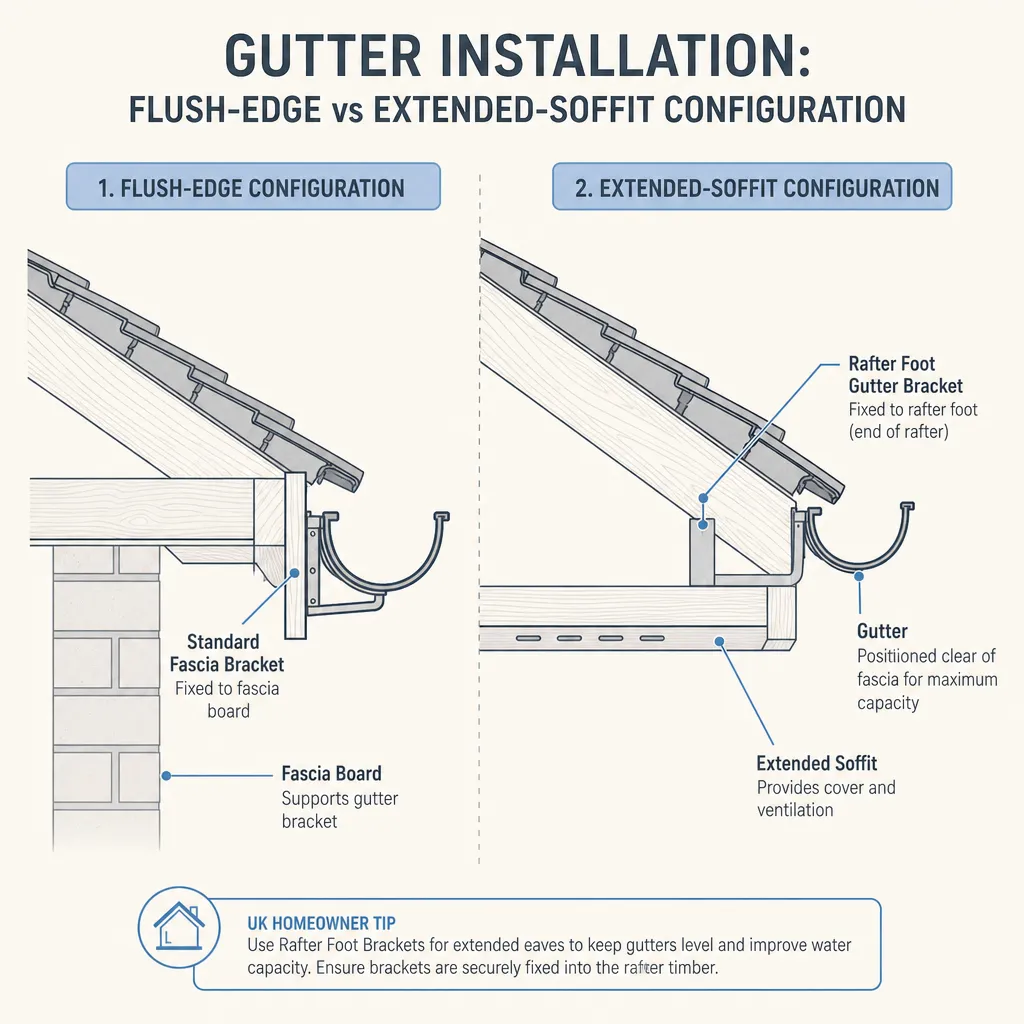
Gutter Installation: Flush-Edge vs Extended-Soffit Configuration
A flush-edge eave uses a standard fascia bracket; an extended-soffit eave typically needs a long-arm or rafter-foot bracket to reach the tile drip edge.
 Improvement & Build
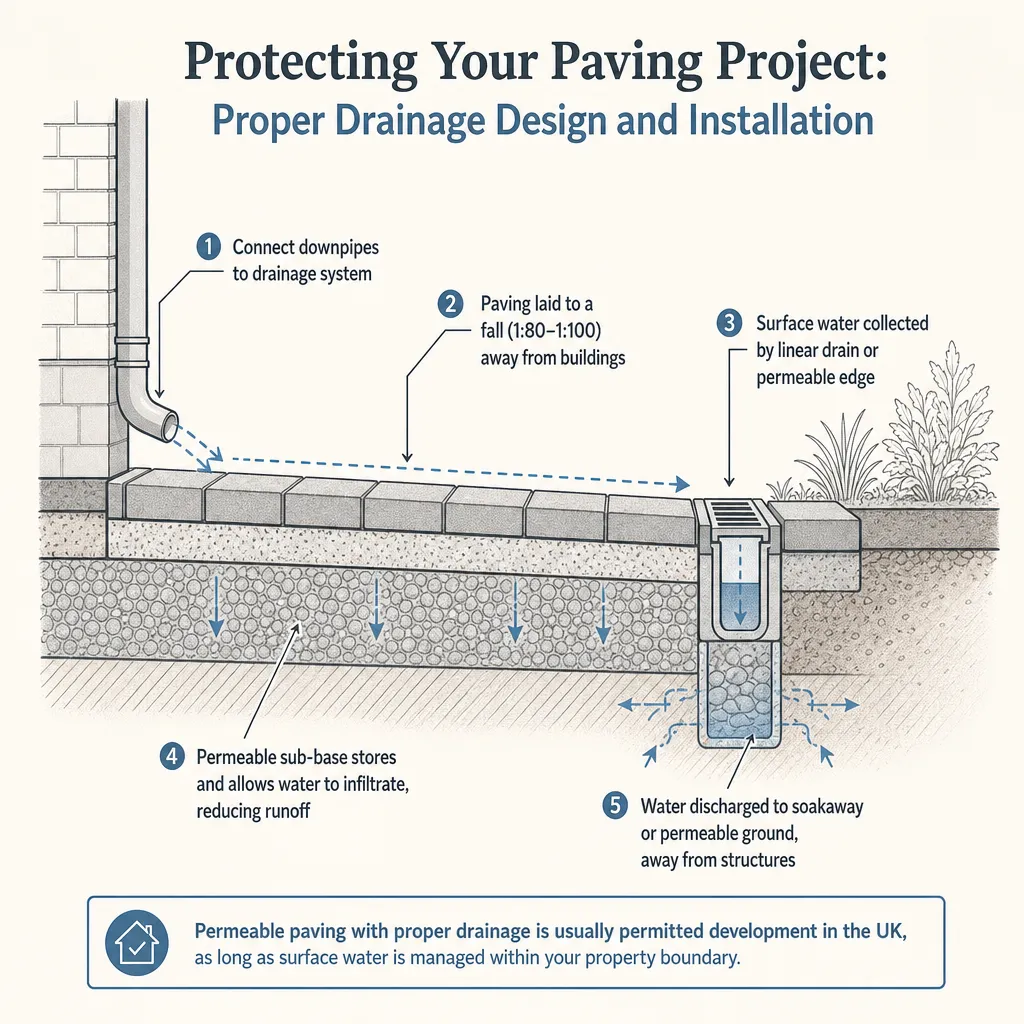
Protecting Your Paving Project: Proper Drainage Design and Installation
Good paving drainage starts with a minimum fall of 1:60 to 1:80 away from buildings, a correctly specified sub-base, and a clear outlet for surface water.
 Improvement & Build
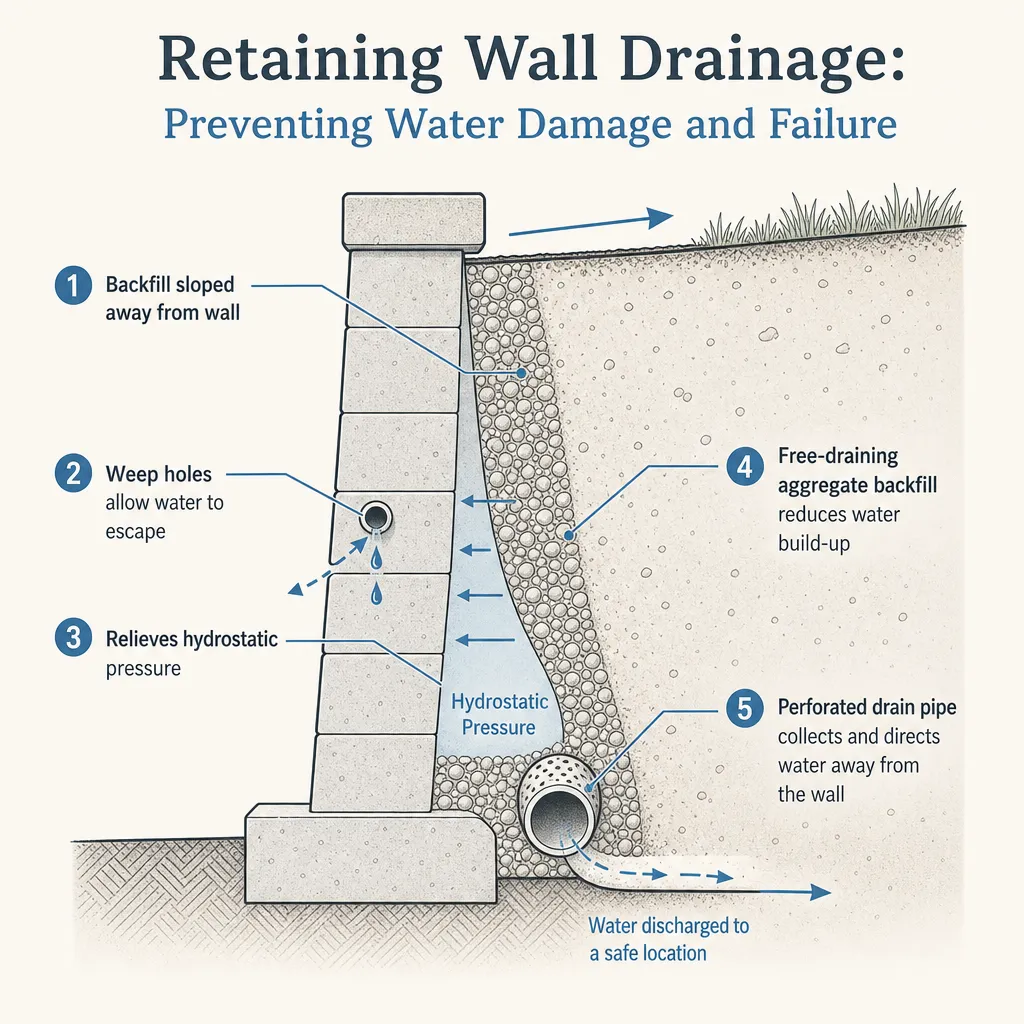
Retaining Wall Drainage: Preventing Water Damage and Failure
Retaining wall drainage fails when hydrostatic pressure builds behind the structure due to poor drainage layers, blocked weep holes, or impermeable backfill.