Installing a Garden Drainage System: Solutions and Costs
By Housey · Last reviewed 7th of May 2026
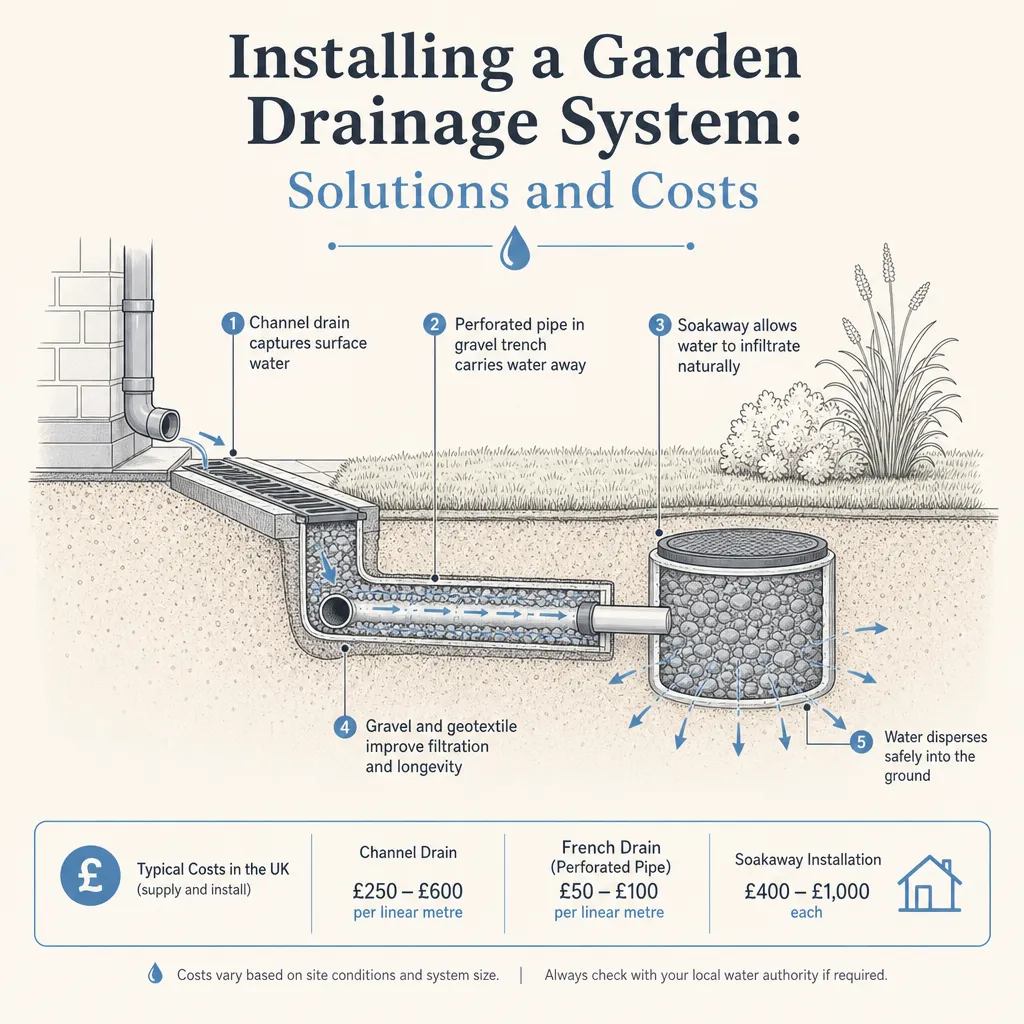
Installing a Garden Drainage System: Solutions and Costs
When prolonged rainfall leaves a lawn underwater or turns paths into streams, the underlying cause is rarely just surface water — it usually points to compacted soil, a high clay content, or poor land grading. Choosing the right drainage solution means understanding your garden's specific conditions, not just reaching for the cheapest fix. UK gardens face particular challenges given average annual rainfall exceeding 1,000mm in wetter regions and a high proportion of clay-rich soils across much of England and Wales.
Key points
- French drains (perforated pipe in a gravel trench) typically cost £50–£100 per linear metre installed, including excavation and backfill (Indicative UK costs, last reviewed 2026-05-07).
- A soakaway pit must be sited at least 5 metres from any building and 2.5 metres from a boundary under Building Regulations Approved Document H.
- Connecting new drainage to a public sewer requires consent under Section 106 of the Water Industry Act 1991 — contact your local water authority before work begins.
- Linear channel drains are often required at the edge of driveways or patios where hard-standing meets a garden, to manage surface run-off.
- Permeable paving and rain gardens can significantly reduce surface water run-off compared with traditional impermeable hard-standing, according to CIRIA SuDS guidance.
Types of garden drainage system
The right solution depends on your soil type, garden size, gradient, and whether standing water is persistent or seasonal. Use this comparison to narrow down the options before getting quotes.
Drainage type | Best for | Approximate installed cost | Main limitation |
|---|---|---|---|
French drain (perforated pipe) | Lawns, beds, general waterlogging | £50–£100/linear metre | Needs a suitable outfall or soakaway |
Soakaway pit | Sandy or free-draining subsoil | £400–£1,200 per unit | Ineffective in heavy clay without soil improvement |
Linear channel drain | Hard-standing edges, driveways, patios | £80–£150/linear metre | Surface only — does not address deep soil saturation |
Catch pit and sump pump | Low-lying areas with no gravity outfall | £600–£2,000 installed | Ongoing maintenance and electricity costs |
Rain garden or bioswale | Front gardens, sustainable drainage | £1,500–£5,000+ depending on size | Requires design and planting plan |
Permeable paving | Driveways, paths | £50–£120/m² supply and install | Requires a prepared sub-base |
Indicative UK costs, last reviewed 2026-05-07. Quotes vary significantly by region, access, and ground conditions.
How to identify the cause of poor drainage
Before committing to a solution, it is worth diagnosing the cause. The most common issues in UK gardens are:
- Compacted soil — often found under lawns with heavy foot traffic. Hollow-tine aeration can help in mild cases without excavation.
- High clay content — clay holds water and drains very slowly. Clay soils are common across the Midlands, parts of London, and much of eastern England.
- Poor gradient or sunken areas — water pools where the ground is level or slightly hollow. Re-grading or raising the level with topsoil may resolve this.
- Blocked or absent existing drainage — older properties may have clay-pipe or brick soakaways that have collapsed or silted up.
- High water table — in some areas the water table is naturally close to the surface; major drainage works may achieve only modest improvement.
A percolation test gives a useful indication of soil absorption rate and helps determine whether a soakaway is viable. Dig a hole 300mm square by 300mm deep, fill it with water, and time how long it takes to drain. A drainage rate of 1–125mm per hour is generally acceptable for a soakaway under Approved Document H.
Planning and permission considerations
Most garden drainage work is permitted development and does not require planning permission, provided the work does not connect to a public highway drain or sewer without consent. However:
- Section 106 connections — connecting to a public sewer requires approval from your local water authority under Section 106 of the Water Industry Act 1991. This is non-negotiable; unpermitted connections can result in costly enforcement action.
- Conservation areas and listed buildings — even minor groundworks may require planning consent or listed building consent. Check with your local planning authority first.
- Neighbour nuisance — drainage that significantly alters water flow onto adjacent land could give rise to a civil claim. Grade levels carefully and consider filter fabric to prevent silt transfer.
- SuDS requirements — Sustainable Drainage Systems are increasingly encouraged or required by local authorities for domestic retrofit, particularly where works affect run-off patterns.
What a garden drainage installation involves
A typical installation by a drainage contractor or groundworker follows this sequence:
- Site survey and percolation test — assess soil type, existing drainage infrastructure, and outfall options.
- Design — specify pipe sizes, gradients (a minimum fall of 1:200 is usually recommended for perforated pipe), inspection chamber positions, and outfall point.
- Excavation — trenches are usually 300–600mm deep for French drains; soakaway pits are typically 1–3m³ in volume.
- Laying and backfilling — pipe is laid on a geotextile-lined gravel bed and wrapped in filter fabric to prevent silt ingress and premature blockage.
- Outfall connection — to a soakaway, watercourse (with Environment Agency consent if required), or surface water sewer.
- Reinstatement — topsoil and turf replaced, hard surfaces restored to a reasonable match.
Inspection chambers should be installed at every change of direction to allow future rodding and jetting.
Homeowner checklist before getting quotes
Red flags to watch for when getting quotes
- A contractor proposing to connect surface water to a foul-water (sewage) sewer — this is not permitted without specific approval and may result in enforcement action.
- No percolation test proposed before specifying a soakaway — this test is essential to confirm soil suitability.
- No geotextile membrane in the specification — without it, French drains silt up within a few years and lose effectiveness.
- Prices that exclude excavation, spoil disposal, or reinstatement — these can add 30–50% to a headline figure and should always be itemised.
- No inspection chambers in the proposed layout — these are a maintenance requirement, not an optional extra.
When to get professional help
Most garden drainage beyond simple surface grading benefits from professional input. Engage a drainage contractor or groundworker if:
- Water is pooling within 3 metres of your house foundations — this can indicate a risk to the structure and should be investigated promptly.
- You suspect an existing drain has collapsed or is blocked (a CCTV drain survey is worth commissioning before any new installation).
- The proposed outfall is a watercourse or ditch — Environment Agency or Internal Drainage Board consent may be required.
- The garden sits in a designated flood zone.
- Works involve breaking into an existing inspection chamber or connecting to a public sewer.
How Housey can help
Housey connects you with vetted drainage contractors and groundworkers covering your postcode, so you can compare quotes from local professionals. If you'd like drainage integrated into a wider garden project, you can also request quotes from garden designers who can co-ordinate design and build.
Frequently asked questions
How much does a French drain cost in the UK?
A French drain typically costs £50–£100 per linear metre installed, including excavation, perforated pipe, gravel, geotextile membrane, and backfill. A typical residential installation of 15–20 metres might therefore cost £750–£2,000. Add £400–£800 for a new soakaway if there is no existing suitable outfall. Indicative UK costs, last reviewed 2026-05-07; get at least three quotes as prices vary by region and ground conditions.
Do I need planning permission for garden drainage?
Most garden drainage works are permitted development. However, connecting to a public sewer requires consent from your local water authority under Section 106 of the Water Industry Act 1991. Works in conservation areas or affecting listed buildings may need planning consent. Check with your local planning authority and water company before starting work.
How do I know if my soil is suitable for a soakaway?
A percolation test is the standard method. Dig a hole 300mm square and 300mm deep, fill it with water, and measure how long it takes to drain. If water drains at 1–125mm per hour, the soil is generally suitable under Building Regulations Approved Document H. Very slow drainage — typical of heavy clay — may mean a soakaway is not viable and alternatives are needed.
Can I install garden drainage myself?
Minor works — such as fitting a simple channel drain or improving surface grading — can be done by a confident DIYer. Excavating to depth, laying perforated pipe at the correct gradient, and making outfall connections close to foundations or public sewers are better handled by a qualified drainage contractor or groundworker.
How long does garden drainage installation take?
A standard French drain for a typical garden (20–30 metres of trench) usually takes one to two days for a two-person team. A soakaway pit adds half a day to a full day depending on size and excavation conditions. Allow additional time if significant reinstatement — turf relaying or patio restoration — is needed.
Sources and further reading
- Building Regulations Approved Document H: Drainage and waste disposal — GOV.UK
- Flood map for planning — Environment Agency
- Sustainable drainage systems: guidance for designers — GOV.UK
- Water Industry Act 1991: Section 106 — legislation.gov.uk
- CIRIA SuDS Manual C753 — CIRIA
Useful next reads
 Improvement & Build
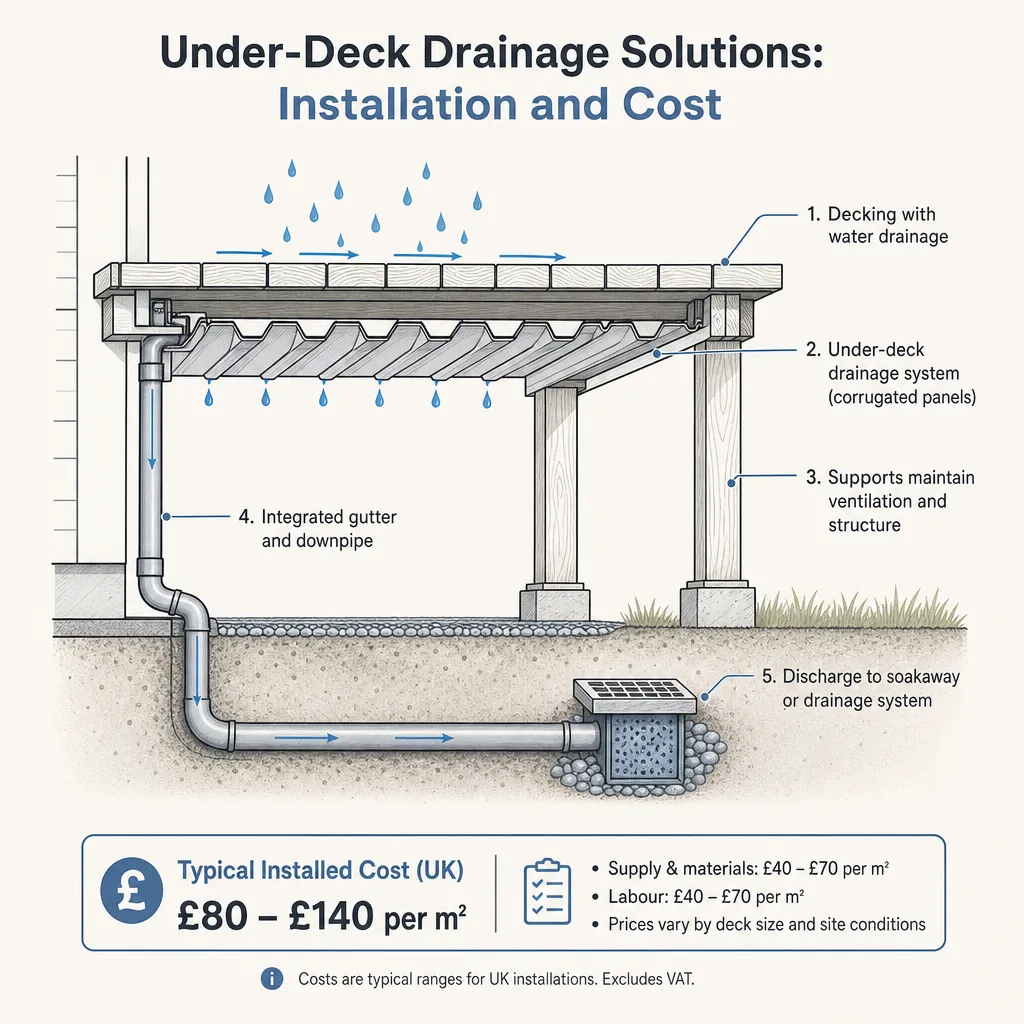
Under-Deck Drainage Solutions: Installation and Cost
Under-deck drainage systems channel rainwater falling through or running off a raised deck away from the space beneath it, keeping the under-deck area dry and usable.
 Improvement & Build
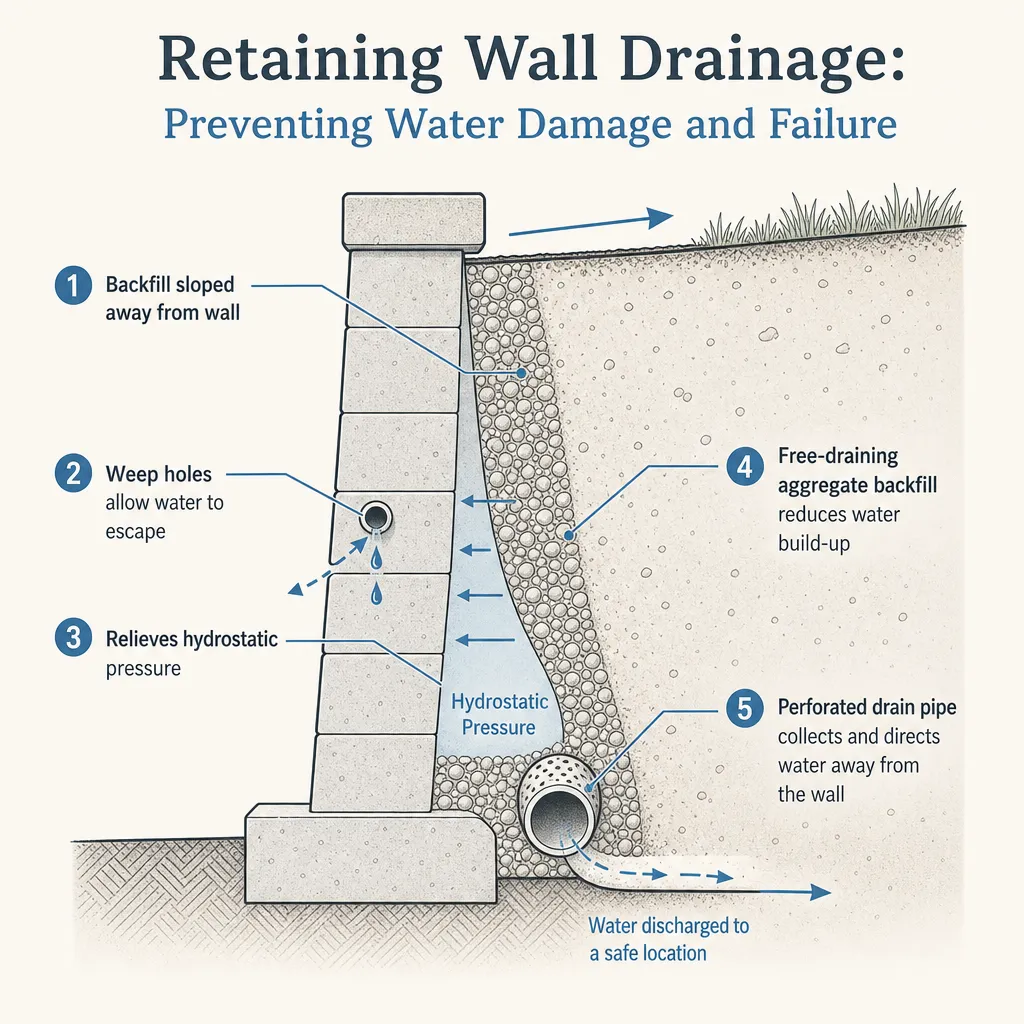
Retaining Wall Drainage: Preventing Water Damage and Failure
Retaining wall drainage fails when hydrostatic pressure builds behind the structure due to poor drainage layers, blocked weep holes, or impermeable backfill.
 Improvement & Build
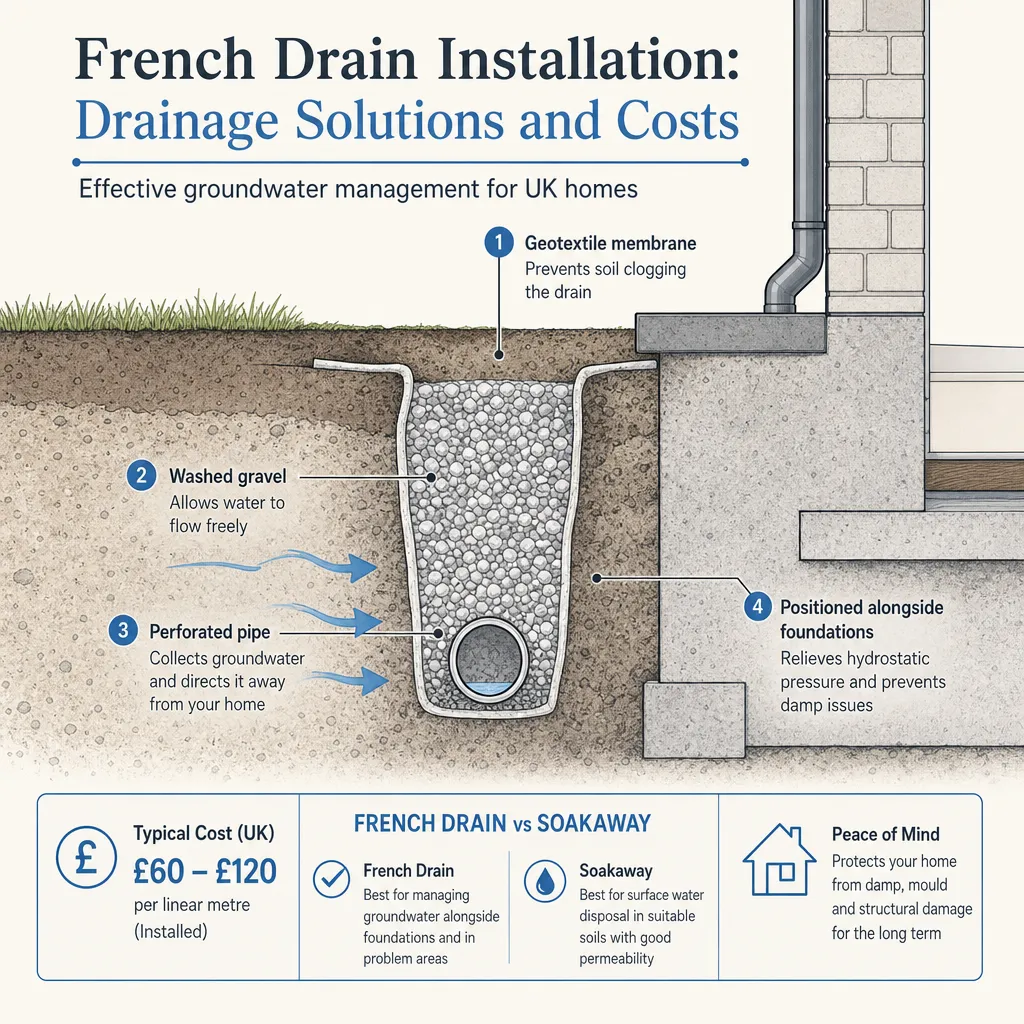
French Drain Installation: Drainage Solutions and Costs
A French drain is a gravel-filled trench containing a perforated pipe that channels subsurface water away from problem areas.
 Improvement & Build
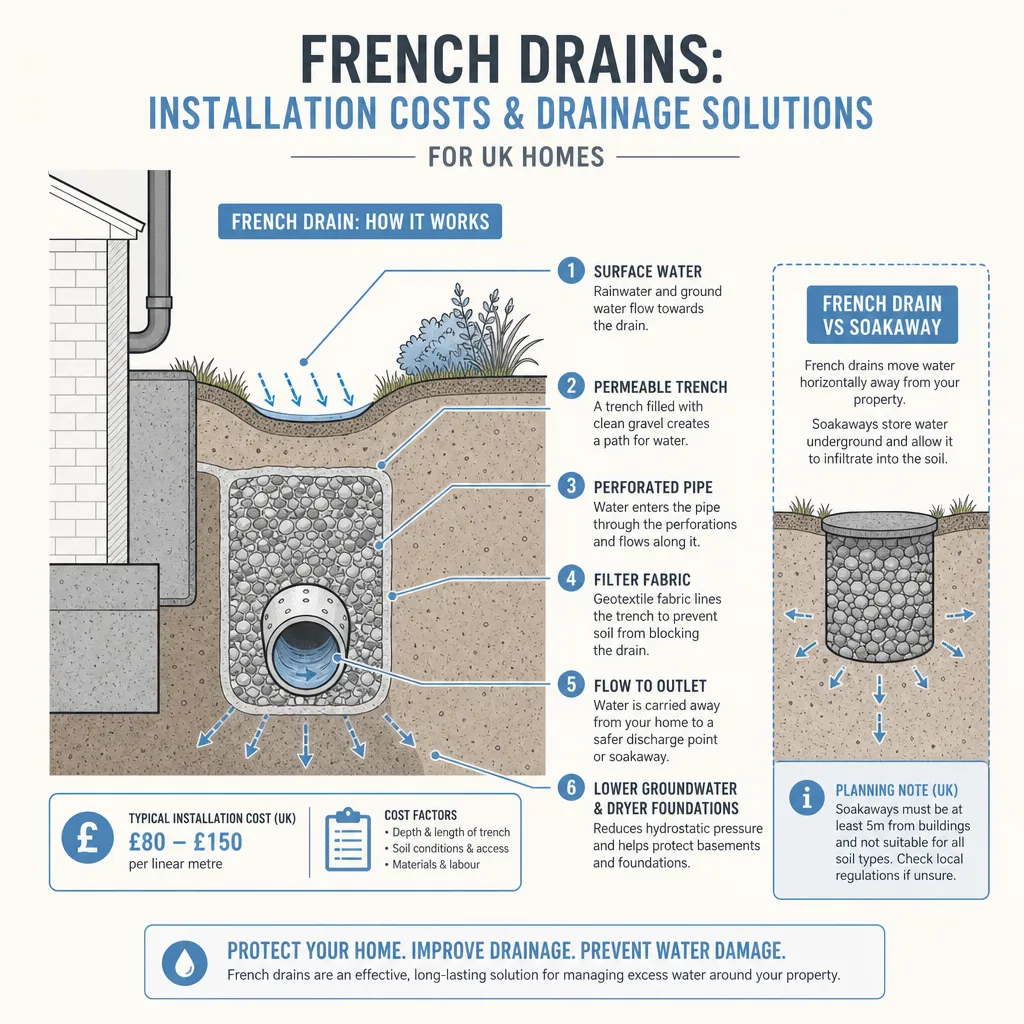
French Drains: Installation Costs and Drainage Solutions
A French drain is a gravel-filled trench with a perforated pipe that redirects groundwater away from a building or waterlogged area.
 Improvement & Build
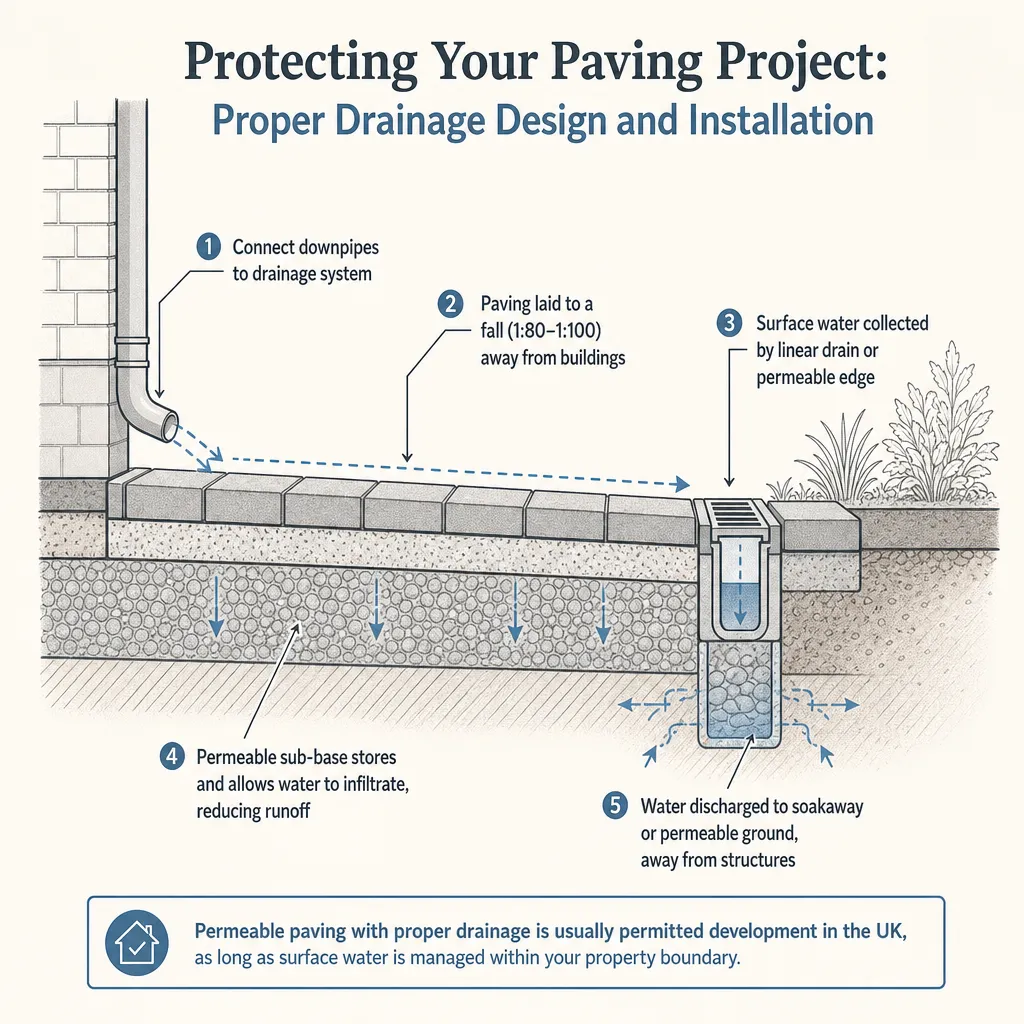
Protecting Your Paving Project: Proper Drainage Design and Installation
Good paving drainage starts with a minimum fall of 1:60 to 1:80 away from buildings, a correctly specified sub-base, and a clear outlet for surface water.