Comparing Window Styles: Full Frame Replacement vs. Insert Windows
By Housey · Last reviewed 18th of May 2026
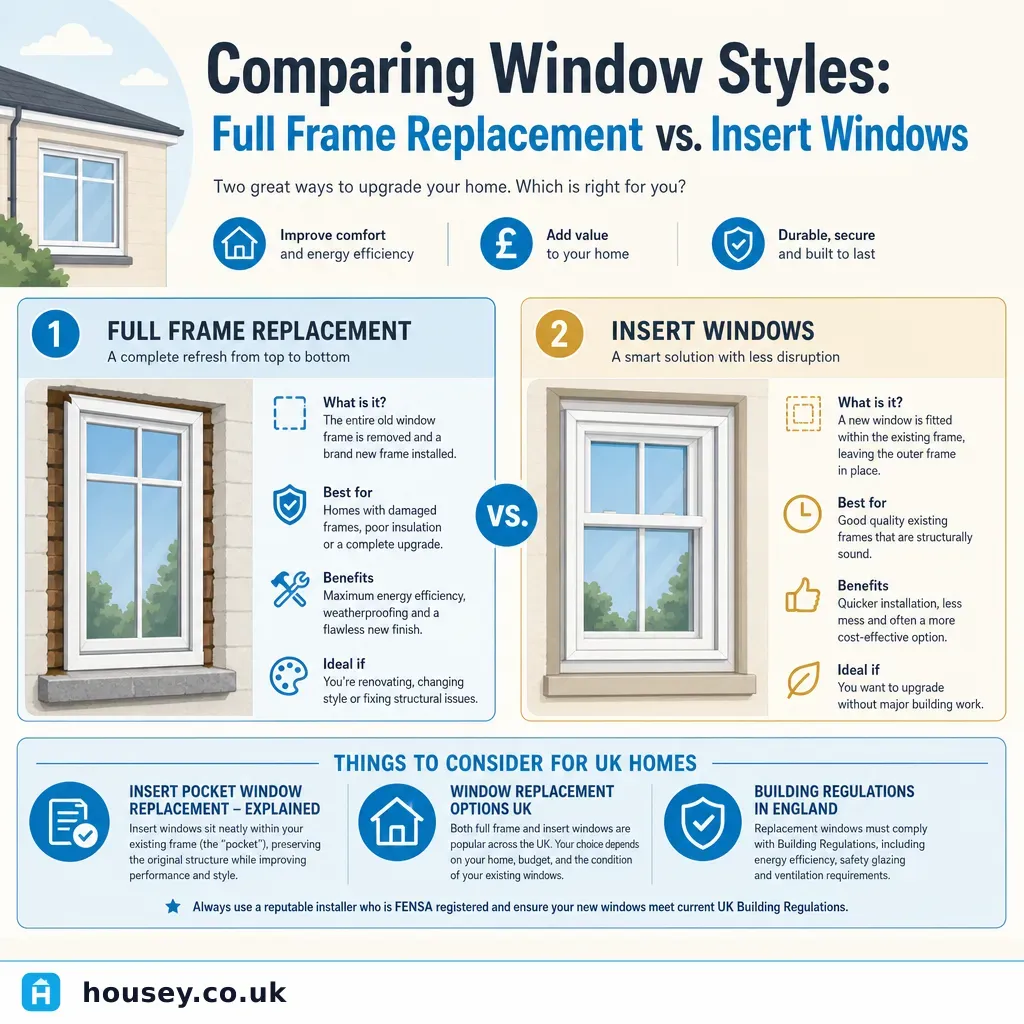
Comparing Window Styles: Full Frame Replacement vs. Insert Windows
Replacing windows is one of the more consequential home improvement decisions a UK homeowner faces — whether prompted by draughts, failed double-glazing seals, rotting timber frames, or a wider renovation programme. The installation method you choose affects disruption levels, cost, regulatory compliance, and how long the finished result lasts. Understanding the two main routes before inviting quotes will help you compare proposals on a like-for-like basis.
Key points
- Full frame replacement removes the entire window unit — outer frame, sill, and lintel casing — back to the structural masonry or timber opening; insert windows fit new sashes and glazing inside the retained existing frame.
- Insert replacement requires the existing frame to be structurally sound, square within roughly 6 mm across both diagonals, and free from rot, damp, or settlement damage.
- Replacement windows in England must comply with Building Regulations Part L (energy efficiency) and Approved Document Q (security); a FENSA- or CERTASS-registered installer can self-certify without a separate building control application.
- The minimum whole-window U-value for replacement glazing under Part L (2021 edition) is 1.4 W/m²K for windows in existing dwellings.
- Listed buildings or properties in conservation areas may require planning permission or listed building consent before any window is replaced — confirm with your local planning authority before ordering.
What is a full frame window replacement?
Full frame replacement means removing everything down to the structural opening: the outer frame, sub-sill, staff beads, and lining boards, right back to the masonry or structural timber frame of the building. A completely new window unit — frame and glazed sashes — is installed from scratch and finished into the reveal.
This is the more disruptive of the two methods. Internal and external decoration around the reveal will usually need making good afterwards. However, it provides the cleanest result, allows any profile or style change, and is the only viable option when the existing frame is damaged, out of square, or when you want to alter the opening.
Full frame replacement is usually necessary when:
- The existing frame is rotted, warped, or structurally compromised.
- The opening is out of square by more than approximately 10 mm across the diagonal.
- You want to change the window style, opening size, or architectural profile.
- Previous extensions or structural settlement have shifted or distorted the opening.
- The home has solid-wall or timber-frame construction where the original frame is integral to the reveal detailing.
What is an insert (pocket) window replacement?
An insert window — sometimes called a pocket replacement — retains the existing outer frame. The old sashes, glazing, and staff beads are removed, and a new pre-assembled inner frame and double-glazed unit is fitted within the original outer frame.
Because the outer frame stays in place, the visible opening is fractionally smaller. Insert windows are significantly faster to install — often one to two hours per window — with far less disruption to internal plasterwork, external rendering, and existing decoration.
Insert replacement usually works when:
- The existing outer frame is timber or uPVC in sound condition — no rot, no significant movement.
- The frame is square within roughly 6 mm across both diagonals.
- You are matching an existing style and the minor reduction in opening size is acceptable.
- The property is occupied or tenanted and minimising disruption to decoration is important.
Full frame vs. insert: side-by-side comparison
Factor | Full frame replacement | Insert (pocket) replacement |
|---|---|---|
Existing frame condition | Any — frame is fully removed | Must be sound, square, and dry |
Disruption to decoration | Higher — reveal work usually needed | Lower — outer frame stays in place |
Opening size after installation | Unchanged or adjustable | Slightly reduced by frame overlap |
Typical time per window | 2–5 hours | 1–2 hours |
Relative cost | Higher (more labour and materials) | Lower |
Listed or conservation area | Check with local planning authority | Check with local planning authority |
Heritage and sash style options | Yes — any profile can be replicated | Limited by existing frame depth |
Building Regulations | Part L and Part Q apply | Part L and Part Q apply |
Indicative comparison only. Outcomes depend on property condition and installer assessment.
Which method should you choose?
- Choose full frame if existing frames are rotted, warped, damp-damaged, or significantly out of square.
- Choose full frame if you want to change the window style, opening size, or architectural configuration.
- Choose insert if existing outer frames are in sound condition and you want a faster, lower-disruption replacement.
- Choose insert if the property is occupied and minimising disturbance to decoration and plasterwork is a priority.
- Ask a window surveyor to inspect first if you are unsure about frame condition — hidden rot or settlement damage is not always visible from inside.
- Check with your local planning authority before proceeding if the property is listed, in a conservation area, or if the original windows are protected by an Article 4 Direction.
Building Regulations and compliance
Any replacement window fitted to a dwelling in England must comply with Building Regulations. The two relevant Approved Documents are:
- Part L (Conservation of Fuel and Power): sets minimum thermal performance. For replacement glazing in existing dwellings, the minimum whole-window U-value is 1.4 W/m²K under the 2021 edition.
- Approved Document Q (Security): requires that replacement windows in accessible locations meet specified resistance-to-attack performance standards.
An installer registered with FENSA or CERTASS can self-certify compliance, issue a certificate, and notify your local building control authority — removing the need for a separate building control application. If your installer is not on a recognised competent persons scheme, you must notify building control before work begins and arrange an inspection on completion.
Retain the compliance certificate carefully. Solicitors and mortgage lenders may request it when you sell the property.
What to ask before accepting a quote
- Does the quote cover full frame or insert installation — and what is the reason for that recommendation given the current frame condition?
- What happens if rot or structural problems are discovered once the existing frame is removed?
- Are you registered with FENSA or CERTASS, and will you provide a compliance certificate on completion?
- What glazing specification will be used — U-value, gas fill type, frame material, and energy rating?
- Is removal and disposal of the old windows included in the price?
- Is any making-good of the internal reveal or external render included, or charged separately?
- Is VAT included in the quoted price?
When to get professional help
Window replacement is standard trade work, but involve a qualified professional beyond the fitter if:
- You notice persistent damp, mould, or condensation inside the wall around existing windows — this may indicate a wider moisture or construction defect, not just a failed glazing seal.
- Cracks have appeared in brickwork or render adjacent to the window opening.
- The property is listed or in a conservation area and you are uncertain about consent requirements — a conservation architect or planning consultant can advise.
- Windows are being replaced as part of a broader structural renovation involving lintels, loft conversions, or extensions.
How Housey can help
Housey connects you with vetted window and door installers who can survey your existing frames, advise on the right installation method, and supply fully compliant replacement glazing with the necessary FENSA or CERTASS certification — whether you need one window replaced or a whole-house upgrade.
Frequently asked questions
Do I always need Building Regulations approval for replacement windows?
In England, yes — replacement windows must comply with Part L and Part Q. If your installer is registered with FENSA or CERTASS, they self-certify and notify building control on your behalf. If not, you must apply to building control before work starts. A compliance certificate should be issued on completion and kept for when you sell the property.
Can I fit insert windows myself?
Insert windows can technically be a DIY project, but you would need to self-notify building control, ensure the specification meets Part L and Part Q, and arrange a building control inspection. Most homeowners find the compliance certificate, workmanship guarantee, and quality assurance from a registered installer is worth the cost of professional installation.
Will insert windows reduce the amount of natural light?
Very marginally. Insert installation reduces each dimension by the frame overlap — typically 25–50 mm per side — which slightly reduces the glazed area. In most cases this is barely noticeable, but worth considering if natural light is a priority in the room.
Do listed buildings need different windows?
Properties that are listed or in some conservation areas may not be permitted to use standard uPVC or aluminium replacement windows. Timber sash or casement windows matching original profiles are often required. Always obtain written confirmation from your local planning authority or conservation officer before ordering any replacement glazing.
Sources and further reading
- Building Regulations Approved Document L — GOV.UK
- Building Regulations Approved Document Q — GOV.UK
- FENSA: competent persons scheme for windows and doors — FENSA
- CERTASS: window and door compliance scheme — CERTASS
- Planning Portal: windows and doors — Planning Portal
Useful next reads
 Improvement & Build
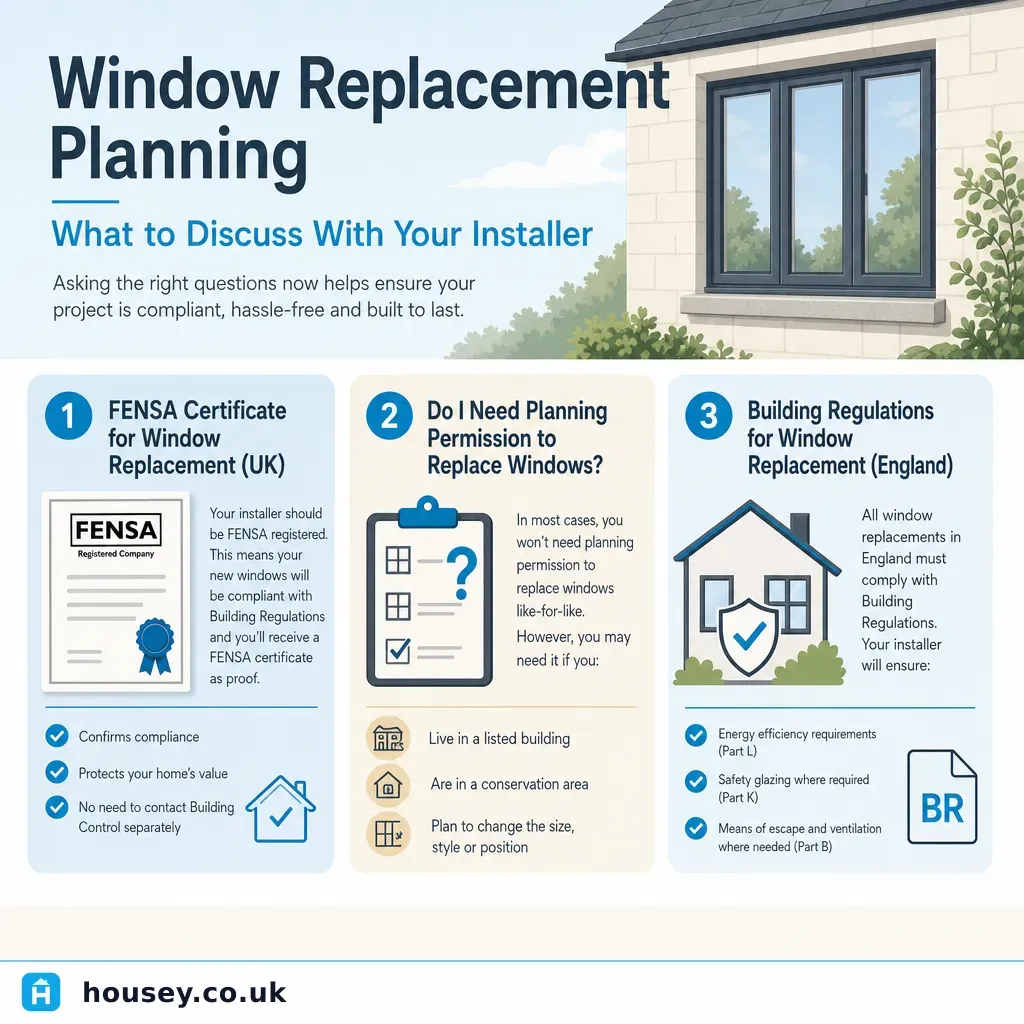
Window Replacement Planning: What to Discuss With Your Installer
Most window replacements in England fall under permitted development rights and do not require planning permission, but they must comply with Building Regulations Part L and Part K.
 Improvement & Build
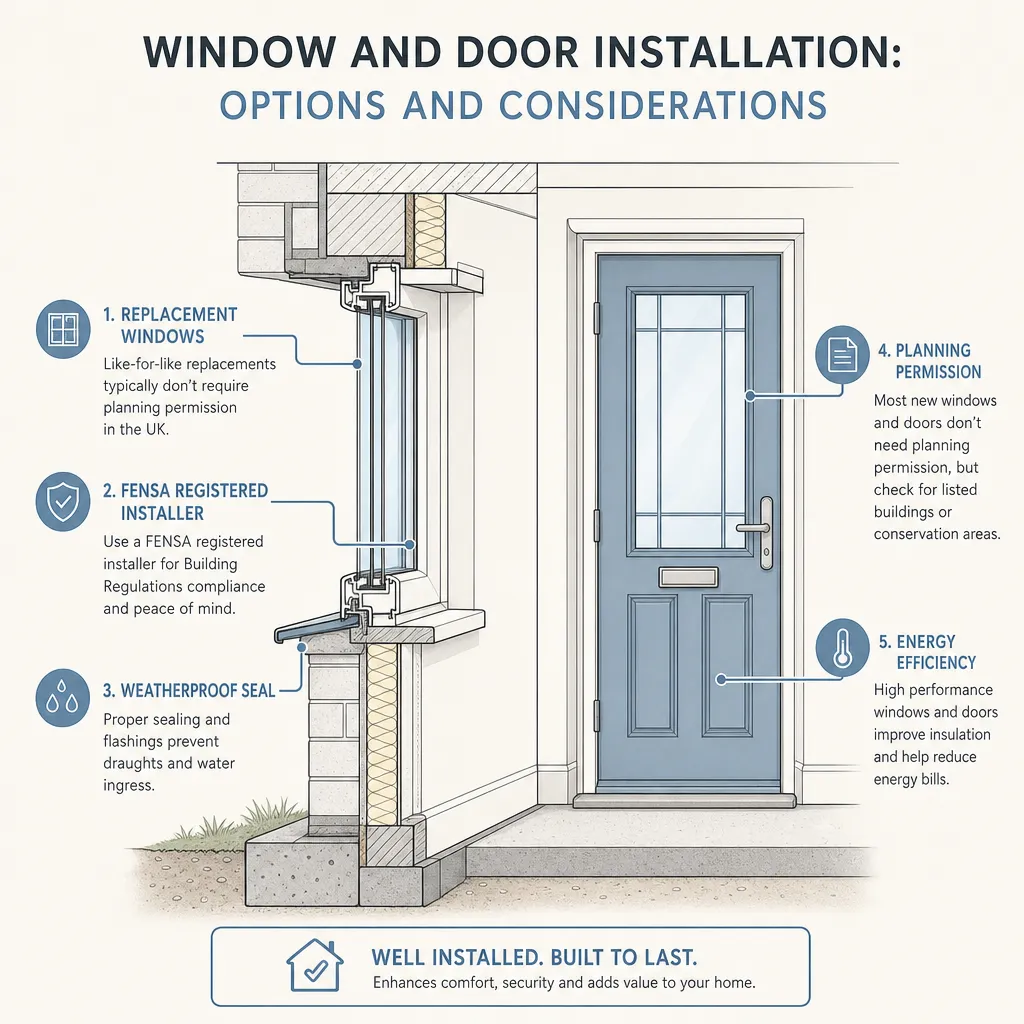
Window and Door Installation: Options and Considerations
Replacing windows and external doors in the UK requires compliance with Building Regulations Part L (thermal performance) and Part K (safety glazing).
 Improvement & Build
PVC Window Options for Home Improvement: Comparison and Benefits
uPVC (unplasticised PVC) is the most widely fitted material for replacement windows in UK homes, combining low maintenance with good thermal performance.
 Improvement & Build
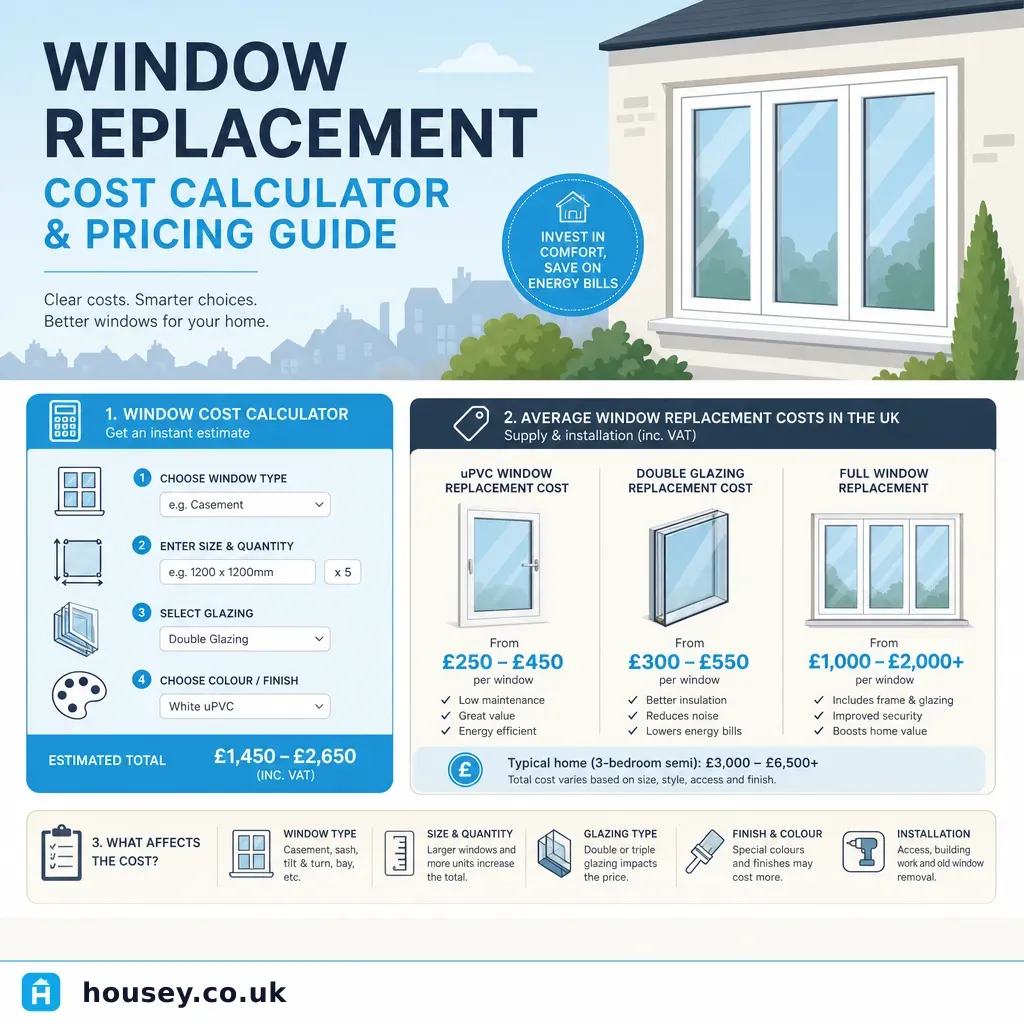
Window Replacement Cost Calculator and Pricing Guide
Replacing a standard uPVC double-glazed casement window in the UK typically costs £400–£800 supply and fit.
 Improvement & Build
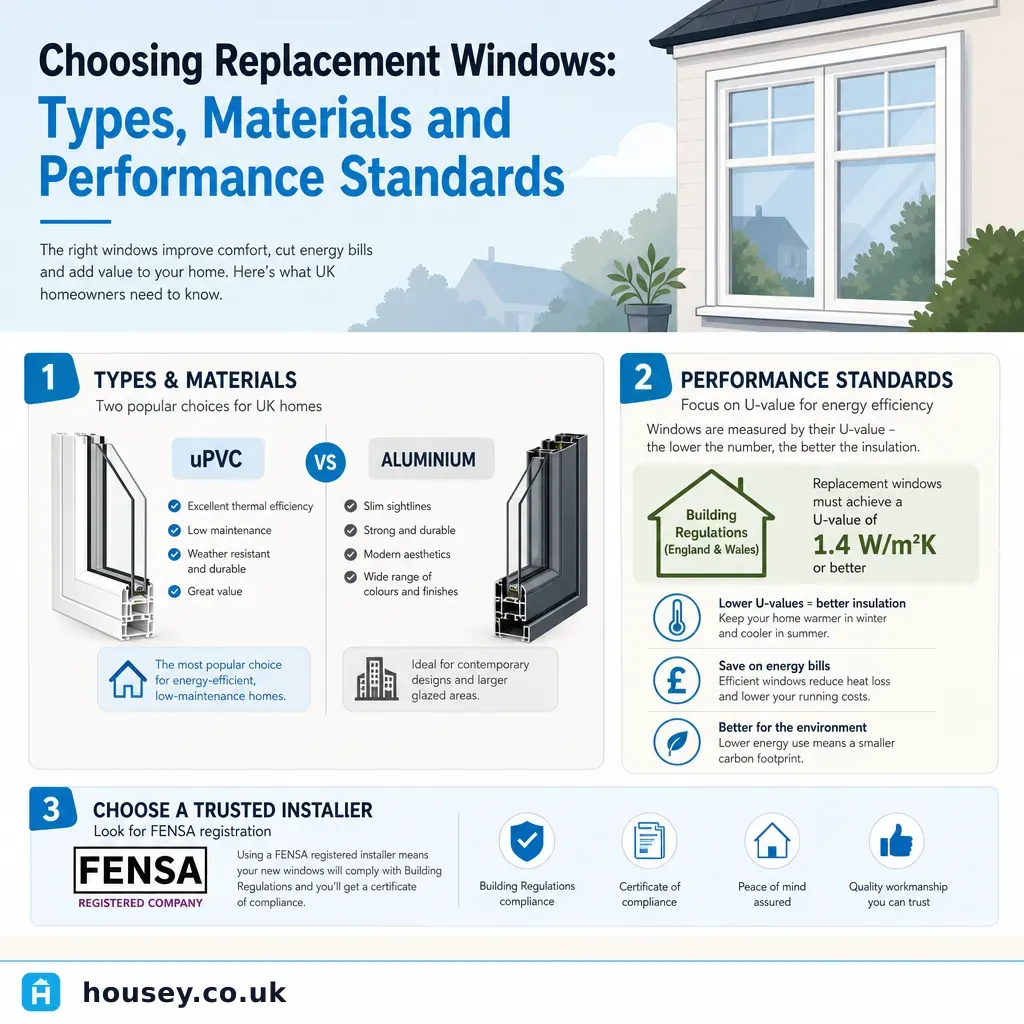
Choosing Replacement Windows: Types, Materials and Performance Standards
Replacement windows in the UK must meet a whole-window U-value of 1.