Full Property Reconstruction Costs in the UK: What to Budget
By Housey · Last reviewed 10th of May 2026
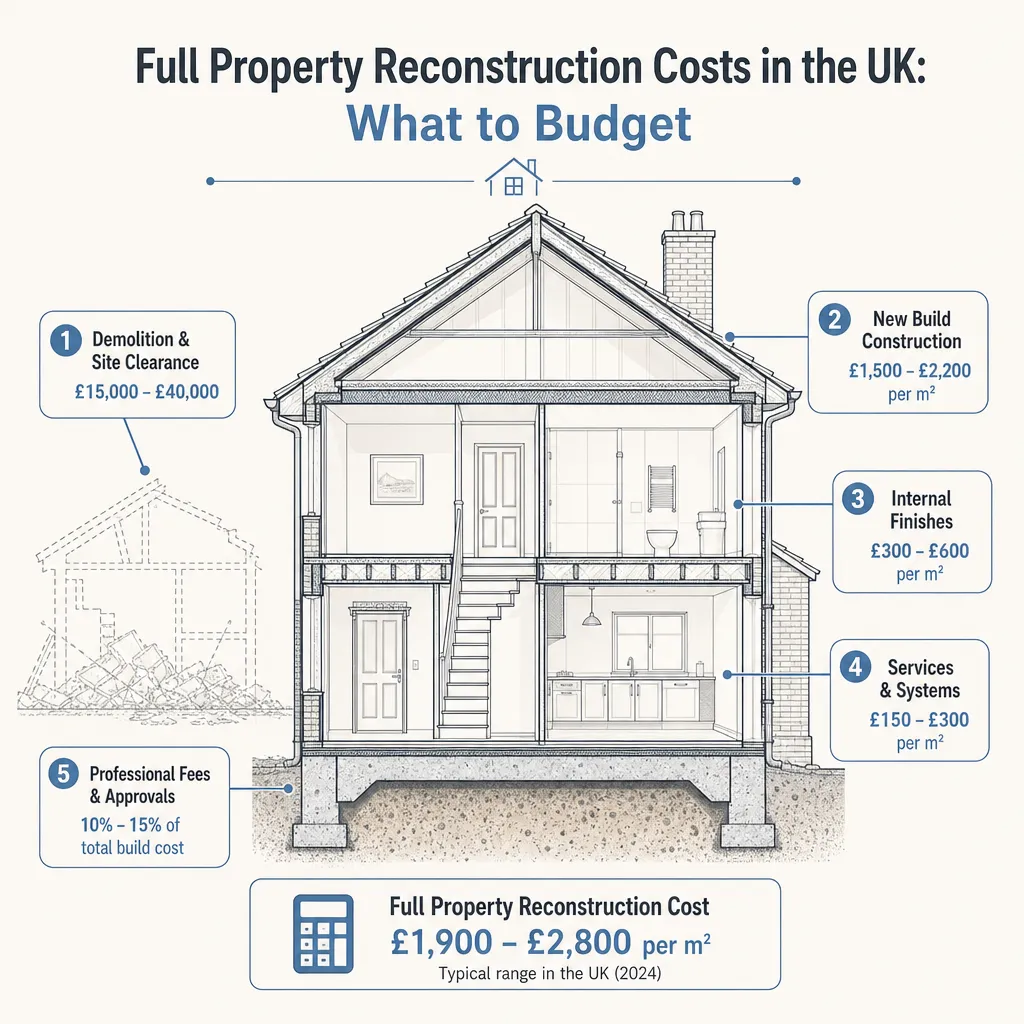
Full Property Reconstruction Costs in the UK: What to Budget
Facing a full property reconstruction — whether after fire, flood, or severe structural failure — is one of the most significant situations a UK homeowner can encounter. Understanding the realistic costs before negotiating an insurance settlement or committing to a build programme is essential to avoiding a serious financial shortfall.
Key points
- Full reconstruction typically costs £1,500–£3,000 or more per m² for a standard residential build, excluding demolition, professional fees, and VAT (Indicative UK costs, last reviewed 2026-05-10).
- Demolition of a typical semi-detached house costs approximately £8,000–£25,000, rising significantly where asbestos-containing materials require specialist licensed removal.
- Building Regulations approval is mandatory for any reconstruction involving structural, fire-safety, thermal, or drainage elements under the Building Act 1984.
- VAT on new-build construction is generally zero-rated under HMRC Notice 708, subject to the works qualifying as a new dwelling — always confirm with a tax adviser.
What counts as a full reconstruction?
A full reconstruction means returning a property from a severely damaged or entirely cleared state to a habitable, Building Regulations-compliant condition. Unlike major renovation, little or no original structure is retained. The scope includes demolition of remaining fabric, new foundations, a new structural frame, external walls and roof, first-fix services, and all internal finishes. The distinction matters because it affects the planning position, VAT treatment, procurement route, and the professional team required.
What drives the cost?
- Location: Build costs in London and the South East run 20–30% above the national average. Remote rural locations attract a logistics premium.
- Ground conditions: Made ground, shrinkable clay, or a high water table may require piled or raft foundations, adding £15,000–£50,000 beyond standard strip foundations. A ground investigation (£1,500–£5,000) is advisable before finalising any budget.
- Specification: High-end finishes — underfloor heating, triple glazing, bespoke joinery — push costs well above the standard range.
- Professional fees: Add 10–20% of construction cost for architect, structural engineer, building control, project manager, and quantity surveyor.
Indicative UK rebuild cost ranges
Property type | Approx. floor area | Estimated rebuild cost (excl. VAT, demolition, fees) |
|---|---|---|
2-bed terrace | 60–75 m² | £90,000–£225,000 |
3-bed semi-detached | 90–110 m² | £135,000–£330,000 |
4-bed detached | 140–180 m² | £210,000–£540,000 |
5-bed detached (high spec) | 220–280 m² | £380,000–£840,000+ |
Indicative UK costs, last reviewed 2026-05-10. Obtain a detailed cost plan from a quantity surveyor before committing to any figure.
Rebuild vs major renovation: a cost comparison
Factor | Full reconstruction | Major renovation (retain structure) |
|---|---|---|
Planning permission | Usually required (new dwelling) | Often not required if permitted development applies |
Building Regulations | Full new-build compliance | Compliance for works undertaken |
Programme | 12–24 months typical | 6–18 months typical |
Cost per m² | £1,500–£3,000+ | £800–£2,000+ |
VAT | Likely zero-rated (new build) | 20% on most work |
Best for | Total loss; severe structural failure | Sound structural shell; partial damage; listed context |
Source: RICS, BCIS Building Cost Information Service. Indicative only.
Worked UK property scenario
Situation: A 1960s detached bungalow (85 m²) in the East Midlands is destroyed by fire. The homeowner needs to establish total reconstruction cost before agreeing an insurance settlement.
Cost element | Estimated range |
|---|---|
Structural engineer (foundation assessment) | £1,200–£2,500 |
Demolition and clearance | £8,000–£14,000 |
Ground investigation | £1,500–£3,000 |
Architect and structural engineering design | £15,000–£28,000 |
Building control | £1,500–£3,500 |
Main contractor (85 m², standard spec) | £127,500–£255,000 |
Project management | £8,000–£18,000 |
Contingency (10–15%) | £16,000–£38,000 |
Total estimated range | £178,000–£362,000+ |
Illustrative only. Actual costs depend on ground conditions, specification, and market conditions at tender.
Homeowner checklist: before commissioning a reconstruction
When to get professional help
Full reconstruction requires specialist support from the outset. Seek qualified help immediately if the property has suffered collapse, fire, flood, or ground movement; if you are negotiating a settlement without an independent cost assessment; if the property is listed or in a conservation area; or if asbestos-containing materials may be present.
How Housey can help
Housey can connect you with qualified professionals at each stage. Start with a structural engineering assessment to evaluate any retained elements, then instruct a project manager to co-ordinate the design and build team. A civil engineer can advise on foundation design for complex ground conditions, and a building control consultant can guide you through compliance and inspections from start to finish.
Frequently asked questions
Do I need planning permission to rebuild on the same footprint?
In most cases, yes. Demolishing and rebuilding constitutes erecting a new dwelling under the Town and Country Planning Act 1990, requiring full planning permission. Some rural exceptions exist. Always confirm with your local planning authority before demolition begins.
Is VAT zero-rated on a full property reconstruction?
New dwelling construction is generally zero-rated under HMRC Notice 708. However, if significant original walls are retained, HMRC may classify the work differently. Confirm the treatment with a tax adviser before finalising your budget.
How long does a full property reconstruction take?
Most straightforward residential reconstructions take 12–24 months from planning consent to completion. Standard planning applications take 8–13 weeks. Listed buildings, complex ground conditions, or bespoke specifications can extend this significantly.
What contingency should I budget for?
Quantity surveyors typically recommend 10–15% of construction cost — on a £200,000 build that is £20,000–£30,000. A larger contingency is sensible where ground conditions are unknown or the project involves unusual structural complexity.
Sources and further reading
- Building Act 1984 — legislation.gov.uk
- VAT Notice 708: Buildings and Construction — GOV.UK / HMRC
- Environment Agency Flood Map for Planning — GOV.UK
- BCIS Building Cost Information Service — RICS
- Planning Portal: When is permission required? — Planning Portal
Useful next reads
 Improvement & Build
Window and Door Sill Damage: Repair Solutions
Window and door sill damage ranges from surface cracking and peeling paint to structural rot, spalling stone, or broken concrete.
 Improvement & Build
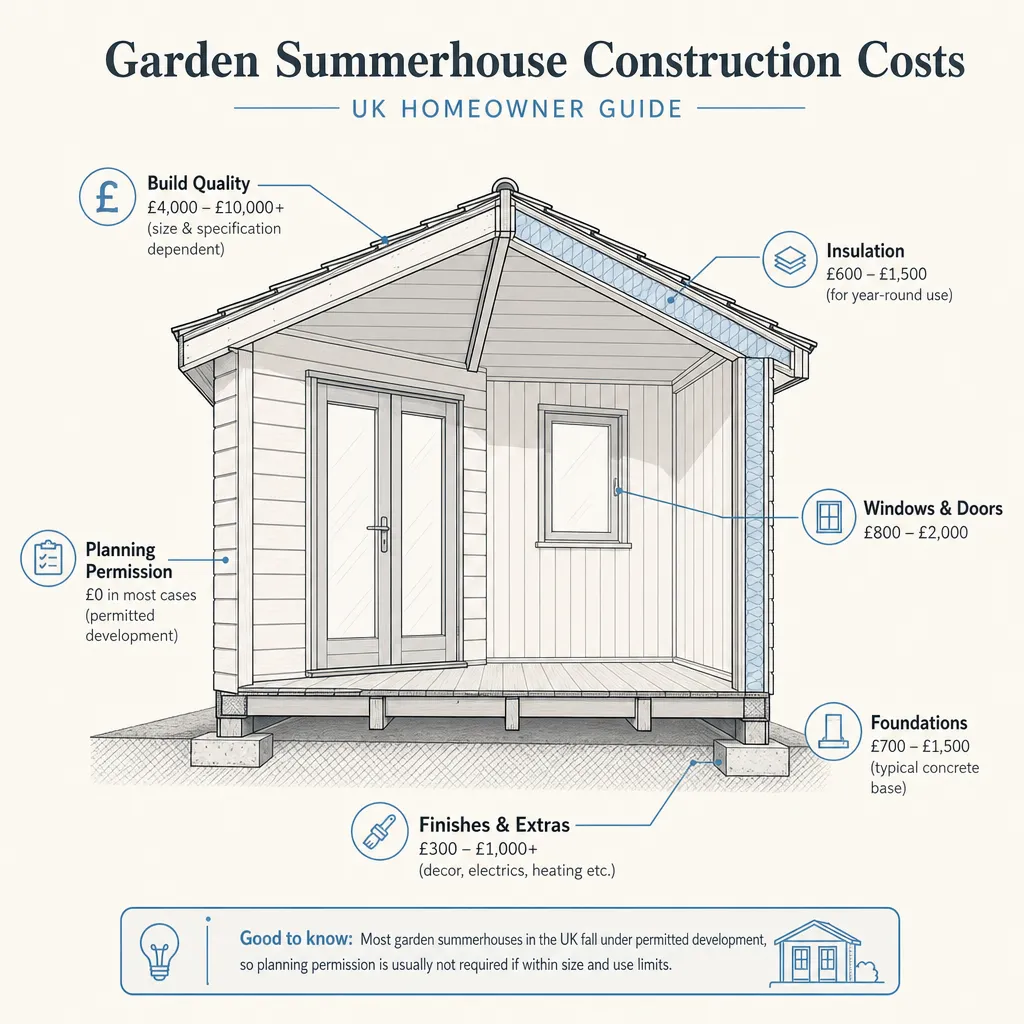
Garden Summerhouse Construction Costs
A garden summerhouse in the UK typically costs £2,000–£5,000 installed for a small standard timber unit, rising to £15,000–£25,000 for a large bespoke insulated garden room.
 Improvement & Build
Storm Damage Repair and Weather Protection Costs
Storm damage repair costs in the UK range from around £200–£600 for emergency weatherproofing to £3,000–£15,000 or more for full roof reinstatement.
 Improvement & Build
What to Do When a Tree Falls on Your House
If a tree falls on your house, evacuate immediately and call 999 if anyone is trapped, you smell gas, or you see sparks or fire.
 Improvement & Build
What Does It Cost to Repair a Window Frame?
Window frame repair typically costs £150–£400 per timber window for minor to moderate rot, or £80–£250 for uPVC hardware and gasket repairs.