Window and Door Sill Damage: Repair Solutions
By Housey · Last reviewed 10th of May 2026
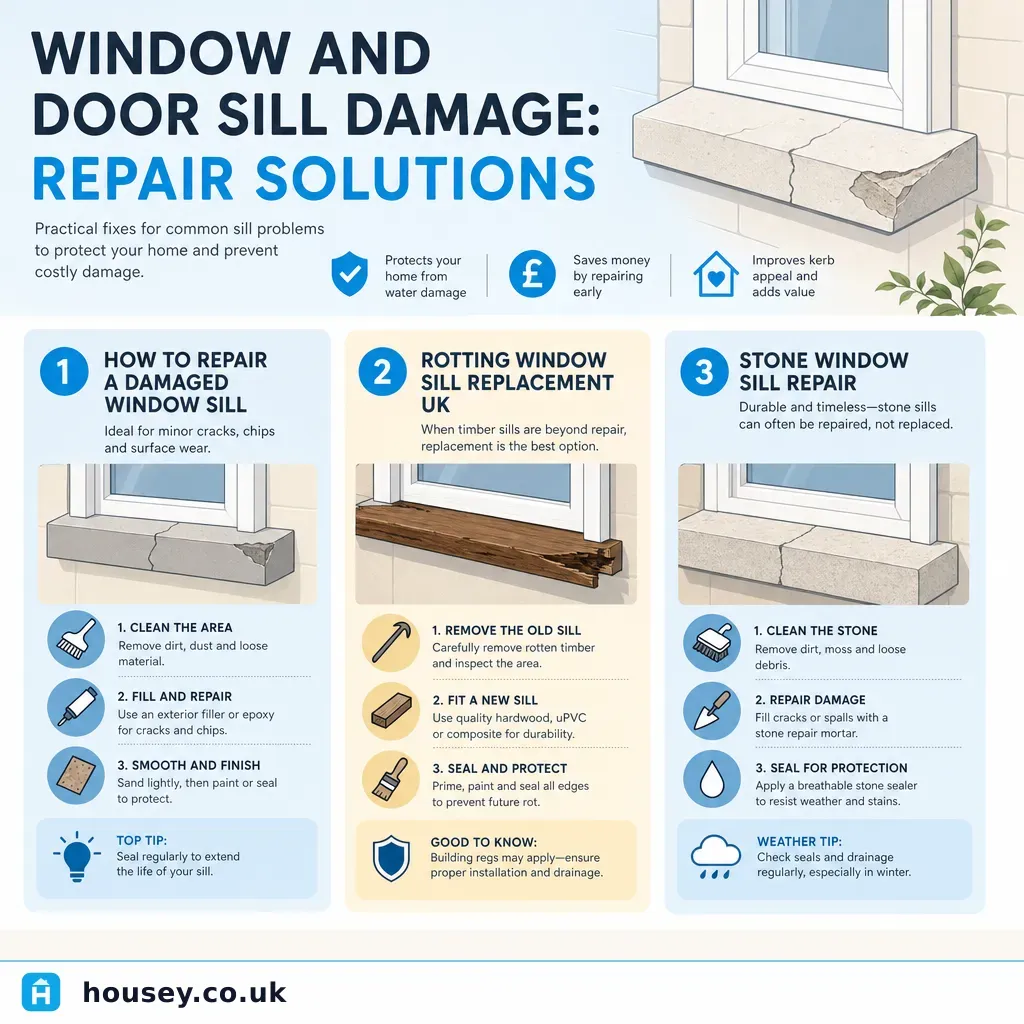
Window and Door Sill Damage: Repair Solutions
Damaged window sills and door thresholds are among the most common maintenance problems UK homeowners face, yet they are frequently left until deterioration becomes serious. Whether you own a Victorian terrace with original stone sills, a 1970s house with concrete surrounds, or a modern home with uPVC frames, the sill sits at a critical junction where water, wind, and UV exposure concentrate. Catching damage early keeps repair costs manageable and protects the wall beneath.
Key points
- The appropriate repair depends on sill material — timber, natural stone, concrete, brick, or uPVC — and the depth of deterioration.
- Indicative costs: surface repair £50–£200 per sill; full replacement £150–£600 or more, depending on material and access (Indicative UK costs, last reviewed 2026-05-10).
- Failed sealant or pointing at the sill-to-frame junction is the single most common cause of water ingress behind the sill.
- Freeze-thaw cycles are a primary driver of spalling in natural stone and concrete sills across UK climates.
- Listed building consent is required for external alterations to listed buildings, including sill replacement, regardless of material chosen.
Understanding sill damage: what are the signs?
Sill problems range from cosmetic to structural. Early indicators to look for include:
- Paint flaking or bubbling — usually indicates moisture beneath the surface, from condensation or external water entry.
- Surface cracking — hairline cracks in stone, concrete, or render are often frost-related and may be confined to the surface layer only.
- Soft spots or a spongy feel in timber — indicates rot, which may be deeper than it appears from the outside.
- Gaps at the sill-to-frame junction — failed sealant or mortar allows water to track behind the sill and into the wall.
- Staining on the wall below — a reliable sign that water is running off the sill onto the facade rather than draining clear.
- Loose or rocking sill — suggests the sill has lost its bedding mortar or the substrate beneath has eroded.
Which repair solution is right for your sill material?
Sill material | Common damage | Recommended repair | Typical cost per sill (indicative, 2026-05-10) | When to replace |
|---|---|---|---|---|
Timber | Rot, paint failure, cracking at end grain | Epoxy wood filler plus hardener treatment and repaint for localised rot; splice or full replacement for deep rot | £50–£200 (repair); £150–£400 (replace) | When rot affects more than 20–25% of depth or reaches the frame |
Natural stone | Spalling, surface cracking, staining | Hydraulic lime mortar repair for small spalls; stone consolidant for friable surfaces; replacement for structural failure | £80–£250 (repair); £300–£600+ (replace) | When cracks penetrate through the sill or the bearing is compromised |
Concrete | Spalling, reinforcement corrosion, cracking | Surface repair mortar for shallow spalls; full replacement if reinforcement is exposed and rusting | £60–£180 (repair); £150–£350 (replace) | When reinforcement is exposed or section loss is significant |
uPVC | Fading, cracking, detachment from frame | Sealant renewal for joint failures; panel replacement for cracked sections | £30–£100 (reseal); £80–£250 (replace) | When cracking is structural or the profile is warped |
Brick (soldier course) | Spalling faces, failed mortar joints, cracked bricks | Repointing with matching mortar; individual brick replacement | £80–£200 | When multiple bricks are structurally compromised |
Repair vs replacement: decision guide
- Choose surface repair if damage is confined to the top face, the sill sounds solid when tapped, and the underlying cause — failed sealant or poor drainage — has been addressed.
- Choose partial splice repair for timber sills where rot is localised to one end. A skilled joiner can cut out the affected section and splice in new timber, retaining the original profile.
- Choose full replacement if the sill rocks, sounds hollow across most of its length, shows through-cracking, or has structural rot or spalling that compromises its water-shedding function.
- Consult a structural engineer if damage extends into the lintel above, the surrounding masonry shows stepped cracking, or doors and windows in the opening are sticking or distorting — these are signs of movement requiring diagnosis before any cosmetic repair.
- Check with your local planning authority before replacing sill material on a listed building or property in a conservation area.
Red flags: when sill damage signals a bigger problem
Some sill damage is symptomatic of a more serious underlying condition. Look out for:
- Diagonal cracks radiating from window corners — may indicate lintel failure or settlement; a chartered surveyor or structural engineer should assess before any repair work proceeds.
- Sill displacement or tilting — a sill that has shifted from its original position suggests the wall below has moved or the bedding mortar has completely failed.
- Persistent damp patches inside the property at window height — if resealing the external junction does not resolve internal damp, water may be tracking through the full wall thickness.
- Multiple sills failing simultaneously on the same elevation — can indicate a systemic problem with water management on that face of the building, or widespread freeze-thaw damage from a period of neglect.
- Spalling masonry around the sill — where the condition of the sill is secondary to wider deterioration of the surrounding wall fabric.
What to ask before hiring a contractor
Before accepting a quote for sill repair or replacement, confirm:
- What is the cause of the damage, and how will you address it before applying the repair?
- Is the quote for surface repair, partial replacement, or full replacement — and why is that option recommended?
- What materials will you use, and are they compatible with the existing construction and surrounding masonry?
- Will you match the original sill profile and material, especially important for older properties and listed buildings?
- What sealant or pointing will you use at the sill-to-frame junction, and what is its expected service life?
- Is scaffolding or access equipment included in the price, or is it charged separately?
- Will you treat adjacent masonry if there is evidence of water ingress beyond the sill itself?
- Does the quote include decoration — priming and painting — or is that charged separately?
When to get professional help
Most sill repairs are straightforward for a competent joiner, stonemason, or builder, but professional advice is warranted when:
- You cannot distinguish between surface damage and structural failure by visual inspection alone.
- The damage involves a listed building or a property in a conservation area.
- There are signs of structural movement — stepped cracks, sticking doors, or displaced lintels.
- Water is tracking through to interior walls despite repeated surface repairs.
- The sill damage was identified in a RICS survey report as part of a larger defect pattern.
A RICS-chartered building surveyor can assess whether sill damage is cosmetic or symptomatic of a deeper problem — particularly valuable in Victorian and Edwardian properties where original fabric has been altered over decades.
How Housey can help
For significant sill damage or where replacement involves structural masonry work, Housey can connect you with specialist window and door installers experienced with both heritage and modern properties. Where you need a professional assessment of associated cracking or movement, Housey also connects homeowners with structural engineering specialists who can advise on the right course of action before repair work begins.
Frequently asked questions
How much does window sill repair cost in the UK?
Surface repairs to a single window sill — filling minor cracks, treating rot, and repainting — typically cost £50–£200 per sill, depending on access and the scope of work. Full sill replacement ranges from £150–£400 for timber to £300–£600 or more for natural stone. Costs rise for upper-floor windows requiring scaffolding. Always obtain itemised quotes specifying materials, preparation, and decoration. Indicative UK costs, last reviewed 2026-05-10.
Can I repair a rotting timber sill myself?
Minor surface rot on timber sills can be stabilised with a two-part epoxy wood filler after treating with a proprietary hardener — this is within most competent DIYers' ability. However, where rot has penetrated more than 20–25% of the sill's depth or spread to the frame, full replacement is safer and more cost-effective. Structural rot affecting the lintel or surrounding masonry requires professional assessment before any repair proceeds.
Do I need permission to replace window sills?
Like-for-like sill replacement on a standard residential property does not normally require planning permission. However, listed buildings require listed building consent for any external alteration including sills, regardless of the scope. In conservation areas, replacing sills with a materially different material may require householder planning permission. Check with your local planning authority if you are uncertain about your property's status.
What causes window sills to crack and deteriorate?
The main causes are water ingress through failed pointing or sealant at the sill-to-frame junction, freeze-thaw cycles that expand absorbed moisture and spall stone or concrete, UV degradation of paint or sealant, and biological growth — moss, algae, and lichen — that retains moisture against the surface. Timber sills deteriorate particularly where end grain is exposed or drainage at the sill-to-frame junction is inadequate.
Sources and further reading
- Repairs and improvements to your home — GOV.UK
- Windows: repair and replacement in traditional buildings — Historic England
- Home repairs and maintenance — Citizens Advice
- Dampness in buildings — RICS
Useful next reads
 Improvement & Build
How much does window sill replacement cost
Window sill replacement in the UK typically costs £100–£400 per sill for a standard installation, depending on the material — uPVC, timber, stone, or composite — and whether the sill is internal or external.
 Improvement & Build
Storm Damage Repair and Weather Protection Costs
Storm damage repair costs in the UK range from around £200–£600 for emergency weatherproofing to £3,000–£15,000 or more for full roof reinstatement.
 Improvement & Build
Fixing Leaking Back Doors and Water Ingress
Most leaking back doors in UK homes fail at one of three points: the threshold or door sill joint, the frame-to-masonry mastic seal, or the door weatherstrip.
 Improvement & Build
Concrete Sealing: Protecting and Maintaining Your Driveway
Sealing a concrete driveway protects against water ingress, freeze-thaw damage, oil stains, and surface wear.
 Improvement & Build
Repairing a Bay Window Roof and Weatherproofing
A bay window roof typically uses felt, lead, or EPDM rubber as its waterproof covering.