Full Renovation Versus Phased Improvement: Decision Framework
By Housey · Last reviewed 11th of May 2026
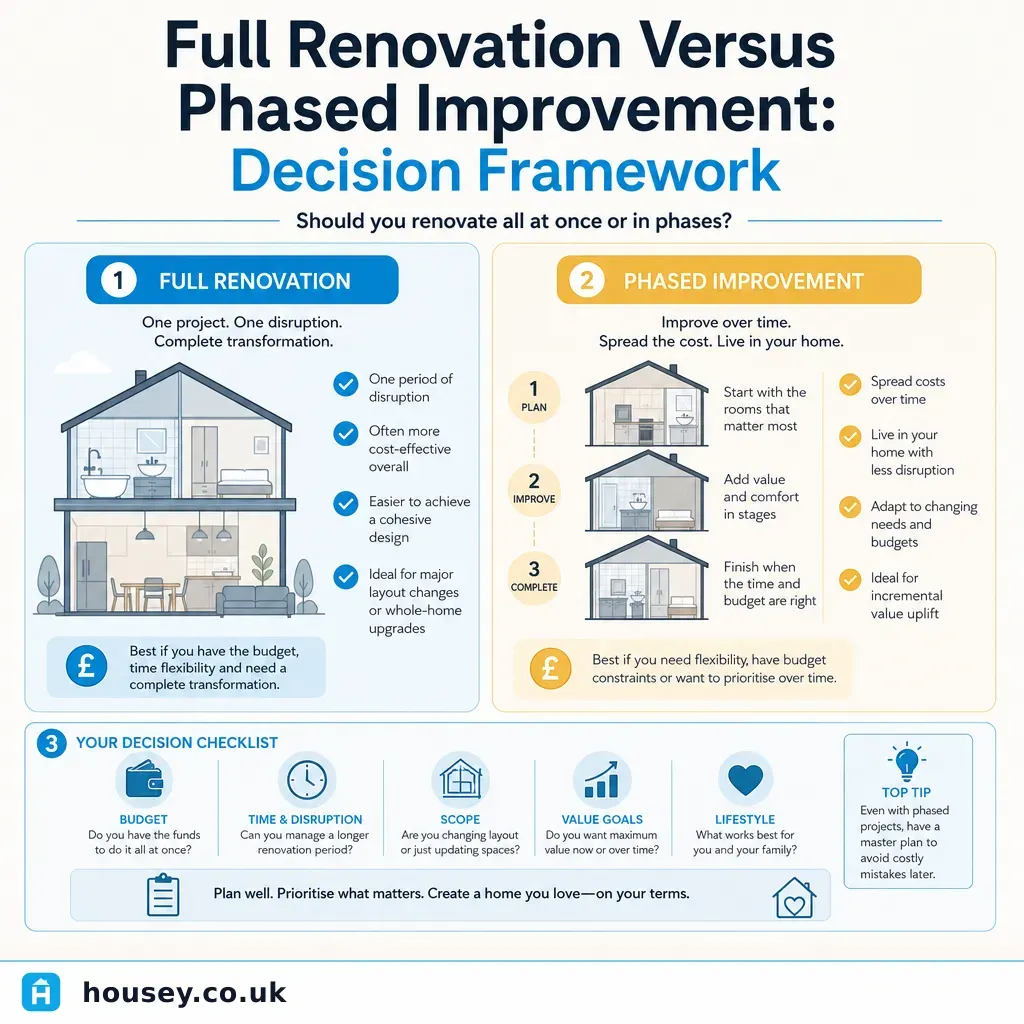
Full Renovation Versus Phased Improvement: Decision Framework
Deciding whether to tackle a property in one comprehensive programme or improve it incrementally is one of the most consequential choices a UK homeowner faces. The decision shapes your budget exposure, the disruption to daily life, and — critically — whether improvements carried out now will need to be partially undone to complete work later. The stakes are highest for properties needing structural, thermal, and layout changes simultaneously, where sequencing errors can be both expensive to correct and difficult to spot until the damage is done.
Key points
- Work carried out in the wrong sequence can add 15–30% to total project cost — finishing plasterwork before first-fix electrical or plumbing, or insulating before addressing active damp, are common examples of abortive spend.
- A full renovation requires detailed design drawings, building regulations approval, and (where applicable) planning permission before works begin; phasing does not remove these requirements — each phase may trigger its own submissions.
- For energy retrofit, PAS 2035 (the publicly available specification governing retrofit work in England) requires a fabric-first approach — insulation and draught-proofing before heating system upgrades — to avoid moisture and ventilation problems.
- Living in a property during a full renovation typically adds 10–20% to project costs compared with a vacant site, due to restricted access, slower programme delivery, and temporary utility provisions.
- A pre-renovation RICS Home Survey helps identify concealed defects before scope is finalised; defects discovered mid-programme are almost always more expensive to address than those identified at the outset.
When a full renovation makes sense
A full renovation addresses the property's structure, fabric, services — electrical, plumbing, heating — and finishes in a single connected programme. This approach is most cost-effective when:
- Multiple systems are life-expired simultaneously — for example, a 1930s semi where the wiring pre-dates Part P of the Building Regulations, the boiler is beyond economic repair, and the roof covering needs replacement.
- Significant layout changes are planned — removing or repositioning load-bearing walls requires structural calculations and building regulations approval regardless of phasing, and combining this with other works avoids repeat disruption to finishes.
- The property is vacant or will be unoccupied during works — a vacant site allows unrestricted access, faster programme delivery, and avoidance of the cost premium associated with working around occupants.
- The full budget is available at the outset — a comprehensive renovation requires committing substantial funds before any return is visible.
Common risks: full renovations are exposed to scope creep and unforeseen defects, particularly in pre-1919 properties where construction can conceal historic repairs. Specify the project thoroughly before going to tender, maintain a contingency of at least 10–15% of build cost, and agree a clear variation procedure with your contractor before works begin.
When phased improvement works — and when it doesn't
A phased approach carries out distinct improvements over months or years, keeping spending and disruption manageable at each stage. It works well when:
- Budget is constrained and must be released in tranches over time.
- The homeowner is living in the property and cannot tolerate a prolonged full-site programme.
- Future plans remain uncertain — for example, a possible loft conversion that depends on planning consent not yet applied for.
- Individual elements are genuinely independent — replacing a kitchen rarely requires changes to structural elements or services beyond that room.
Where phasing fails: phasing becomes expensive when phases are not planned together from the outset. A homeowner who tiles a bathroom, then discovers a concealed leak, then replaces pipework and re-tiles, has effectively paid for the tiling twice. Similarly, improving ground-floor insulation before addressing a roof that needs replacing in three years may create moisture-trapping conditions that damage the insulation prematurely.
Worked UK property scenario
Property: 1930s three-bedroom semi-detached, owner-occupied. The homeowner wants to add a kitchen extension, convert the loft, replace the gas boiler with a heat pump, and redecorate throughout. Total budget available: approximately £120,000 over five years.
Planned-in-reverse phasing approach:
- Establish the end state first. Commission an architect or designer to produce a feasibility study covering the extension, loft conversion, and heat pump specification together. Cost: approximately £2,000–£5,000, but prevents abortive work across all later phases.
- Phase 1 (Year 1–2): Kitchen extension. Structural works, including any load-bearing wall removal, carried out with building regulations approval and planning permission if required. Extension built and connected to existing services. Kitchen fit-out kept neutral if full redecoration is deferred.
- Phase 2 (Year 2–3): Loft conversion. Separate permitted development check or planning application submitted. Structural engineer engaged for the new floor and stair opening. Building regulations submission required.
- Phase 3 (Year 3–5): Heat pump installation. Retrofit assessment under PAS 2035 commissioned first. Whole-house fabric improvements — loft insulation top-up, draught-proofing, cavity wall insulation where suitable — completed before sizing the heat pump. MCS-accredited installer required for the heat pump itself.
- Redecoration: Final phase, carried out after all works that could disturb plaster, floors, and surfaces are complete.
Key lesson from this scenario: the retrofit assessment in Phase 3 must be considered at the feasibility stage in Year 1, because the heat-loss calculation for the heat pump is affected by the insulation improvements and the additional floor area added by the extension. Waiting until Year 3 to think about this risks either an oversized heat pump or abortive re-insulation work.
Comparison: full renovation versus phased improvement
Factor | Full renovation | Phased improvement |
|---|---|---|
Upfront cost | High — all committed at outset | Lower per phase; potentially higher in total if poorly sequenced |
Disruption period | Concentrated over weeks or months | Extended over months or years |
Living on-site | Possible but costly | Usually more manageable |
Risk of abortive work | Lower if well specified | Higher if phases not planned together from the start |
Best suited to | Vacant properties; multiple failing systems; layout changes | Budget-constrained; continuous occupancy; genuinely independent upgrades |
Project management complexity | High — requires detailed programme from day one | Lower per phase; increases when phases interact |
Energy retrofit compatibility | Ideal — fabric first, then systems, in one programme | Possible — but PAS 2035 sequence must be respected across phases |
How to decide: a decision framework
- Choose a full renovation if three or more major systems or fabric elements need replacement simultaneously, the property is vacant or will be vacant during works, and the full budget is available at the outset.
- Choose phased improvement if budget must be staged, occupancy is continuous, individual phases are genuinely independent of each other, or future plans such as an extension or loft conversion depend on planning consent not yet granted.
- Plan in reverse regardless of approach — identify the intended end state first, then sequence backwards to confirm no phase will need to be partially undone to enable the next. This step costs little but prevents significant abortive expenditure.
- Engage a project manager if the full programme involves multiple trades, overlapping building regulations submissions, or a build cost above £80,000. A project manager's fee — typically 10–15% of project value — is often recovered through better contractor management and programme control.
- Commission a RICS Home Survey before finalising scope — hidden defects discovered after work has started are almost always more disruptive and costly to address than those identified before a single tool is used on site.
Renovation sequencing homeowner checklist
Before committing to either approach, confirm the following:
When to get professional help
For any project involving structural alterations, planning permission, building regulations submissions, or an energy retrofit, engage qualified professionals from the outset. An architect or RIBA-chartered designer for extensions and loft conversions, a structural engineer for load-bearing work, and a PAS 2035 retrofit coordinator for insulation and heat pump projects each have a distinct, non-interchangeable role. Consolidating these responsibilities into a single contractor's scope without the appropriate credentials is a common source of costly errors.
How Housey can help
Whether you are planning a single-phase extension or a multi-year renovation programme, Housey can connect you with experienced extension builders and project managers who can help you scope, sequence, and deliver the works effectively — from initial feasibility through to final completion.
Frequently asked questions
Is it always cheaper to renovate in phases?
Not necessarily. Phased renovation can cost more in total if phases are not planned together, because later phases may undo or modify work completed earlier. The key is to establish the full end state first, then decide which phases to carry out and when — even if some phases are deferred by several years. Poor sequencing is the main driver of abortive cost.
Do I need planning permission for a full renovation?
Internal works generally do not require planning permission. However, structural alterations, loft conversions, extensions, and changes to the external appearance of the property may need planning permission or permitted development confirmation. Building regulations approval is separately required for structural work, electrical and plumbing installations, and certain energy-related changes, regardless of whether planning permission is needed.
How much contingency should I budget for a renovation?
For most UK renovation projects, a contingency of 10–15% of the total build cost is a sensible minimum. For pre-1919 properties, older solid-wall homes, or projects involving structural work, 15–20% is more appropriate — concealed defects such as hidden damp, historic repairs, and buried services are more likely to emerge once work begins and costs become difficult to predict in advance.
Should I live in the property during a full renovation?
Living on-site is possible but adds cost and complexity. Access is restricted, progress is slower, and dust, noise, and utility disruptions affect daily life throughout the programme. If works are extensive — full strip-out, structural alteration, or whole-system replacement — short-term rental or staying elsewhere during the most intensive phases often represents better value than the cost premium of an occupied site.
Sources and further reading
Useful next reads
 Improvement & Build
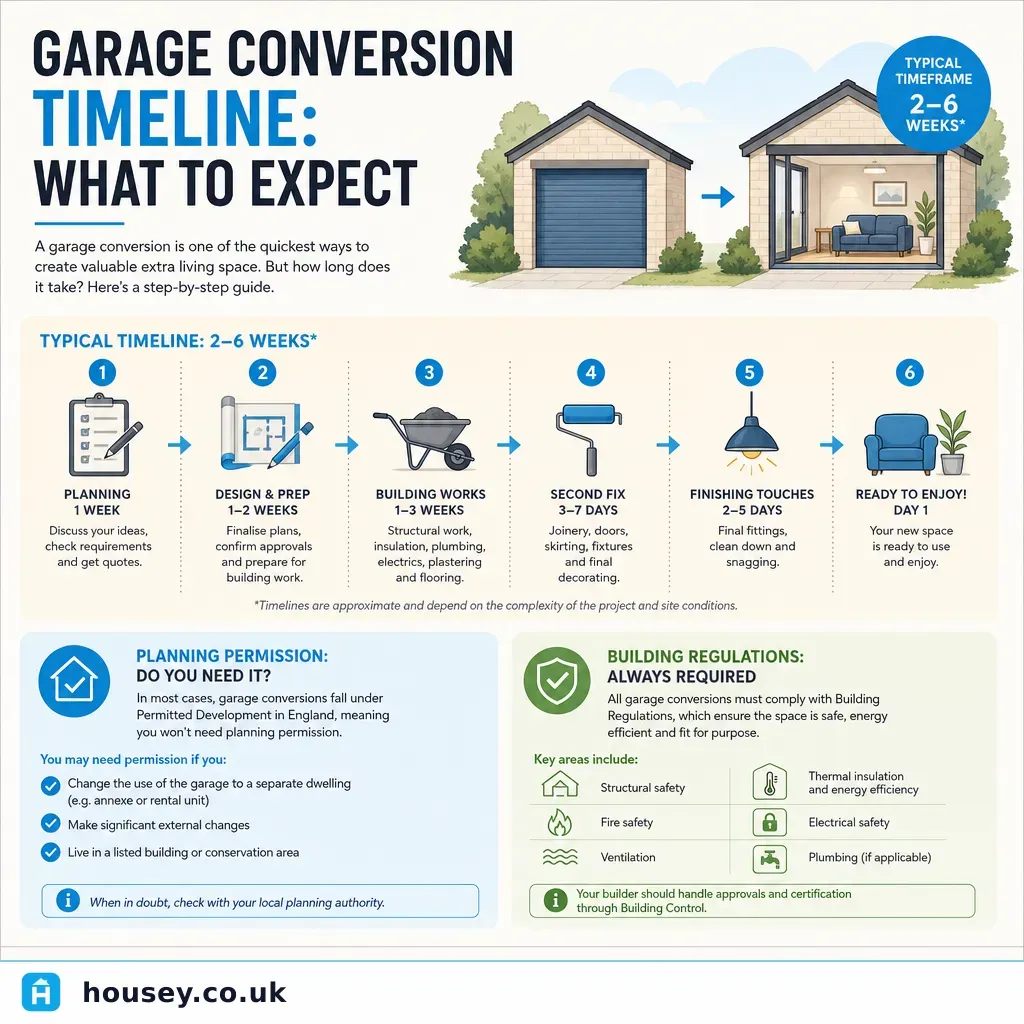
Garage Conversion Timeline: What to Expect
A straightforward attached garage conversion in England usually takes 4–8 weeks of construction, plus pre-start time for building control approval (5 working days for Full Plans).
 Improvement & Build
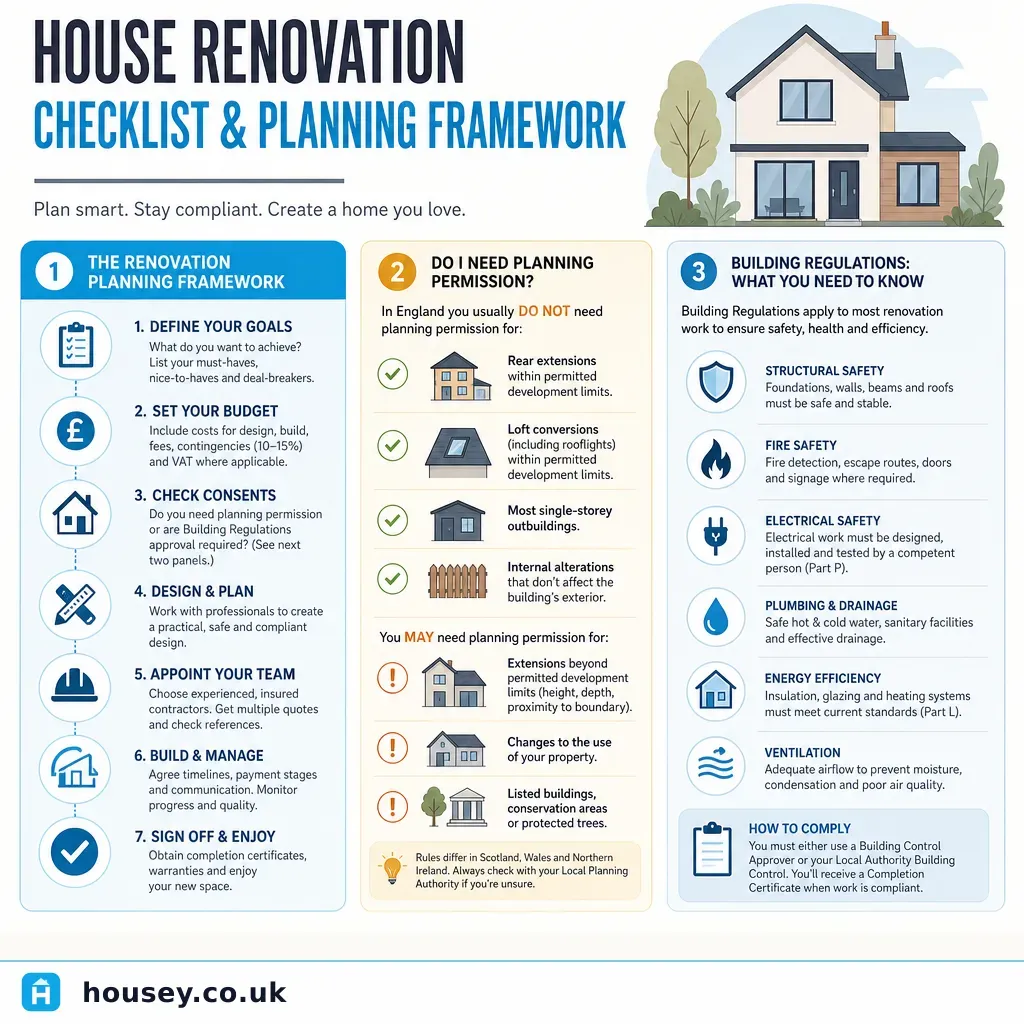
House Renovation Checklist and Planning Framework
A UK house renovation needs clear planning across five stages: defining scope and budget, obtaining consents (planning permission, building regulations, party wall), appointing professionals, managing the build sequence, and snagging.
 Improvement & Build
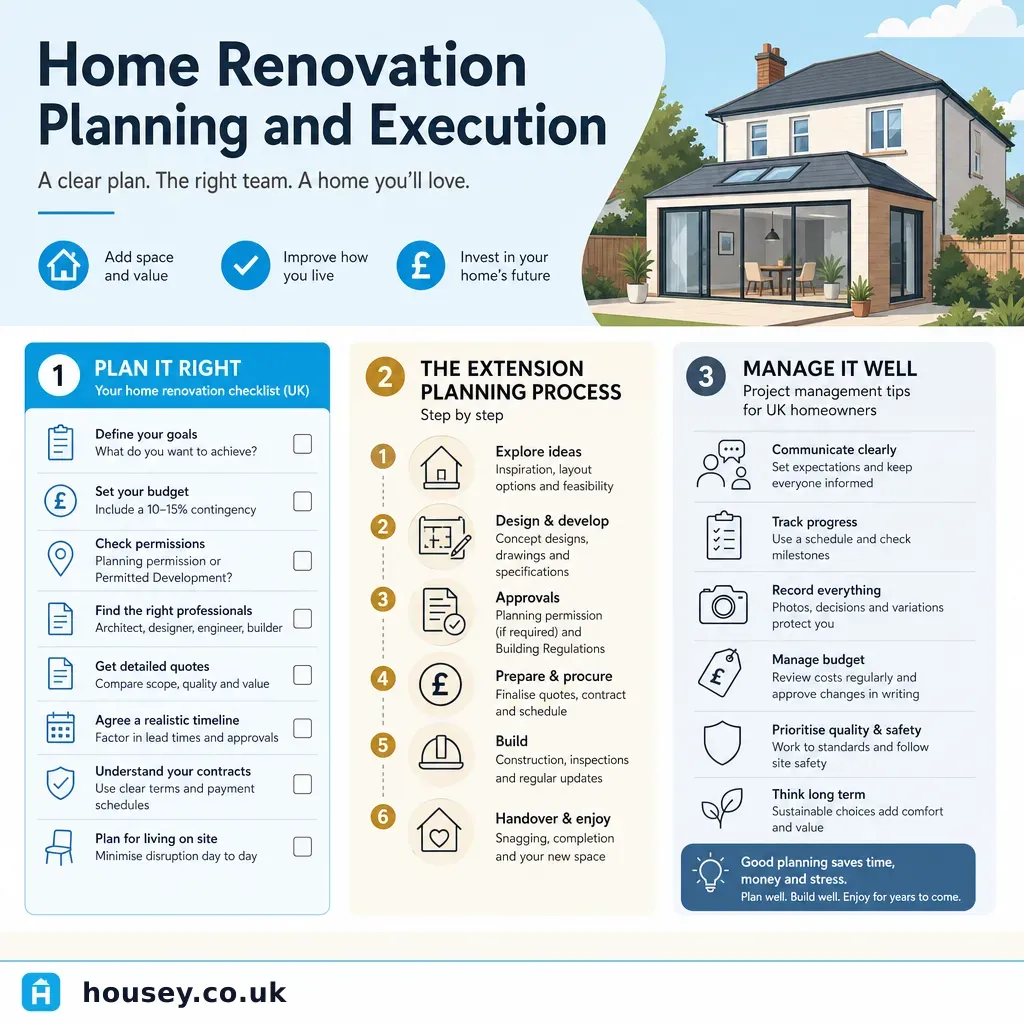
Home Renovation Planning and Execution
Successful home renovation in the UK requires a clear scope definition, a realistic budget with 15–20% contingency, confirmed planning permission or permitted development status, and a written contract before work starts.
 Improvement & Build
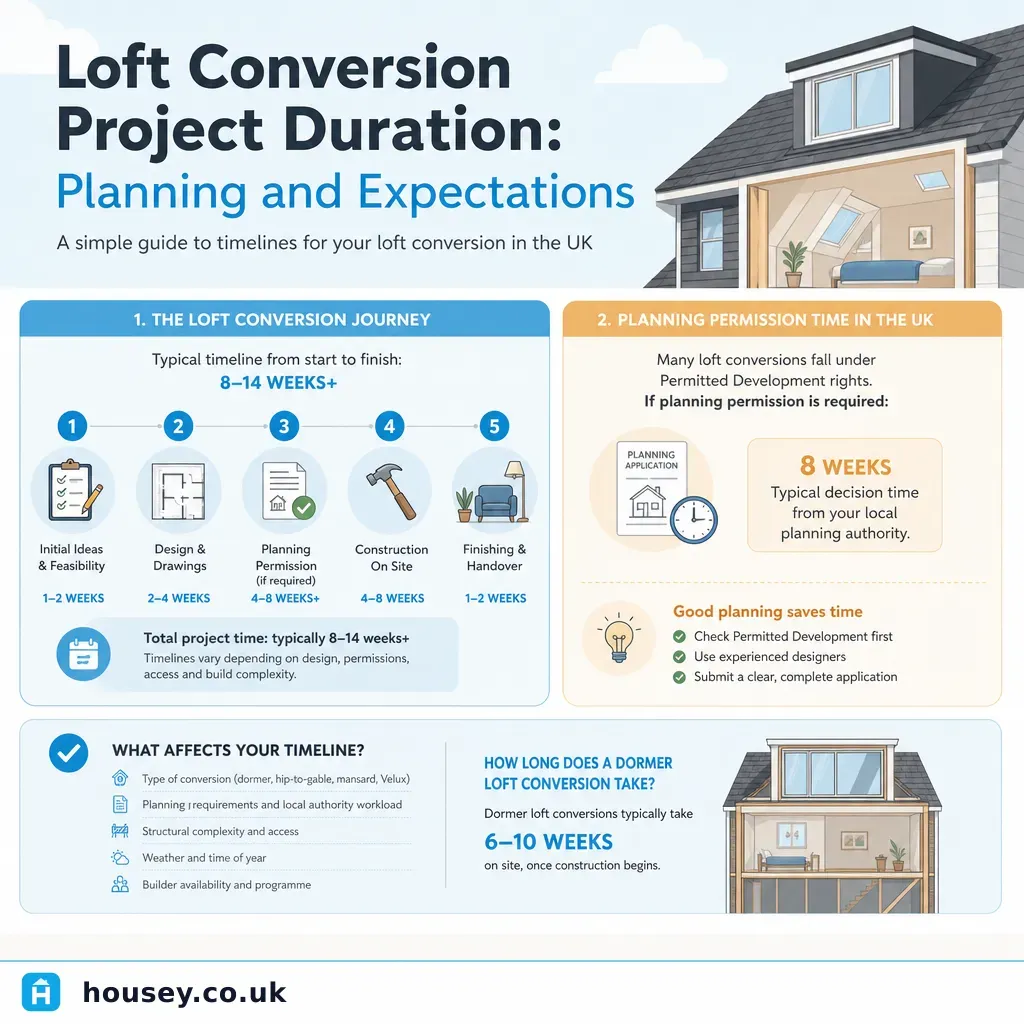
Loft Conversion Project Duration: Planning and Expectations
A loft conversion in the UK typically takes 4 to 16 weeks of on-site construction depending on the type.
 Improvement & Build
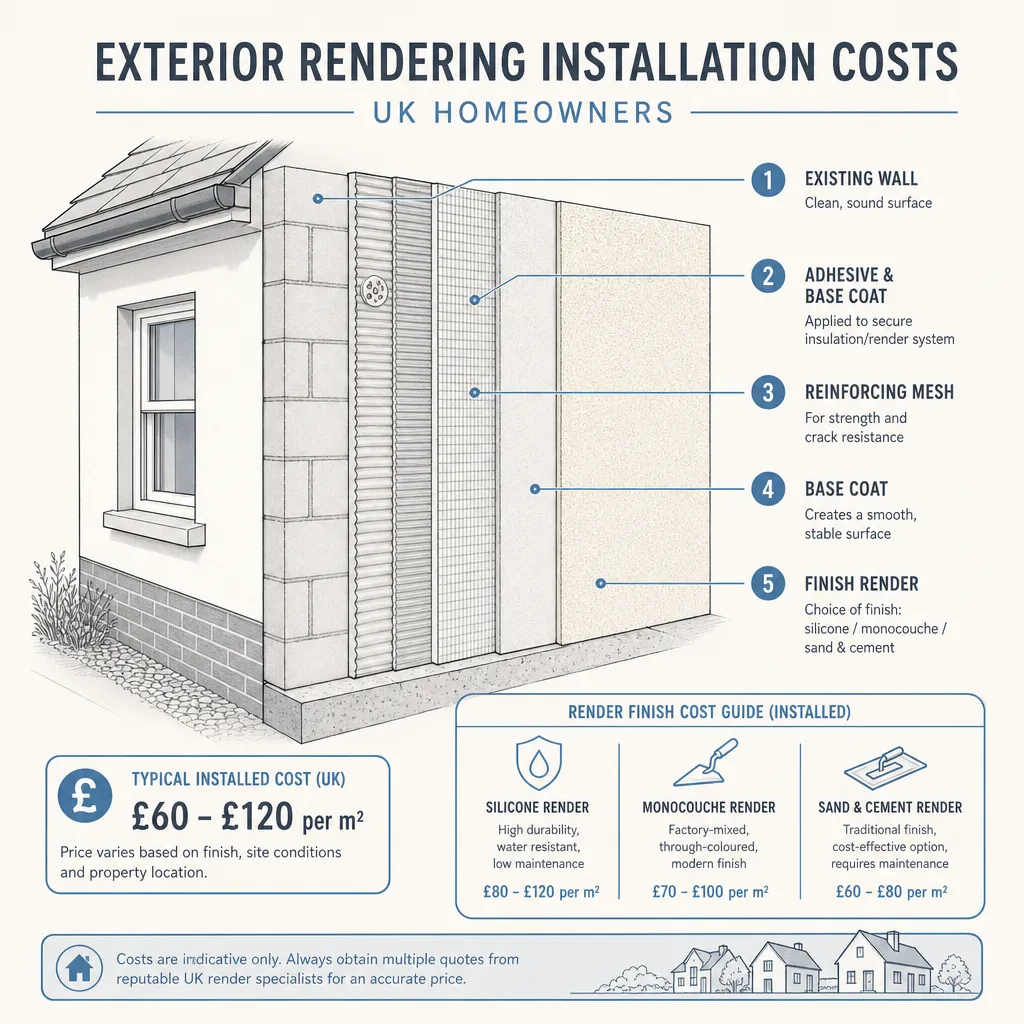
Exterior Rendering Installation Costs
Exterior rendering in the UK typically costs £20–£60 per square metre for standard render systems, or £80–£150 per square metre for External Wall Insulation with a render finish.